Energy practice
Work from memory first. Draw a diagram, state the assumptions and keep units through every step. Worked answers are separate.
· Open separate worked solutions
1. Work it out
Original textbook practice
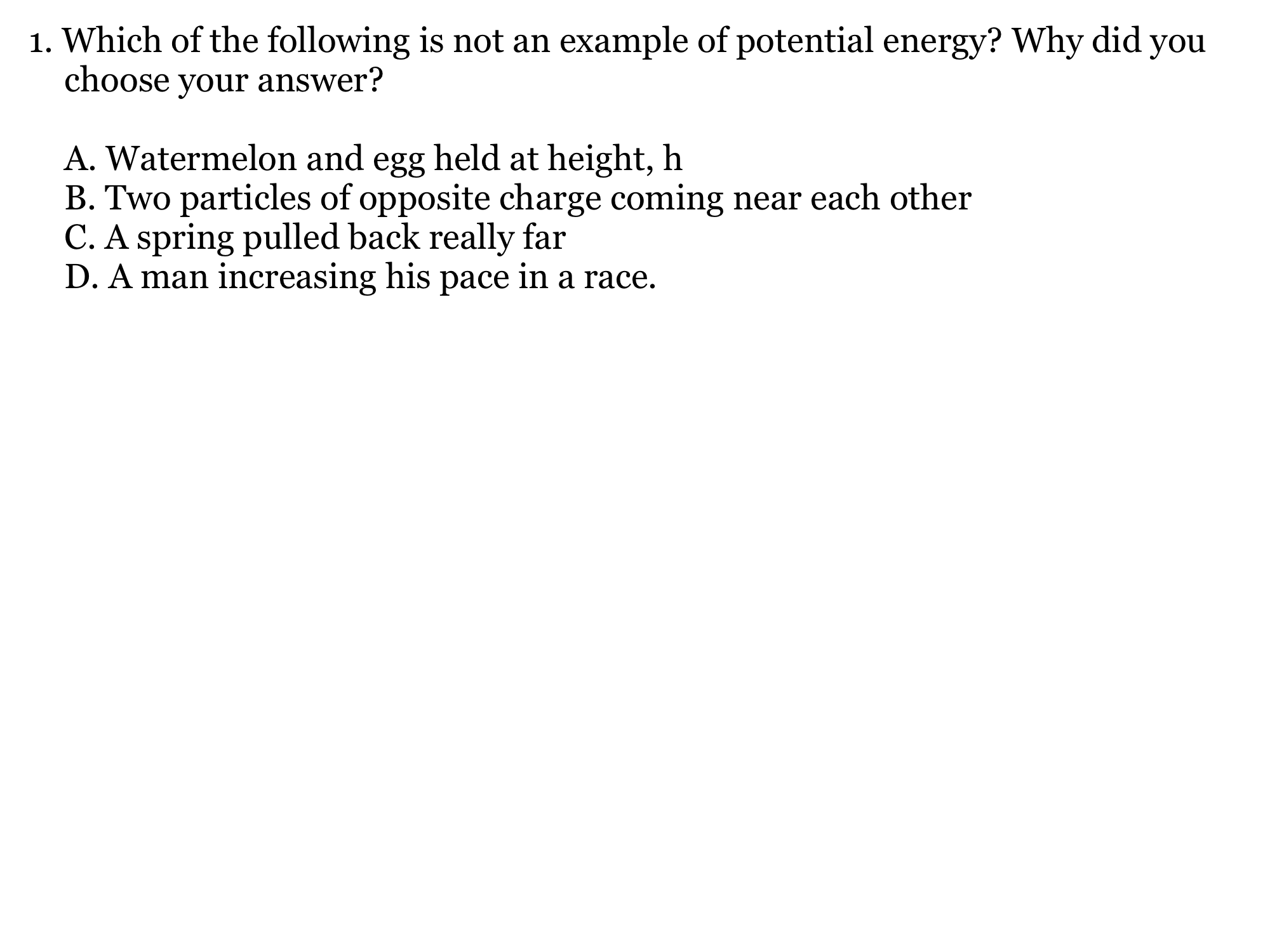
Which describes a kinetic-energy increase rather than a potential-energy example? A. A watermelon and egg held at height h. B. Two opposite charges held stationary at a fixed separation. C. A stretched spring. D. A runner increasing speed. Explain.
Original problem 1
AP-017: Keep both charges stationary so this option illustrates configuration energy without an ambiguous kinetic-energy increase. Electric potential energy may be negative relative to infinite separation.
Problem text
Which describes a kinetic-energy increase rather than a potential-energy example? A. A watermelon and egg held at height h. B. Two opposite charges held stationary at a fixed separation. C. A stretched spring. D. A runner increasing speed. Explain.
Drawing is temporarily unavailable. Work on paper if needed, then record your reasoning here.
Saving written working requires JavaScript. The problem remains available above; keep your work on paper or in your own notes.
2. Work it out
Original textbook practice
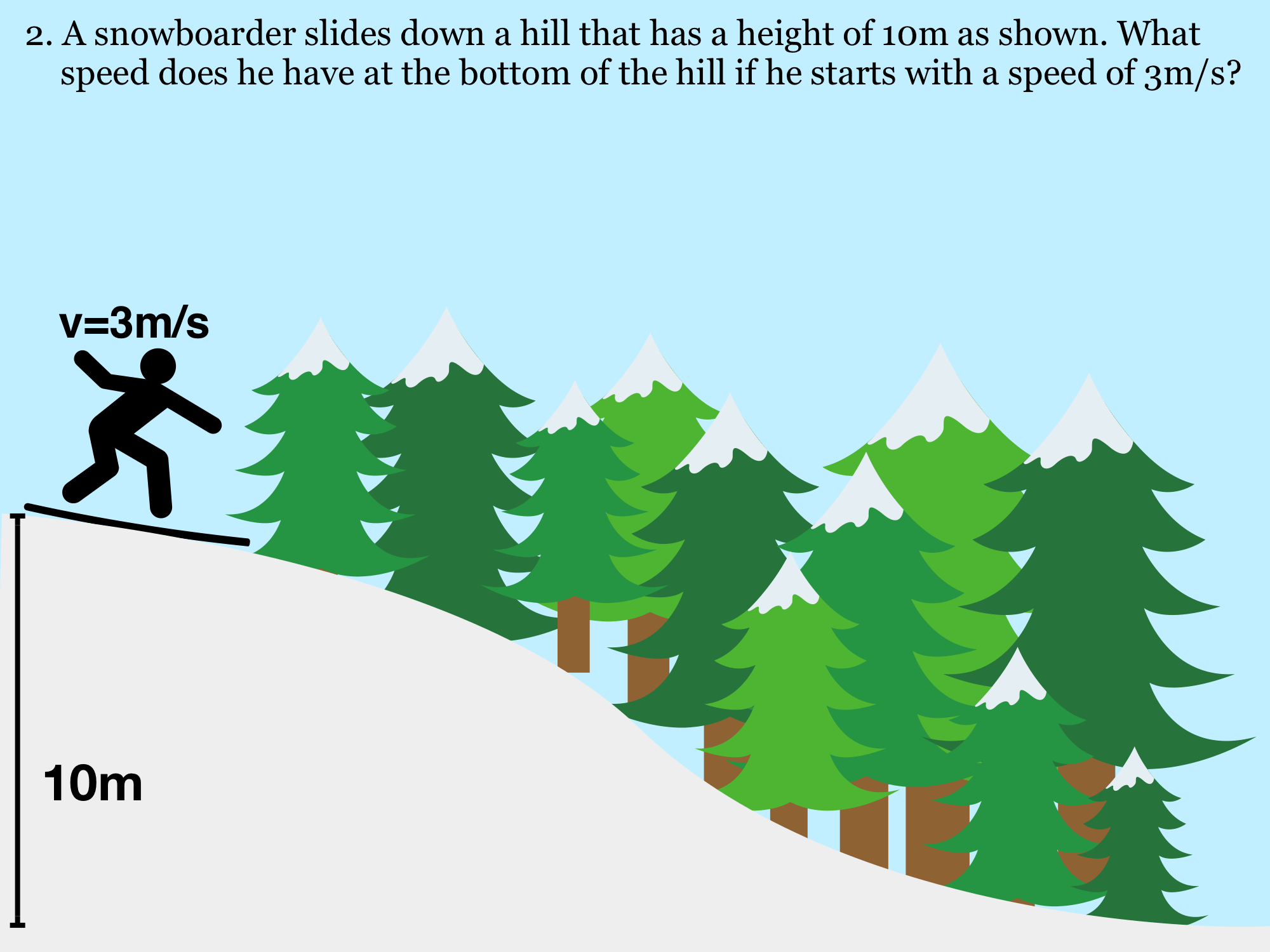
A snowboarder starts 10 m above the bottom at 3 m/s. Neglect friction and air drag and find the speed at the bottom. Use g = 9.81 m/s².
Original problem 2
The result assumes negligible friction, air resistance, and rotational kinetic energy.
Problem text
A snowboarder starts 10 m above the bottom at 3 m/s. Neglect friction and air drag and find the speed at the bottom. Use g = 9.81 m/s².
Drawing is temporarily unavailable. Work on paper if needed, then record your reasoning here.
Saving written working requires JavaScript. The problem remains available above; keep your work on paper or in your own notes.
3. Work it out
Original textbook practice
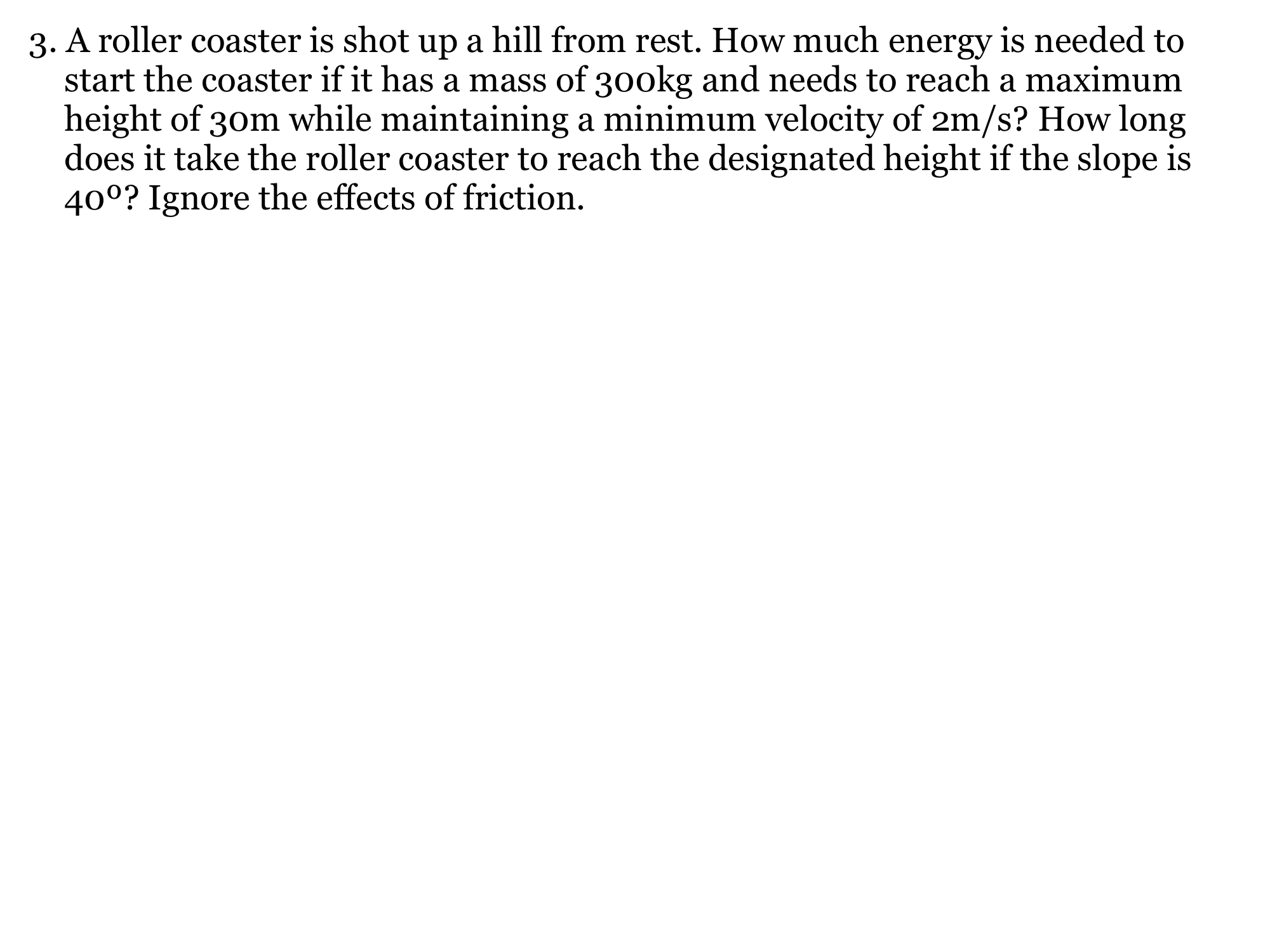
A 300 kg coaster receives an instantaneous launch at the bottom of a straight 40° frictionless hill. It must reach a point 30 m above the bottom with speed at least 2 m/s. Find the minimum launch energy and the uphill travel time after launch. Use g = 9.81 m/s².
Original problem 3
The unspecified launcher’s acceleration duration is excluded. Calling 30 m the “maximum height” while retaining 2 m/s is inconsistent; this is a designated hill height, reached while still moving.
Problem text
A 300 kg coaster receives an instantaneous launch at the bottom of a straight 40° frictionless hill. It must reach a point 30 m above the bottom with speed at least 2 m/s. Find the minimum launch energy and the uphill travel time after launch. Use g = 9.81 m/s².
Drawing is temporarily unavailable. Work on paper if needed, then record your reasoning here.
Saving written working requires JavaScript. The problem remains available above; keep your work on paper or in your own notes.
4. Work it out
Original textbook practice
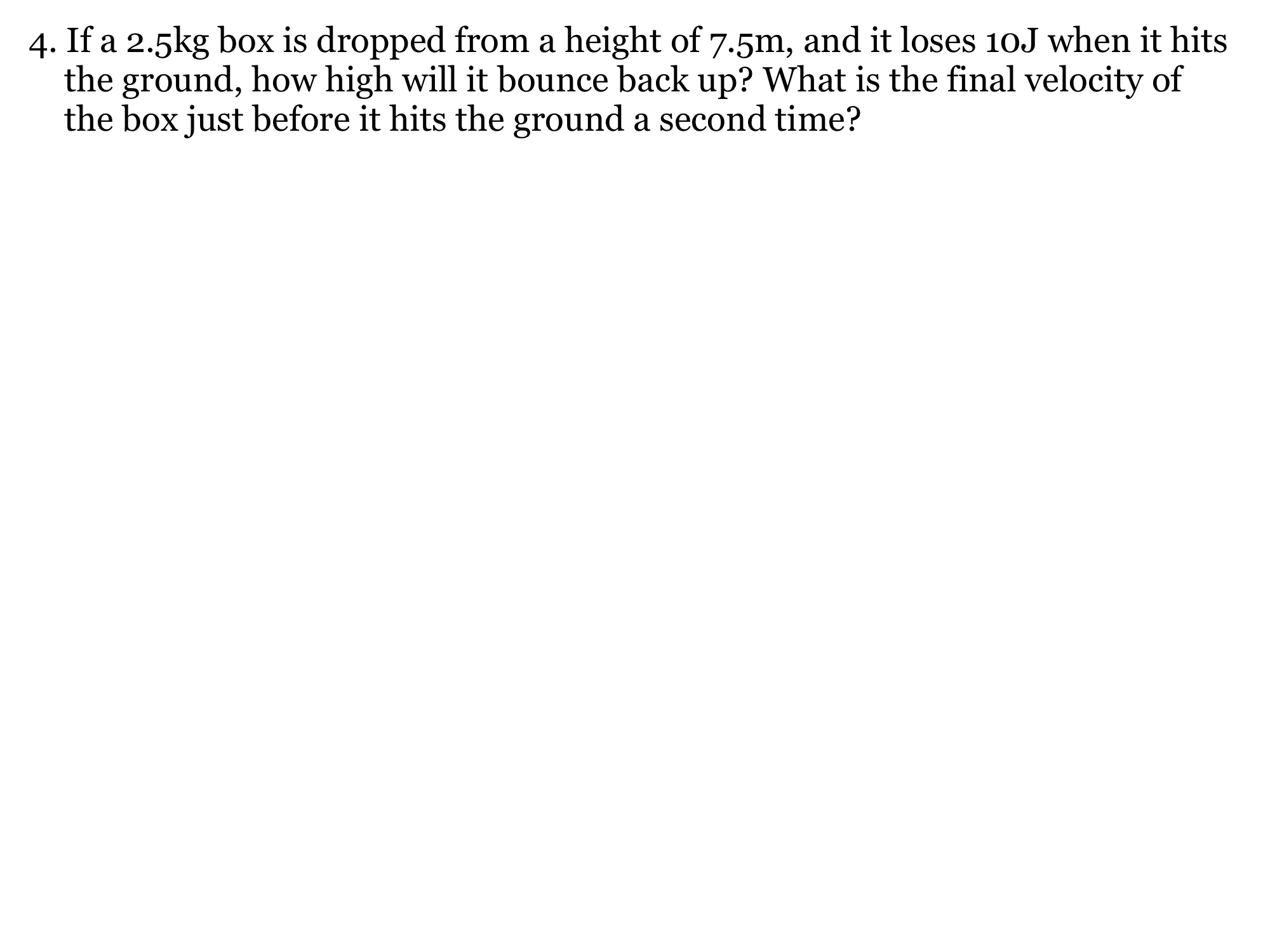
A 2.5 kg box falls from rest from height 7.5 m. It loses 10 J of mechanical energy at its first impact with the ground. Neglect air resistance. Find its rebound height and its velocity immediately before its second impact. Use g = 9.81 m/s².
Original problem 4
The 10 J loss occurs at the first impact; the second impact has not yet happened.
Problem text
A 2.5 kg box falls from rest from height 7.5 m. It loses 10 J of mechanical energy at its first impact with the ground. Neglect air resistance. Find its rebound height and its velocity immediately before its second impact. Use g = 9.81 m/s².
Drawing is temporarily unavailable. Work on paper if needed, then record your reasoning here.
Saving written working requires JavaScript. The problem remains available above; keep your work on paper or in your own notes.
5. Work it out
Original textbook practice
Rory supplies 40 J of launch kinetic energy to his ball at 50° above horizontal; Phil supplies 70 J at 60°. Whose ball goes farther, and by how much? First identify the missing data. Then solve in terms of a common mass m assuming equal masses, negligible air drag, and equal launch/landing heights.
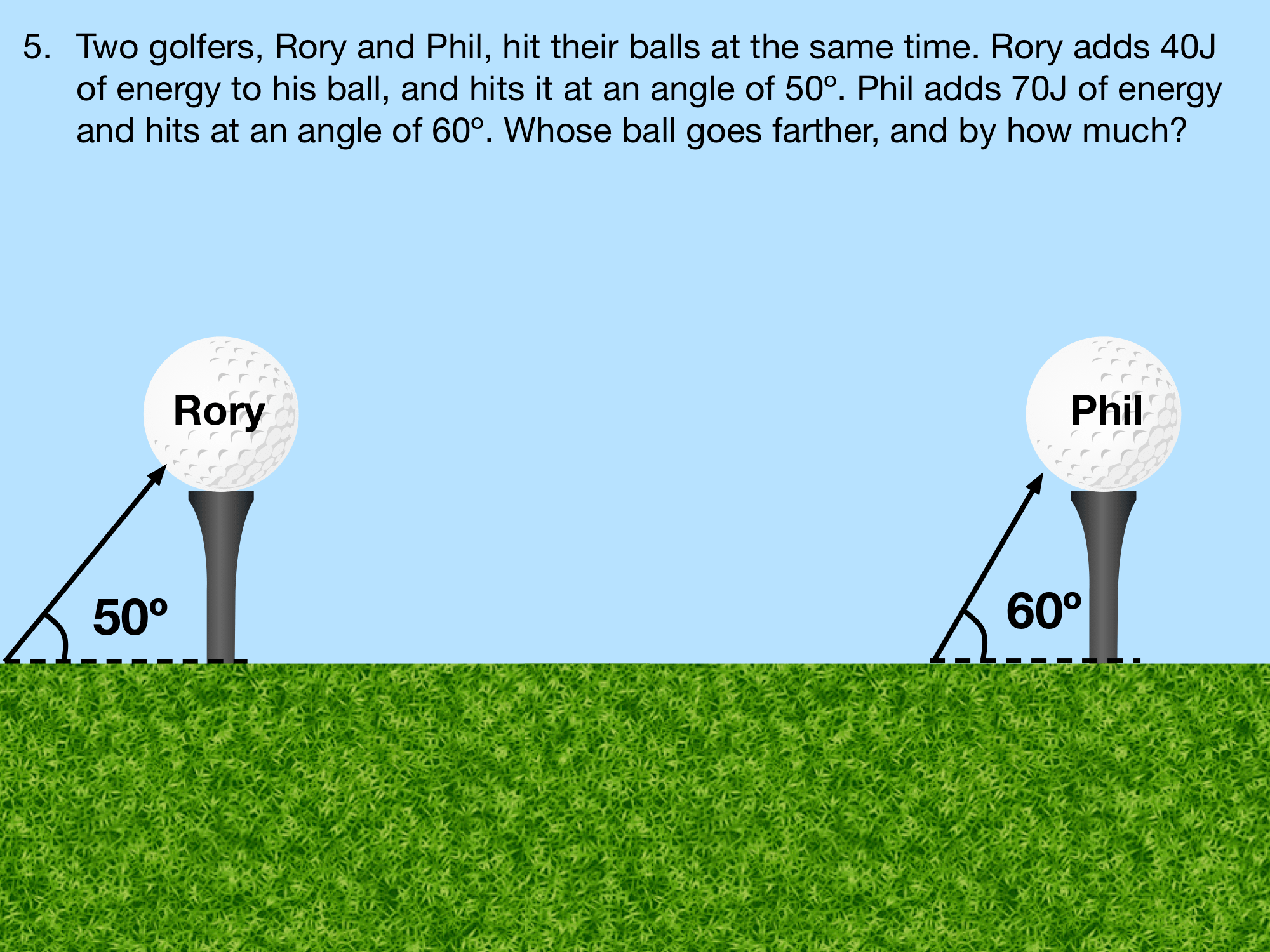
Original problem 5
The original omits both masses. This is a consistency/model check and symbolic solution; no numerical mass is invented. Equal masses, no drag, and equal heights are explicit assumptions for the comparison.
Problem text
Rory supplies 40 J of launch kinetic energy to his ball at 50° above horizontal; Phil supplies 70 J at 60°. Whose ball goes farther, and by how much? First identify the missing data. Then solve in terms of a common mass m assuming equal masses, negligible air drag, and equal launch/landing heights.
Drawing is temporarily unavailable. Work on paper if needed, then record your reasoning here.
Saving written working requires JavaScript. The problem remains available above; keep your work on paper or in your own notes.
6. Work it out
Original textbook practice
An 8 kg block starts from rest and slides down a frictionless 25° incline onto a level frictionless floor at the ramp base. It then compresses a horizontal ideal massless spring by 0.8 m before stopping. Use k = 22.25 N/m, as printed in the source text, instead of the conflicting diagram label 8.45 N/m. Find (a) its kinetic energy at spring contact, (b) its speed then, and (c) the distance it slid down the incline before reaching the spring. Use g = 9.81 m/s².
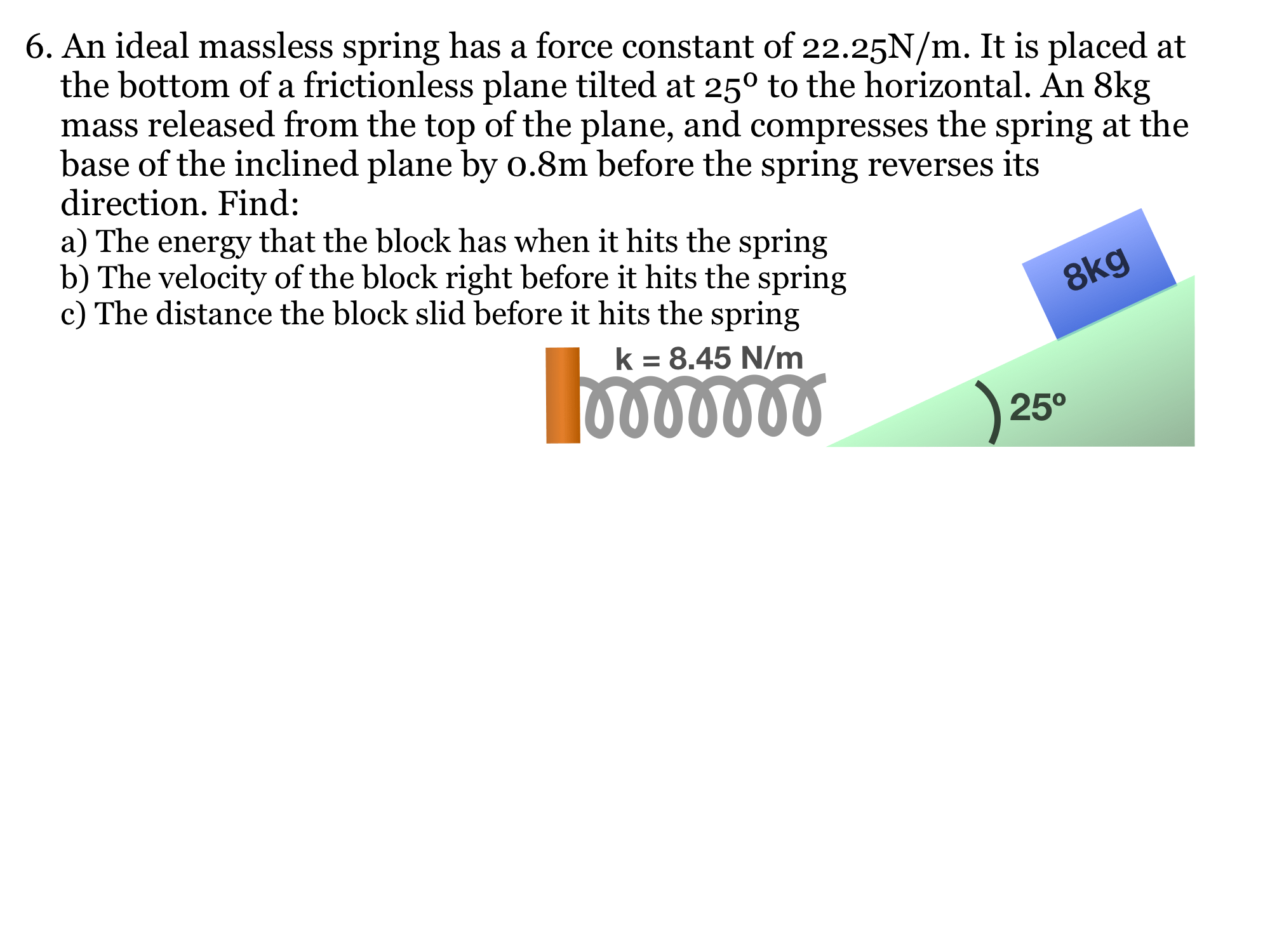
Original problem 6
The text prints k = 22.25 N/m while the diagram prints 8.45 N/m. Retain the textual constant and explicitly state the horizontal spring model shown by the diagram. If instead the spring lies along the incline, K_contact = ½kx² − mgxsin25° = −19.41 J for k = 22.25 N/m (or −23.83 J for 8.45 N/m), which is impossible; that interpretation cannot be silently used.
Problem text
An 8 kg block starts from rest and slides down a frictionless 25° incline onto a level frictionless floor at the ramp base. It then compresses a horizontal ideal massless spring by 0.8 m before stopping. Use k = 22.25 N/m, as printed in the source text, instead of the conflicting diagram label 8.45 N/m. Find (a) its kinetic energy at spring contact, (b) its speed then, and (c) the distance it slid down the incline before reaching the spring. Use g = 9.81 m/s².
Drawing is temporarily unavailable. Work on paper if needed, then record your reasoning here.
Saving written working requires JavaScript. The problem remains available above; keep your work on paper or in your own notes.
7. Work it out
Original textbook practice
Bobby lifts a 15 kg mass upward 0.65 m at constant speed 873 times. Fat provides 38 MJ/kg, with 50% conversion to mechanical work. Find total upward lifting work and the modeled fat mass used. Use g = 9.81 m/s²; count only the upward lifting work.
Original problem 7
This model counts the specified upward lifting only; it excludes metabolism and work while lowering the load.
Problem text
Bobby lifts a 15 kg mass upward 0.65 m at constant speed 873 times. Fat provides 38 MJ/kg, with 50% conversion to mechanical work. Find total upward lifting work and the modeled fat mass used. Use g = 9.81 m/s²; count only the upward lifting work.
Drawing is temporarily unavailable. Work on paper if needed, then record your reasoning here.
Saving written working requires JavaScript. The problem remains available above; keep your work on paper or in your own notes.
8. Work it out
Original textbook practice
A 25 g bullet embeds in a stationary 5.8 kg block suspended by two thin ropes. The combined block and bullet subsequently rise 7 cm vertically. Neglect external horizontal impulse during embedding and losses during the swing. Find the bullet’s initial speed. Use g = 9.81 m/s².
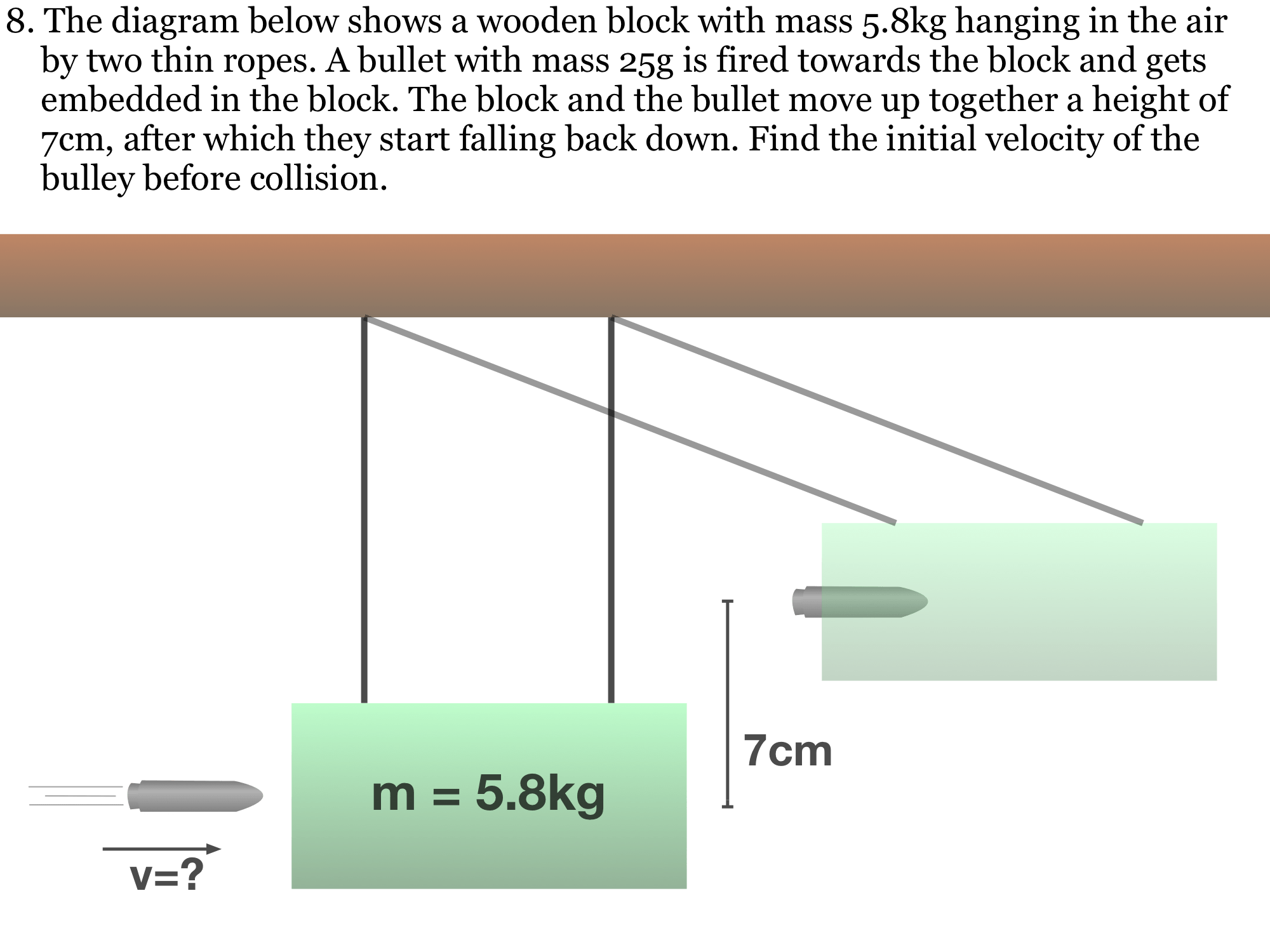
Original problem 8
Ignore external horizontal impulse during embedding and air/rope losses during the swing. The 7 cm is a vertical rise, not the distance traveled along an arc.
Problem text
A 25 g bullet embeds in a stationary 5.8 kg block suspended by two thin ropes. The combined block and bullet subsequently rise 7 cm vertically. Neglect external horizontal impulse during embedding and losses during the swing. Find the bullet’s initial speed. Use g = 9.81 m/s².
Drawing is temporarily unavailable. Work on paper if needed, then record your reasoning here.
Saving written working requires JavaScript. The problem remains available above; keep your work on paper or in your own notes.
9. Work it out
Enrichment beyond the AP course
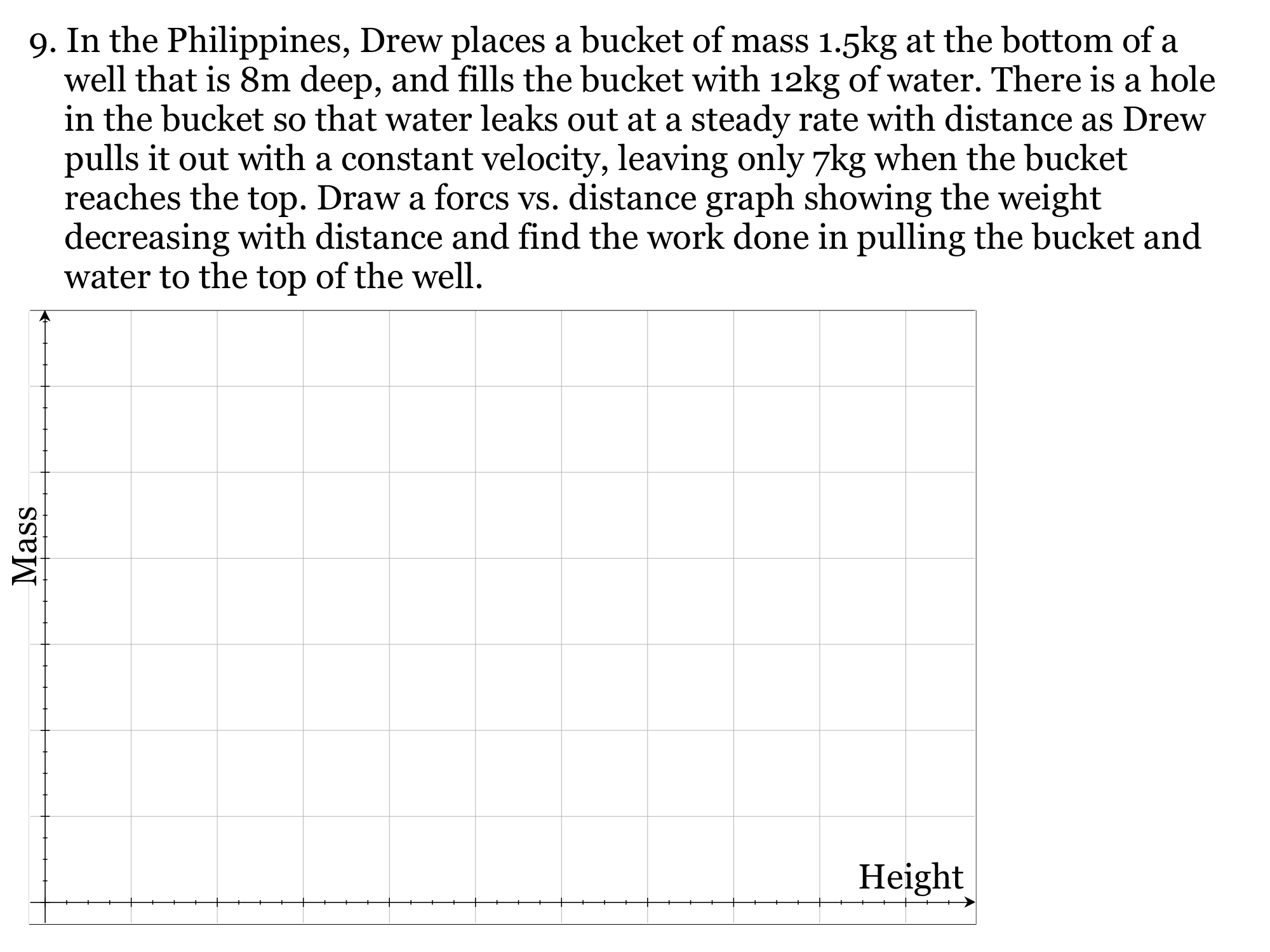
A 1.5 kg bucket initially holds 12 kg of water at the bottom of an 8 m well. It is lifted at constant speed while water mass decreases linearly with height, leaving 7 kg at the top. Neglect thrust from the leak. Sketch lifting force versus upward distance and calculate the lifting work. Use g = 9.81 m/s².
Original problem 9
Assume leaking water leaves with the bucket’s instantaneous vertical velocity and contributes negligible relative-jet thrust. The force axis must show weight/force, not mass.
Problem text
A 1.5 kg bucket initially holds 12 kg of water at the bottom of an 8 m well. It is lifted at constant speed while water mass decreases linearly with height, leaving 7 kg at the top. Neglect thrust from the leak. Sketch lifting force versus upward distance and calculate the lifting work. Use g = 9.81 m/s².
Drawing is temporarily unavailable. Work on paper if needed, then record your reasoning here.
Saving written working requires JavaScript. The problem remains available above; keep your work on paper or in your own notes.
10. Work it out
Original textbook practice
A block starts at the bottom of a frictionless ramp at 2.5 m/s. It climbs to a horizontal rough patch 3 cm above the bottom. The patch is 0.6 m long and has kinetic friction coefficient 0.5; beyond it the path is frictionless. Find whether the block reaches the far end. If it does, find its exit speed; if it stops, find its travel distance on the patch. Use g = 9.81 m/s².
Original problem 10
Recovered question 10 repeats energy question 10. Original wording did not say where 2.5 m/s was measured. The clarified model puts it at the bottom before the 3 cm rise. If 2.5 m/s were instead the speed at the patch entrance, it would cross the patch with speed 0.603 m/s.
Problem text
A block starts at the bottom of a frictionless ramp at 2.5 m/s. It climbs to a horizontal rough patch 3 cm above the bottom. The patch is 0.6 m long and has kinetic friction coefficient 0.5; beyond it the path is frictionless. Find whether the block reaches the far end. If it does, find its exit speed; if it stops, find its travel distance on the patch. Use g = 9.81 m/s².
Drawing is temporarily unavailable. Work on paper if needed, then record your reasoning here.
Saving written working requires JavaScript. The problem remains available above; keep your work on paper or in your own notes.
Additional practice
11. Stair-climbing efficiency
Original textbook practice
A 65 kg hiker climbs 18 m vertically. The body converts chemical energy to gravitational potential energy with 25% efficiency. Find the potential-energy increase and required chemical energy. Use g = 9.81 m/s².
Your written working
Drawing is temporarily unavailable. Work on paper if needed, then record your reasoning here.
Saving written working requires JavaScript. The problem remains available above; keep your work on paper or in your own notes.
12. Variable force work
Original textbook practice
A 2 kg sled is nudged forward from x = 0 with negligible initial kinetic energy. After the nudge, its net force is F(x) = 6x N, where x is measured in meters, up to x = 3 m. Neglect that initial kinetic energy when finding the work and final speed.
Your written working
Drawing is temporarily unavailable. Work on paper if needed, then record your reasoning here.
Saving written working requires JavaScript. The problem remains available above; keep your work on paper or in your own notes.
13. Angled pull reduces friction
Original textbook practice
A 10 kg crate starts from rest and moves 4 m horizontally while pulled by a 50 N force 30° above horizontal. Kinetic friction coefficient is 0.20. Find its final speed. Assume the crate begins sliding immediately, with no vertical acceleration, and use g = 9.81 m/s².
Your written working
Drawing is temporarily unavailable. Work on paper if needed, then record your reasoning here.
Saving written working requires JavaScript. The problem remains available above; keep your work on paper or in your own notes.
14. Coasting uphill with friction
Original textbook practice
A skier enters a 20° uphill slope at 6 m/s. The kinetic friction coefficient is 0.15. Find the distance traveled along the slope before stopping. Use g = 9.81 m/s².
Your written working
Drawing is temporarily unavailable. Work on paper if needed, then record your reasoning here.
Saving written working requires JavaScript. The problem remains available above; keep your work on paper or in your own notes.
15. Vertical spring launch includes gravity
Original textbook practice
A 0.50 kg ball is placed on a vertical ideal spring compressed 0.20 m from its unloaded length. The spring constant is 400 N/m. Find the speed when the spring first reaches its unloaded length and the maximum rise above the initial ball position. Neglect losses and use g = 9.81 m/s².
Your written working
Drawing is temporarily unavailable. Work on paper if needed, then record your reasoning here.
Saving written working requires JavaScript. The problem remains available above; keep your work on paper or in your own notes.
16. Minimum speed for a vertical loop
Original textbook practice
A small sliding cart enters the bottom of a frictionless circular loop of radius 2.0 m. It is supported by the inside of the track with no retaining wheels. Find the minimum bottom speed needed to maintain contact throughout. Use g = 9.81 m/s².
Your written working
Drawing is temporarily unavailable. Work on paper if needed, then record your reasoning here.
Saving written working requires JavaScript. The problem remains available above; keep your work on paper or in your own notes.
17. Pump power from flow rate
Original textbook practice
A pump lifts water through a vertical height of 12 m at a mass rate of 3.0 kg/s. Its efficiency is 70%. Neglect changes in water speed and use g = 9.81 m/s². Find hydraulic output power and electrical input power.
Your written working
Drawing is temporarily unavailable. Work on paper if needed, then record your reasoning here.
Saving written working requires JavaScript. The problem remains available above; keep your work on paper or in your own notes.
18. Pendulum released at an angle
Original textbook practice
A small pendulum bob on a 1.2 m string is released from rest at 50° from the downward vertical. Find its speed at the lowest point. Neglect drag and use g = 9.81 m/s².
Your written working
Drawing is temporarily unavailable. Work on paper if needed, then record your reasoning here.
Saving written working requires JavaScript. The problem remains available above; keep your work on paper or in your own notes.
19. Choose a different potential-energy datum
Original textbook practice
A 2 kg package falls from rest from a shelf 5 m above the floor to a platform 1 m above the floor. Find its final speed using (a) the floor and (b) the shelf as zero gravitational potential energy. Neglect air drag and use g = 9.81 m/s².
Your written working
Drawing is temporarily unavailable. Work on paper if needed, then record your reasoning here.
Saving written working requires JavaScript. The problem remains available above; keep your work on paper or in your own notes.
20. Hydroelectric energy conversion
Original textbook practice
In one hour, 2.0×10⁶ kg of water descends 40 m through a hydroelectric plant with 85% overall efficiency. Find electrical energy in kilowatt-hours and average electrical power. Use g = 9.81 m/s².
Your written working
Drawing is temporarily unavailable. Work on paper if needed, then record your reasoning here.
Saving written working requires JavaScript. The problem remains available above; keep your work on paper or in your own notes.
21. Collision followed by spring compression
Original textbook practice
A 1 kg cart at 4 m/s hits and sticks to a stationary 3 kg cart. The pair then compresses a horizontal ideal spring with k = 800 N/m on a frictionless track. Find maximum compression and energy converted internally during the collision.
Your written working
Drawing is temporarily unavailable. Work on paper if needed, then record your reasoning here.
Saving written working requires JavaScript. The problem remains available above; keep your work on paper or in your own notes.
22. A falling object against constant drag
Original textbook practice
A 0.20 kg object falls 5.0 m from rest. Throughout that descent an upward drag force has constant magnitude 0.60 N. Find its impact speed and energy transferred by drag. Use g = 9.81 m/s².
Your written working
Drawing is temporarily unavailable. Work on paper if needed, then record your reasoning here.
Saving written working requires JavaScript. The problem remains available above; keep your work on paper or in your own notes.
23. Braking heat raises temperature
Original textbook practice · AP Physics 2 topic
A 1200 kg car brakes from 20 m/s to rest on a level road. Suppose 70% of its initial kinetic energy heats 12 kg of brake material with specific heat 500 J/(kg·°C). Find the brake temperature rise. Neglect heat transfer during the stop.
Your written working
Drawing is temporarily unavailable. Work on paper if needed, then record your reasoning here.
Saving written working requires JavaScript. The problem remains available above; keep your work on paper or in your own notes.
24. Steady road power
Original textbook practice
At 15 m/s on a level road, a vehicle experiences a 600 N resistive force. Find the mechanical drive power required for constant speed and energy delivered over 10 minutes.
Your written working
Drawing is temporarily unavailable. Work on paper if needed, then record your reasoning here.
Saving written working requires JavaScript. The problem remains available above; keep your work on paper or in your own notes.
25. Acceleration at constant power
Original textbook practice
A 1000 kg electric vehicle speeds up from 10 to 20 m/s on a level road. A motor supplies a constant 30 kW entirely to translational kinetic energy; neglect resistance. Find the time and the drive-force magnitudes at the start and end.
Your written working
Drawing is temporarily unavailable. Work on paper if needed, then record your reasoning here.
Saving written working requires JavaScript. The problem remains available above; keep your work on paper or in your own notes.
26. Potential-energy curve and turning points
Original textbook practice
A 1 kg particle moves along x with potential energy U(x) = 4x² J, where x is in meters. Its total mechanical energy is 16 J. Find its speed at x = 1 m, its turning points, and the force at x = 1 m.
Your written working
Drawing is temporarily unavailable. Work on paper if needed, then record your reasoning here.
Saving written working requires JavaScript. The problem remains available above; keep your work on paper or in your own notes.
27. Perpendicular force does no work
Original textbook practice
A 0.50 kg puck moves at constant speed 4 m/s in a horizontal circle of radius 2 m, held by a string on a frictionless table. Find tension and the work tension does over one complete revolution.
Your written working
Drawing is temporarily unavailable. Work on paper if needed, then record your reasoning here.
Saving written working requires JavaScript. The problem remains available above; keep your work on paper or in your own notes.
28. Signed areas under a force graph
Original textbook practice
A 2 kg cart initially moves at 4 m/s along +x. Its net force is +4 N for 0≤x≤2 m and −3 N for 2≤x≤5 m. Find the net work and speed at x=5 m.
Your written working
Drawing is temporarily unavailable. Work on paper if needed, then record your reasoning here.
Saving written working requires JavaScript. The problem remains available above; keep your work on paper or in your own notes.
29. Energy units and electricity cost
Original textbook practice
A 1.2 kW heater runs for 45 minutes. Find the energy used in kilowatt-hours and joules, then its cost at $0.20 per kWh.
Your written working
Drawing is temporarily unavailable. Work on paper if needed, then record your reasoning here.
Saving written working requires JavaScript. The problem remains available above; keep your work on paper or in your own notes.
30. Two springs store energy together
Original textbook practice
A 2 kg block moving at 3 m/s compresses two initially relaxed horizontal springs in parallel, with constants 100 and 200 N/m. Each compresses by the same distance x. Neglect losses. Find maximum compression and the energy in each spring.
Your written working
Drawing is temporarily unavailable. Work on paper if needed, then record your reasoning here.
Saving written working requires JavaScript. The problem remains available above; keep your work on paper or in your own notes.