Force practice
Work from memory first. Draw a diagram, state the assumptions and keep units through every step. Worked answers are separate.
· Open separate worked solutions
1. Work it out
Original textbook practice
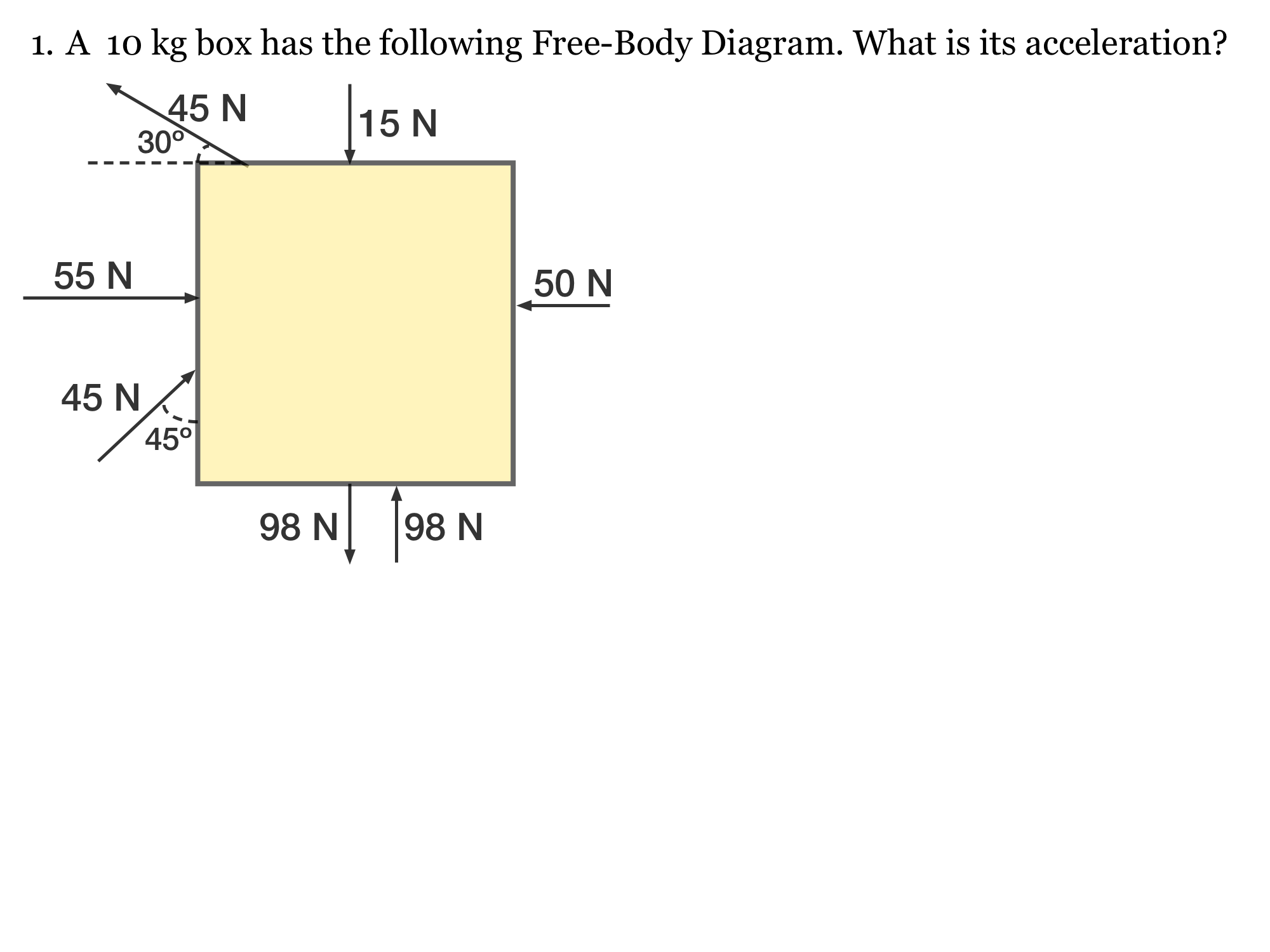
A 10 kg box experiences all the forces shown in the diagram: 55 N right, 50 N left, 15 N down, 98 N down, 98 N up, 45 N at 30° above the leftward horizontal, and 45 N at 45° above the rightward horizontal. Find its acceleration vector, magnitude and direction.
Original problem 1
Treat every arrow as a prescribed force. The pair of 98 N arrows cancel; do not impose an additional vertical equilibrium condition.
Problem text
A 10 kg box experiences all the forces shown in the diagram: 55 N right, 50 N left, 15 N down, 98 N down, 98 N up, 45 N at 30° above the leftward horizontal, and 45 N at 45° above the rightward horizontal. Find its acceleration vector, magnitude and direction.
Drawing is temporarily unavailable. Work on paper if needed, then record your reasoning here.
Saving written working requires JavaScript. The problem remains available above; keep your work on paper or in your own notes.
2. Work it out
Original textbook practice
A 20 kg object hangs at rest from an ideal vertical spring whose unstretched length is 0.50 m and whose spring constant is 96 N/m. How far below the anchor does the object hang? Use g = 9.8 m/s².
Original problem 2
Problem text
A 20 kg object hangs at rest from an ideal vertical spring whose unstretched length is 0.50 m and whose spring constant is 96 N/m. How far below the anchor does the object hang? Use g = 9.8 m/s².
Drawing is temporarily unavailable. Work on paper if needed, then record your reasoning here.
Saving written working requires JavaScript. The problem remains available above; keep your work on paper or in your own notes.
3. Work it out
Original textbook practice
A pirate commandeers a ship of mass 5.8 Mg. Each raised sail provides 11.6 kN of forward force. Neglect resistance. How many sails are needed to accelerate the ship at 6.0 m/s²?
Original problem 3
Problem text
A pirate commandeers a ship of mass 5.8 Mg. Each raised sail provides 11.6 kN of forward force. Neglect resistance. How many sails are needed to accelerate the ship at 6.0 m/s²?
Drawing is temporarily unavailable. Work on paper if needed, then record your reasoning here.
Saving written working requires JavaScript. The problem remains available above; keep your work on paper or in your own notes.
4. Work it out
Enrichment beyond the AP course
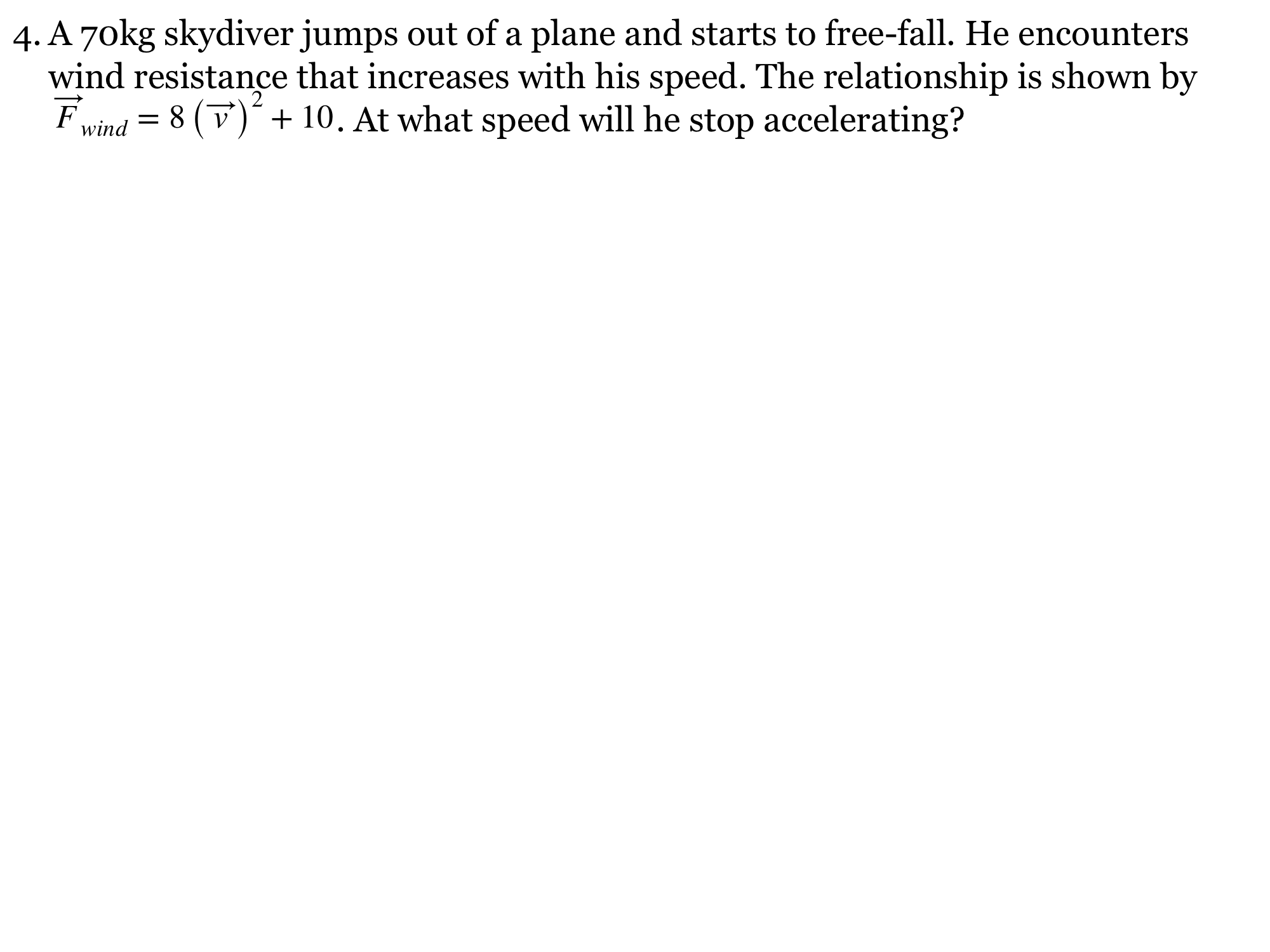
A 70 kg skydiver falls downward. The upward resistance-force magnitude is D = 8v² + 10 N when speed v is entered in m/s. At what terminal speed is the acceleration zero? Use g = 9.8 m/s².
Original problem 4
The original writes a squared vector. Read v as scalar speed, with coefficient 8 kg/m and constant force 10 N. This is a stated empirical model, including its nonzero value at v = 0.
Problem text
A 70 kg skydiver falls downward. The upward resistance-force magnitude is D = 8v² + 10 N when speed v is entered in m/s. At what terminal speed is the acceleration zero? Use g = 9.8 m/s².
Drawing is temporarily unavailable. Work on paper if needed, then record your reasoning here.
Saving written working requires JavaScript. The problem remains available above; keep your work on paper or in your own notes.
5. Work it out
Original textbook practice
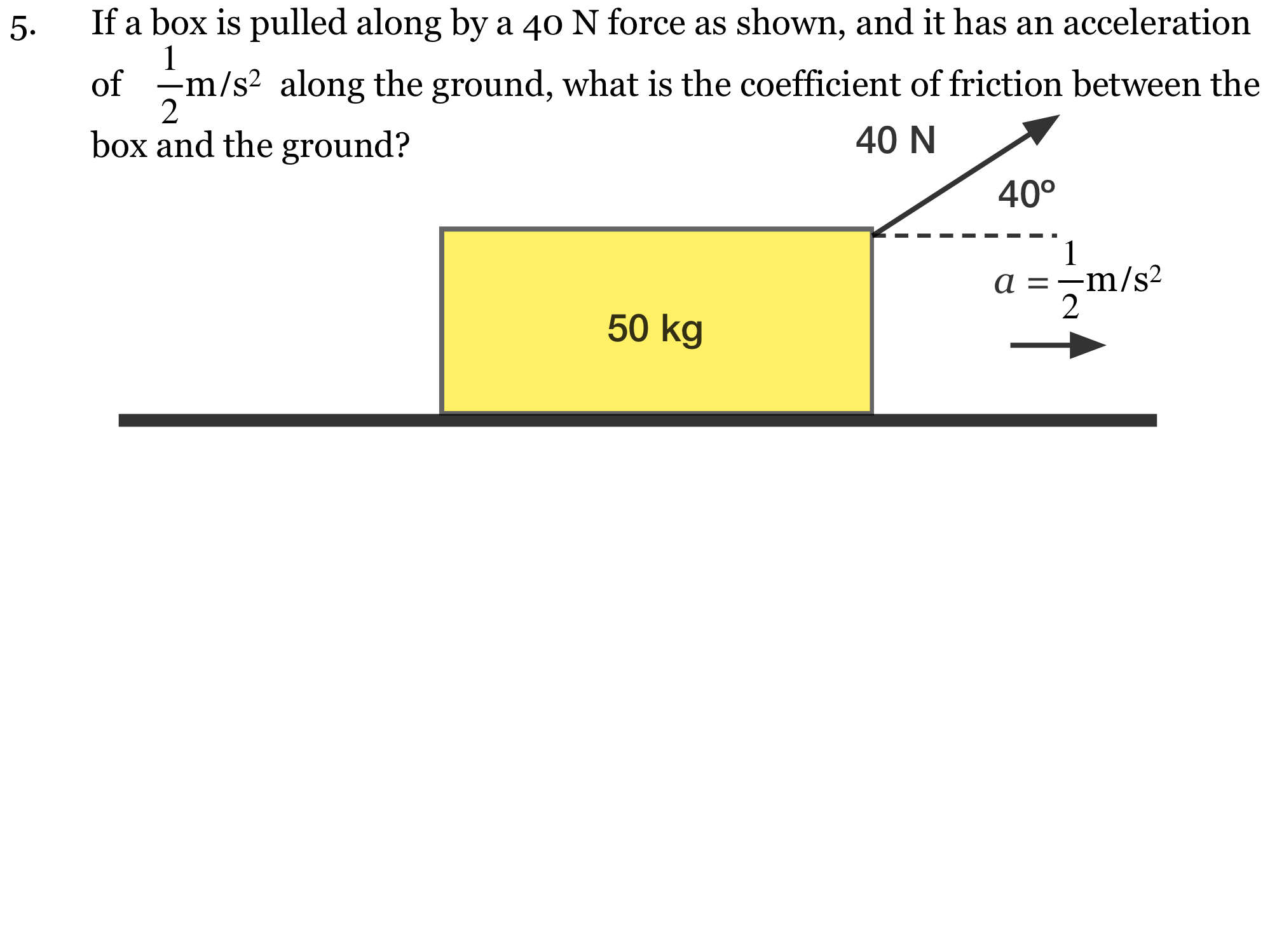
A 50 kg box slides to the right on a level floor. A 40 N pull acts at 40° above horizontal, and the horizontal acceleration is +0.50 m/s². Find the kinetic friction coefficient. Use g = 9.8 m/s².
Original problem 5
The diagram’s acceleration is 1/2 m/s², not an unreadable blank or 5 m/s².
Problem text
A 50 kg box slides to the right on a level floor. A 40 N pull acts at 40° above horizontal, and the horizontal acceleration is +0.50 m/s². Find the kinetic friction coefficient. Use g = 9.8 m/s².
Drawing is temporarily unavailable. Work on paper if needed, then record your reasoning here.
Saving written working requires JavaScript. The problem remains available above; keep your work on paper or in your own notes.
6. Work it out
Original textbook practice
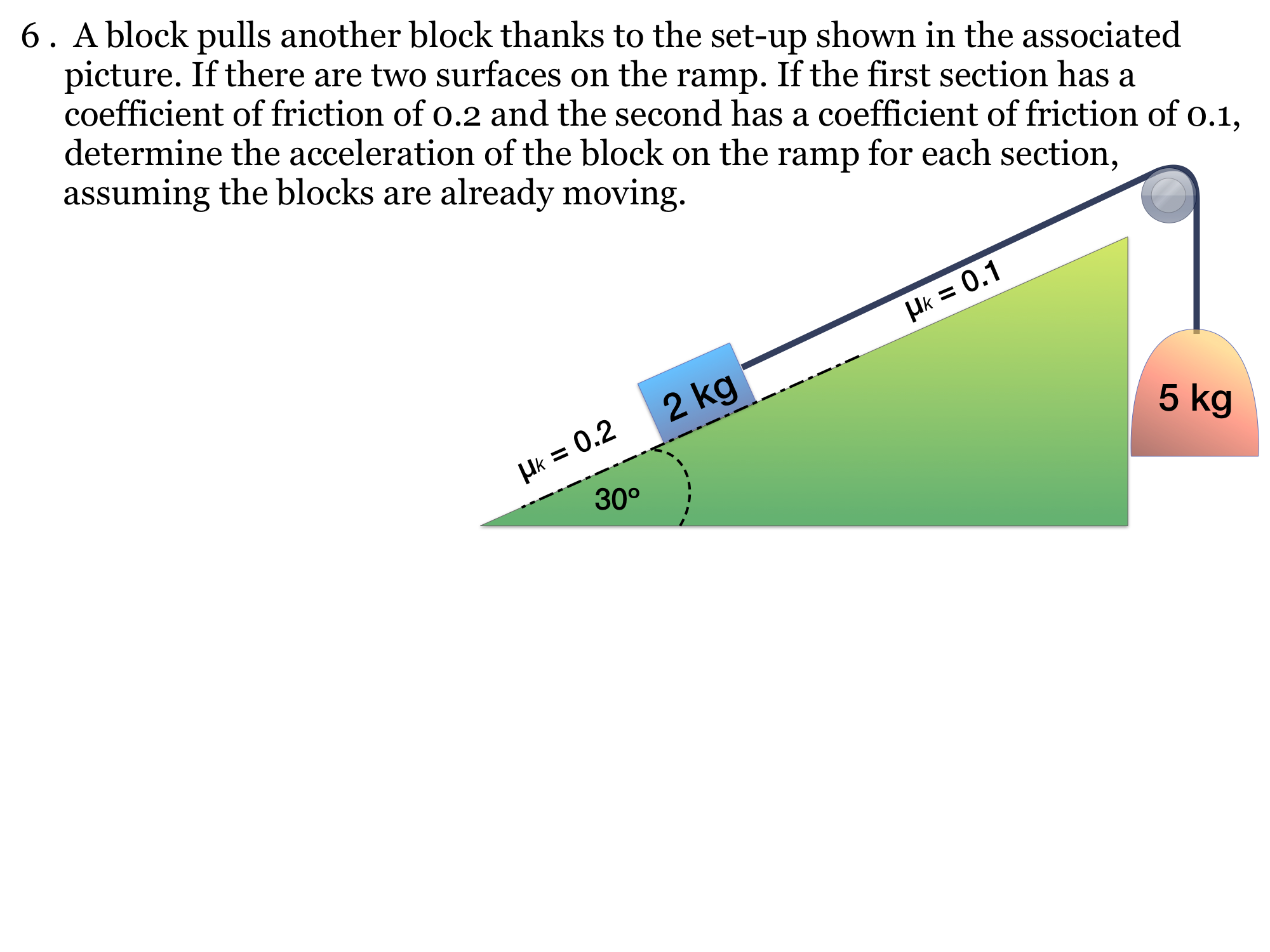
A 2 kg block on a 30° incline is linked by a light inextensible rope over an ideal fixed pulley to a hanging 5 kg block. The incline has sections with μₖ = 0.20 and μₖ = 0.10. Find the ramp block’s acceleration on each section if it is moving up the ramp. Also state how the answers change if it is moving down. Use g = 9.8 m/s².
Original problem 6
The original only says “already moving,” which does not specify the direction required to choose kinetic friction. Both directions are therefore treated explicitly.
Problem text
A 2 kg block on a 30° incline is linked by a light inextensible rope over an ideal fixed pulley to a hanging 5 kg block. The incline has sections with μₖ = 0.20 and μₖ = 0.10. Find the ramp block’s acceleration on each section if it is moving up the ramp. Also state how the answers change if it is moving down. Use g = 9.8 m/s².
Drawing is temporarily unavailable. Work on paper if needed, then record your reasoning here.
Saving written working requires JavaScript. The problem remains available above; keep your work on paper or in your own notes.
7. Work it out
Original textbook practice
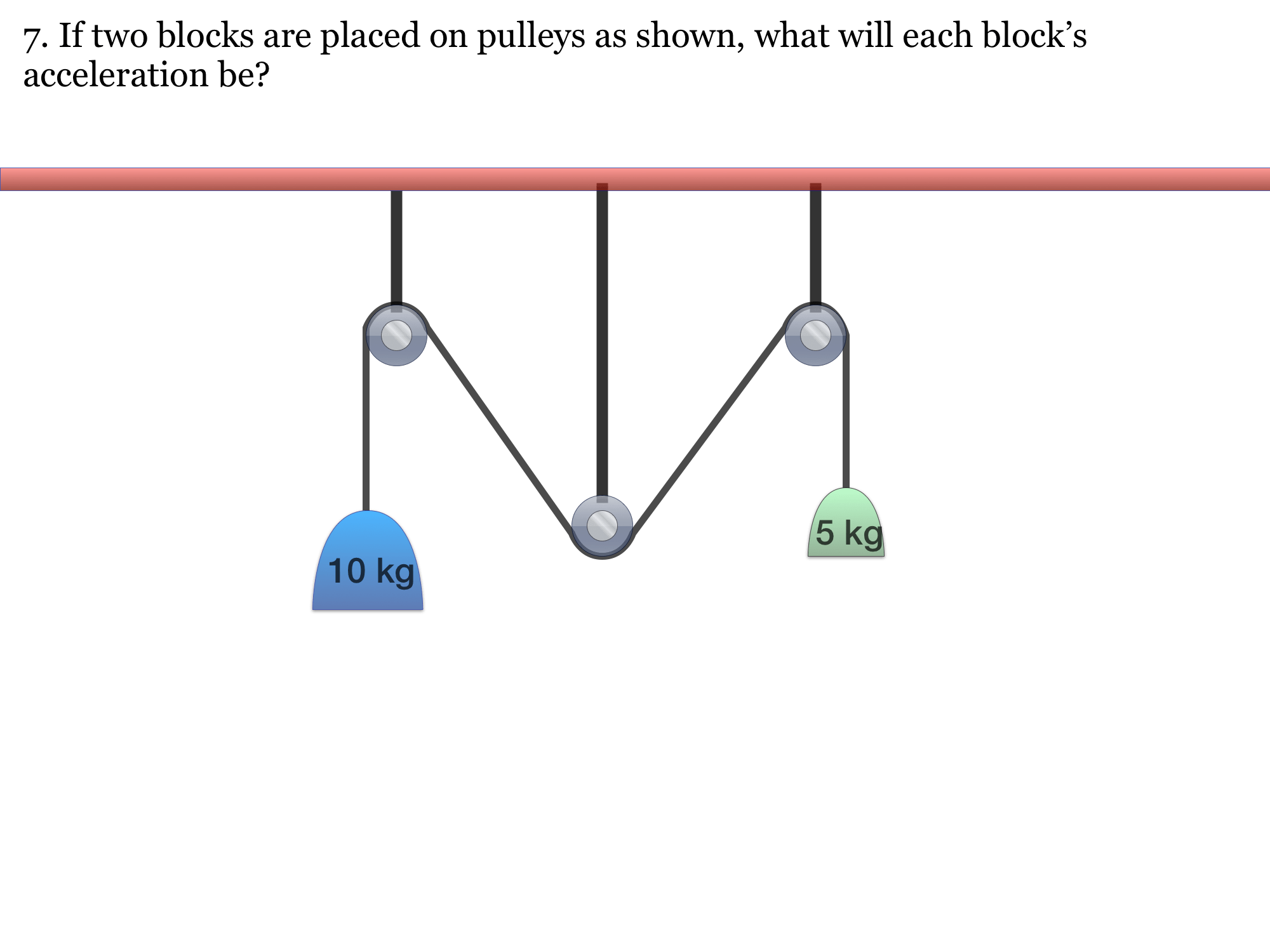
A 10 kg mass and a 5 kg mass hang from opposite ends of one light rope routed over the three pulleys shown. All three pulley axles are fixed to the ceiling, including the lower central axle. Find each mass’s acceleration. Use g = 9.8 m/s².
Original problem 7
The center pulley is fixed by its visible ceiling support; it is not a movable pulley attached to either mass.
Problem text
A 10 kg mass and a 5 kg mass hang from opposite ends of one light rope routed over the three pulleys shown. All three pulley axles are fixed to the ceiling, including the lower central axle. Find each mass’s acceleration. Use g = 9.8 m/s².
Drawing is temporarily unavailable. Work on paper if needed, then record your reasoning here.
Saving written working requires JavaScript. The problem remains available above; keep your work on paper or in your own notes.
8. Work it out
Original textbook practice
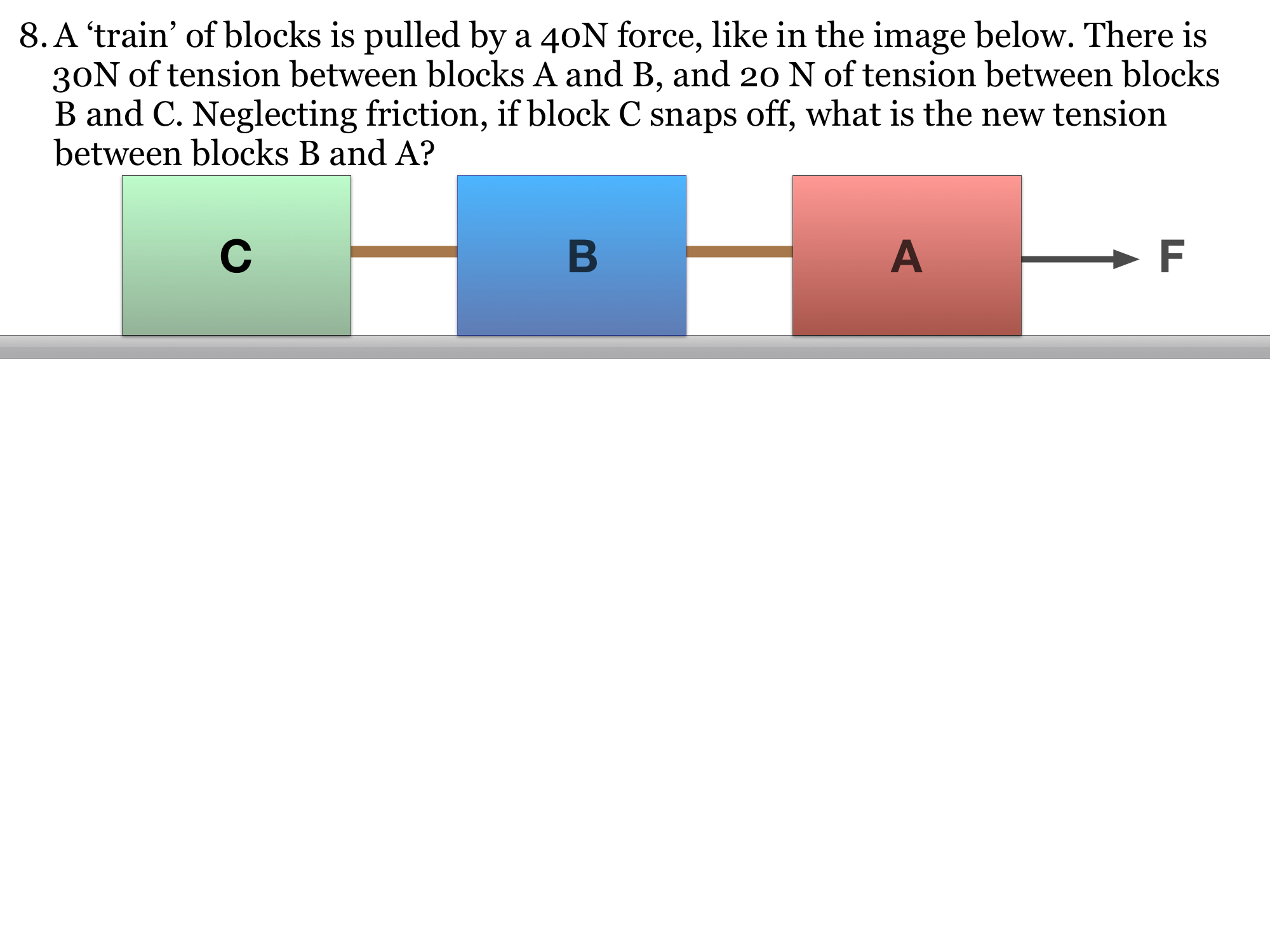
A frictionless train of blocks C–B–A is pulled to the right by a 40 N force applied to A. The A–B tension is 30 N and the B–C tension is 20 N. If C separates and the same 40 N pull continues on A, find the new A–B tension.
Original problem 8
Problem text
A frictionless train of blocks C–B–A is pulled to the right by a 40 N force applied to A. The A–B tension is 30 N and the B–C tension is 20 N. If C separates and the same 40 N pull continues on A, find the new A–B tension.
Drawing is temporarily unavailable. Work on paper if needed, then record your reasoning here.
Saving written working requires JavaScript. The problem remains available above; keep your work on paper or in your own notes.
9. Work it out
Original textbook practice
A 12 kg block on a 30° ramp is connected over an ideal fixed pulley to a hanging 5 kg block. A downward external force F acts on the hanging block. Interpret the stated friction coefficient 0.010 as μₛ. Find the range of F that can hold both blocks at rest and the minimum required F. Use g = 9.8 m/s².
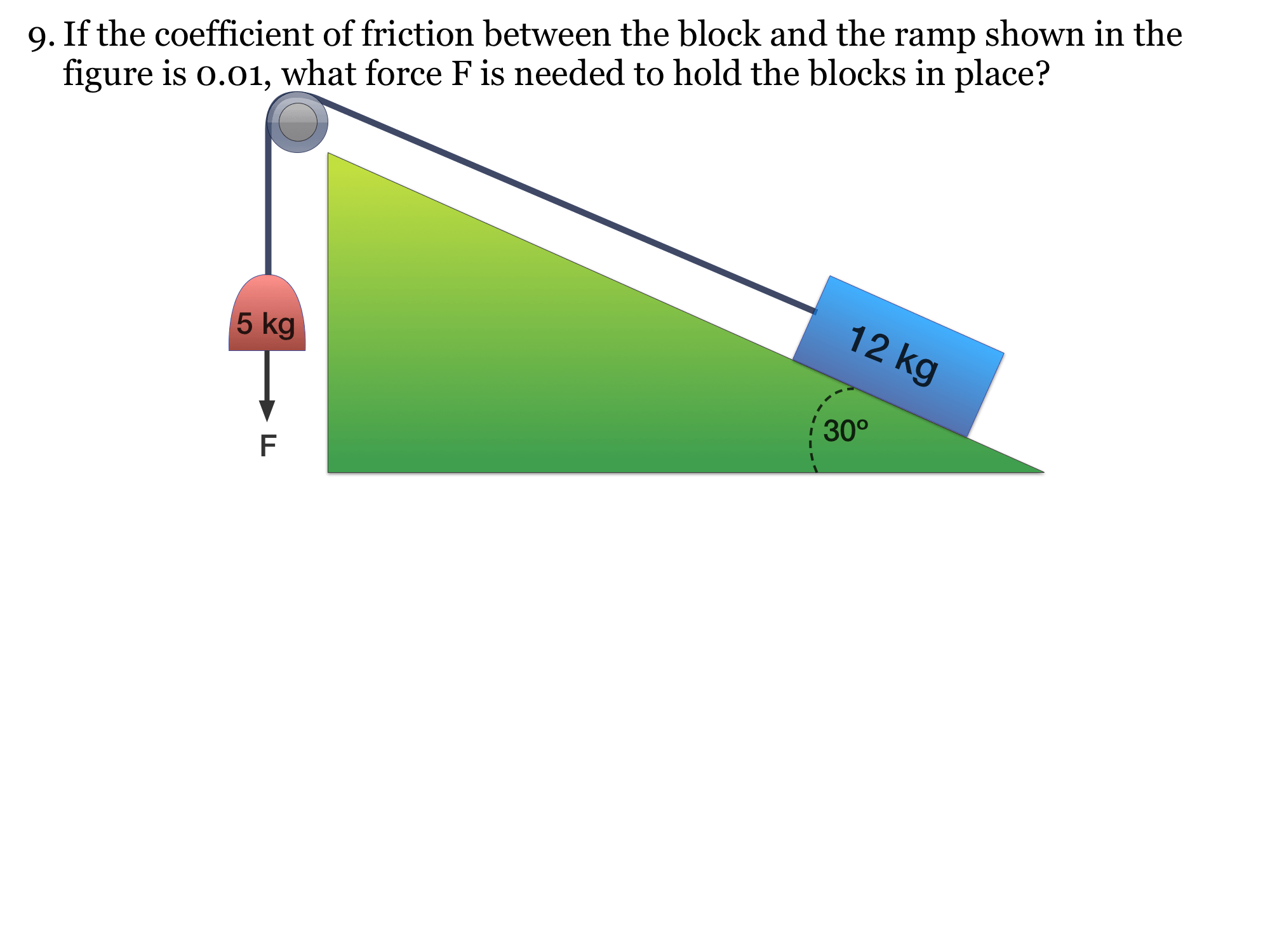
Original problem 9
The original asks for one force although static friction adjusts within a range. No kinetic coefficient is appropriate for “hold in place.”
Problem text
A 12 kg block on a 30° ramp is connected over an ideal fixed pulley to a hanging 5 kg block. A downward external force F acts on the hanging block. Interpret the stated friction coefficient 0.010 as μₛ. Find the range of F that can hold both blocks at rest and the minimum required F. Use g = 9.8 m/s².
Drawing is temporarily unavailable. Work on paper if needed, then record your reasoning here.
Saving written working requires JavaScript. The problem remains available above; keep your work on paper or in your own notes.
10. Work it out
Original textbook practice
An ideal movable pulley supports a 10 kg mass by two vertical segments of one light rope. A fixed upper pulley redirects the free end, where a downward force F is applied. Find F for steady upward lifting, and state the condition for upward acceleration. Use g = 9.8 m/s².
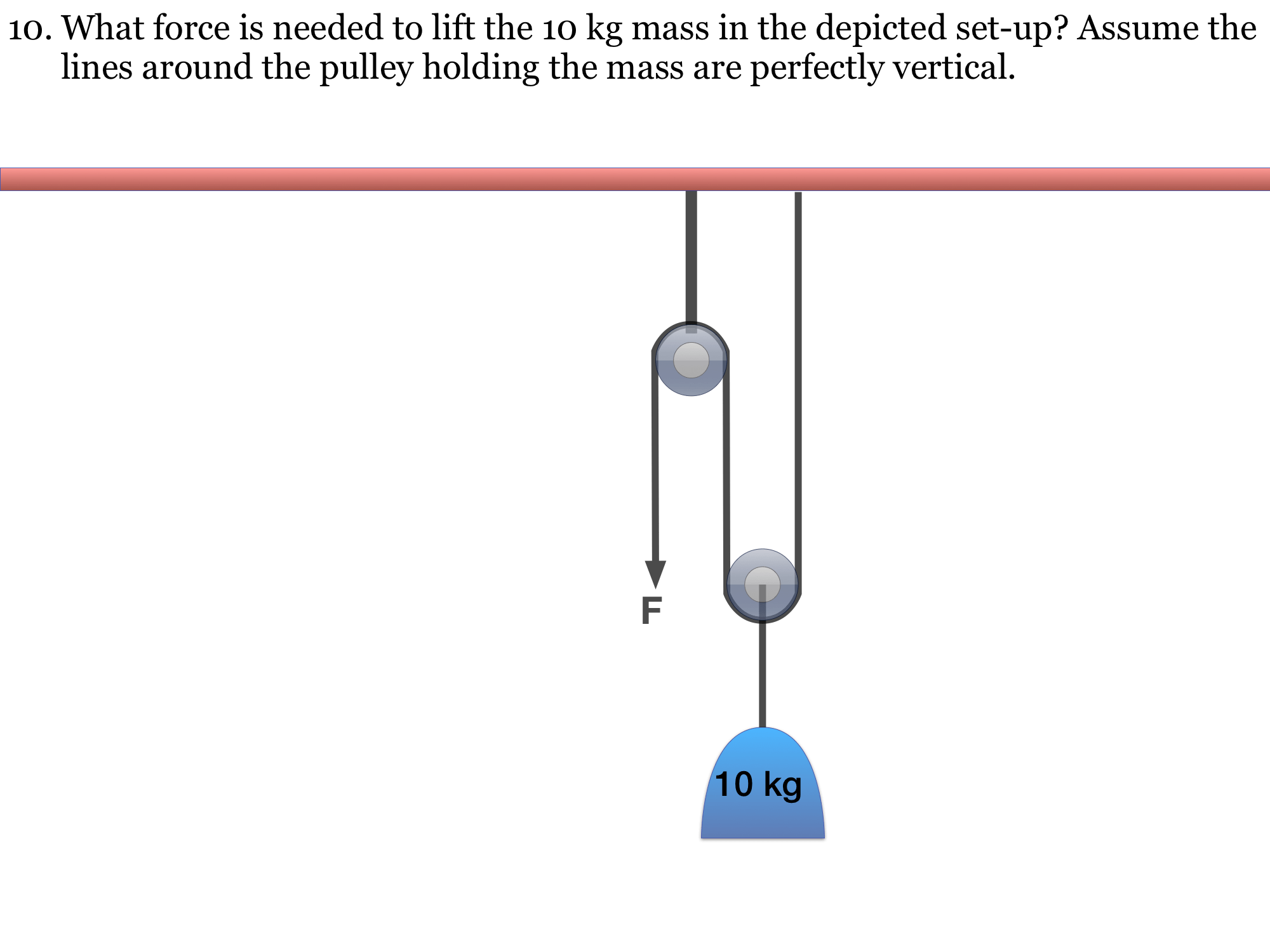
Original problem 10
The original’s “lift” is interpreted as the threshold or steady lifting force; positive upward acceleration requires a larger force.
Problem text
An ideal movable pulley supports a 10 kg mass by two vertical segments of one light rope. A fixed upper pulley redirects the free end, where a downward force F is applied. Find F for steady upward lifting, and state the condition for upward acceleration. Use g = 9.8 m/s².
Drawing is temporarily unavailable. Work on paper if needed, then record your reasoning here.
Saving written working requires JavaScript. The problem remains available above; keep your work on paper or in your own notes.
Additional practice
11. Down a smooth slope
Original textbook practice
A block slides down a frictionless 20° incline. Find its acceleration, using g = 9.8 m/s².
Your written working
Drawing is temporarily unavailable. Work on paper if needed, then record your reasoning here.
Saving written working requires JavaScript. The problem remains available above; keep your work on paper or in your own notes.
12. Static friction adjusts
Original textbook practice
A 5 kg box is at rest on a horizontal floor with μₛ = 0.4. A horizontal 12 N push is applied. Find the friction force and acceleration. What is the largest push that can be balanced? Use g = 9.8 m/s².
Your written working
Drawing is temporarily unavailable. Work on paper if needed, then record your reasoning here.
Saving written working requires JavaScript. The problem remains available above; keep your work on paper or in your own notes.
13. Pulling lightens the normal force
Original textbook practice
A 10 kg crate slides horizontally while a 50 N rope pulls at 30° above horizontal. If μₖ = 0.2, find the normal force and horizontal acceleration. Use g = 9.8 m/s². Assume the crate is already sliding horizontally in the direction of the rope’s horizontal pull.
Your written working
Drawing is temporarily unavailable. Work on paper if needed, then record your reasoning here.
Saving written working requires JavaScript. The problem remains available above; keep your work on paper or in your own notes.
14. Sliding at constant speed
Original textbook practice
A crate slides down a 25° incline at constant speed. Find the kinetic friction coefficient.
Your written working
Drawing is temporarily unavailable. Work on paper if needed, then record your reasoning here.
Saving written working requires JavaScript. The problem remains available above; keep your work on paper or in your own notes.
15. Two hanging masses
Original textbook practice
Masses 3 kg and 5 kg are connected by a light string over a frictionless massless pulley. Find acceleration and string tension. Use g = 9.8 m/s².
Your written working
Drawing is temporarily unavailable. Work on paper if needed, then record your reasoning here.
Saving written working requires JavaScript. The problem remains available above; keep your work on paper or in your own notes.
16. A fixed pulley redirects a force
Original textbook practice
A 12 kg load is raised at constant speed with one ideal fixed pulley. What downward pulling force is needed? How much work does the pull do while the load rises 0.5 m? Use g = 9.8 m/s².
Your written working
Drawing is temporarily unavailable. Work on paper if needed, then record your reasoning here.
Saving written working requires JavaScript. The problem remains available above; keep your work on paper or in your own notes.
17. A movable pulley trades force for distance
Original textbook practice
An ideal movable pulley supports a 20 kg load with two vertical string segments. Find the pulling force to lift it steadily, and the distance pulled to raise the load 0.3 m. Use g = 9.8 m/s².
Your written working
Drawing is temporarily unavailable. Work on paper if needed, then record your reasoning here.
Saving written working requires JavaScript. The problem remains available above; keep your work on paper or in your own notes.
18. Tension inside a train of carts
Original textbook practice
A 12 N force pulls a 2 kg cart joined to a 4 kg cart on a frictionless track. The force is applied to the 2 kg cart. Find system acceleration and coupling tension.
Your written working
Drawing is temporarily unavailable. Work on paper if needed, then record your reasoning here.
Saving written working requires JavaScript. The problem remains available above; keep your work on paper or in your own notes.
19. Velocity does not set force direction
Original textbook practice
A 2 kg object is moving right at 5 m/s while a constant 6 N net force points left. Describe its acceleration and find when it stops.
Your written working
Drawing is temporarily unavailable. Work on paper if needed, then record your reasoning here.
Saving written working requires JavaScript. The problem remains available above; keep your work on paper or in your own notes.
20. Terminal speed with quadratic drag
Enrichment beyond the AP course
A 2 kg falling object experiences upward drag D = 0.08v² N when v is in m/s. Find terminal speed. Use g = 9.8 m/s².
Your written working
Drawing is temporarily unavailable. Work on paper if needed, then record your reasoning here.
Saving written working requires JavaScript. The problem remains available above; keep your work on paper or in your own notes.
21. A rope at an angle
Original textbook practice
A 4 kg object hangs at rest from a rope tilted 20° from vertical because of a horizontal force. Find rope tension and horizontal force. Use g = 9.8 m/s².
Your written working
Drawing is temporarily unavailable. Work on paper if needed, then record your reasoning here.
Saving written working requires JavaScript. The problem remains available above; keep your work on paper or in your own notes.
22. The sign of a restoring force
Original textbook practice
A spring of constant 80 N/m lies along x. Its free end is at x = −0.15 m relative to its relaxed position. Find the force on an attached object.
Your written working
Drawing is temporarily unavailable. Work on paper if needed, then record your reasoning here.
Saving written working requires JavaScript. The problem remains available above; keep your work on paper or in your own notes.
23. Springs in parallel
Original textbook practice
Springs of constants 100 N/m and 200 N/m support a 3 kg mass in parallel. Find their common extension. Use g = 9.8 m/s².
Your written working
Drawing is temporarily unavailable. Work on paper if needed, then record your reasoning here.
Saving written working requires JavaScript. The problem remains available above; keep your work on paper or in your own notes.
24. Springs in series
Original textbook practice
Springs of constants 100 N/m and 200 N/m are connected in series and stretched by a 10 N force. Find each extension and the effective constant.
Your written working
Drawing is temporarily unavailable. Work on paper if needed, then record your reasoning here.
Saving written working requires JavaScript. The problem remains available above; keep your work on paper or in your own notes.
25. Work from an angled pull
Original textbook practice
A suitcase moves 6 m horizontally under a constant 25 N pulling force at 60° above horizontal. Find the work done by that force.
Your written working
Drawing is temporarily unavailable. Work on paper if needed, then record your reasoning here.
Saving written working requires JavaScript. The problem remains available above; keep your work on paper or in your own notes.
26. Work from a force graph
Original textbook practice
A force along x varies as Fₓ = 4x N, with x in metres. Find its work from x = 1 m to x = 3 m.
Your written working
Drawing is temporarily unavailable. Work on paper if needed, then record your reasoning here.
Saving written working requires JavaScript. The problem remains available above; keep your work on paper or in your own notes.
27. The normal force and work
Original textbook practice
A block travels 3 m down a straight stationary incline. Which of gravity, kinetic friction and the normal force do positive, negative or zero work?
Your written working
Drawing is temporarily unavailable. Work on paper if needed, then record your reasoning here.
Saving written working requires JavaScript. The problem remains available above; keep your work on paper or in your own notes.
28. Work done by a spring
Original textbook practice
A 200 N/m spring contracts from extension 0.20 m to 0.05 m. Find the work the spring does on an attached object.
Your written working
Drawing is temporarily unavailable. Work on paper if needed, then record your reasoning here.
Saving written working requires JavaScript. The problem remains available above; keep your work on paper or in your own notes.
29. Cancel three forces
Original textbook practice
Two forces on a stationary object are (5, −2) N and (−1, 7) N. What third force produces equilibrium?
Your written working
Drawing is temporarily unavailable. Work on paper if needed, then record your reasoning here.
Saving written working requires JavaScript. The problem remains available above; keep your work on paper or in your own notes.
30. When Hooke’s law stops working
Original textbook practice
A rubber band is measured to exert 1 N at extension 1 cm, 3 N at 2 cm and 6 N at 3 cm. Can a single constant k model this entire range? Explain.
Your written working
Drawing is temporarily unavailable. Work on paper if needed, then record your reasoning here.
Saving written working requires JavaScript. The problem remains available above; keep your work on paper or in your own notes.