Harmonics practice
Work from memory first. Draw a diagram, state the assumptions and keep units through every step. Worked answers are separate.
· Open separate worked solutions
1. Work it out
Original textbook practice · AP Physics 2 topic
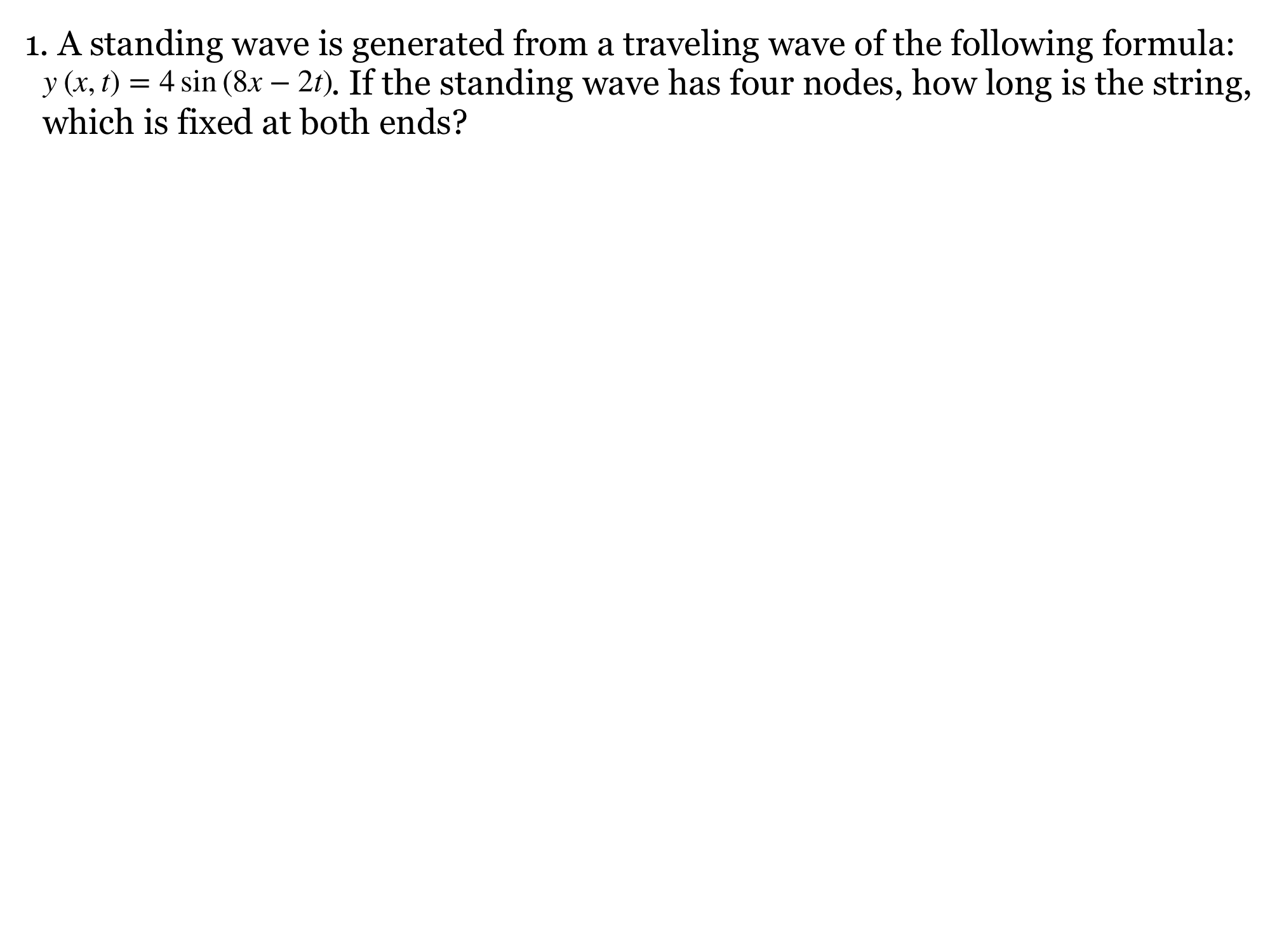
A traveling wave is y(x,t)=4 sin(8x−2t), with x in metres, t in seconds, k=8 rad/m and ω=2 rad/s. It combines with an equal counterpropagating wave to form a standing wave on a string fixed at both ends. If there are four nodes in total, including the endpoints, find the string length.
Original problem 1
Corrected OCR t and stated the endpoint-counting and SI conventions. A standing-wave pattern does not itself travel along the string.
Problem text
A traveling wave is y(x,t)=4 sin(8x−2t), with x in metres, t in seconds, k=8 rad/m and ω=2 rad/s. It combines with an equal counterpropagating wave to form a standing wave on a string fixed at both ends. If there are four nodes in total, including the endpoints, find the string length.
Drawing is temporarily unavailable. Work on paper if needed, then record your reasoning here.
Saving written working requires JavaScript. The problem remains available above; keep your work on paper or in your own notes.
2. Work it out
Original textbook practice
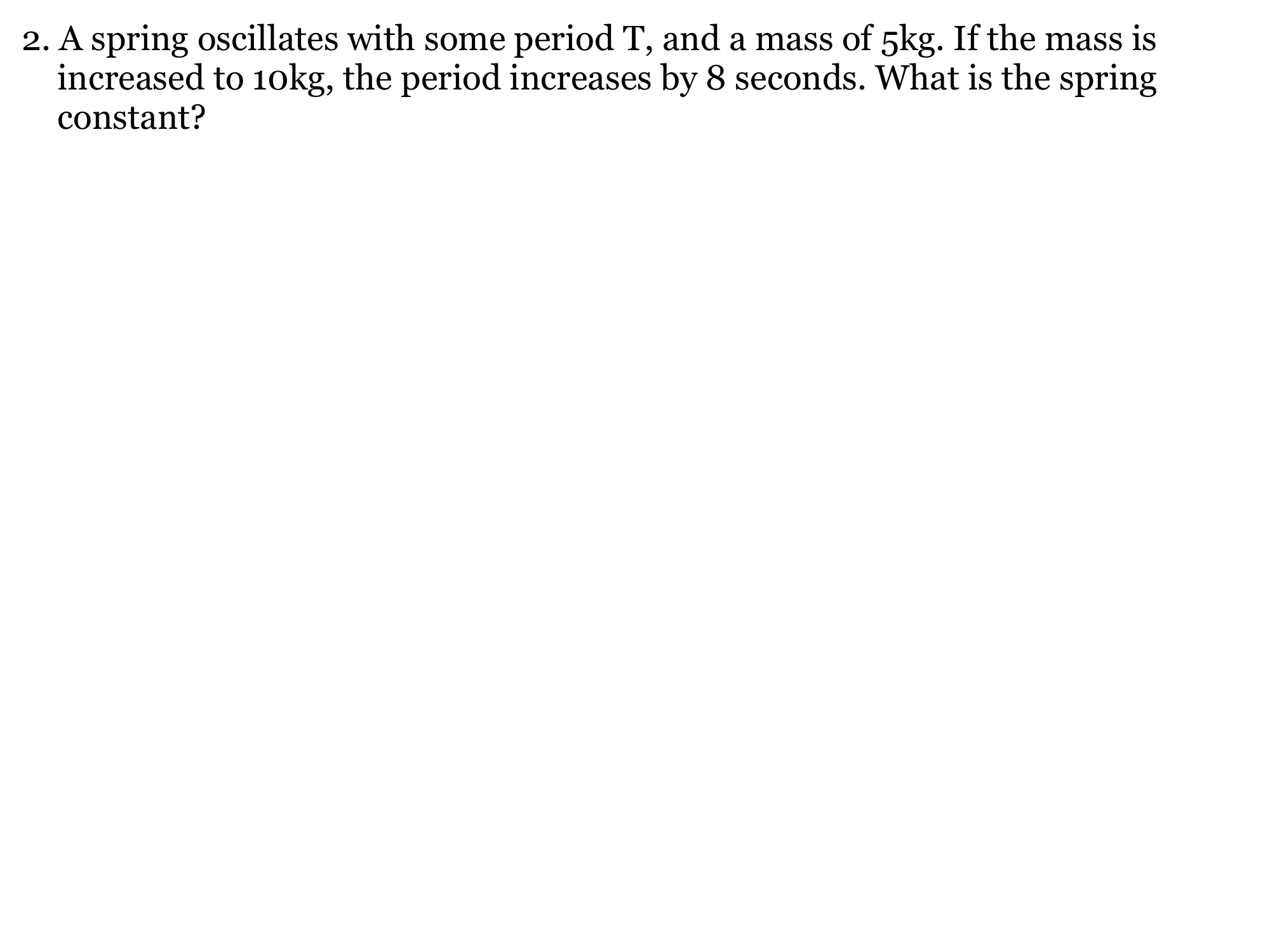
An ideal spring carries a 5 kg mass. Replacing it with a 10 kg mass increases the oscillation period by 8 s. Find the spring constant. Neglect the spring mass and damping.
Original problem 2
Made the ideal mass–spring model explicit; no source numbers changed.
Problem text
An ideal spring carries a 5 kg mass. Replacing it with a 10 kg mass increases the oscillation period by 8 s. Find the spring constant. Neglect the spring mass and damping.
Drawing is temporarily unavailable. Work on paper if needed, then record your reasoning here.
Saving written working requires JavaScript. The problem remains available above; keep your work on paper or in your own notes.
3. Work it out
Original textbook practice · AP Physics 2 topic
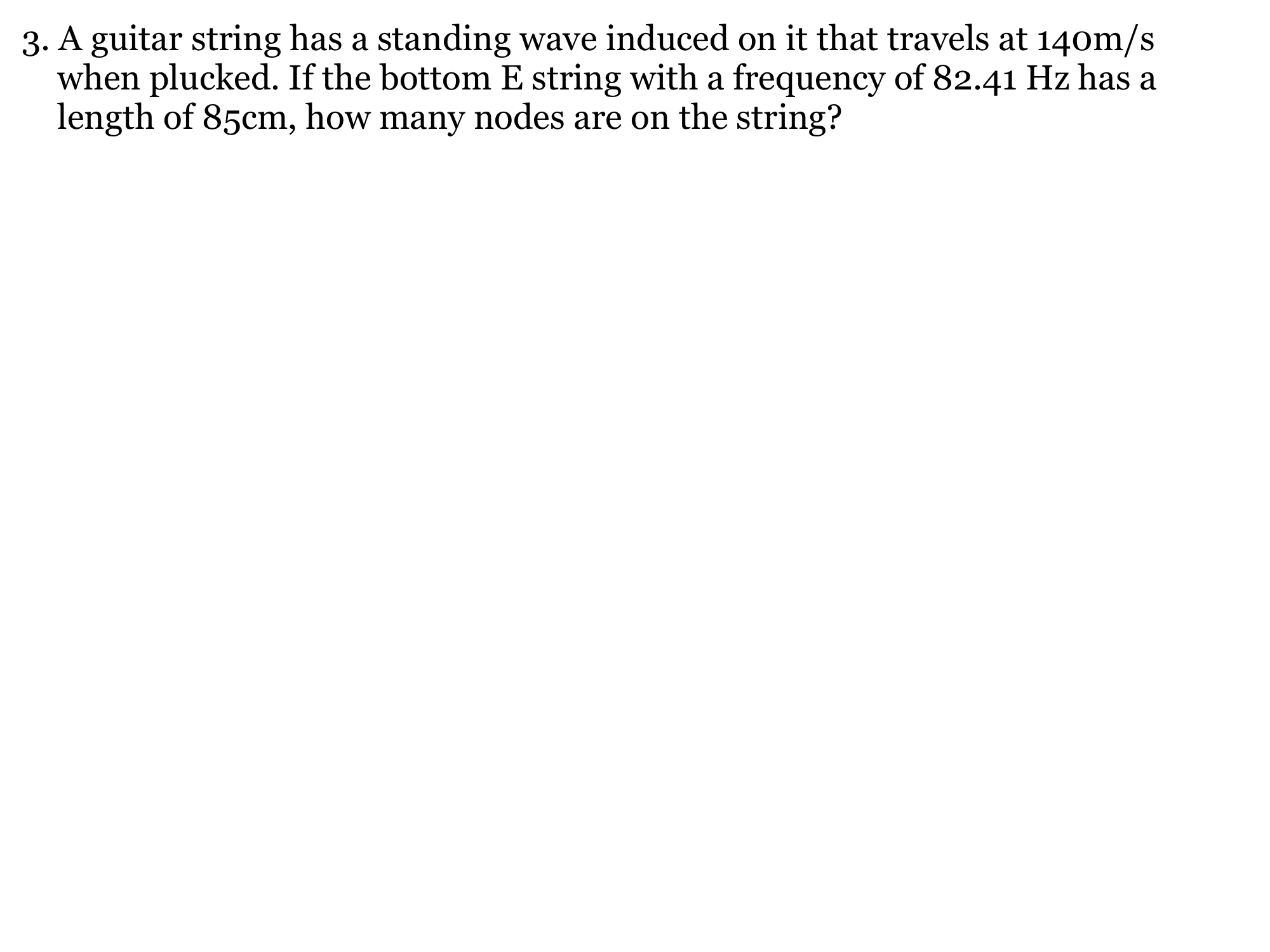
The transverse traveling-wave speed on an 85 cm guitar string fixed at both ends is approximately 140 m/s. Its low-E frequency is 82.41 Hz. Determine the intended harmonic and count the nodes, treating the stated speed and length as rounded measurements. Also check whether all three numbers fit an exact normal mode.
Original problem 3
The source numbers differ from an exact fundamental by 0.0693%; this is compatible with their displayed precision, but an exact noninteger mode number must not be accepted.
Problem text
The transverse traveling-wave speed on an 85 cm guitar string fixed at both ends is approximately 140 m/s. Its low-E frequency is 82.41 Hz. Determine the intended harmonic and count the nodes, treating the stated speed and length as rounded measurements. Also check whether all three numbers fit an exact normal mode.
Drawing is temporarily unavailable. Work on paper if needed, then record your reasoning here.
Saving written working requires JavaScript. The problem remains available above; keep your work on paper or in your own notes.
4. Work it out
Original textbook practice
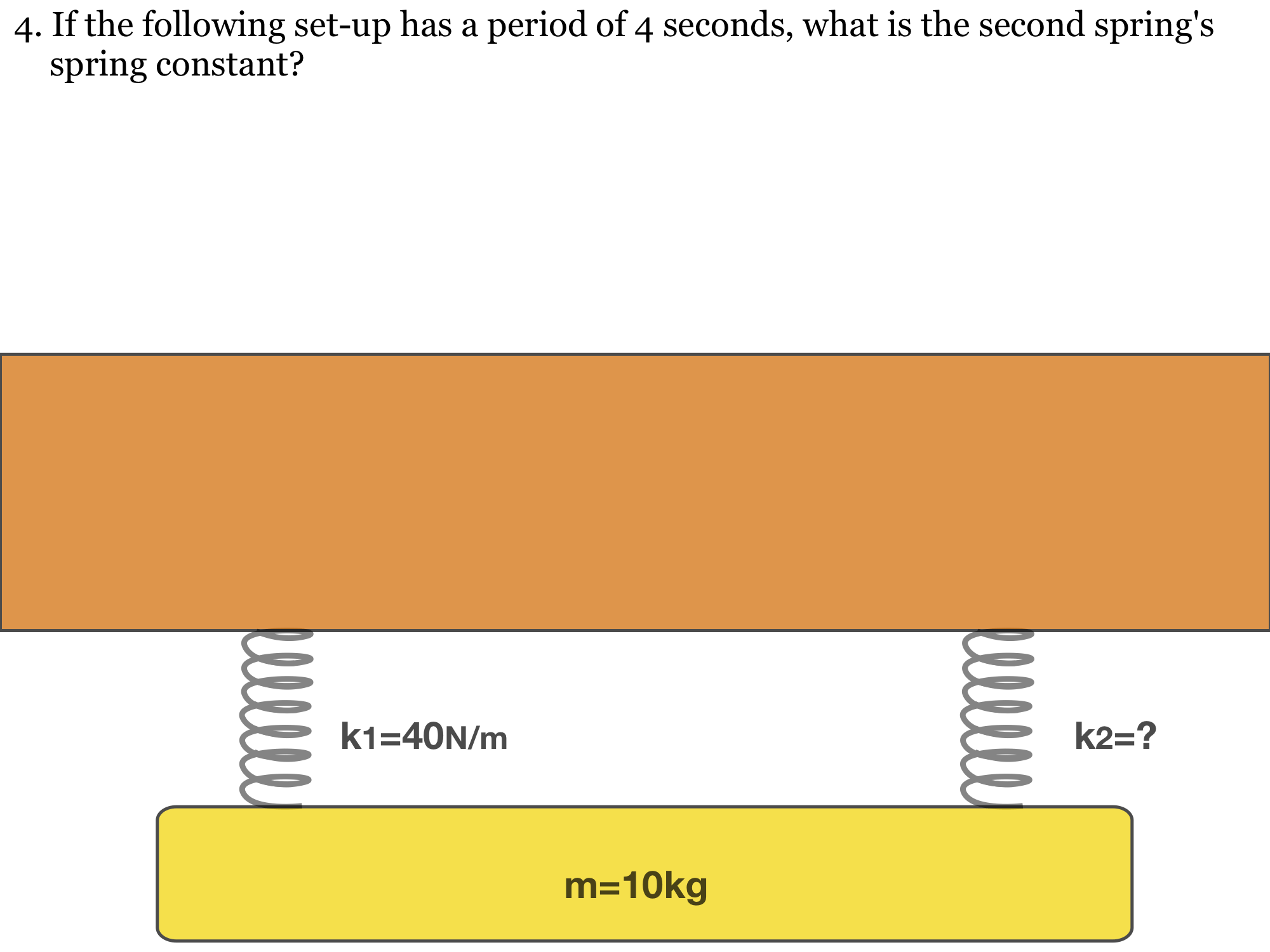
A 10 kg rigid block hangs from two ideal springs in parallel, as shown in the source diagram. One spring has k₁=40 N/m and the claimed period of pure vertical translation is 4 s. Solve for k₂ and assess whether that value can describe an ordinary positive-stiffness spring.
Original problem 4
The diagram is parallel, not series. The source period requires negative stiffness; the repaired question retains the data and asks for the consistency check instead of silently changing a number.
Problem text
A 10 kg rigid block hangs from two ideal springs in parallel, as shown in the source diagram. One spring has k₁=40 N/m and the claimed period of pure vertical translation is 4 s. Solve for k₂ and assess whether that value can describe an ordinary positive-stiffness spring.
Drawing is temporarily unavailable. Work on paper if needed, then record your reasoning here.
Saving written working requires JavaScript. The problem remains available above; keep your work on paper or in your own notes.
5. Work it out
Original textbook practice · AP Physics 2 topic
The source gives y(x,t)=4 sin(4x)cos(8t), a string length of 1.118 m, four nodes, and a period of 5 s. With x in metres and t in seconds, (a) find the component traveling-wave speed from the equation and (b) check the length, node count, and period for mutual consistency. For comparison, find the speed implied solely by L=1.118 m, four total fixed-end nodes and T=5 s.
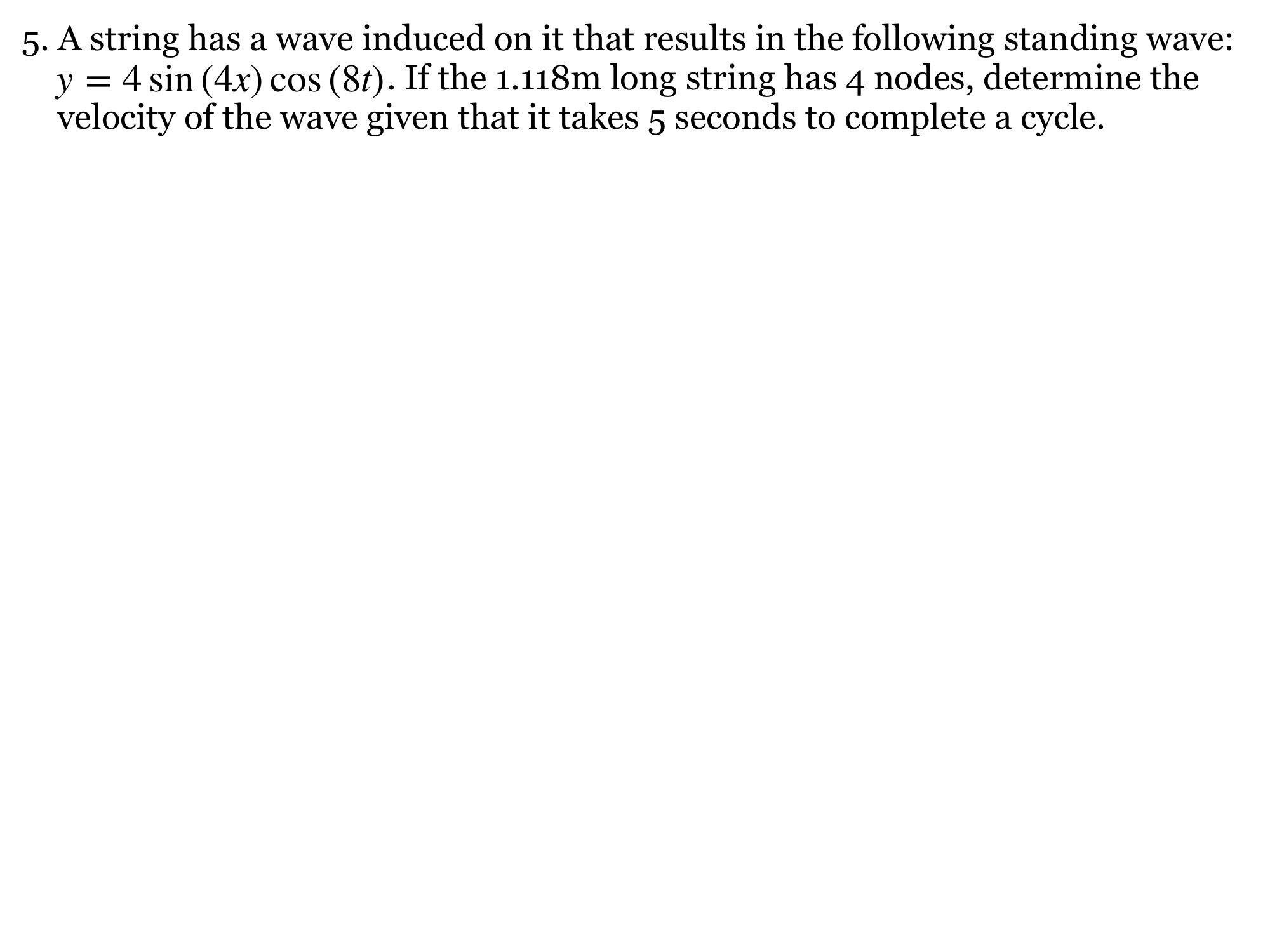
Original problem 5
The wave equation, period and stated geometry conflict. Both consistent subsets are evaluated; no missing boundary condition or replacement number is presented as source fact.
Problem text
The source gives y(x,t)=4 sin(4x)cos(8t), a string length of 1.118 m, four nodes, and a period of 5 s. With x in metres and t in seconds, (a) find the component traveling-wave speed from the equation and (b) check the length, node count, and period for mutual consistency. For comparison, find the speed implied solely by L=1.118 m, four total fixed-end nodes and T=5 s.
Drawing is temporarily unavailable. Work on paper if needed, then record your reasoning here.
Saving written working requires JavaScript. The problem remains available above; keep your work on paper or in your own notes.
6. Work it out
Enrichment beyond the AP course
A physical pendulum has total stated length L=2 m, pivot-to-centre-of-mass distance h=L/3, moment of inertia about the pivot I=20 kg·m², and small-amplitude period T=5 s. Using g=9.8 m/s², infer its mass from the physical-pendulum period formula.
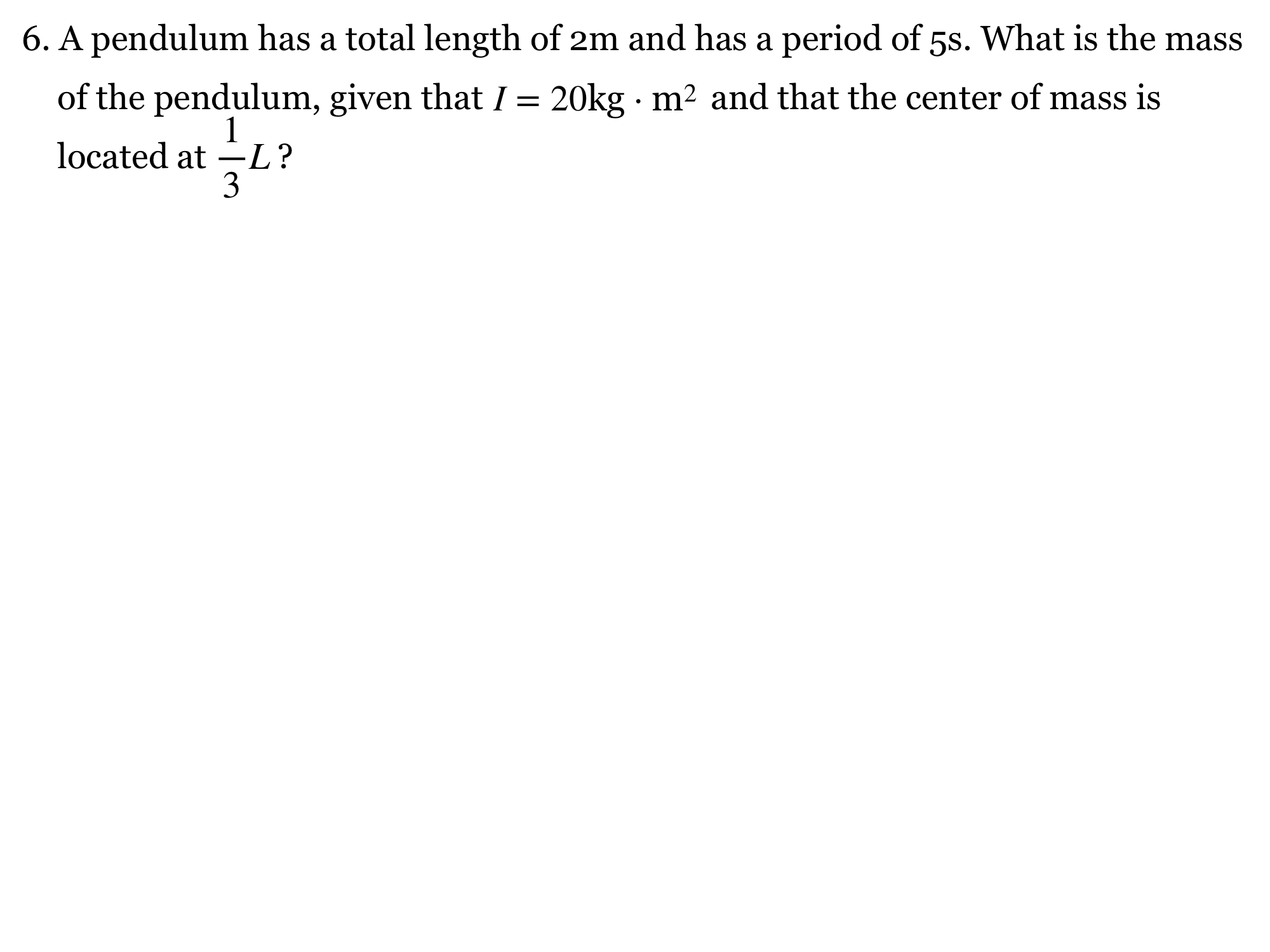
Original problem 6
Verified h=L/3 and I=20 kg·m² from the source image. Stated the required pivot-axis inertia and small-angle assumption.
Problem text
A physical pendulum has total stated length L=2 m, pivot-to-centre-of-mass distance h=L/3, moment of inertia about the pivot I=20 kg·m², and small-amplitude period T=5 s. Using g=9.8 m/s², infer its mass from the physical-pendulum period formula.
Drawing is temporarily unavailable. Work on paper if needed, then record your reasoning here.
Saving written working requires JavaScript. The problem remains available above; keep your work on paper or in your own notes.
7. Work it out
Enrichment beyond the AP course
A spherical pendulum has radius R=1 m, a pivot 1 m from its centre, mass 10 g, a stated turning angle of 25°, and a stated bottom speed of 4 m/s. The source also asks for the distance traveled by its tip in 5 s. Determine which bottom acceleration can be found, explain the speed-location ambiguity, and check whether the angle and speed can coexist for a uniform solid sphere in conservative motion. Identify what prevents a unique tip-distance answer.
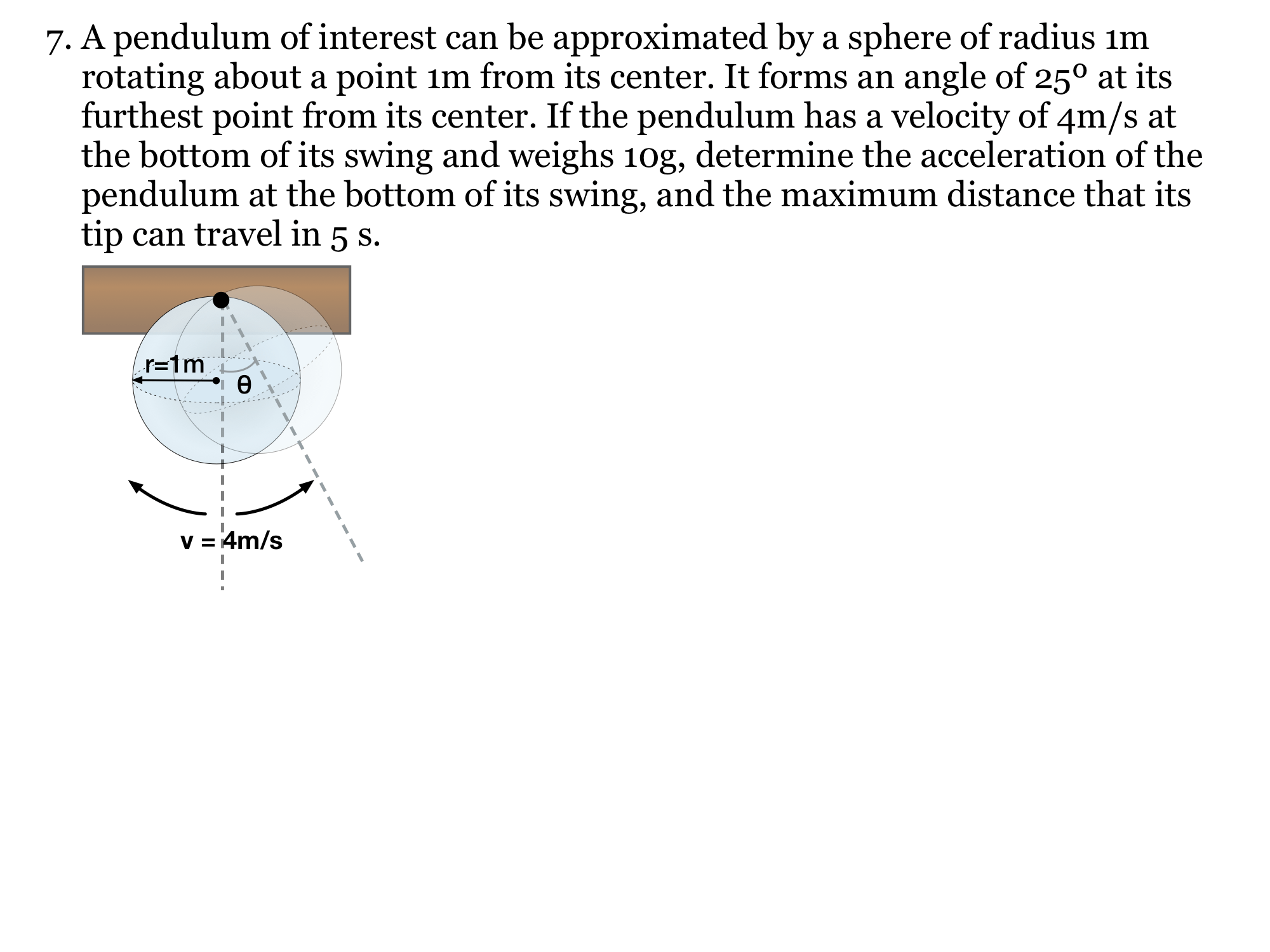
Original problem 7
The source does not specify whether 4 m/s belongs to the centre or tip, or whether the sphere is solid/hollow, or a consistent initial phase. The review exposes those limits and gives clearly conditional calculations.
Problem text
A spherical pendulum has radius R=1 m, a pivot 1 m from its centre, mass 10 g, a stated turning angle of 25°, and a stated bottom speed of 4 m/s. The source also asks for the distance traveled by its tip in 5 s. Determine which bottom acceleration can be found, explain the speed-location ambiguity, and check whether the angle and speed can coexist for a uniform solid sphere in conservative motion. Identify what prevents a unique tip-distance answer.
Drawing is temporarily unavailable. Work on paper if needed, then record your reasoning here.
Saving written working requires JavaScript. The problem remains available above; keep your work on paper or in your own notes.
8. Work it out
Original textbook practice · AP Physics 2 topic
A 2 m string has a standing wave with three nodes and period 10 s; its antinode displacement amplitude is 1 m. The source calls it “loose” without specifying its endpoints. Give a valid equation for the intended ideal model with two free ends, placing x=0 at a free end, and explain how the equation changes if both ends are fixed. Choose the time origin at maximum deformation.
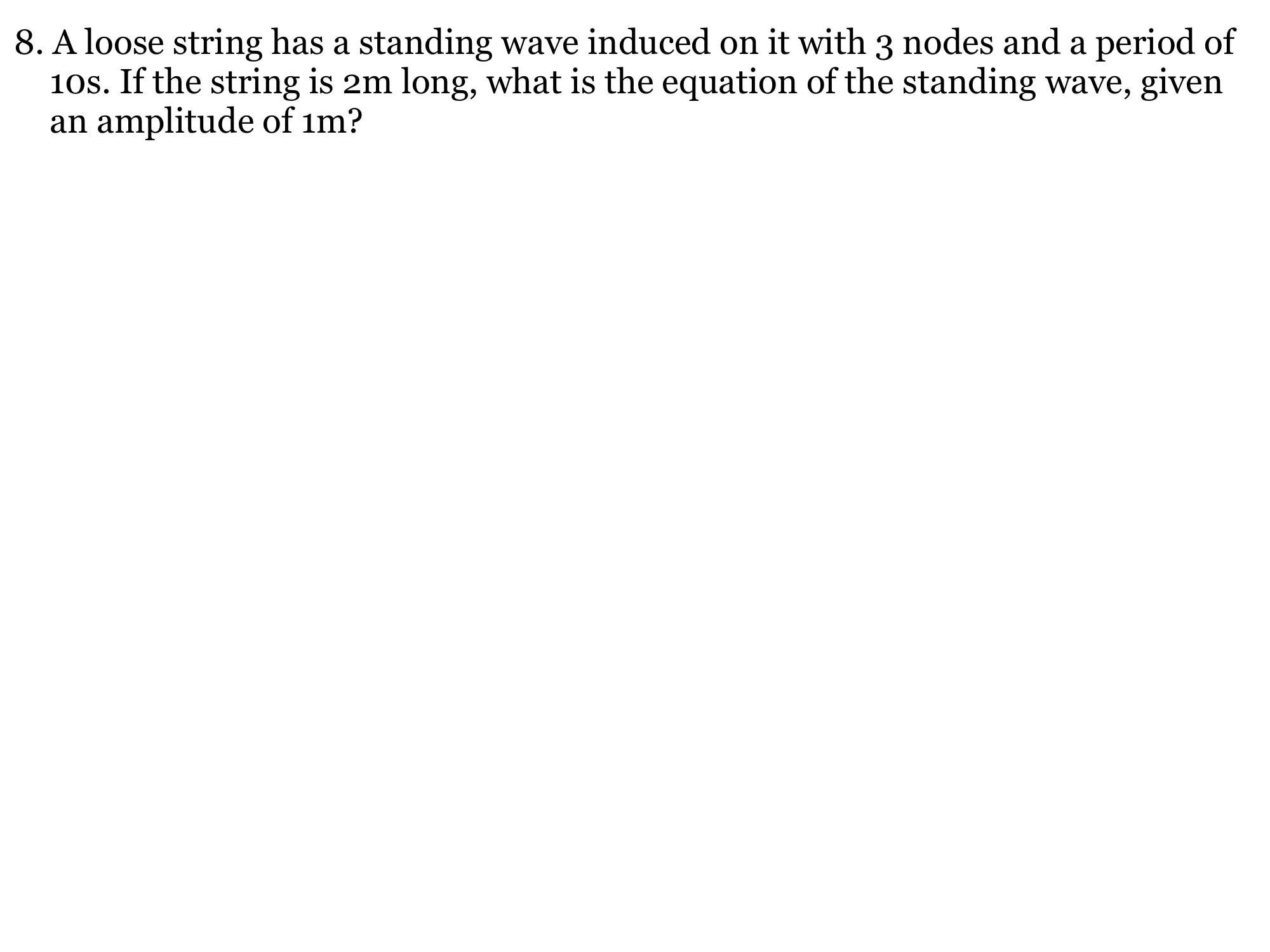
Original problem 8
Image verification recovers T=10 s. “Loose” alone does not establish a boundary condition. Both endpoint interpretations are explicit; amplitude refers to the standing-wave antinode, not each traveling component.
Problem text
A 2 m string has a standing wave with three nodes and period 10 s; its antinode displacement amplitude is 1 m. The source calls it “loose” without specifying its endpoints. Give a valid equation for the intended ideal model with two free ends, placing x=0 at a free end, and explain how the equation changes if both ends are fixed. Choose the time origin at maximum deformation.
Drawing is temporarily unavailable. Work on paper if needed, then record your reasoning here.
Saving written working requires JavaScript. The problem remains available above; keep your work on paper or in your own notes.
9. Work it out
Enrichment beyond the AP course
A 4 kg mass on a spring follows the damped displacement y(t)=10 exp[−(1/3 s⁻¹)t] cos[(4 rad/s)t−2], where 10 is expressed in the source’s unspecified displacement unit. Assuming linear viscous damping, determine the spring constant. Evaluate the amplitude envelope after 12 s and assess the source’s claim that the mass “stops completely” then.
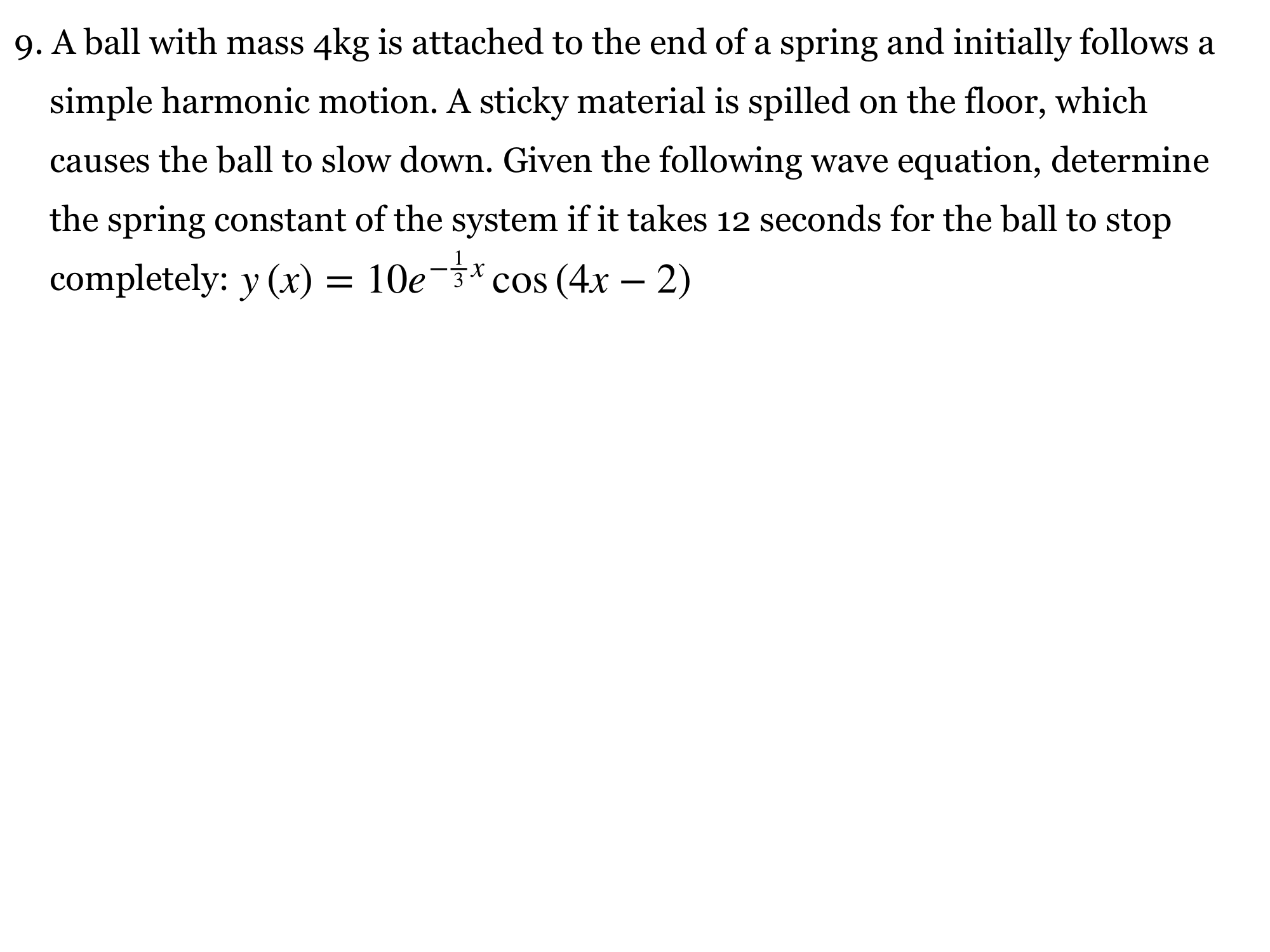
Original problem 9
The image exponent is −x/3, not −3x. Replaced x with time because the question describes temporal damping. An exponential envelope does not become exactly zero at a finite time; a detection threshold would be needed for a practical stop time.
Problem text
A 4 kg mass on a spring follows the damped displacement y(t)=10 exp[−(1/3 s⁻¹)t] cos[(4 rad/s)t−2], where 10 is expressed in the source’s unspecified displacement unit. Assuming linear viscous damping, determine the spring constant. Evaluate the amplitude envelope after 12 s and assess the source’s claim that the mass “stops completely” then.
Drawing is temporarily unavailable. Work on paper if needed, then record your reasoning here.
Saving written working requires JavaScript. The problem remains available above; keep your work on paper or in your own notes.
10. Work it out
Original textbook practice
The same pendulum has a 10 s period on Earth. Find its period on Mars, where g=3.71 m/s². Take Earth’s g=9.8 m/s² and keep the pendulum geometry and oscillation amplitude unchanged; neglect damping.
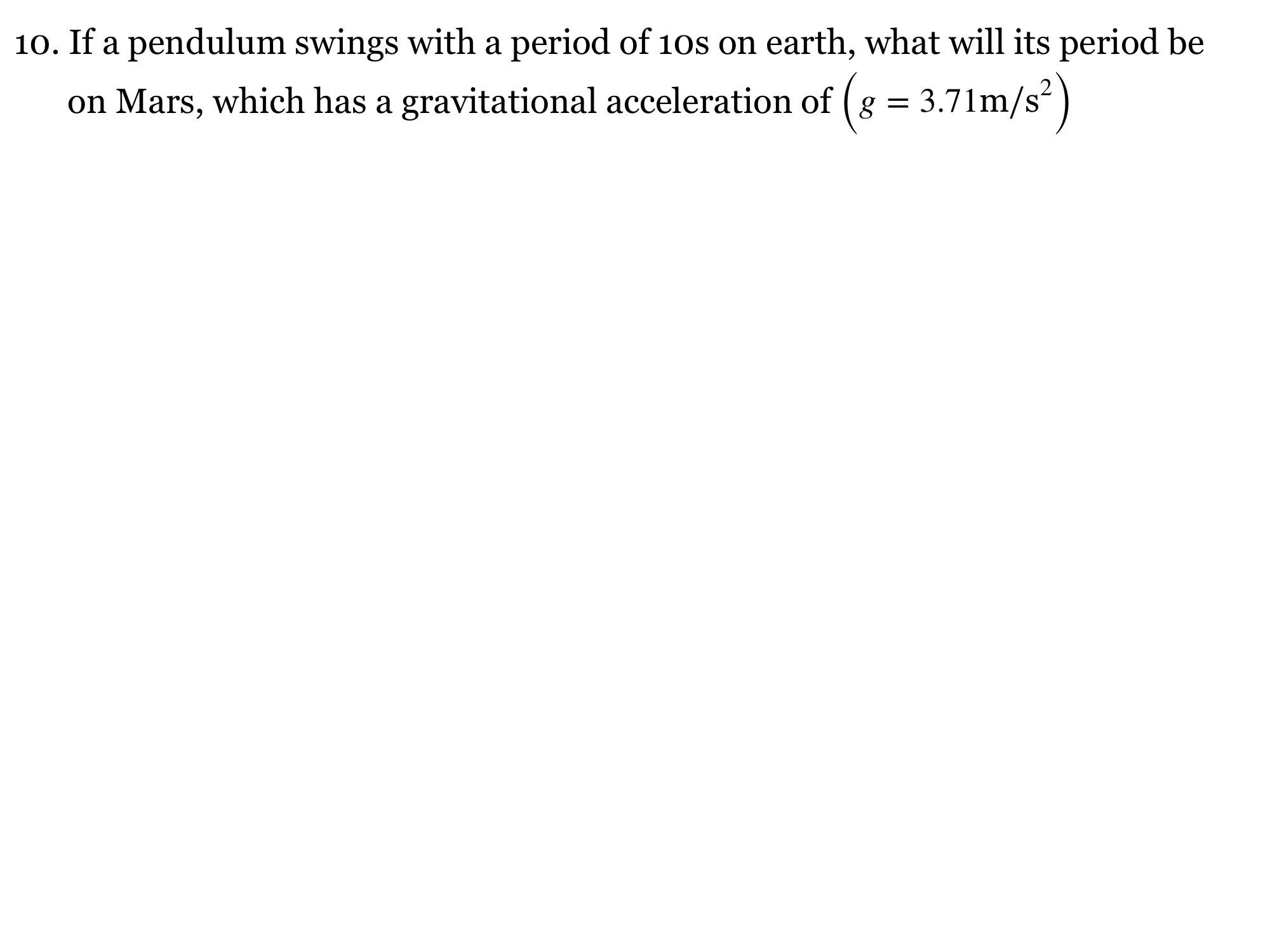
Original problem 10
Restored acceleration units and stated the Earth value used by the chapter.
Problem text
The same pendulum has a 10 s period on Earth. Find its period on Mars, where g=3.71 m/s². Take Earth’s g=9.8 m/s² and keep the pendulum geometry and oscillation amplitude unchanged; neglect damping.
Drawing is temporarily unavailable. Work on paper if needed, then record your reasoning here.
Saving written working requires JavaScript. The problem remains available above; keep your work on paper or in your own notes.
Additional practice
11. Reconstructing a glider’s motion
Original textbook practice
A 0.50 kg glider moves on a frictionless track attached to a 50 N/m spring. At t=0 its displacement from equilibrium is +0.030 m and its velocity is −0.400 m/s. Find its amplitude, a displacement equation with the correct phase, and maximum speed.
Your written working
Drawing is temporarily unavailable. Work on paper if needed, then record your reasoning here.
Saving written working requires JavaScript. The problem remains available above; keep your work on paper or in your own notes.
12. Static stretch predicts a vertical period
Original textbook practice
A 0.60 kg laboratory mass stretches a light vertical spring 7.5 cm at rest. The mass is then displaced slightly and released. With g=9.8 m/s² and no damping, find the spring constant and the oscillation period. Explain the role of gravity.
Your written working
Drawing is temporarily unavailable. Work on paper if needed, then record your reasoning here.
Saving written working requires JavaScript. The problem remains available above; keep your work on paper or in your own notes.
13. Energy with two wall springs
Original textbook practice
A 0.75 kg cart on a frictionless horizontal rail lies between two walls. It is attached to a 120 N/m spring on the left and a 180 N/m spring on the right. Both are unstrained at equilibrium. The cart is pulled 0.080 m right and released. Find the restoring force at release, total energy and maximum speed.
Your written working
Drawing is temporarily unavailable. Work on paper if needed, then record your reasoning here.
Saving written working requires JavaScript. The problem remains available above; keep your work on paper or in your own notes.
14. Two series springs share the extension
Original textbook practice
A 1.20 kg oscillator is attached to a fixed wall through two light springs in series with constants 200 N/m and 300 N/m. The track is frictionless. Find the effective spring constant, period, and the individual spring extensions when the total extension is 0.050 m.
Your written working
Drawing is temporarily unavailable. Work on paper if needed, then record your reasoning here.
Saving written working requires JavaScript. The problem remains available above; keep your work on paper or in your own notes.
15. Embedding collision starts an oscillation
Original textbook practice
A 0.030 kg pellet moving horizontally at 60.0 m/s embeds in a stationary 0.500 kg block attached to a 212 N/m spring. The spring is initially unstrained on a frictionless track. Treat the impact as instantaneous so the spring impulse during it is negligible. Find the subsequent oscillation amplitude and the mechanical energy lost in the impact.
Your written working
Drawing is temporarily unavailable. Work on paper if needed, then record your reasoning here.
Saving written working requires JavaScript. The problem remains available above; keep your work on paper or in your own notes.
16. Pendulum tension at the bottom
Original textbook practice
A 0.250 kg point bob on a light 1.20 m string is released from rest at 30.0° from the downward vertical. Neglect air resistance and use g=9.8 m/s². Without making a small-angle approximation, find its bottom speed and the string tension there.
Your written working
Drawing is temporarily unavailable. Work on paper if needed, then record your reasoning here.
Saving written working requires JavaScript. The problem remains available above; keep your work on paper or in your own notes.
17. Choosing the fastest pivot for a rod
Enrichment beyond the AP course
A uniform slender rod of length 1.50 m can be pivoted at any point along it. Its centre of mass hangs below the pivot. For small oscillations, find the pivot-to-centre distance d that minimizes the period, and the minimum period. Use g=9.8 m/s².
Your written working
Drawing is temporarily unavailable. Work on paper if needed, then record your reasoning here.
Saving written working requires JavaScript. The problem remains available above; keep your work on paper or in your own notes.
18. Torsion pendulum reveals rotational inertia
Enrichment beyond the AP course
A turntable suspended by a torsion wire has restoring torque τ=−κθ with κ=0.800 N·m/rad. Its small-amplitude period is 1.60 s. Find its rotational inertia and the restoring torque when displaced +0.120 rad.
Your written working
Drawing is temporarily unavailable. Work on paper if needed, then record your reasoning here.
Saving written working requires JavaScript. The problem remains available above; keep your work on paper or in your own notes.
19. Two measured peaks reveal damping and stiffness
Enrichment beyond the AP course
A 0.250 kg mass undergoes underdamped motion with viscous force −bv. Two consecutive positive displacement maxima are 0.0120 m and 0.0100 m, separated by 0.800 s. Find b and the spring constant k.
Your written working
Drawing is temporarily unavailable. Work on paper if needed, then record your reasoning here.
Saving written working requires JavaScript. The problem remains available above; keep your work on paper or in your own notes.
20. Which dashpot oscillates?
Enrichment beyond the AP course
Three 0.400 kg carts each have a 25.0 N/m spring. Their dashpots have coefficients 3.00 kg/s, 2√10 kg/s, and 9.00 kg/s. Classify each as underdamped, critically damped, or overdamped. Find the damped angular frequency for any cart that oscillates.
Your written working
Drawing is temporarily unavailable. Work on paper if needed, then record your reasoning here.
Saving written working requires JavaScript. The problem remains available above; keep your work on paper or in your own notes.
21. When a sensor stops detecting motion
Enrichment beyond the AP course
An underdamped instrument with linear viscous damping has mass 0.300 kg and damping coefficient 0.120 kg/s. Its displacement envelope begins at 0.0500 m. The sensor reports no motion once the envelope falls to 0.200 mm. Find the earliest threshold time and explain why this does not mean exact rest.
Your written working
Drawing is temporarily unavailable. Work on paper if needed, then record your reasoning here.
Saving written working requires JavaScript. The problem remains available above; keep your work on paper or in your own notes.
22. Adjacent resonances determine tension
Original textbook practice · AP Physics 2 topic
A string fixed at both ends has vibrating length 0.650 m and linear density 2.00×10⁻³ kg/m. Two adjacent resonances occur at 240 Hz and 320 Hz. Find their harmonic numbers, the wave speed, and the string tension.
Your written working
Drawing is temporarily unavailable. Work on paper if needed, then record your reasoning here.
Saving written working requires JavaScript. The problem remains available above; keep your work on paper or in your own notes.
23. A free-end laboratory waveguide
Original textbook practice · AP Physics 2 topic
An ideal transverse waveguide of length 1.80 m has free ends (zero transverse slope) and wave speed 90.0 m/s. It oscillates in its fourth nonzero normal mode with antinode amplitude 2.00 mm. At t=0 it is at maximum deformation. Write its displacement equation, list the nodes and find the frequency.
Your written working
Drawing is temporarily unavailable. Work on paper if needed, then record your reasoning here.
Saving written working requires JavaScript. The problem remains available above; keep your work on paper or in your own notes.
24. One fixed end and one free end
Original textbook practice · AP Physics 2 topic
An ideal 1.40 m transverse waveguide is fixed at x=0 and free at x=1.40 m. Its wave speed is 56.0 m/s. For its third allowed nonzero mode, find the wavelength and frequency, and list the node and antinode positions.
Your written working
Drawing is temporarily unavailable. Work on paper if needed, then record your reasoning here.
Saving written working requires JavaScript. The problem remains available above; keep your work on paper or in your own notes.
25. Same mode with different phases
Original textbook practice · AP Physics 2 topic
Two contributions to one allowed string mode are y₁=(3.00 mm)sin(kx)cos(ωt) and y₂=(4.00 mm)sin(kx)cos(ωt+2π/3). Find the combined antinode amplitude and phase in y=R sin(kx)cos(ωt+φ). Does the amplitude equal 7.00 mm?
Your written working
Drawing is temporarily unavailable. Work on paper if needed, then record your reasoning here.
Saving written working requires JavaScript. The problem remains available above; keep your work on paper or in your own notes.
26. A zero now need not be a node
Original textbook practice · AP Physics 2 topic
A string of length 1.00 m, fixed at both ends, has speed 2.00 m/s and displacement y=(0.010 m)sin(πx)cos(2πt)+(0.005 m)sin(2πx)cos(4πt), with x in m and t in s. Find all points that remain at zero for every time. Then find y at x=0.50 m, t=0.25 s and explain whether that point is a node.
Your written working
Drawing is temporarily unavailable. Work on paper if needed, then record your reasoning here.
Saving written working requires JavaScript. The problem remains available above; keep your work on paper or in your own notes.
27. Energy stored in a string mode
Original textbook practice · AP Physics 2 topic
A taut string has length 1.20 m, linear density 0.00800 kg/m and traveling-wave speed 30.0 m/s. Its fundamental standing wave has maximum antinode displacement 0.00500 m. Find the total mechanical energy in this ideal mode. Assume small slopes.
Your written working
Drawing is temporarily unavailable. Work on paper if needed, then record your reasoning here.
Saving written working requires JavaScript. The problem remains available above; keep your work on paper or in your own notes.
28. A driven vibration isolator
Enrichment beyond the AP course
A 0.200 kg oscillator has k=40.0 N/m, damping coefficient b=0.800 kg/s, and driving force F(t)=(0.500 N)cos(Ωt). Find its steady-state displacement amplitude and phase lag when Ω=√(k/m). Also find the driving angular frequency at which its displacement amplitude is greatest.
Your written working
Drawing is temporarily unavailable. Work on paper if needed, then record your reasoning here.
Saving written working requires JavaScript. The problem remains available above; keep your work on paper or in your own notes.
29. An elevator changes a pendulum’s period
Original textbook practice
A small-angle pendulum of length 0.800 m hangs in an elevator accelerating steadily upward. Its measured period relative to the elevator is 1.60 s. Take Earth’s g=9.8 m/s². Find the elevator acceleration and its direction.
Your written working
Drawing is temporarily unavailable. Work on paper if needed, then record your reasoning here.
Saving written working requires JavaScript. The problem remains available above; keep your work on paper or in your own notes.
30. How much time is spent near equilibrium?
Original textbook practice
An ideal oscillator has x(t)=A cos(8.00t), with t in seconds. What fraction of each period does it spend within |x|≤A/2? Find the total time in that region during one period.
Your written working
Drawing is temporarily unavailable. Work on paper if needed, then record your reasoning here.
Saving written working requires JavaScript. The problem remains available above; keep your work on paper or in your own notes.