Introduction practice
Work from memory first. Draw a diagram, state the assumptions and keep units through every step. Worked answers are separate.
· Open separate worked solutions
1. Work it out
Original textbook practice
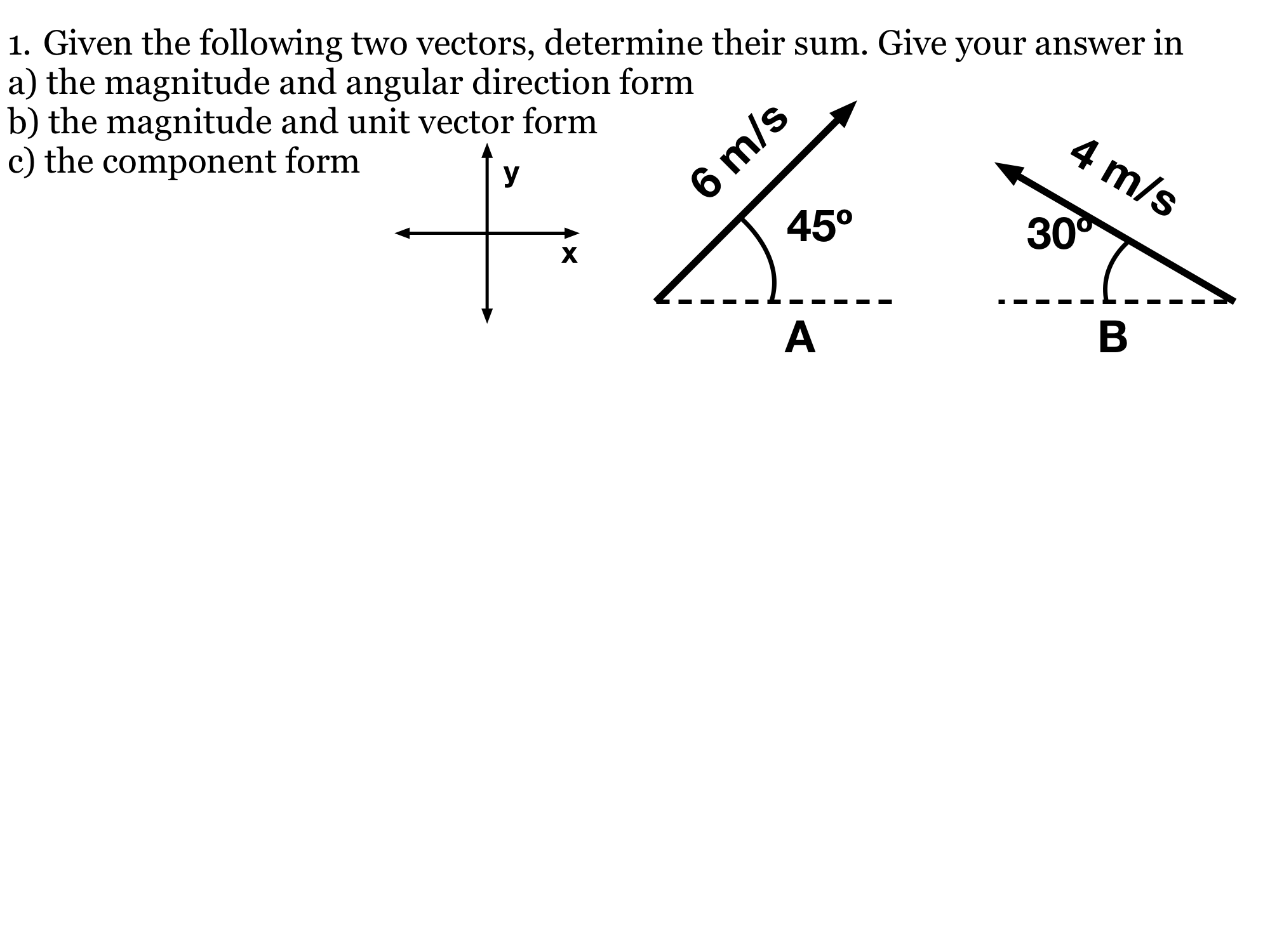
Add A, 6 m/s at 45° counterclockwise from +x, and B, 4 m/s at 150° from +x (30° north of west). Give the result as magnitude and direction, magnitude times a unit vector, and components.
Original problem 1
Problem text
Add A, 6 m/s at 45° counterclockwise from +x, and B, 4 m/s at 150° from +x (30° north of west). Give the result as magnitude and direction, magnitude times a unit vector, and components.
Drawing is temporarily unavailable. Work on paper if needed, then record your reasoning here.
Saving written working requires JavaScript. The problem remains available above; keep your work on paper or in your own notes.
2. Work it out
Original textbook practice
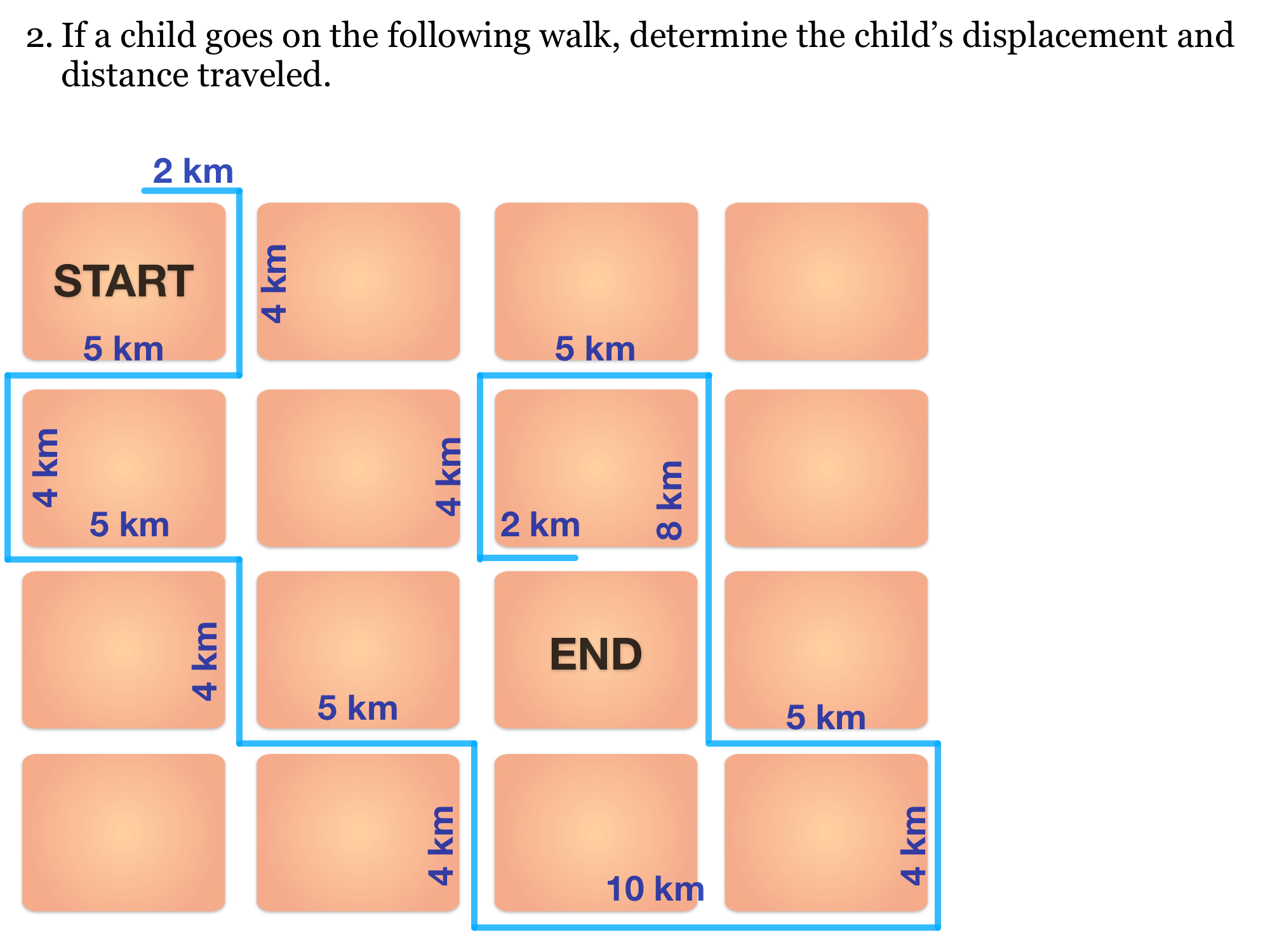
Follow the diagram’s route. Its legs, starting at START, are: 2 km east, 4 km south, 5 km west, 4 km south, 5 km east, 4 km south, 5 km east, 4 km south, 10 km east, 4 km north, 5 km west, 8 km north, 5 km west, 4 km south and 2 km east. Find distance and displacement.
Original problem 2
The source answer key drops the “k” in km; use the kilometre units shown in the diagram.
Problem text
Follow the diagram’s route. Its legs, starting at START, are: 2 km east, 4 km south, 5 km west, 4 km south, 5 km east, 4 km south, 5 km east, 4 km south, 10 km east, 4 km north, 5 km west, 8 km north, 5 km west, 4 km south and 2 km east. Find distance and displacement.
Drawing is temporarily unavailable. Work on paper if needed, then record your reasoning here.
Saving written working requires JavaScript. The problem remains available above; keep your work on paper or in your own notes.
3. Work it out
Enrichment beyond the AP course
A man walks 1 km south, 3 km east and 1 km north and returns to his starting point. Give a possible starting point on an ideal spherical Earth, and explain why a flat-plane model cannot produce this result.
Original problem 3
“Where is he?” has several spherical-Earth solutions; the source key lists only the North Pole.
Problem text
A man walks 1 km south, 3 km east and 1 km north and returns to his starting point. Give a possible starting point on an ideal spherical Earth, and explain why a flat-plane model cannot produce this result.
Drawing is temporarily unavailable. Work on paper if needed, then record your reasoning here.
Saving written working requires JavaScript. The problem remains available above; keep your work on paper or in your own notes.
4. Work it out
Enrichment beyond the AP course
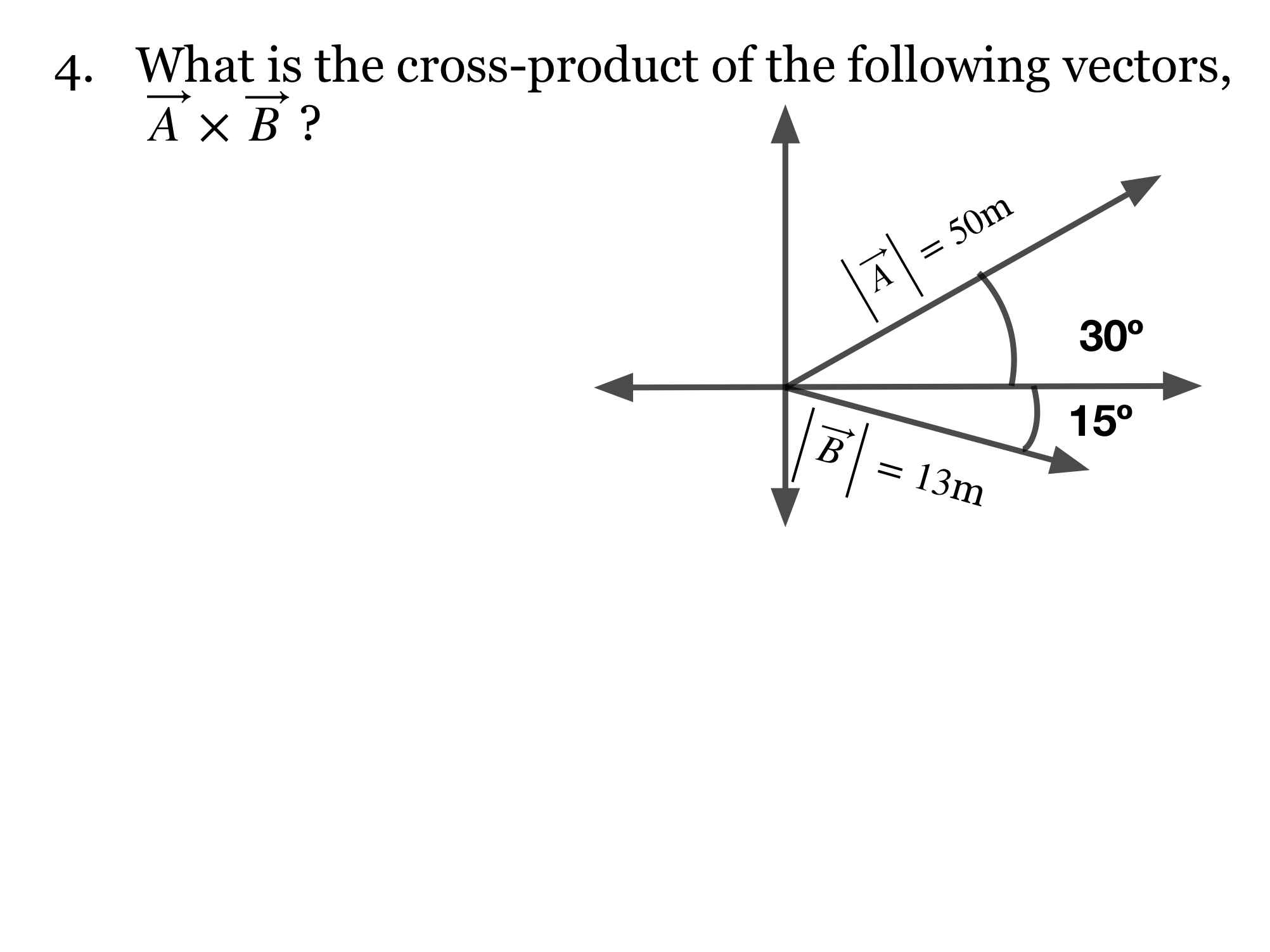
In a right-handed x–y plane, A has magnitude 50 m and angle +30° from +x. B has magnitude 13 m and angle −15° from +x. Find A × B.
Original problem 4
The source key gives a length unit; the cross product here has units m².
Problem text
In a right-handed x–y plane, A has magnitude 50 m and angle +30° from +x. B has magnitude 13 m and angle −15° from +x. Find A × B.
Drawing is temporarily unavailable. Work on paper if needed, then record your reasoning here.
Saving written working requires JavaScript. The problem remains available above; keep your work on paper or in your own notes.
5. Work it out
Enrichment beyond the AP course
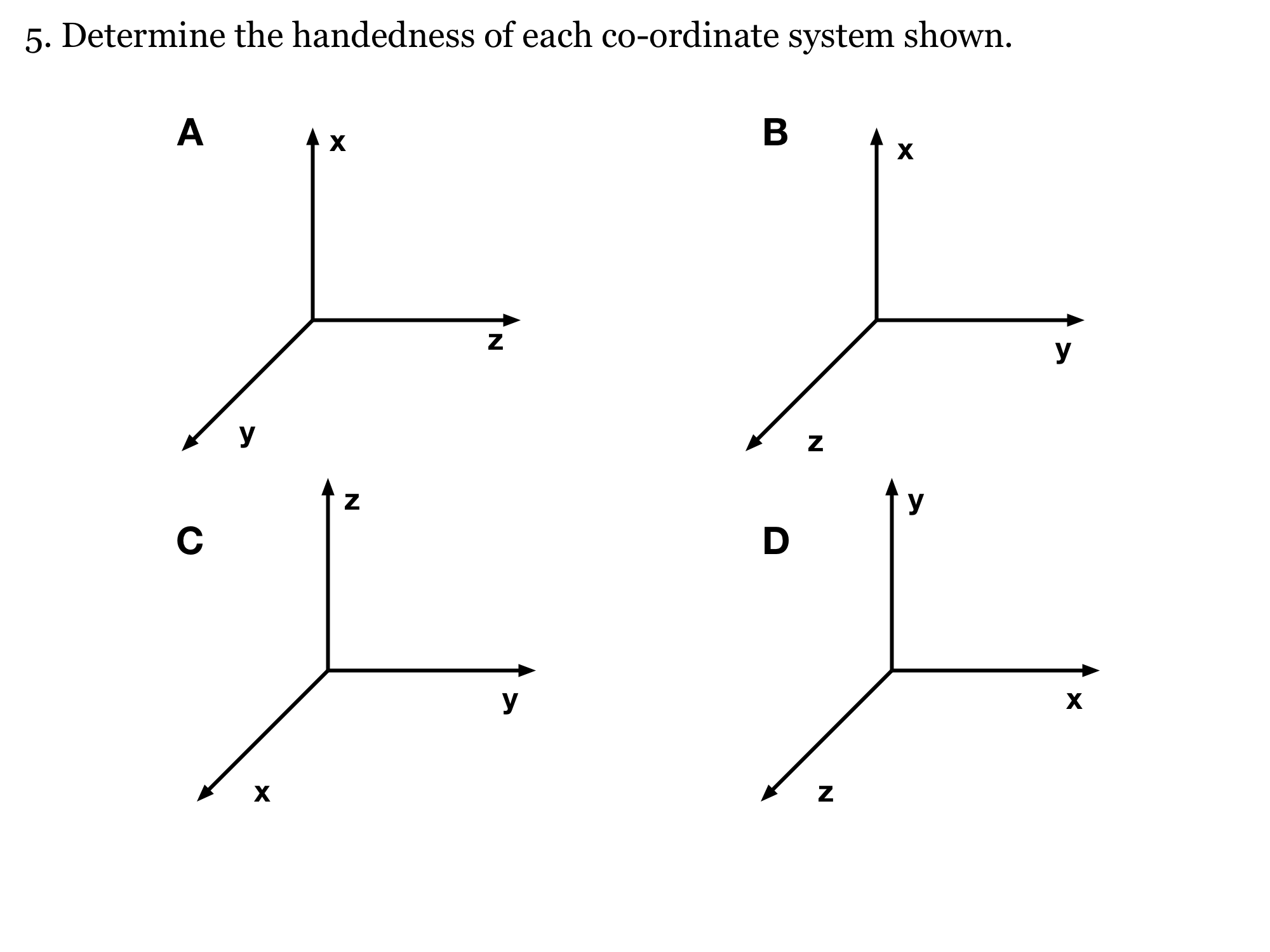
Determine whether coordinate systems A, B, C and D in the diagram are right- or left-handed. For the perspective drawing, the diagonal axis points out toward the viewer.
Original problem 5
Problem text
Determine whether coordinate systems A, B, C and D in the diagram are right- or left-handed. For the perspective drawing, the diagonal axis points out toward the viewer.
Drawing is temporarily unavailable. Work on paper if needed, then record your reasoning here.
Saving written working requires JavaScript. The problem remains available above; keep your work on paper or in your own notes.
6. Work it out
Enrichment beyond the AP course
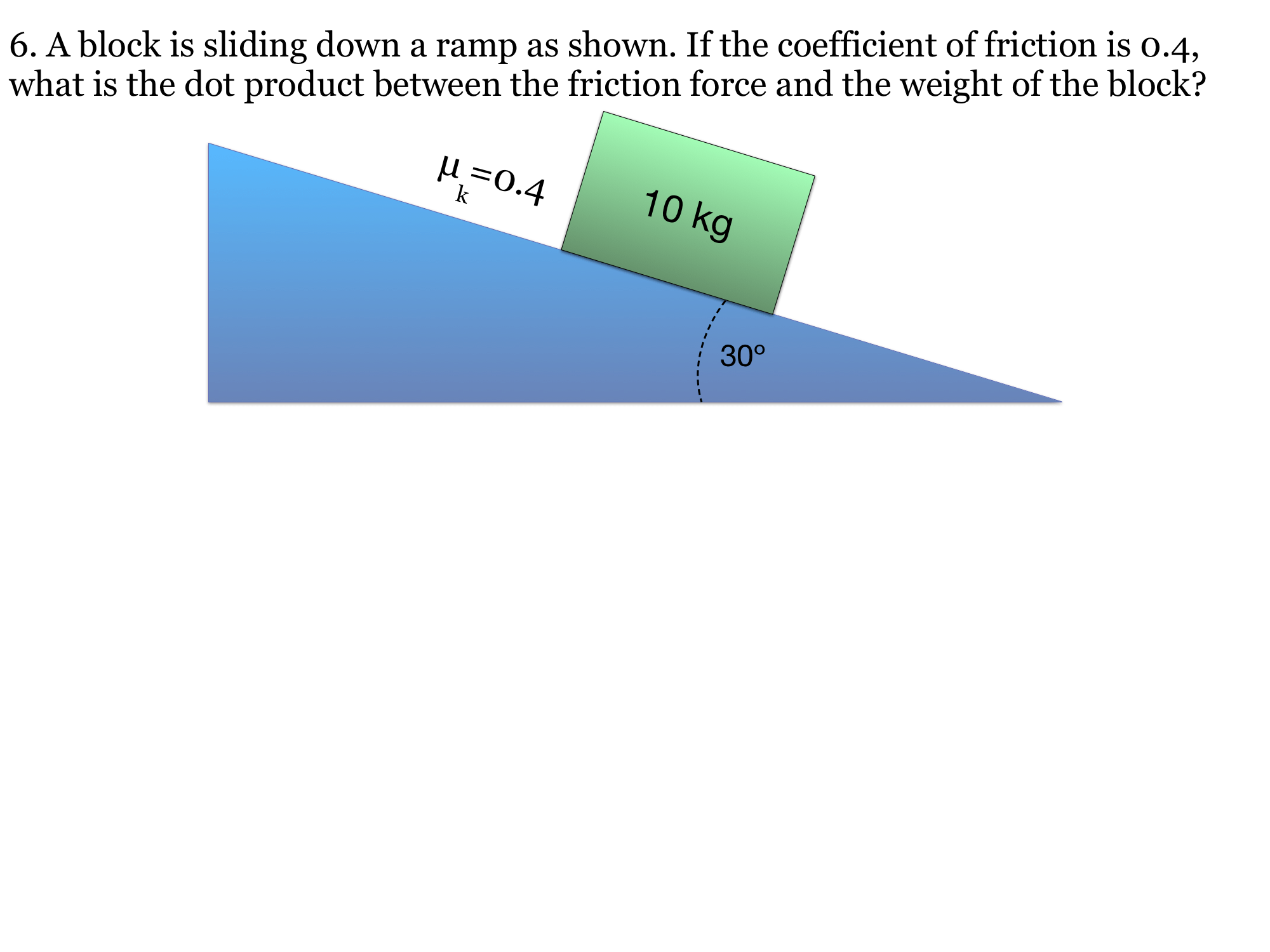
A 10 kg block slides down a 30° ramp. The kinetic friction coefficient is 0.4. Find the dot product of the friction force and the weight. Use g = 9.8 m/s².
Original problem 6
This is a dot product of two forces, so its unit is N²; it is not work.
Problem text
A 10 kg block slides down a 30° ramp. The kinetic friction coefficient is 0.4. Find the dot product of the friction force and the weight. Use g = 9.8 m/s².
Drawing is temporarily unavailable. Work on paper if needed, then record your reasoning here.
Saving written working requires JavaScript. The problem remains available above; keep your work on paper or in your own notes.
7. Work it out
Enrichment beyond the AP course
For real two-dimensional vectors α, β and γ, α · γ = 0 and α × β = 0. What can you conclude about β · γ? Consider separately α ≠ 0 and α = 0.
Original problem 7
The source’s unconditional answer overlooks the zero-vector case.
Problem text
For real two-dimensional vectors α, β and γ, α · γ = 0 and α × β = 0. What can you conclude about β · γ? Consider separately α ≠ 0 and α = 0.
Drawing is temporarily unavailable. Work on paper if needed, then record your reasoning here.
Saving written working requires JavaScript. The problem remains available above; keep your work on paper or in your own notes.
8. Work it out
Original textbook practice
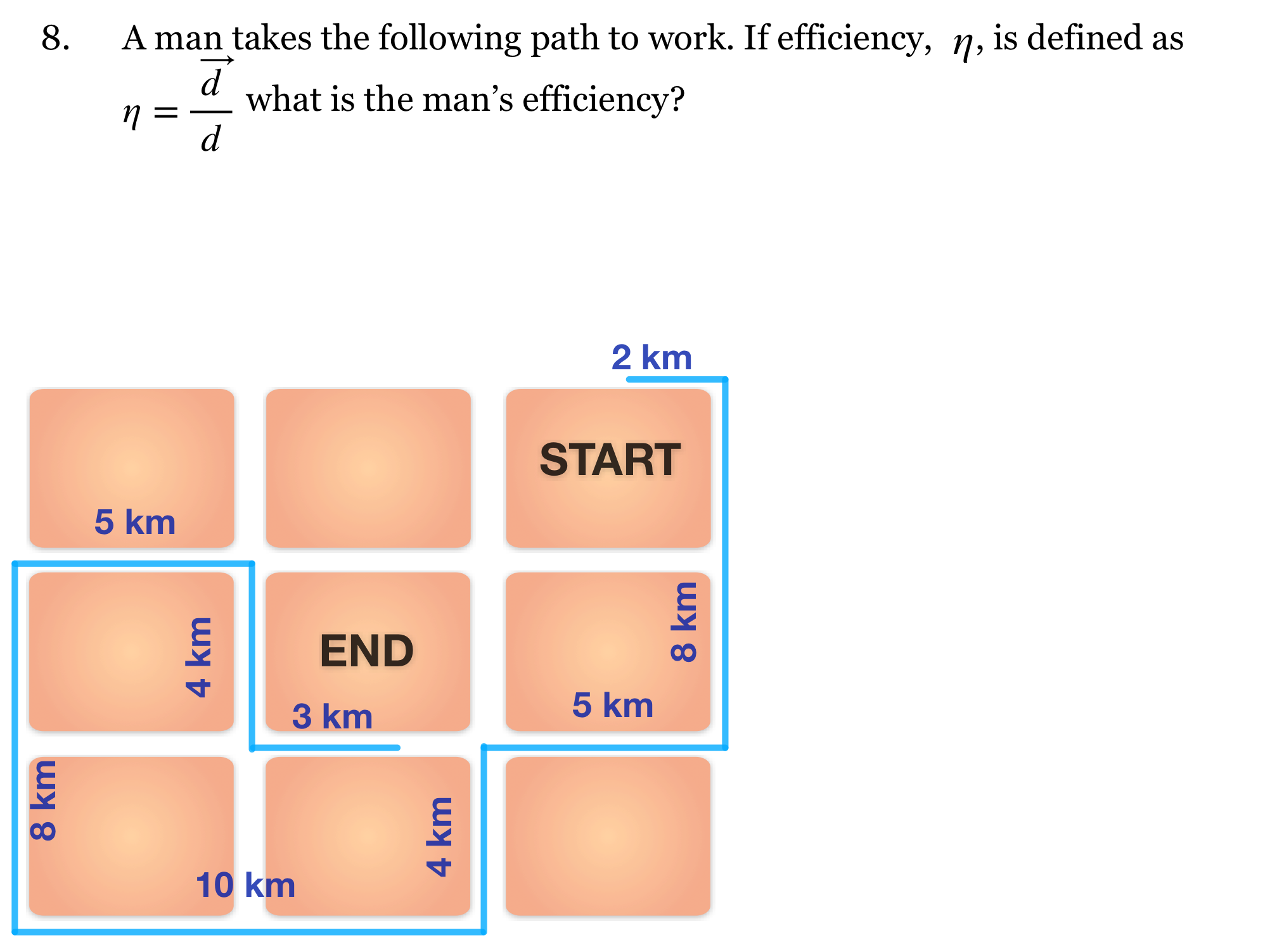
Use the pictured path: 2 km east, 8 km south, 5 km west, 4 km south, 10 km west, 8 km north, 5 km east, 4 km south and 3 km east. Define route efficiency as η = |displacement| / distance traveled. Find η.
Original problem 8
Use the magnitude of displacement in this scalar ratio; a vector divided by distance would remain a vector.
Problem text
Use the pictured path: 2 km east, 8 km south, 5 km west, 4 km south, 10 km west, 8 km north, 5 km east, 4 km south and 3 km east. Define route efficiency as η = |displacement| / distance traveled. Find η.
Drawing is temporarily unavailable. Work on paper if needed, then record your reasoning here.
Saving written working requires JavaScript. The problem remains available above; keep your work on paper or in your own notes.
9. Work it out
Enrichment beyond the AP course
The diagram is a closed track with four semicircular turns. Correct radius A to 30 m; retain B = C = D = 10 m. The two outer straight segments are each 250 m and the two inner straight segments are each 150 m. Find displacement and distance for one complete lap.
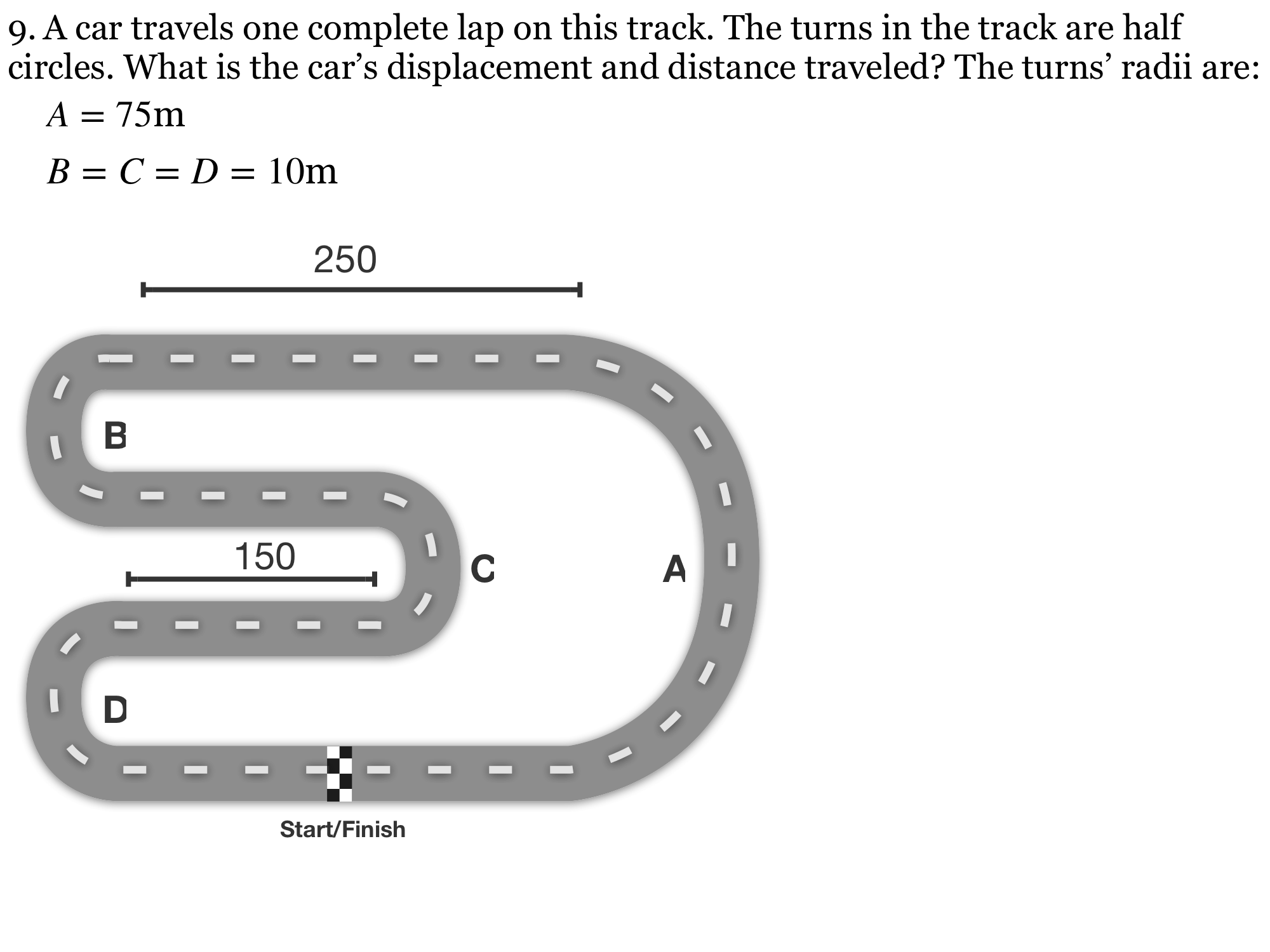
Original problem 9
The original A = 75 m cannot connect the depicted three 10 m semicircles with horizontal straights: vertical closure requires 2RA = 2(RB + RC + RD). This reviewed version repairs A to 30 m. Taking the original arc radii independently would give 1129.87 m, but that geometry would not close.
Problem text
The diagram is a closed track with four semicircular turns. Correct radius A to 30 m; retain B = C = D = 10 m. The two outer straight segments are each 250 m and the two inner straight segments are each 150 m. Find displacement and distance for one complete lap.
Drawing is temporarily unavailable. Work on paper if needed, then record your reasoning here.
Saving written working requires JavaScript. The problem remains available above; keep your work on paper or in your own notes.
10. Work it out
Enrichment beyond the AP course
Embed the following vectors in the x–y plane of a right-handed 3D system: α = (4, 3), β = (1, 3), γ = (−1, 4), δ = (8, 0). Evaluate (α × β) · (γ × δ).
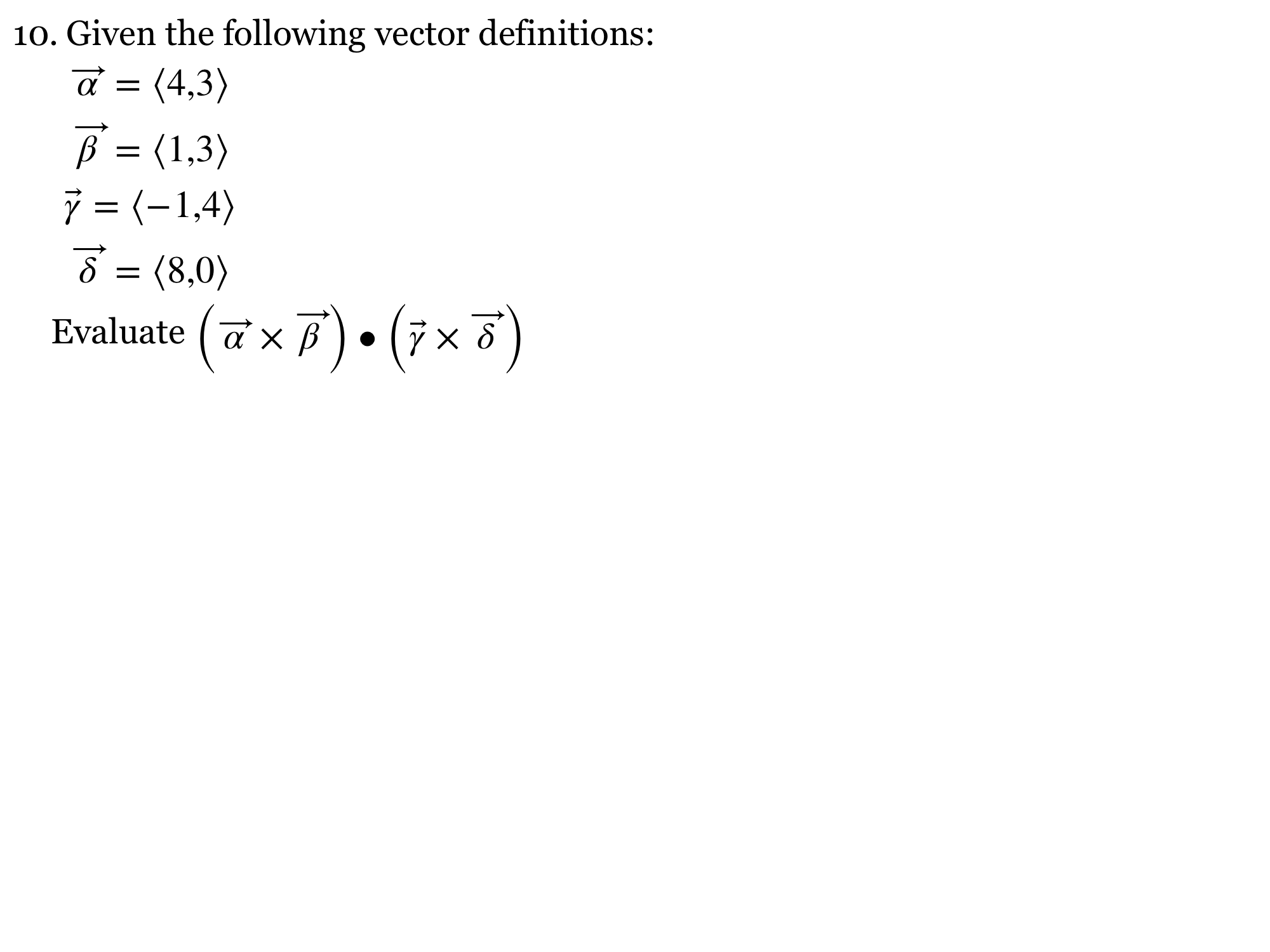
Original problem 10
Direct component calculation corrects the source key’s −387.6.
Problem text
Embed the following vectors in the x–y plane of a right-handed 3D system: α = (4, 3), β = (1, 3), γ = (−1, 4), δ = (8, 0). Evaluate (α × β) · (γ × δ).
Drawing is temporarily unavailable. Work on paper if needed, then record your reasoning here.
Saving written working requires JavaScript. The problem remains available above; keep your work on paper or in your own notes.
Additional practice
11. What needs a direction?
Original textbook practice
Classify mass, temperature, displacement, velocity, kinetic energy and force as scalars or vectors. Explain why a negative temperature is still a scalar.
Your written working
Drawing is temporarily unavailable. Work on paper if needed, then record your reasoning here.
Saving written working requires JavaScript. The problem remains available above; keep your work on paper or in your own notes.
12. A force pointing west
Original textbook practice
With east as +x, a horizontal force is Fₓ = −12 N. State its magnitude, direction and unit vector.
Your written working
Drawing is temporarily unavailable. Work on paper if needed, then record your reasoning here.
Saving written working requires JavaScript. The problem remains available above; keep your work on paper or in your own notes.
13. Choose the quadrant
Original textbook practice
A displacement is (−6, 8) m. Find its magnitude and its direction counterclockwise from +x.
Your written working
Drawing is temporarily unavailable. Work on paper if needed, then record your reasoning here.
Saving written working requires JavaScript. The problem remains available above; keep your work on paper or in your own notes.
14. From an angle to components
Original textbook practice
A velocity has magnitude 12 m/s and direction 120° counterclockwise from +x. Find vₓ and vᵧ.
Your written working
Drawing is temporarily unavailable. Work on paper if needed, then record your reasoning here.
Saving written working requires JavaScript. The problem remains available above; keep your work on paper or in your own notes.
15. The zero vector
Original textbook practice
Two displacement vectors are (3, −4) m and (−3, 4) m. Find their sum, magnitude and unit vector.
Your written working
Drawing is temporarily unavailable. Work on paper if needed, then record your reasoning here.
Saving written working requires JavaScript. The problem remains available above; keep your work on paper or in your own notes.
16. A direction in three dimensions
Enrichment beyond the AP course
Normalize the vector (2, −3, 6). Verify that your result has magnitude 1.
Your written working
Drawing is temporarily unavailable. Work on paper if needed, then record your reasoning here.
Saving written working requires JavaScript. The problem remains available above; keep your work on paper or in your own notes.
17. An orthogonality test
Enrichment beyond the AP course
Are A = (3, 4) and B = (8, −6) perpendicular? Support your answer with a dot product.
Your written working
Drawing is temporarily unavailable. Work on paper if needed, then record your reasoning here.
Saving written working requires JavaScript. The problem remains available above; keep your work on paper or in your own notes.
18. Angle between two vectors
Enrichment beyond the AP course
Find the smaller angle between A = (1, 2) and B = (2, 1).
Your written working
Drawing is temporarily unavailable. Work on paper if needed, then record your reasoning here.
Saving written working requires JavaScript. The problem remains available above; keep your work on paper or in your own notes.
19. Project a pull
Original textbook practice
A 50 N rope force acts at 37° above a horizontal floor. Find its horizontal and vertical components.
Your written working
Drawing is temporarily unavailable. Work on paper if needed, then record your reasoning here.
Saving written working requires JavaScript. The problem remains available above; keep your work on paper or in your own notes.
20. Cross product and handedness
Enrichment beyond the AP course
In a right-handed coordinate system, A = (2, 0, 0) m and B = (0, 3, 0) m. Find A × B and B × A.
Your written working
Drawing is temporarily unavailable. Work on paper if needed, then record your reasoning here.
Saving written working requires JavaScript. The problem remains available above; keep your work on paper or in your own notes.
21. A parallelogram from vectors
Enrichment beyond the AP course
A = (4, 1, 0) m and B = (−2, 3, 0) m form adjacent sides of a parallelogram. Find its area.
Your written working
Drawing is temporarily unavailable. Work on paper if needed, then record your reasoning here.
Saving written working requires JavaScript. The problem remains available above; keep your work on paper or in your own notes.
22. Work is a scalar
Original textbook practice
A constant force F = (6, −2) N acts through displacement Δr = (3, 4) m. Find the work done.
Your written working
Drawing is temporarily unavailable. Work on paper if needed, then record your reasoning here.
Saving written working requires JavaScript. The problem remains available above; keep your work on paper or in your own notes.
23. Two routes, one endpoint
Original textbook practice
A walker goes 300 m east and then 400 m north. Another walker goes directly between the same endpoints. Compare the distances and displacements.
Your written working
Drawing is temporarily unavailable. Work on paper if needed, then record your reasoning here.
Saving written working requires JavaScript. The problem remains available above; keep your work on paper or in your own notes.
24. A return journey
Original textbook practice
A runner travels 100 m east in 20 s and returns in 30 s. Find average speed and average velocity for the whole trip.
Your written working
Drawing is temporarily unavailable. Work on paper if needed, then record your reasoning here.
Saving written working requires JavaScript. The problem remains available above; keep your work on paper or in your own notes.
25. Boat and current
Enrichment beyond the AP course
A boat moves north at 3 m/s relative to the water. The water flows east at 4 m/s. Find the boat’s velocity relative to the bank.
Your written working
Drawing is temporarily unavailable. Work on paper if needed, then record your reasoning here.
Saving written working requires JavaScript. The problem remains available above; keep your work on paper or in your own notes.
26. Net force in a plane
Original textbook practice
A 2 kg cart experiences forces (8, 0) N, (−2, 6) N and (0, −2) N. Find its acceleration.
Your written working
Drawing is temporarily unavailable. Work on paper if needed, then record your reasoning here.
Saving written working requires JavaScript. The problem remains available above; keep your work on paper or in your own notes.
27. Action and reaction
Original textbook practice
A person pushes a wall with 80 N. Identify the Newton’s third-law pair and explain why the two forces do not cancel in the person’s free-body diagram.
Your written working
Drawing is temporarily unavailable. Work on paper if needed, then record your reasoning here.
Saving written working requires JavaScript. The problem remains available above; keep your work on paper or in your own notes.
28. An accelerating elevator
Original textbook practice
A 60 kg passenger accelerates upward at 1.5 m/s². Find the normal force from the floor. Use g = 9.8 m/s².
Your written working
Drawing is temporarily unavailable. Work on paper if needed, then record your reasoning here.
Saving written working requires JavaScript. The problem remains available above; keep your work on paper or in your own notes.
29. Balanced ropes
Original textbook practice
A 100 N lamp hangs symmetrically from two ropes, each at 30° above horizontal. Find the tension in each rope.
Your written working
Drawing is temporarily unavailable. Work on paper if needed, then record your reasoning here.
Saving written working requires JavaScript. The problem remains available above; keep your work on paper or in your own notes.
30. Can magnitudes alone determine a sum?
Original textbook practice
Two forces have magnitudes 5 N and 7 N, but their directions are unknown. What are the largest and smallest possible magnitudes of their sum? Give configurations that achieve each.
Your written working
Drawing is temporarily unavailable. Work on paper if needed, then record your reasoning here.
Saving written working requires JavaScript. The problem remains available above; keep your work on paper or in your own notes.