Kinematics practice
Work from memory first. Draw a diagram, state the assumptions and keep units through every step. Worked answers are separate.
· Open separate worked solutions
1. Work it out
Original textbook practice
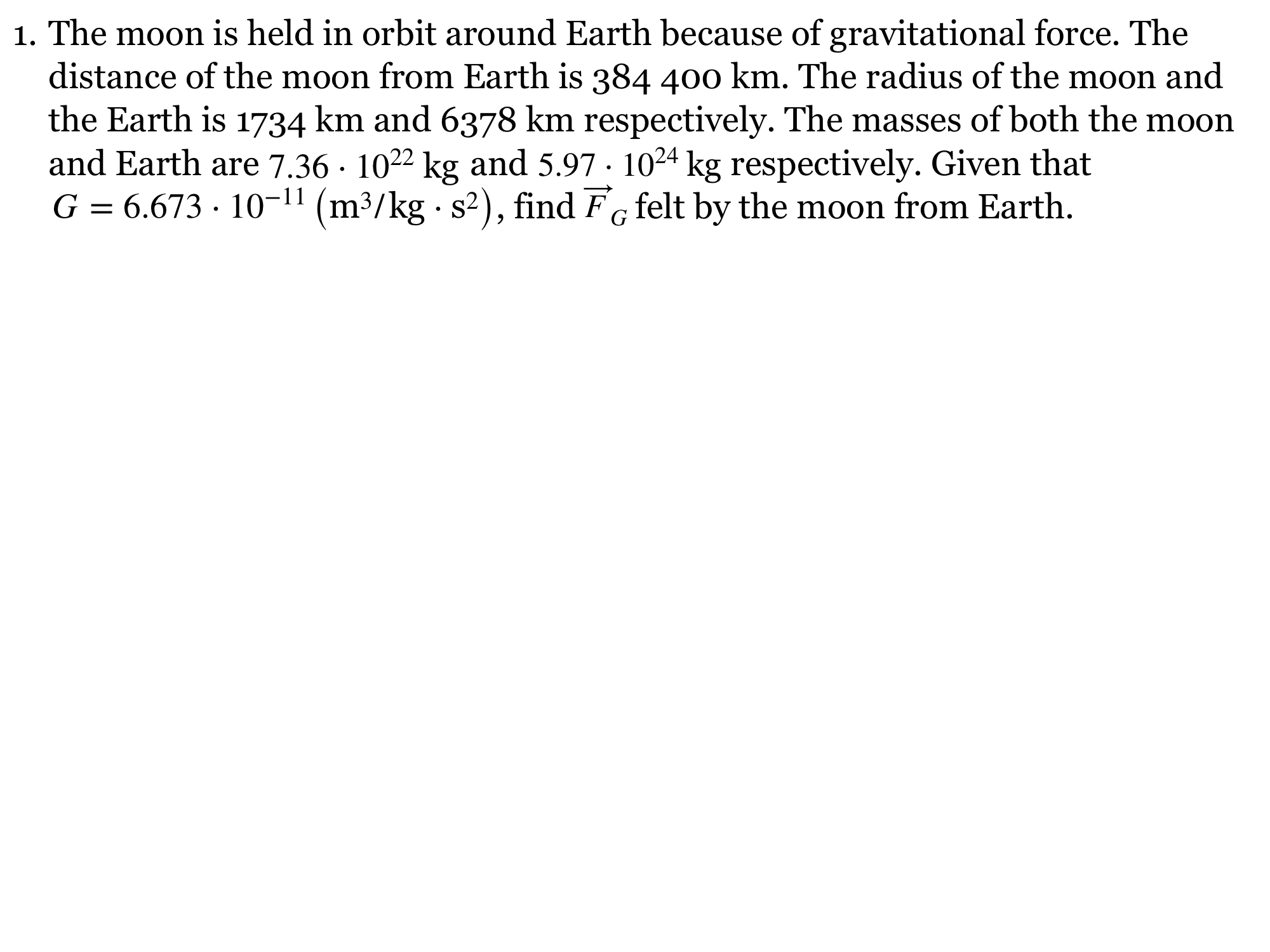
The Moon’s center is 384 400 km from Earth’s center. Their masses are 7.36 × 10²² kg and 5.97 × 10²⁴ kg. Using G = 6.673 × 10⁻¹¹ m³/(kg·s²), find the gravitational force on the Moon from Earth.
Original problem 1
384 400 km is interpreted as center-to-center separation. The given Moon and Earth radii are not added to this standard lunar distance.
Problem text
The Moon’s center is 384 400 km from Earth’s center. Their masses are 7.36 × 10²² kg and 5.97 × 10²⁴ kg. Using G = 6.673 × 10⁻¹¹ m³/(kg·s²), find the gravitational force on the Moon from Earth.
Drawing is temporarily unavailable. Work on paper if needed, then record your reasoning here.
Saving written working requires JavaScript. The problem remains available above; keep your work on paper or in your own notes.
2. Work it out
Original textbook practice
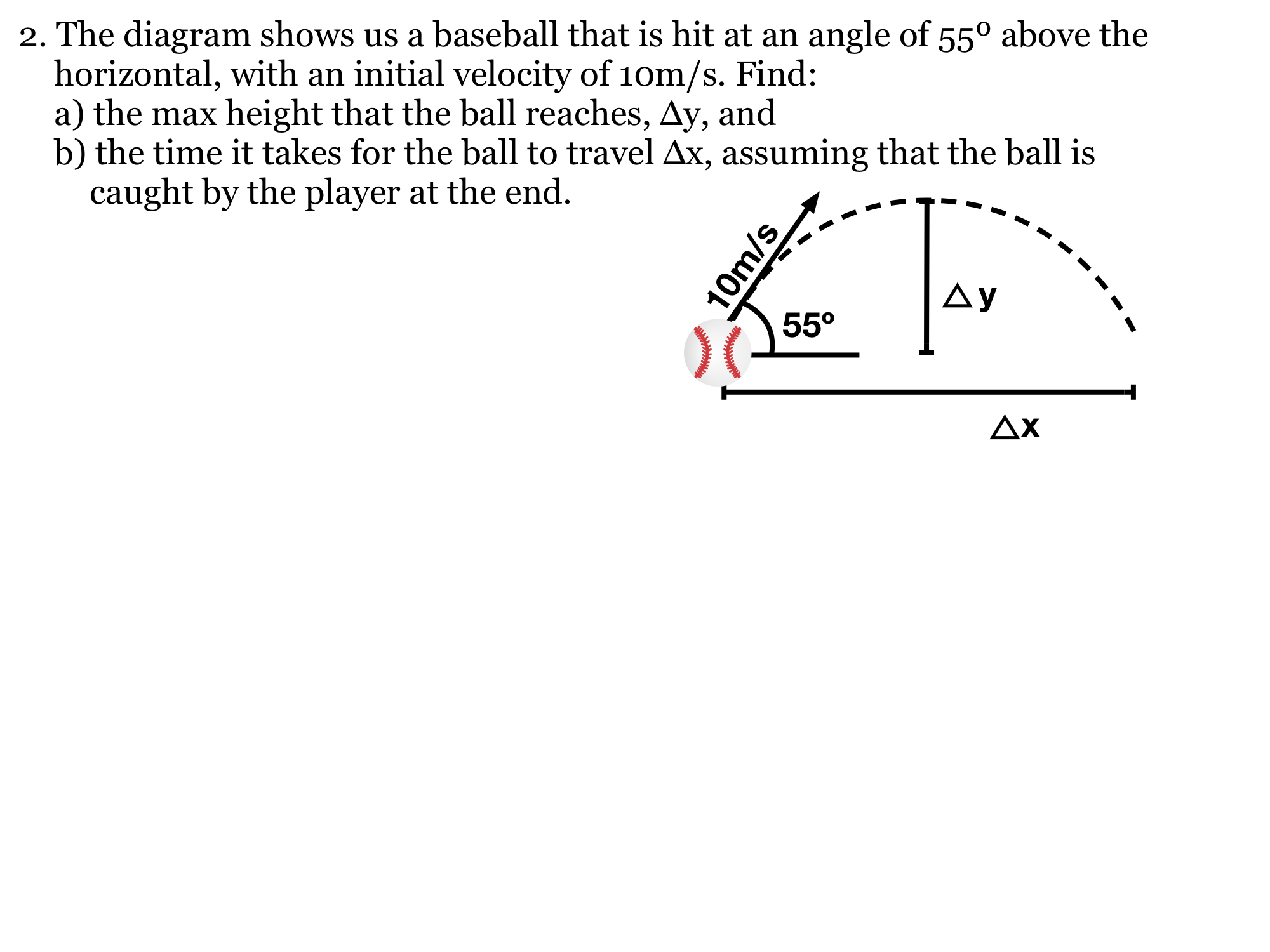
A baseball is launched at 10 m/s and 55° above horizontal and is caught at its launch height. Find (a) its maximum height above launch and (b) its flight time. Neglect air resistance and use g = 9.8 m/s².
Original problem 2
The diagram implies equal launch and catch height. Without a catch height, the flight time would be underdetermined.
Problem text
A baseball is launched at 10 m/s and 55° above horizontal and is caught at its launch height. Find (a) its maximum height above launch and (b) its flight time. Neglect air resistance and use g = 9.8 m/s².
Drawing is temporarily unavailable. Work on paper if needed, then record your reasoning here.
Saving written working requires JavaScript. The problem remains available above; keep your work on paper or in your own notes.
3. Work it out
Enrichment beyond the AP course
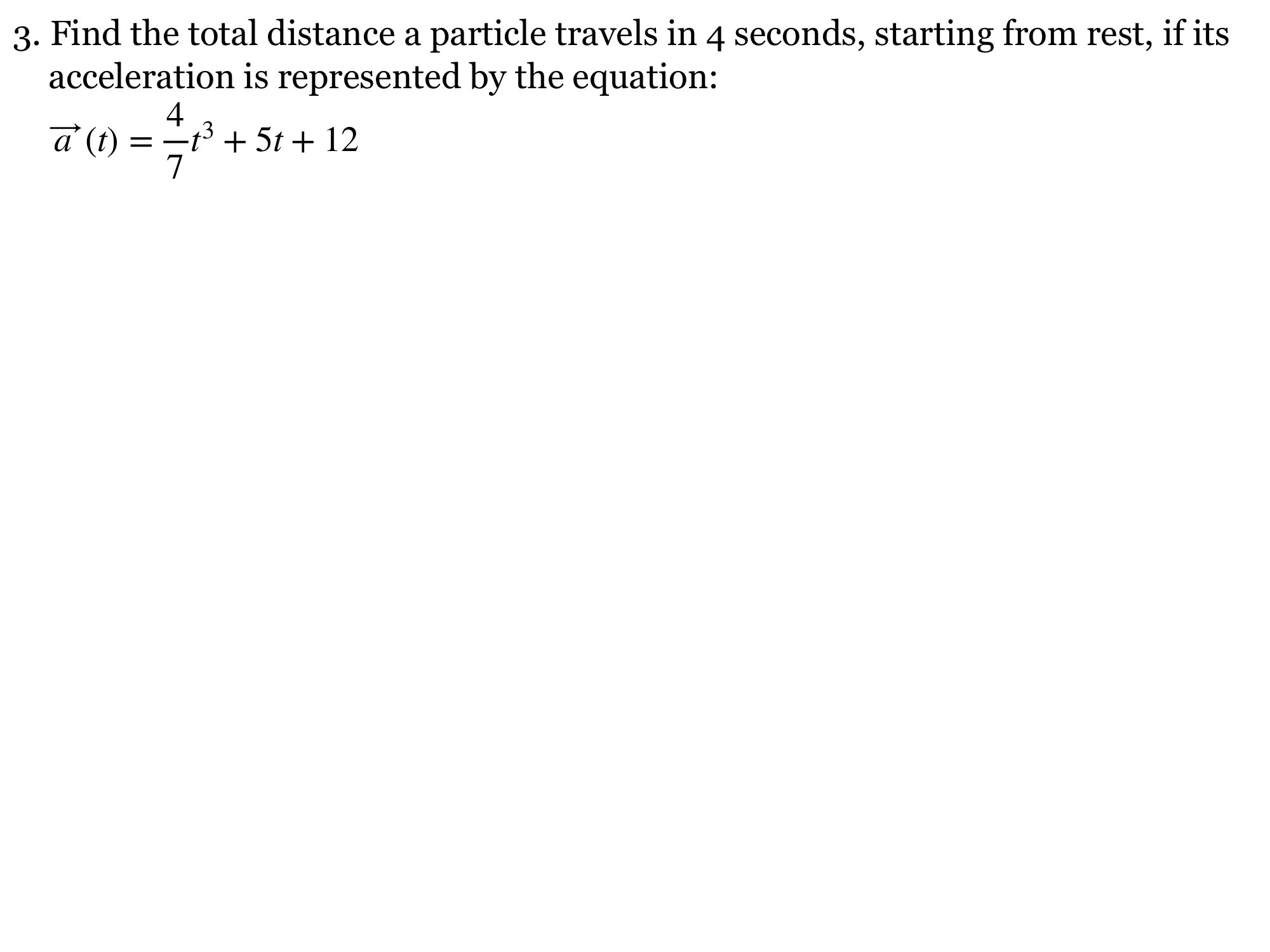
A particle starts from rest in one dimension. Its acceleration is aₓ(t) = (4/7)t³ + 5t + 12, with t in seconds and the numerical result in m/s². Find the total distance it travels from t = 0 to 4 s.
Original problem 3
The original equation is (4/7)t³ + 5t + 12. The coefficients have the SI units required to produce m/s²; the polynomial is a component, not a squared vector.
Problem text
A particle starts from rest in one dimension. Its acceleration is aₓ(t) = (4/7)t³ + 5t + 12, with t in seconds and the numerical result in m/s². Find the total distance it travels from t = 0 to 4 s.
Drawing is temporarily unavailable. Work on paper if needed, then record your reasoning here.
Saving written working requires JavaScript. The problem remains available above; keep your work on paper or in your own notes.
4. Work it out
Original textbook practice
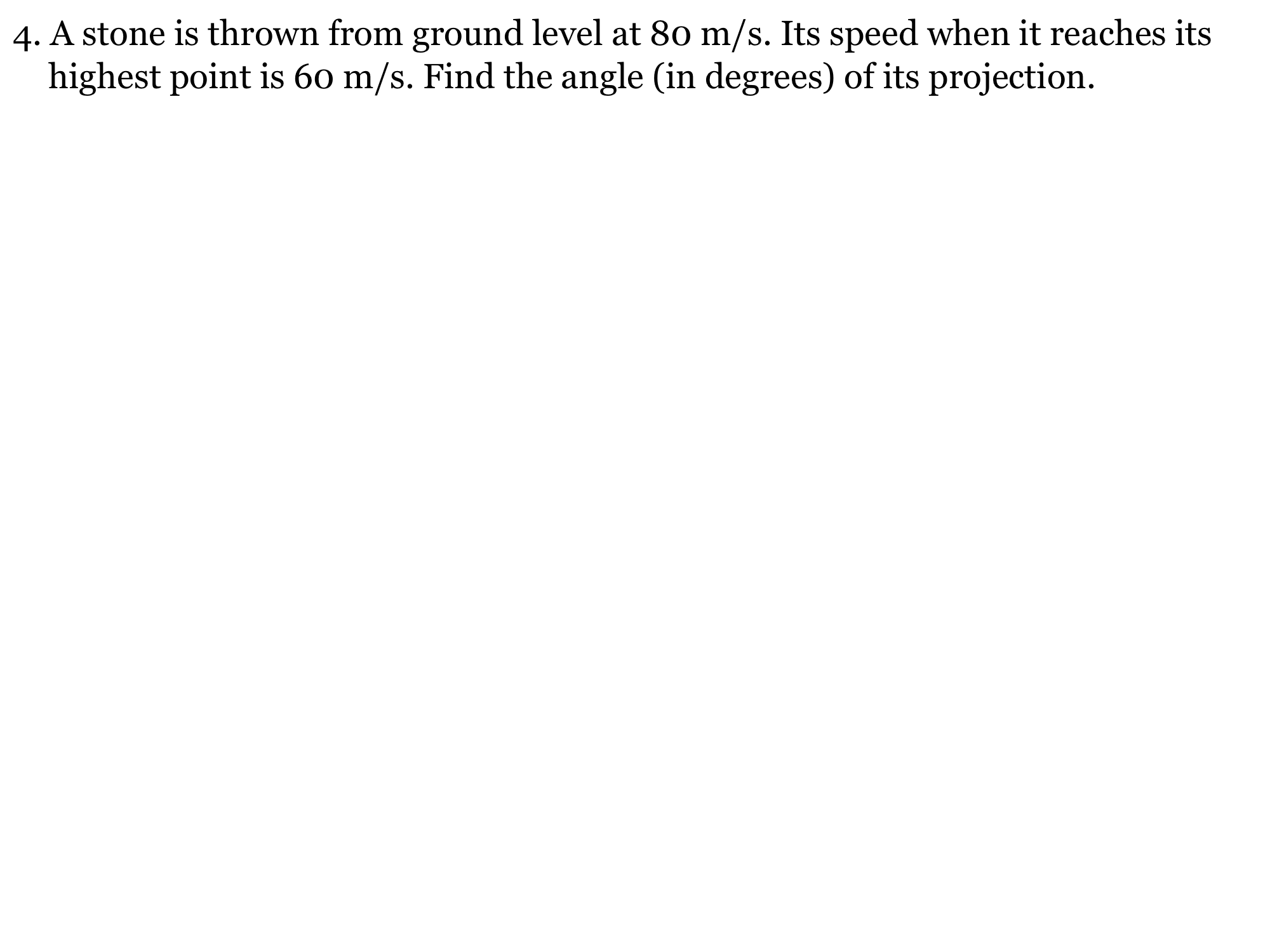
A stone is launched from ground level at 80 m/s. Its speed at the highest point is 60 m/s. Neglect air resistance. Find the launch angle above horizontal.
Original problem 4
Problem text
A stone is launched from ground level at 80 m/s. Its speed at the highest point is 60 m/s. Neglect air resistance. Find the launch angle above horizontal.
Drawing is temporarily unavailable. Work on paper if needed, then record your reasoning here.
Saving written working requires JavaScript. The problem remains available above; keep your work on paper or in your own notes.
5. Work it out
Original textbook practice
For the same launch speed and angle and equal launch/landing height, would an ideal projectile travel farther on Mars or Earth? On Jupiter or Mars? Explain using gravitational acceleration. Neglect air resistance.
Original problem 5
Use representative surface accelerations Mars 3.71 m/s², Earth 9.8 m/s² and Jupiter 24.79 m/s². Jupiter has no solid surface; “surface” here denotes its conventional reference level.
Problem text
For the same launch speed and angle and equal launch/landing height, would an ideal projectile travel farther on Mars or Earth? On Jupiter or Mars? Explain using gravitational acceleration. Neglect air resistance.
Drawing is temporarily unavailable. Work on paper if needed, then record your reasoning here.
Saving written working requires JavaScript. The problem remains available above; keep your work on paper or in your own notes.
6. Work it out
Original textbook practice
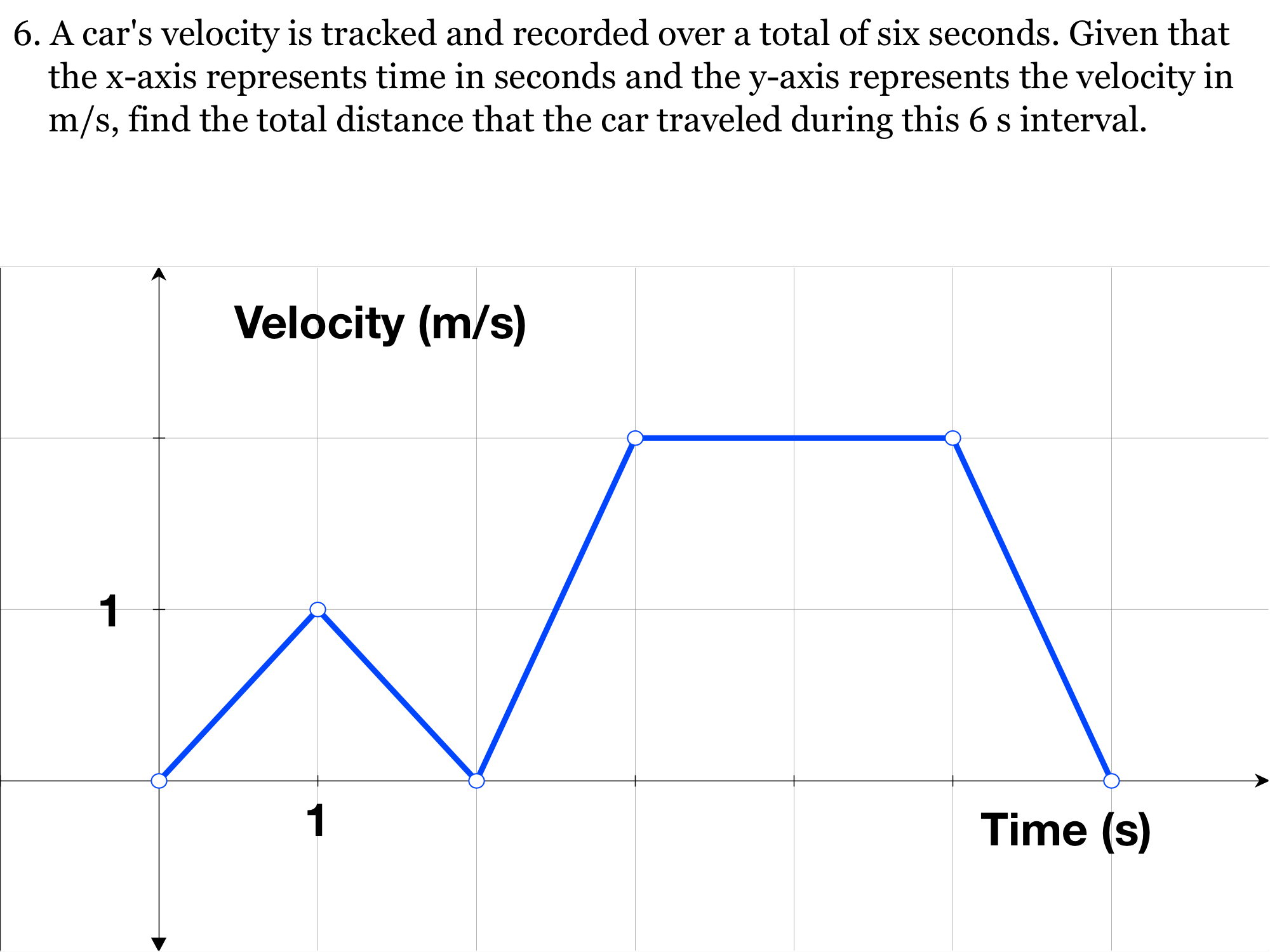
A velocity–time graph joins these points by straight lines: (t, vₓ) = (0 s, 0 m/s), (1 s, 1 m/s), (2 s, 0 m/s), (3 s, 2 m/s), (5 s, 2 m/s), (6 s, 0 m/s). Find the total distance traveled during the 6 s interval.
Original problem 6
The inspected diagram has one-second horizontal grid spacing and one-metre-per-second vertical grid spacing.
Problem text
A velocity–time graph joins these points by straight lines: (t, vₓ) = (0 s, 0 m/s), (1 s, 1 m/s), (2 s, 0 m/s), (3 s, 2 m/s), (5 s, 2 m/s), (6 s, 0 m/s). Find the total distance traveled during the 6 s interval.
Drawing is temporarily unavailable. Work on paper if needed, then record your reasoning here.
Saving written working requires JavaScript. The problem remains available above; keep your work on paper or in your own notes.
7. Work it out
Original textbook practice
Two objects are stated to attract with force 2.8 × 10⁻⁸ N at a center separation of 243 cm, and their total mass is stated to be 70.5 kg. Using G = 6.673 × 10⁻¹¹ m³/(kg·s²), check whether any two positive masses can satisfy all these data.
Original problem 7
This repairs the original request to find two masses into a consistency check. The stated data have no real mass solution; no numerical input has been guessed or silently changed.
Problem text
Two objects are stated to attract with force 2.8 × 10⁻⁸ N at a center separation of 243 cm, and their total mass is stated to be 70.5 kg. Using G = 6.673 × 10⁻¹¹ m³/(kg·s²), check whether any two positive masses can satisfy all these data.
Drawing is temporarily unavailable. Work on paper if needed, then record your reasoning here.
Saving written working requires JavaScript. The problem remains available above; keep your work on paper or in your own notes.
8. Work it out
Enrichment beyond the AP course
A mini-planet has solar-orbit semimajor axis 13 AU and mass 3.4 × 10¹⁸ kg. A probe is described as making a circular orbit of radius 79.5 km around its center and completing 5000 probe orbits per planet year. Find the speed implied by the stated orbit count, compare it with the circular speed required by the planet’s gravity, and check consistency. Use G = 6.673 × 10⁻¹¹ m³/(kg·s²) and 1 Earth year = 3.156 × 10⁷ s.
Original problem 8
The original data conflict for a freely orbiting circular probe. Treat 13 AU as the solar-orbit semimajor axis; the solar Kepler normalization uses years and AU.
Problem text
A mini-planet has solar-orbit semimajor axis 13 AU and mass 3.4 × 10¹⁸ kg. A probe is described as making a circular orbit of radius 79.5 km around its center and completing 5000 probe orbits per planet year. Find the speed implied by the stated orbit count, compare it with the circular speed required by the planet’s gravity, and check consistency. Use G = 6.673 × 10⁻¹¹ m³/(kg·s²) and 1 Earth year = 3.156 × 10⁷ s.
Drawing is temporarily unavailable. Work on paper if needed, then record your reasoning here.
Saving written working requires JavaScript. The problem remains available above; keep your work on paper or in your own notes.
9. Work it out
Original textbook practice
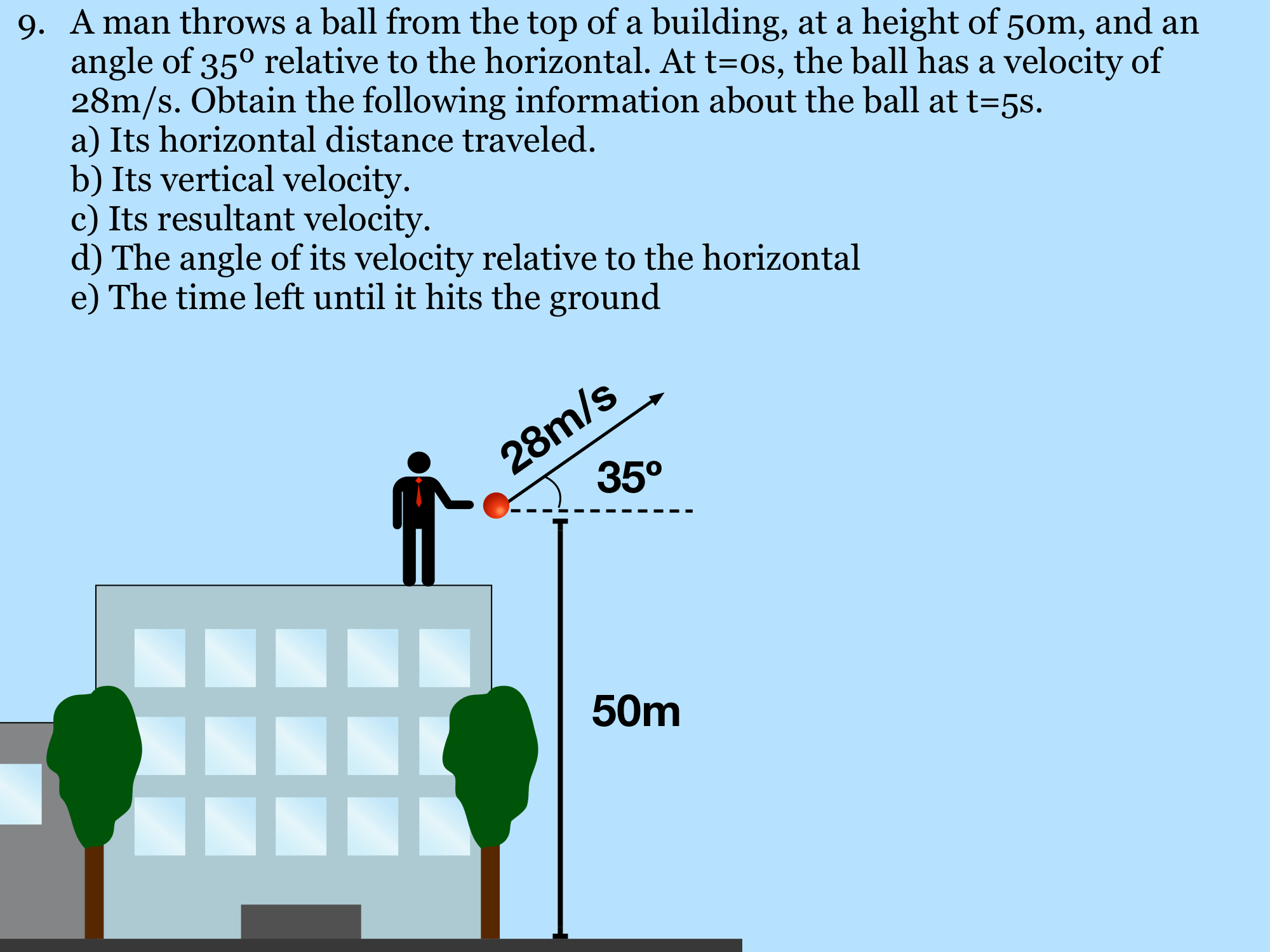
A ball is thrown from height 50 m at 28 m/s and 35° above horizontal. At t = 5.0 s find (a) horizontal distance, (b) vertical velocity, (c) resultant velocity vector and speed, (d) velocity angle relative to horizontal and (e) time remaining before ground impact. Neglect air resistance; use g = 9.8 m/s².
Original problem 9
The original PNG clearly labels 28 m/s in both text and diagram. The OCR reading “20 m/s” is incorrect.
Problem text
A ball is thrown from height 50 m at 28 m/s and 35° above horizontal. At t = 5.0 s find (a) horizontal distance, (b) vertical velocity, (c) resultant velocity vector and speed, (d) velocity angle relative to horizontal and (e) time remaining before ground impact. Neglect air resistance; use g = 9.8 m/s².
Drawing is temporarily unavailable. Work on paper if needed, then record your reasoning here.
Saving written working requires JavaScript. The problem remains available above; keep your work on paper or in your own notes.
10. Work it out
Enrichment beyond the AP course
Prove that the sum of the distances from any point on an ellipse to its two foci equals the major-axis length. Use an ellipse x²/a² + y²/b² = 1 with a ≥ b > 0 and foci (±c, 0), where c² = a² − b².
Original problem 10
Problem text
Prove that the sum of the distances from any point on an ellipse to its two foci equals the major-axis length. Use an ellipse x²/a² + y²/b² = 1 with a ≥ b > 0 and foci (±c, 0), where c² = a² − b².
Drawing is temporarily unavailable. Work on paper if needed, then record your reasoning here.
Saving written working requires JavaScript. The problem remains available above; keep your work on paper or in your own notes.
Additional practice
11. A return trip changes average velocity
Original textbook practice
A delivery robot moves 30 m east in 10 s, waits 5 s, then moves 18 m west in 6 s. Find total distance, displacement, average speed and average velocity. Take east as positive.
Your written working
Drawing is temporarily unavailable. Work on paper if needed, then record your reasoning here.
Saving written working requires JavaScript. The problem remains available above; keep your work on paper or in your own notes.
12. A cyclist starts late
Original textbook practice
A runner passes a marker at 4 m/s. A cyclist starts at the same marker 6 s later and rides at a constant 10 m/s. When and where does the cyclist catch the runner? Measure time from the runner’s passage.
Your written working
Drawing is temporarily unavailable. Work on paper if needed, then record your reasoning here.
Saving written working requires JavaScript. The problem remains available above; keep your work on paper or in your own notes.
13. A braking tram and a stopping limit
Original textbook practice
A tram moves east at 18 m/s and brakes with constant acceleration −1.5 m/s². Find stopping time and distance. Can it stop within 100 m?
Your written working
Drawing is temporarily unavailable. Work on paper if needed, then record your reasoning here.
Saving written working requires JavaScript. The problem remains available above; keep your work on paper or in your own notes.
14. Three stages of a metro journey
Original textbook practice
A metro train starts from rest, accelerates at 1.2 m/s² for 10 s, travels at that speed for 20 s, then brakes uniformly to rest in 8 s. Find total distance, total time and average speed.
Your written working
Drawing is temporarily unavailable. Work on paper if needed, then record your reasoning here.
Saving written working requires JavaScript. The problem remains available above; keep your work on paper or in your own notes.
15. A cart reverses while its position stays positive
Original textbook practice
A lab cart has position x(t) = 2 + 6t − t² metres for 0 ≤ t ≤ 5 s. Find its velocity and acceleration functions, turning time, displacement and total distance.
Your written working
Drawing is temporarily unavailable. Work on paper if needed, then record your reasoning here.
Saving written working requires JavaScript. The problem remains available above; keep your work on paper or in your own notes.
16. Read a piecewise acceleration record
Original textbook practice
A test sled starts with vₓ = 3 m/s. Its acceleration is +2 m/s² from 0 to 4 s, then −1 m/s² from 4 to 10 s. Find its velocity at 4 s and 10 s and its total displacement.
Your written working
Drawing is temporarily unavailable. Work on paper if needed, then record your reasoning here.
Saving written working requires JavaScript. The problem remains available above; keep your work on paper or in your own notes.
17. A velocity graph crosses zero
Original textbook practice
A maintenance vehicle has vₓ = +4 m/s for the first 3 s. Its velocity then decreases linearly from +4 m/s at t = 3 s to −2 m/s at t = 6 s. Find displacement and total distance over 0–6 s.
Your written working
Drawing is temporarily unavailable. Work on paper if needed, then record your reasoning here.
Saving written working requires JavaScript. The problem remains available above; keep your work on paper or in your own notes.
18. Infer acceleration from timed photographs
Original textbook practice
A toy car is photographed at t = 0, 1, 2 and 3 s. Its positions are 0, 1, 4 and 9 m on a straight track. Assuming constant acceleration throughout, find its initial velocity and acceleration.
Your written working
Drawing is temporarily unavailable. Work on paper if needed, then record your reasoning here.
Saving written working requires JavaScript. The problem remains available above; keep your work on paper or in your own notes.
19. Use the last second of a fall
Original textbook practice
A stone is dropped from rest and travels 24.5 m during the last 1.0 s before hitting the ground. Find its total fall time and the drop height. Neglect air resistance; use g = 9.8 m/s².
Your written working
Drawing is temporarily unavailable. Work on paper if needed, then record your reasoning here.
Saving written working requires JavaScript. The problem remains available above; keep your work on paper or in your own notes.
20. The same height on the way up and down
Original textbook practice
A ball is thrown straight upward at 14 m/s from a balcony. Find both times when it is 5 m above release, and its vertical velocity at each time. Ignore air resistance; use g = 9.8 m/s² and up positive.
Your written working
Drawing is temporarily unavailable. Work on paper if needed, then record your reasoning here.
Saving written working requires JavaScript. The problem remains available above; keep your work on paper or in your own notes.
21. A horizontal launch from a cliff
Original textbook practice
A rescue package leaves a 45 m cliff horizontally at 12 m/s. Find flight time, horizontal range and impact speed. Neglect air resistance; use g = 9.8 m/s².
Your written working
Drawing is temporarily unavailable. Work on paper if needed, then record your reasoning here.
Saving written working requires JavaScript. The problem remains available above; keep your work on paper or in your own notes.
22. Reach an elevated target at a fixed angle
Original textbook practice
A water stream is launched at 40° above horizontal toward a target 20 m away and 4 m above the nozzle. What launch speed is needed in the ideal projectile model? Use g = 9.8 m/s².
Your written working
Drawing is temporarily unavailable. Work on paper if needed, then record your reasoning here.
Saving written working requires JavaScript. The problem remains available above; keep your work on paper or in your own notes.
23. Two launch angles share a range
Original textbook practice
Two balls are launched from level ground at 16 m/s, one at 30° and one at 60°. Compare their ranges, maximum heights and flight times. Neglect air resistance; use g = 9.8 m/s².
Your written working
Drawing is temporarily unavailable. Work on paper if needed, then record your reasoning here.
Saving written working requires JavaScript. The problem remains available above; keep your work on paper or in your own notes.
24. Throw vertically from a moving trolley
Original textbook practice
A trolley moves east at a constant 3 m/s. A person on it throws a ball straight upward at 9.8 m/s relative to the trolley and catches it at the same height. Find the ball’s flight time and horizontal displacement relative to the ground and trolley. Ignore air resistance; use g = 9.8 m/s².
Your written working
Drawing is temporarily unavailable. Work on paper if needed, then record your reasoning here.
Saving written working requires JavaScript. The problem remains available above; keep your work on paper or in your own notes.
25. Aim at a target that starts to fall
Original textbook practice
A launcher at (0,0) aims directly at a target initially at (12,5) m. It launches a ball at 26 m/s exactly when the target is released from rest. Neglect air resistance; use g = 9.8 m/s². Will they meet before the target reaches the ground, and where?
Your written working
Drawing is temporarily unavailable. Work on paper if needed, then record your reasoning here.
Saving written working requires JavaScript. The problem remains available above; keep your work on paper or in your own notes.
26. Equal gravitational forces, unequal accelerations
Original textbook practice
Two small spheres of masses 2 kg and 6 kg are separated by 0.50 m center to center. Find their mutual gravitational-force magnitude and initial acceleration magnitudes. Then double the separation without changing masses: how does each quantity change? Use G = 6.673 × 10⁻¹¹ m³/(kg·s²); neglect other forces.
Your written working
Drawing is temporarily unavailable. Work on paper if needed, then record your reasoning here.
Saving written working requires JavaScript. The problem remains available above; keep your work on paper or in your own notes.
27. A low-mass moon and its circular orbit
Original textbook practice
A small moon follows a circular orbit of radius 2.0 × 10⁶ m around a planet of mass 8.0 × 10²² kg. Find orbital speed and period. Ignore the moon’s effect on the planet and use G = 6.673 × 10⁻¹¹ m³/(kg·s²).
Your written working
Drawing is temporarily unavailable. Work on paper if needed, then record your reasoning here.
Saving written working requires JavaScript. The problem remains available above; keep your work on paper or in your own notes.
28. Altitude where gravity is one quarter
Original textbook practice
Treat Earth as a sphere of radius 6.40 × 10⁶ m. At what height above the surface is gravitational acceleration one quarter of its surface value? Find the acceleration there if the surface value is 9.8 m/s².
Your written working
Drawing is temporarily unavailable. Work on paper if needed, then record your reasoning here.
Saving written working requires JavaScript. The problem remains available above; keep your work on paper or in your own notes.
29. Read an elliptical orbit from its axes
Enrichment beyond the AP course
A negligible-mass asteroid orbits the Sun on an ellipse with semimajor axis 4.0 AU and semiminor axis 3.0 AU. Find the focus distance, eccentricity, perihelion and aphelion distances, and orbital period in Earth years.
Your written working
Drawing is temporarily unavailable. Work on paper if needed, then record your reasoning here.
Saving written working requires JavaScript. The problem remains available above; keep your work on paper or in your own notes.
30. Kepler’s equal areas compare speeds
Enrichment beyond the AP course
A comet’s Kepler orbit about the Sun has perihelion 0.80 AU and aphelion 5.20 AU. Find its semimajor axis and period, and the ratio of perihelion speed to aphelion speed. Neglect the comet’s mass.
Your written working
Drawing is temporarily unavailable. Work on paper if needed, then record your reasoning here.
Saving written working requires JavaScript. The problem remains available above; keep your work on paper or in your own notes.