Momentum practice
Work from memory first. Draw a diagram, state the assumptions and keep units through every step. Worked answers are separate.
· Open separate worked solutions
1. Work it out
Original textbook practice
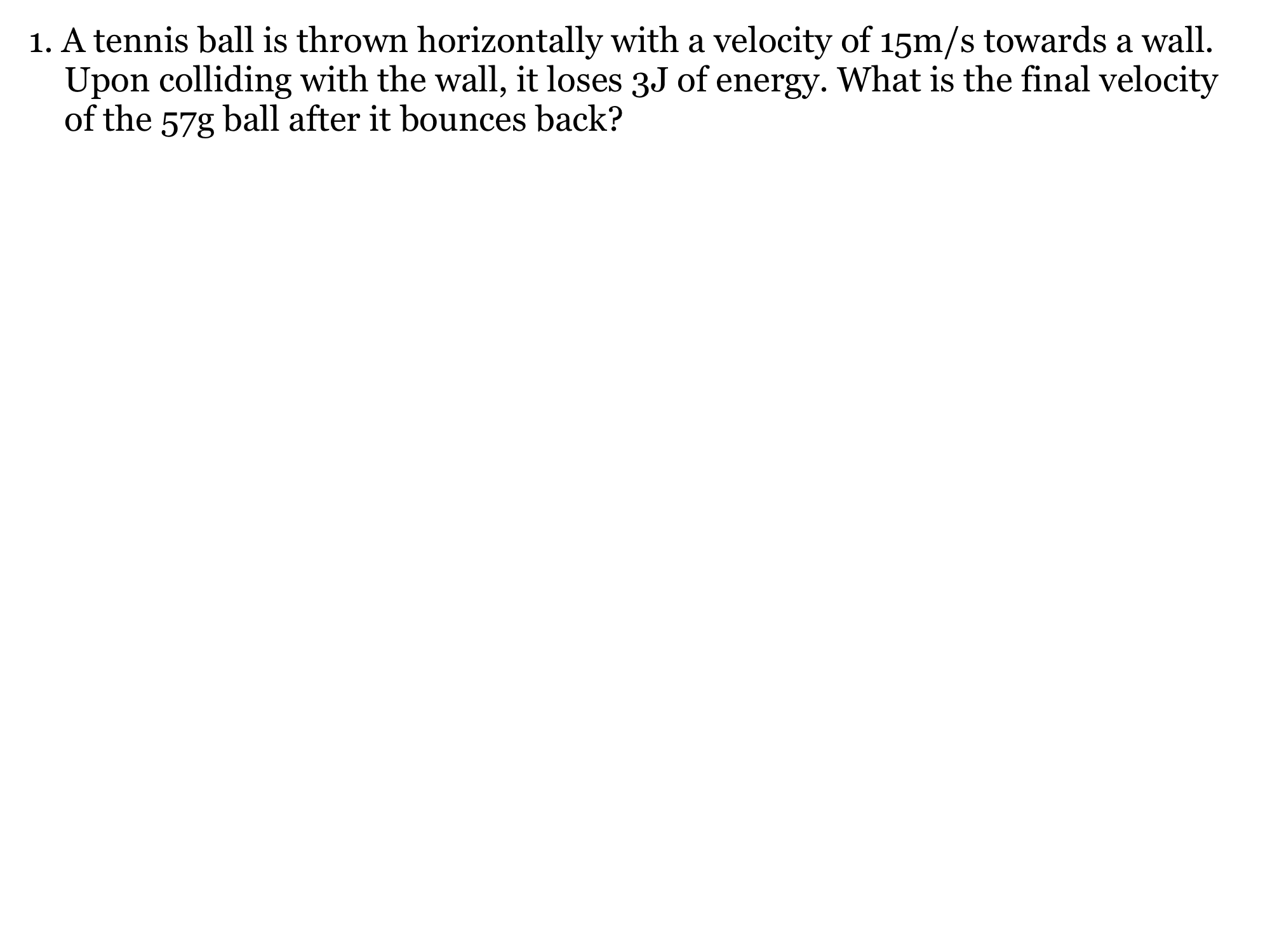
A 57 g tennis ball travels horizontally toward a wall at 15 m/s. Its collision reduces its kinetic energy by 3 J. Find its velocity after it rebounds, taking motion toward the wall as positive.
Original problem 1
Transcription checked; SI units and model stated.
Problem text
A 57 g tennis ball travels horizontally toward a wall at 15 m/s. Its collision reduces its kinetic energy by 3 J. Find its velocity after it rebounds, taking motion toward the wall as positive.
Drawing is temporarily unavailable. Work on paper if needed, then record your reasoning here.
Saving written working requires JavaScript. The problem remains available above; keep your work on paper or in your own notes.
2. Work it out
Original textbook practice
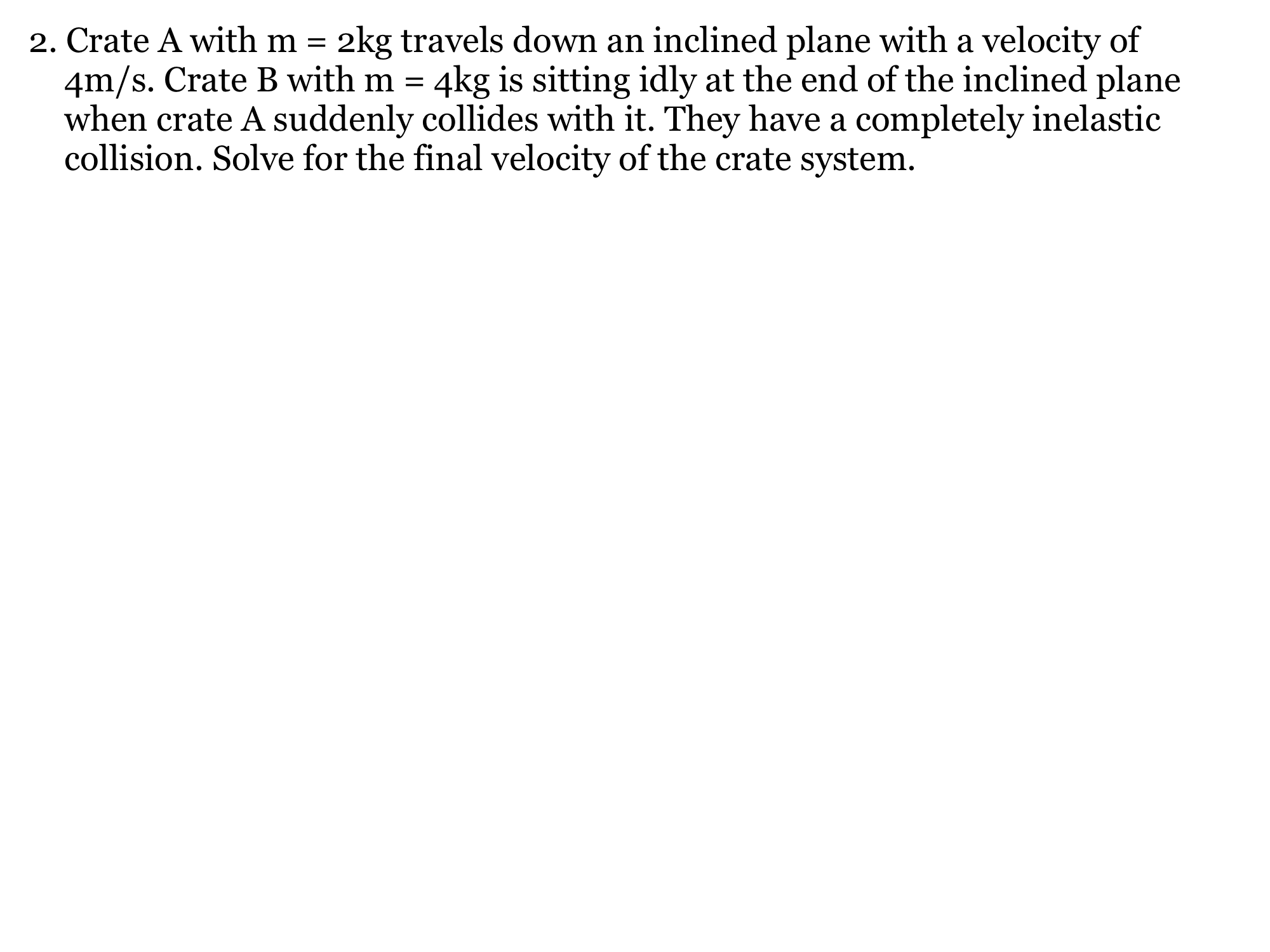
A 2 kg crate A approaches a stationary 4 kg crate B at 4 m/s along the same collision axis. They stick together. Neglect external impulse along that axis during impact and find their common final velocity.
Original problem 2
The stated 4 m/s is the speed immediately before impact. The formula requires a common collision axis; if the ramp redirects motion during impact, its external impulse must be included.
Problem text
A 2 kg crate A approaches a stationary 4 kg crate B at 4 m/s along the same collision axis. They stick together. Neglect external impulse along that axis during impact and find their common final velocity.
Drawing is temporarily unavailable. Work on paper if needed, then record your reasoning here.
Saving written working requires JavaScript. The problem remains available above; keep your work on paper or in your own notes.
3. Work it out
Original textbook practice
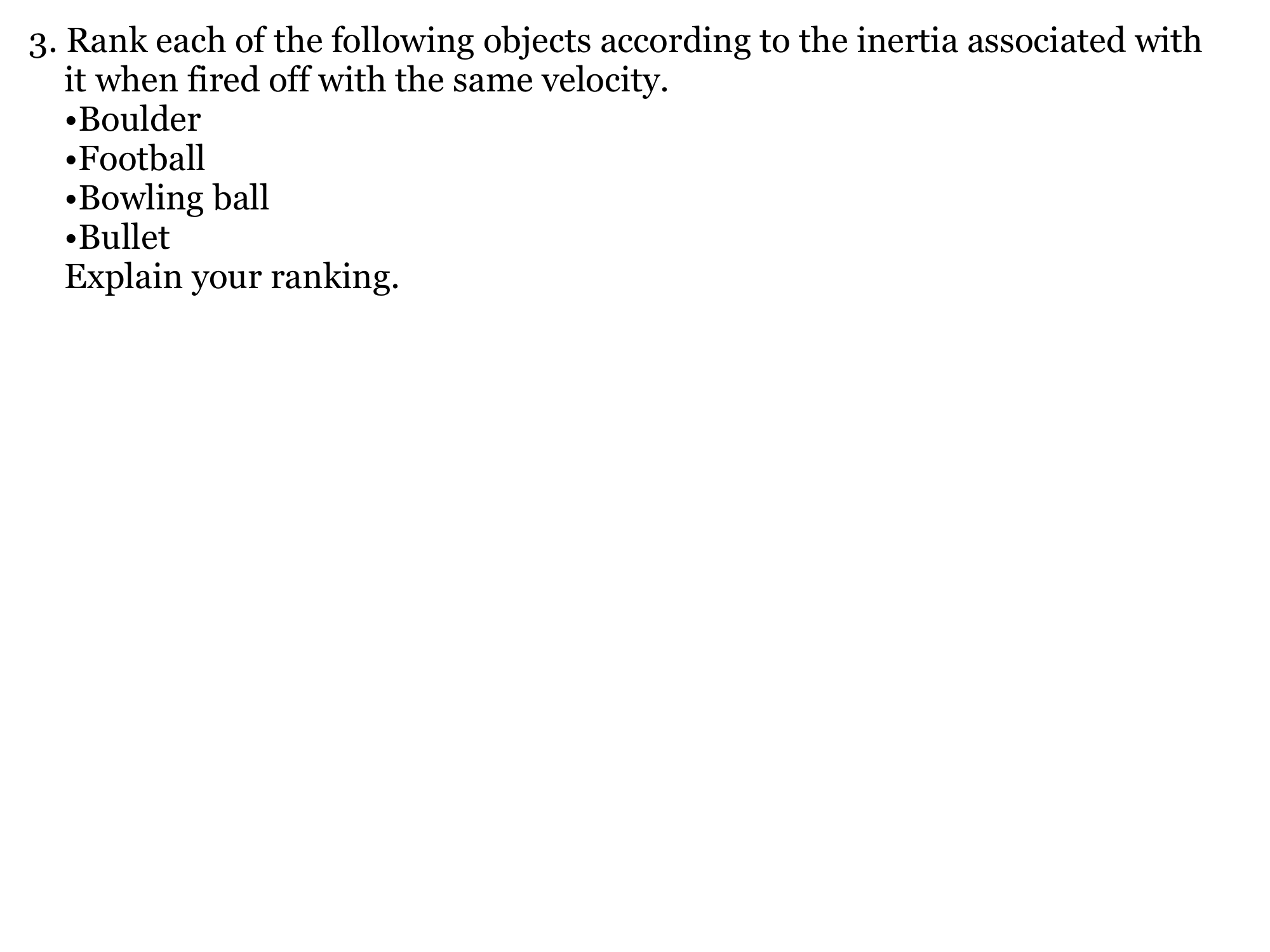
Using typical masses, rank a boulder, football, bowling ball, and bullet by inertia when each has the same velocity. Explain what inertia depends on and how their momentum magnitudes compare.
Original problem 3
No masses are supplied. This ranking assumes ordinary objects of these types; unusual masses could change it.
Problem text
Using typical masses, rank a boulder, football, bowling ball, and bullet by inertia when each has the same velocity. Explain what inertia depends on and how their momentum magnitudes compare.
Drawing is temporarily unavailable. Work on paper if needed, then record your reasoning here.
Saving written working requires JavaScript. The problem remains available above; keep your work on paper or in your own notes.
4. Work it out
Original textbook practice
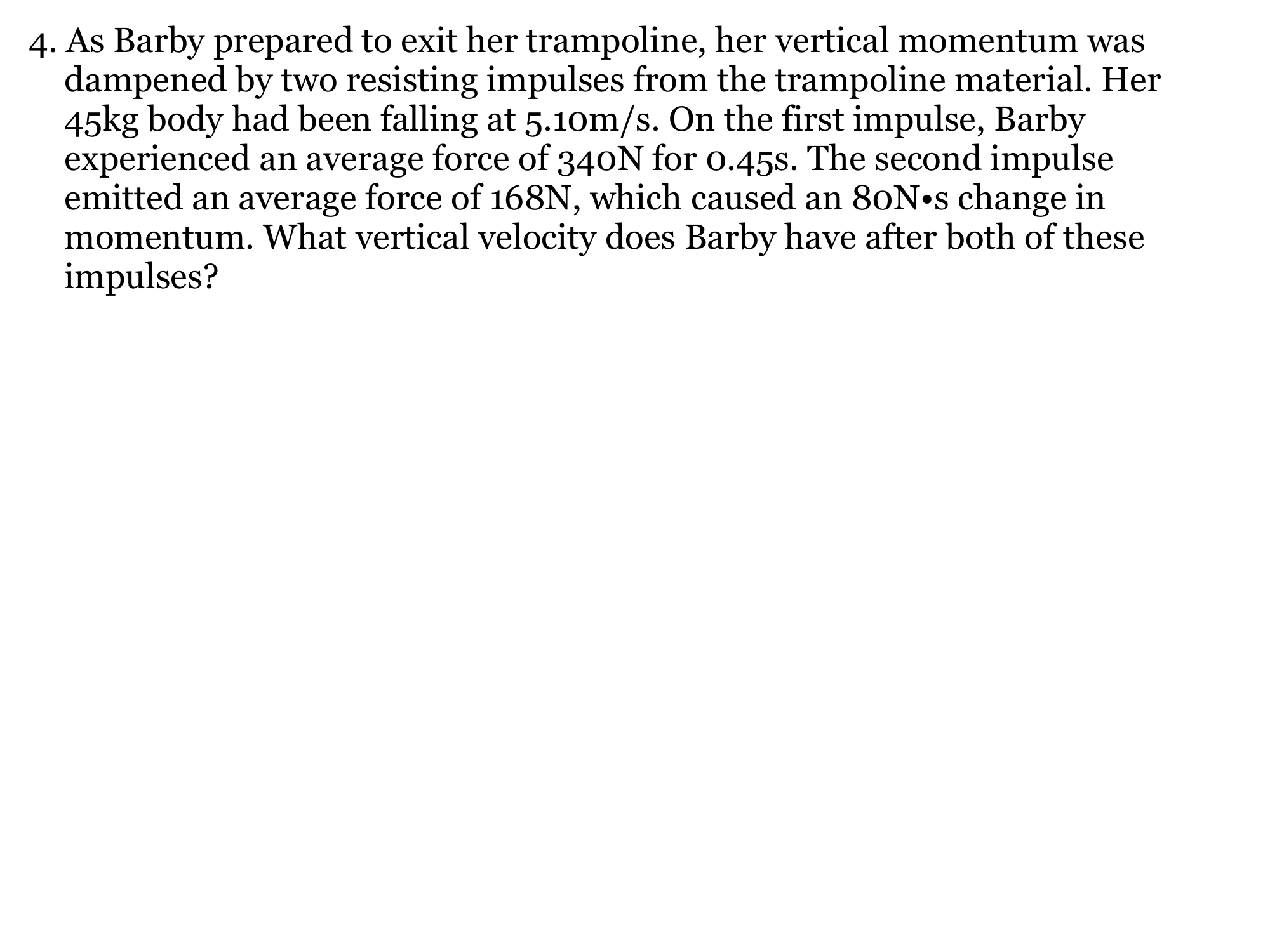
Barby, mass 45 kg, is initially falling at 5.10 m/s. Two upward net impulses oppose her motion: the first has average net force 340 N for 0.45 s; the second has impulse 80 N·s and average net force 168 N. Find her velocity after both impulses. The net forces already include gravity.
Original problem 4
Editorial clarification: the given impulses are NET impulses, including gravity. If 340 N and 168 N instead mean upward trampoline forces alone acting successively, Δt_total = 0.45 + 80/168 = 0.9262 s; including gravity then gives v_f = −9.008 m/s. The original wording did not distinguish these models.
Problem text
Barby, mass 45 kg, is initially falling at 5.10 m/s. Two upward net impulses oppose her motion: the first has average net force 340 N for 0.45 s; the second has impulse 80 N·s and average net force 168 N. Find her velocity after both impulses. The net forces already include gravity.
Drawing is temporarily unavailable. Work on paper if needed, then record your reasoning here.
Saving written working requires JavaScript. The problem remains available above; keep your work on paper or in your own notes.
5. Work it out
Enrichment beyond the AP course
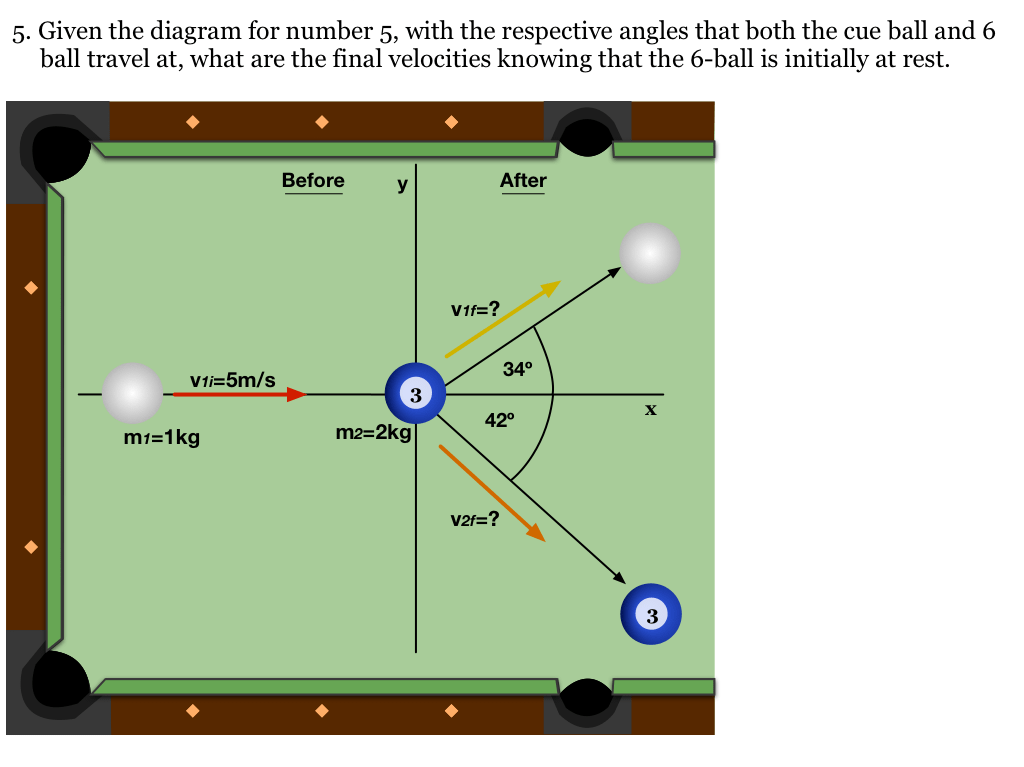
A 1 kg cue ball moves at 5 m/s along +x toward a stationary 2 kg ball. After collision the cue ball moves 34° above +x and the target ball 42° below +x. Neglect external impulse and find both final velocities.
Original problem 5
The diagram gives different masses and angles. Do not impose elastic kinetic-energy conservation; those values would be incompatible with that additional assumption.
Problem text
A 1 kg cue ball moves at 5 m/s along +x toward a stationary 2 kg ball. After collision the cue ball moves 34° above +x and the target ball 42° below +x. Neglect external impulse and find both final velocities.
Drawing is temporarily unavailable. Work on paper if needed, then record your reasoning here.
Saving written working requires JavaScript. The problem remains available above; keep your work on paper or in your own notes.
6. Work it out
Original textbook practice
A 45 kg matador moving east at 4 m/s collides head-on with a 125 kg bull moving west at 8 m/s. They move together afterward. Neglect external horizontal impulse and find their common velocity.
Original problem 6
Neglect external horizontal impulse during the collision.
Problem text
A 45 kg matador moving east at 4 m/s collides head-on with a 125 kg bull moving west at 8 m/s. They move together afterward. Neglect external horizontal impulse and find their common velocity.
Drawing is temporarily unavailable. Work on paper if needed, then record your reasoning here.
Saving written working requires JavaScript. The problem remains available above; keep your work on paper or in your own notes.
7. Work it out
Original textbook practice
A plane crashes into a wall at 100 m/s and stops in 0.3 s. Calculate the average horizontal force exerted by the seat belt on an 85 kg test dummy, assuming the belt supplies the stopping impulse.
Original problem 7
Recovered from the original low-resolution preview, which clearly shows 0.3 s and 85 kg after white-backed magnification. The foreground widget incorrectly repeats question 5.
Problem text
A plane crashes into a wall at 100 m/s and stops in 0.3 s. Calculate the average horizontal force exerted by the seat belt on an 85 kg test dummy, assuming the belt supplies the stopping impulse.
Drawing is temporarily unavailable. Work on paper if needed, then record your reasoning here.
Saving written working requires JavaScript. The problem remains available above; keep your work on paper or in your own notes.
8. Work it out
Original textbook practice
A 60 kg parachutist lands with downward speed 20 m/s and comes to rest over 0.6 s. Find both the average net vertical force and the average upward ground contact force. Use g = 9.81 m/s².
Original problem 8
Recovered intended question 8. “Force felt” refers to the contact force; Δp/Δt alone gives the net force. Gravity is included in the stated answer.
Problem text
A 60 kg parachutist lands with downward speed 20 m/s and comes to rest over 0.6 s. Find both the average net vertical force and the average upward ground contact force. Use g = 9.81 m/s².
Drawing is temporarily unavailable. Work on paper if needed, then record your reasoning here.
Saving written working requires JavaScript. The problem remains available above; keep your work on paper or in your own notes.
9. Work it out
Original textbook practice
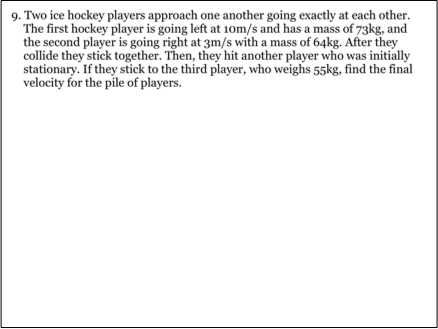
A 73 kg hockey player moves left at 10 m/s and a 64 kg player moves right at 3 m/s. They collide and stick, then collide and stick with a stationary 55 kg player. Neglect external horizontal impulse and find the final velocity of all three.
Original problem 9
Recovered intended question 9. Assume external horizontal impulse is negligible in both collisions.
Problem text
A 73 kg hockey player moves left at 10 m/s and a 64 kg player moves right at 3 m/s. They collide and stick, then collide and stick with a stationary 55 kg player. Neglect external horizontal impulse and find the final velocity of all three.
Drawing is temporarily unavailable. Work on paper if needed, then record your reasoning here.
Saving written working requires JavaScript. The problem remains available above; keep your work on paper or in your own notes.
10. Work it out
Original textbook practice
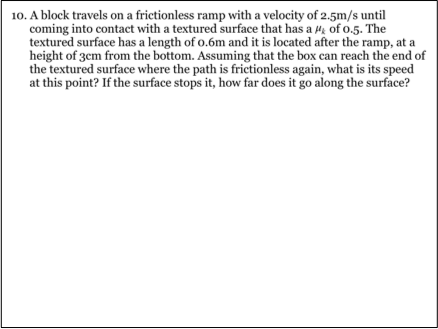
A block starts at the bottom of a frictionless ramp at 2.5 m/s. It climbs to a horizontal rough patch 3 cm above the bottom. The patch is 0.6 m long and has kinetic friction coefficient 0.5; beyond it the path is frictionless. Find whether the block reaches the far end. If it does, find its exit speed; if it stops, find its travel distance on the patch. Use g = 9.81 m/s².
Original problem 10
Recovered question 10 repeats energy question 10. Original wording did not say where 2.5 m/s was measured. The clarified model puts it at the bottom before the 3 cm rise. If 2.5 m/s were instead the speed at the patch entrance, it would cross the patch with speed 0.603 m/s.
Problem text
A block starts at the bottom of a frictionless ramp at 2.5 m/s. It climbs to a horizontal rough patch 3 cm above the bottom. The patch is 0.6 m long and has kinetic friction coefficient 0.5; beyond it the path is frictionless. Find whether the block reaches the far end. If it does, find its exit speed; if it stops, find its travel distance on the patch. Use g = 9.81 m/s².
Drawing is temporarily unavailable. Work on paper if needed, then record your reasoning here.
Saving written working requires JavaScript. The problem remains available above; keep your work on paper or in your own notes.
Additional practice
11. Drone momentum vector
Original textbook practice
A 1.5 kg drone flies 4 m/s east and 3 m/s north. Find its momentum vector, magnitude, and direction.
Your written working
Drawing is temporarily unavailable. Work on paper if needed, then record your reasoning here.
Saving written working requires JavaScript. The problem remains available above; keep your work on paper or in your own notes.
12. Equal momentum, unequal energy
Original textbook practice
A 2 kg cart and an 8 kg cart each have momentum magnitude 16 kg·m/s. Find their speeds and kinetic energies. Which has more inertia?
Your written working
Drawing is temporarily unavailable. Work on paper if needed, then record your reasoning here.
Saving written working requires JavaScript. The problem remains available above; keep your work on paper or in your own notes.
13. Triangular force pulse
Original textbook practice
A 0.20 kg puck initially moves at 2 m/s along +x. A net force pulse along +x rises linearly from 0 to 60 N over 0.02 s, then falls linearly to zero over the next 0.02 s. Find its final velocity and the average force during the pulse.
Your written working
Drawing is temporarily unavailable. Work on paper if needed, then record your reasoning here.
Saving written working requires JavaScript. The problem remains available above; keep your work on paper or in your own notes.
14. Opposing impulse intervals
Original textbook practice
A 3 kg cart initially moves at +2 m/s. Its net force is +12 N for 0.5 s, then −9 N for 1.0 s. Find the final velocity and state whether it reversed.
Your written working
Drawing is temporarily unavailable. Work on paper if needed, then record your reasoning here.
Saving written working requires JavaScript. The problem remains available above; keep your work on paper or in your own notes.
15. Recoil with a relative launch speed
Original textbook practice
A stationary 4.00 kg launcher ejects a 0.020 kg ball horizontally at 300 m/s relative to the launcher immediately afterward. Neglect external impulse. Find the launcher and ball velocities in the laboratory.
Your written working
Drawing is temporarily unavailable. Work on paper if needed, then record your reasoning here.
Saving written working requires JavaScript. The problem remains available above; keep your work on paper or in your own notes.
16. Moving satellite separates
Original textbook practice
A 12 kg satellite moving at +3 m/s separates into an 8 kg module and a 4 kg module. The 4 kg module afterward moves at +9 m/s. Neglect external impulse. Find the 8 kg module velocity and the kinetic-energy increase.
Your written working
Drawing is temporarily unavailable. Work on paper if needed, then record your reasoning here.
Saving written working requires JavaScript. The problem remains available above; keep your work on paper or in your own notes.
17. Catch from the opposite direction
Original textbook practice
A 60 kg skater moves east at 2 m/s. A 3 kg medicine ball moving west at 5 m/s is caught and held. Neglect horizontal external impulse. Find their common velocity and lost kinetic energy.
Your written working
Drawing is temporarily unavailable. Work on paper if needed, then record your reasoning here.
Saving written working requires JavaScript. The problem remains available above; keep your work on paper or in your own notes.
18. Elastic carts initially both moving
Original textbook practice
A 2 kg cart moves at +5 m/s and a 3 kg cart at −1 m/s. They collide elastically in one dimension. Find both final velocities.
Your written working
Drawing is temporarily unavailable. Work on paper if needed, then record your reasoning here.
Saving written working requires JavaScript. The problem remains available above; keep your work on paper or in your own notes.
19. Classify a measured collision
Original textbook practice
A 1 kg cart at +4 m/s hits a stationary 3 kg cart. Afterward the 1 kg cart has velocity −1 m/s. With negligible external impulse, find the other velocity and classify the collision.
Your written working
Drawing is temporarily unavailable. Work on paper if needed, then record your reasoning here.
Saving written working requires JavaScript. The problem remains available above; keep your work on paper or in your own notes.
20. Glancing collision of equal masses
Enrichment beyond the AP course
A smooth equal-mass ball moving at 6 m/s along +x elastically hits an identical stationary ball. The incoming ball emerges 30° above +x. Find both outgoing speeds and the target direction. Neglect spin.
Your written working
Drawing is temporarily unavailable. Work on paper if needed, then record your reasoning here.
Saving written working requires JavaScript. The problem remains available above; keep your work on paper or in your own notes.
21. Center-of-mass motion
Original textbook practice
A 2 kg glider has velocity +6 m/s and a 4 kg glider has velocity −3 m/s on a frictionless track. Find the center-of-mass velocity. If they stick, what is their common velocity?
Your written working
Drawing is temporarily unavailable. Work on paper if needed, then record your reasoning here.
Saving written working requires JavaScript. The problem remains available above; keep your work on paper or in your own notes.
22. Coefficient of restitution
Enrichment beyond the AP course
A 1 kg cart moving at +6 m/s hits a stationary 2 kg cart on a frictionless track. The coefficient of restitution is e = 0.50. Find both final velocities. Here e = (v_2f−v_1f)/(v_1i−v_2i).
Your written working
Drawing is temporarily unavailable. Work on paper if needed, then record your reasoning here.
Saving written working requires JavaScript. The problem remains available above; keep your work on paper or in your own notes.
23. Sticking collision followed by braking
Original textbook practice
A 1 kg cart moving at 4 m/s hits and sticks to a stationary 3 kg cart. Immediately afterward, a constant 2 N braking force opposes their motion. Find the common post-impact speed and subsequent stopping distance.
Your written working
Drawing is temporarily unavailable. Work on paper if needed, then record your reasoning here.
Saving written working requires JavaScript. The problem remains available above; keep your work on paper or in your own notes.
24. Rocket thrust from exhaust
Enrichment beyond the AP course
A rocket ejects gas at a mass rate of 0.080 kg/s with exhaust speed 2500 m/s backward relative to the rocket. Neglect pressure thrust. Find thrust and the instantaneous upward acceleration of a 25 kg rocket near Earth, ignoring drag.
Your written working
Drawing is temporarily unavailable. Work on paper if needed, then record your reasoning here.
Saving written working requires JavaScript. The problem remains available above; keep your work on paper or in your own notes.
25. Reversing a water jet
Enrichment beyond the AP course
A horizontal jet carries 0.40 kg/s of water at +12 m/s into a curved stationary vane. It exits at −8 m/s. Neglect pressure forces. Find the horizontal force of the vane on the water and the water on the vane.
Your written working
Drawing is temporarily unavailable. Work on paper if needed, then record your reasoning here.
Saving written working requires JavaScript. The problem remains available above; keep your work on paper or in your own notes.
26. Helmet padding and stopping time
Original textbook practice
A 5 kg effective head mass moving at 4 m/s is brought to rest horizontally. Padding A stops it in 0.020 s and padding B in 0.080 s. Find the average net stopping-force magnitudes and compare their impulses.
Your written working
Drawing is temporarily unavailable. Work on paper if needed, then record your reasoning here.
Saving written working requires JavaScript. The problem remains available above; keep your work on paper or in your own notes.
27. Turning momentum through a right angle
Original textbook practice
Thrusters turn a 2 kg probe from velocity 6 m/s along +x to velocity 6 m/s along +y over 3 s. Find the net impulse vector, its magnitude, the average net force vector, and the kinetic-energy change.
Your written working
Drawing is temporarily unavailable. Work on paper if needed, then record your reasoning here.
Saving written working requires JavaScript. The problem remains available above; keep your work on paper or in your own notes.
28. External impulse prevents momentum conservation
Original textbook practice
Two carts together have initial momentum +10 kg·m/s. They collide while a track-mounted actuator gives their combined system an external impulse of −3 N·s. What is their final total momentum? Explain why internal collision forces cannot supply the missing term.
Your written working
Drawing is temporarily unavailable. Work on paper if needed, then record your reasoning here.
Saving written working requires JavaScript. The problem remains available above; keep your work on paper or in your own notes.
29. Perpendicular carts latch together
Enrichment beyond the AP course
A 2 kg cart moves east at 3 m/s and a 1 kg cart moves north at 4 m/s. They latch at an intersection. Neglect external horizontal impulse. Find their velocity vector, speed, and direction.
Your written working
Drawing is temporarily unavailable. Work on paper if needed, then record your reasoning here.
Saving written working requires JavaScript. The problem remains available above; keep your work on paper or in your own notes.
30. Find the unknown part of a force record
Original textbook practice
A 0.50 kg robot initially moves at +1 m/s and finally at −3 m/s. Its net force is −5 N for 0.20 s and then an unknown constant F for 0.40 s. Find F.
Your written working
Drawing is temporarily unavailable. Work on paper if needed, then record your reasoning here.
Saving written working requires JavaScript. The problem remains available above; keep your work on paper or in your own notes.