Rotational Motion practice
Work from memory first. Draw a diagram, state the assumptions and keep units through every step. Worked answers are separate.
· Open separate worked solutions
1. Work it out
Original textbook practice
Identify the physical forces whose inward components keep these objects on circular paths: (a) a plane in a level banked turn, (b) a car on a wet banked curve, (c) Tarzan swinging around a tree on a vine, and (d) a planet orbiting the Sun. Explain each; “centripetal force” alone is not an identification.
Original problem 1
The plane and Tarzan cases require a specified plane of motion; the answer uses a level turn for the plane and a horizontal swing around the tree for Tarzan.
Problem text
Identify the physical forces whose inward components keep these objects on circular paths: (a) a plane in a level banked turn, (b) a car on a wet banked curve, (c) Tarzan swinging around a tree on a vine, and (d) a planet orbiting the Sun. Explain each; “centripetal force” alone is not an identification.
Drawing is temporarily unavailable. Work on paper if needed, then record your reasoning here.
Saving written working requires JavaScript. The problem remains available above; keep your work on paper or in your own notes.
2. Work it out
Original textbook practice
A shuttle of mass 40 metric tonnes is described as moving in a circular Earth orbit at 45 m/s while Earth’s gravitational force on it is 10 kN. Check whether these values describe one circular orbit. If they do not, find the altitude implied by the force and the circular speed required there. Use G = 6.67430 × 10⁻¹¹ N·m²/kg², M_E = 5.98 × 10²⁴ kg and R_E = 6.38 × 10⁶ m.
Original problem 2
The prompt is explicitly reframed as a consistency check. “Tons” is interpreted as metric tonnes. The very distant speed-based calculation is only an Earth-only mathematical model; other celestial gravity would matter there.
Problem text
A shuttle of mass 40 metric tonnes is described as moving in a circular Earth orbit at 45 m/s while Earth’s gravitational force on it is 10 kN. Check whether these values describe one circular orbit. If they do not, find the altitude implied by the force and the circular speed required there. Use G = 6.67430 × 10⁻¹¹ N·m²/kg², M_E = 5.98 × 10²⁴ kg and R_E = 6.38 × 10⁶ m.
Drawing is temporarily unavailable. Work on paper if needed, then record your reasoning here.
Saving written working requires JavaScript. The problem remains available above; keep your work on paper or in your own notes.
3. Work it out
Original textbook practice
A 9 kg tire of radius 0.30 m moves at 40 m/s. A pebble redirects its center-of-mass velocity to 30° above horizontal and removes 2000 J of translational kinetic energy. During flight the spin speed stays constant. Neglect air resistance. Find the maximum rise of its center of mass above the launch position.
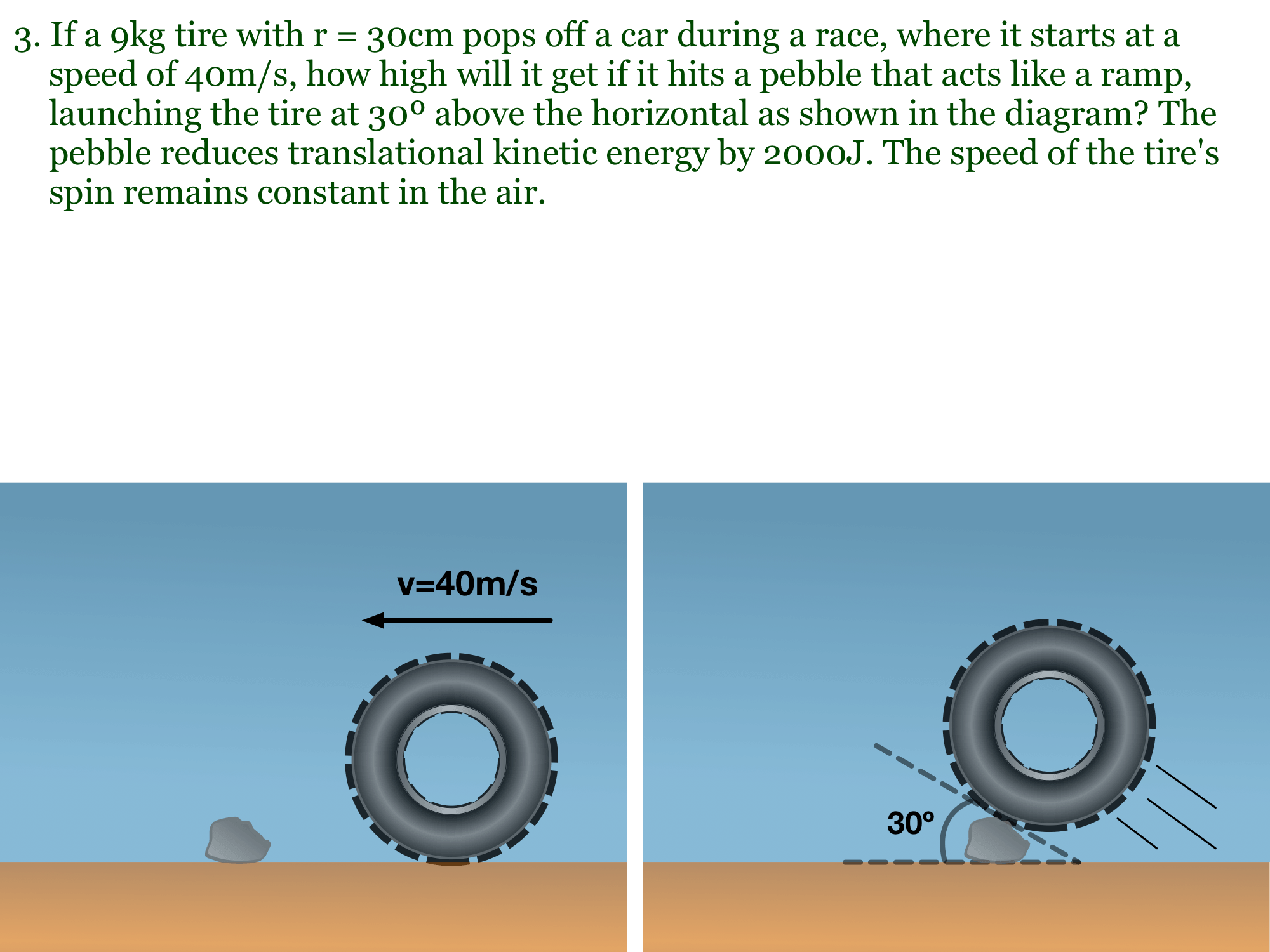
Original problem 3
The source image confirms 9 kg. The radius is unnecessary because the spin energy is unchanged. Absolute height above the ground would also require the launch height of the center of mass.
Problem text
A 9 kg tire of radius 0.30 m moves at 40 m/s. A pebble redirects its center-of-mass velocity to 30° above horizontal and removes 2000 J of translational kinetic energy. During flight the spin speed stays constant. Neglect air resistance. Find the maximum rise of its center of mass above the launch position.
Drawing is temporarily unavailable. Work on paper if needed, then record your reasoning here.
Saving written working requires JavaScript. The problem remains available above; keep your work on paper or in your own notes.
4. Work it out
Original textbook practice
A 75 kg ice skater spins at 30 rpm. The separation of her hands changes from 1.0 m to 0.40 m. With negligible external torque, determine what can be inferred about her final angular speed. Explain why hand separation alone is insufficient; also give the result for an explicitly idealized model in which the whole moment of inertia is proportional to the square of half the hand separation.
Original problem 4
The source lacks a mass-distribution model. The model result is identified as conditional, not as an inferred physical inertia.
Problem text
A 75 kg ice skater spins at 30 rpm. The separation of her hands changes from 1.0 m to 0.40 m. With negligible external torque, determine what can be inferred about her final angular speed. Explain why hand separation alone is insufficient; also give the result for an explicitly idealized model in which the whole moment of inertia is proportional to the square of half the hand separation.
Drawing is temporarily unavailable. Work on paper if needed, then record your reasoning here.
Saving written working requires JavaScript. The problem remains available above; keep your work on paper or in your own notes.
5. Work it out
Original textbook practice
A plane maintains a speed of 325 m/s while making a semicircular U-turn. Its centripetal acceleration must not exceed 62 m/s². Find the minimum radius and minimum turning time.
Original problem 5
Constant speed and a semicircular path are explicit assumptions. If “under” is strictly less than 62 m/s², 16.468 s is a limiting lower bound; any allowed turn takes slightly longer.
Problem text
A plane maintains a speed of 325 m/s while making a semicircular U-turn. Its centripetal acceleration must not exceed 62 m/s². Find the minimum radius and minimum turning time.
Drawing is temporarily unavailable. Work on paper if needed, then record your reasoning here.
Saving written working requires JavaScript. The problem remains available above; keep your work on paper or in your own notes.
6. Work it out
Original textbook practice
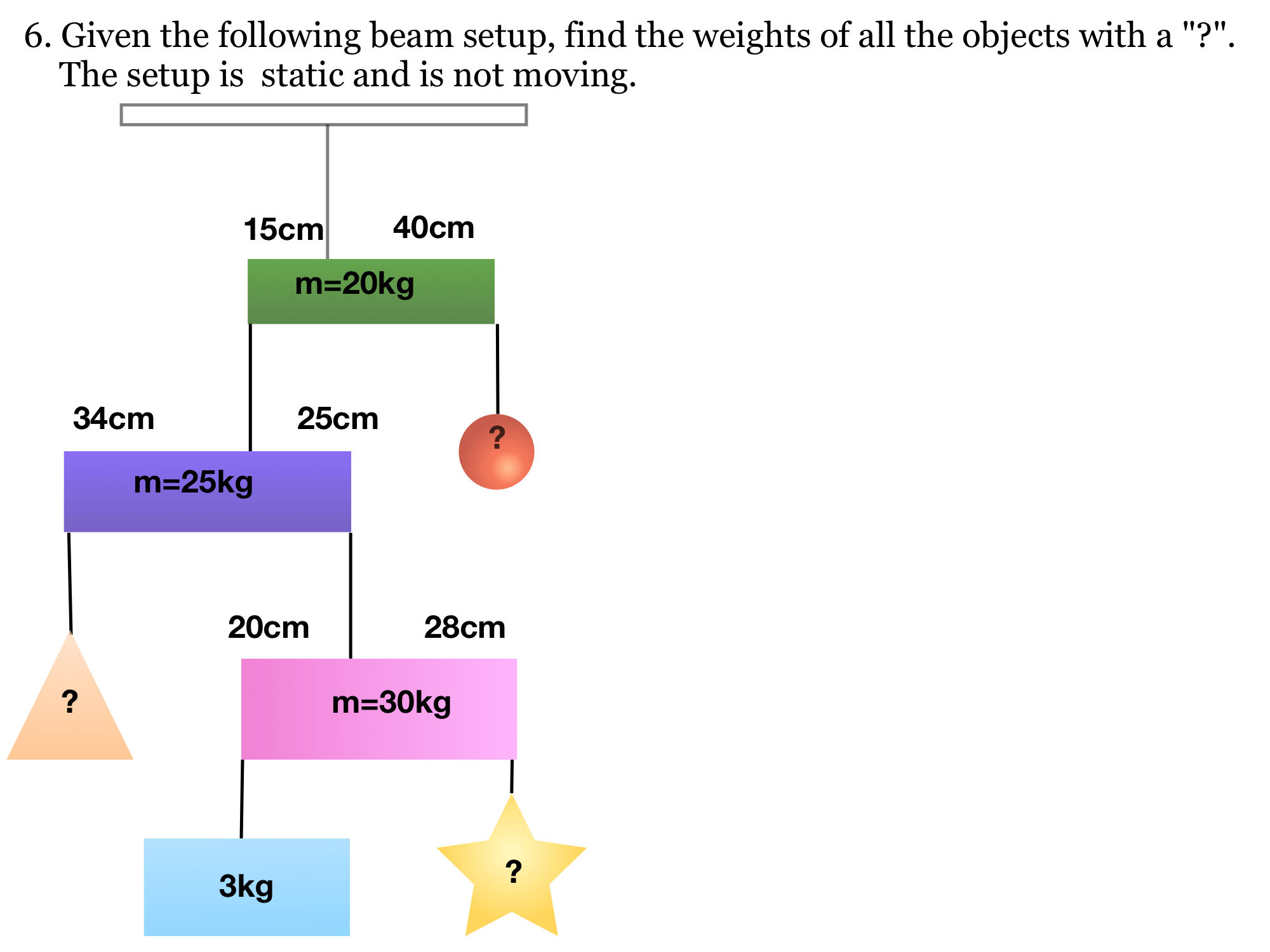
The source diagram shows three horizontal beams with masses 20 kg, 25 kg and 30 kg, suspended by flexible strings. Their left/right endpoint distances from their supports are respectively 15/40 cm, 34/25 cm and 20/28 cm. The bottom beam carries a 3 kg mass at its left end and an unknown star at its right end; the higher beams carry the connected lower assemblies and other unknown objects as shown. Assuming uniform beams, determine whether positive unknown weights can make the pictured configuration static.
Original problem 6
The source labels nonzero beam masses but omits their mass distribution and asserts equilibrium. This reviewed version diagnoses the contradiction under the conventional uniform-beam model instead of silently dropping beam weights.
Problem text
The source diagram shows three horizontal beams with masses 20 kg, 25 kg and 30 kg, suspended by flexible strings. Their left/right endpoint distances from their supports are respectively 15/40 cm, 34/25 cm and 20/28 cm. The bottom beam carries a 3 kg mass at its left end and an unknown star at its right end; the higher beams carry the connected lower assemblies and other unknown objects as shown. Assuming uniform beams, determine whether positive unknown weights can make the pictured configuration static.
Drawing is temporarily unavailable. Work on paper if needed, then record your reasoning here.
Saving written working requires JavaScript. The problem remains available above; keep your work on paper or in your own notes.
7. Work it out
Original textbook practice
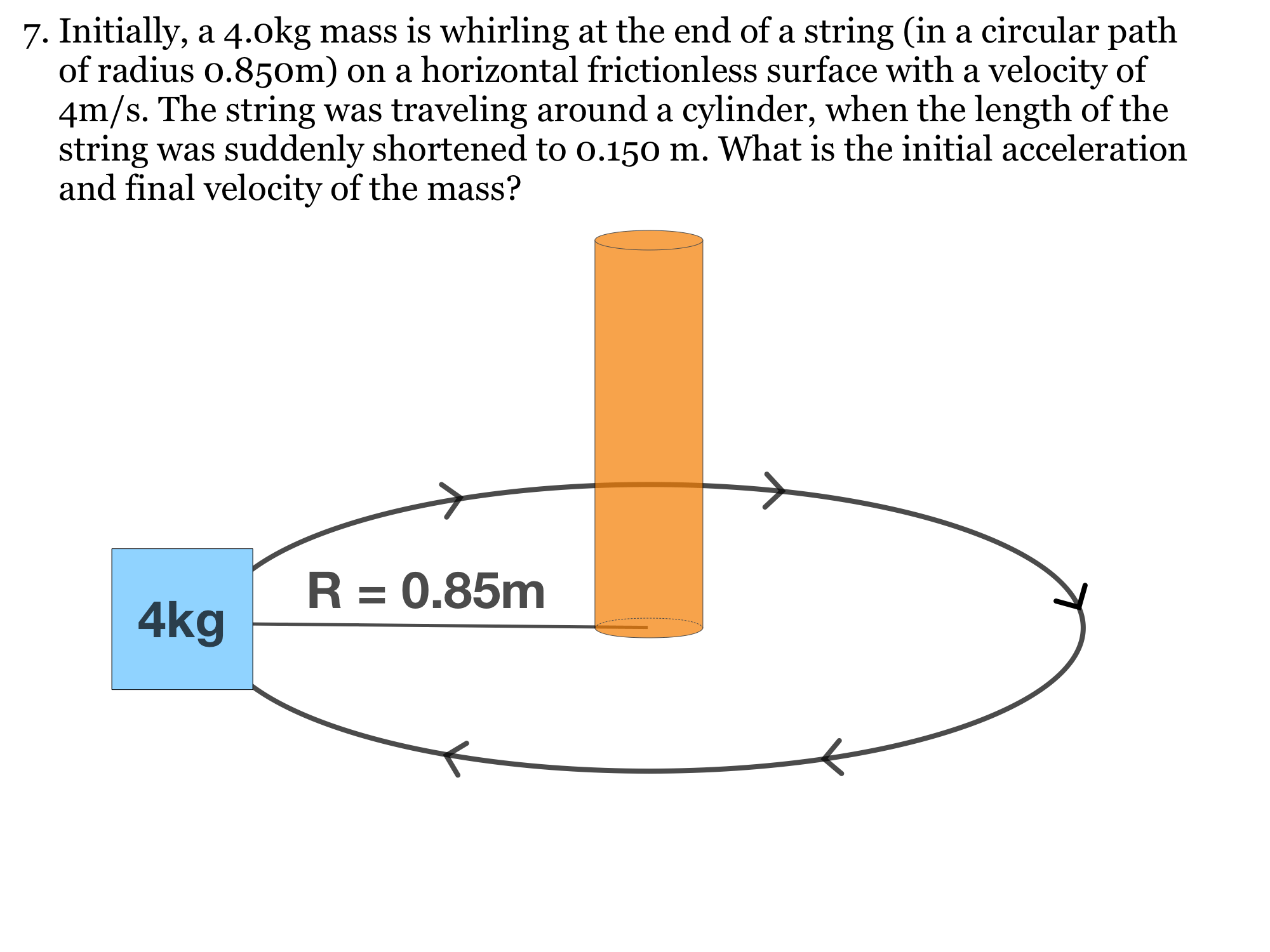
A 4.0 kg mass initially moves at 4.0 m/s on a horizontal frictionless table in a circle of radius 0.850 m. For the central-pull model, a string is drawn inward through a small fixed hole so that the radius becomes 0.150 m; the force is always radial and the motion is circular at the initial and final instants. Find its initial centripetal acceleration and final speed. Then explain why this model differs from a string wrapping around a fixed finite cylinder, as suggested by the original illustration.
Original problem 7
The central-pull geometry is an explicit repair. One cannot apply m r v conservation about a finite cylinder’s axis to its noncentral wrapping force. “Suddenly shortened” alone also does not specify the impulse or final radial velocity.
Problem text
A 4.0 kg mass initially moves at 4.0 m/s on a horizontal frictionless table in a circle of radius 0.850 m. For the central-pull model, a string is drawn inward through a small fixed hole so that the radius becomes 0.150 m; the force is always radial and the motion is circular at the initial and final instants. Find its initial centripetal acceleration and final speed. Then explain why this model differs from a string wrapping around a fixed finite cylinder, as suggested by the original illustration.
Drawing is temporarily unavailable. Work on paper if needed, then record your reasoning here.
Saving written working requires JavaScript. The problem remains available above; keep your work on paper or in your own notes.
8. Work it out
Original textbook practice
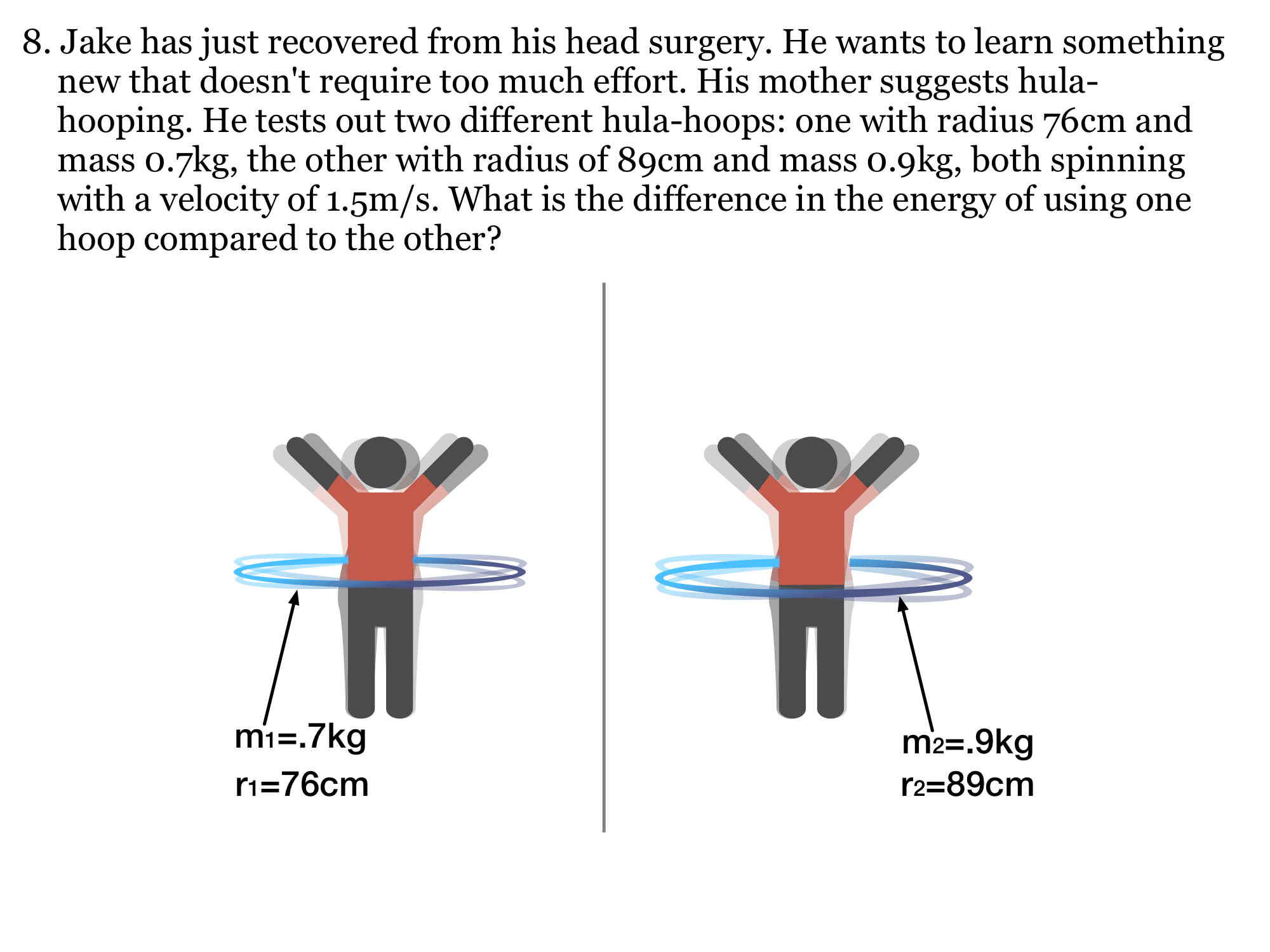
Two thin hoops rotate about fixed axes through their centers, perpendicular to their planes. One has radius 0.76 m and mass 0.70 kg; the other has radius 0.89 m and mass 0.90 kg. Each has rim speed 1.5 m/s. Find the difference in their rotational kinetic energies.
Original problem 8
Real hula-hooping involves additional translation and body motion. The reviewed exercise explicitly uses the intended fixed-axis thin-hoop model.
Problem text
Two thin hoops rotate about fixed axes through their centers, perpendicular to their planes. One has radius 0.76 m and mass 0.70 kg; the other has radius 0.89 m and mass 0.90 kg. Each has rim speed 1.5 m/s. Find the difference in their rotational kinetic energies.
Drawing is temporarily unavailable. Work on paper if needed, then record your reasoning here.
Saving written working requires JavaScript. The problem remains available above; keep your work on paper or in your own notes.
9. Work it out
Original textbook practice
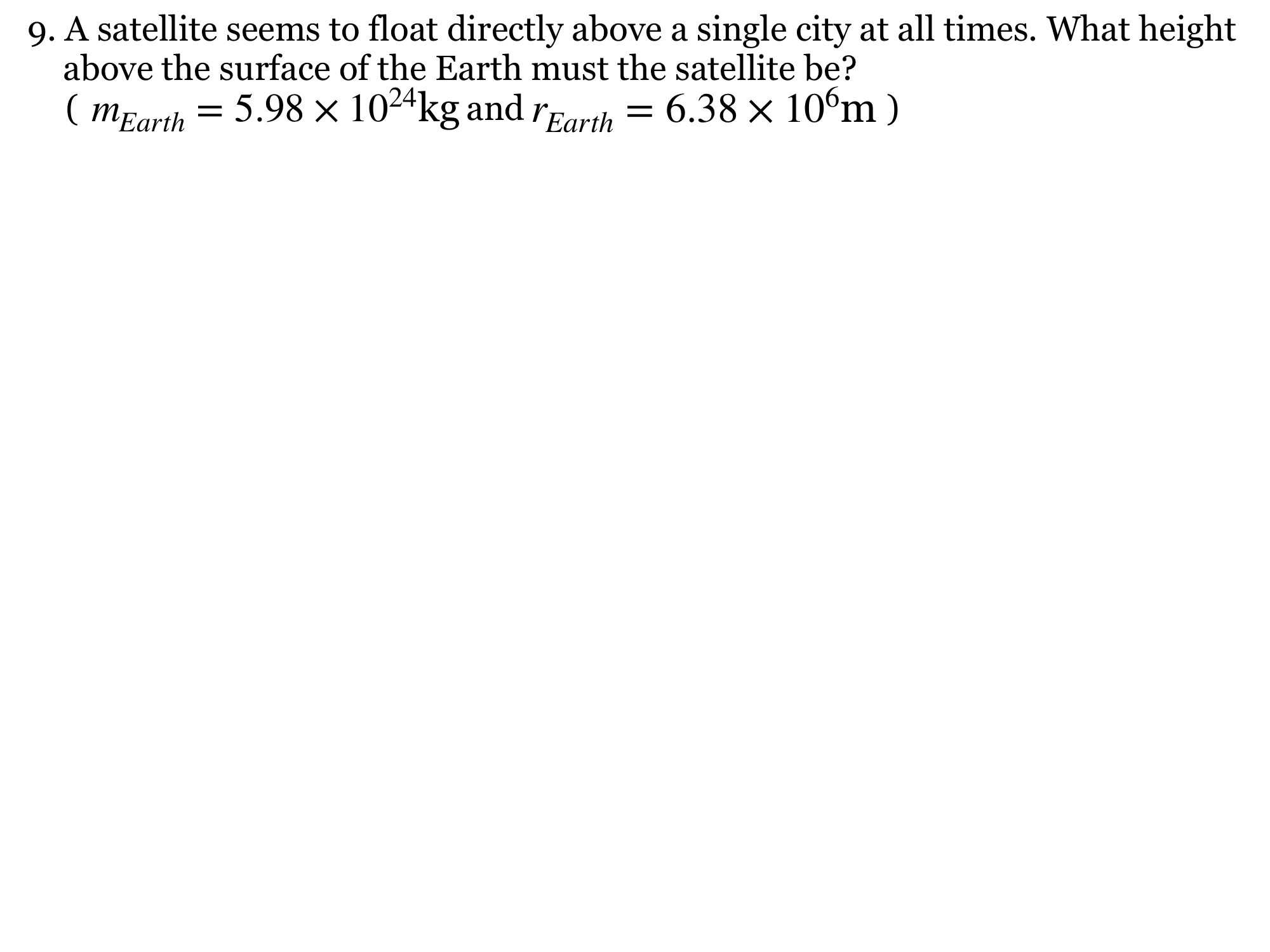
A satellite appears fixed above a city on Earth’s equator. Find its altitude for a circular equatorial orbit in Earth’s direction of rotation. Use G = 6.67430 × 10⁻¹¹ N·m²/kg², M_E = 5.98 × 10²⁴ kg, R_E = 6.38 × 10⁶ m and Earth’s sidereal rotation period T = 86,164.1 s. Explain why this is impossible directly above a city away from the equator.
Original problem 9
The original unspecified city is restricted to the equator. A 24-hour approximation gives a slightly different altitude; the sidereal period is the correct rotation period.
Problem text
A satellite appears fixed above a city on Earth’s equator. Find its altitude for a circular equatorial orbit in Earth’s direction of rotation. Use G = 6.67430 × 10⁻¹¹ N·m²/kg², M_E = 5.98 × 10²⁴ kg, R_E = 6.38 × 10⁶ m and Earth’s sidereal rotation period T = 86,164.1 s. Explain why this is impossible directly above a city away from the equator.
Drawing is temporarily unavailable. Work on paper if needed, then record your reasoning here.
Saving written working requires JavaScript. The problem remains available above; keep your work on paper or in your own notes.
10. Work it out
Original textbook practice
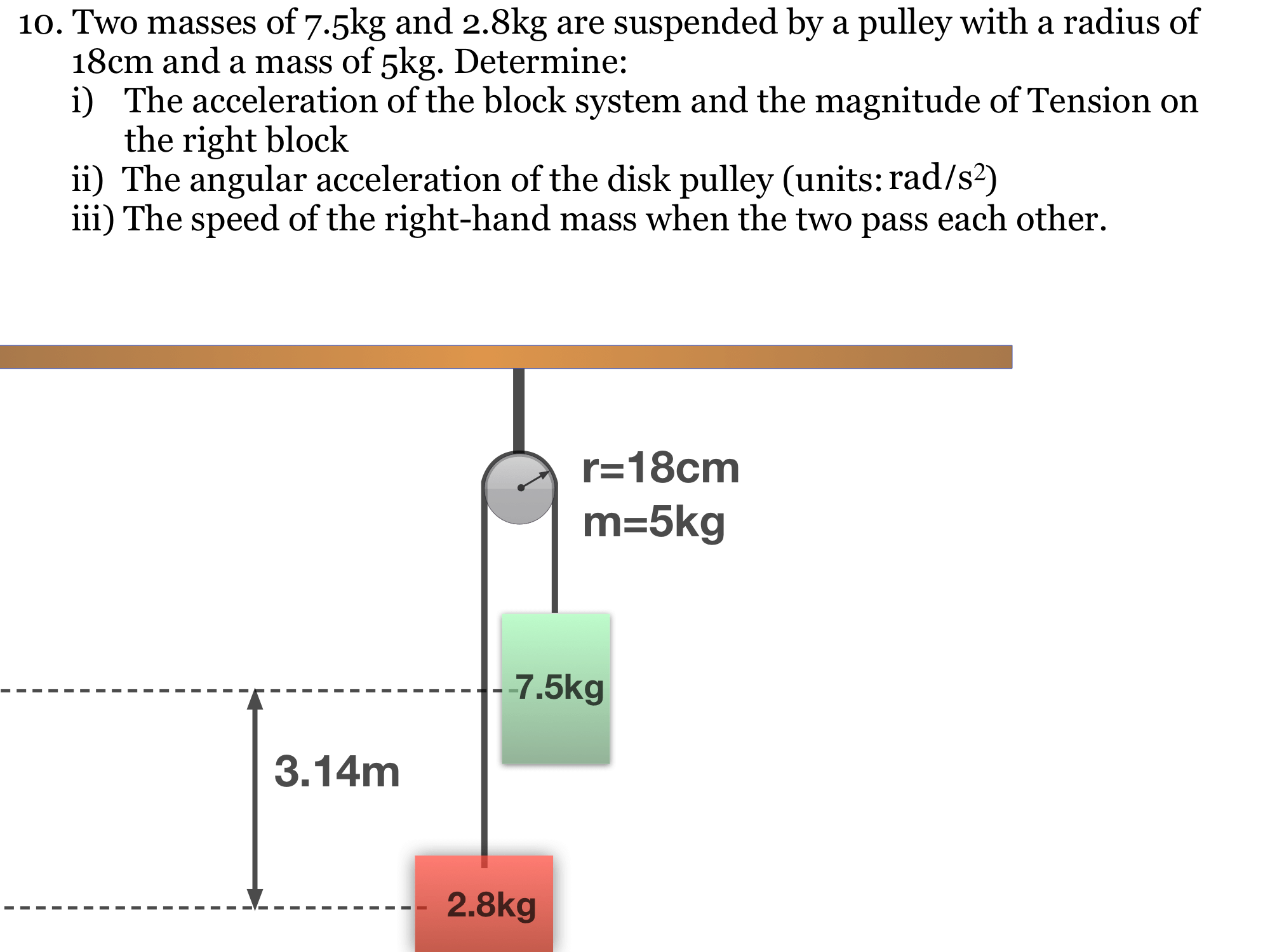
A 7.5 kg block on the RIGHT and a 2.8 kg block on the LEFT hang from a massless inextensible string over a uniform disk pulley of radius 0.18 m and mass 5.0 kg. The axle is frictionless and the string does not slip. The system starts from rest with block centers separated vertically by 3.14 m. Find (i) the acceleration and right-block tension, (ii) the pulley’s angular acceleration in rad/s², and (iii) each block’s speed when their centers pass.
Original problem 10
The image establishes that the 7.5 kg mass is on the right. Rest release and the uniform disk/no-slip assumptions are made explicit; angular-acceleration units are rad/s².
Problem text
A 7.5 kg block on the RIGHT and a 2.8 kg block on the LEFT hang from a massless inextensible string over a uniform disk pulley of radius 0.18 m and mass 5.0 kg. The axle is frictionless and the string does not slip. The system starts from rest with block centers separated vertically by 3.14 m. Find (i) the acceleration and right-block tension, (ii) the pulley’s angular acceleration in rad/s², and (iii) each block’s speed when their centers pass.
Drawing is temporarily unavailable. Work on paper if needed, then record your reasoning here.
Saving written working requires JavaScript. The problem remains available above; keep your work on paper or in your own notes.
Additional practice
11. A turntable accelerates
Original textbook practice
A turntable initially rotates at 4.0 rad/s and has constant angular acceleration 1.5 rad/s² for 8.0 s. Find its final angular speed and angular displacement in radians and revolutions.
Your written working
Drawing is temporarily unavailable. Work on paper if needed, then record your reasoning here.
Saving written working requires JavaScript. The problem remains available above; keep your work on paper or in your own notes.
12. Centrifuge acceleration limit
Original textbook practice
A sample in a centrifuge is 0.120 m from the spin axis. Find the rotation rate in rpm that produces a centripetal acceleration of 50.0g, with g = 9.81 m/s².
Your written working
Drawing is temporarily unavailable. Work on paper if needed, then record your reasoning here.
Saving written working requires JavaScript. The problem remains available above; keep your work on paper or in your own notes.
13. Traction on a flat roundabout
Original textbook practice
A car takes an unbanked circular roundabout of radius 80 m. The tire–road coefficient of static friction is 0.45. Find its maximum speed without skidding, assuming a level road and neglecting aerodynamic forces.
Your written working
Drawing is temporarily unavailable. Work on paper if needed, then record your reasoning here.
Saving written working requires JavaScript. The problem remains available above; keep your work on paper or in your own notes.
14. Design speed of a banked track
Original textbook practice
A circular track of radius 80 m is banked at 15° above horizontal. At what speed can a car follow the track with no tire friction needed?
Your written working
Drawing is temporarily unavailable. Work on paper if needed, then record your reasoning here.
Saving written working requires JavaScript. The problem remains available above; keep your work on paper or in your own notes.
15. Conical pendulum
Original textbook practice
A 0.80 kg bob on a 1.20 m string moves in a horizontal circle with the string making 30° with vertical. Find the string tension and the orbital period. Neglect drag.
Your written working
Drawing is temporarily unavailable. Work on paper if needed, then record your reasoning here.
Saving written working requires JavaScript. The problem remains available above; keep your work on paper or in your own notes.
16. Minimum height for a vertical loop
Original textbook practice
A small bead slides without friction on the inside of a vertical circular track of radius 0.90 m. It starts from rest at height h above the loop’s lowest point. What minimum h keeps it in contact at the top? Treat the bead as a point mass.
Your written working
Drawing is temporarily unavailable. Work on paper if needed, then record your reasoning here.
Saving written working requires JavaScript. The problem remains available above; keep your work on paper or in your own notes.
17. Rod and attached point mass
Original textbook practice
A uniform 2.0 kg rod of length 1.20 m rotates about a fixed axis through one end, perpendicular to the rod. A 0.40 kg point mass is attached to its other end. Find the combined moment of inertia and the net torque needed for angular acceleration 2.0 rad/s².
Your written working
Drawing is temporarily unavailable. Work on paper if needed, then record your reasoning here.
Saving written working requires JavaScript. The problem remains available above; keep your work on paper or in your own notes.
18. Annular rotor energy
Original textbook practice
A uniform annular rotor has mass 2.0 kg, inner radius 0.10 m and outer radius 0.25 m. It rotates about its symmetry axis at 20 rad/s. Find its moment of inertia and rotational kinetic energy.
Your written working
Drawing is temporarily unavailable. Work on paper if needed, then record your reasoning here.
Saving written working requires JavaScript. The problem remains available above; keep your work on paper or in your own notes.
19. Torque from coordinate vectors
Original textbook practice
A disk in the xy-plane has its axle at the origin. Force (0, 12) N acts at position (0.40, 0) m; force (8, 0) N acts at (0, 0.30) m; a third force of magnitude 60 N acts at the origin. Find the net z-component of torque, taking counterclockwise as positive.
Your written working
Drawing is temporarily unavailable. Work on paper if needed, then record your reasoning here.
Saving written working requires JavaScript. The problem remains available above; keep your work on paper or in your own notes.
20. A time-dependent driving torque
Enrichment beyond the AP course
A flywheel of fixed moment of inertia 2.0 kg·m² initially rotates at 3.0 rad/s. Its net driving torque is τ(t) = (4.0 N·m/s)t for 0 ≤ t ≤ 5.0 s. Find its angular speed and angular displacement at 5.0 s.
Mixed task: final angular speed has an AP6.3 torque-graph solution; the exact angular-displacement calculation requires calculus and is enrichment.
Your written working
Drawing is temporarily unavailable. Work on paper if needed, then record your reasoning here.
Saving written working requires JavaScript. The problem remains available above; keep your work on paper or in your own notes.
21. Flywheel braking distance
Original textbook practice
A flywheel has I = 0.80 kg·m² and initial angular speed 30 rad/s. A constant resisting torque of magnitude 6.0 N·m stops it. Find the stop time and the angle turned before rest.
Your written working
Drawing is temporarily unavailable. Work on paper if needed, then record your reasoning here.
Saving written working requires JavaScript. The problem remains available above; keep your work on paper or in your own notes.
22. Rolling cylinder and required friction
Original textbook practice
A uniform solid cylinder rolls down a 20° incline without slipping from rest. Find its acceleration and the minimum coefficient of static friction that permits this motion. Use I = ½mR².
Your written working
Drawing is temporarily unavailable. Work on paper if needed, then record your reasoning here.
Saving written working requires JavaScript. The problem remains available above; keep your work on paper or in your own notes.
23. A sliding sphere begins to roll
Enrichment beyond the AP course
A uniform solid sphere of mass 1.0 kg and radius 0.20 m enters a rough level floor at 7.0 m/s with zero spin. The kinetic friction coefficient is 0.20. Find its speed and angular speed when rolling without slipping begins, the slipping duration, and the energy dissipated. Use I = (2/5)mR².
Your written working
Drawing is temporarily unavailable. Work on paper if needed, then record your reasoning here.
Saving written working requires JavaScript. The problem remains available above; keep your work on paper or in your own notes.
24. Falling mass drives a rotor
Original textbook practice
A 2.0 kg mass descends from rest by 1.0 m while unwinding a light string from a fixed-axis rotor of radius 0.20 m and moment of inertia 0.080 kg·m². There is no slipping or axle friction. Find the downward acceleration and final speed.
Your written working
Drawing is temporarily unavailable. Work on paper if needed, then record your reasoning here.
Saving written working requires JavaScript. The problem remains available above; keep your work on paper or in your own notes.
25. Insect walks inward on a turntable
Original textbook practice
A turntable has fixed inertia 0.45 kg·m². A 0.20 kg insect, treated as a point mass, initially sits 0.50 m from the axis while both rotate at 4.0 rad/s. The insect walks to the axis and stops relative to the turntable. External torque is negligible. Find the final angular speed and the increase in rotational kinetic energy.
Your written working
Drawing is temporarily unavailable. Work on paper if needed, then record your reasoning here.
Saving written working requires JavaScript. The problem remains available above; keep your work on paper or in your own notes.
26. Counterrotating flywheels lock together
Original textbook practice
Two coaxial flywheels have inertias 0.40 and 0.60 kg·m². Their initial angular velocities are +10 and −2.0 rad/s. A clutch couples them until they share one angular velocity; external torque is negligible. Find that angular velocity and the mechanical energy converted to internal energy.
Your written working
Drawing is temporarily unavailable. Work on paper if needed, then record your reasoning here.
Saving written working requires JavaScript. The problem remains available above; keep your work on paper or in your own notes.
27. Angular momentum of a straight-moving particle
Original textbook practice
At t = 0 a 0.30 kg particle is at position (2.0, 1.0) m and moves at constant velocity (−4.0, 3.0) m/s in the xy-plane. Find its angular momentum about the origin at t = 0 and t = 8.0 s. Explain why circular motion is unnecessary.
Your written working
Drawing is temporarily unavailable. Work on paper if needed, then record your reasoning here.
Saving written working requires JavaScript. The problem remains available above; keep your work on paper or in your own notes.
28. Bullet embeds in a pivoted rod
Original textbook practice
A uniform 1.20 kg rod of length 1.20 m is initially at rest on a frictionless pivot through its center. A 0.010 kg bullet moving at 200 m/s strikes perpendicular to the rod at one end and embeds. Find the angular speed immediately after impact and the final rotational energy. Ignore external torque during the brief collision.
Your written working
Drawing is temporarily unavailable. Work on paper if needed, then record your reasoning here.
Saving written working requires JavaScript. The problem remains available above; keep your work on paper or in your own notes.
29. Angled pull on a wrench
Original textbook practice
A mechanic must apply 18 N·m of torque to a bolt using a 0.25 m wrench. The applied force makes 30° with the handle, directed to produce counterclockwise rotation. Find the required force. What force would suffice if the pull were perpendicular?
Your written working
Drawing is temporarily unavailable. Work on paper if needed, then record your reasoning here.
Saving written working requires JavaScript. The problem remains available above; keep your work on paper or in your own notes.
30. Gyroscope precession rate
Enrichment beyond the AP course
A rapidly spinning gyroscope of total mass 1.50 kg is supported at one end of its axle. Its center of mass is 0.10 m horizontally from the support. Its spin inertia is 0.020 kg·m² and spin angular speed is 200 rad/s. In the slow steady-precession approximation Ω = τ/L_spin, find the precession rate and period.
Your written working
Drawing is temporarily unavailable. Work on paper if needed, then record your reasoning here.
Saving written working requires JavaScript. The problem remains available above; keep your work on paper or in your own notes.