Thermo-physics practice
Work from memory first. Draw a diagram, state the assumptions and keep units through every step. Worked answers are separate.
· Open separate worked solutions
1. Work it out
Original textbook practice · AP Physics 2 topic
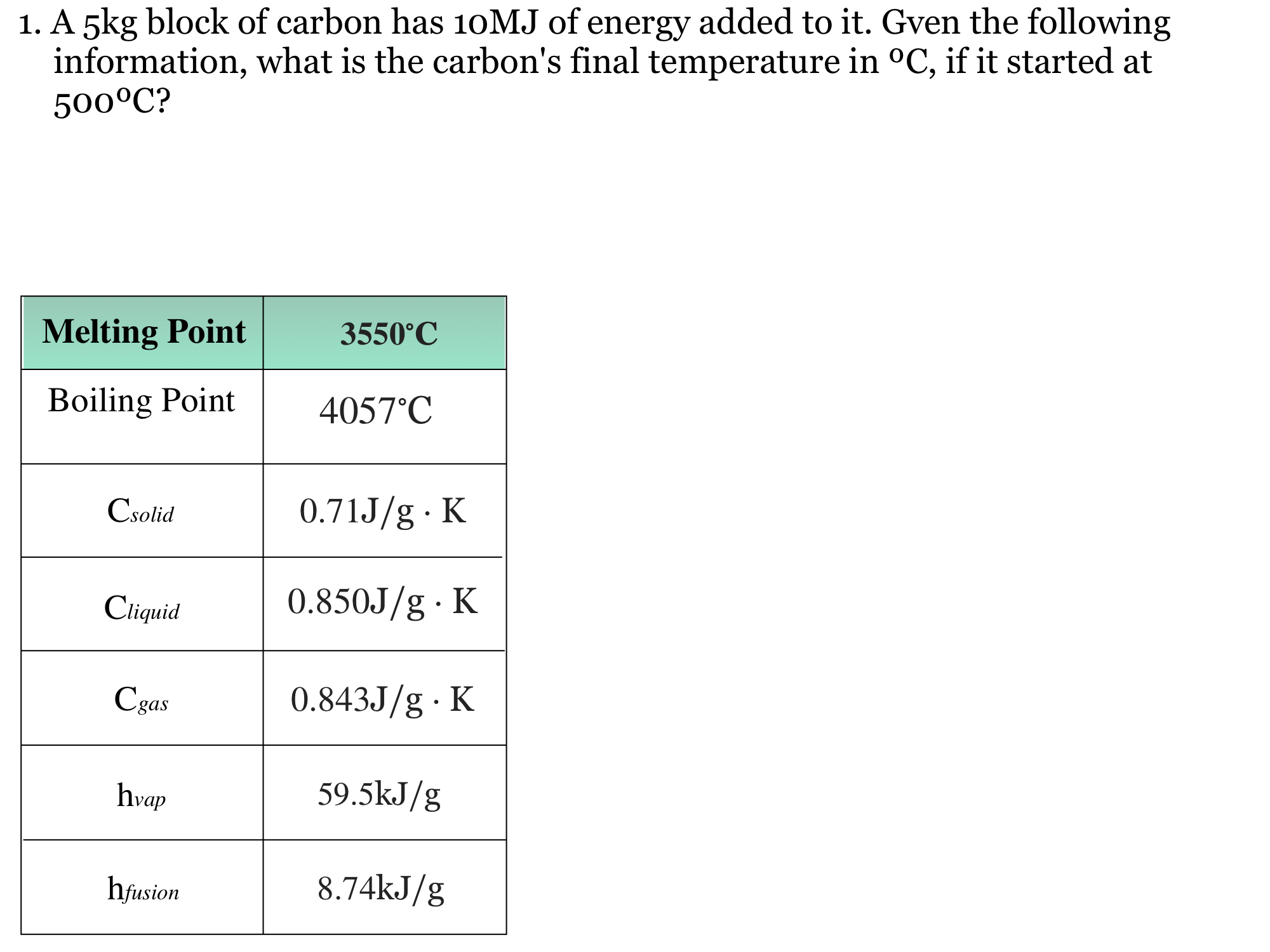
A 5.0 kg carbon block initially at 500°C receives 10 MJ. In the supplied simplified material model, c_solid = 0.71 J/(g·K), the listed melting threshold is 3550°C, c_liquid = 0.850 J/(g·K), c_gas = 0.843 J/(g·K), the listed boiling threshold is 4057°C, L_f = 8.74 kJ/g and L_v = 59.5 kJ/g. Calculate its final temperature within this model and determine whether the listed phase thresholds are reached.
Original problem 1
This is a constant-specific-heat exercise using the provided table. Real carbon’s high-temperature phase behavior depends on pressure and allotrope; its listed melting/boiling data are not a general atmospheric-pressure phase diagram. The unused phase data do not affect this calculation.
Problem text
A 5.0 kg carbon block initially at 500°C receives 10 MJ. In the supplied simplified material model, c_solid = 0.71 J/(g·K), the listed melting threshold is 3550°C, c_liquid = 0.850 J/(g·K), c_gas = 0.843 J/(g·K), the listed boiling threshold is 4057°C, L_f = 8.74 kJ/g and L_v = 59.5 kJ/g. Calculate its final temperature within this model and determine whether the listed phase thresholds are reached.
Drawing is temporarily unavailable. Work on paper if needed, then record your reasoning here.
Saving written working requires JavaScript. The problem remains available above; keep your work on paper or in your own notes.
2. Work it out
Original textbook practice · AP Physics 2 topic
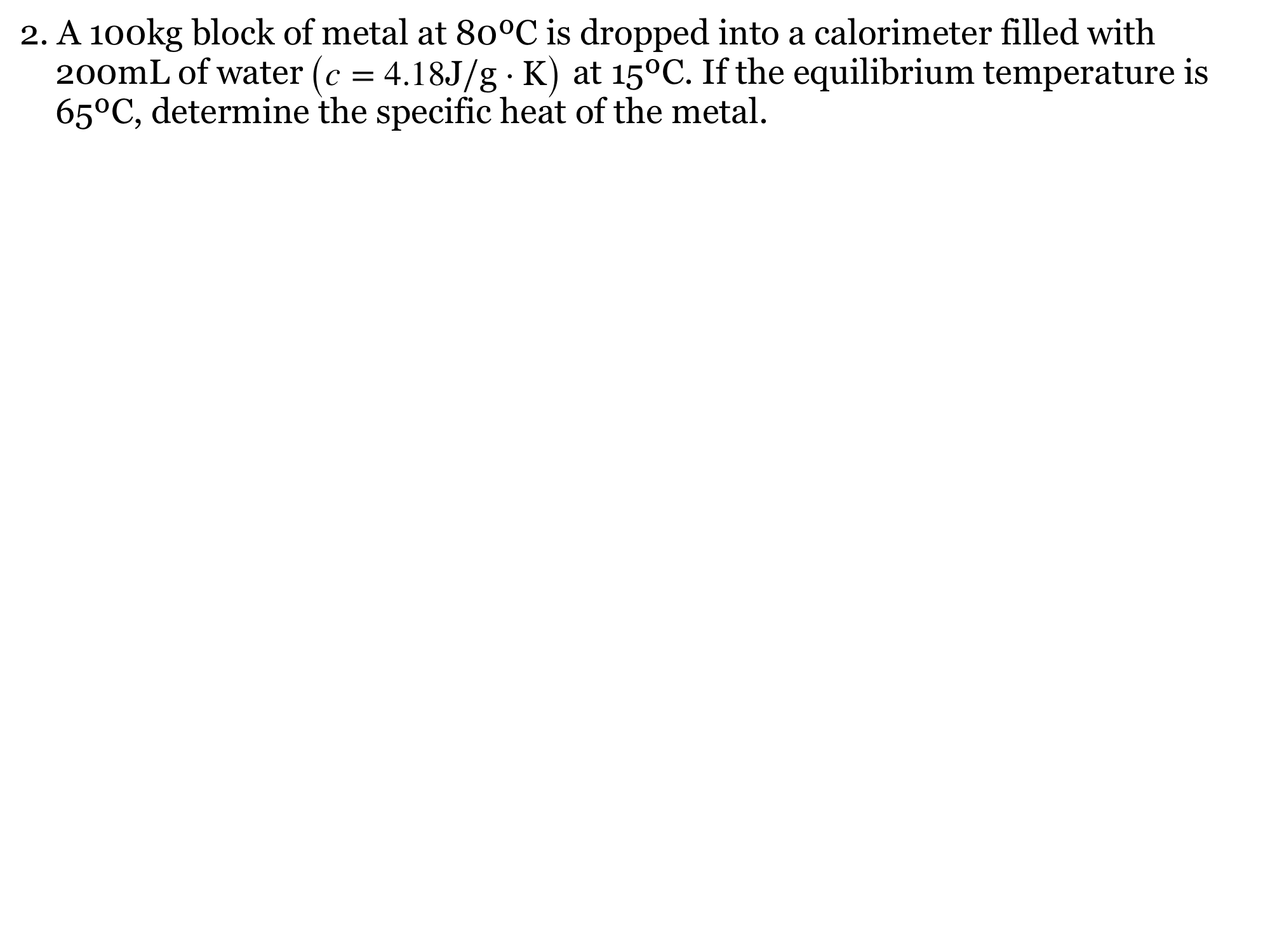
The source states that a 100 kg metal block at 80°C is placed in 200 mL of water initially at 15°C and the final temperature is 65°C. Take water density as 1.00 g/mL and c_w = 4.18 J/(g·K), ignore the container and heat loss, and infer the metal’s specific heat. Comment on the plausibility of the source mass and resulting value.
Original problem 2
The source mass is preserved. Changing it to 100 g would yield 27.9 J/(g·K), which is also not a justified ordinary-metal value.
Problem text
The source states that a 100 kg metal block at 80°C is placed in 200 mL of water initially at 15°C and the final temperature is 65°C. Take water density as 1.00 g/mL and c_w = 4.18 J/(g·K), ignore the container and heat loss, and infer the metal’s specific heat. Comment on the plausibility of the source mass and resulting value.
Drawing is temporarily unavailable. Work on paper if needed, then record your reasoning here.
Saving written working requires JavaScript. The problem remains available above; keep your work on paper or in your own notes.
3. Work it out
Original textbook practice · AP Physics 2 topic
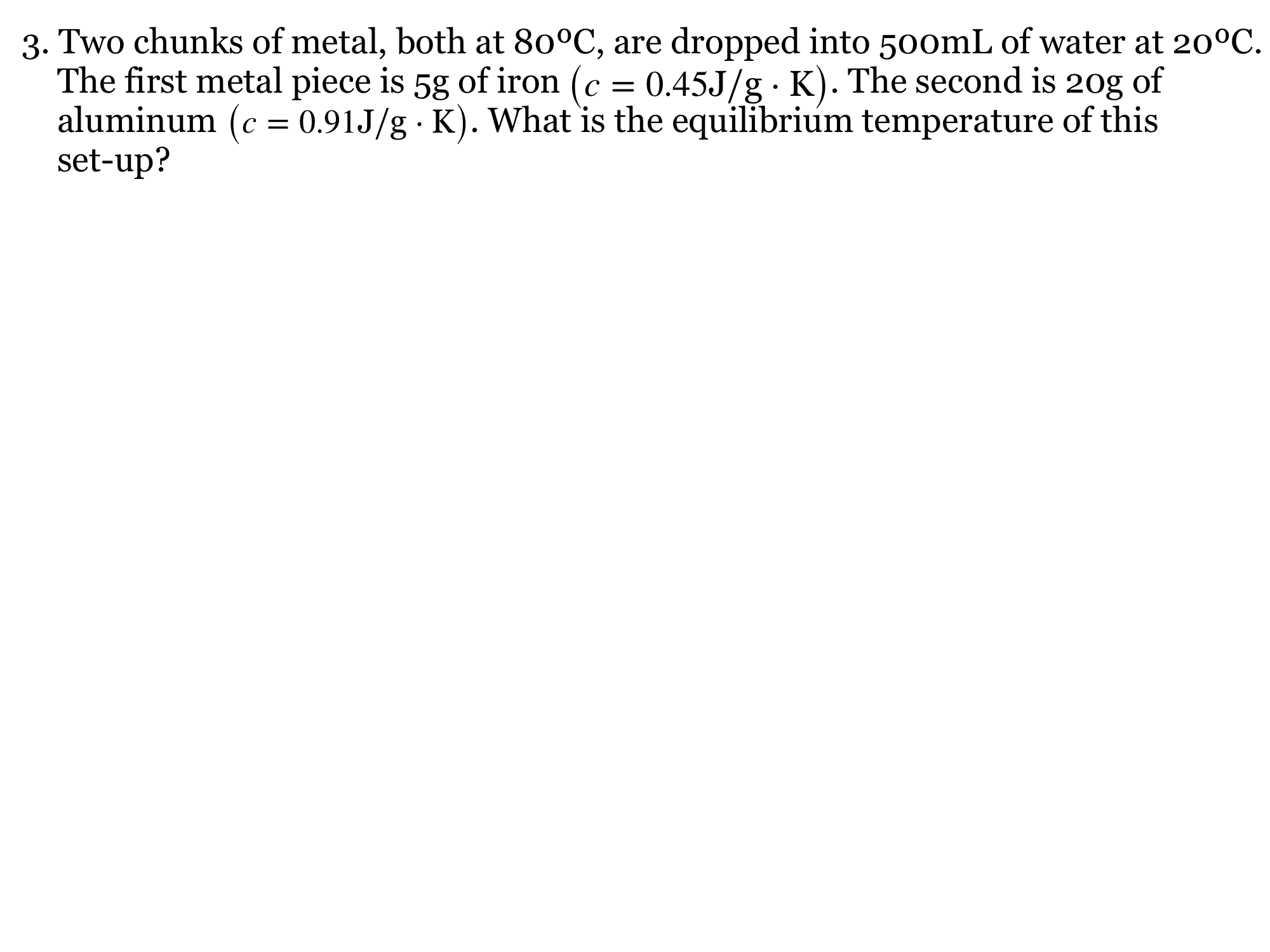
An insulated calorimeter contains 500 mL of water at 20°C. Add 5.0 g of iron with c = 0.45 J/(g·K) and 20 g of aluminum with c = 0.91 J/(g·K), both at 80°C. Use water density 1.00 g/mL and c_w = 4.18 J/(g·K). Neglect the calorimeter’s heat capacity. Find the final equilibrium temperature.
Original problem 3
Problem text
An insulated calorimeter contains 500 mL of water at 20°C. Add 5.0 g of iron with c = 0.45 J/(g·K) and 20 g of aluminum with c = 0.91 J/(g·K), both at 80°C. Use water density 1.00 g/mL and c_w = 4.18 J/(g·K). Neglect the calorimeter’s heat capacity. Find the final equilibrium temperature.
Drawing is temporarily unavailable. Work on paper if needed, then record your reasoning here.
Saving written working requires JavaScript. The problem remains available above; keep your work on paper or in your own notes.
4. Work it out
Original textbook practice · AP Physics 2 topic
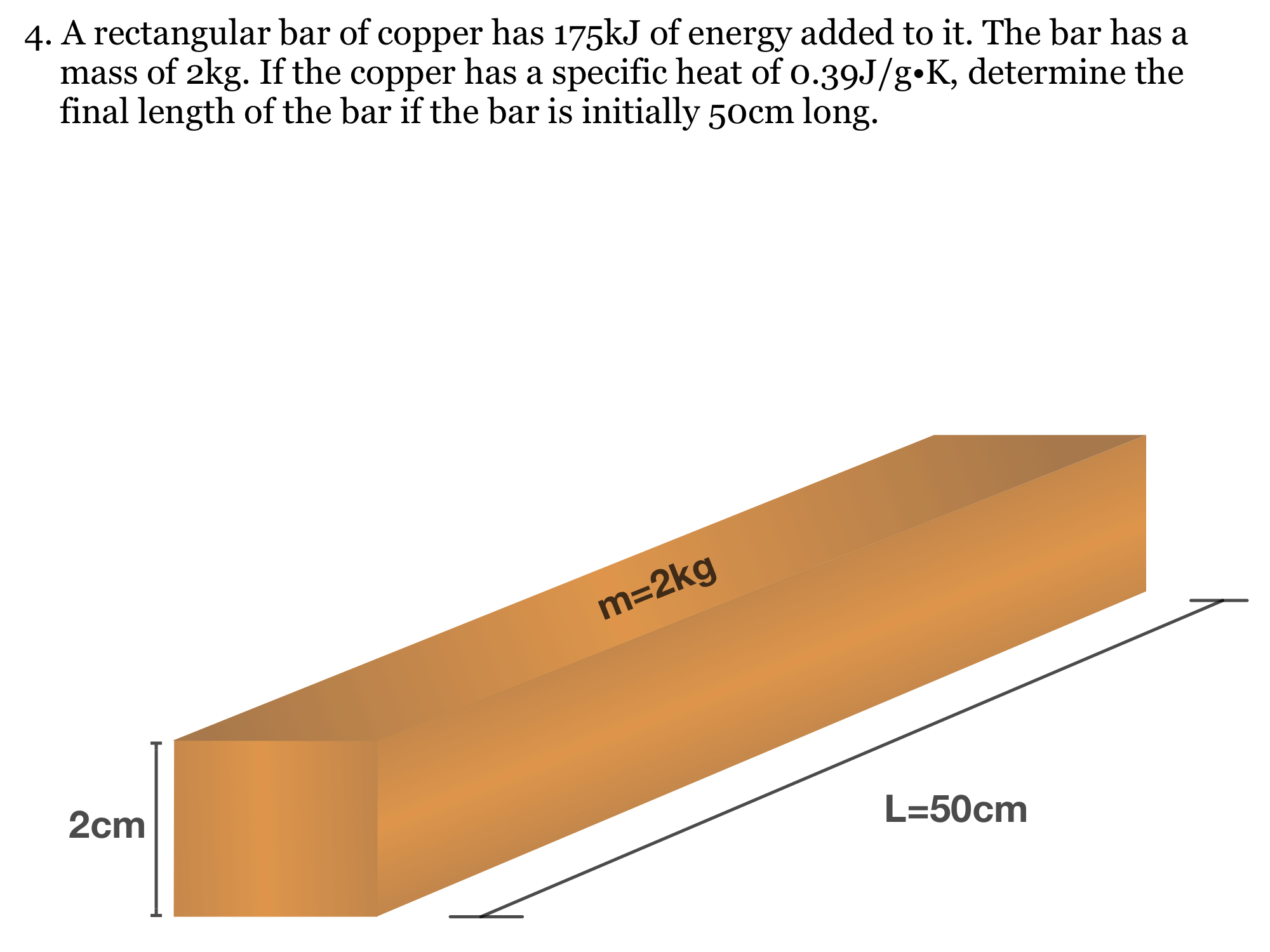
A copper bar of mass 2.0 kg and initial length 0.50 m absorbs 175 kJ. Take c = 0.39 J/(g·K) and the source-table linear expansion coefficient α = 17 × 10⁻⁶ K⁻¹ as constant. Assume the bar remains solid and expands freely. Find its final length.
Original problem 4
The source-table copper coefficient is supplied explicitly. An initial temperature is unnecessary for the length change with constant c and α, but remaining below a phase transition is required.
Problem text
A copper bar of mass 2.0 kg and initial length 0.50 m absorbs 175 kJ. Take c = 0.39 J/(g·K) and the source-table linear expansion coefficient α = 17 × 10⁻⁶ K⁻¹ as constant. Assume the bar remains solid and expands freely. Find its final length.
Drawing is temporarily unavailable. Work on paper if needed, then record your reasoning here.
Saving written working requires JavaScript. The problem remains available above; keep your work on paper or in your own notes.
5. Work it out
Original textbook practice · AP Physics 2 topic
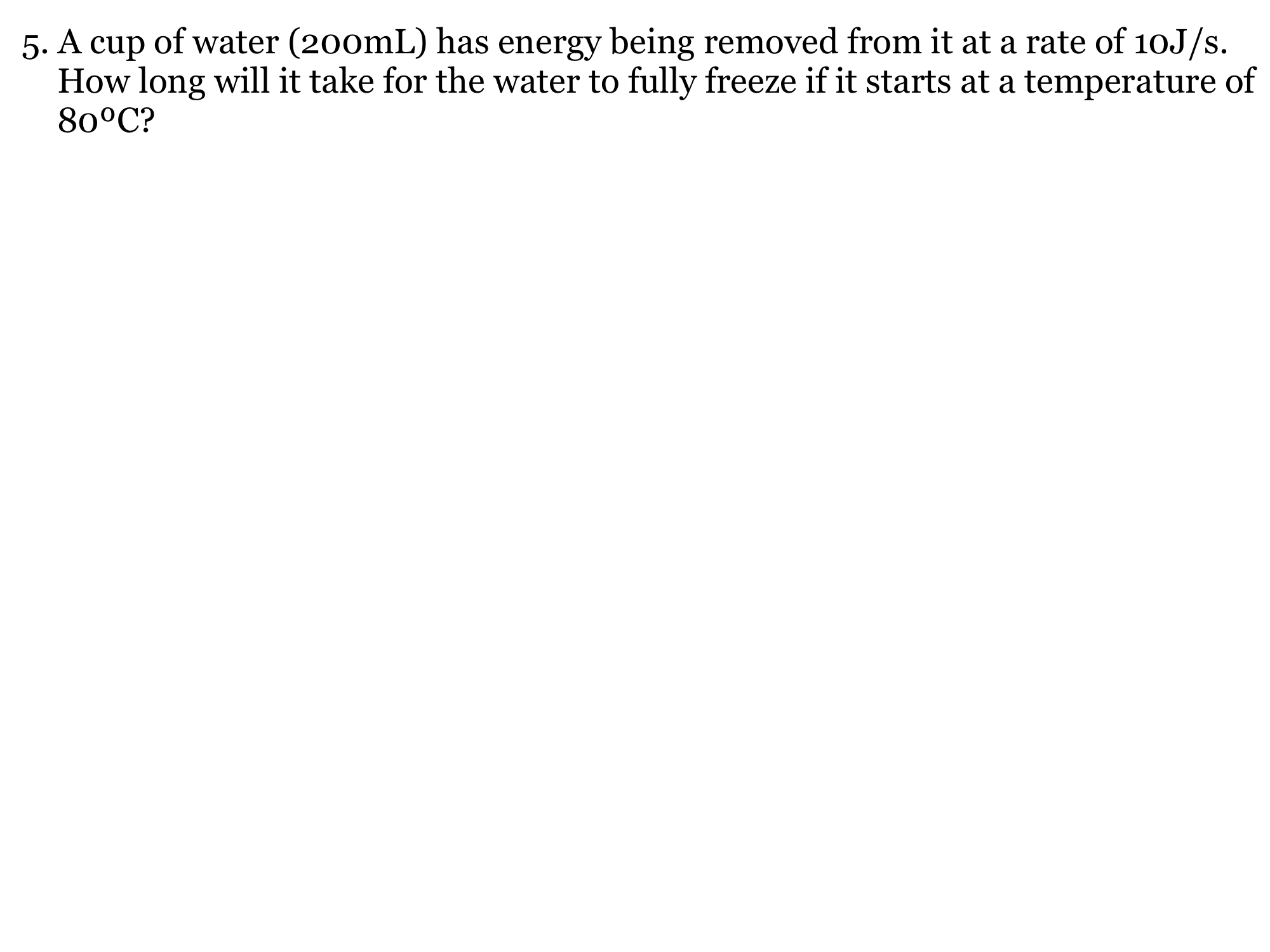
A 200 mL sample of water begins at 80°C. A cooling device removes energy at a constant rate of 10 J/s. Use water density 1.00 g/mL, c_w = 4.18 J/(g·K), L_f = 334 J/g and a freezing temperature of 0°C at approximately atmospheric pressure. Ignore the cup and heat leaks. Find the time to turn all the water into ice at 0°C.
Original problem 5
Problem text
A 200 mL sample of water begins at 80°C. A cooling device removes energy at a constant rate of 10 J/s. Use water density 1.00 g/mL, c_w = 4.18 J/(g·K), L_f = 334 J/g and a freezing temperature of 0°C at approximately atmospheric pressure. Ignore the cup and heat leaks. Find the time to turn all the water into ice at 0°C.
Drawing is temporarily unavailable. Work on paper if needed, then record your reasoning here.
Saving written working requires JavaScript. The problem remains available above; keep your work on paper or in your own notes.
6. Work it out
Original textbook practice · AP Physics 2 topic
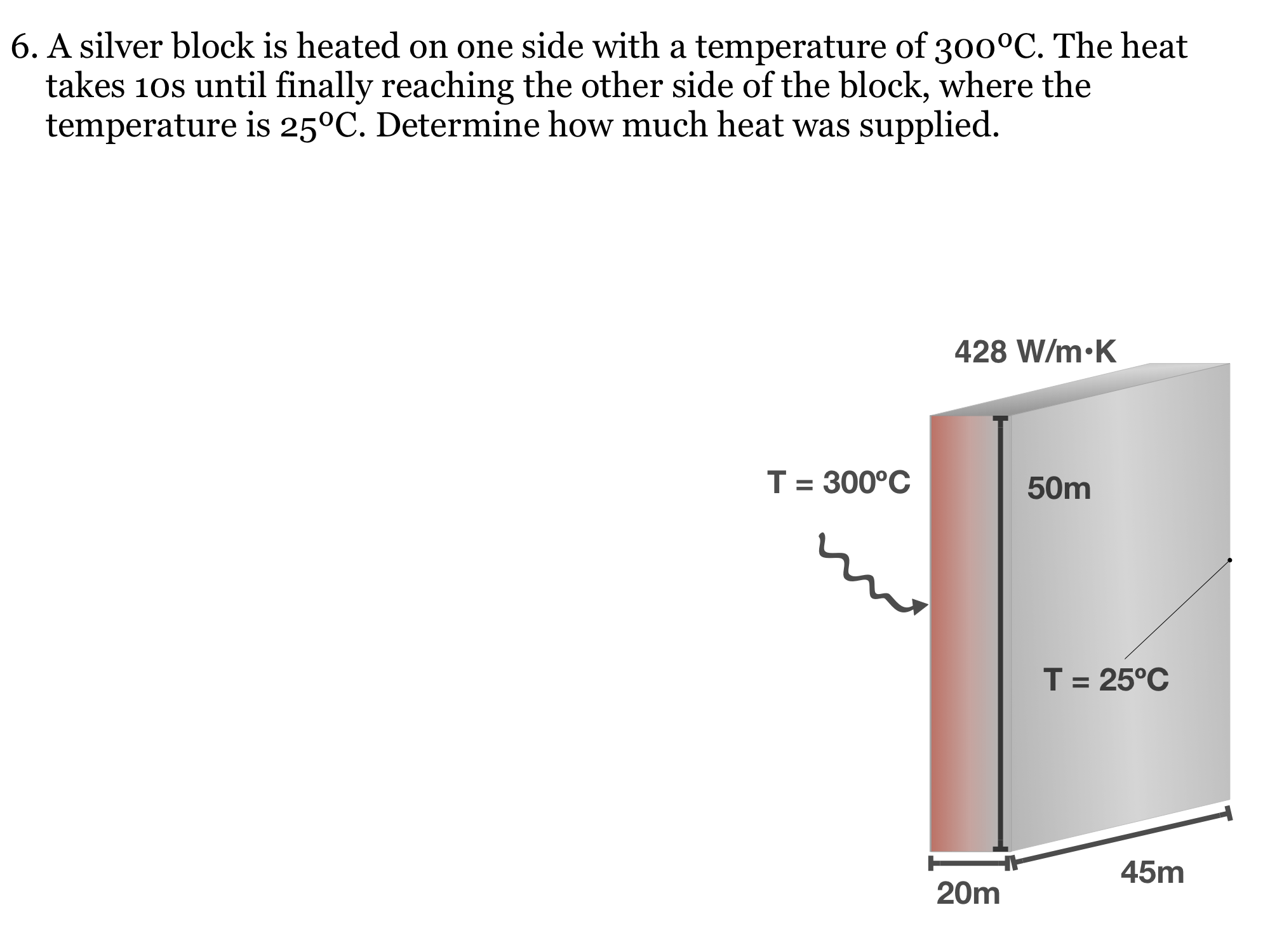
The source silver-block diagram has a heated face 50 m high by 20 m wide and a heat-flow length of 45 m. With conductivity k = 428 W/(m·K), keep one face at 300°C and the opposite face at 25°C. Assume one-dimensional steady conduction, insulated side faces and constant k. How much energy passes through the block during 10 s?
Original problem 6
The original wording that heat “takes 10 s until reaching the other side” is not a steady-conduction boundary condition. A transient heating calculation would additionally need the initial temperature profile, density and specific heat. The dimensions are retained as meters, as shown.
Problem text
The source silver-block diagram has a heated face 50 m high by 20 m wide and a heat-flow length of 45 m. With conductivity k = 428 W/(m·K), keep one face at 300°C and the opposite face at 25°C. Assume one-dimensional steady conduction, insulated side faces and constant k. How much energy passes through the block during 10 s?
Drawing is temporarily unavailable. Work on paper if needed, then record your reasoning here.
Saving written working requires JavaScript. The problem remains available above; keep your work on paper or in your own notes.
7. Work it out
Original textbook practice · AP Physics 2 topic
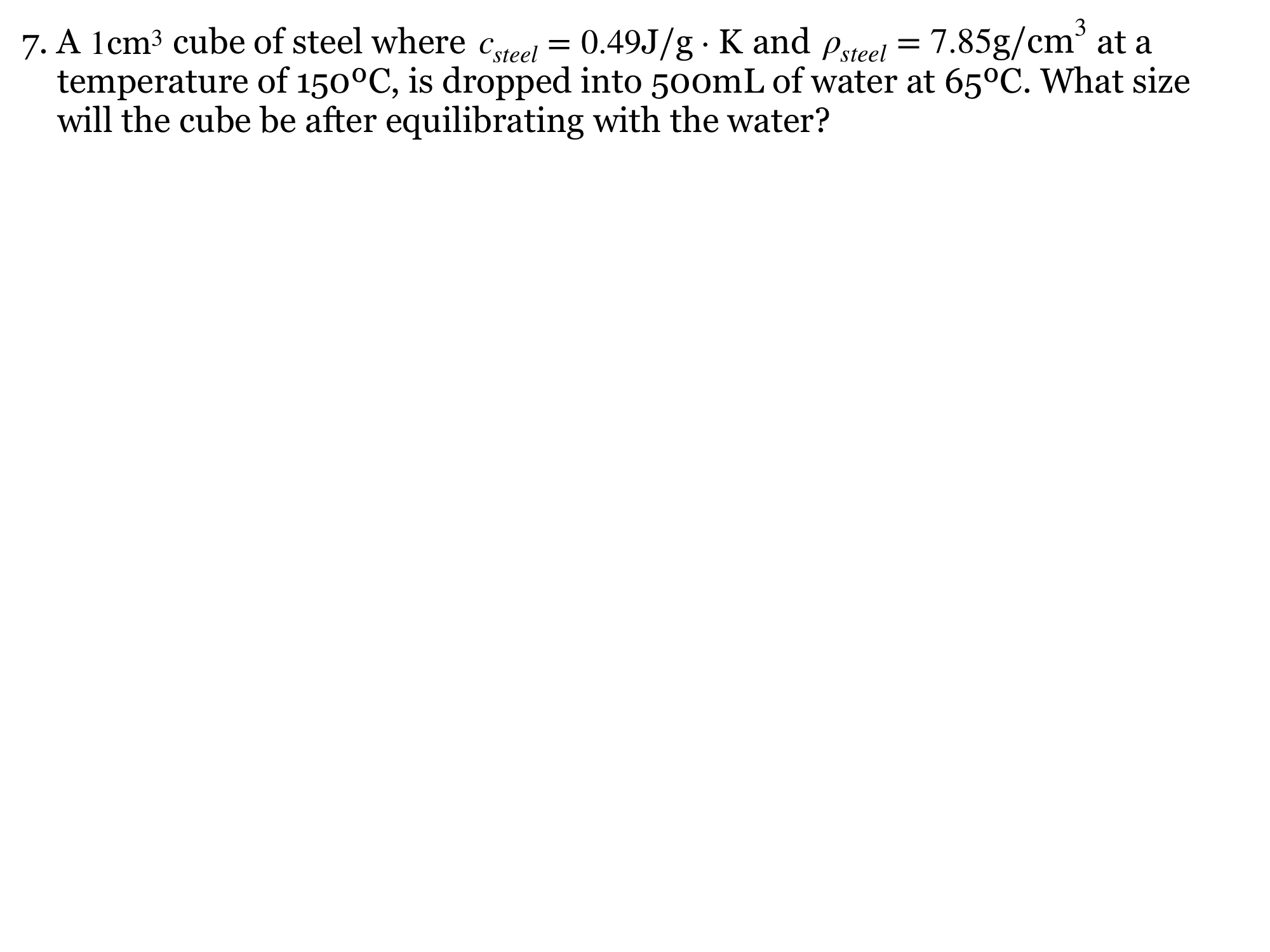
A steel cube initially has volume 1.00 cm³ at 150°C and density 7.85 g/cm³ at that temperature. Its specific heat is 0.49 J/(g·K). Place it into 500 mL of water at 65°C in an ideal insulated calorimeter; use water density 1.00 g/mL and c_w = 4.18 J/(g·K). Take steel’s source-table α = 11 × 10⁻⁶ K⁻¹ as constant. Find the final temperature, edge length and volume, neglecting the container.
Original problem 7
The source’s 1 cm³ means an initial volume, and the source-table steel coefficient is 11 × 10⁻⁶ K⁻¹. Density is used once to find mass at the initial state, not reapplied as a temperature-independent constraint on final volume.
Problem text
A steel cube initially has volume 1.00 cm³ at 150°C and density 7.85 g/cm³ at that temperature. Its specific heat is 0.49 J/(g·K). Place it into 500 mL of water at 65°C in an ideal insulated calorimeter; use water density 1.00 g/mL and c_w = 4.18 J/(g·K). Take steel’s source-table α = 11 × 10⁻⁶ K⁻¹ as constant. Find the final temperature, edge length and volume, neglecting the container.
Drawing is temporarily unavailable. Work on paper if needed, then record your reasoning here.
Saving written working requires JavaScript. The problem remains available above; keep your work on paper or in your own notes.
8. Work it out
Original textbook practice · AP Physics 2 topic
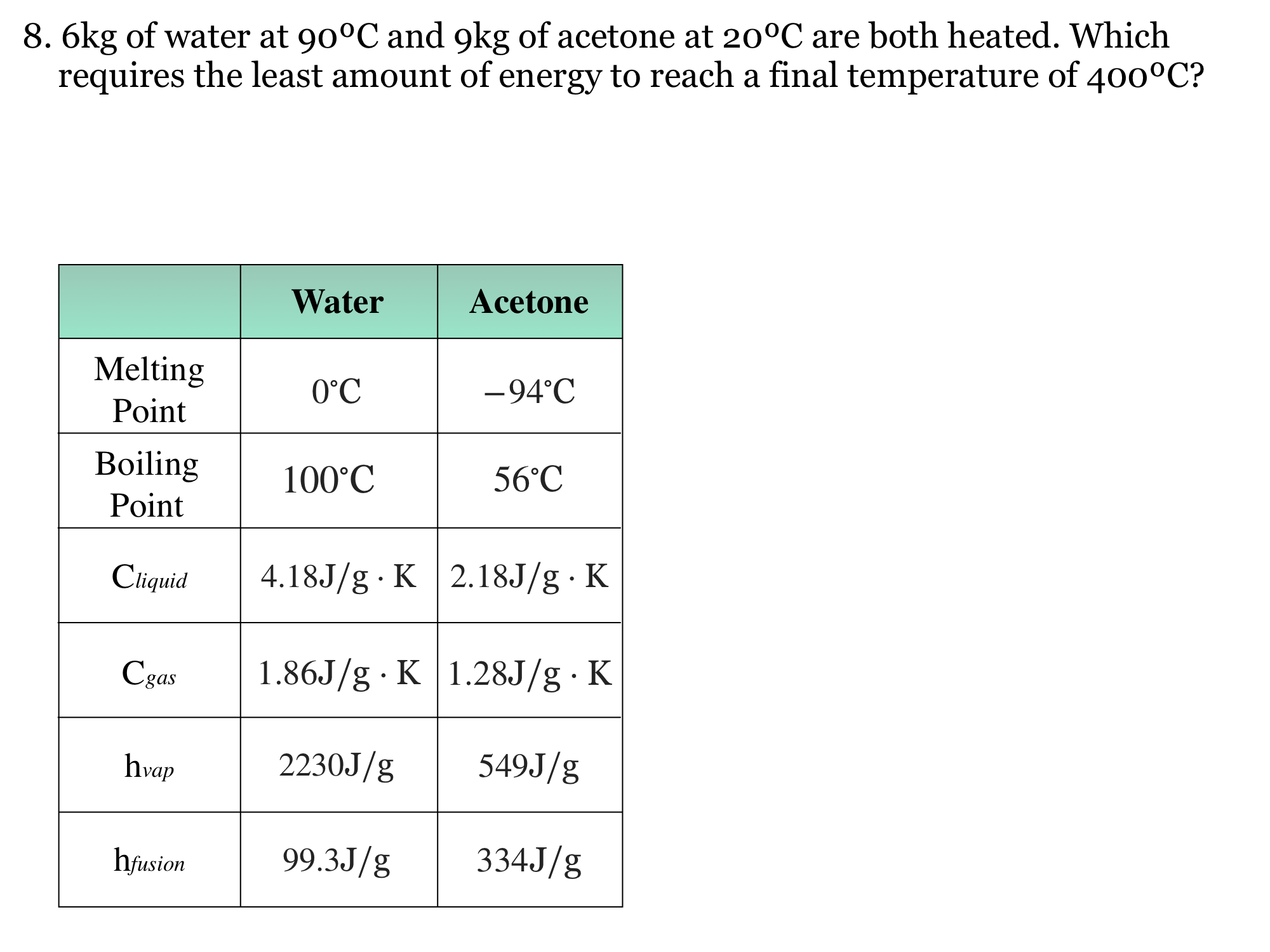
Compare the energy required to bring 6.0 kg of water from 90°C and 9.0 kg of acetone from 20°C to gases at 400°C. Use the source’s idealized constant-property model at approximately atmospheric pressure: water boils at 100°C, c_liquid = 4.18 J/(g·K), c_gas = 1.86 J/(g·K), L_v = 2230 J/g; acetone boils at 56°C, c_liquid = 2.18 J/(g·K), c_gas = 1.28 J/(g·K), L_v = 549 J/g. Neglect losses and chemical reactions.
Original problem 8
The source table interchanges the two fusion values, but fusion is not used in this exercise. The 400°C gas calculations are simplified constant-property estimates; acetone chemical stability and temperature-dependent heat capacities are outside the model.
Problem text
Compare the energy required to bring 6.0 kg of water from 90°C and 9.0 kg of acetone from 20°C to gases at 400°C. Use the source’s idealized constant-property model at approximately atmospheric pressure: water boils at 100°C, c_liquid = 4.18 J/(g·K), c_gas = 1.86 J/(g·K), L_v = 2230 J/g; acetone boils at 56°C, c_liquid = 2.18 J/(g·K), c_gas = 1.28 J/(g·K), L_v = 549 J/g. Neglect losses and chemical reactions.
Drawing is temporarily unavailable. Work on paper if needed, then record your reasoning here.
Saving written working requires JavaScript. The problem remains available above; keep your work on paper or in your own notes.
9. Work it out
Original textbook practice · AP Physics 2 topic
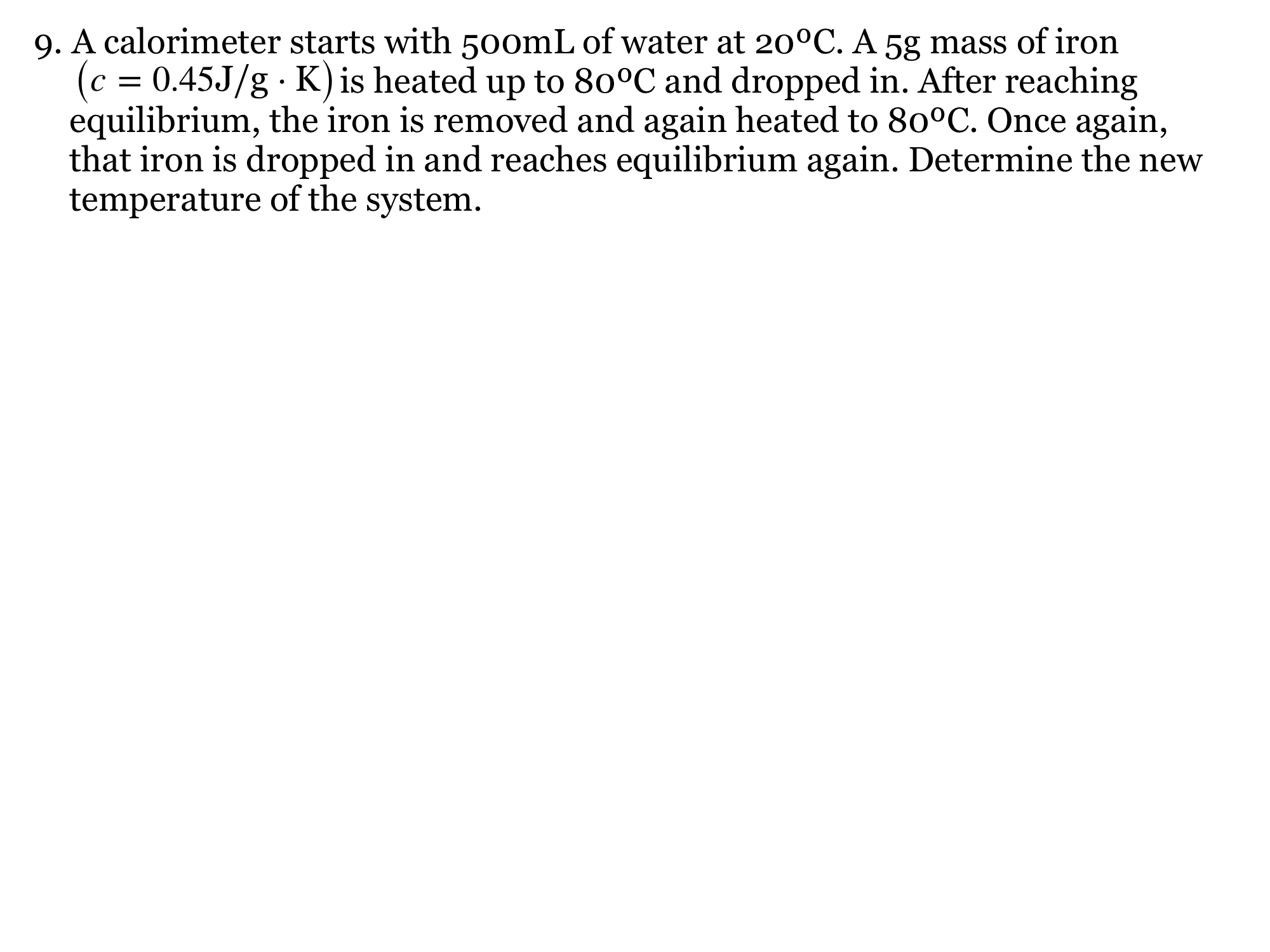
An ideal calorimeter contains 500 mL of water at 20°C. A 5.0 g iron sample with c_Fe = 0.45 J/(g·K), heated separately to 80°C, is placed in the water and allowed to equilibrate. Remove the iron without removing any water, reheat it to 80°C, return it, and allow a second equilibration. Use water density 1.00 g/mL and c_w = 4.18 J/(g·K). Find the second equilibrium temperature, neglecting the container and losses.
Original problem 9
Problem text
An ideal calorimeter contains 500 mL of water at 20°C. A 5.0 g iron sample with c_Fe = 0.45 J/(g·K), heated separately to 80°C, is placed in the water and allowed to equilibrate. Remove the iron without removing any water, reheat it to 80°C, return it, and allow a second equilibration. Use water density 1.00 g/mL and c_w = 4.18 J/(g·K). Find the second equilibrium temperature, neglecting the container and losses.
Drawing is temporarily unavailable. Work on paper if needed, then record your reasoning here.
Saving written working requires JavaScript. The problem remains available above; keep your work on paper or in your own notes.
10. Work it out
Original textbook practice · AP Physics 2 topic
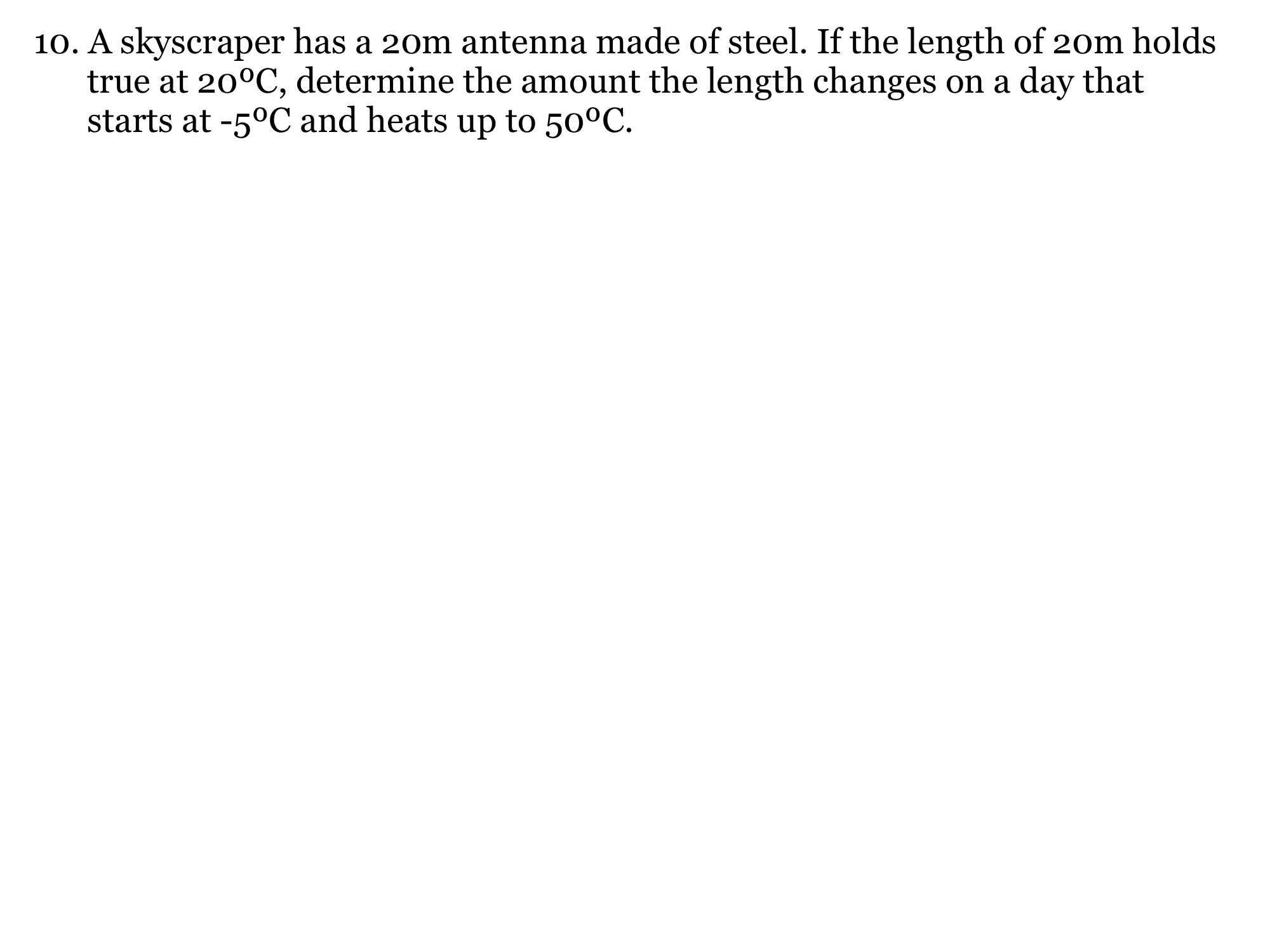
A steel antenna has length 20.0 m at 20°C. Use the source-table α = 11 × 10⁻⁶ K⁻¹ as constant. Find its lengths at −5°C and 50°C and the length increase as the day warms between these temperatures.
Original problem 10
Problem text
A steel antenna has length 20.0 m at 20°C. Use the source-table α = 11 × 10⁻⁶ K⁻¹ as constant. Find its lengths at −5°C and 50°C and the length increase as the day warms between these temperatures.
Drawing is temporarily unavailable. Work on paper if needed, then record your reasoning here.
Saving written working requires JavaScript. The problem remains available above; keep your work on paper or in your own notes.
Additional practice
11. Where Celsius and Fahrenheit agree
Original textbook practice · AP Physics 2 topic
Find the temperature for which the Celsius and Fahrenheit readings are equal. Then convert a temperature rise of 30°F into a rise in kelvins.
Your written working
Drawing is temporarily unavailable. Work on paper if needed, then record your reasoning here.
Saving written working requires JavaScript. The problem remains available above; keep your work on paper or in your own notes.
12. Mix two water samples
Original textbook practice · AP Physics 2 topic
Mix 250 g of water at 80°C with 400 g of water at 15°C in an insulated container of negligible heat capacity. Find the final temperature, assuming no phase change.
Your written working
Drawing is temporarily unavailable. Work on paper if needed, then record your reasoning here.
Saving written working requires JavaScript. The problem remains available above; keep your work on paper or in your own notes.
13. Include the calorimeter itself
Original textbook practice · AP Physics 2 topic
Place 0.20 kg of brass at 100°C into 0.25 kg of water initially at 20°C in a calorimeter also initially at 20°C. The calorimeter heat capacity is 150 J/K. Use c_brass = 380 J/(kg·K) and c_water = 4180 J/(kg·K). The combined system is insulated. Find its final temperature.
Your written working
Drawing is temporarily unavailable. Work on paper if needed, then record your reasoning here.
Saving written working requires JavaScript. The problem remains available above; keep your work on paper or in your own notes.
14. Efficient electric kettle
Original textbook practice · AP Physics 2 topic
A 1000 W kettle transfers 80% of its electrical energy into 0.50 kg of water. Find the time to heat the water from 18°C to 95°C, using c_w = 4180 J/(kg·K). Neglect the kettle’s heat capacity and evaporation.
Your written working
Drawing is temporarily unavailable. Work on paper if needed, then record your reasoning here.
Saving written working requires JavaScript. The problem remains available above; keep your work on paper or in your own notes.
15. Brake heating from a stop
Original textbook practice · AP Physics 2 topic
A bicycle and rider of total mass 75 kg stop from 12 m/s. Half of their initial translational kinetic energy is absorbed by a 1.0 kg steel brake assembly. Use c_steel = 490 J/(kg·K). Find the assembly’s temperature rise, ignoring wheel spin and cooling during the stop.
Your written working
Drawing is temporarily unavailable. Work on paper if needed, then record your reasoning here.
Saving written working requires JavaScript. The problem remains available above; keep your work on paper or in your own notes.
16. Partial melting after warming ice
Original textbook practice · AP Physics 2 topic
A 0.100 kg ice sample starts at −20°C and receives 20.0 kJ at atmospheric pressure. Use c_ice = 2100 J/(kg·K) and L_f = 334,000 J/kg. Find its final temperature and the masses of liquid water and remaining ice.
Your written working
Drawing is temporarily unavailable. Work on paper if needed, then record your reasoning here.
Saving written working requires JavaScript. The problem remains available above; keep your work on paper or in your own notes.
17. Ice cools a drink
Original textbook practice · AP Physics 2 topic
Add 50 g of ice at −10°C to 200 g of water at 40°C in an ideal insulated cup. Use c_ice = 2.10 J/(g·K), c_water = 4.18 J/(g·K), and L_f = 334 J/g. Find the final temperature and determine whether all the ice melts.
Your written working
Drawing is temporarily unavailable. Work on paper if needed, then record your reasoning here.
Saving written working requires JavaScript. The problem remains available above; keep your work on paper or in your own notes.
18. Steam condenses into water
Original textbook practice · AP Physics 2 topic
Inject 10.0 g of steam at 100°C into 200 g of water at 20°C in an insulated vessel at atmospheric pressure. All steam condenses and no water escapes. Use L_v = 2257 J/g and c_water = 4.18 J/(g·K). Find the final temperature and verify that it is below 100°C.
Your written working
Drawing is temporarily unavailable. Work on paper if needed, then record your reasoning here.
Saving written working requires JavaScript. The problem remains available above; keep your work on paper or in your own notes.
19. Read material properties from a heating curve
Original textbook practice · AP Physics 2 topic
A heater delivers a constant 50 W to a 0.040 kg pure sample with negligible heat losses. A single-phase segment rises by 20 K in 40 s, then a phase-change plateau lasts 120 s at constant pressure. Find the specific heat on the rising segment and the latent heat of the transition.
Your written working
Drawing is temporarily unavailable. Work on paper if needed, then record your reasoning here.
Saving written working requires JavaScript. The problem remains available above; keep your work on paper or in your own notes.
20. Wax cools and solidifies
Original textbook practice · AP Physics 2 topic
A 30 g pure wax sample starts liquid at 80°C and ends solid at 20°C. Its melting point is 60°C, liquid specific heat is 2.4 J/(g·K), solid specific heat is 2.0 J/(g·K), and latent heat of fusion is 200 J/g. Find the magnitude and sign of heat transferred to the wax.
Your written working
Drawing is temporarily unavailable. Work on paper if needed, then record your reasoning here.
Saving written working requires JavaScript. The problem remains available above; keep your work on paper or in your own notes.
21. Length of a heated brass wire
Original textbook practice · AP Physics 2 topic
A brass wire is 0.750 m long at 20°C and is freely heated to 100°C. With constant α = 19 × 10⁻⁶ K⁻¹, find its extension and final length.
Your written working
Drawing is temporarily unavailable. Work on paper if needed, then record your reasoning here.
Saving written working requires JavaScript. The problem remains available above; keep your work on paper or in your own notes.
22. A hole in a heated plate
Original textbook practice · AP Physics 2 topic
An aluminum plate has a circular hole of diameter 20.0 mm at 20°C. Heat the unconstrained plate uniformly to 170°C. With α = 23 × 10⁻⁶ K⁻¹, find the hole’s new diameter. Explain whether the hole grows or shrinks.
Your written working
Drawing is temporarily unavailable. Work on paper if needed, then record your reasoning here.
Saving written working requires JavaScript. The problem remains available above; keep your work on paper or in your own notes.
23. Differential expansion of two rails
Original textbook practice · AP Physics 2 topic
An aluminum rail and a steel rail each have length 2.00 m at 10°C, with their left ends aligned. They are free to expand when heated to 80°C. Use α_aluminum = 23 × 10⁻⁶ K⁻¹ and α_steel = 11 × 10⁻⁶ K⁻¹. By how much do their right ends separate?
Your written working
Drawing is temporarily unavailable. Work on paper if needed, then record your reasoning here.
Saving written working requires JavaScript. The problem remains available above; keep your work on paper or in your own notes.
24. Density changes when a liquid expands
Original textbook practice · AP Physics 2 topic
Ethanol has density 789 kg/m³ at 20°C. A fixed mass is warmed to 50°C. In the linear volume-expansion model use β = 1.10 × 10⁻³ K⁻¹ and neglect evaporation. Find its final density.
Your written working
Drawing is temporarily unavailable. Work on paper if needed, then record your reasoning here.
Saving written working requires JavaScript. The problem remains available above; keep your work on paper or in your own notes.
25. Thermal stress in a constrained steel rod
Original textbook practice · AP Physics 2 topic
A steel rod is fixed firmly at both ends so its length cannot change. It warms by 40 K. Use Young’s modulus E = 200 GPa and α = 11 × 10⁻⁶ K⁻¹. In the elastic small-strain model, determine the stress needed to cancel its free thermal expansion and state whether it is tensile or compressive.
Your written working
Drawing is temporarily unavailable. Work on paper if needed, then record your reasoning here.
Saving written working requires JavaScript. The problem remains available above; keep your work on paper or in your own notes.
26. Heat conducted through window glass
Original textbook practice · AP Physics 2 topic
A glass pane has area 2.0 m² and thickness 6.0 mm. Maintain its faces at 22°C and 2°C. With k = 1.0 W/(m·K), find the steady conduction rate and the energy transmitted in 30 min. Ignore surface-film resistance and edge losses.
Your written working
Drawing is temporarily unavailable. Work on paper if needed, then record your reasoning here.
Saving written working requires JavaScript. The problem remains available above; keep your work on paper or in your own notes.
27. Composite wall and interface temperature
Original textbook practice · AP Physics 2 topic
A wall of area 8.0 m² has 0.12 m of brick (k = 0.60 W/(m·K)) next to 0.040 m of foam (k = 0.030 W/(m·K)). The brick-side outer face is held at 20°C and the foam-side outer face at −10°C. Find the steady heat rate and the brick–foam interface temperature, neglecting contact and surface resistances.
Your written working
Drawing is temporarily unavailable. Work on paper if needed, then record your reasoning here.
Saving written working requires JavaScript. The problem remains available above; keep your work on paper or in your own notes.
28. Radiative cooling at the initial instant
Original textbook practice · AP Physics 2 topic
A small body with mass 0.20 kg, specific heat 900 J/(kg·K), radiating area 0.10 m² and emissivity 0.80 is initially at 400 K in a large 300 K enclosure. Find its initial net radiative heat-loss rate and initial cooling rate. Ignore convection and conduction. Use σ = 5.670374419 × 10⁻⁸ W/(m²·K⁴).
Your written working
Drawing is temporarily unavailable. Work on paper if needed, then record your reasoning here.
Saving written working requires JavaScript. The problem remains available above; keep your work on paper or in your own notes.
29. Convective heat transfer from a panel
Original textbook practice · AP Physics 2 topic
A panel’s surface is maintained at 50°C in moving air at 25°C. Its exposed area is 1.5 m². For this flow the convective heat-transfer coefficient is h = 8.0 W/(m²·K), with P_out = hA(T_surface − T_air). Find the heat-loss rate and the energy lost in 5.0 min.
Your written working
Drawing is temporarily unavailable. Work on paper if needed, then record your reasoning here.
Saving written working requires JavaScript. The problem remains available above; keep your work on paper or in your own notes.
30. Calorimetry with a measured heat leak
Original textbook practice · AP Physics 2 topic
Mix a 0.50 kg copper object at 90°C with 0.30 kg water at 20°C. During equilibration the combined system loses 5.00 kJ to the room. Use c_copper = 390 J/(kg·K), c_water = 4180 J/(kg·K), and negligible container heat capacity. Find the final common temperature.
Your written working
Drawing is temporarily unavailable. Work on paper if needed, then record your reasoning here.
Saving written working requires JavaScript. The problem remains available above; keep your work on paper or in your own notes.