Waves practice
Work from memory first. Draw a diagram, state the assumptions and keep units through every step. Worked answers are separate.
· Open separate worked solutions
1. Work it out
Original textbook practice · AP Physics 2 topic
Two waves on a string are y₁ = 4U sin(9x − 4t) and y₂ = 6U sin(4x − t), where x is in metres, t in seconds, and U denotes the common displacement unit omitted in the source. Find the resultant displacement at x = 4 m and t = 4 s. Use radians.
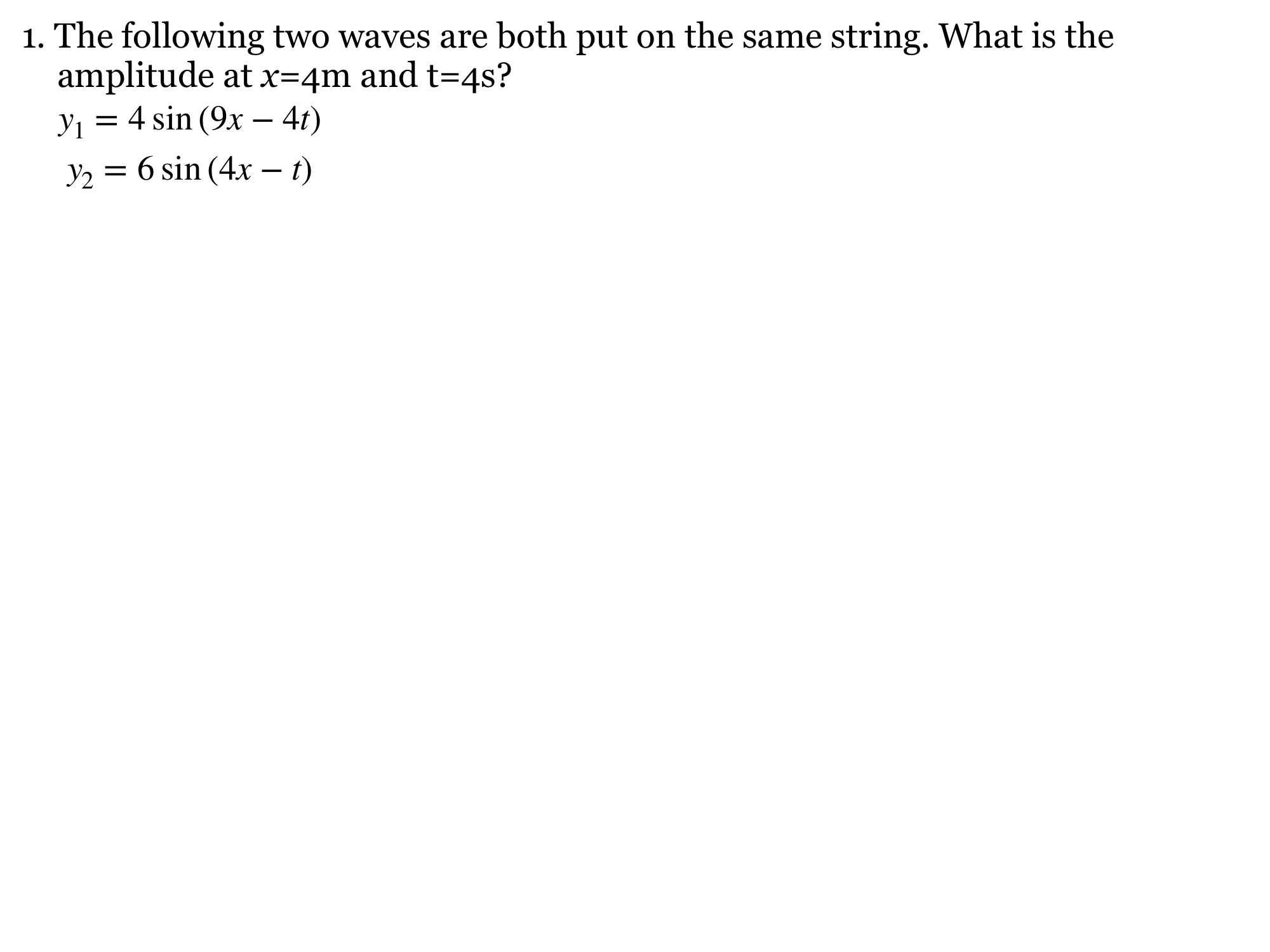
Original problem 1
The source calls this “amplitude,” but a value at one position and time is displacement. It omits the coefficients’ displacement unit, so metres cannot be asserted for y.
Problem text
Two waves on a string are y₁ = 4U sin(9x − 4t) and y₂ = 6U sin(4x − t), where x is in metres, t in seconds, and U denotes the common displacement unit omitted in the source. Find the resultant displacement at x = 4 m and t = 4 s. Use radians.
Drawing is temporarily unavailable. Work on paper if needed, then record your reasoning here.
Saving written working requires JavaScript. The problem remains available above; keep your work on paper or in your own notes.
2. Work it out
Original textbook practice · AP Physics 2 topic
Two waves on a string are y₁ = 6U sin(x − t) and y₂ = 8U sin(x + t), where x is in metres, t in seconds, and U is the common displacement unit omitted in the source. Find the resultant displacement at x = 1 m and t = 6 s. Use radians.
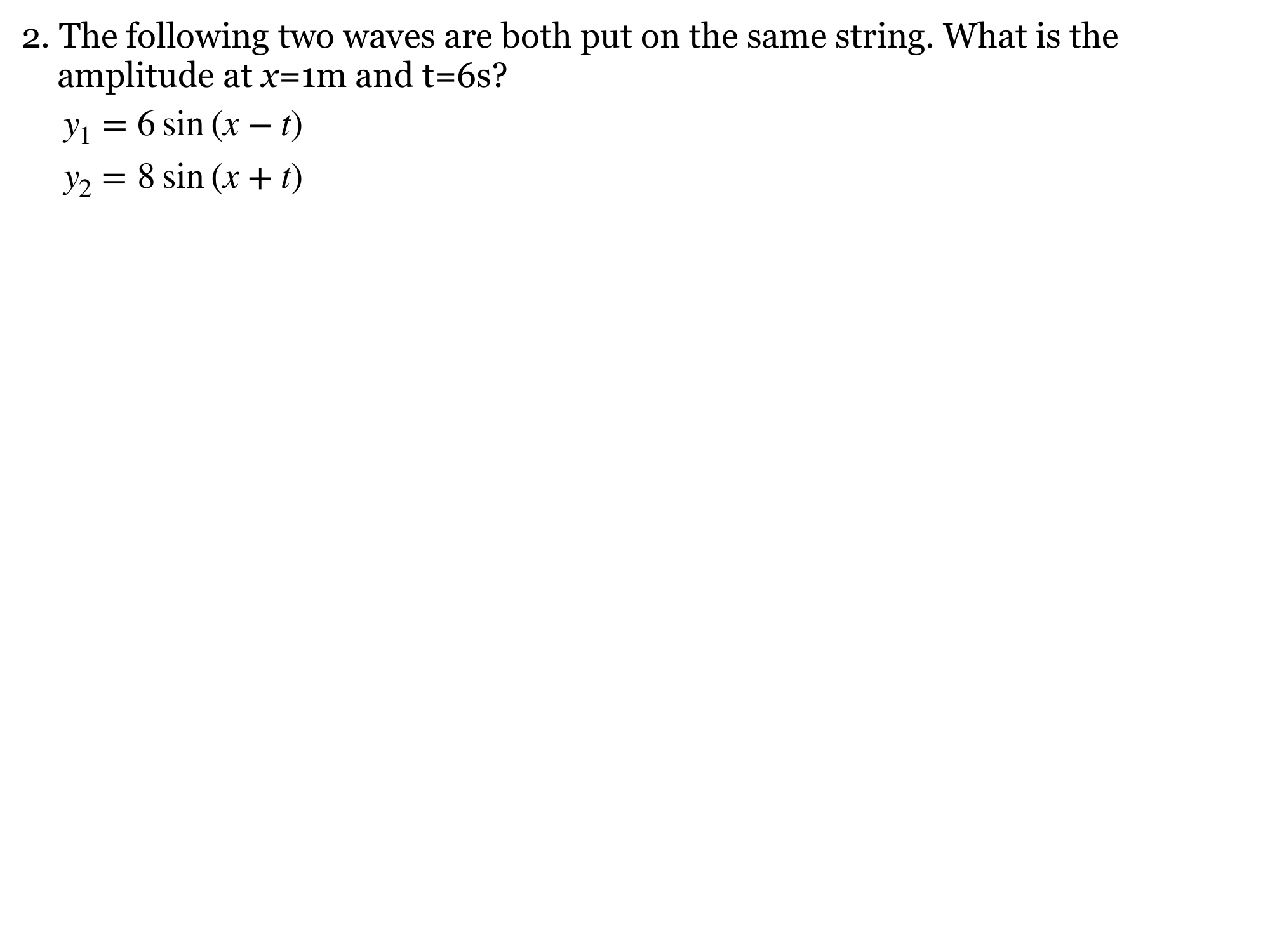
Original problem 2
The requested quantity is displacement, not a time-independent resultant amplitude. The source omits the displacement unit.
Problem text
Two waves on a string are y₁ = 6U sin(x − t) and y₂ = 8U sin(x + t), where x is in metres, t in seconds, and U is the common displacement unit omitted in the source. Find the resultant displacement at x = 1 m and t = 6 s. Use radians.
Drawing is temporarily unavailable. Work on paper if needed, then record your reasoning here.
Saving written working requires JavaScript. The problem remains available above; keep your work on paper or in your own notes.
3. Work it out
Original textbook practice · AP Physics 2 topic
A guitarist on a van travels directly away from a stationary audience at 40 m/s in still air. The local speed of sound is 340 m/s. Find the observed frequency as a fraction of the emitted frequency and the percentage decrease.
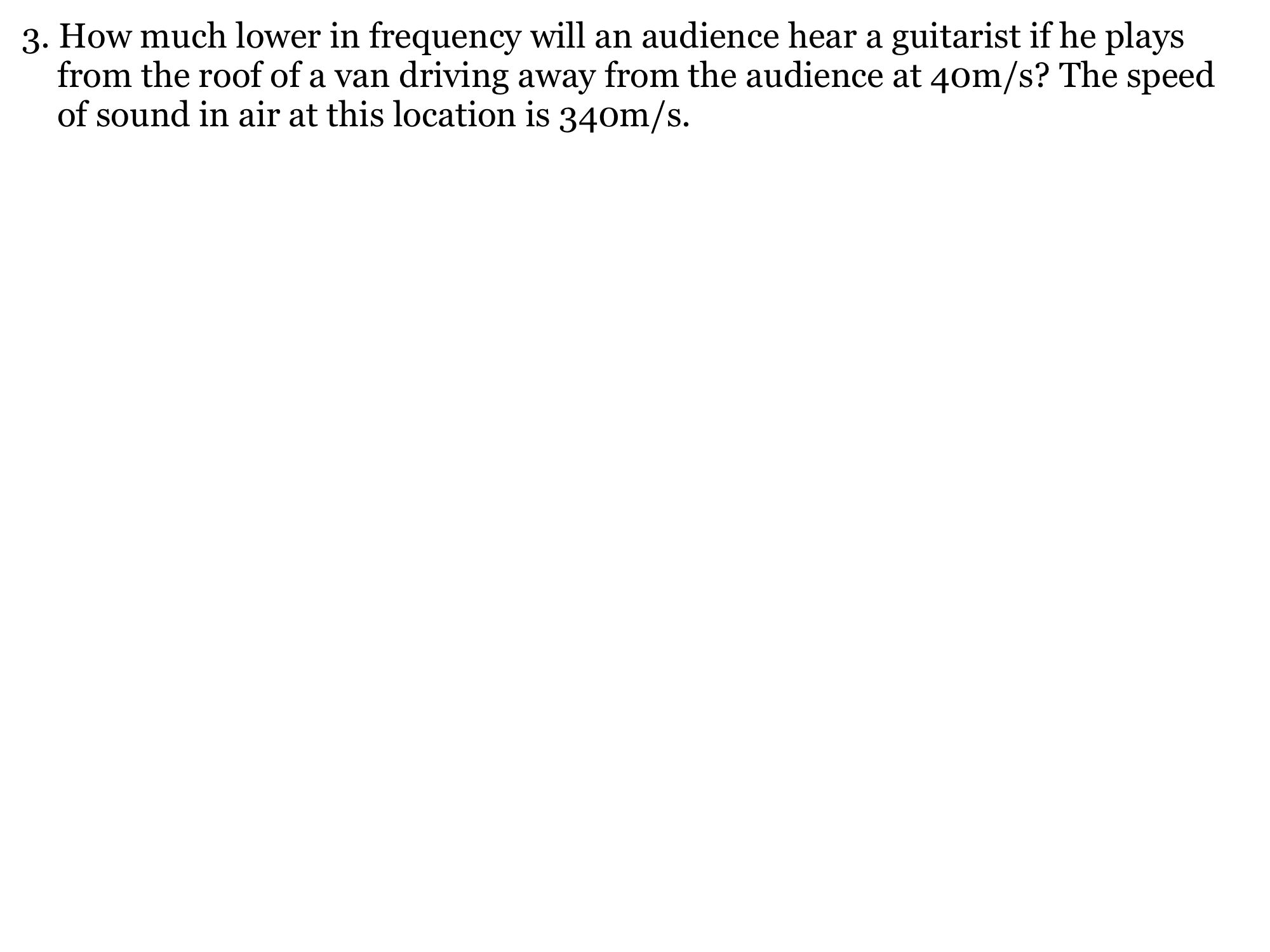
Original problem 3
An emitted frequency is not given, so the decrease cannot be stated as a unique number of hertz.
Problem text
A guitarist on a van travels directly away from a stationary audience at 40 m/s in still air. The local speed of sound is 340 m/s. Find the observed frequency as a fraction of the emitted frequency and the percentage decrease.
Drawing is temporarily unavailable. Work on paper if needed, then record your reasoning here.
Saving written working requires JavaScript. The problem remains available above; keep your work on paper or in your own notes.
4. Work it out
Original textbook practice · AP Physics 2 topic
A source recedes directly from Earth in vacuum. Light emitted at wavelength 500 nm is observed at 700 nm. Find its relative recession speed using the relativistic longitudinal Doppler relation.
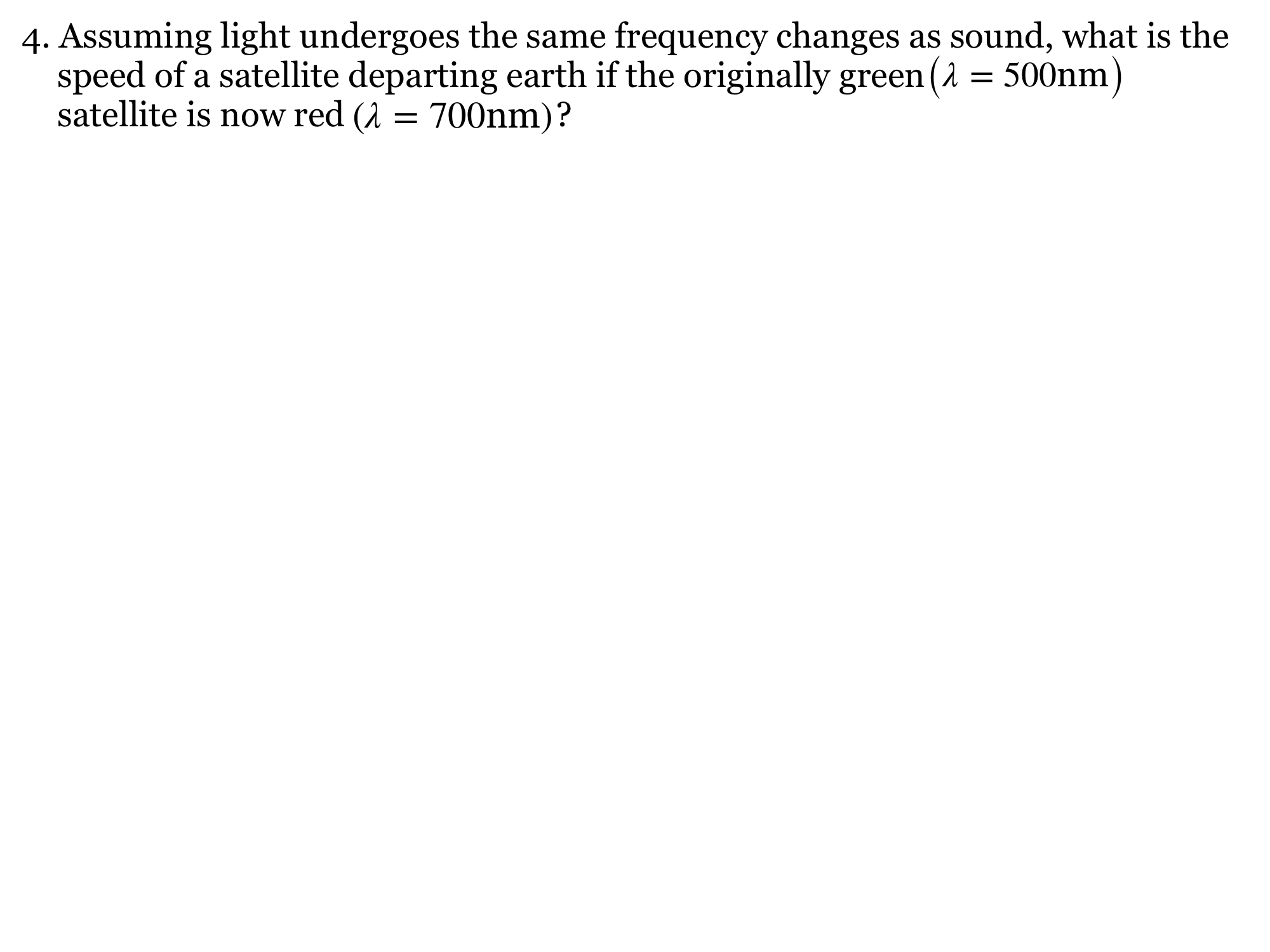
Original problem 4
The source explicitly assumes light obeys the sound formula. That assumption is physically wrong. Its formal sound-like result would be 0.4c, but it is not the valid light answer. This is a hypothetical source; it is not a plausible Earth satellite speed.
Problem text
A source recedes directly from Earth in vacuum. Light emitted at wavelength 500 nm is observed at 700 nm. Find its relative recession speed using the relativistic longitudinal Doppler relation.
Drawing is temporarily unavailable. Work on paper if needed, then record your reasoning here.
Saving written working requires JavaScript. The problem remains available above; keep your work on paper or in your own notes.
5. Work it out
Original textbook practice · AP Physics 2 topic
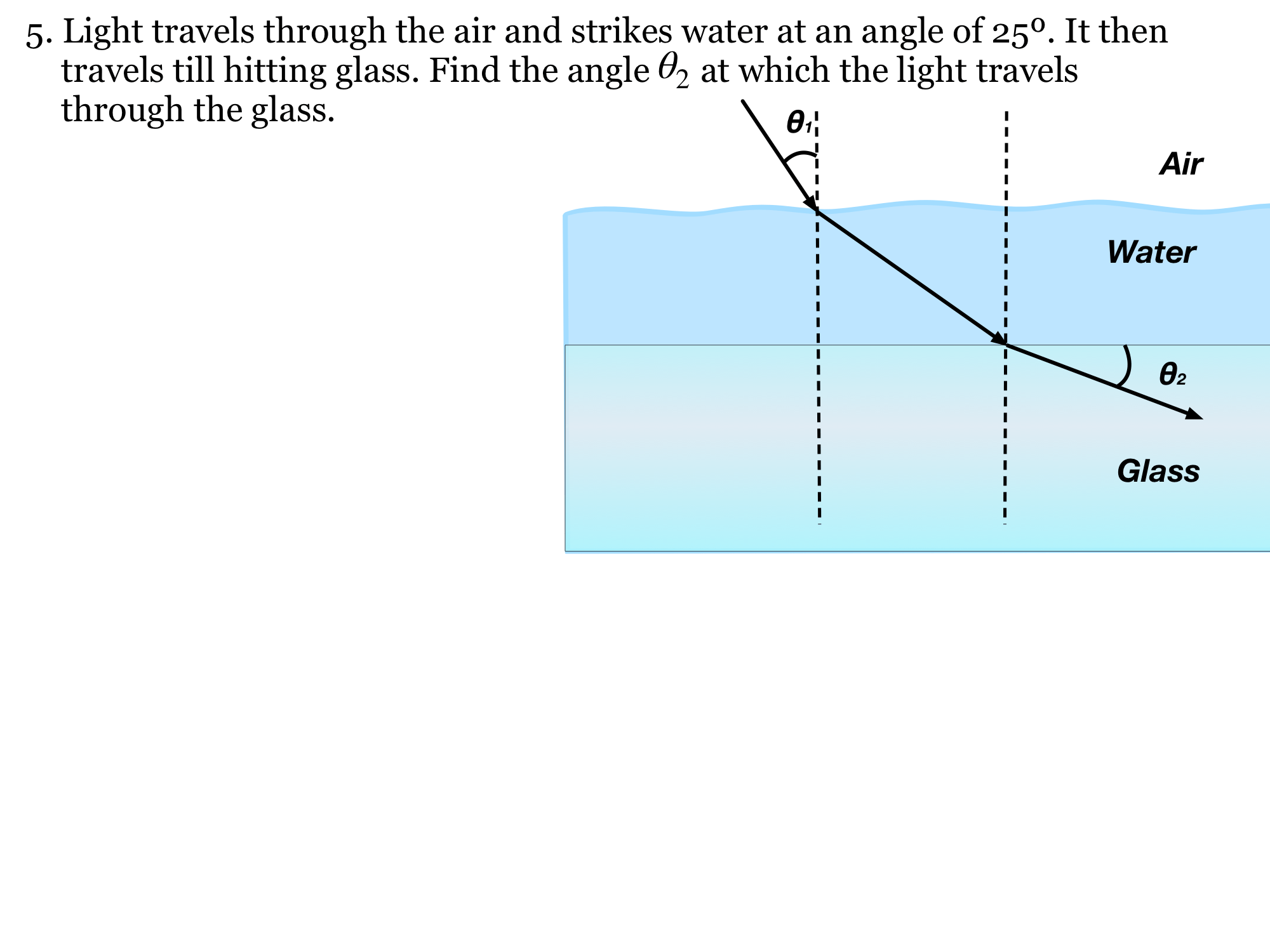
A light ray in air (n = 1.00) enters water (n = 1.33) at 25° to the normal and then enters glass (n = 1.52). Treat the interfaces as parallel. Find its angle in glass to the normal, and θ₂ marked in the source diagram, which is measured from the interface.
Original problem 5
The drawn ray bends in the wrong direction on entering higher-index media. Use the labelled incidence angle and the parallel-interface model, not the ray’s pictorial slope. Refractive indices come from source Table 9.3.1.
Problem text
A light ray in air (n = 1.00) enters water (n = 1.33) at 25° to the normal and then enters glass (n = 1.52). Treat the interfaces as parallel. Find its angle in glass to the normal, and θ₂ marked in the source diagram, which is measured from the interface.
Drawing is temporarily unavailable. Work on paper if needed, then record your reasoning here.
Saving written working requires JavaScript. The problem remains available above; keep your work on paper or in your own notes.
6. Work it out
Original textbook practice · AP Physics 2 topic
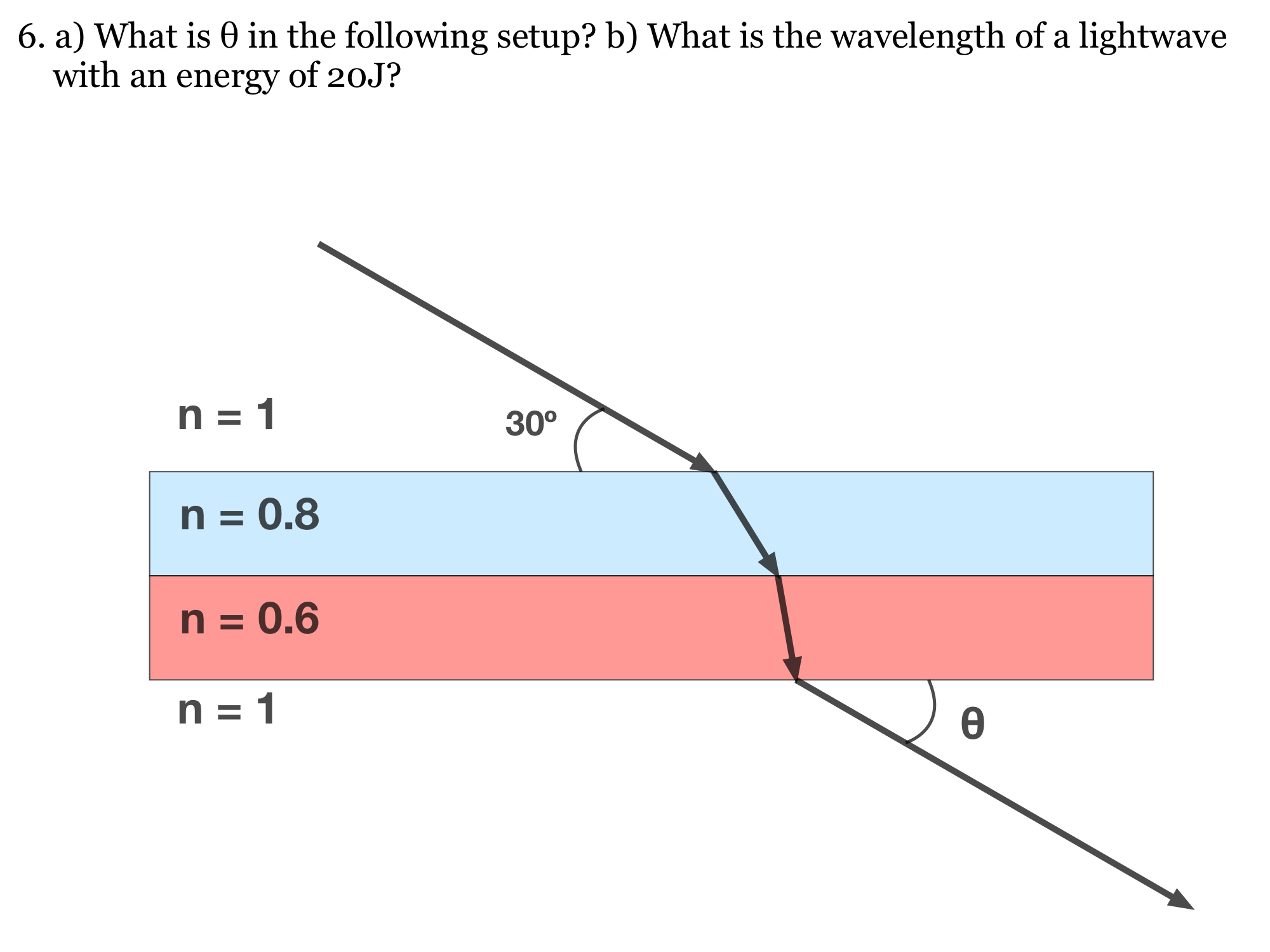
In the source diagram, a ray in n = 1 is incident at 30° to a flat surface, followed by layers of index 0.8 and 0.6 and finally n = 1. In the simple Snell-law ray model, can a ray emerge with the indicated angle θ? Separately, can a light wave’s total energy of 20 J determine its wavelength? Give the formal wavelength if 20 J is instead the energy of one photon.
Original problem 6
Indices below 1 are not ordinary visible-light glass/water indices. The solution checks the abstract given ray model without treating those layers as ordinary materials. Wave transmission through thin layers would require additional material and thickness data.
Problem text
In the source diagram, a ray in n = 1 is incident at 30° to a flat surface, followed by layers of index 0.8 and 0.6 and finally n = 1. In the simple Snell-law ray model, can a ray emerge with the indicated angle θ? Separately, can a light wave’s total energy of 20 J determine its wavelength? Give the formal wavelength if 20 J is instead the energy of one photon.
Drawing is temporarily unavailable. Work on paper if needed, then record your reasoning here.
Saving written working requires JavaScript. The problem remains available above; keep your work on paper or in your own notes.
7. Work it out
Original textbook practice · AP Physics 2 topic
Light of wavelength 500 nm strikes a material with work function 6.4 × 10⁻¹⁹ J. The electron mass is 9.11 × 10⁻²⁸ g. In the ordinary single-photon photoelectric model, can it remove the source’s stated five electrons? If emission occurs, determine the maximum momentum per electron.
Original problem 7
The source’s premise that five electrons are removed conflicts with its wavelength and work function. Five is an electron count, not permission to pool five photons’ energies into one ordinary photoelectric event. Multiphoton effects are outside this problem and require additional intensity information.
Problem text
Light of wavelength 500 nm strikes a material with work function 6.4 × 10⁻¹⁹ J. The electron mass is 9.11 × 10⁻²⁸ g. In the ordinary single-photon photoelectric model, can it remove the source’s stated five electrons? If emission occurs, determine the maximum momentum per electron.
Drawing is temporarily unavailable. Work on paper if needed, then record your reasoning here.
Saving written working requires JavaScript. The problem remains available above; keep your work on paper or in your own notes.
8. Work it out
Original textbook practice · AP Physics 2 topic
For water, B = 2.2 × 10⁹ Pa and ρ = 1 g/cm³. For air, B = 1.42 × 10⁵ Pa and ρ = 1.275 kg/m³. Assuming the stated bulk moduli describe sound propagation in each uniform medium, how far does a disturbance travel through each medium in 5 s?
Original problem 8
The question compares propagation distances. It does not model the efficiency of coupling a lightning-generated disturbance from air into water.
Problem text
For water, B = 2.2 × 10⁹ Pa and ρ = 1 g/cm³. For air, B = 1.42 × 10⁵ Pa and ρ = 1.275 kg/m³. Assuming the stated bulk moduli describe sound propagation in each uniform medium, how far does a disturbance travel through each medium in 5 s?
Drawing is temporarily unavailable. Work on paper if needed, then record your reasoning here.
Saving written working requires JavaScript. The problem remains available above; keep your work on paper or in your own notes.
9. Work it out
Original textbook practice · AP Physics 2 topic
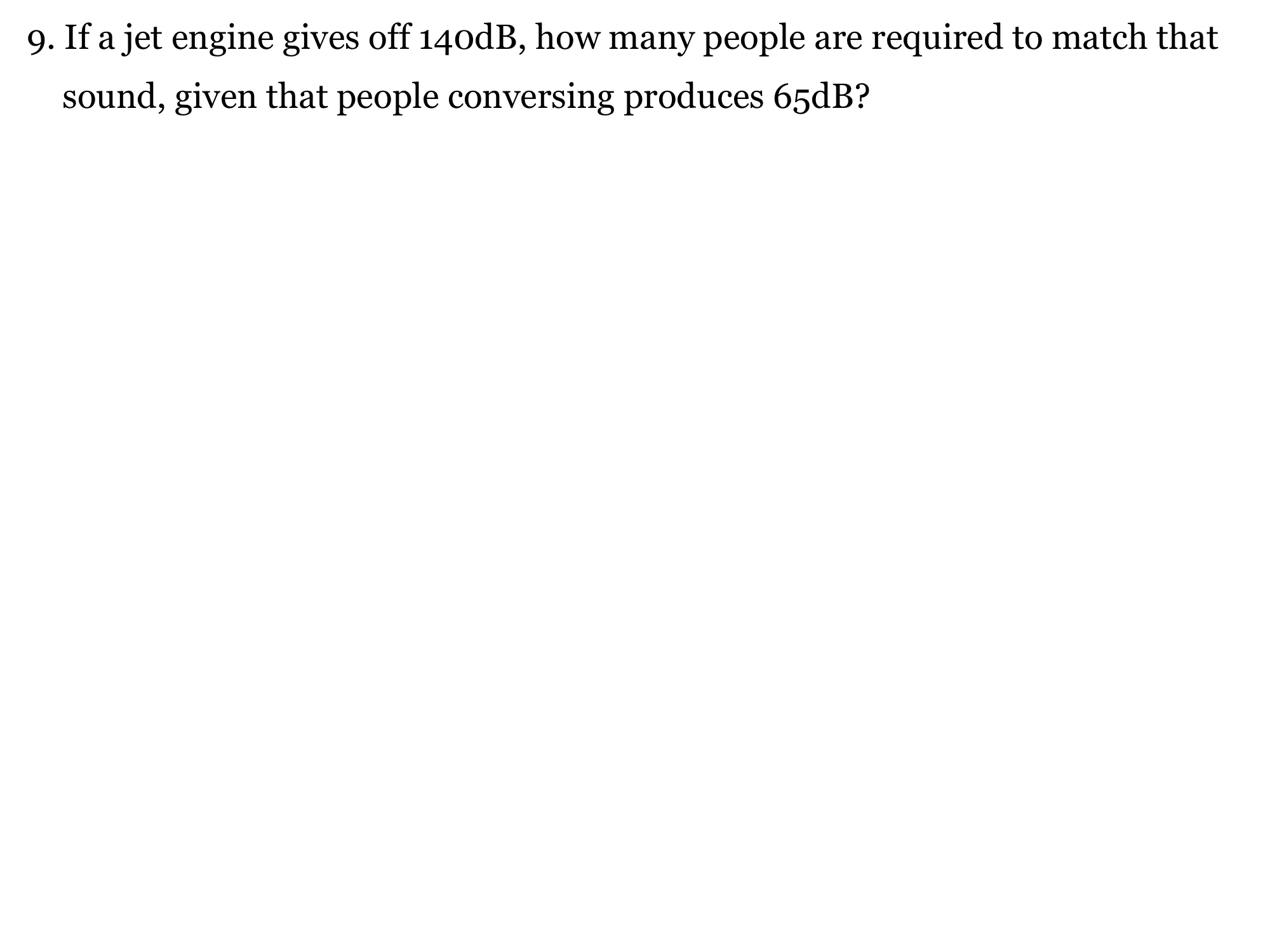
A jet produces a sound intensity level of 140 dB at a detector. Assume each independent conversation source contributes 65 dB at that same detector and the intensities add. How many such sources are needed to match the jet’s intensity?
Original problem 9
The source says “people conversing” rather than a calibrated per-person contribution. A head count is only valid if 65 dB is assumed for each person at the same detector. Different positions, coherence, and absorption would change the comparison.
Problem text
A jet produces a sound intensity level of 140 dB at a detector. Assume each independent conversation source contributes 65 dB at that same detector and the intensities add. How many such sources are needed to match the jet’s intensity?
Drawing is temporarily unavailable. Work on paper if needed, then record your reasoning here.
Saving written working requires JavaScript. The problem remains available above; keep your work on paper or in your own notes.
10. Work it out
Original textbook practice · AP Physics 2 topic
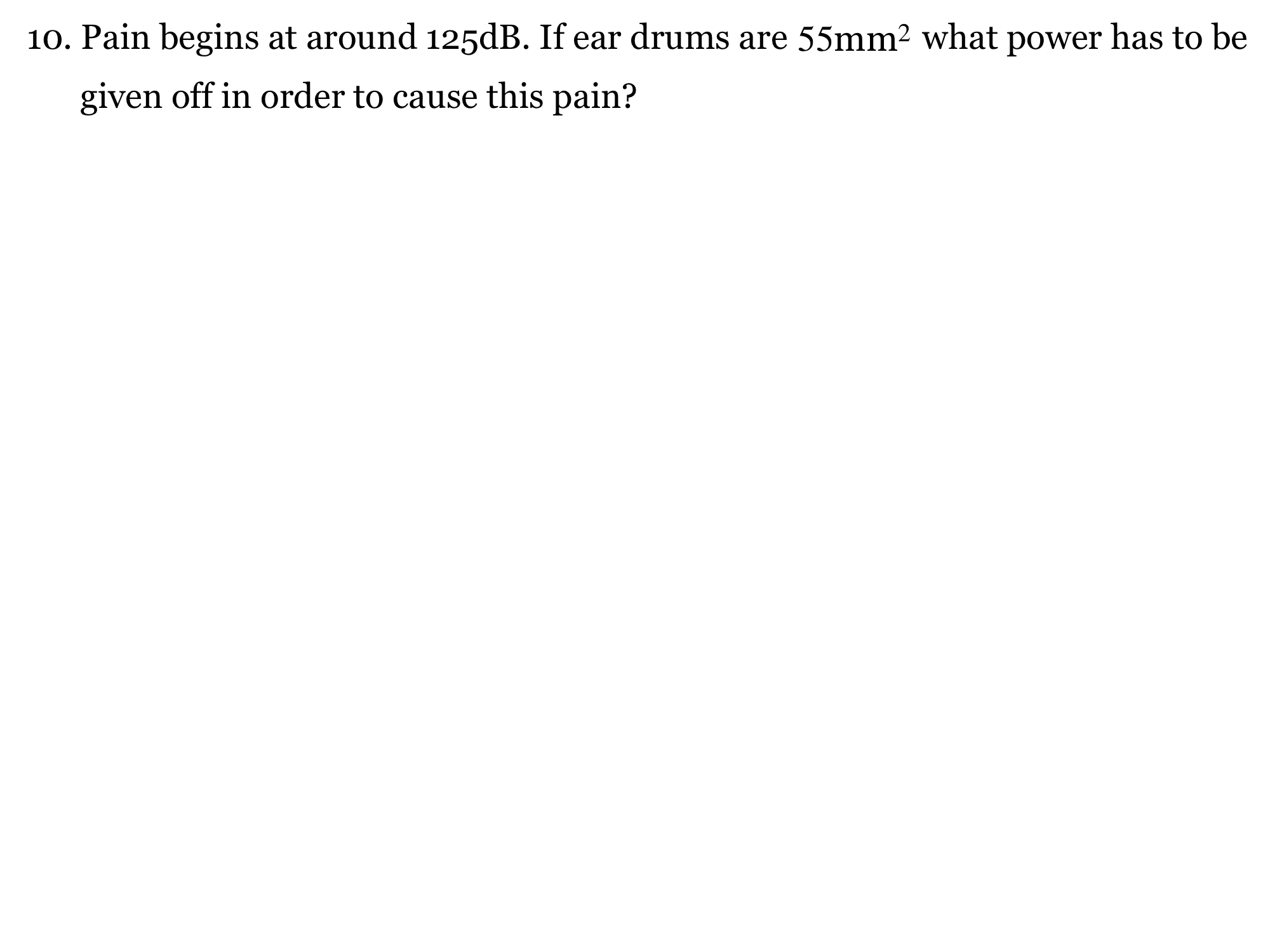
Using the source’s stipulated level of 125 dB, find the acoustic power incident on one eardrum of area 55 mm². Use reference intensity I₀ = 10⁻¹² W/m² and uniform incident intensity. Is this sufficient to determine the source’s emitted power?
Original problem 10
125 dB is used only as the source’s given level. Pain and hearing injury do not have one universal threshold.
Problem text
Using the source’s stipulated level of 125 dB, find the acoustic power incident on one eardrum of area 55 mm². Use reference intensity I₀ = 10⁻¹² W/m² and uniform incident intensity. Is this sufficient to determine the source’s emitted power?
Drawing is temporarily unavailable. Work on paper if needed, then record your reasoning here.
Saving written working requires JavaScript. The problem remains available above; keep your work on paper or in your own notes.
Additional practice
11. Reading a wave’s parameters
Original textbook practice · AP Physics 2 topic
A sinusoidal string wave has amplitude 4.00 mm, wavelength 0.750 m, frequency 12.0 Hz, and zero phase at x = t = 0. It travels toward +x. Write its equation and find its period and speed. Use SI units and radians.
Your written working
Drawing is temporarily unavailable. Work on paper if needed, then record your reasoning here.
Saving written working requires JavaScript. The problem remains available above; keep your work on paper or in your own notes.
12. Signed displacement at one event
Original textbook practice · AP Physics 2 topic
Two string waves are y₁ = (3.00 mm)sin(πx − 2πt) and y₂ = (4.00 mm)cos(πx + 2πt), with x in metres and t in seconds. Find the total displacement at x = 1.50 m and t = 0.125 s. Use radians.
Your written working
Drawing is temporarily unavailable. Work on paper if needed, then record your reasoning here.
Saving written working requires JavaScript. The problem remains available above; keep your work on paper or in your own notes.
13. Phase difference and resultant amplitude
Original textbook practice · AP Physics 2 topic
Two sinusoidal waves travel in the same direction with the same frequency and wavelength. Each has amplitude 7.00 mm and their phase difference is π/3 rad. Find the resultant amplitude.
Your written working
Drawing is temporarily unavailable. Work on paper if needed, then record your reasoning here.
Saving written working requires JavaScript. The problem remains available above; keep your work on paper or in your own notes.
14. Third harmonic on a fixed string
Original textbook practice · AP Physics 2 topic
A 1.20 m string fixed at both ends carries waves at 72.0 m/s. Find its third-harmonic frequency and the positions of all nodes measured from the left end.
Your written working
Drawing is temporarily unavailable. Work on paper if needed, then record your reasoning here.
Saving written working requires JavaScript. The problem remains available above; keep your work on paper or in your own notes.
15. String tension and travel time
Original textbook practice · AP Physics 2 topic
A string has linear density 6.00 g/m and tension 96.0 N. Find its transverse wave speed and the time for a pulse to travel 3.50 m. Use v = √(T/μ).
Your written working
Drawing is temporarily unavailable. Work on paper if needed, then record your reasoning here.
Saving written working requires JavaScript. The problem remains available above; keep your work on paper or in your own notes.
16. Beating tuning forks
Original textbook practice · AP Physics 2 topic
Two tuning forks sound simultaneously at 436 Hz and 442 Hz. Find the beat frequency and the time between successive loudness maxima. Assume stable frequencies and comparable amplitudes.
Your written working
Drawing is temporarily unavailable. Work on paper if needed, then record your reasoning here.
Saving written working requires JavaScript. The problem remains available above; keep your work on paper or in your own notes.
17. Sound speed in a liquid
Original textbook practice · AP Physics 2 topic
A liquid has an adiabatic bulk modulus of 1.65 × 10⁹ Pa and density 950 kg/m³. Find its sound speed and the wavelength at 2.50 kHz.
Your written working
Drawing is temporarily unavailable. Work on paper if needed, then record your reasoning here.
Saving written working requires JavaScript. The problem remains available above; keep your work on paper or in your own notes.
18. Particle displacement in a sound wave
Original textbook practice · AP Physics 2 topic
A sinusoidal sound wave of frequency 750 Hz in air has pressure amplitude 0.180 Pa. The air density is 1.18 kg/m³ and sound speed is 346 m/s. Find the particle displacement amplitude using p_max = ρvωs_max.
Your written working
Drawing is temporarily unavailable. Work on paper if needed, then record your reasoning here.
Saving written working requires JavaScript. The problem remains available above; keep your work on paper or in your own notes.
19. An isotropic loudspeaker
Original textbook practice · AP Physics 2 topic
A model loudspeaker emits 0.120 W of acoustic power equally in all directions. Neglect absorption and reflections. Find the intensity and intensity level at distance 7.50 m. Use I₀ = 10⁻¹² W/m².
Your written working
Drawing is temporarily unavailable. Work on paper if needed, then record your reasoning here.
Saving written working requires JavaScript. The problem remains available above; keep your work on paper or in your own notes.
20. Distance needed for a lower sound level
Original textbook practice · AP Physics 2 topic
A compact source produces 88.0 dB at 2.50 m. At what distance would its level be 70.0 dB if it radiates spherically without absorption or reflections?
Your written working
Drawing is temporarily unavailable. Work on paper if needed, then record your reasoning here.
Saving written working requires JavaScript. The problem remains available above; keep your work on paper or in your own notes.
21. Two different background noises
Original textbook practice · AP Physics 2 topic
At one microphone, two independent incoherent sources separately produce levels of 62.0 dB and 67.0 dB. Find the combined level. Use the same reference intensity for both.
Your written working
Drawing is temporarily unavailable. Work on paper if needed, then record your reasoning here.
Saving written working requires JavaScript. The problem remains available above; keep your work on paper or in your own notes.
22. A passing ambulance siren
Original textbook practice · AP Physics 2 topic
An ambulance emits a 780 Hz siren while moving directly toward and then directly away from a stationary observer at 28.0 m/s. Sound speed in still air is 343 m/s. Find the approaching and receding frequencies.
Your written working
Drawing is temporarily unavailable. Work on paper if needed, then record your reasoning here.
Saving written working requires JavaScript. The problem remains available above; keep your work on paper or in your own notes.
23. A cyclist moving away from a horn
Original textbook practice · AP Physics 2 topic
A stationary horn emits 520 Hz. A cyclist moves directly away from it at 14.0 m/s in still air, where sound speed is 344 m/s. Find the frequency heard by the cyclist.
Your written working
Drawing is temporarily unavailable. Work on paper if needed, then record your reasoning here.
Saving written working requires JavaScript. The problem remains available above; keep your work on paper or in your own notes.
24. Doppler shift of a reflected ultrasound signal
Original textbook practice · AP Physics 2 topic
A stationary transducer emits 4.00 MHz ultrasound toward a reflector moving directly toward it at 1.80 m/s. Sound speed in the stationary medium is 1540 m/s. Find the return-frequency shift using f_return = f_emit(v + u)/(v − u).
Your written working
Drawing is temporarily unavailable. Work on paper if needed, then record your reasoning here.
Saving written working requires JavaScript. The problem remains available above; keep your work on paper or in your own notes.
25. A red ray entering fused silica
Original textbook practice · AP Physics 2 topic
Light with vacuum wavelength 632 nm enters fused silica of refractive index 1.46 from air of index 1.00 at 38.0° to the normal. Find the refracted angle and wavelength in the silica. Assume lossless isotropic media.
Your written working
Drawing is temporarily unavailable. Work on paper if needed, then record your reasoning here.
Saving written working requires JavaScript. The problem remains available above; keep your work on paper or in your own notes.
26. Critical angle at a glass–water boundary
Original textbook practice · AP Physics 2 topic
Light travels inside glass of refractive index 1.62 toward water of index 1.33. Find the critical angle to the normal and determine whether incidence at 58.0° yields a propagating transmitted ray.
Your written working
Drawing is temporarily unavailable. Work on paper if needed, then record your reasoning here.
Saving written working requires JavaScript. The problem remains available above; keep your work on paper or in your own notes.
27. Transit time in an optical fiber
Original textbook practice · AP Physics 2 topic
A pulse follows a 2.40 km optical path inside a fiber. Its group refractive index is 1.48. Find its one-way travel time. Use vacuum speed of light c = 299792458 m/s.
Your written working
Drawing is temporarily unavailable. Work on paper if needed, then record your reasoning here.
Saving written working requires JavaScript. The problem remains available above; keep your work on paper or in your own notes.
28. Photon flux of a violet LED
Original textbook practice · AP Physics 2 topic
An LED emits 4.50 mW of monochromatic light of wavelength 405 nm in vacuum. Find the number of photons emitted per second. Use h = 6.62607015 × 10⁻³⁴ J·s and c = 299792458 m/s.
Your written working
Drawing is temporarily unavailable. Work on paper if needed, then record your reasoning here.
Saving written working requires JavaScript. The problem remains available above; keep your work on paper or in your own notes.
29. Momentum of an emitted photoelectron
Original textbook practice · AP Physics 2 topic
A material has work function 4.20 × 10⁻¹⁹ J. It is illuminated with vacuum wavelength 240 nm light. Find the maximum kinetic energy and momentum per emitted electron. Use electron mass 9.10938 × 10⁻³¹ kg, h = 6.62607015 × 10⁻³⁴ J·s, and c = 299792458 m/s. Use nonrelativistic electron mechanics.
Your written working
Drawing is temporarily unavailable. Work on paper if needed, then record your reasoning here.
Saving written working requires JavaScript. The problem remains available above; keep your work on paper or in your own notes.
30. Speed from a spectral redshift
Original textbook practice · AP Physics 2 topic
A spectral line from a source moving directly away in vacuum is observed at a wavelength 1.080 times its emitted wavelength. Use the relativistic longitudinal Doppler relation to find the recession speed as a fraction of c and in m/s.
Your written working
Drawing is temporarily unavailable. Work on paper if needed, then record your reasoning here.
Saving written working requires JavaScript. The problem remains available above; keep your work on paper or in your own notes.