Fluids practice
Work from memory first. Draw a diagram, state the assumptions and keep units through every step. Worked answers are separate.
· Open separate worked solutions
1. Work it out
Original textbook practice · AP Physics 2 topic
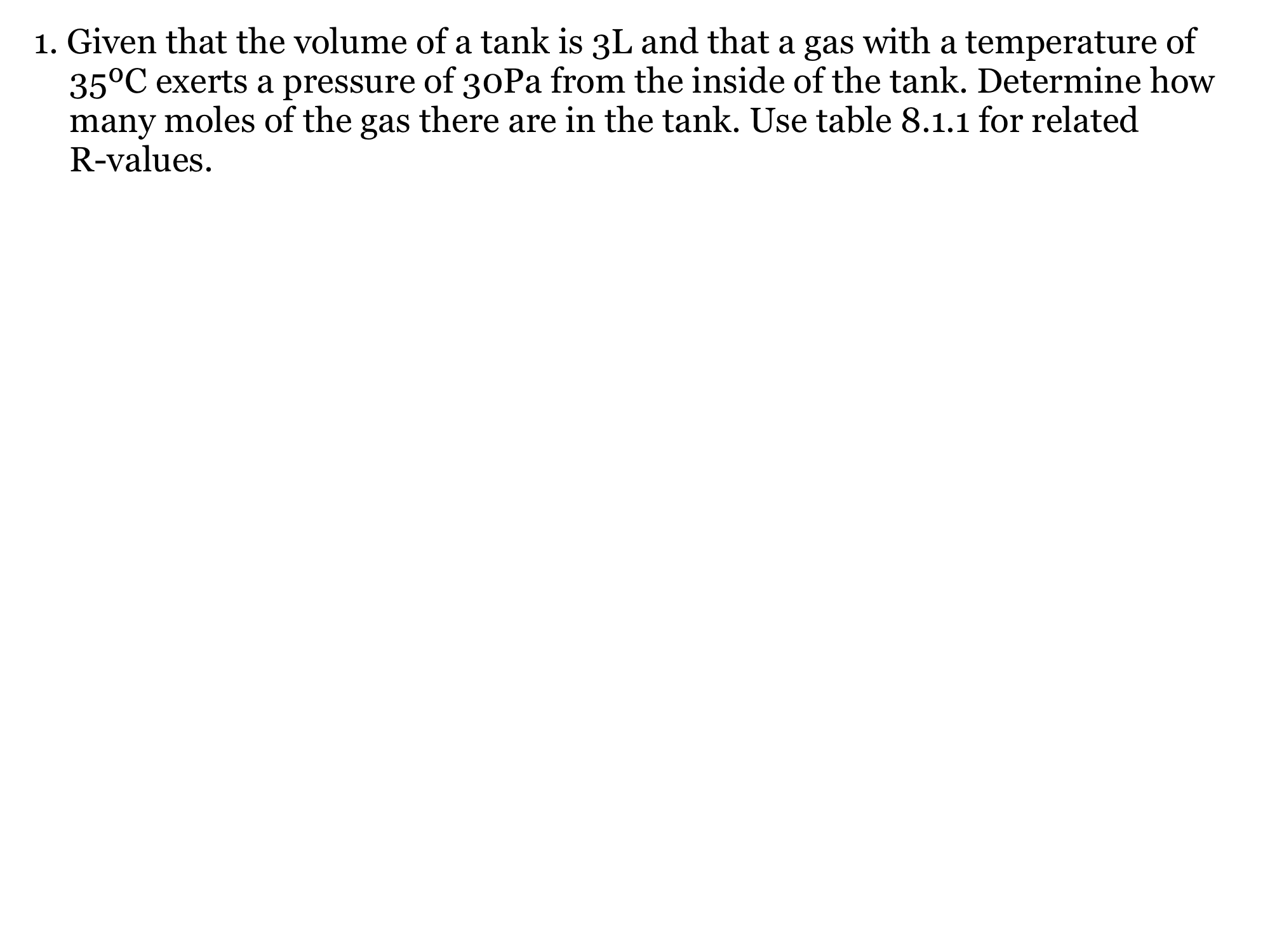
A 3 L tank contains an ideal gas at 35 °C and an absolute pressure of 30 Pa. Find the amount of gas in moles.
Original problem 1
The pressure is unusually low but is retained. The gas law requires absolute pressure; a gauge reading would require atmospheric pressure as another input.
Problem text
A 3 L tank contains an ideal gas at 35 °C and an absolute pressure of 30 Pa. Find the amount of gas in moles.
Drawing is temporarily unavailable. Work on paper if needed, then record your reasoning here.
Saving written working requires JavaScript. The problem remains available above; keep your work on paper or in your own notes.
2. Work it out
Original textbook practice
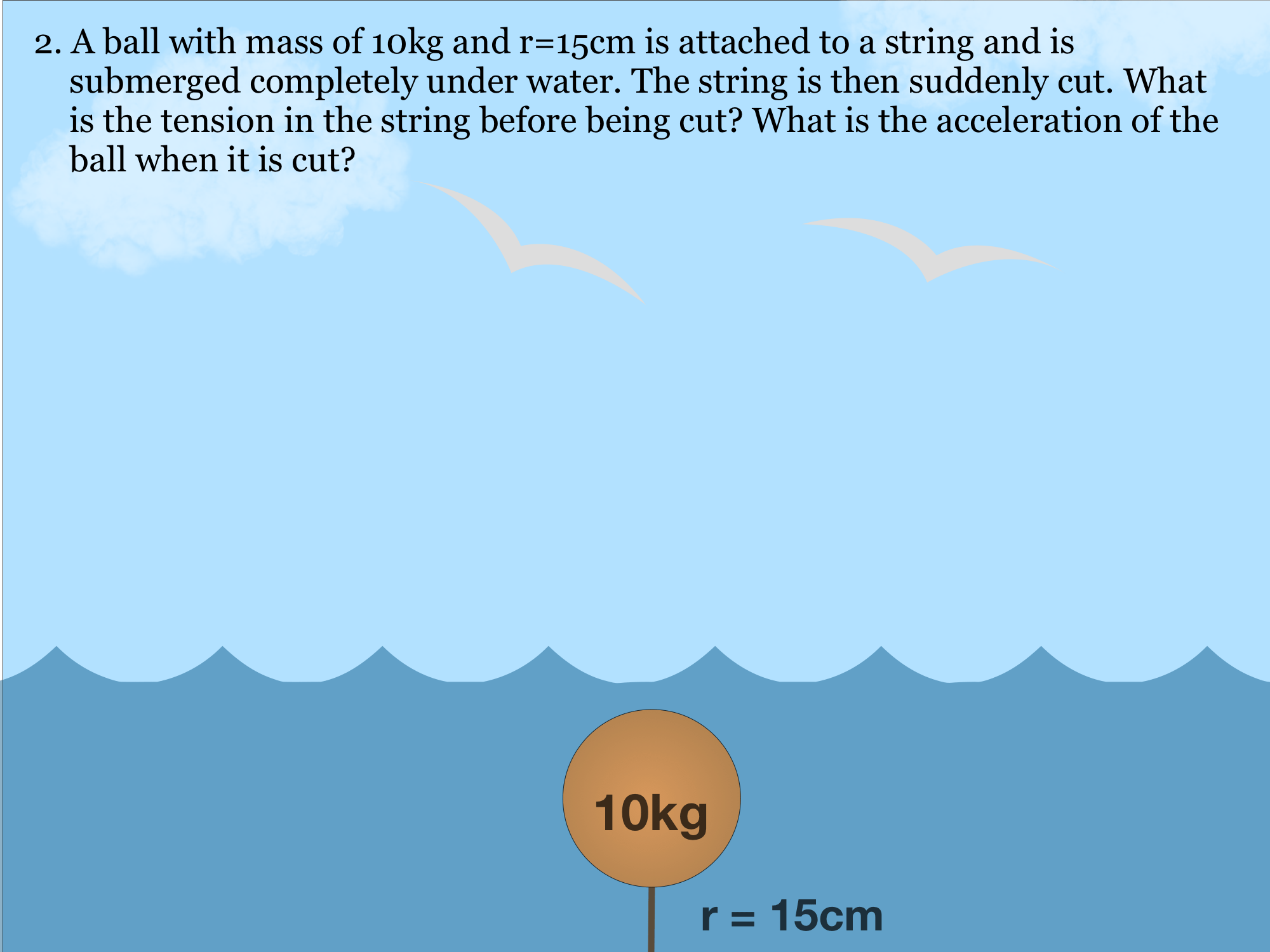
A 10 kg sphere of radius 15 cm is fully submerged in water and held at rest by a string attached below it, as shown. Find the string tension and the initial acceleration just after it is cut. Use water density 1000 kg/m³ and g = 9.81 m/s²; neglect drag and added-mass effects.
Original problem 2
This is the ideal introductory model. Real acceleration in water also depends on hydrodynamic added mass and later on drag.
Problem text
A 10 kg sphere of radius 15 cm is fully submerged in water and held at rest by a string attached below it, as shown. Find the string tension and the initial acceleration just after it is cut. Use water density 1000 kg/m³ and g = 9.81 m/s²; neglect drag and added-mass effects.
Drawing is temporarily unavailable. Work on paper if needed, then record your reasoning here.
Saving written working requires JavaScript. The problem remains available above; keep your work on paper or in your own notes.
3. Work it out
Original textbook practice · AP Physics 2 topic
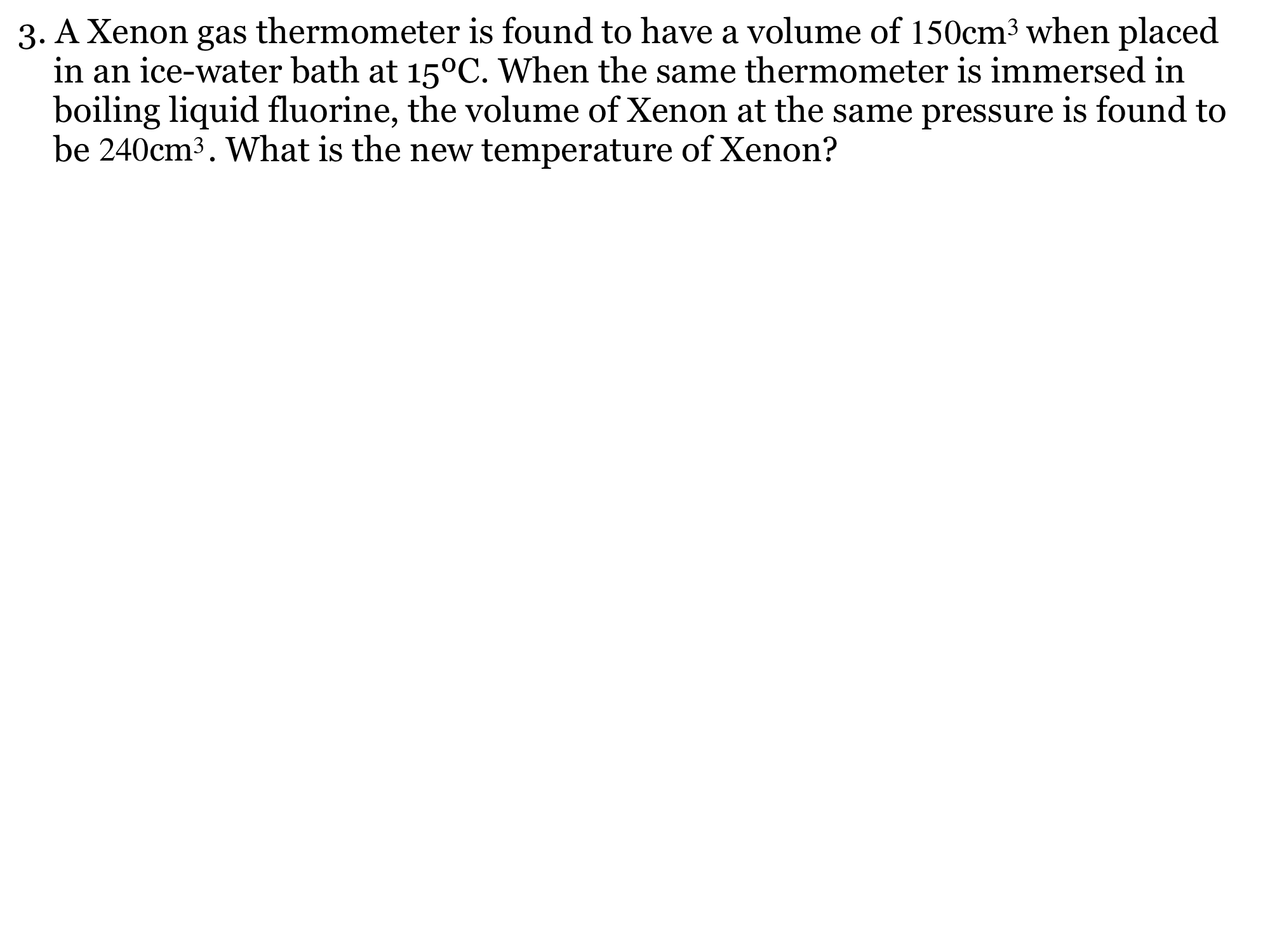
A fixed amount of ideal xenon gas occupies 150 cm³ in a bath at 15 °C. At the same pressure in a second bath, it occupies 240 cm³. Calculate the second temperature. Check the source descriptions of an “ice-water bath at 15 °C” and “boiling liquid fluorine” against this result.
Original problem 3
The reviewed wording preserves 15 °C and both measured volumes, but treats the second bath as unnamed. If the initial temperature were explicitly changed to 0 °C, the same volume ratio would instead imply 163.89 °C, still not boiling fluorine. No actual bath temperature is inferred.
Problem text
A fixed amount of ideal xenon gas occupies 150 cm³ in a bath at 15 °C. At the same pressure in a second bath, it occupies 240 cm³. Calculate the second temperature. Check the source descriptions of an “ice-water bath at 15 °C” and “boiling liquid fluorine” against this result.
Drawing is temporarily unavailable. Work on paper if needed, then record your reasoning here.
Saving written working requires JavaScript. The problem remains available above; keep your work on paper or in your own notes.
4. Work it out
Original textbook practice
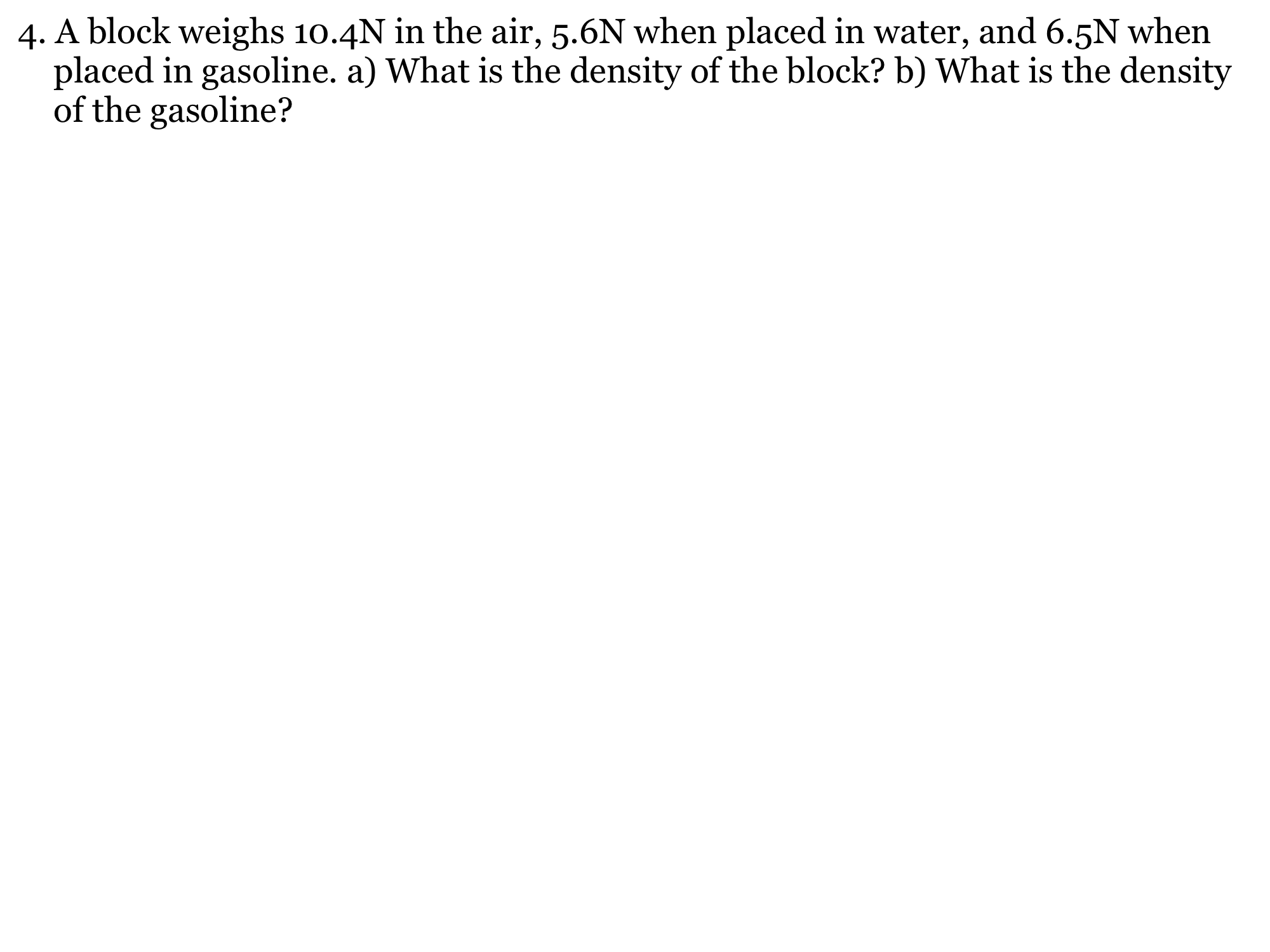
A block has weight 10.4 N in air and apparent weights 5.6 N in water and 6.5 N in gasoline. It is fully immersed in each liquid. Find the density of the block and gasoline. Neglect air buoyancy; use water density 1000 kg/m³.
Original problem 4
Problem text
A block has weight 10.4 N in air and apparent weights 5.6 N in water and 6.5 N in gasoline. It is fully immersed in each liquid. Find the density of the block and gasoline. Neglect air buoyancy; use water density 1000 kg/m³.
Drawing is temporarily unavailable. Work on paper if needed, then record your reasoning here.
Saving written working requires JavaScript. The problem remains available above; keep your work on paper or in your own notes.
5. Work it out
Original textbook practice
A cylindrical rod floats vertically in water. Its lower 5 cm has density 1500 kg/m³ and its upper 7 cm has density 400 kg/m³. Both sections have the same radius R. Find the depth of the rod’s bottom below the water surface. Use water density 1000 kg/m³.
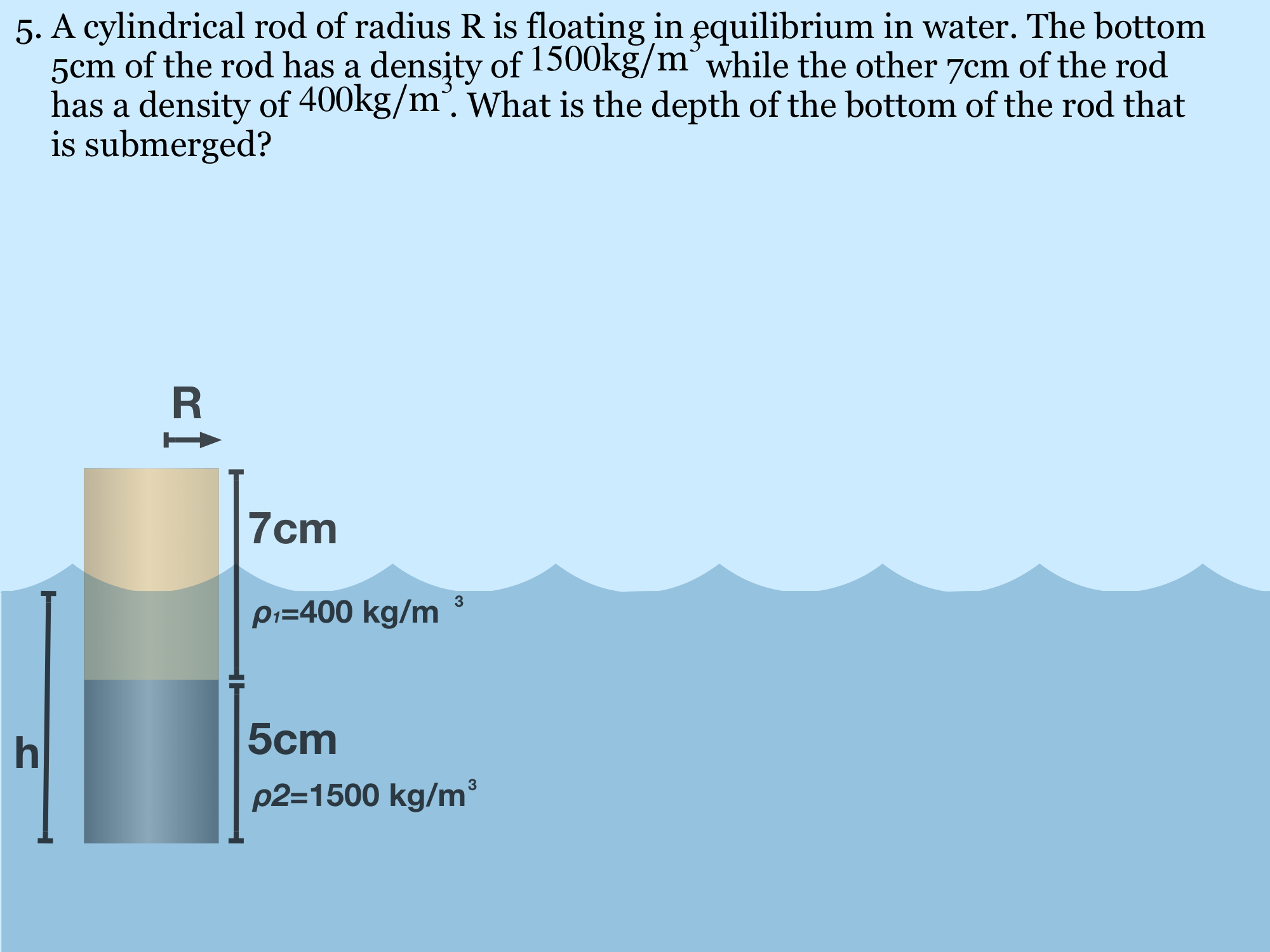
Original problem 5
The result assumes the vertical equilibrium shown, not a claim that every possible orientation is stable.
Problem text
A cylindrical rod floats vertically in water. Its lower 5 cm has density 1500 kg/m³ and its upper 7 cm has density 400 kg/m³. Both sections have the same radius R. Find the depth of the rod’s bottom below the water surface. Use water density 1000 kg/m³.
Drawing is temporarily unavailable. Work on paper if needed, then record your reasoning here.
Saving written working requires JavaScript. The problem remains available above; keep your work on paper or in your own notes.
6. Work it out
Original textbook practice
Water at street level has pressure 4.6 atm and speed 0.09 m/s in an 8.0 cm diameter pipe. It rises 40 cm to a 3.4 cm diameter pipe. Find the upper speed and pressure, assuming steady incompressible flow, no head loss, water density 1000 kg/m³, and g = 9.81 m/s². Keep the pressure convention the same at both points.
Original problem 6
“Top floor” suggests a possible height typo, but the image clearly says 40 cm. The main answer preserves it. The 40 m result is explicitly an alternative interpretation. If 4.6 atm is gauge pressure, the reported upper pressure is also gauge; if it is absolute, the result is absolute.
Problem text
Water at street level has pressure 4.6 atm and speed 0.09 m/s in an 8.0 cm diameter pipe. It rises 40 cm to a 3.4 cm diameter pipe. Find the upper speed and pressure, assuming steady incompressible flow, no head loss, water density 1000 kg/m³, and g = 9.81 m/s². Keep the pressure convention the same at both points.
Drawing is temporarily unavailable. Work on paper if needed, then record your reasoning here.
Saving written working requires JavaScript. The problem remains available above; keep your work on paper or in your own notes.
7. Work it out
Original textbook practice · AP Physics 2 topic
Find the pressure of 0.7000 mol of helium in 0.4000 L at −30 °C, first as an ideal gas and then using the source table’s van der Waals constants a = 0.034 atm·L²/mol² and b = 0.024 L/mol. Use R = 0.0820574 L·atm/(mol·K).
Original problem 7
The van der Waals result is a model estimate, not an exact experimental “non-ideal” pressure. The constants and their litre/atmosphere units are made explicit.
Problem text
Find the pressure of 0.7000 mol of helium in 0.4000 L at −30 °C, first as an ideal gas and then using the source table’s van der Waals constants a = 0.034 atm·L²/mol² and b = 0.024 L/mol. Use R = 0.0820574 L·atm/(mol·K).
Drawing is temporarily unavailable. Work on paper if needed, then record your reasoning here.
Saving written working requires JavaScript. The problem remains available above; keep your work on paper or in your own notes.
8. Work it out
Enrichment beyond the AP course
Explain how a water sprinkler produces jets and, for a rotating sprinkler, how its arms turn.
Original problem 8
The source does not specify a sprinkler design. Fixed spray heads need not rotate; the reaction-torque explanation applies to angled rotating arms.
Problem text
Explain how a water sprinkler produces jets and, for a rotating sprinkler, how its arms turn.
Drawing is temporarily unavailable. Work on paper if needed, then record your reasoning here.
Saving written working requires JavaScript. The problem remains available above; keep your work on paper or in your own notes.
9. Work it out
Original textbook practice
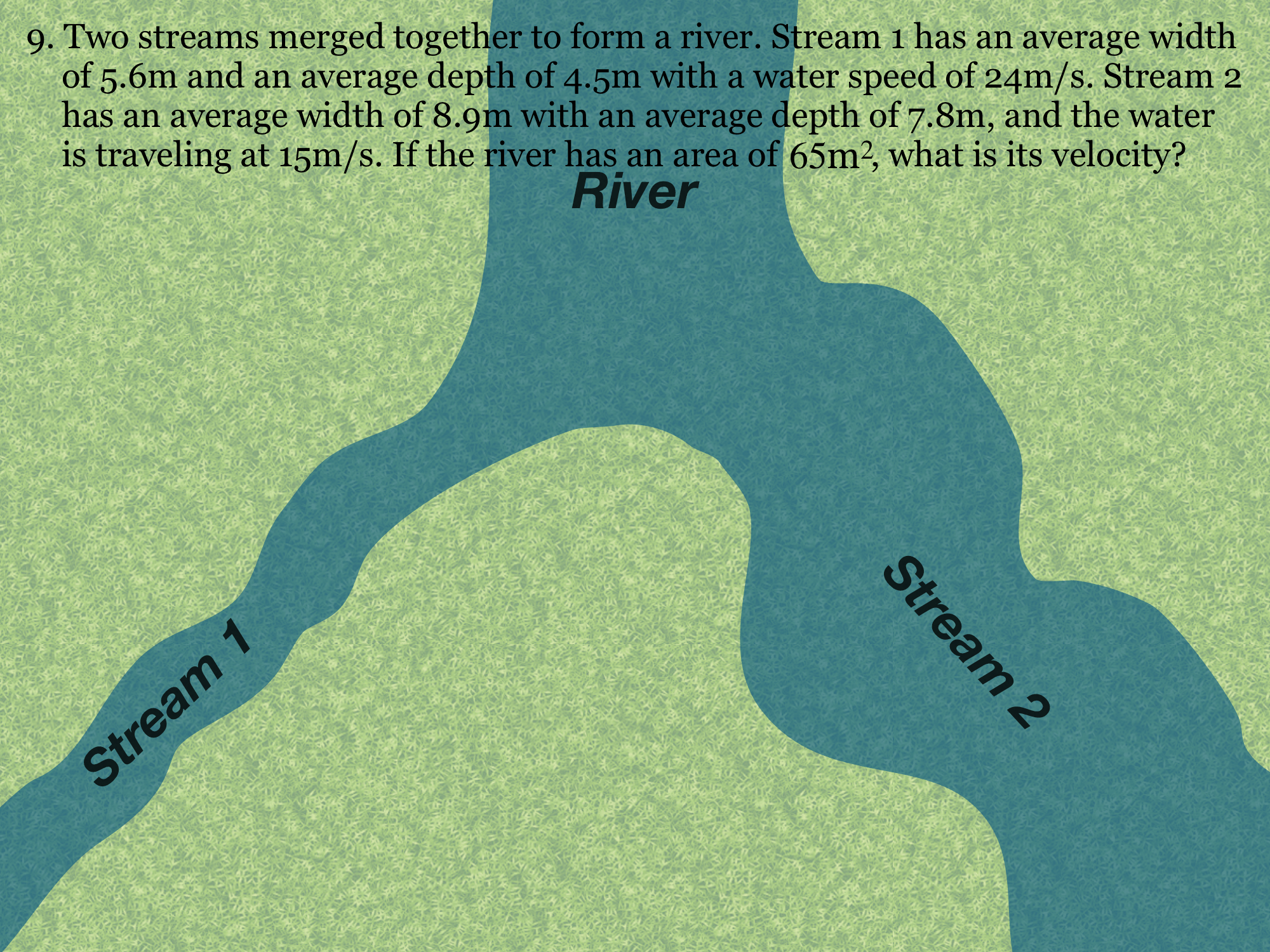
Two streams merge without water storage or loss. Stream 1 has width 5.6 m, mean depth 4.5 m, and mean speed 24 m/s. Stream 2 has width 8.9 m, mean depth 7.8 m, and mean speed 15 m/s. Approximate each cross-section as rectangular. The downstream river has area 65 m². Find its mean speed.
Original problem 9
The very high stream speeds are retained as source data. This is a mass-conservation exercise, not a realistic hydraulic river model.
Problem text
Two streams merge without water storage or loss. Stream 1 has width 5.6 m, mean depth 4.5 m, and mean speed 24 m/s. Stream 2 has width 8.9 m, mean depth 7.8 m, and mean speed 15 m/s. Approximate each cross-section as rectangular. The downstream river has area 65 m². Find its mean speed.
Drawing is temporarily unavailable. Work on paper if needed, then record your reasoning here.
Saving written working requires JavaScript. The problem remains available above; keep your work on paper or in your own notes.
10. Work it out
Original textbook practice
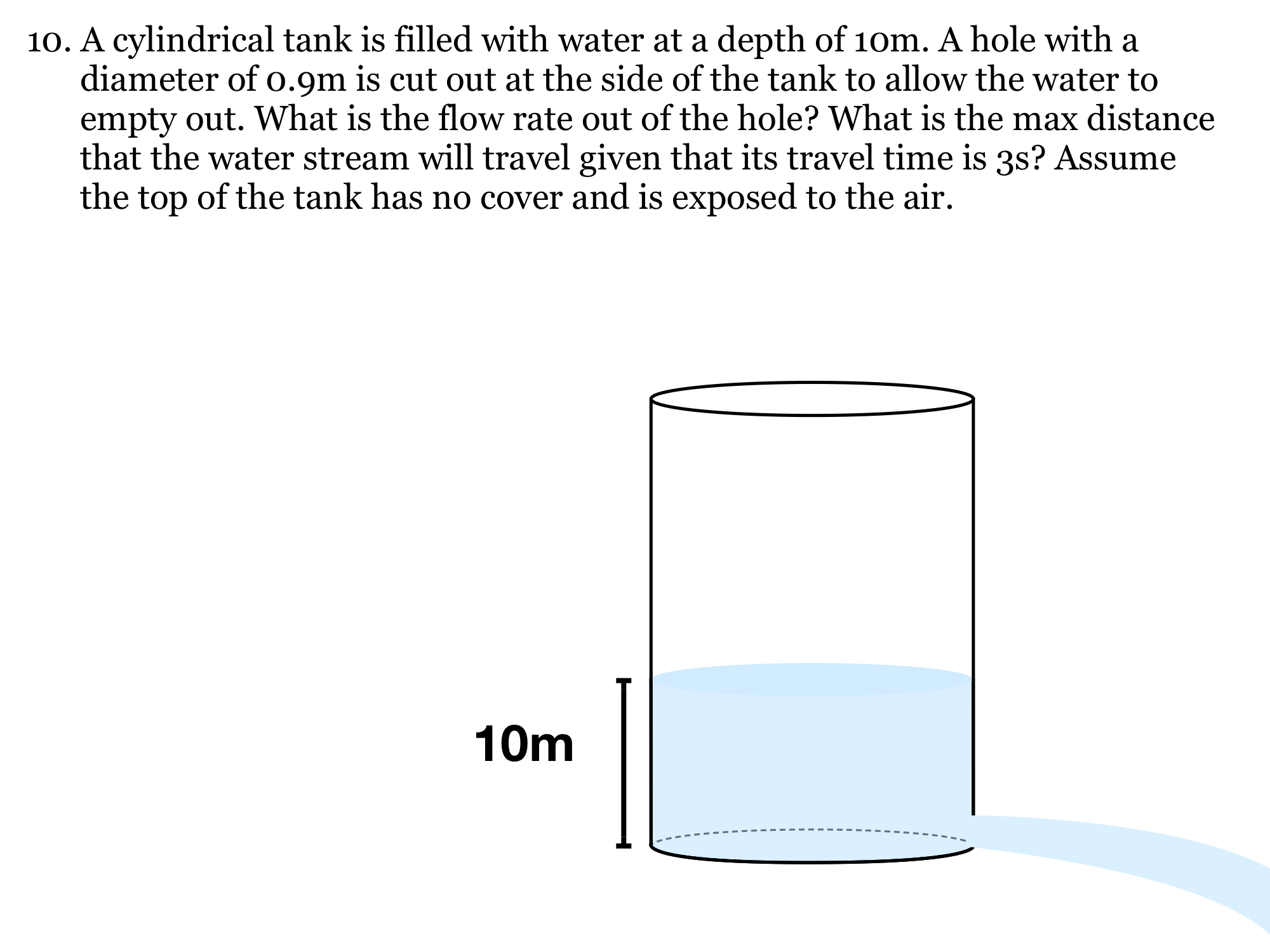
An open cylindrical tank initially has a water surface 10 m above a side opening of diameter 0.9 m, as shown. Estimate the initial ideal volume flow rate and the horizontal distance of an initially horizontal jet during a given 3 s flight. Assume the tank area is much larger than the opening area, negligible losses, and g = 9.81 m/s².
Original problem 10
The tank diameter, discharge coefficient, and landing height are omitted. Therefore the source does not determine an exact time-varying drain rate or a general maximum range. The numerical result is conditional on the stated large-tank idealization and initial 10 m head.
Problem text
An open cylindrical tank initially has a water surface 10 m above a side opening of diameter 0.9 m, as shown. Estimate the initial ideal volume flow rate and the horizontal distance of an initially horizontal jet during a given 3 s flight. Assume the tank area is much larger than the opening area, negligible losses, and g = 9.81 m/s².
Drawing is temporarily unavailable. Work on paper if needed, then record your reasoning here.
Saving written working requires JavaScript. The problem remains available above; keep your work on paper or in your own notes.
Additional practice
11. Gas amount in a sampling vial
Original textbook practice · AP Physics 2 topic
An ideal gas in a 1.80 L sampling vial has absolute pressure 182 kPa and temperature 22.0 °C. Find the amount in moles. Use R = 8.31446 J/(mol·K).
Your written working
Drawing is temporarily unavailable. Work on paper if needed, then record your reasoning here.
Saving written working requires JavaScript. The problem remains available above; keep your work on paper or in your own notes.
12. Isothermal piston compression
Original textbook practice · AP Physics 2 topic
A fixed amount of ideal gas occupies 2.40 L at absolute pressure 125 kPa. A piston compresses it isothermally to 0.850 L. Find its final absolute pressure.
Your written working
Drawing is temporarily unavailable. Work on paper if needed, then record your reasoning here.
Saving written working requires JavaScript. The problem remains available above; keep your work on paper or in your own notes.
13. Warming a rigid tire
Original textbook practice · AP Physics 2 topic
A rigid tire has gauge pressure 220 kPa at 15.0 °C. It warms to 55.0 °C without leakage. Atmospheric pressure remains 101.3 kPa. Find the final gauge pressure using the ideal-gas model.
Your written working
Drawing is temporarily unavailable. Work on paper if needed, then record your reasoning here.
Saving written working requires JavaScript. The problem remains available above; keep your work on paper or in your own notes.
14. Weather balloon in colder air
Original textbook practice · AP Physics 2 topic
A flexible sealed balloon contains 3.60 L of gas at absolute pressure 92.0 kPa and 18.0 °C. Its surroundings later have pressure 68.0 kPa and temperature −22.0 °C. Neglect membrane tension and assume equilibrium. Find the final volume.
Your written working
Drawing is temporarily unavailable. Work on paper if needed, then record your reasoning here.
Saving written working requires JavaScript. The problem remains available above; keep your work on paper or in your own notes.
15. Mass of nitrogen in a chamber
Original textbook practice · AP Physics 2 topic
A 28.0 L chamber contains ideal nitrogen gas at absolute pressure 145 kPa and 42.0 °C. Take its molar mass as 28.0 g/mol. Find the mass in grams.
Your written working
Drawing is temporarily unavailable. Work on paper if needed, then record your reasoning here.
Saving written working requires JavaScript. The problem remains available above; keep your work on paper or in your own notes.
16. Carbon dioxide density
Original textbook practice · AP Physics 2 topic
Find the ideal-gas density of carbon dioxide at absolute pressure 86.0 kPa and 8.00 °C. Use molar mass 44.0 g/mol.
Your written working
Drawing is temporarily unavailable. Work on paper if needed, then record your reasoning here.
Saving written working requires JavaScript. The problem remains available above; keep your work on paper or in your own notes.
17. Competing real-gas corrections
Original textbook practice · AP Physics 2 topic
A model gas has van der Waals constants a = 3.59 atm·L²/mol² and b = 0.0427 L/mol. For 0.600 mol in 1.50 L at 310 K, calculate its ideal and van der Waals pressures. Use R = 0.0820574 L·atm/(mol·K), and identify which correction raises pressure.
Your written working
Drawing is temporarily unavailable. Work on paper if needed, then record your reasoning here.
Saving written working requires JavaScript. The problem remains available above; keep your work on paper or in your own notes.
18. A mineral sample on a spring scale
Original textbook practice
A mineral sample weighs 31.5 N in air and 24.0 N when fully immersed in water of density 1000 kg/m³. Ignore air buoyancy. Find its volume in cm³ and density. Use g = 9.81 m/s².
Your written working
Drawing is temporarily unavailable. Work on paper if needed, then record your reasoning here.
Saving written working requires JavaScript. The problem remains available above; keep your work on paper or in your own notes.
19. Ice in fresh water and seawater
Original textbook practice
Ice of density 917 kg/m³ floats first in fresh water of density 1000 kg/m³ and then in seawater of density 1025 kg/m³. Find the fraction of its volume submerged in each case. Neglect surface tension.
Your written working
Drawing is temporarily unavailable. Work on paper if needed, then record your reasoning here.
Saving written working requires JavaScript. The problem remains available above; keep your work on paper or in your own notes.
20. Payload on a sealed pontoon
Original textbook practice
A sealed pontoon has external volume 0.180 m³ and empty mass 42.0 kg. What extra mass can it support in fresh water immediately before becoming fully submerged? Use water density 1000 kg/m³ and neglect surface tension.
Your written working
Drawing is temporarily unavailable. Work on paper if needed, then record your reasoning here.
Saving written working requires JavaScript. The problem remains available above; keep your work on paper or in your own notes.
21. Suspending a dense tool underwater
Original textbook practice
A steel tool has volume 620 cm³ and density 7800 kg/m³. It hangs at rest from a cable in water of density 1000 kg/m³. Find the cable tension. Use g = 9.81 m/s²; neglect air buoyancy and drag.
Your written working
Drawing is temporarily unavailable. Work on paper if needed, then record your reasoning here.
Saving written working requires JavaScript. The problem remains available above; keep your work on paper or in your own notes.
22. An ideal hydraulic platform
Enrichment beyond the AP course
An ideal hydraulic system has small piston area 25.0 cm² and large piston area 850 cm². Both pistons are at the same height. What force on the small piston supports a 14.5 kN load on the large piston? Neglect piston weight and friction.
Your written working
Drawing is temporarily unavailable. Work on paper if needed, then record your reasoning here.
Saving written working requires JavaScript. The problem remains available above; keep your work on paper or in your own notes.
23. Pressure below two liquid layers
Original textbook practice
An open tank has a 0.350 m layer of oil of density 850 kg/m³ above a 1.20 m layer of water of density 1000 kg/m³. Find the gauge pressure at the bottom. Use g = 9.81 m/s².
Your written working
Drawing is temporarily unavailable. Work on paper if needed, then record your reasoning here.
Saving written working requires JavaScript. The problem remains available above; keep your work on paper or in your own notes.
24. A water-and-alcohol U-tube
Original textbook practice
Both arms of a U-tube are open to air. A column of alcohol of density 790 kg/m³ sits above water in one arm. The water surface in the other arm is 8.00 cm above the alcohol–water interface. Find the alcohol-column height, assuming static equilibrium.
Your written working
Drawing is temporarily unavailable. Work on paper if needed, then record your reasoning here.
Saving written working requires JavaScript. The problem remains available above; keep your work on paper or in your own notes.
25. Filling a rain barrel
Original textbook practice
Water flows steadily through a hose of inside radius 6.00 mm at mean speed 1.80 m/s. How long does it take to deliver 75.0 L into an empty barrel, assuming no leakage?
Your written working
Drawing is temporarily unavailable. Work on paper if needed, then record your reasoning here.
Saving written working requires JavaScript. The problem remains available above; keep your work on paper or in your own notes.
26. A horizontal Venturi meter
Original textbook practice
Water flows through a horizontal pipe that narrows from diameter 5.00 cm to 2.00 cm. The upstream pressure exceeds the throat pressure by 5.40 kPa. Find the throat speed and volume flow rate. Assume steady incompressible lossless flow and density 1000 kg/m³.
Your written working
Drawing is temporarily unavailable. Work on paper if needed, then record your reasoning here.
Saving written working requires JavaScript. The problem remains available above; keep your work on paper or in your own notes.
27. Pressure in an elevated outlet
Original textbook practice
Water flows steadily from a point with gauge pressure 310 kPa and speed 1.20 m/s to a point 6.50 m higher with speed 2.80 m/s. Find the upper gauge pressure assuming no pumps or losses. Use density 1000 kg/m³ and g = 9.81 m/s².
Your written working
Drawing is temporarily unavailable. Work on paper if needed, then record your reasoning here.
Saving written working requires JavaScript. The problem remains available above; keep your work on paper or in your own notes.
28. Force from a jet on a wall
Enrichment beyond the AP course
A horizontal water jet of volume rate 3.40 L/s strikes a flat wall normally at 17.0 m/s. The water leaves sideways with zero normal velocity. Find the mean force on the wall. Use water density 1000 kg/m³ and neglect gravity in the impact region.
Your written working
Drawing is temporarily unavailable. Work on paper if needed, then record your reasoning here.
Saving written working requires JavaScript. The problem remains available above; keep your work on paper or in your own notes.
29. Range of a water jet from a raised tank
Original textbook practice
A small horizontal opening lies 3.20 m below the surface of a large open water tank and 1.25 m above level ground. Find the ideal jet speed and horizontal distance to the ground. Neglect losses, falling surface speed, and air drag. Use g = 9.81 m/s².
Your written working
Drawing is temporarily unavailable. Work on paper if needed, then record your reasoning here.
Saving written working requires JavaScript. The problem remains available above; keep your work on paper or in your own notes.
30. Pumping against elevation and pipe friction
Enrichment beyond the AP course
Water must rise 12.0 m between two large open reservoirs through a 45.0 m long pipe of diameter 6.00 cm. The pipe speed is 2.20 m/s and the Darcy friction factor is 0.0260. Neglect minor losses. Find friction head h_f = f(L/D)v²/(2g), and the ideal hydraulic pump power. Use water density 1000 kg/m³ and g = 9.81 m/s².
Your written working
Drawing is temporarily unavailable. Work on paper if needed, then record your reasoning here.
Saving written working requires JavaScript. The problem remains available above; keep your work on paper or in your own notes.