Frictional Head Loss
Reference from the original Physics I textbook.
- Frictional Head Loss
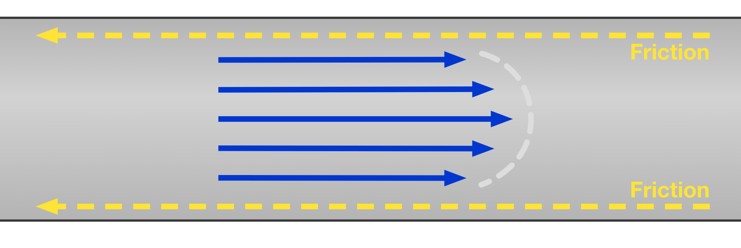
Frictional or major head loss is the reduction in mechanical energy per unit weight caused by viscosity during flow through a pipe. Head loss has units of length.
- Related Glossary Terms
- Index
Reviewed physics notes (1)
These corrections keep the original lesson’s purpose while fixing errors in the source edition.
- Head loss is not a resistive force and does not necessarily reduce steady flow speed. — Reference 1
Glossary and deeper reading · 1 refreshers
These editorial refreshers supplement the reading. Definitions and examples are added guidance; original source wording and recorded answers remain in their original context.
-
Head loss
Head loss describes a decrease in a flowing fluid’s mechanical energy per unit weight. Friction and fittings can produce losses that the ideal Bernoulli model omits. For example, a long rough pipe can require a greater pressure difference than a short smooth one to maintain the same flow.