Buoyancy
Reference from the original Physics I textbook.
- Buoyancy
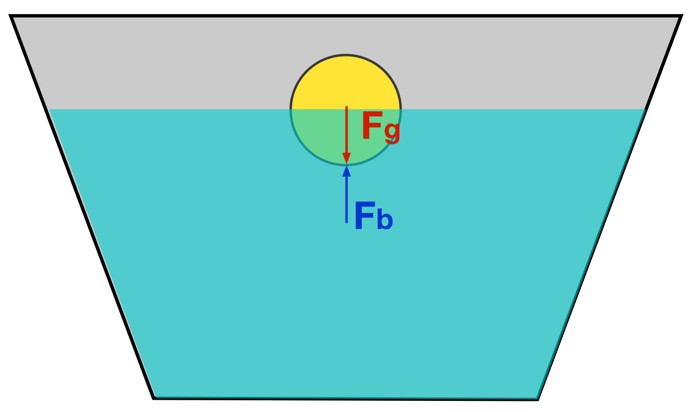
Buoyancy is the net upward force exerted by fluid pressure on an immersed object. Its magnitude equals the weight of the displaced fluid: F_B = ρ_fluid gV_displaced.
- Related Glossary Terms
- Index
Reviewed physics notes (1)
These corrections keep the original lesson’s purpose while fixing errors in the source edition.
- Buoyancy is the net pressure force, not simply the force on the bottom surface. — Reference 1
Glossary and deeper reading · 1 refreshers
These editorial refreshers supplement the reading. Definitions and examples are added guidance; original source wording and recorded answers remain in their original context.
-
Buoyancy
Buoyancy is the net upward force arising from pressure differences over an object in a fluid under gravity. Its magnitude equals the weight of the displaced fluid in the usual hydrostatic model. For example, a fully submerged object can rise, sink, or remain suspended depending on how buoyancy compares with its weight.