Buoyancy
Original textbook reading.
Now that you know a bit about how fluids work, it’s time to start looking at how solids and fluids can interact. In this section, we will examine buoyancy.
Buoyancy is the net upward force exerted by fluid pressure on an immersed body. For a fluid at rest in a uniform gravitational field, its magnitude equals the weight of the displaced fluid. Both floating and fully submerged objects experience buoyancy.
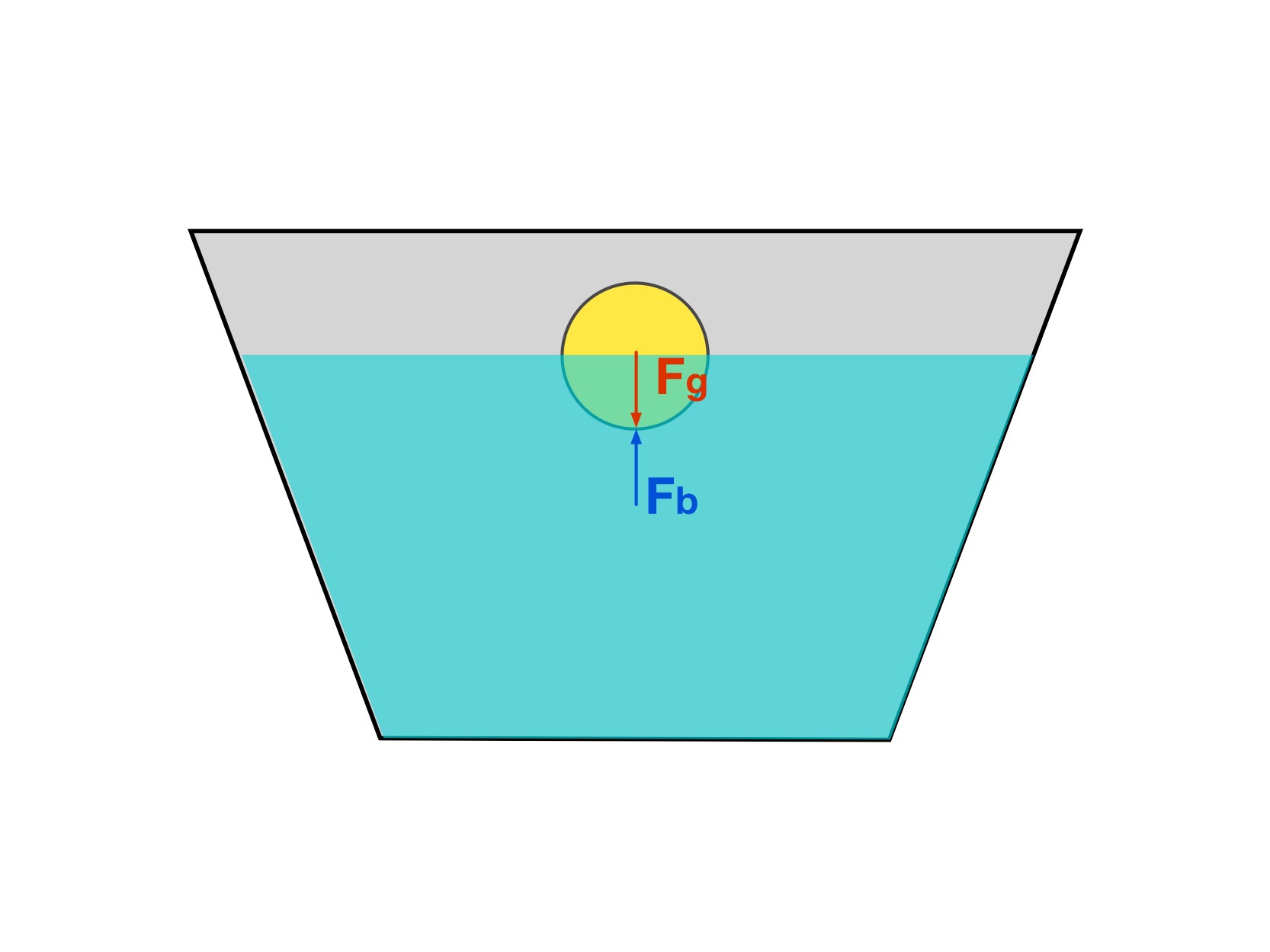
A basic diagram showing buoyancy is shown on the next page in Figure 8.3.1 The buoyancy force determines whether an object will float or not. The equation for buoyancy force is:
F_B = ρ_fluid V_displaced g (Equation 8.3.1). This is a magnitude; the buoyant force points opposite to gravity.
Now, if the object weighs more than the buoyancy force, then the object will sink. If that is true, then that means that (for fully submerged objects):
Figure 8.3.1 Buoyancy
This means that objects which are denser than water will sink, while objects which are less dense than water will float.
You might be wondering then, why is it that sometimes some objects, like paperclips, can float on top of the water, but if they are dropped in water, they don’t float to the surface.
That actually comes from surface tension. The idea behind surface tension is that the water can act like a thin sheet of paper that is very weak. The paper holds together, but if something with enough weight comes along, it will tear. The surface of water acts just like that.
Truly floating objects are actually in the water, instead of just on top of it. This is the biggest difference between floating in water and resting on water.
Another oddity in the mechanics of buoyancy is the fish. Most fish neither sink nor float, so it might be confusing as to whether or not buoyancy affects them. In fact, these fish have ‘neutral buoyancy’. This means that their buoyant force is equal to their weight, which means zero net vertical force if there are no other vertical forces. A fish initially at rest stays at rest; a moving fish does not have to stop just because its buoyancy is neutral. Many fish can actually control their buoyancy as well, using swim bladders, which are kind of like our lungs. They are simply bags of gas that can inflate and deflate. This changes the density of the fish, thus changing its buoyancy.
A boat of mass 3000 kg floats in water. Approximate the water density as 1000 kg/m³. Its displaced volume is V = (5/8 m)x², where draft x is in metres and V is in m³. Find the draft.
Example Problem 8.3.1

Step 1. Determine the volume of water that will be displaced by the boat
As this is a buoyancy problem, the weight of the displaced water will need to fully counteract the weight of the boat. We can think of this as an FBD where the weights equal each other.
We also know that the weight of water displaced is what causes the buoyant force so we can say .
We know the density of water is :
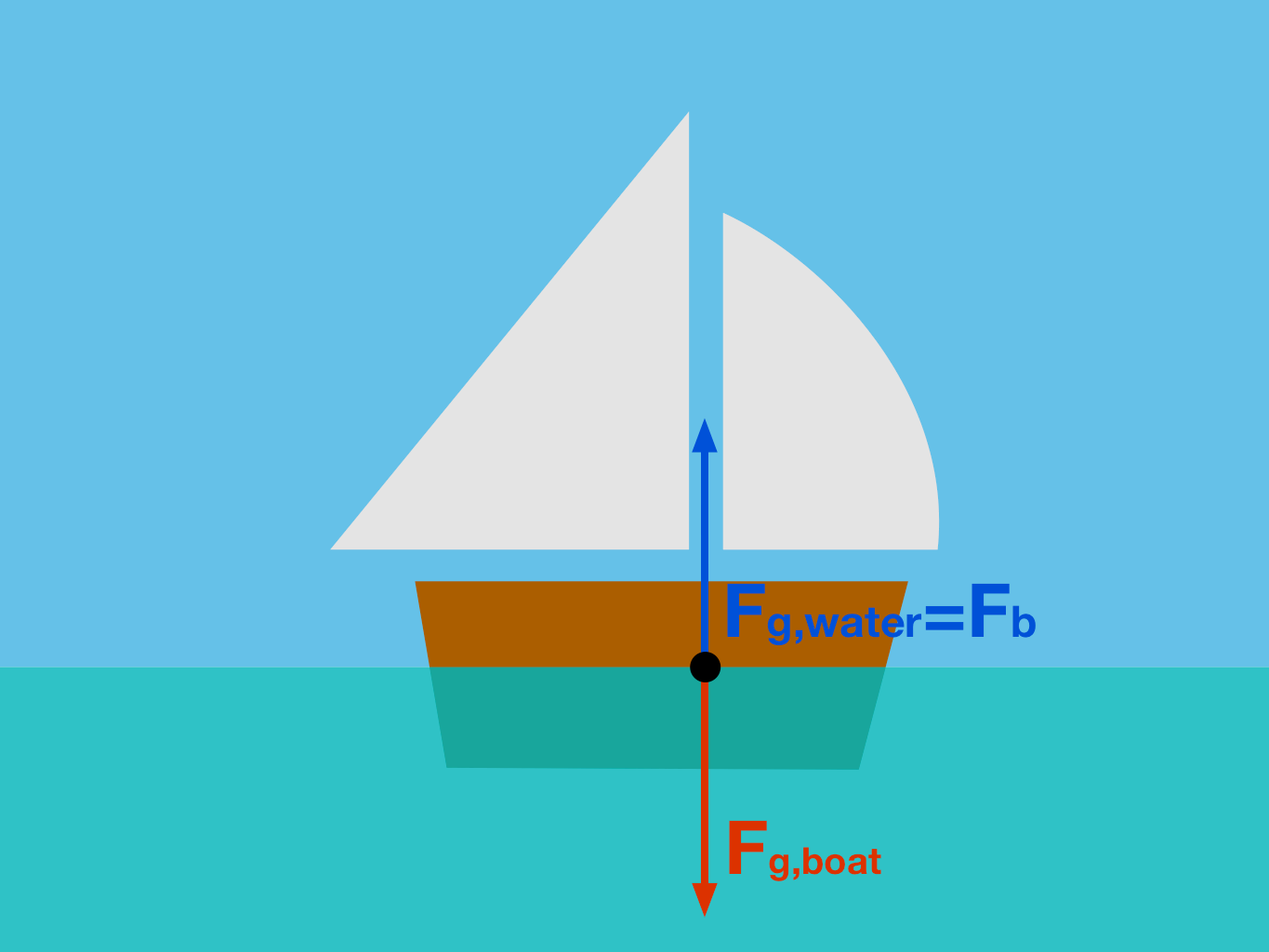
Drawing the FBD for this boat shows that the buoyant force has to equal the weight of the displaced fluid which is caused by the weight of the boat. Therefore, we can say that the weight of the boat is the same as the weight of water that is displaced.
Step 2. Determine the depth of the boat that gives that volume of displaced water.
We are given the volume function of the boat, so we can use that to determine the depth of the boat underwater.
x² = 4.8 m².
Therefore, the boat will have a draft of . (The draft is the depth of the boat beneath the water).
Pop Quiz 8.3.1 Buoyancy
Question 1 of 5 · 0 correct
AP Topic 8.3 · Read the worked solution
A cube with side length 2 m and mass 50 kg floats with a horizontal face in water of density 1000 kg/m³. What is its submerged depth?
Read every full question without answers
Question 1
Question 2
Question 3
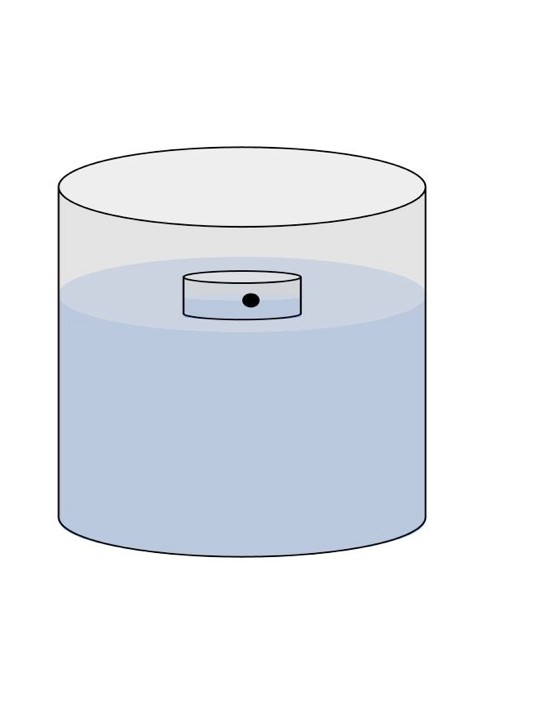
A cylinder is 100 mm long, 250 mm in radius, and has mass 100 kg. It is released upright in water. Will a hole halfway up its side become submerged?
Question 4
Question 5
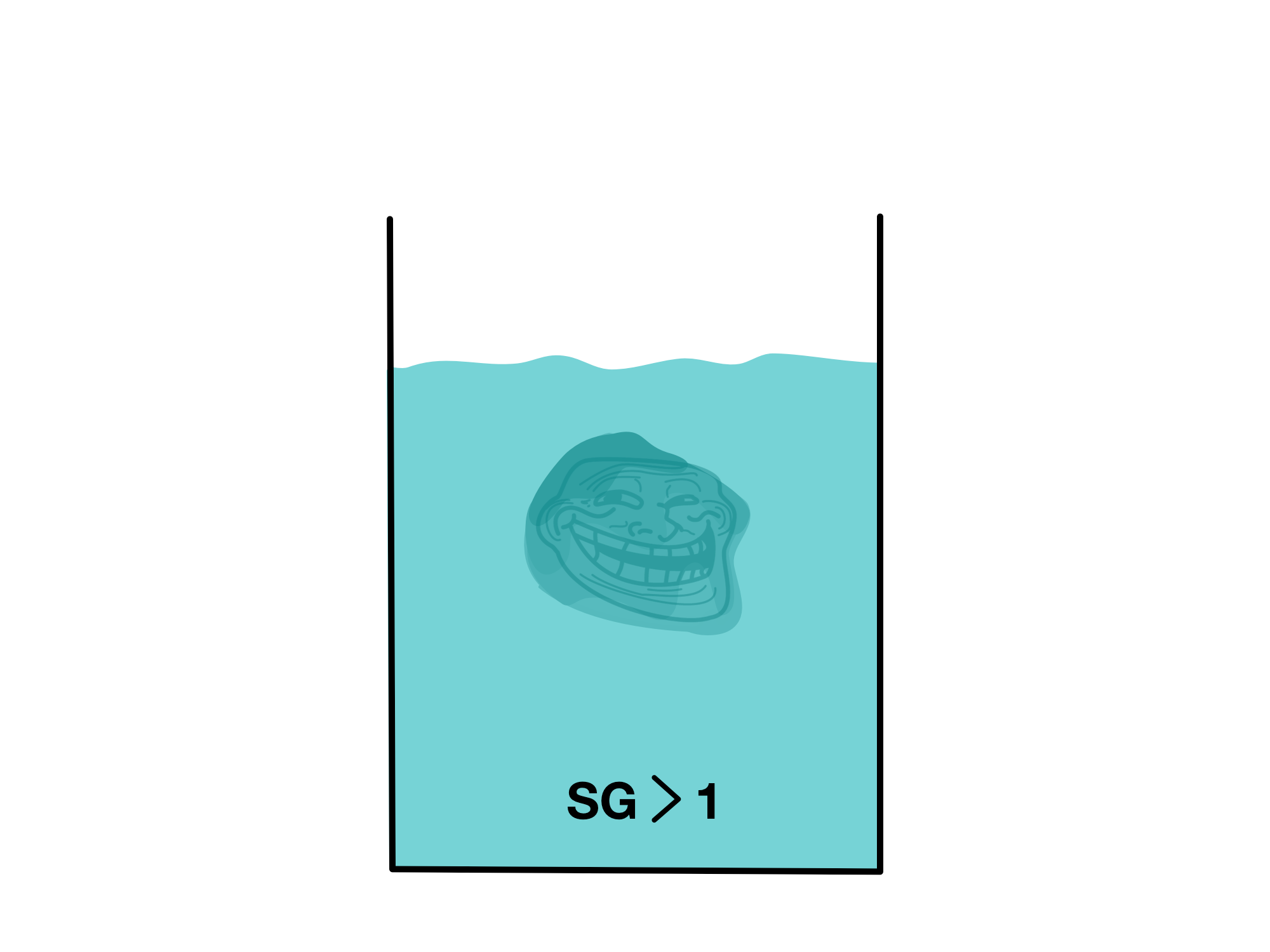
Here the SG >1, therefore the stone is more dense than water so it will sink and be fully submerged.
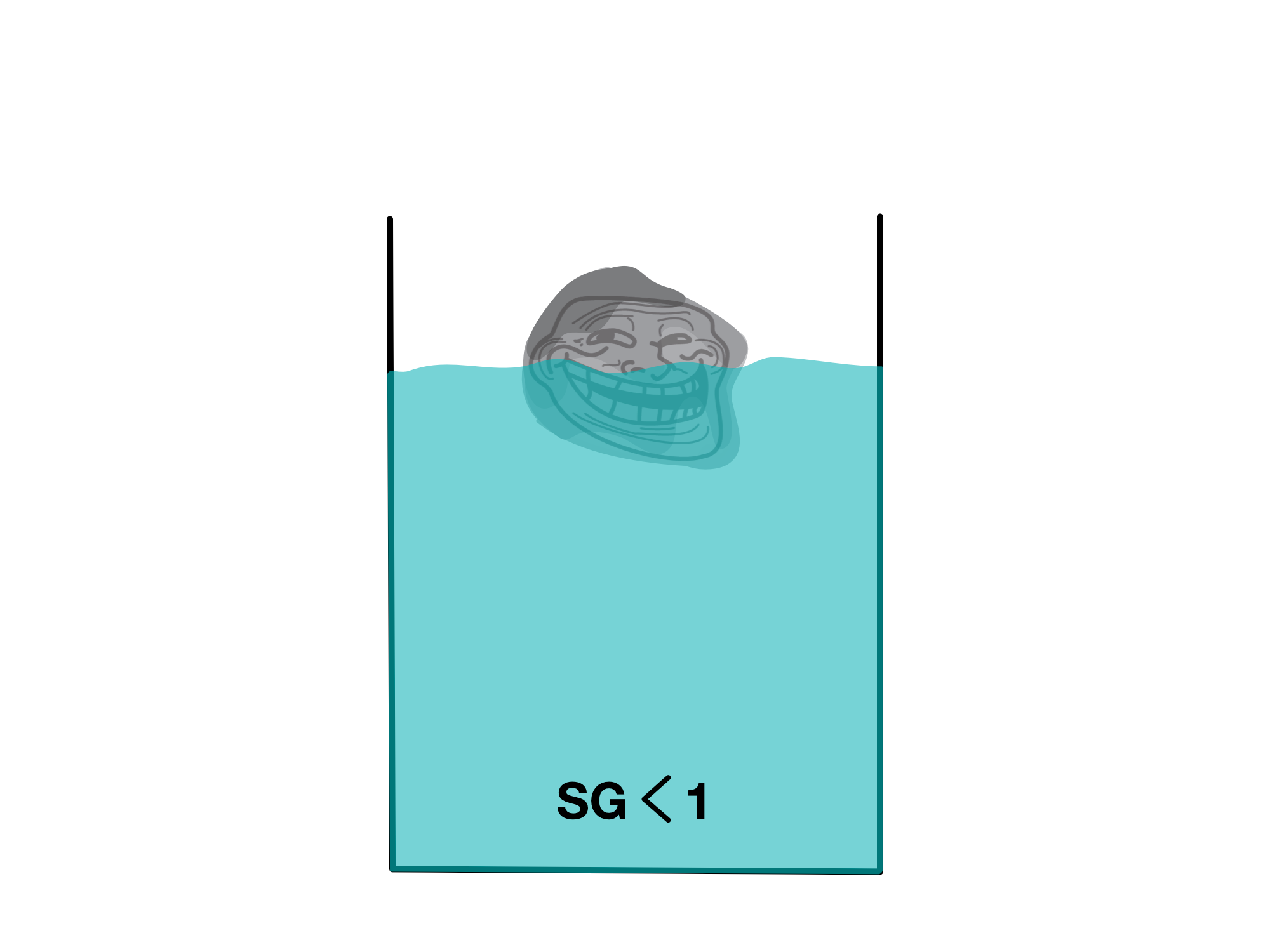
Specific Gravity is another term that comes up when discussing buoyancy.
The specific gravity of an object is given as the ratio of the object’s density to the density of water.
This ratio determines the buoyancy of the object, as if it exceeds one, then that means that the object is denser than water, and will therefore sink. Conversely, if the object’s is less than one, then object will float.
SG also has one other use for objects that will float. If the object has a specific gravity less than one, then that specific gravity will give the fraction of the object’s volume that will be below the surface.
To prove this concept, we will look at the equation for the specific gravity of an object that is floating in water.
If we substitute the definitions of the densities in, we get:
Now we rearrange that to get:
For an object floating at rest with only weight and buoyancy acting, its mass equals the mass of displaced water. This follows from force balance and Archimedes’ principle.
This lets us cancel the masses, leaving:
And now, for floating objects, the volume of the displaced water is equal to the volume of the object that is submerged. This lets us finally say:
This means that if we had a cube, and we knew that it had a , then if it were to be floating in water, then of the cube will be underwater.


Reviewed physics notes (11)
These corrections keep the original lesson’s purpose while fixing errors in the source edition.
- Buoyancy is not merely a force on the bottom or limited to objects at the surface. — Reference 1
- The source equates the buoyant force vector to a downward weight vector and uses g-vector with the wrong sign. — Reference 1
- Distinguishes equilibrium from the definition of buoyancy. — Reference 1
- The worked source uses fresh-water density despite saying ocean; stating the approximation also supplies dimensions for the geometric coefficient. — Reference 1
- The squared draft must have square-metre units, not metres. — Reference 1
- “Breaking” surface tension is not the cause of a boat’s flotation. — Reference 1
- Kilograms specify mass, not weight; face orientation and requested depth are clarified. — Reference 1
- The marked fall assumes the anchor is no longer suspended by the boat. — Reference 1
- The source’s claim of flotation is impossible: full displaced-water mass is only 19.6 kg. It sinks, so the marked Yes remains valid for the explicitly revised consistency question. — Reference 1
- The source asks weight but its choices are masses in kg. — Reference 1
- Neutral buoyancy implies zero vertical acceleration under the stated force model, rather than necessarily zero velocity. — Reference 1, Reference 2
Glossary and deeper reading · 9 refreshers
These editorial refreshers supplement the reading. Definitions and examples are added guidance; original source wording and recorded answers remain in their original context.
-
Fluid
A fluid is a material that flows and continuously deforms under a sustained shear stress. Liquids and gases are both fluids, although their compressibility and other properties can differ greatly. For example, both water in a pipe and air flowing through a duct are fluids.
-
Force
A force describes an interaction that can change an object’s momentum. It is a vector measured in newtons, so both size and direction matter when forces are added. For example, a rope can pull a cart while the floor exerts friction in another direction.
-
Pressure
Pressure is the normal force per unit area exerted on a surface. It is a scalar measured in pascals, with one pascal equal to one newton per square meter. For example, a gas exerts pressure throughout its volume through many microscopic collisions, even when its bulk motion is zero.
-
Magnitude
Magnitude is the nonnegative size of a vector quantity. It does not specify direction, and it differs from a signed component. For example, a westward velocity can have a negative x component while its speed, the velocity magnitude, stays positive.
-
Gravity
Gravity is the attractive interaction between masses in the Newtonian model. For spherical bodies or point-mass approximations, its strength decreases with the square of the separation between their centers. For example, Earth’s gravity provides the inward force that keeps a satellite in orbit.
-
Mass density
Mass density is mass per unit volume of a material or sample. It is commonly measured in kilograms per cubic meter and can vary with temperature or pressure. For example, equal-volume samples of water and oil generally have different masses because their densities differ.
-
Specific gravity
Specific gravity is a material’s density divided by a chosen reference density. It is dimensionless; for liquids and solids the reference is usually water at a specified temperature. For example, a liquid with specific gravity below one is less dense than the reference water.
-
Weight
Weight is the gravitational force exerted on an object by a specified attracting body. Near Earth’s surface its magnitude is approximately mass times the local gravitational field strength, and it is measured in newtons. For example, an astronaut has less weight on the Moon while retaining the same mass.
-
Archimedes’ principle
Archimedes’ principle states that a submerged object’s buoyant-force magnitude equals the weight of the fluid it displaces. Only the submerged volume contributes to displaced fluid for a partly floating object. For example, a floating boat displaces enough water for the water’s weight to match the boat’s total weight.