Centripetal Acceleration
Reference from the original Physics I textbook.
- Centripetal Acceleration
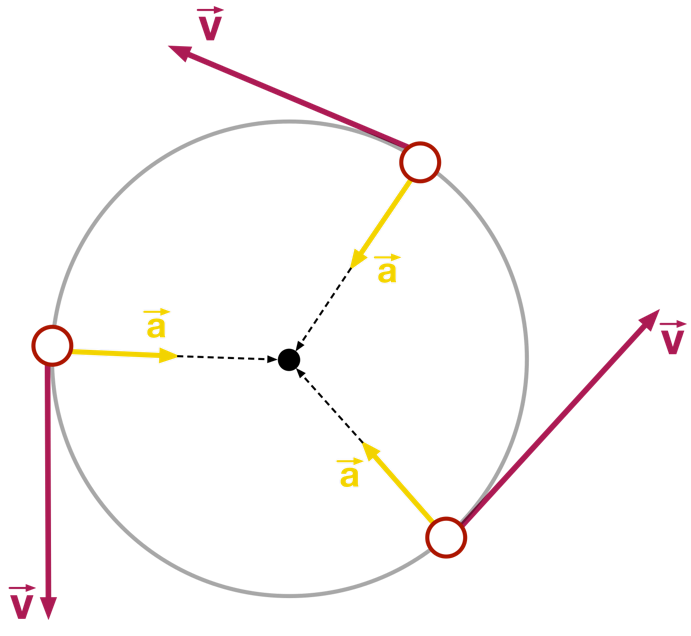
Centripetal acceleration is the inward radial component of acceleration in circular motion: a_c = v²/r. In nonuniform circular motion, a tangential component also changes the speed.
- Related Glossary Terms
Centripetal Acceleration Equation, Centripetal Force↗, Centripetal Force Equation, Uniform Circular Motion
- Index
Reviewed physics notes (1)
These corrections keep the original lesson’s purpose while fixing errors in the source edition.
- Only the centripetal component always points to the center; total acceleration need not. — Reference 1
Glossary and deeper reading · 2 refreshers
These editorial refreshers supplement the reading. Definitions and examples are added guidance; original source wording and recorded answers remain in their original context.
-
Centripetal acceleration
Centripetal acceleration is the inward acceleration component that changes the direction of motion along a curved path. For circular motion its magnitude is speed squared divided by the circle’s radius. For example, a car moving at constant speed around a bend still has centripetal acceleration.
-
Centripetal force
Centripetal force names the inward net-force component required for motion along a circular path. It is supplied by actual interactions such as tension, friction, gravity, or normal forces rather than being an additional type of force. For example, gravity supplies the centripetal force on a satellite in a circular orbit.