Circular Motion
Original textbook reading.
The inward-force reasoning fits AP. Quantitative banked-curve calculations with friction go beyond the supplied CED; its quantitative banked curves are frictionless.
In this section, we will be looking at circular motion and everything associated with an objects movement in a circular path. Circular motion is everywhere!
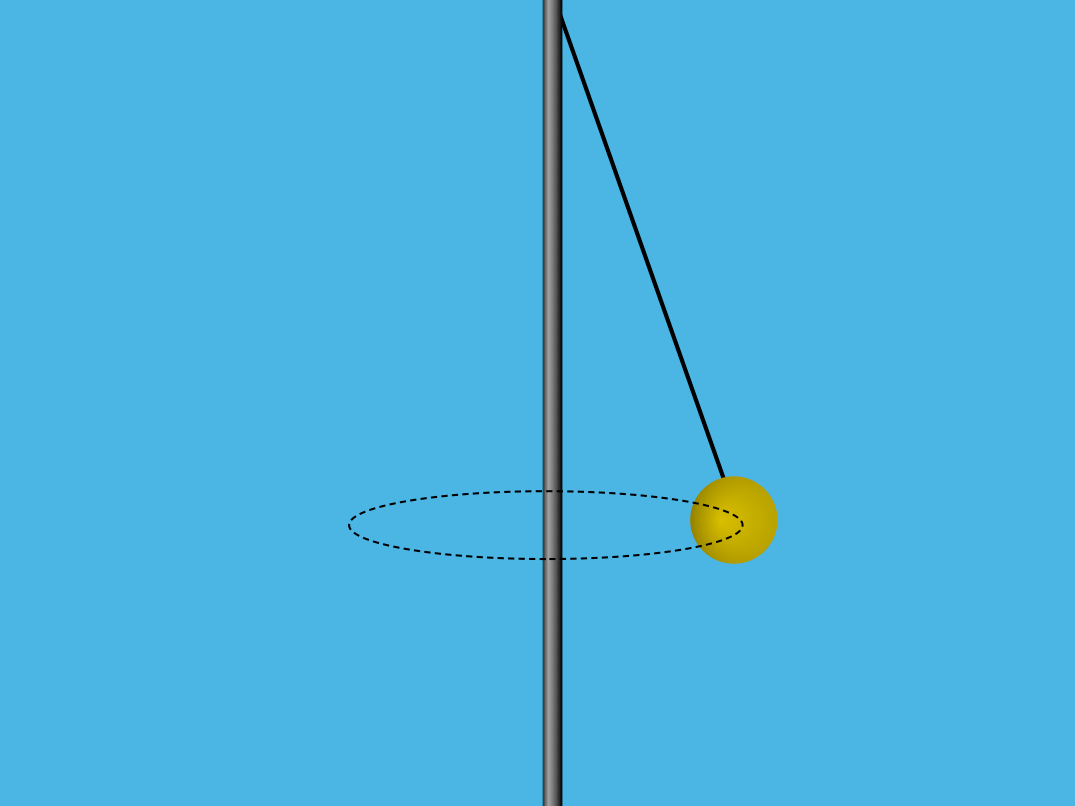
A Ball moving in a circular path is one example of centripetal motion.
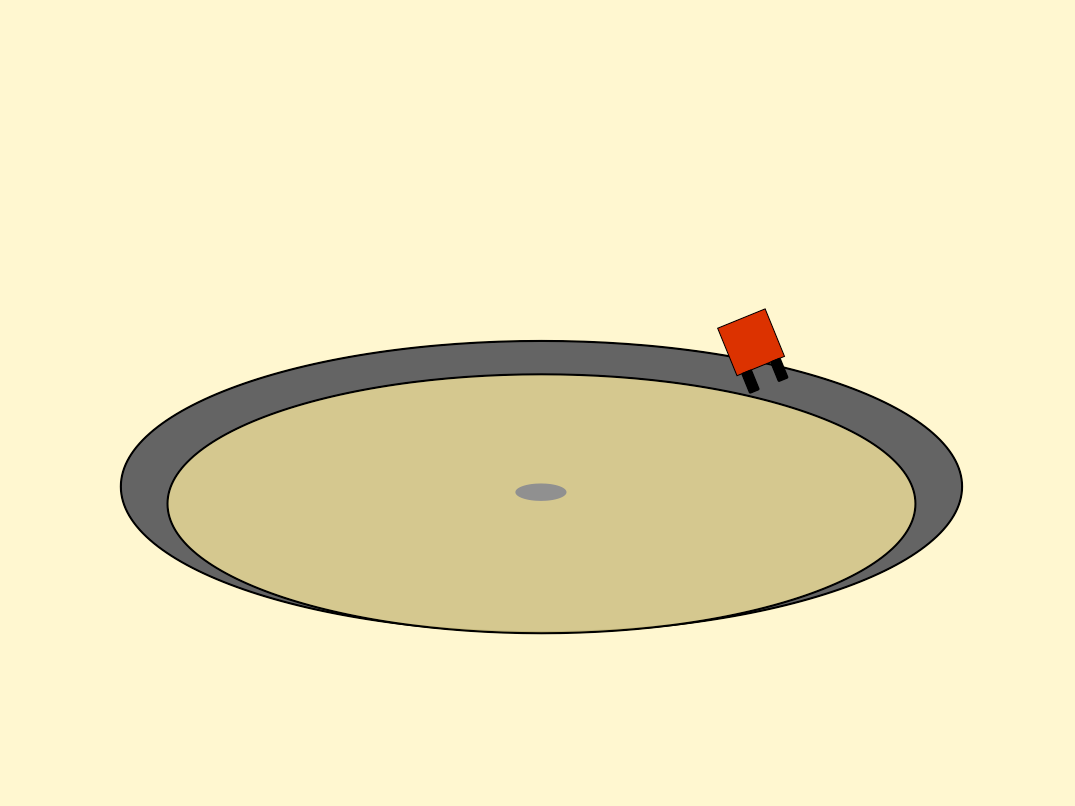
Uniform Circular Motion
Figure 6.1.1 Velocity of Particle in Circular Motion
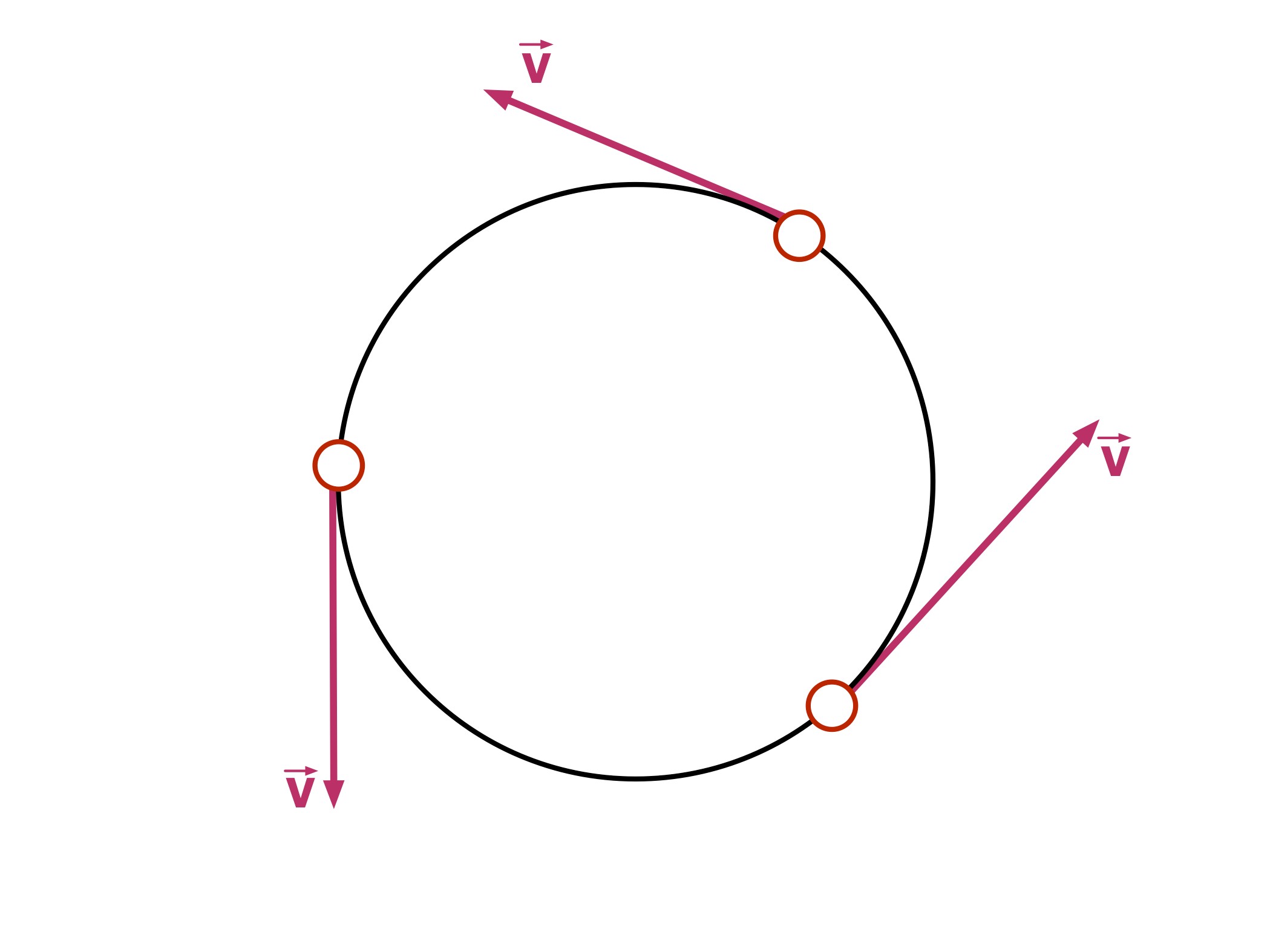
An object that moves in a circular motion with a constant speed is said to be in uniform circular motion. Therefore, there is a velocity that is associated with the object that has both magnitude and direction, so it is a vector.
In uniform circular motion the speed is constant, but the velocity changes because its direction changes. The centripetal acceleration also changes direction as the particle moves around the circle.
Centripetal Acceleration
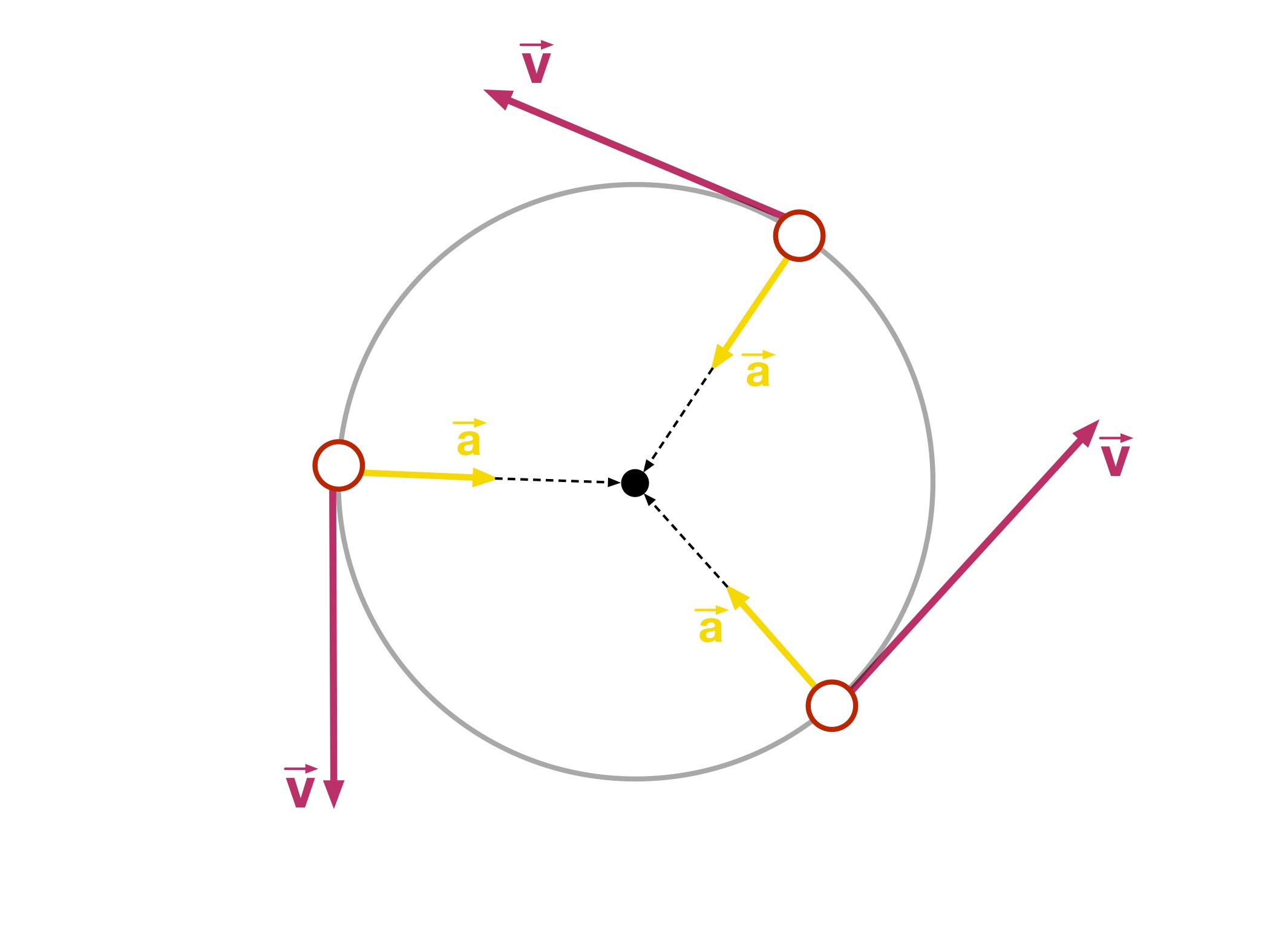
Figure 6.1.2 shows the relationship between the particle’s velocity and it’s acceleration.
For uniform circular motion, velocity is tangent to the path and acceleration points toward its center. For nonuniform circular motion there is also tangential acceleration when speed changes.
The equation for centripetal acceleration is:
a_c = v²/r (Equation 6.1.1), where a_c and v are magnitudes; the acceleration vector points inward.
Figure 6.1.2 Particles Acceleration Around a Circular Path
The net inward component of the real forces supplies the centripetal acceleration. “Centripetal force” names this resultant, rather than an additional force to add to a free-body diagram. For uniform circular motion, its magnitude is m v²/r.
Gravity, tension, friction, or a normal force can supply inward force components. On a level unbanked curve, tire–road static friction supplies the inward resultant; on a banked curve the normal force also has an inward component.
Example Problem 6.1.1
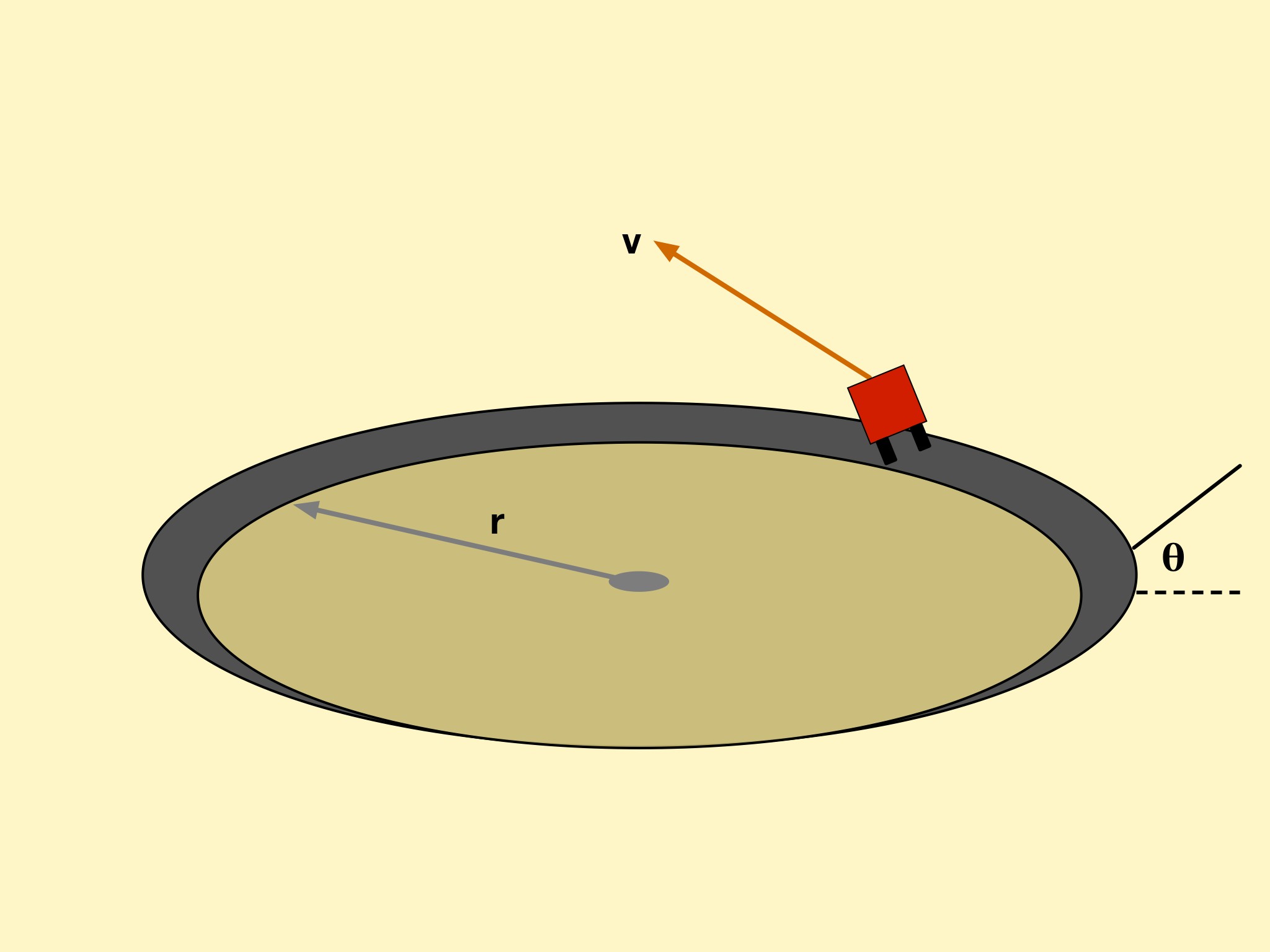
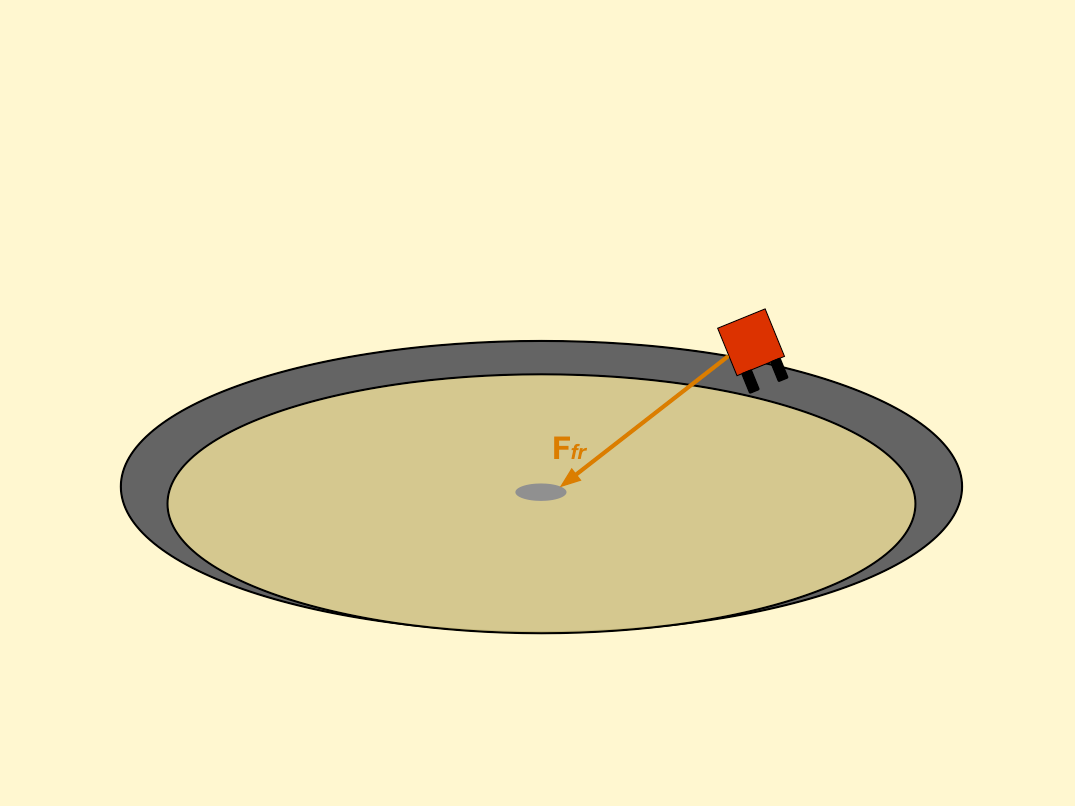
For a banked curve, inward components of the road’s normal force and, when needed, static friction provide the centripetal resultant.
Read every step and figure
Step 1
For a banked curve, inward components of the road’s normal force and, when needed, static friction provide the centripetal resultant.
Step 2
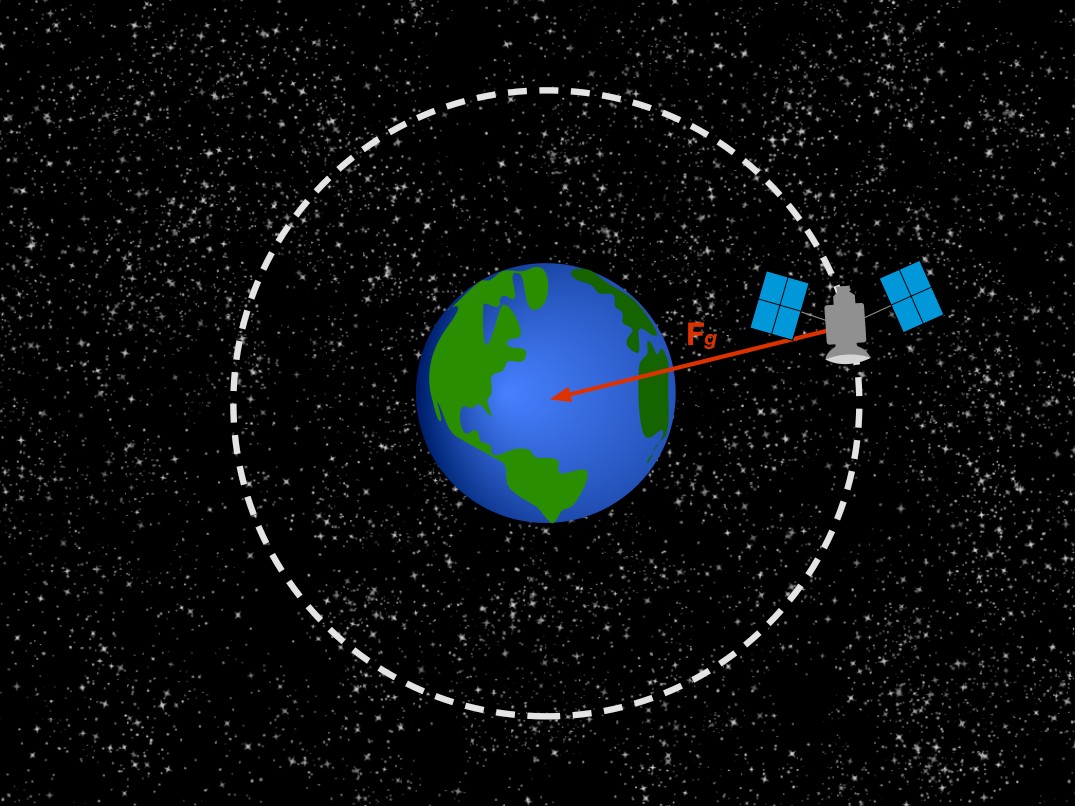
Remember from chapter 3, we discussed gravitational forces. This gravity force is the centripetal force that keeps the satellite in orbit!
Step 3
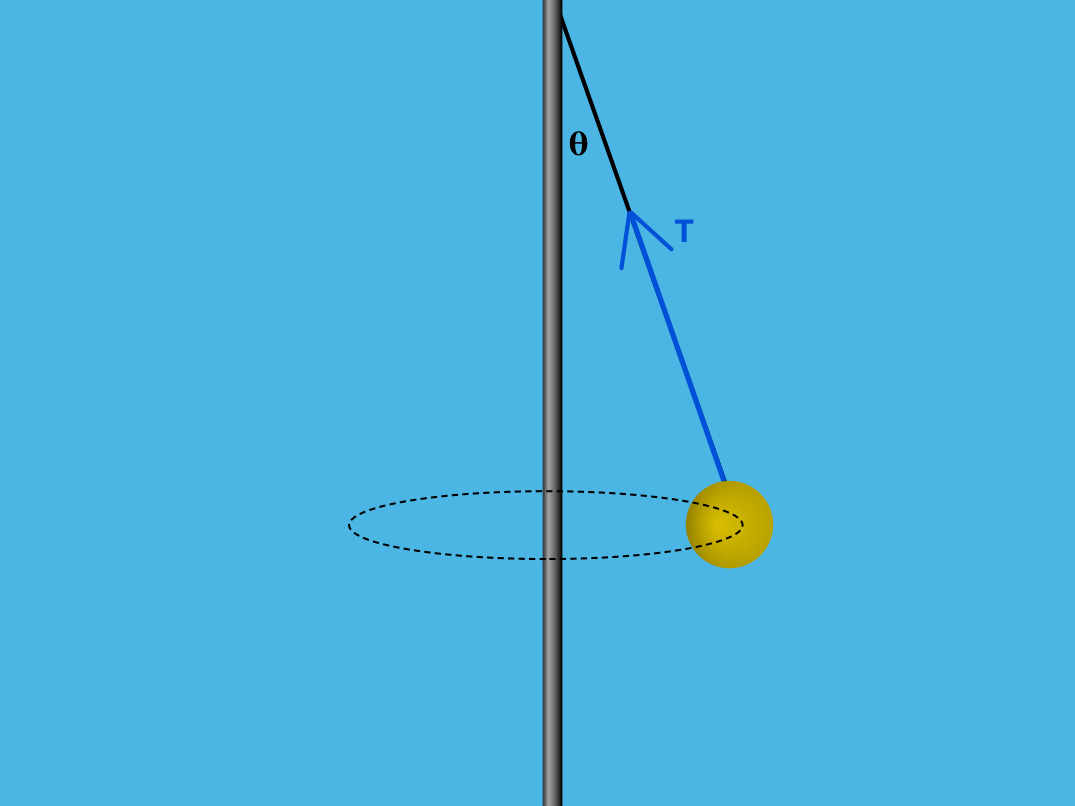
Curved parts of roads are typically banked as an added way to keep cars from sliding off the road. This is why engineers angle the road. Imagine a car with mass of traveling around a banked road with an angle and radius in the figure below with a constant speed of . What coefficient of static friction is necessary in order to prevent the car to start slipping up the banked road?
Step 1: Recognize that there is centripetal acceleration
Because the car moves at constant speed on a circular path, its acceleration is horizontal and inward with magnitude v²/r.
Step 2: Draw the free body diagram of the car
The gallery to the right shows how the FBD should look for this example problem, so look over them carefully
Step 3: Break down into x and y components
Choose x horizontally inward and y vertically upward. The normal force has components N sinθ inward and N cosθ upward. At this speed, friction acts down the bank, with components f cosθ inward and f sinθ downward.
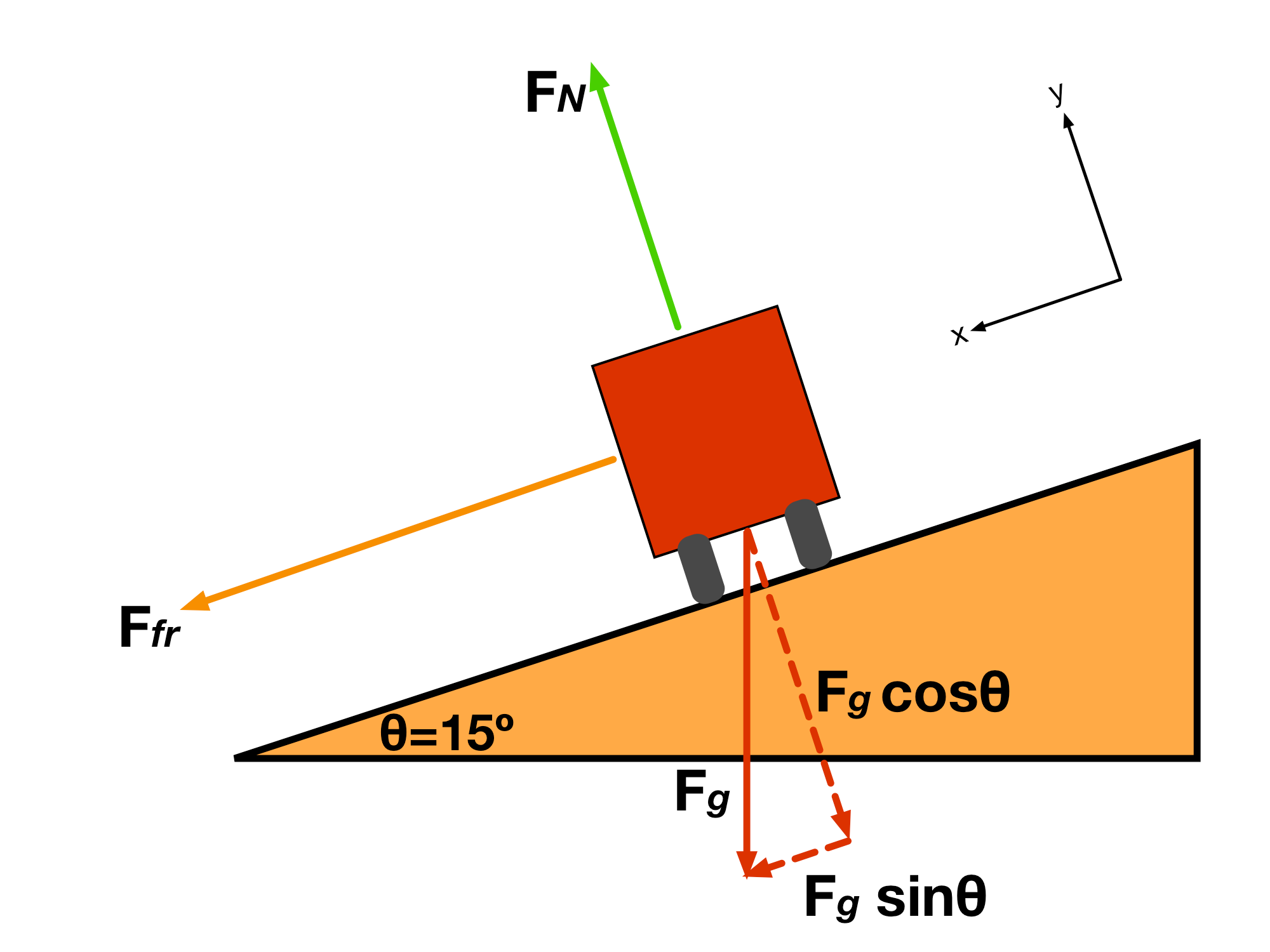
Here we draw an FBD with all the forces that are acting on the car. We know there is weight, there is a normal force, and there is also a friction force that acts against the tires to keep the car from sliding up the curb.
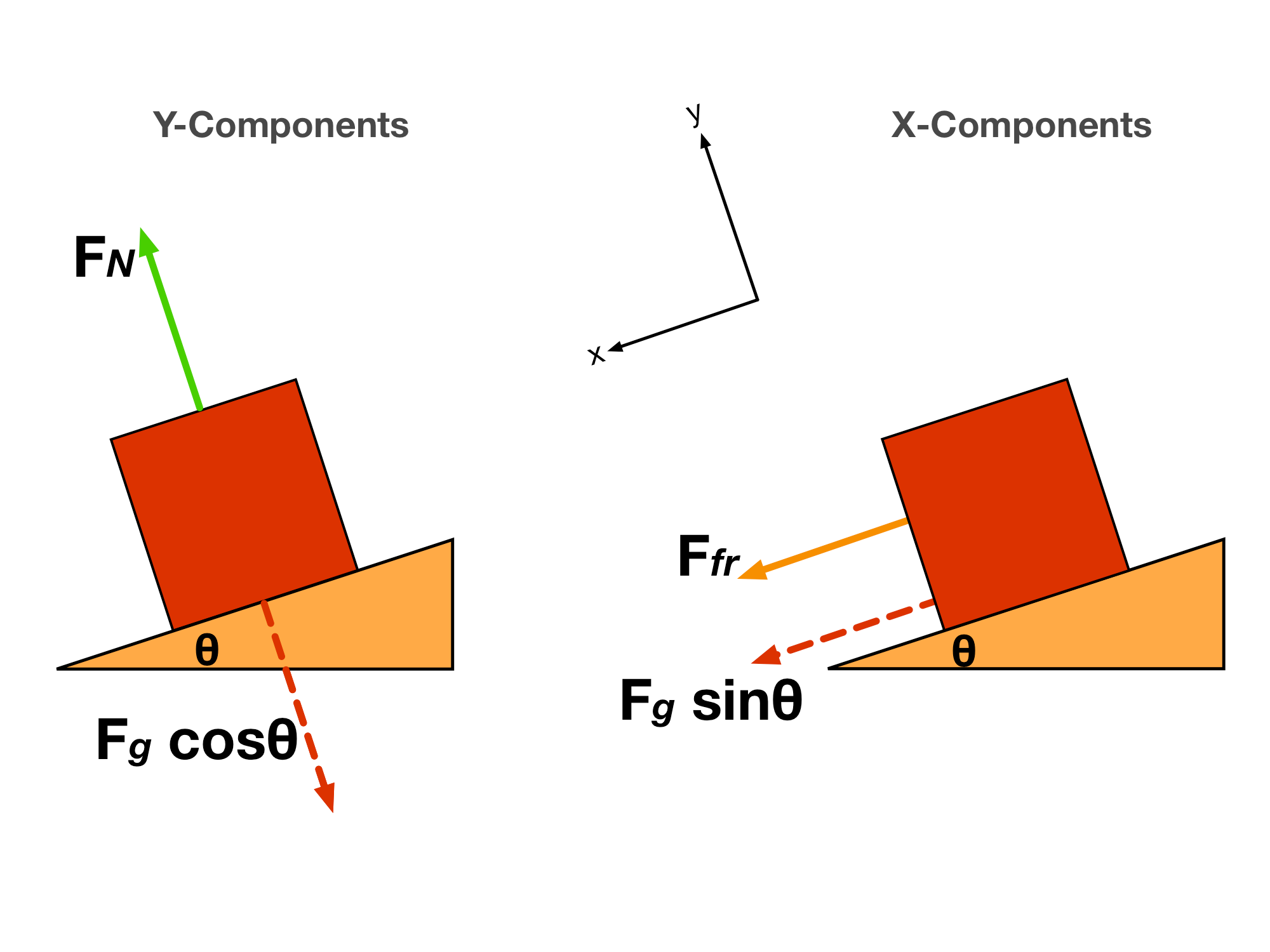
Here θ = 15°. Since v = 30 m/s exceeds the frictionless design speed √(rg tanθ), the car tends to slide up the bank; static friction must act down the bank.
Step 4: Set up equations of motion (EOM)
Vertical direction: there is no vertical acceleration, so N cosθ − f sinθ − mg = 0.
N cosθ − f sinθ = mg.
Horizontal inward direction: the acceleration is v²/r.
N sinθ + f cosθ = m v²/r.
Which simplifies to:
At the limiting condition, f = μ_s N, so N(sinθ + μ_s cosθ) = m v²/r and N(cosθ − μ_s sinθ) = mg.
Step 5: Solve for the coefficient of static friction
Let’s solve for the normal force by plugging in our known values:
At the limiting coefficient found below, N = mg/(cosθ − μ_s sinθ) = 2412.78 N.
With this value let’s recall our force balance equation. Remember that the acceleration of this car is centripetal acceleration since it is moving in a circle, so the equation can be rewritten as:
N(sinθ + μ_s cosθ) = m v²/r.
And can be simplified to:
Pop Quiz 6.1.1 Review of Circular Motion
Question 1 of 5 · 0 correct
AP Topic 2.9 · Read the worked solution
On a level, unbanked road, which real force supplies the inward horizontal resultant that keeps a car on a circular path?
Read every full question without answers
Question 1
Question 2
Question 3
Question 4
Question 5
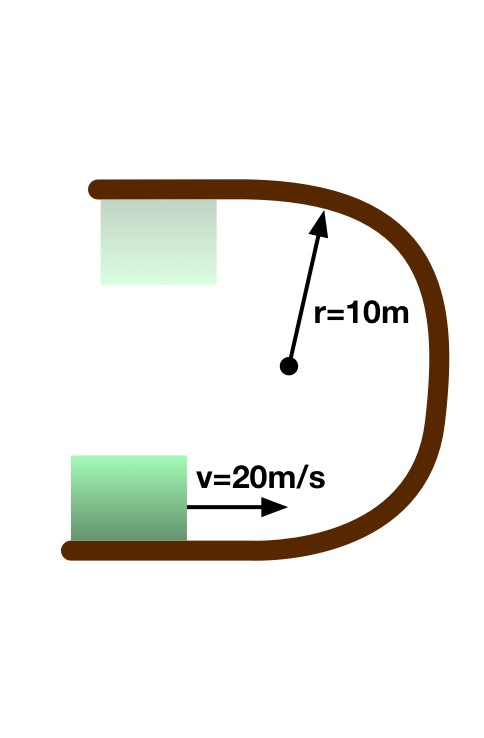
A 2.0 kg box moves on the inside of a vertical circular loop of radius 10 m. Its speed at the top is 20 m/s. With g the gravitational-acceleration magnitude, what is the inward normal force there?


Reviewed physics notes (31)
These corrections keep the original lesson’s purpose while fixing errors in the source edition.
- Constant speed does not mean constant velocity. — Reference 1
- Purely inward total acceleration applies only when speed is constant. — Reference 1
- Squaring a velocity vector as an ordinary vector quotient is incorrect. — Reference 1
- Different interactions can supply the same radial resultant. — Reference 1
- Replace invalid squared vector notation with a radial scalar balance. — Reference 1
- The source omitted the normal-force contribution for a banked curve. — Reference 1
- Velocity direction changes during a turn. — Reference 1
- The original incorrectly applied zero acceleration normal to a sloped bank. — Reference 1
- State the friction direction before forming components. — Reference 1
- Use a truly vertical axis for the zero-acceleration balance. — Reference 1
- Correct the banked-road vertical force equation. — Reference 1
- Specify the radial direction. — Reference 1
- Normal force and friction both contribute inward. — Reference 1
- Use the correct threshold friction and both equations together. — Reference 1
- N is not mg cosθ on a circular banked road; the source normal force was wrong. — Reference 1
- Correct the inward balance. — Reference 1
- Eliminate N using both horizontal and vertical equations. — Reference 1
- Use v²/r = 30²/90 = 10 m/s². — Reference 1
- The source answer 0.79 follows from an incorrect force balance. — Reference 1
- Correct the matching banked-curve gallery caption. — Reference 1
- The gallery incorrectly identified friction alone as the inward force on a banked curve. — Reference 1
- The original unspecified road made the answer ambiguous. — Reference 1
- Clarify that acceleration magnitude is fixed and specify the order of the ratio. — Reference 1
- v_i/v_f = √(r_i/r_f) = √(1/3). — Reference 1
- A universal constant cannot legitimately be redefined by physically incompatible orbital data. — Reference 1
- Retain the arithmetic as an explicit consistency check. — Reference 1
- The √μ scaling requires the unbanked-road friction model. — Reference 1
- Specify the top-of-loop geometry and use scalar g. — Reference 1
- At the top N + mg = mv²/r; force choices must include mass multiplying g. — Reference 1
- Static friction supplies the horizontal inward force on the stated unbanked road. — Reference 1
- Gravity is vertical and has no horizontal inward component on the stated road. — Reference 1
Glossary and deeper reading · 9 refreshers
These editorial refreshers supplement the reading. Definitions and examples are added guidance; original source wording and recorded answers remain in their original context.
-
Velocity
Velocity describes how position changes with time and includes direction. Instantaneous velocity describes one moment, while average velocity is displacement divided by elapsed time. For example, a car turning a corner can change velocity while maintaining the same speed.
-
Magnitude
Magnitude is the nonnegative size of a vector quantity. It does not specify direction, and it differs from a signed component. For example, a westward velocity can have a negative x component while its speed, the velocity magnitude, stays positive.
-
Centripetal acceleration
Centripetal acceleration is the inward acceleration component that changes the direction of motion along a curved path. For circular motion its magnitude is speed squared divided by the circle’s radius. For example, a car moving at constant speed around a bend still has centripetal acceleration.
-
Acceleration
Acceleration is the vector rate of change of velocity with time. It can change an object’s speed, direction, or both, and it is measured in meters per second squared. For example, a satellite moving at constant speed in a circular orbit accelerates toward the center.
-
Vector
A vector is a quantity with a magnitude and a direction, represented by an arrow or by components along chosen axes. Vectors add by adding corresponding components rather than simply adding their magnitudes. For example, an eastward displacement followed by a northward displacement produces a resultant pointing northeast. The zero vector has zero magnitude and no unique direction.
-
Force
A force describes an interaction that can change an object’s momentum. It is a vector measured in newtons, so both size and direction matter when forces are added. For example, a rope can pull a cart while the floor exerts friction in another direction.
-
Resultant vector
A resultant vector is the vector sum of two or more vectors. Its components are the sums of the corresponding components of the vectors being combined. For example, two equal forces in opposite directions have a zero resultant even though both forces are present.
-
Gravity
Gravity is the attractive interaction between masses in the Newtonian model. For spherical bodies or point-mass approximations, its strength decreases with the square of the separation between their centers. For example, Earth’s gravity provides the inward force that keeps a satellite in orbit.
-
Tension
Tension is a pulling force transmitted through a stretched rope, string, or similar connector. It acts along the connector away from the object it pulls, and an ideal massless rope has the same tension throughout an uninterrupted segment. For example, a rope supporting an accelerating load can have a tension different from the load’s weight.