Destructive Interference
Reference from the original Physics I textbook.
- Destructive Interference
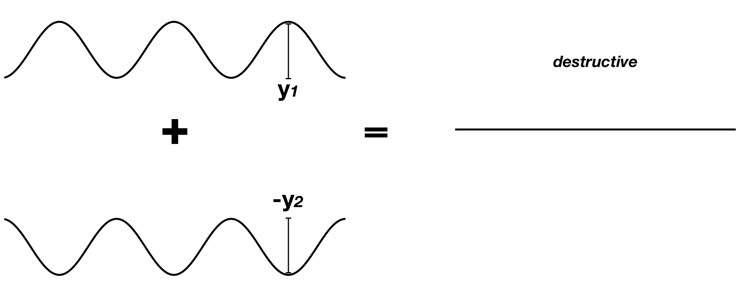
Destructive interference occurs when overlapping disturbances oppose one another. Two otherwise identical sinusoidal waves with phase difference π have resultant amplitude |A₁ − A₂|, which is zero for equal amplitudes.
- Related Glossary Terms
Constructive Interferenceⓘ, Two Wave Interference Equation, Wave Interference Equation, Waves with Equal Amplitude and Angular Frequency
- Index
Reviewed physics notes (1)
These corrections keep the original lesson’s purpose while fixing errors in the source edition.
- The result is reduced amplitude, not a shorter wavelength. — Reference 1
Glossary and deeper reading · 2 refreshers
These editorial refreshers supplement the reading. Definitions and examples are added guidance; original source wording and recorded answers remain in their original context.
-
Destructive interference
Destructive interference occurs when overlapping wave contributions oppose one another. Complete cancellation requires equal-magnitude opposite disturbances at the relevant place and time. For example, equal sinusoidal waves half a cycle out of phase can produce zero net displacement during their overlap.
-
Constructive interference
Constructive interference occurs when overlapping wave contributions reinforce one another. For equal-frequency sinusoidal waves, in-phase contributions produce increased amplitude at the location considered. For example, coherent light arriving with an integer-wavelength path difference can form a bright interference fringe.