Mechanical Waves
Original textbook reading.
Enrichment beyond the AP course.
This original chapter is extra exploration beyond the supplied AP Physics 1 course. Keep it if you're curious about where these ideas go next.
Mechanical waves carry a disturbance and energy through a medium while the medium’s particles oscillate. The particle motion differs from the propagation of the disturbance. Electromagnetic waves can propagate in vacuum.
One common example in wave propagation is the ripples formed by dropping something in a puddle of water. The ripples are actually a wave that is generated from the kinetic energy of the object dropped into the puddle.
The waves in the picture to the right are getting smaller over time as they are losing energy to the environment. This means that their amplitude (how tall they are) is decreased.
In a small-amplitude wave model, water particles move locally while the disturbance travels outward. Real surface waves can also produce a small net drift, so floating objects or dye need not remain at exactly the same mean position.
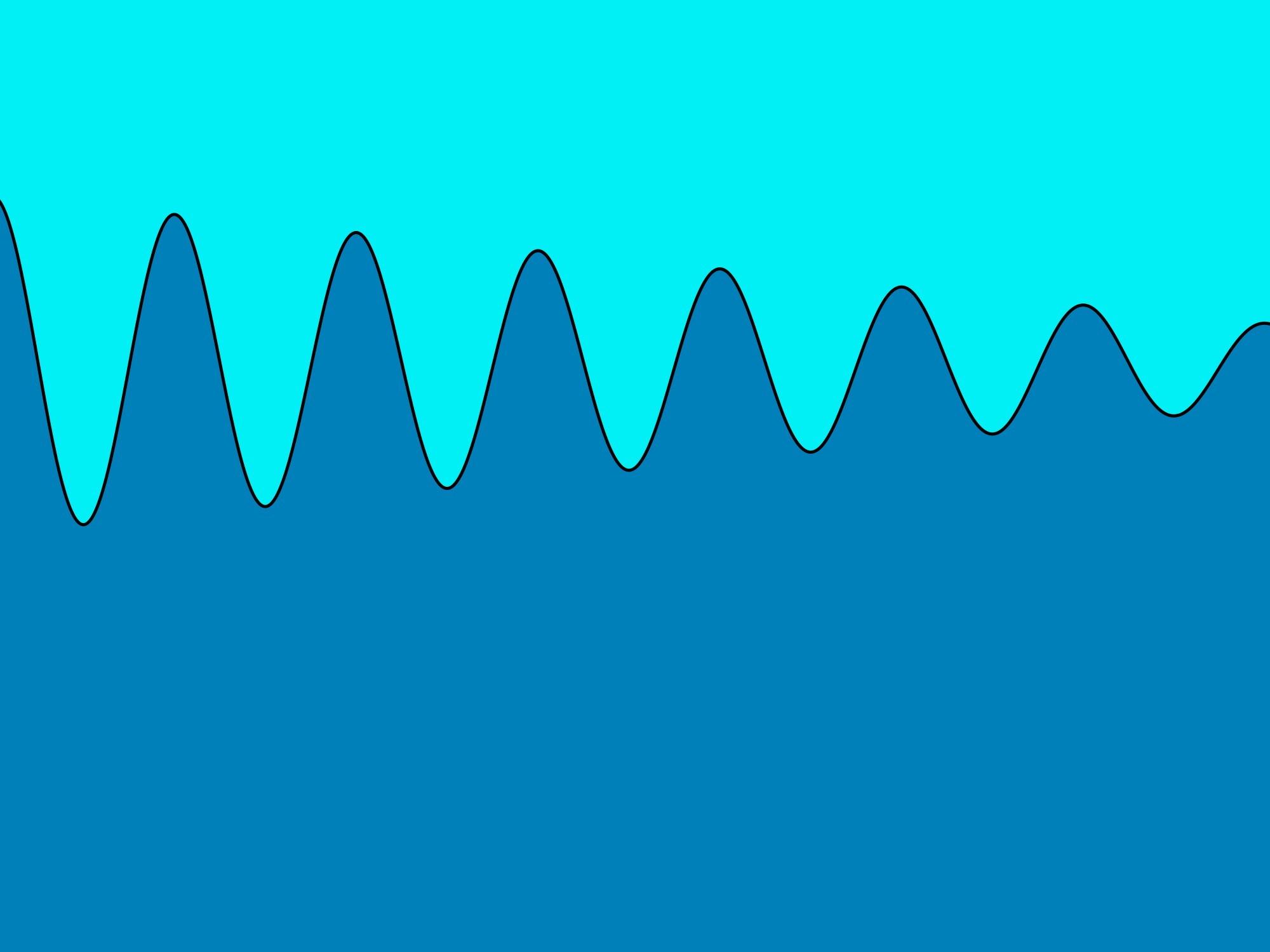
Here you can see the ripples decrease in the height and depth of their waves over time. In this picture, the object was dropped to the left side of the picture.
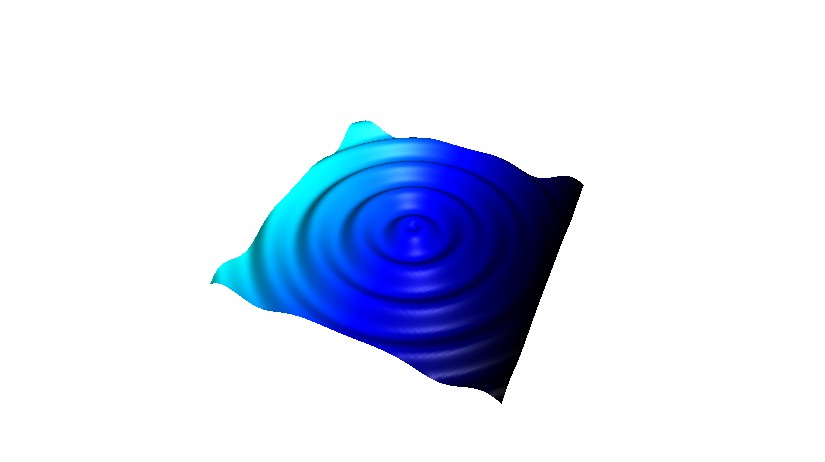
A transverse wave has medium-particle displacement perpendicular to the direction of wave propagation. A wave on a taut string is a standard example. Surface water waves generally combine horizontal and vertical particle motion.
The wave shown in the following interactive image is a basic sinusoidal wave, which means that it can be represented mathematically with a sine-based graph. The top-most points are called crests and the bottom most points are troughs.
The amplitude of the wave refers to the distance from the center of the wave to the top of one of the peaks. The length between one peak to the next (or any particular point on the wave to its next instance) is the wavelengthⓘ.
Frequency is the number of complete oscillation cycles per second at a fixed position. Its unit is hertz, Hz = s⁻¹.
Figure 9.1.1 Sine Wave
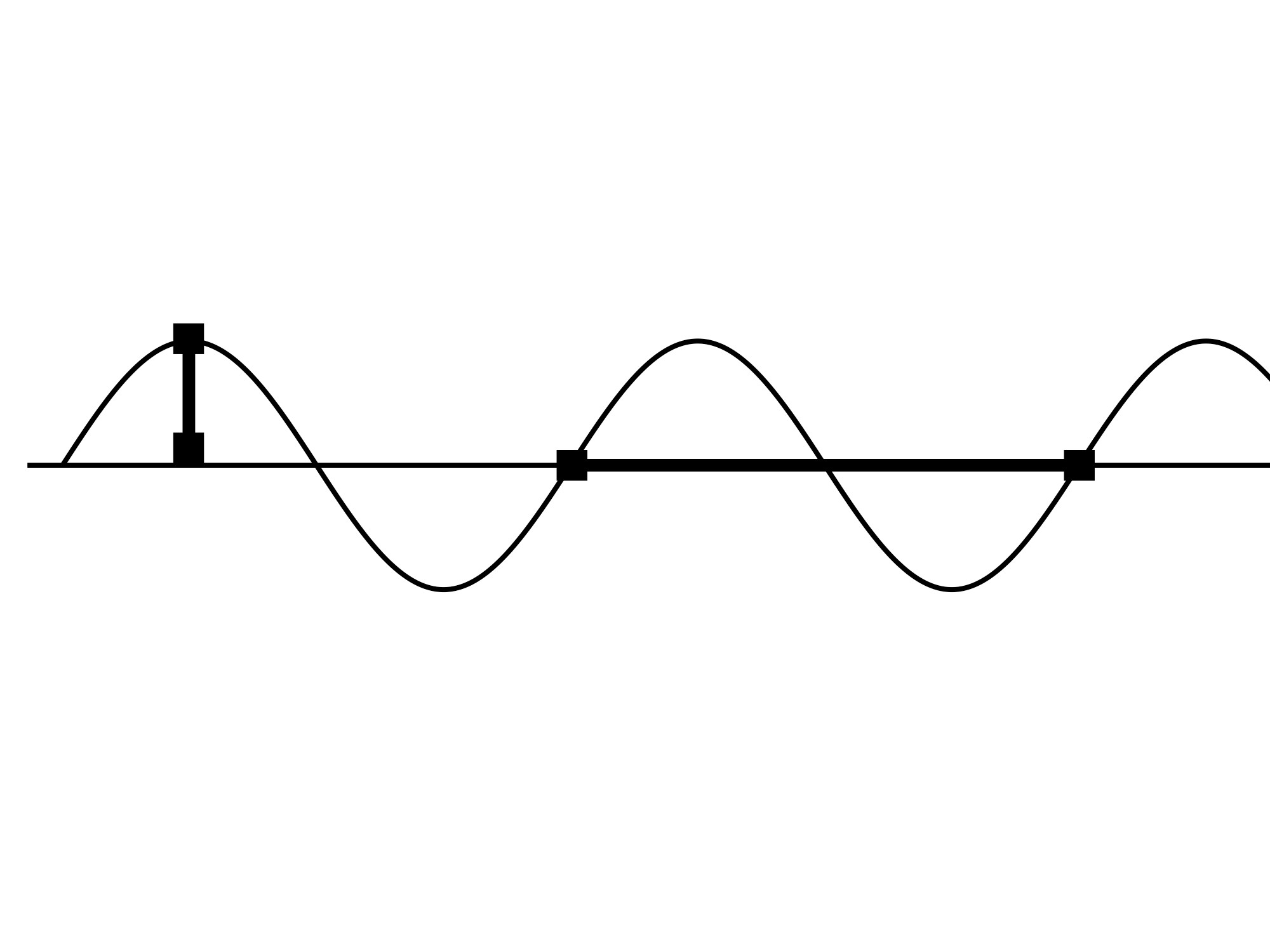
Figure 9.1.2 Sine Wave Variables
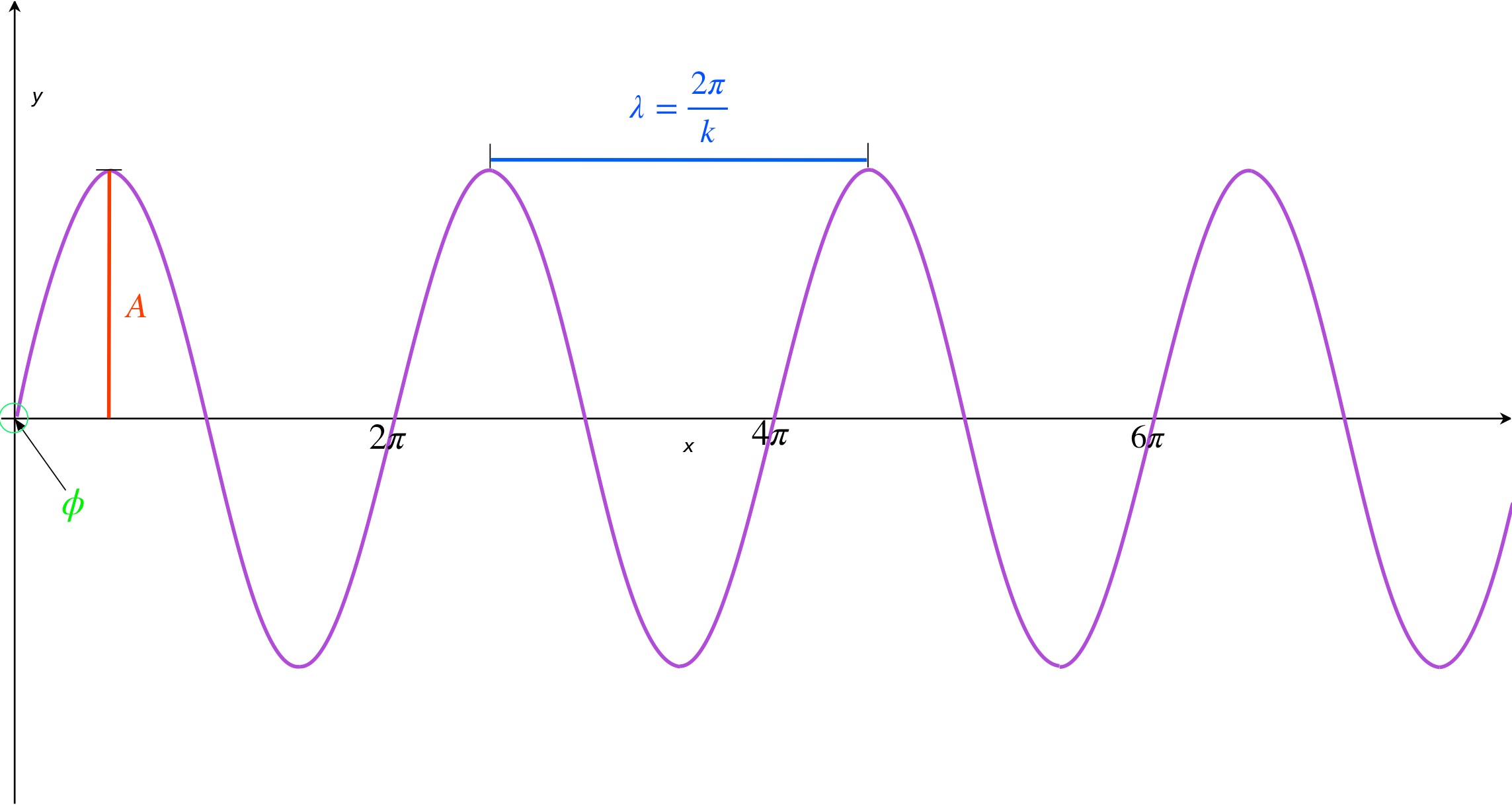
When dealing with waves in physics, we will represent them mathematically using the general sine wave function:
Here, the refers to the amplitude of the wave and is the highest value that can reach, refers to the angular frequency, and represents the phase, which basically means, where is the wave at time ?
The angular frequency is a function of the normal frequency:
The coordinate x specifies position along the medium. Wavenumber k is spatial phase change per unit distance, measured in rad/m, and is related to wavelength by k = 2π/λ.
Another useful variable in waves is the period. The period is the time it takes for one wavelength to pass. It is actually the inverse of the frequency:
A graph of y versus x at a fixed t is a spatial snapshot. A graph of y versus t at a fixed x shows one point’s oscillation. Both can be plotted in two dimensions; a three-dimensional surface is optional when showing all x and t together.
However, this concept will be important in future classes if you are planning to go into certain engineering fields or become a physics major!
A sinusoidal wave on a string has amplitude 15 mm, wavelength 1 m, period 8 s, zero phase, and travels toward +x. Write its equation, find its displacement at x = 9 m and t = 0 s, and sketch y versus x at t = 0.
We can replace in terms of the period, , by solving for in Equation 9.1.4 to get:
- with this, we plug it back in to get
The other unknown is . We know is :
That is the basic idea behind a single sine wave. But what if you have multiple waves along the same medium? That leads to interference.
Example Problem 9.1.1 Graphed Solution
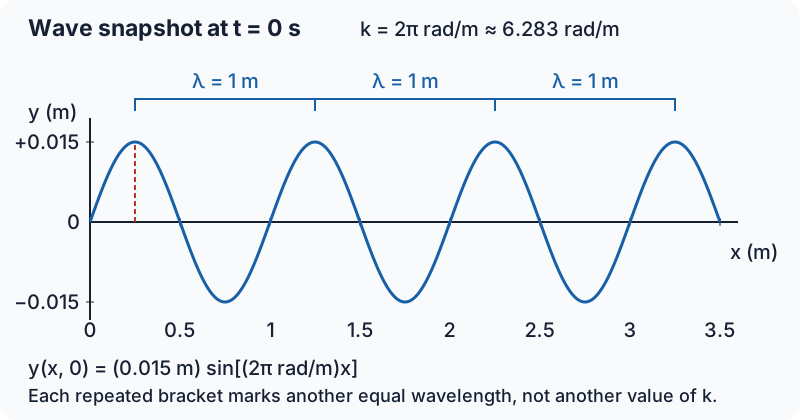
Every adjacent-crest bracket marks the same λ = 1 m. The wavenumber is k = 2π/λ = 2π rad/m; the brackets do not count out different wavenumbers. Sinusoidal-wave model.
Wave Interference
For linear waves, superposition means that the resultant instantaneous displacement is the sum of the signed displacements of the component waves. For example, simultaneous displacements of +0.5 m and +1 m give +1.5 m. Component amplitudes add directly only under the appropriate phase conditions.
The basic equation is this:
If we assume that we have two waves, then we can say that the equation can be re-written as:
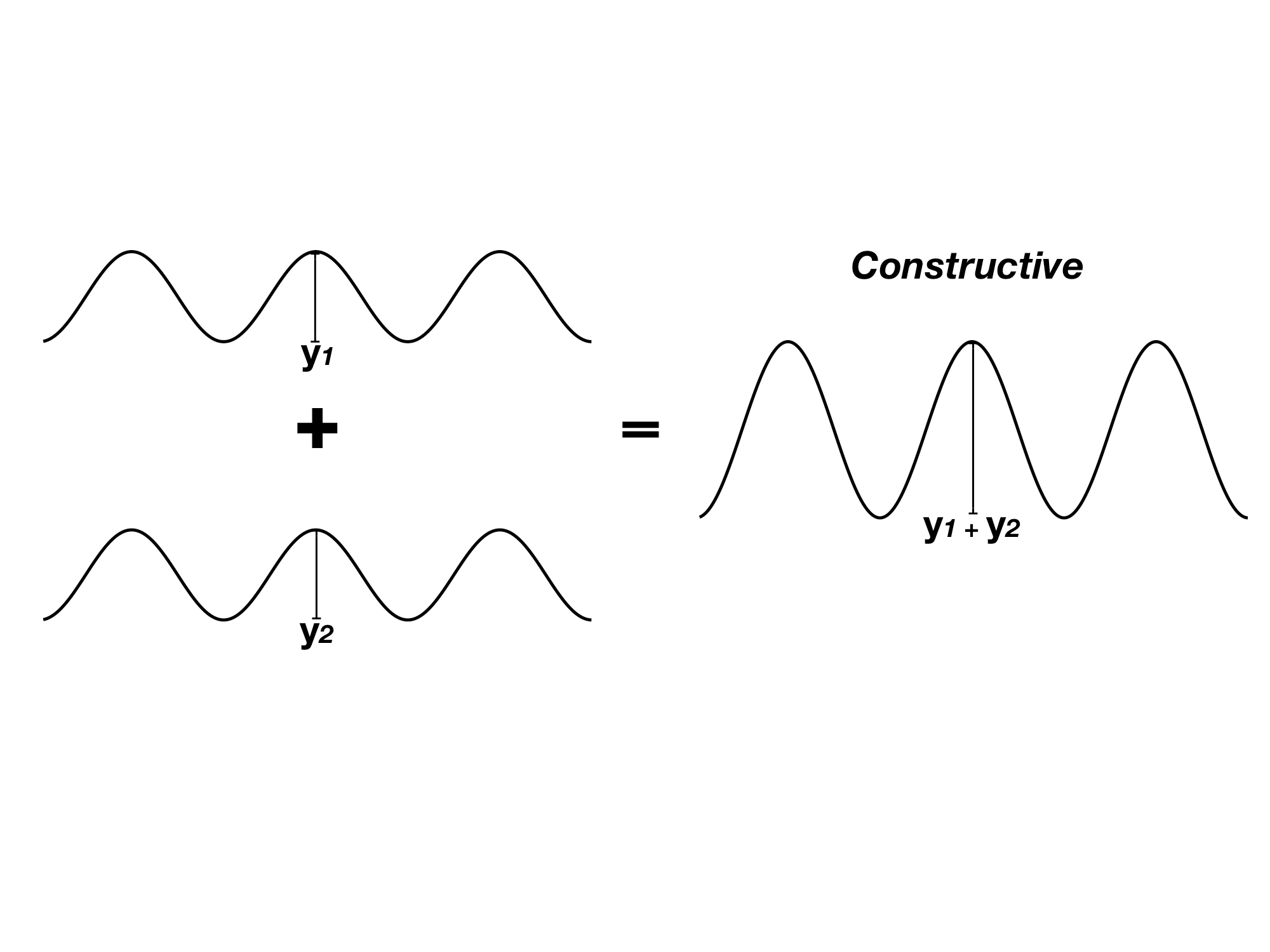
The same points along each wave are added together and since all the points match up and have the same value at each point, when the waves are added together, you get a much taller wave.
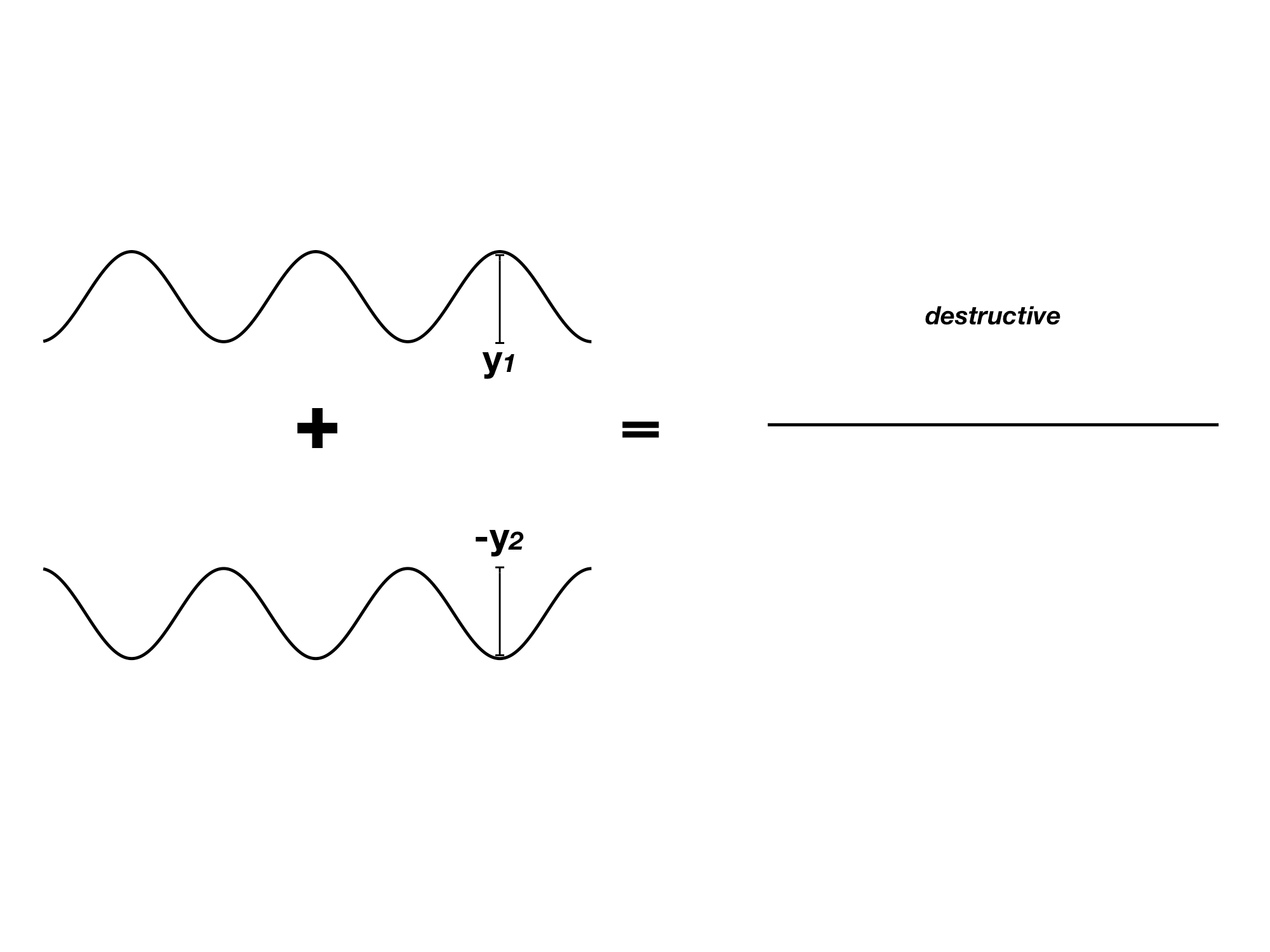
For two waves traveling in the same direction with equal amplitude A, the same k and ω, and phases 0 and −ϕ, the sum-to-product identity gives the expression below. Its resultant amplitude is 2A|cos(ϕ/2)|.
The resultant amplitude changes continuously with phase difference. It is 2A for phases equal modulo 2π and zero for phase difference π modulo 2π. For other phase differences use 2A|cos(ϕ/2)|; do not apply a universal 2π/3 boundary between constructive and destructive interference.


Step 3. Write the wave equation
Combining all we know, we can write:
Step 4. Calculate the displacement at the given point.
Using exact k = 2π rad/m, y(9 m, 0 s) = (0.015 m)sin(18π) = 0.
y = 0 m.
y = 0 mm; the wave amplitude is still 15 mm.
Just for added practice, let’s see what the graph looks like on the next page at just to see if everything matches up. Our equation for the graph will be:
Reviewed physics notes (23)
These corrections keep the original lesson’s purpose while fixing errors in the source edition.
- The chapter includes light, which does not require a material medium. — Reference 1
- The source makes an absolute no-transport claim for water waves. — Reference 1
- It is the displacement, not the wave’s propagation itself, that is perpendicular. Surface ripples are not purely transverse in general. — Reference 1
- A point undergoes oscillations, not spatial wavelengths. — Reference 1
- Corrects “position from the point of time t = 0” and the interpretation of wavenumber as a count of wavelengths. — Reference 1
- The source incorrectly says any nonzero time requires a 3D graph. — Reference 1
- Asks displacement at an event and specifies travel direction. — Reference 1
- The source treats instantaneous displacement and amplitude as interchangeable. — Reference 1
- Equal angular frequency and amplitude alone do not guarantee the stated simplification; equal wave number and phase convention are also needed. — Reference 1
- Removes a nonstandard hard threshold and states the unambiguous limiting cases. — Reference 1
- The source says crest to next trough is a wavelength. — Reference 1
- The quantity at x,t is displacement, not amplitude. — Reference 1
- Correct radian evaluation of an integer number of wavelengths. — Reference 1
- The original 0.0125 m is wrong. — Reference 1
- Separates displacement from amplitude and corrects the numerical result. — Reference 1
- Corrects the 6.23 display typo and supplies units. — Reference 1
- Corrects the interpretation of wavenumber. — Reference 1
- Qualifies the medium so the marked False is unambiguous; solids can support transverse elastic waves. — Reference 1
- The source question omits displacement units and incorrectly asks amplitude. Its mm choices support explicitly stating the working unit. — Reference 1
- The marked answer must be 5sin(0) + 2sin(0.6) = 1.12928 mm, not 20.9 mm. — Reference 1
- A 2π phase change reproduces the original wave rather than cancelling it. A π phase shift cancels it. This preserves the request for two correct choices. — Reference 1
- The component frequencies and wave numbers differ, so their relative phase varies with x and t. — Reference 1
- Replaces the wrongly universal “Constructive” label with the valid answer while retaining its correct weight. — Reference 1
Glossary and deeper reading · 14 refreshers
These editorial refreshers supplement the reading. Definitions and examples are added guidance; original source wording and recorded answers remain in their original context.
-
Electromagnetic wave
An electromagnetic wave contains oscillating electric and magnetic fields that transport energy. In the plane-wave vacuum model, both fields are perpendicular to each other and to the propagation direction. For example, visible light and radio waves can both travel through empty space.
-
Kinetic energy
Kinetic energy is energy associated with motion relative to a chosen reference frame. For a nonrelativistic translating object it is one half of its mass times speed squared. For example, doubling a cart’s speed quadruples its translational kinetic energy when its mass stays fixed.
-
Amplitude
Amplitude is the maximum magnitude of a repeating disturbance measured from its equilibrium value. It describes the size of the oscillation rather than its frequency or propagation speed. For example, pulling a spring-mounted mass farther from equilibrium increases its oscillation amplitude when it is released from rest.
-
Transverse wave
In a transverse wave, the disturbance is perpendicular to the direction of propagation. The disturbance direction and the energy-transfer direction must therefore be distinguished. For example, a rope pulse can travel horizontally while rope segments move up and down.
-
Displacement
Displacement is the vector change in position from the start of an interval to its end. It depends on those endpoints rather than the length or shape of the path traveled. For example, walking around a closed track and returning to the start gives zero displacement but a nonzero distance traveled.
-
Wavelength
Wavelength is the spatial distance between neighboring points at the same phase of a periodic wave. It connects propagation speed and frequency through speed equal to frequency times wavelength. For example, neighboring crests of a sinusoidal water wave are separated by one wavelength.
-
Frequency
Frequency is the number of complete repeating cycles per unit time. It is measured in hertz, meaning cycles per second, and is the reciprocal of the period. For example, a vibrating string with a higher frequency produces more cycles each second.
-
Angular frequency
Angular frequency measures how rapidly the phase of a sinusoidal oscillation advances. It equals two pi times the ordinary frequency and is measured in radians per second. For example, two oscillators at the same ordinary frequency also have the same angular frequency even if their amplitudes differ.
-
Oscillation phase
Phase specifies the position within a repeating oscillation cycle. A phase difference tells how much one oscillation leads or lags another at a chosen place and time. For example, two sinusoidal waves half a cycle out of phase can cancel when their amplitudes are equal.
-
Wavenumber
Angular wavenumber measures the change of wave phase per unit distance. In the sinusoidal convention used in the source reading, it equals two pi divided by wavelength and is measured in radians per meter. For example, shortening a wave’s wavelength increases its angular wavenumber.
-
Oscillation period
An oscillation period is the time required for one complete repeating cycle. It is the reciprocal of frequency and is measured in seconds. For example, measuring the time for several pendulum swings and dividing by the number of cycles estimates the period.
-
Superposition
Superposition means adding the separate contributions to obtain a total response in a linear model. Vector fields add vectorially, scalar potentials add algebraically, and wave disturbances add with their signs at each place and time. For example, equal but opposite electric-field contributions can give zero net field at one point while both sources remain present.
-
Resultant vector
A resultant vector is the vector sum of two or more vectors. Its components are the sums of the corresponding components of the vectors being combined. For example, two equal forces in opposite directions have a zero resultant even though both forces are present.
-
Destructive interference
Destructive interference occurs when overlapping wave contributions oppose one another. Complete cancellation requires equal-magnitude opposite disturbances at the relevant place and time. For example, equal sinusoidal waves half a cycle out of phase can produce zero net displacement during their overlap.