A basketball trajectory at a different height
Background reading · AP Physics 1
Read the related lesson → · Full original reading →
Treat the ball as a point projectile after release, with negligible air resistance and constant gravitational acceleration. Use one consistent coordinate system: changing the origin requires changing both release and target coordinates. The release and rim heights differ, so the equal-height range shortcut does not apply.
A basketball player attempts to sink a 3-pointer, and his shot has a height of , an angle of , and , and he is away from the net. If the basket is high, will his shot make it into the basket? If not, how far away is the shot?
Example Problem 3.2.4
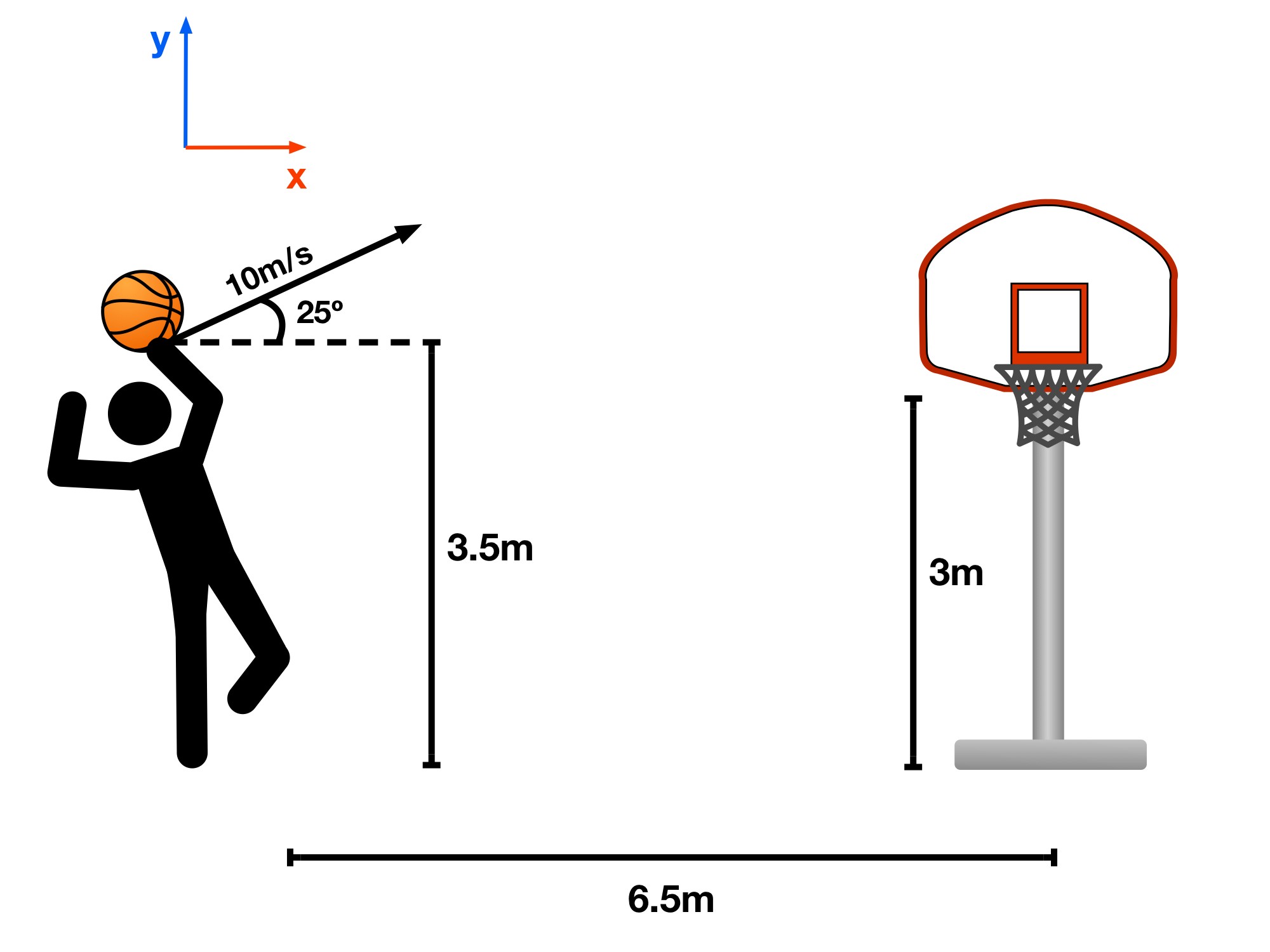
Step 1: Figure out the knowns and unknowns
The rim is at x = 6.5 m and y = 3.0 m relative to a release point at (0, 3.5) m. We can evaluate the trajectory height at x = 6.5 m, or find the horizontal coordinate where the descending ball reaches y = 3.0 m.
What we do have is an initial point for , which we can say is . You could also say that the shot starts at , it’s up to you. We also can use time as a second unknown.
Step 2: Set up the system of equations.
For this problem, we use the same equation as
in Example Problem 3.2.3.
for the -direction
for the -direction
The system we get is:
x = (10 cos 25°)t = (9.06308 m/s)t.
y = 3.5 m + (10 sin 25°)t − ½(9.81 m/s²)t² = 3.5 m + (4.22618 m/s)t − (4.905 m/s²)t².
At the rim’s height, 0 = 0.5 + x tan 25° − [9.81/(2·10² cos²25°)]x², with x in metres.
Solving this equation gives us:
The descending ball reaches y = 3.0 m at x ≈ 8.764 m, so it overshoots that rim-height crossing by 2.264 m. At the actual rim location x = 6.5 m, its center is approximately 4.008 m high, 1.008 m above the rim. Under the point-projectile model, the shot misses.
Source and curriculum context
Adapted from Physics I by Jake Yap and Laurence Vincent.
physics1 · 1.5.B.1, 1.5.B.2 · printed pages 34.