Projectile Motion
Original textbook reading.
In the previous section, you learned about how to work with the kinematic equations in one dimension. This section is where we take that idea and expound upon it, so that we can solve for motion in 2-dimensions.
The constant-acceleration equations apply independently to each Cartesian component when that component of acceleration is constant. A two- or three-dimensional problem can therefore be solved by combining its component equations at the same time.
That seems like using the equations in 2-dimensions is actually impossible. That is untrue. We just need to do twice the work. What I mean by that is that we must divide the 2-dimensional problems into 2 one-dimensional problems. To do so, we resort to our old friend, vector components. By setting an x and y coordinate system, we can solve for any 2-dimensional problem. We just make a couple minor variations to the equations:
(Equation 3.2.1)
(Equation 3.2.2)
(Equation 3.2.3)
(Equation 3.2.4)
As you can see here, we have designated each vector as its component in the x direction. This allows us to define the kinematic equations in one direction, the x direction.
Example Problem 3.2.1
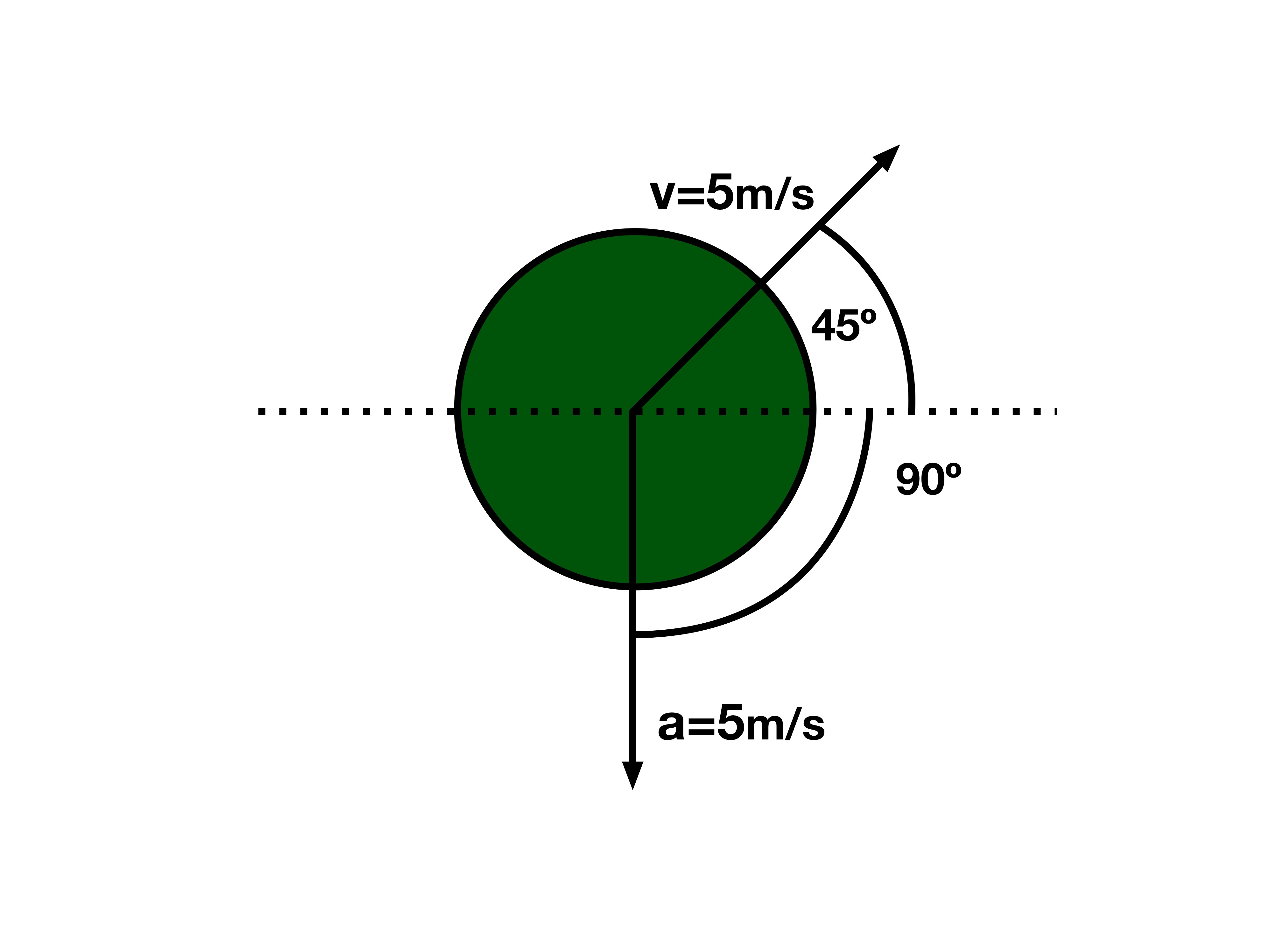
Quick correction: the downward acceleration is 5 m/s², not 5 m/s as printed in the original drawing. The initial velocity is 5 m/s at 45° above the rightward horizontal. Take x right and y up.
The same can be applied to the y components, just replace each subscript x with y. This might be a little confusing, so let’s just say that the x-position is given as , and the y-position is .
If a disk is on a plane, moving with an initial velocity of as shown, and it has an of
in the direction shown, what will its position be after , assuming it starts at m?
Step 1: Separate the velocity and acceleration into components
If we want to analyze this problem using kinematic equations, we have to get everything into either x or y components. The velocity components are , . The acceleration components are , .
Step 2: Calculate the x position after 10 seconds.
For the x-direction, we know the time, , initial position, , the initial velocity, and acceleration, . We want to know the final position, . This means we need the equation incorporating , , , and , these are all in Equation 3.2.1:
Now, that situation is a very theoretical problem without many real applications. However, one problem that this technique is very good at solving for is projectile motion.
During projectile motion, a body is given a certain initial velocity, and is then subject to gravity as the only force acting on the object. Air resistance is present, but most typically avoided.
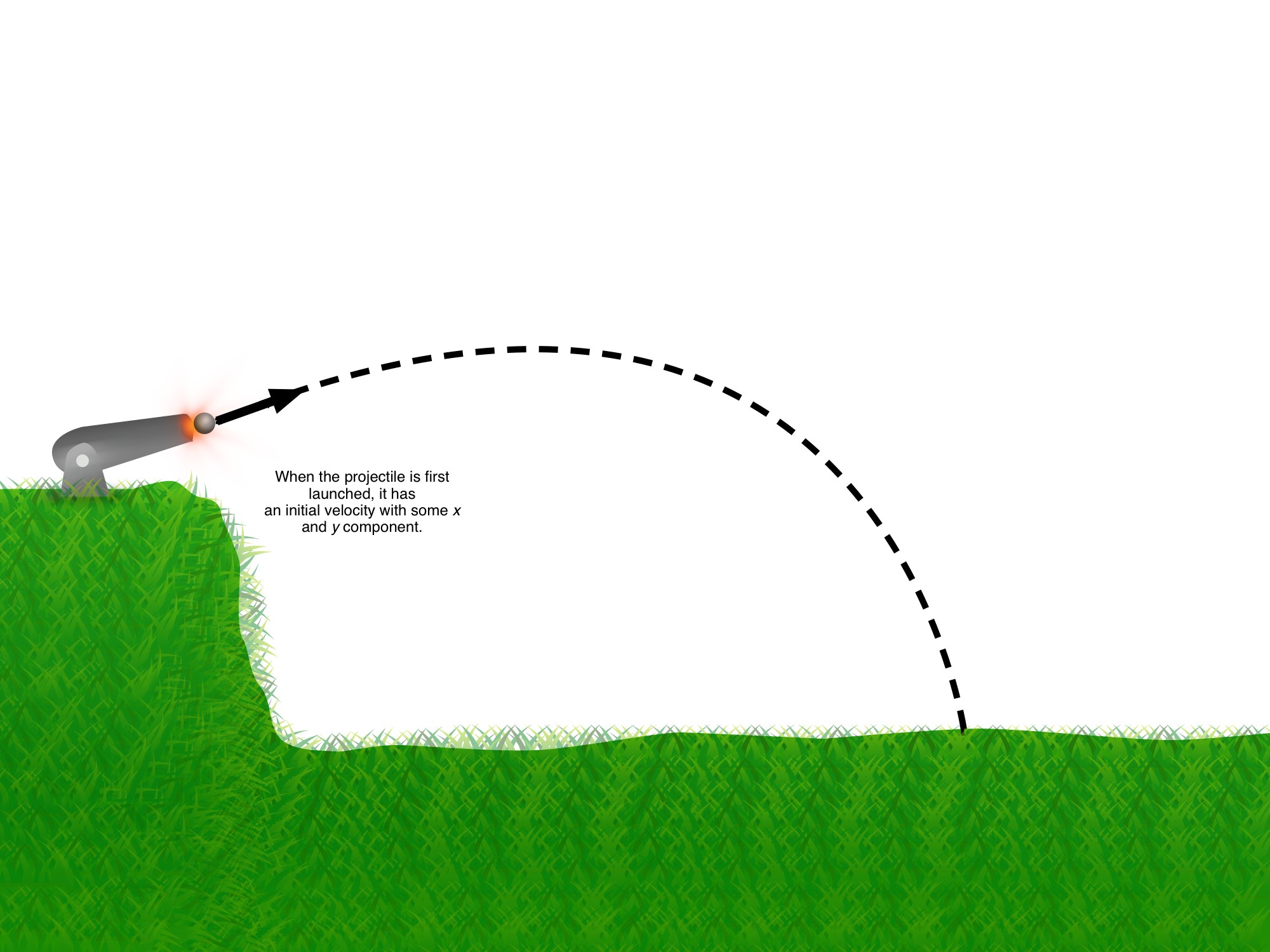
Step 1: Resolve the launch velocity. The initial velocity points up and right. Choose x right and y up. Separate it into v₀ₓ and v₀ᵧ; both components are initially positive.
This sequence uses a constant downward gravitational acceleration and neglects air resistance. Horizontal velocity stays constant while vertical velocity changes.
Read every step and figure
Step 1
Step 1: Resolve the launch velocity. The initial velocity points up and right. Choose x right and y up. Separate it into v₀ₓ and v₀ᵧ; both components are initially positive.
This sequence uses a constant downward gravitational acceleration and neglects air resistance. Horizontal velocity stays constant while vertical velocity changes.
Step 2
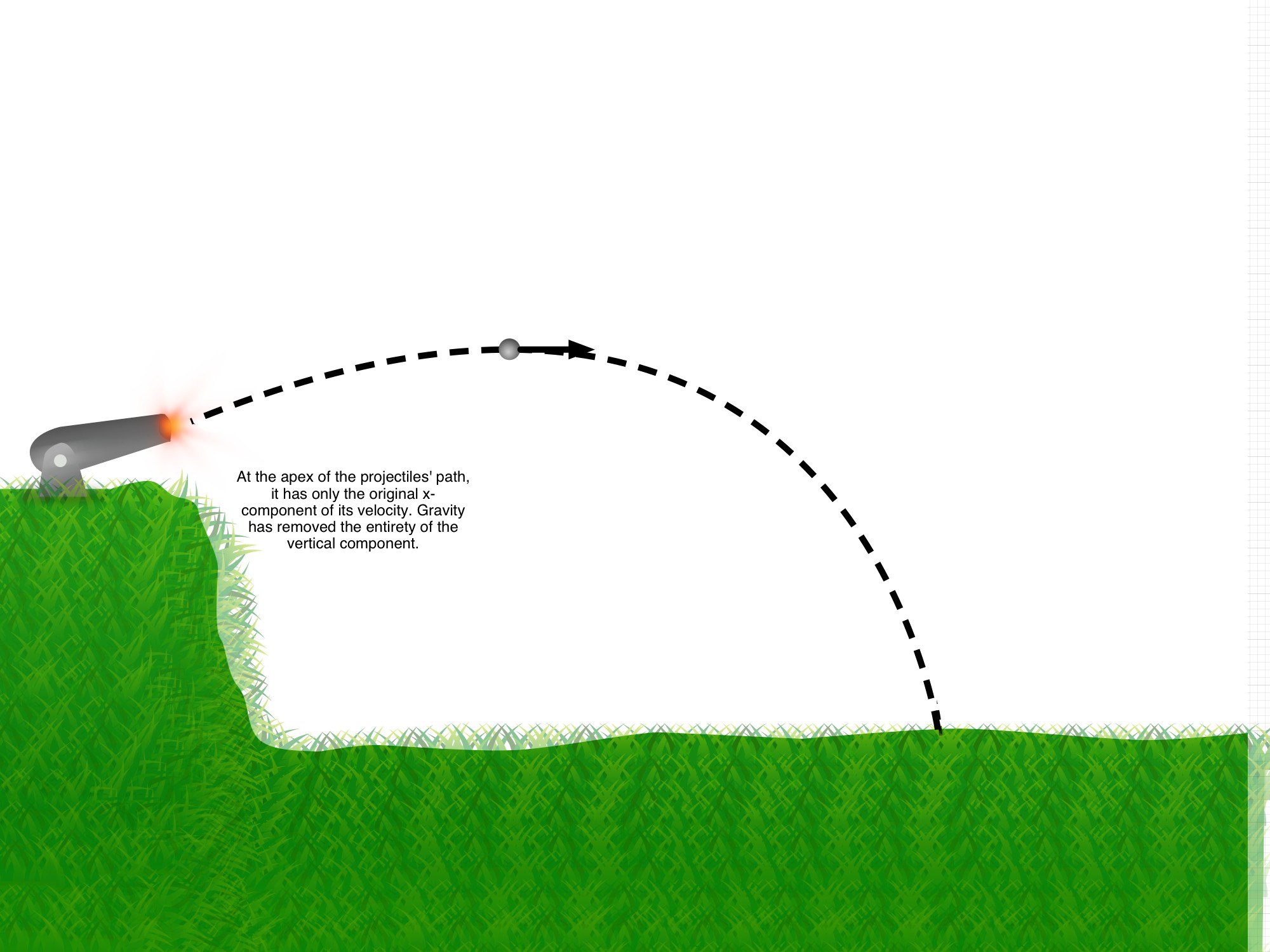
Step 2: Check the top of the path. At the highest point, vᵧ = 0 for an instant, so the velocity points horizontally right. The ball has not stopped: vₓ remains positive.
Downward acceleration continues at the top. Zero vertical velocity does not mean zero acceleration.
Step 3
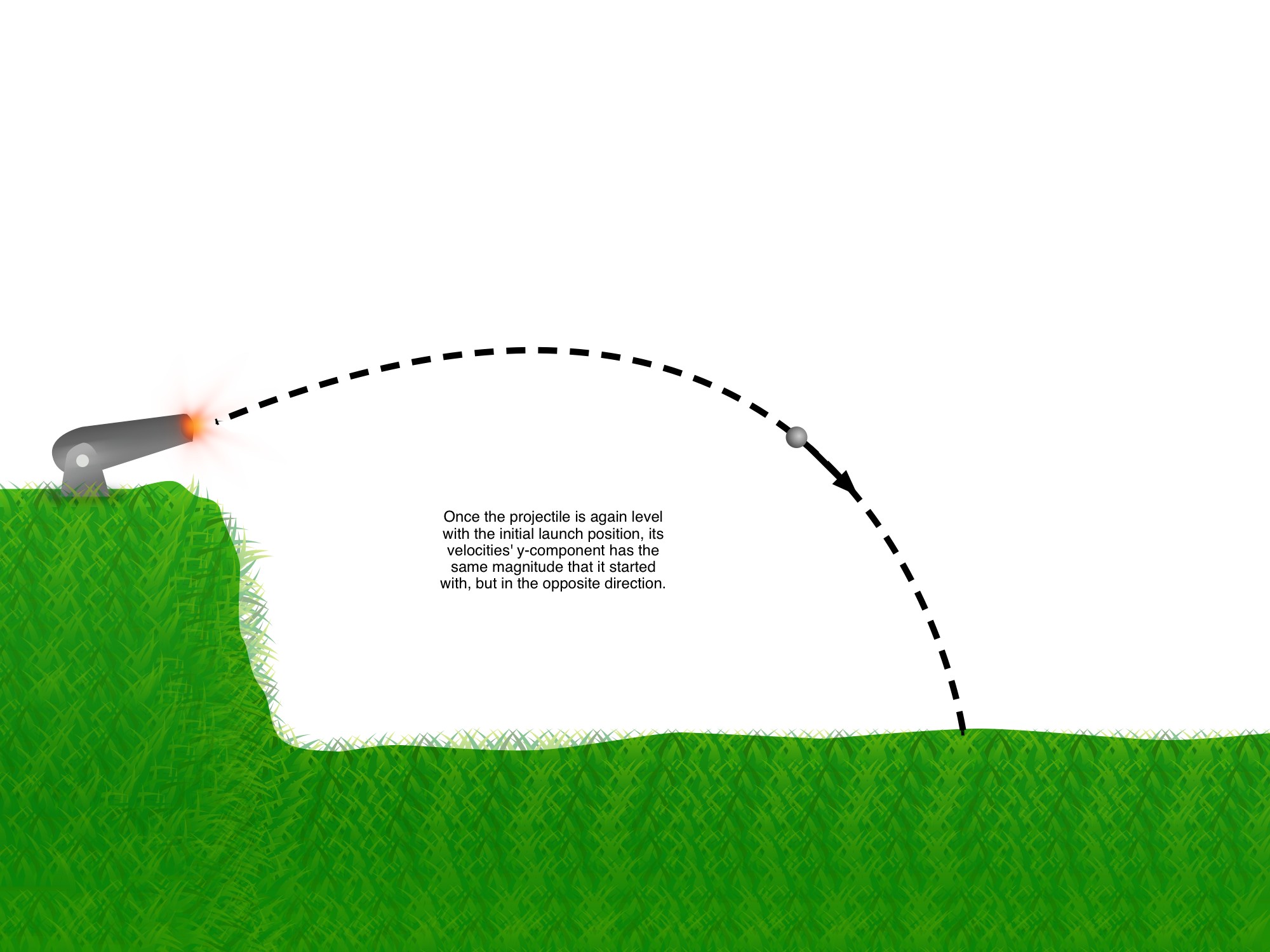
Step 3: Compare equal heights. When the ball descends to its launch height, vₓ is unchanged and vᵧ has the same magnitude as at launch with the opposite sign.
That equal-height comparison relies on constant gravity and negligible air resistance. The ball’s speed matches its launch speed there, but its velocity has a different direction.
Step 4
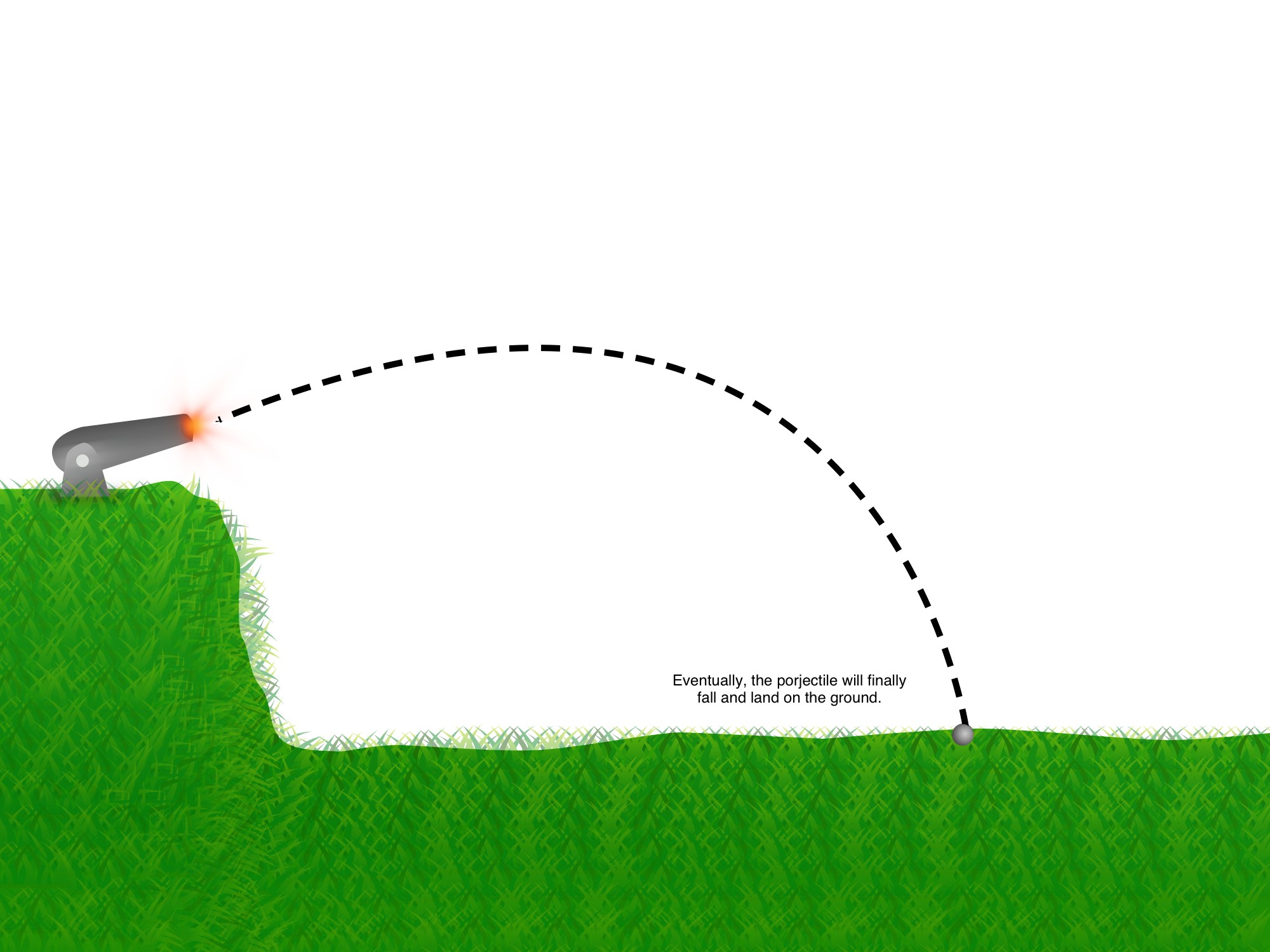
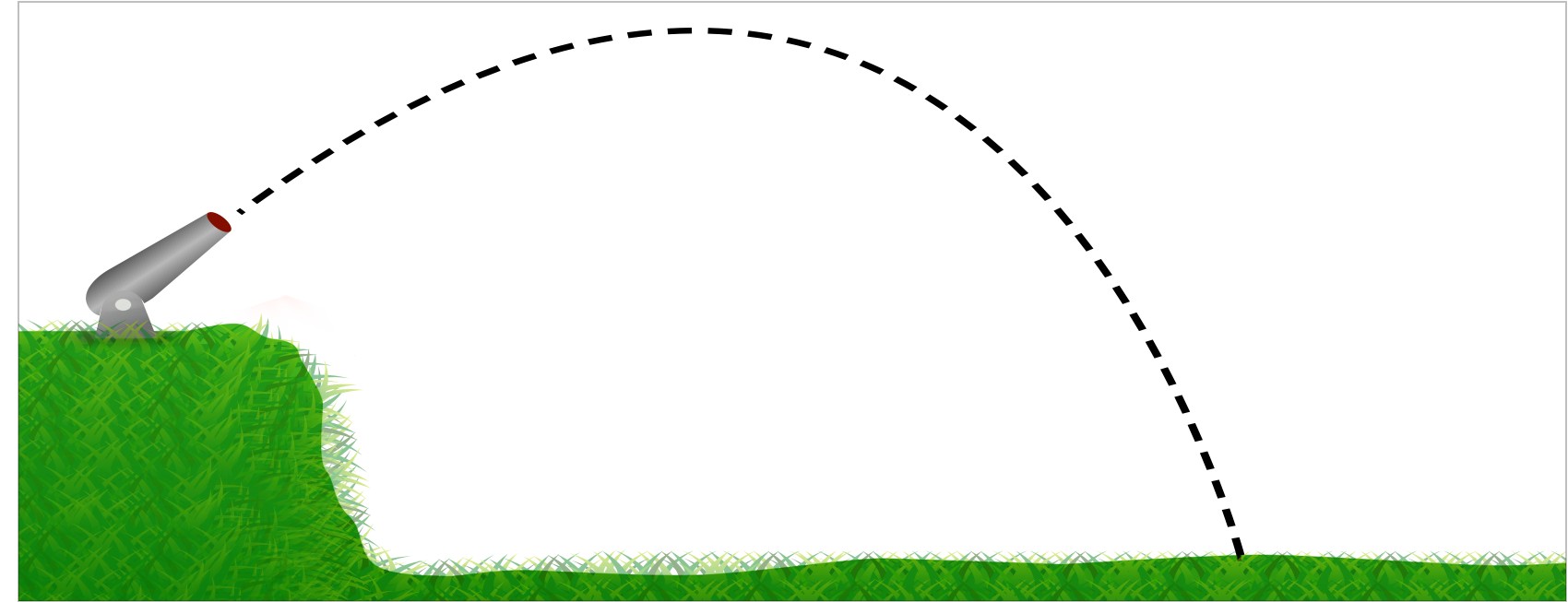
Step 4: Find the actual landing event. Landing occurs when the ball reaches the lower ground, not when it returns to launch height. Use that ground height in the vertical-position equation to find the flight time.
Just before impact, its speed exceeds its launch speed in this gravity-only model because it has fallen to a lower height. Horizontal velocity remains constant throughout the flight. Projectile-motion reference.
Projectile motion has another unique use for it. As the time for each direction is the same for each component, projectile motion is a great way of using this idea to solve problems. A few typical problems are shown in the next few Example problems.
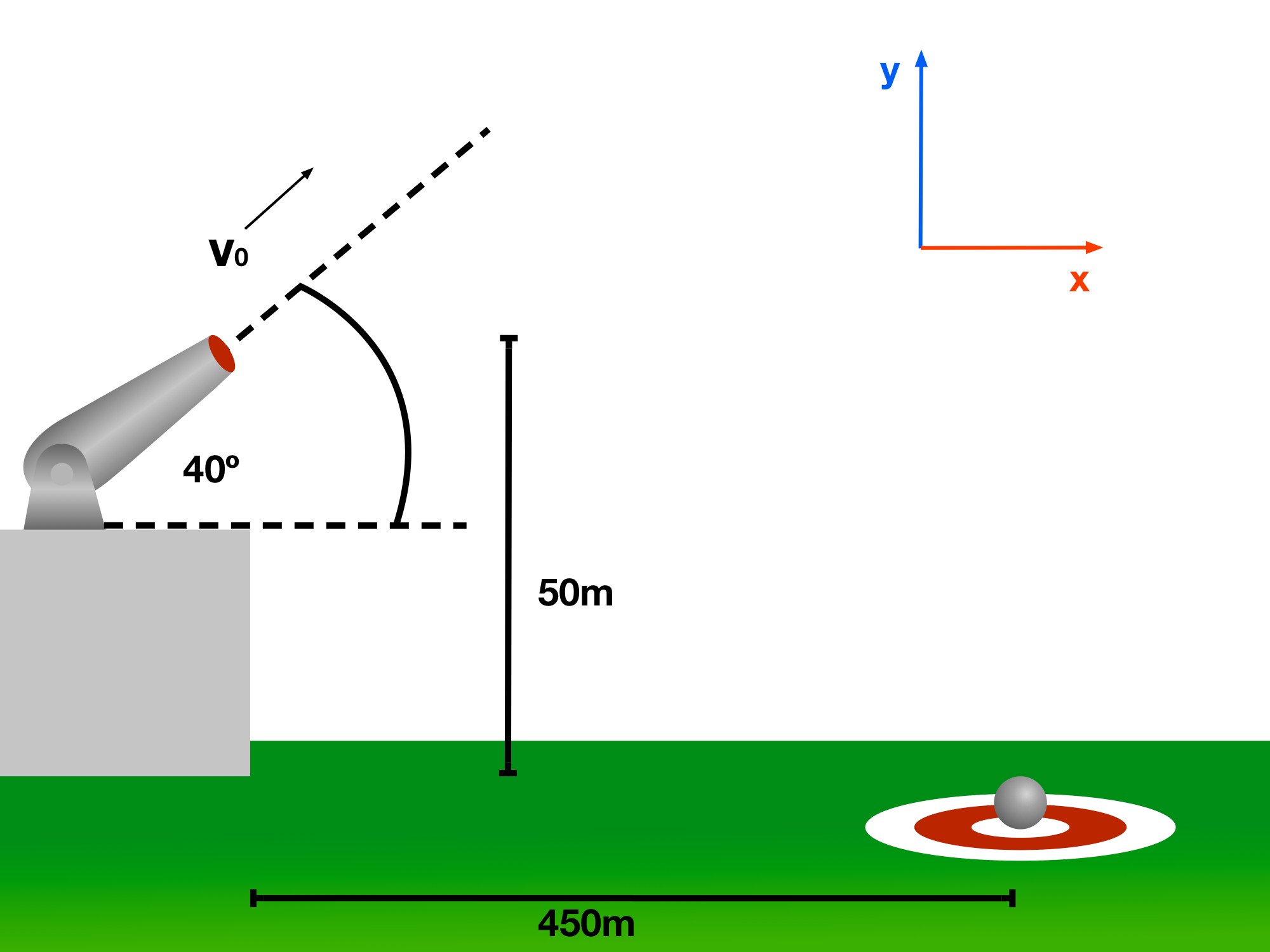
A cannonball is launched off of a cliff at with an unknown initial velocity. If the cannonball winds up hitting the target away, what was the initial velocity of the cannonball?
Example Problem 3.2.2
We can, however, use the time variable to help us out, as the time will be the same for both situations, and therefore we can set up a system of equations.
Step 2: Solve for the unknowns
With the chosen variables, we pick our equation. Here, Equation 3.2.1 works and we choose the 1st and 4th equation since we know both the and variables. Setting up the system gives us the following two equations.
By inputting the knowns, as well as our chosen definitions for initial velocity, we get:
Step 1: Determine what we know
Choose the target’s ground level as y = 0 and the launch horizontal coordinate as x₀ = 0. Then x = 450 m, y₀ = 50 m and y = 0. The launch angle is 40°; use g = 9.81 m/s².
We can assume that is , and that is only due to gravity. That gives us and .
What we want to know is . To use this in our kinematic equations, we have to split it up into its components. Using the given value of , we get:
Working with the variables , we are still a variable short from picking a kinematic equation. But that’s it. There are no more assumptions that we can make.
We can use the first equation in the system to substitute for time. Doing so and performing a bit of algebra, we get:
With t = 450/(v₀ cos 40°), the vertical equation becomes 0 = 50 + 450 tan 40° − [993262.5/(v₀² cos²40°)], using SI numerical values. Equivalently, v₀² = (9.81)(450²)/[2 cos²40°(50 + 450 tan 40°)].
Solving this for , we find
v₀ = 62.916 m/s at 40° above horizontal. The corresponding flight time is approximately 9.337 s.
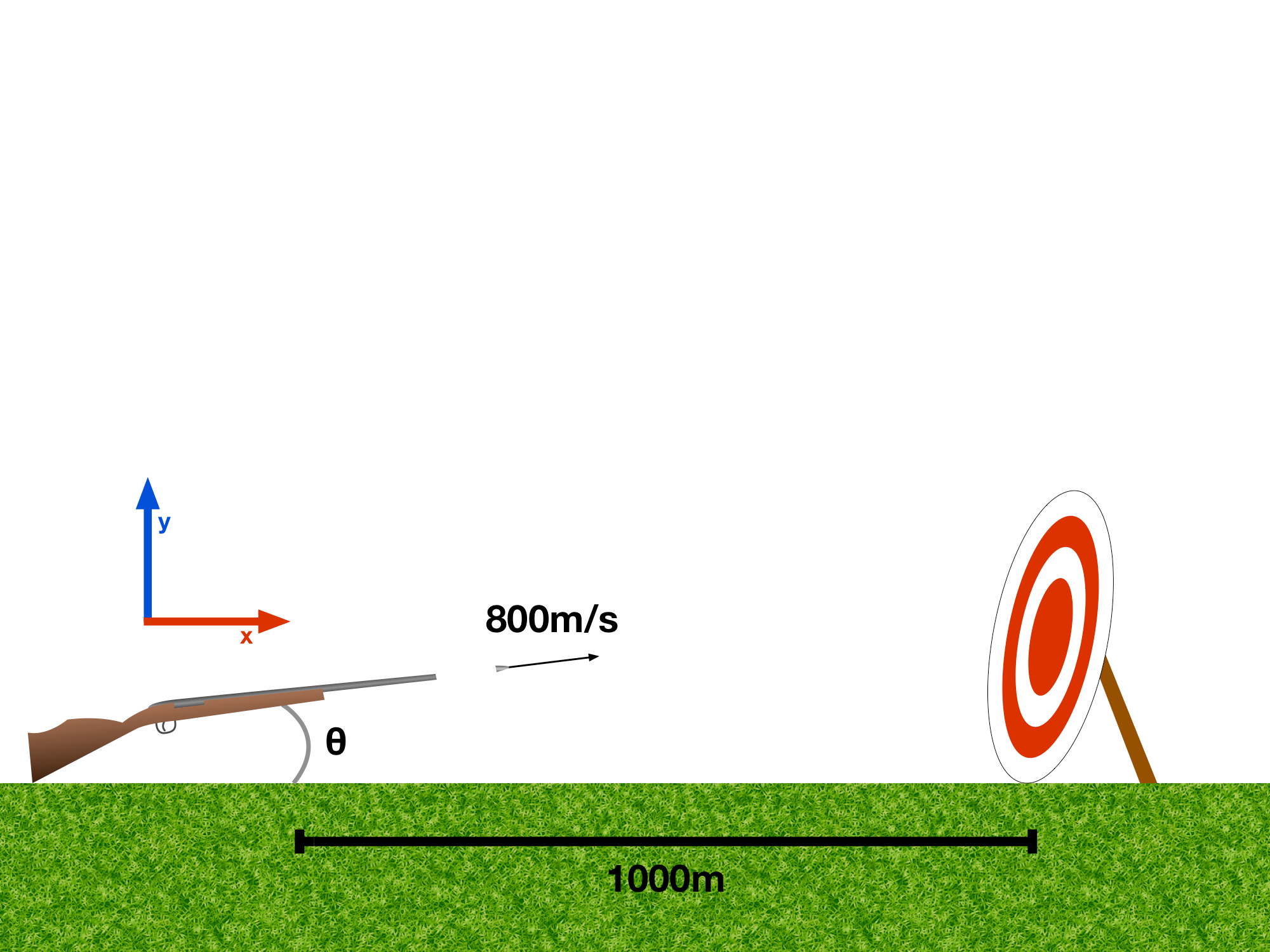
Step 1: Read the launch and target. The initial speed is 800 m/s, the target is 1000 m to the right, and launch and target heights are equal. The angle θ is measured above horizontal.
Step 2: Use one flight time for both components. With no air resistance, Δx = (800 cos θ)t and 0 = (800 sin θ)t − ½gt². Solve these together; the vertical equation has a launch-time root t = 0 as well as the later return to launch height.
Read every step and figure
Step 1
Step 1: Read the launch and target. The initial speed is 800 m/s, the target is 1000 m to the right, and launch and target heights are equal. The angle θ is measured above horizontal.
Step 2: Use one flight time for both components. With no air resistance, Δx = (800 cos θ)t and 0 = (800 sin θ)t − ½gt². Solve these together; the vertical equation has a launch-time root t = 0 as well as the later return to launch height.
If a rifle shoots a bullet with an initial velocity of , at what angle does the barrel need to be to hit a target away? Assume the target is at the same height as the barrel.
Step 1: Identify the knowns and unknowns
We are given the initial velocity, and the displacement, as well as the displacement. We can assume the and accelerations as being and , respectively. As we are still short on variables, we need to add an unknown, time, to have a successful system of equations.
Step 2: Set up the equations.
We have to use a system of equations, as we only have , , , and are solving for . We need equations for both the x and y direction:
, plug in the values.
We can use the first equation to substitute in for in the second equation. This gives us:
A bit tricky to solve, we start by using one of the trigonometric identities:
cos θ = √(1 − sin²θ), for 0° ≤ θ ≤ 90°.
We substitute this in for the and then square both sides of the equation to get the following:
Using sin(2θ) = 2 sin θ cos θ gives sin(2θ) = gR/v₀² = 0.015328125.
This equation can be solved through the use of the quadratic equation, if we choose to solve for .
Doing so gives us:
The two solutions are θ = ½arcsin(0.015328125) and θ = 90° − ½arcsin(0.015328125).
θ ≈ 0.439° or 89.561°.
Both angles reach the target in the ideal model. The shallow 0.439° trajectory is the practical low-angle choice; discarding the high-angle mathematical solution requires an additional practical constraint.
Pop Quiz 3.2.1 Projectile Motion
Question 1 of 5 · 0 correct
AP Topic 1.5 · Read the worked solution
If a ball is thrown as shown, what with the magnitude of its velocity be when it returns to its original y-value?
Read every full question without answers
Question 1
If a ball is thrown as shown, what with the magnitude of its velocity be when it returns to its original y-value?
Question 2
Question 3
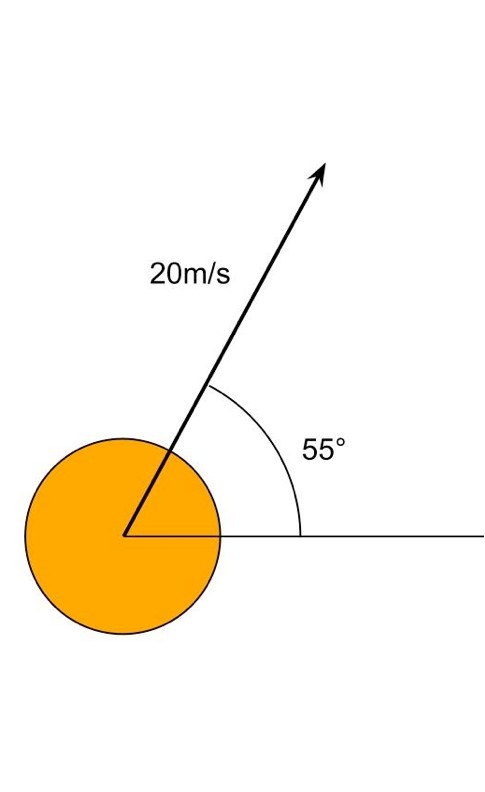
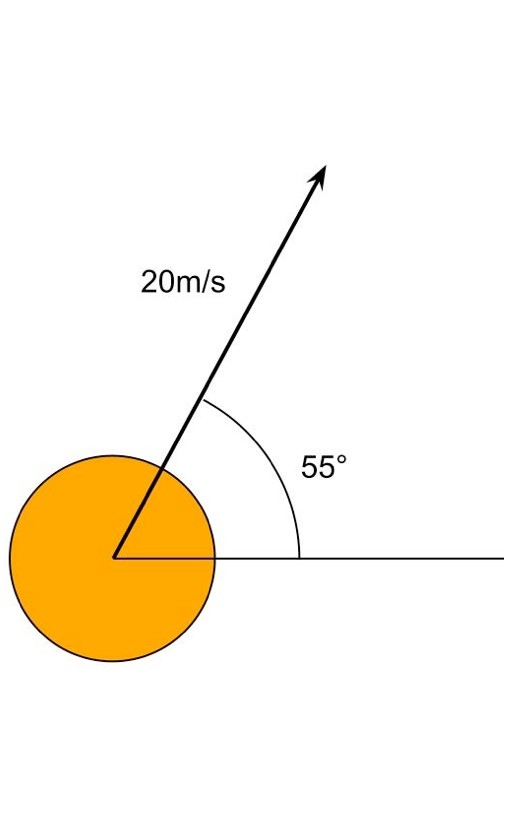
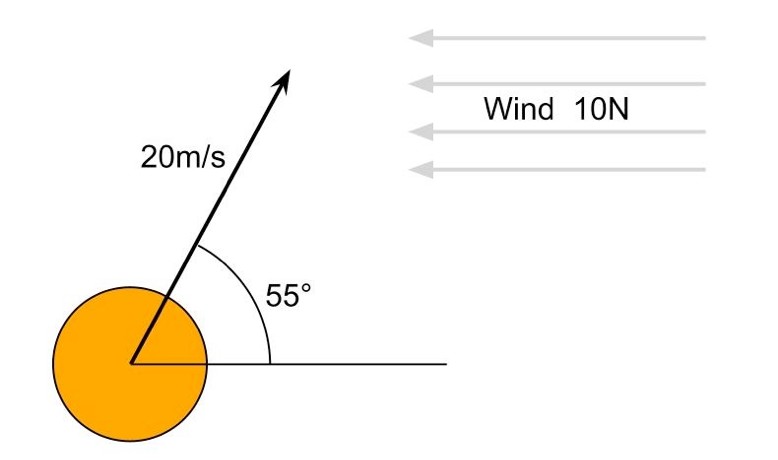
A 50 g ball is launched at 20 m/s and 55° above horizontal, as shown. A constant 10 N force acts horizontally to the left throughout flight. Find its horizontal landing coordinate when it returns to launch height. Use g = 9.81 m/s²; take right as +x.
Question 4
Question 5
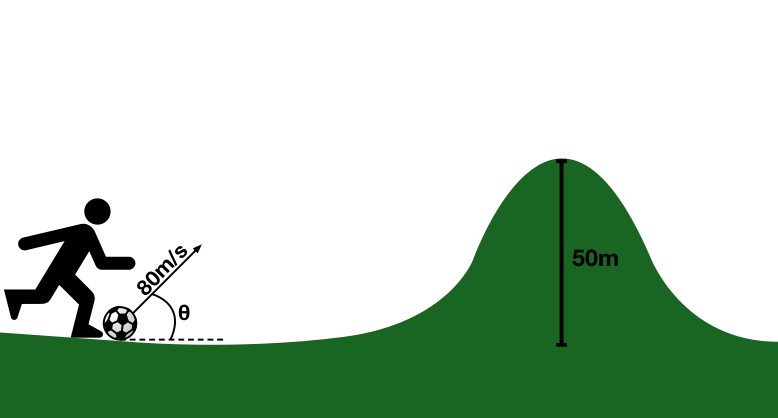
In the following diagram, a ball is shot over a hill. What is the smallest initial angle needed to make it over the hill, assuming it peaks atop the hill.
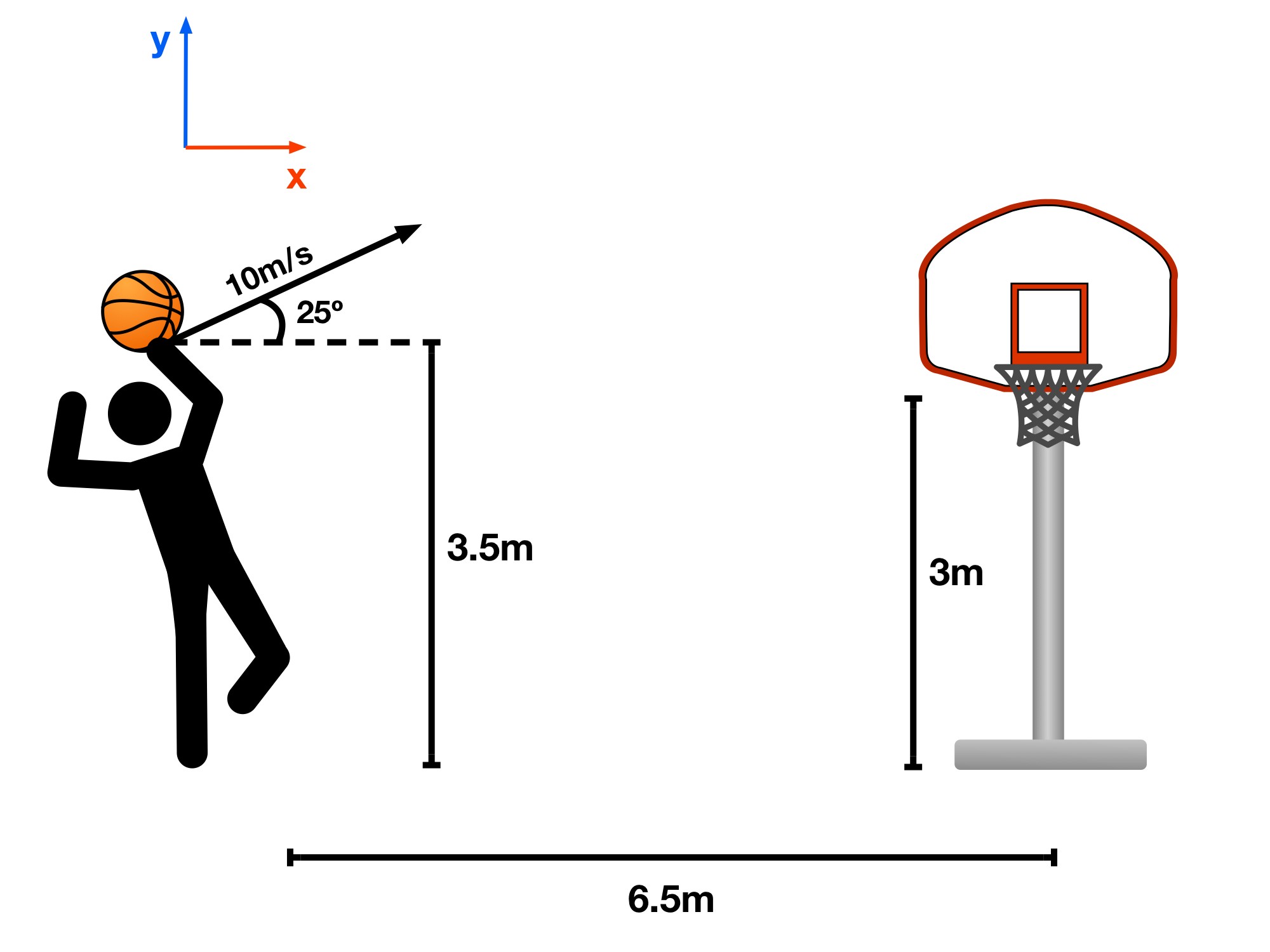
A basketball player attempts to sink a 3-pointer, and his shot has a height of , an angle of , and , and he is away from the net. If the basket is high, will his shot make it into the basket? If not, how far away is the shot?
Example Problem 3.2.4
Step 1: Figure out the knowns and unknowns
The rim is at x = 6.5 m and y = 3.0 m relative to a release point at (0, 3.5) m. We can evaluate the trajectory height at x = 6.5 m, or find the horizontal coordinate where the descending ball reaches y = 3.0 m.
What we do have is an initial point for , which we can say is . You could also say that the shot starts at , it’s up to you. We also can use time as a second unknown.
Step 2: Set up the system of equations.
For this problem, we use the same equation as
in Example Problem 3.2.3.
for the -direction
for the -direction
The system we get is:
x = (10 cos 25°)t = (9.06308 m/s)t.
y = 3.5 m + (10 sin 25°)t − ½(9.81 m/s²)t² = 3.5 m + (4.22618 m/s)t − (4.905 m/s²)t².
At the rim’s height, 0 = 0.5 + x tan 25° − [9.81/(2·10² cos²25°)]x², with x in metres.
Solving this equation gives us:
The descending ball reaches y = 3.0 m at x ≈ 8.764 m, so it overshoots that rim-height crossing by 2.264 m. At the actual rim location x = 6.5 m, its center is approximately 4.008 m high, 1.008 m above the rim. Under the point-projectile model, the shot misses.
Pop Quiz 3.2.2 Projectile Motion
Question 1 of 5 · 0 correct
AP Topic 1.5 · Read the worked solution
Read every full question without answers
Question 1
Question 2
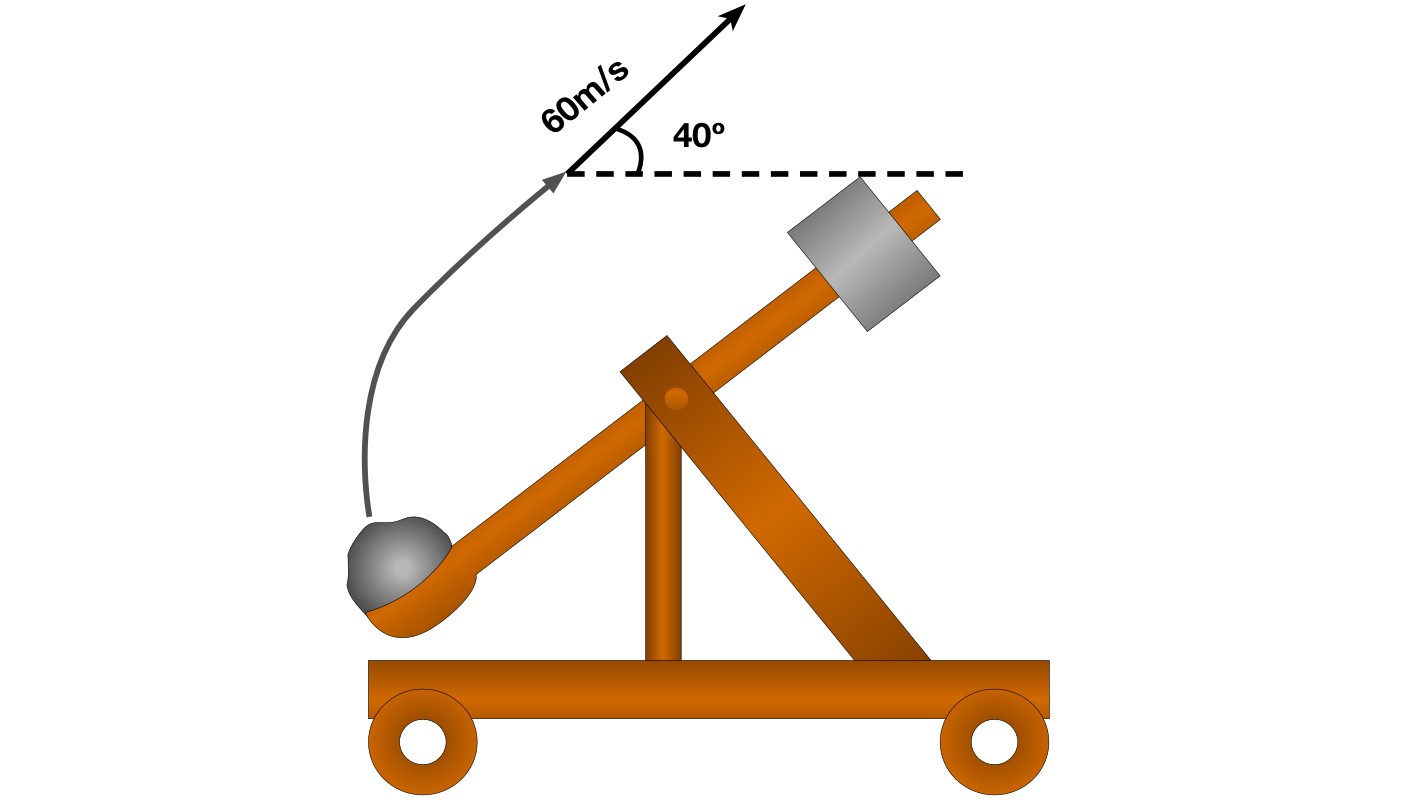
If a projectile is launched with the shown trajectory, how far away will it land? The landing spot is at the same elevation as the launch point.
Question 3
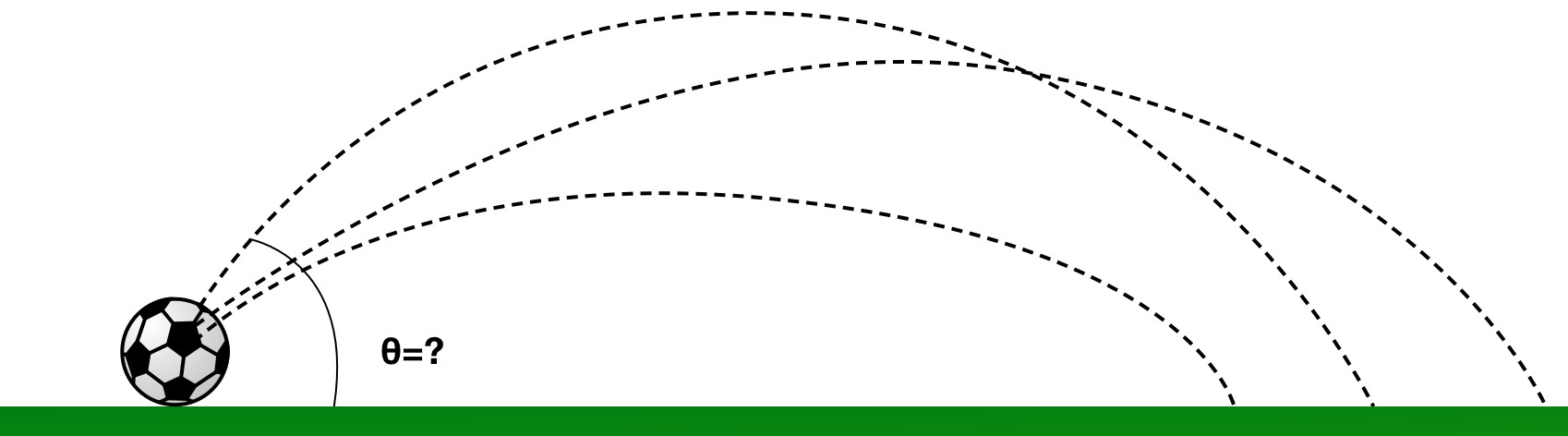
For a fixed launch speed, which angle maximizes the range over flat ground at the launch elevation? Neglect air resistance.
Question 4
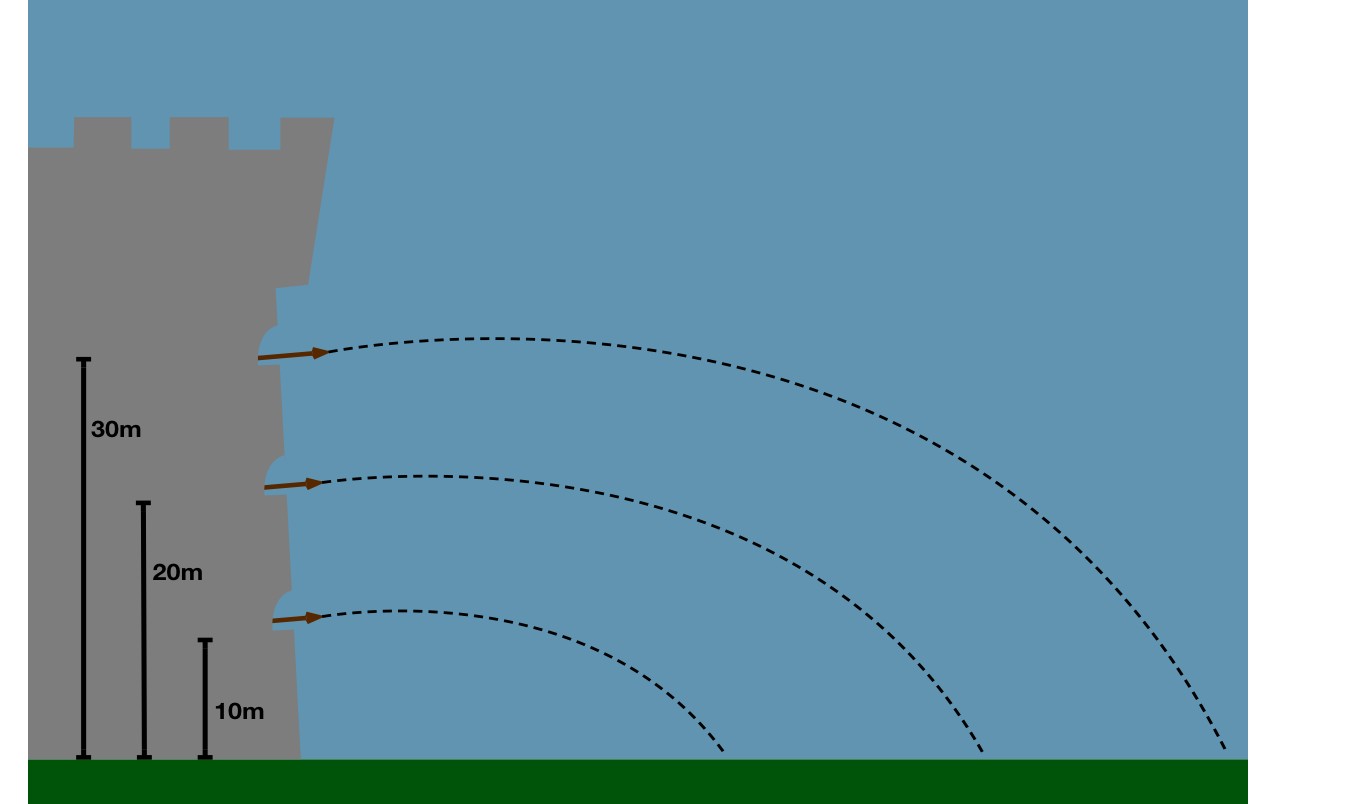
Three ballistas are arranged along a castle’s wall. If they each try to hit a target away from the base of the wall by launching the bolt horizontally, what speed will the middle ballista need to fire its bolt?
Question 5
 1234
Match these labels to the numbered figure targets. Write your matches before opening the separate worked answer.


Reviewed physics notes (18)
These corrections keep the original lesson’s purpose while fixing errors in the source edition.
- The equations do not require the entire motion to be one-dimensional. — Reference 1
- The printed identity omitted the square root. — Reference 1
- Use the exact range relation, avoiding the source’s inconsistent intermediate rounding. — Reference 1
- Both complementary angles solve the ideal range condition. — Reference 1
- Recalculate both launch-angle solutions. — Reference 1
- The source calls one solution the only correct angle without a constraint. — Reference 1
- The known rim location may be used directly; it is not an unknown. — Reference 1
- The source substitutes 8.45 m/s despite a given initial speed of 10 m/s. — Reference 1
- Use the actual initial vertical component. — Reference 1
- Correct the launch speed in the eliminated-time equation. — Reference 1
- The source incorrectly concludes the 10 m/s shot makes the basket. — Reference 1
- Specify constant force, mass conversion, axes and landing height. — Reference 1
- aₓ = −10/0.050 = −200 m/s², t = 3.34007 s, and x = v₀ₓt + ½aₓt² ≈ −1077.29 m. — Reference 1
- The source says starting position instead of starting height, which is generally never revisited for a forward projectile. — Reference 1
- Constant launch force alone does not establish a fixed launch speed. — Reference 1
- The source reverses the initial and final heights despite using the correct heights in its later system. — Reference 1
- The source’s numerator 99300 is incorrect; ½g(450 m)² = 993262.5 m³/s². — Reference 1
- Recalculate the initial speed from the stated cliff height, horizontal range and angle. — Reference 1
Glossary and deeper reading · 6 refreshers
These editorial refreshers supplement the reading. Definitions and examples are added guidance; original source wording and recorded answers remain in their original context.
-
Kinematics
Kinematics describes motion using position, velocity, acceleration, and time without first analyzing its forces. The familiar constant-acceleration equations apply only over intervals in which that acceleration is constant. For example, a ball falling near Earth with negligible air resistance can be modeled with constant vertical acceleration.
-
Acceleration
Acceleration is the vector rate of change of velocity with time. It can change an object’s speed, direction, or both, and it is measured in meters per second squared. For example, a satellite moving at constant speed in a circular orbit accelerates toward the center.
-
Vector component
A vector component describes the part of a vector along a chosen axis. Its signed value changes when the axes change, even though the physical vector remains the same. For example, a diagonal launch velocity can be resolved into horizontal and vertical components that share the same elapsed time.
-
Vector
A vector is a quantity with a magnitude and a direction, represented by an arrow or by components along chosen axes. Vectors add by adding corresponding components rather than simply adding their magnitudes. For example, an eastward displacement followed by a northward displacement produces a resultant pointing northeast. The zero vector has zero magnitude and no unique direction.
-
Projectile motion
Projectile motion describes an object after launch when gravity is the only significant force in the chosen model. Near Earth, horizontal and vertical motion can be analyzed separately using the same time interval and approximately constant downward acceleration. For example, a ball rolling off a table continues horizontally while its downward velocity increases.
-
Velocity
Velocity describes how position changes with time and includes direction. Instantaneous velocity describes one moment, while average velocity is displacement divided by elapsed time. For example, a car turning a corner can change velocity while maintaining the same speed.