Thin-shell inertia derivation
Enrichment article · Physics C: Mechanics
Read the related lesson → · Full original reading →
The simplest form of inertia is a point mass revolving around a given axis. For the point mass, the moment of inertia is given as:
In I = mr², r is the perpendicular distance of the point mass from the rotation axis. For extended bodies, the inertia depends on every mass element’s distance from that same axis.
This question is only fully answered through the use of calculus, and it goes into the idea behind a moment of inertia.
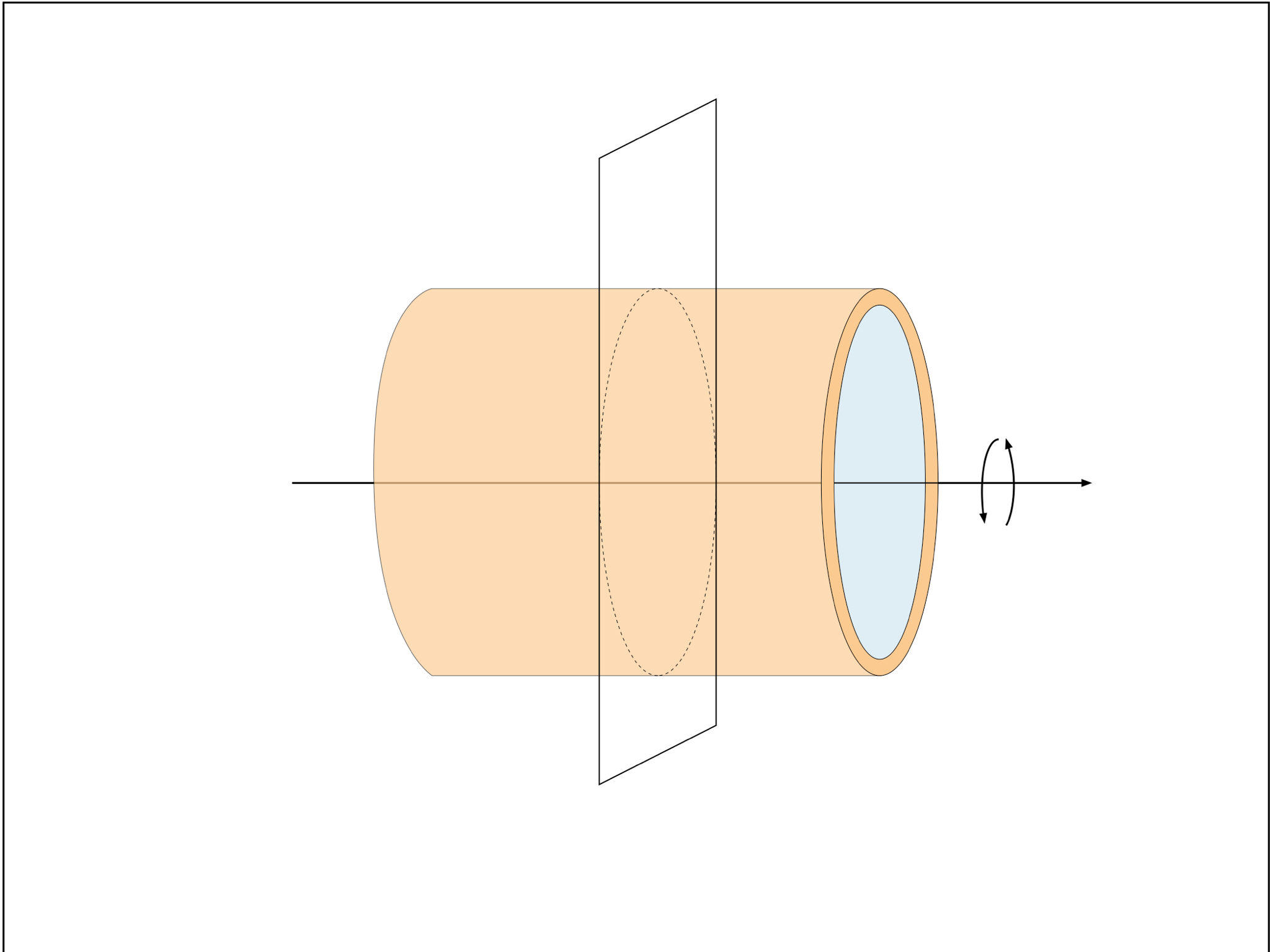
Step 1: Identify the axis. The shell rotates about the line through the centers of its circular ends, along its length. The slicing plane is perpendicular to that axis and exposes a ring-shaped cross-section.
For an ideal thin wall, all its mass lies at the same perpendicular distance r from this axis. A transverse rotation axis would be a different problem.
Read every step and figure
Step 1
Step 1: Identify the axis. The shell rotates about the line through the centers of its circular ends, along its length. The slicing plane is perpendicular to that axis and exposes a ring-shaped cross-section.
For an ideal thin wall, all its mass lies at the same perpendicular distance r from this axis. A transverse rotation axis would be a different problem.
Step 2
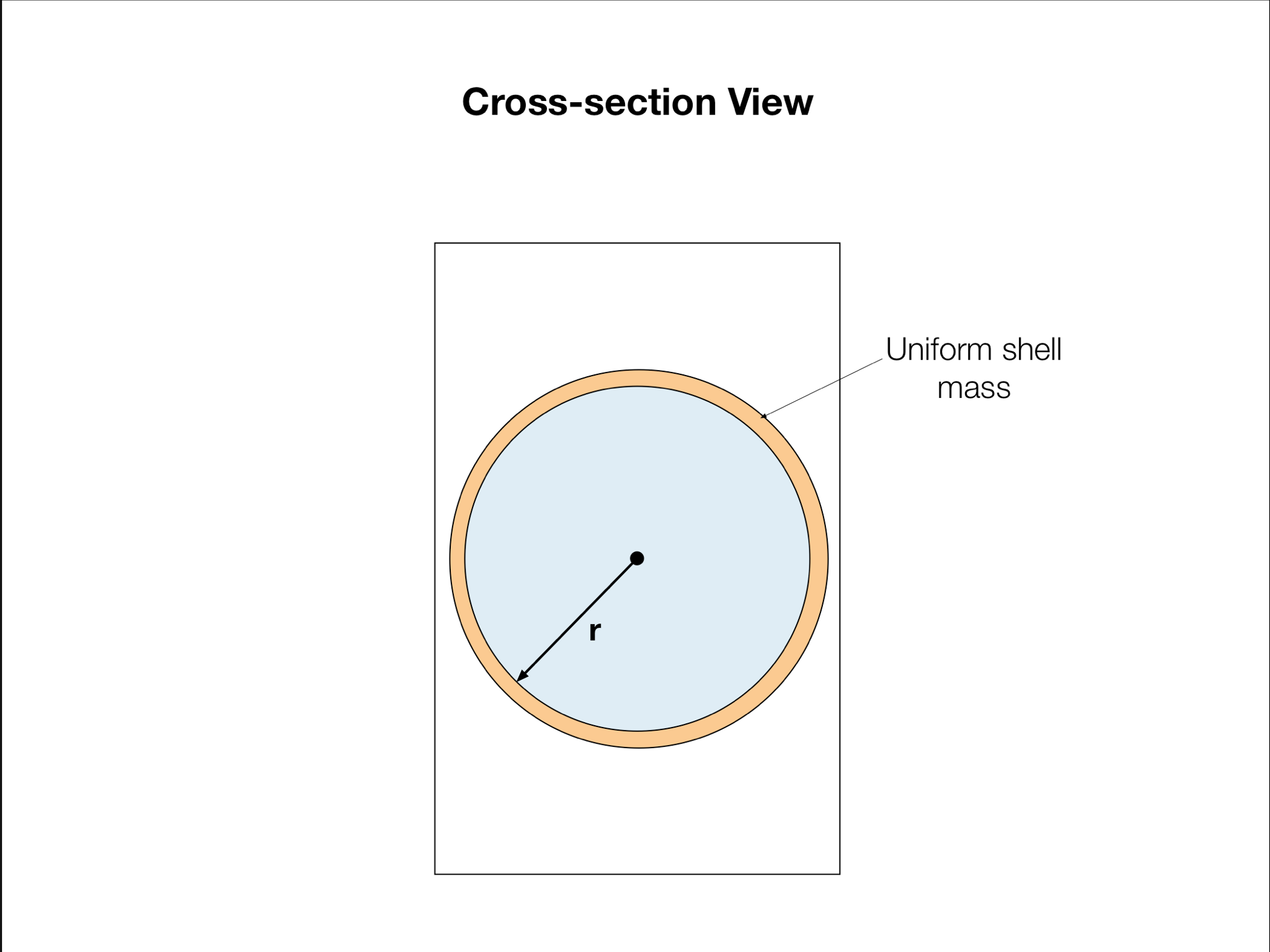
Step 2: Locate the mass. The orange ring is the shell’s material. The blue interior is empty; it contributes no mass. The marked radius r is the perpendicular distance from the central axis to the thin wall.
Step 3: Add the contributions. Each small mass contributes r²dm, so I = r²Σdm = mr² about this central longitudinal axis. This thin-shell result is not the ½mr² result for a solid cylinder. Moment-of-inertia reference.
This shell has no deviation in its mass distribution around the axis of rotation, as it is of uniform density and its mass is only present at a constant distance from its axis.
As you can see in the picture, the cross section of the object is a pure circle. Therefore the only mass will always be a distance of from the center of rotation.
This means that the integral can be simplified by declaring and to be constants:
This becomes:
As density is given as:
We can say that:
Now we need to figure out what is equivalent to. As measures the distance between the axis of rotation and the mass, is the radius of the shell, . Using that, we find that we can fully define the moment of inertia of a shell rotating as shown to be:
Now this is for a shell with a constant radius. Things change when you have weird mass shapes with varying radii.
Source and curriculum context
Adapted from Physics I by Jake Yap and Laurence Vincent.
physics-c-mechanics · 5.4.A.4 · printed pages 100, 101.
Glossary and deeper reading · 2 refreshers
These editorial refreshers supplement the reading. Definitions and examples are added guidance; original source wording and recorded answers remain in their original context.
-
Inertia
Inertia is an object’s resistance to a change in its velocity. Mass measures translational inertia, whereas rotational inertia also depends on how mass is distributed relative to an axis. For example, a loaded cart accelerates less than an empty cart under the same net force.
-
Rotational inertia
Rotational inertia measures how strongly a mass distribution resists a change in angular velocity about a specified axis. Mass farther from that axis contributes more strongly because each contribution depends on squared distance. For example, moving small masses outward along a rotating rod increases its rotational inertia without changing its total mass.