Phase-change heating
Enrichment article
Read the related lesson → · Full original reading →
Read this fixed-pressure model with its atmospheric-pressure water example, all five heating stages and the retained material and no-loss assumptions. The native thermal instruction is a prerequisite; this source calculation has no accepted course attribution.
Last section, you learned about how an object can have a certain temperature, and how it takes more energy to heat up certain objects because of specific heatⓘ.
In this section, we will talk about how it takes a certain amount of energy to induce phase changes in objects.
Phase changes include melting, freezing, vaporization, condensation, sublimation and deposition. During an equilibrium transition of a pure substance at fixed pressure, the temperature remains constant while the phase fractions change.
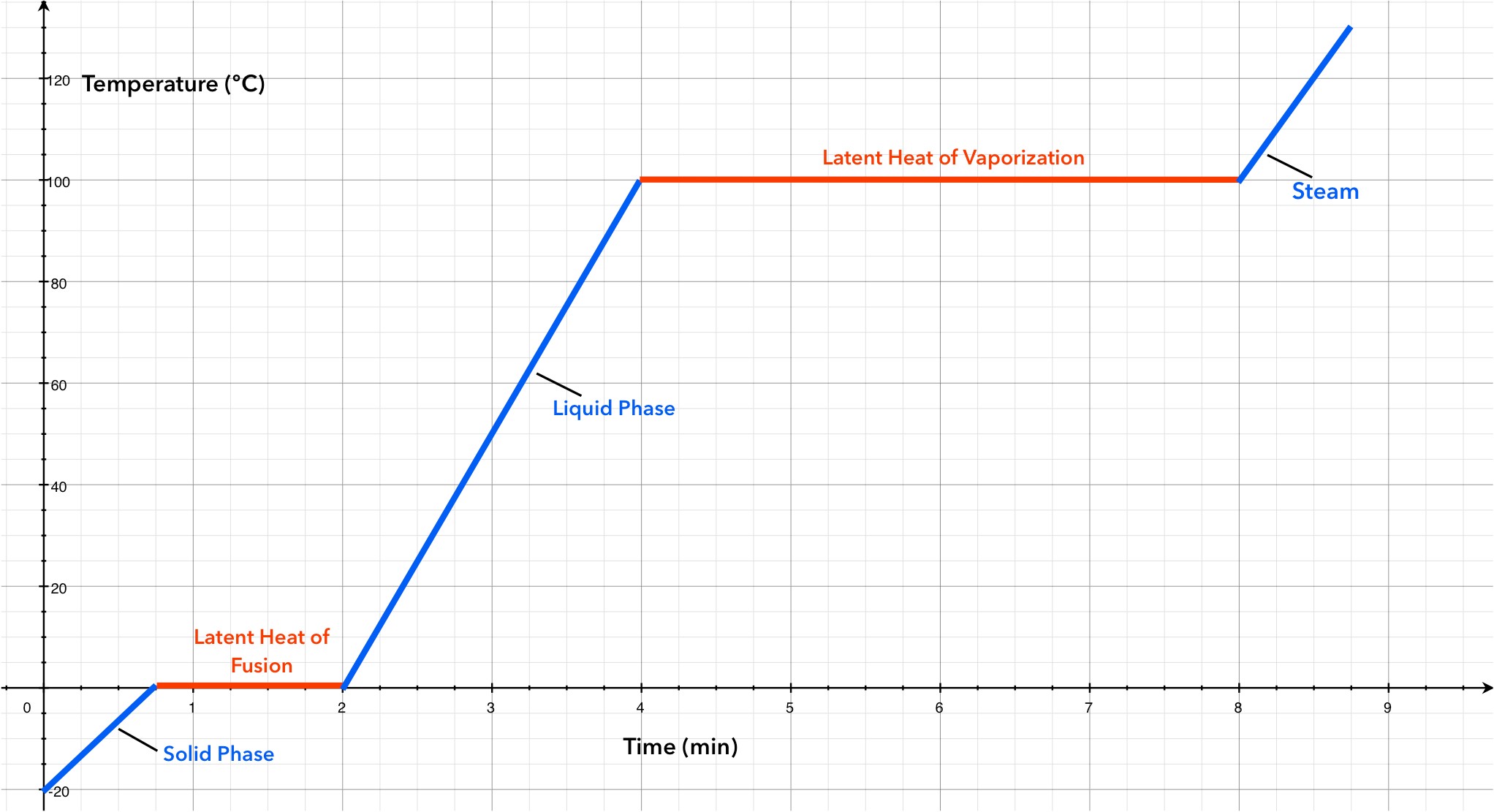
During a phase-change plateau, added or removed energy changes the material’s phase and intermolecular configuration rather than raising or lowering its temperature. Internal energy can therefore change at constant temperature.
Figure 7.2.1 How Water Melts
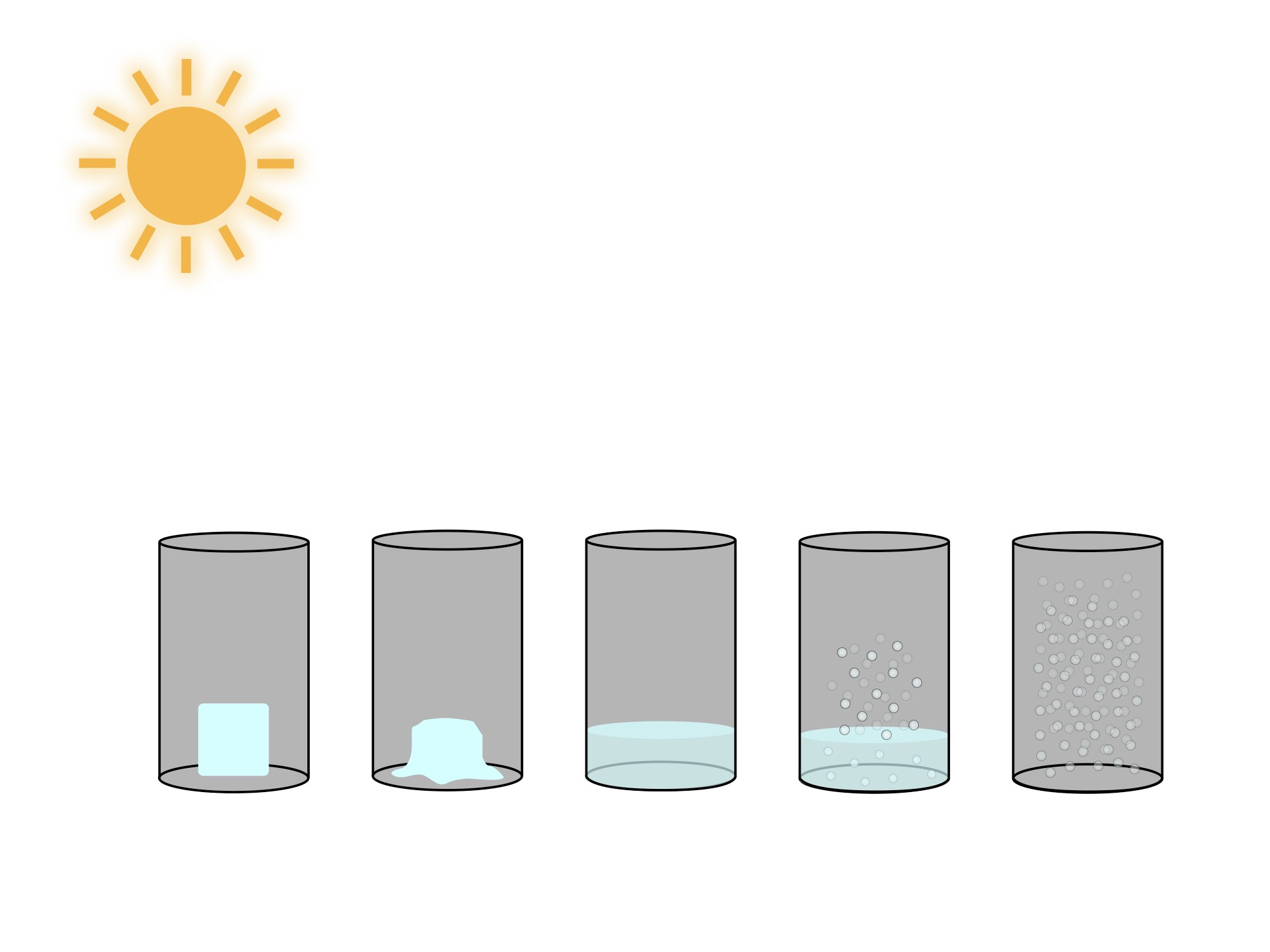
Even though the temperature is not changing, the object still needs a certain amount of heat to be added or removed to continue the phase change. This concept is called latent heat.
Latent Heat refers to the amount of heat that is added or removed from a body while temperature is constant. The only process you’ll see this in during this class is in phase changes, so we’ll concentrate on those.
For phase changes, you will be working with two types of latent heat: Latent heat of fusion and Latent heat of vaporization. Fusion refers to transitions between solid and liquid, and vaporization refers to the transition from liquid to gas and vice-versa.
Heat of fusion describes the solid–liquid transition: energy is absorbed on melting and released on freezing. Heat of vaporization describes the liquid–gas transition: energy is absorbed on vaporization and released on condensation.
A heating curve plots temperature against heat supplied, or against time when the heating rate is constant. Sloped portions heat a single phase; plateaus show equilibrium phase changes at fixed pressure.
Figure 7.2.2 Heating Curve of Water
Anyway, when using these two latent heats, you will be using the latent heat equation:
At atmospheric pressure, what heat is needed to change 5 g of ice at −10°C into steam at 150°C? Use L_v = 2257 J/g, L_f = 334 J/g, c_ice = 2.11 J/(g·K), c_water = 4.1813 J/(g·K) and c_vapor = 2.080 J/(g·K). Assume constant properties and retain all material.
Source and curriculum context
Adapted from Physics I by Jake Yap and Laurence Vincent.
Glossary and deeper reading · 6 refreshers
These editorial refreshers supplement the reading. Definitions and examples are added guidance; original source wording and recorded answers remain in their original context.
-
Temperature
Temperature is a state quantity that determines the direction of net energy transfer through thermal contact. For a classical ideal gas it is proportional to the average translational kinetic energy per particle, rather than to the total energy of the sample. For example, a small hot metal sample can have a higher temperature but less total internal energy than a large cooler sample.
-
Specific heat
Specific heat is the energy needed per unit mass for a unit temperature increase under the stated conditions. Its units are joules per kilogram per kelvin, and the simple calorimetry model treats it as constant without a phase change. For example, equal masses of two materials can require different energy transfers for the same temperature rise.
-
Pressure
Pressure is the normal force per unit area exerted on a surface. It is a scalar measured in pascals, with one pascal equal to one newton per square meter. For example, a gas exerts pressure throughout its volume through many microscopic collisions, even when its bulk motion is zero.
-
Internal energy
Internal energy is energy associated with the microscopic motion and configuration of a system’s constituents. It excludes the kinetic energy of the whole system’s bulk motion and depends on the thermodynamic state. For example, a stationary solid can gain internal energy as its atomic vibrations become more energetic.
-
Latent heat
Specific latent heat is the energy transferred per unit mass during a specified phase change at the stated conditions. During an ideal equilibrium phase change at constant pressure, energy can change microscopic arrangement while temperature stays constant. For example, melting ice requires energy even while an ice–water mixture remains at its melting temperature.
-
Heat
Heat is energy transferred between systems because of a temperature difference. It describes a transfer rather than a substance or energy store contained in an object. For example, when a warmer mug transfers energy to a cooler hand, the mug loses internal energy and the hand gains it.