Quadratic drag and terminal-speed balance
Enrichment article
Read the related lesson → · Full original reading →
Use speed relative to the fluid and drag opposite that relative motion. Terminal speed is a force-balance limit for the stated quadratic model; it is not the CED’s linear-resistance solution. Retain all parachutist givens and both complete figure sequences.
In most introductory physics problems, air resistance is typically neglected. Air resistance is very tricky subject as it changes with velocity, so it is hard to determine the force exerted by air resistance on a system, because it can change over time.
For steady vertical falling, terminal velocity is reached when upward drag balances weight and the net force is zero.
The quadratic drag-force magnitude is D = ½ρC_DAv² (Equation 2.1.1), where v is speed relative to the fluid. Drag points opposite that relative velocity.
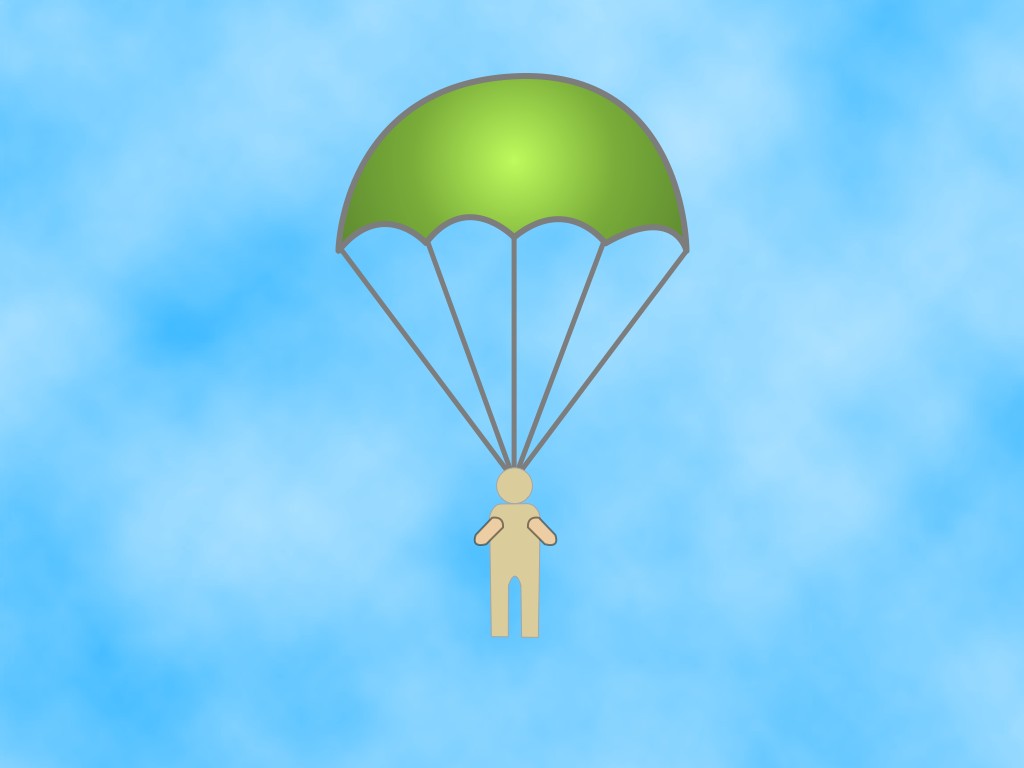
Example Problem 2.1.3
A parachutist has mass 80 kg and carries a pack of mass 15 kg. The parachute has diameter 3 m and drag coefficient C_D = 2.068. Air density is 1.25 kg/m³. Use g = 9.81 m/s².
a) What is the man’s terminal velocity?
b) Suppose the man dropped his backpack. What would his new terminal velocity be?
Step 1: Draw a Free Body Diagram
In this problem, there are only 2 forces, the drag force and the force due to gravity. Therefore, the Free Body Diagram is fairly simple.
Step 2: Determine the value of the force due to gravity
Again, a straightforward step, this is simply . With a combined mass of , the gravitational force is .
Step 3: Set up a force balance in the vertical direction
Defining the vertical direction as being y, we have:
We know terminal velocity occurs when drag force and force of gravity are equal.
Step 4: Solve for velocity
By substituting in Equation 2.1.1, we get:
We are given the drag coefficient and density, and area is simply .
If we plug in those values, we get:
With the stated density, A = π(1.5 m)² = 7.06858 m² and ½ρAC_D = 9.13614 kg/m. Thus 931.95 N = (9.13614 kg/m)v².
v² = 102.00693 m²/s².
v = 10.100 m/s downward.
We know that the direction is downwards, as he is falling due to gravity. This is our answer for part a.
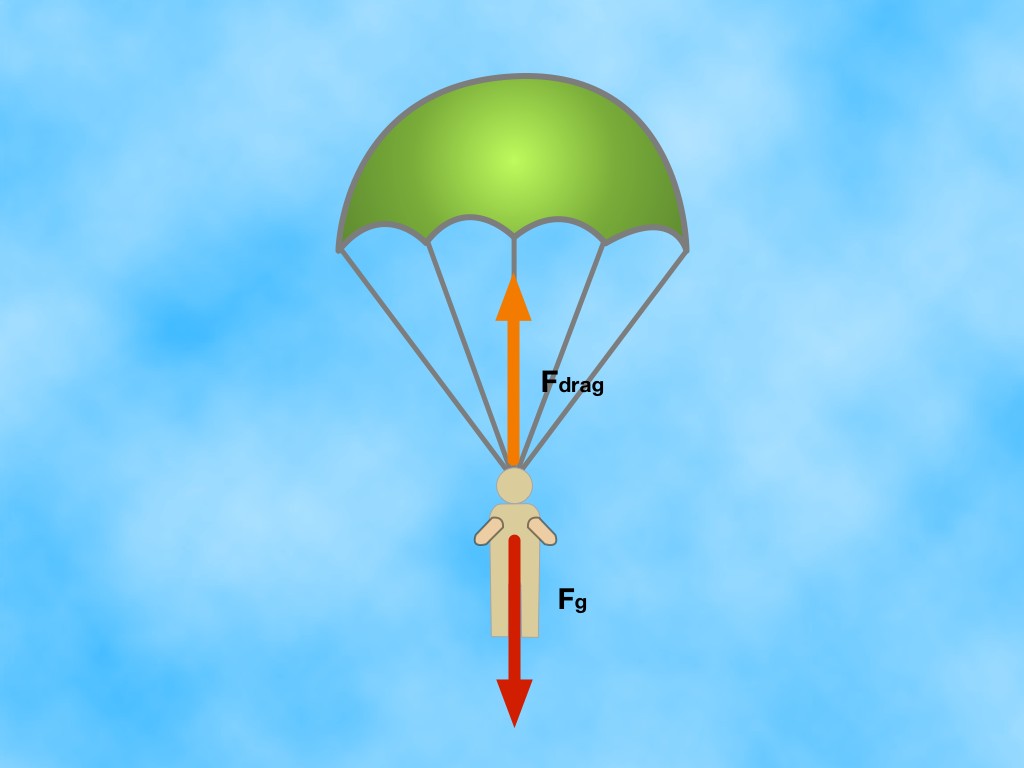
Free Body Diagram
Source and curriculum context
Adapted from Physics I by Jake Yap and Laurence Vincent.
Glossary and deeper reading · 6 refreshers
These editorial refreshers supplement the reading. Definitions and examples are added guidance; original source wording and recorded answers remain in their original context.
-
Drag
Drag is a force from a fluid that opposes an object’s motion relative to that fluid. Its dependence on speed, shape, and fluid properties varies with the physical regime. For example, a parachute increases air drag by presenting a large area to the moving air.
-
Velocity
Velocity describes how position changes with time and includes direction. Instantaneous velocity describes one moment, while average velocity is displacement divided by elapsed time. For example, a car turning a corner can change velocity while maintaining the same speed.
-
Terminal speed
Terminal speed is a constant speed reached when the forces along the direction of motion balance. For a falling object in fluid, increasing drag can eventually balance weight after buoyancy is also accounted for. For example, a falling raindrop can reach approximately constant downward velocity instead of accelerating indefinitely.
-
Weight
Weight is the gravitational force exerted on an object by a specified attracting body. Near Earth’s surface its magnitude is approximately mass times the local gravitational field strength, and it is measured in newtons. For example, an astronaut has less weight on the Moon while retaining the same mass.
-
Magnitude
Magnitude is the nonnegative size of a vector quantity. It does not specify direction, and it differs from a signed component. For example, a westward velocity can have a negative x component while its speed, the velocity magnitude, stays positive.
-
Fluid
A fluid is a material that flows and continuously deforms under a sustained shear stress. Liquids and gases are both fluids, although their compressibility and other properties can differ greatly. For example, both water in a pipe and air flowing through a duct are fluids.