Thermal expansion and model limits
Enrichment article
Read the related lesson → · Full original reading →
Keep initial length or volume, the small-temperature-range approximation, free expansion and isotropy in view. Water’s exception and the source questions about invalid extrapolation limit use of these formulas. The preceding calorimetry belongs to the native thermal model.
Thermal Expansion
Thermal expansionⓘ is the expansion of an object through the use of thermal energy. You can see this when you place a cold jar under hot water. The hot water causes the lid on the jar to expand just a little bit and is therefore loosened. This is also why bridge designers have holes larger than needed when putting in rods for stability. The rod would have to be able to withstand expansion on hot summer days.
There are two types of thermal expansion that we are concerned with at this point: linear expansion and volume expansion.
Linear Expansion
If the temperature of a metal rod of length L is subjected to an increase in temperature of , then it has an increase in length equivalent to:
For a freely expanding homogeneous isotropic solid, α applies to every linear dimension in the small-temperature-range approximation. Use the original length L_0 and evaluate ΔL = L_0αΔT.
So if all the dimensions of a solid expand, then so should its volume. Volume expansion also occurs with an increase in temperature. The equation associated with volume expansion is:
(Equation 7.4.4)
where
β ≈ 3α for a homogeneous isotropic solid when |αΔT| is small.
The volume expansion coefficient β characterizes a material’s fractional volume change per kelvin. For liquid water near ordinary pressure, density is greatest near 4°C: water contracts when warmed from 0°C to 4°C and expands when heated above 4°C. Cooling from 4°C toward 0°C makes it expand.
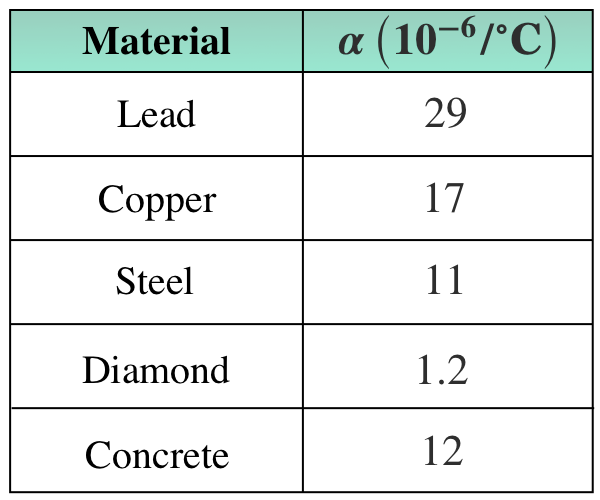
Below is a table of some coefficients of linear expansion for different materials.
Table 7.4.1: Coefficients of Linear Expansion
Source and curriculum context
Adapted from Physics I by Jake Yap and Laurence Vincent.
Glossary and deeper reading · 4 refreshers
These editorial refreshers supplement the reading. Definitions and examples are added guidance; original source wording and recorded answers remain in their original context.
-
Thermal expansion
Thermal expansion is a change in a material’s dimensions as its temperature changes. A simple coefficient model approximates the change over a limited temperature range and depends on the material and geometry. For example, leaving gaps between sections of a metal rail allows space for expansion in warmer conditions.
-
Temperature
Temperature is a state quantity that determines the direction of net energy transfer through thermal contact. For a classical ideal gas it is proportional to the average translational kinetic energy per particle, rather than to the total energy of the sample. For example, a small hot metal sample can have a higher temperature but less total internal energy than a large cooler sample.
-
Kelvin temperature scale
The kelvin scale measures thermodynamic temperature from absolute zero. A temperature interval of one kelvin has the same size as one degree Celsius, but their zero points differ. For example, temperature ratios in the ideal gas law must use kelvin values rather than Celsius values.
-
Pressure
Pressure is the normal force per unit area exerted on a surface. It is a scalar measured in pascals, with one pascal equal to one newton per square meter. For example, a gas exerts pressure throughout its volume through many microscopic collisions, even when its bulk motion is zero.