Specific Heat and Thermal Conductivity
Separate specific heat from sample heat capacity and thermal conductivity from energy storage.
AP Physics 2 Topic 9.5 · College Board CED printed p. 33 / PDF p. 40 · See this topic in the course outline
The energy needed to warm a material and the rate at which energy moves through it are different questions. Specific heat describes a temperature change; thermal conductivity describes transfer through a temperature gradient.
Before you start
- First-law energy accounting and thermal equilibrium.
- Proportional reasoning, linear slopes, and SI unit conversions.
Temperature change requires energy in proportion to mc
When thermal energy changes a material’s temperature without a phase change, . Here m is mass, c is specific heat in J/(kg·K), and ΔT = T_f − T_i. A temperature interval of 1 °C is the same size as 1 K, so Celsius differences work in this equation. Q is positive when the object warms and negative when it cools in this simple thermal-transfer model. If significant work also changes the internal energy, account for it with the first law instead of assigning all temperature change to Q.
Specific heat is an intrinsic material property, governed by atomic arrangement and interactions and by the ways atoms store internal energy. It does not increase merely because the sample has more mass. The sample heat capacity mc is larger for a larger sample. AP Physics 2 treats c as independent of temperature. Thus, for fixed m and c, a Q-versus-ΔT graph is a line through the origin with slope mc. A large c means more energy is required per kilogram for the same temperature rise; it does not directly tell how rapidly that energy enters.
Frictional dissipation and a plank’s temperature rise
Friction removes mechanical energy from the box; the stipulated deposited energy raises the plank’s internal energy. Positive friction-magnitude times distance is dissipated energy, not the signed friction work on the box, and dissipation is not automatically thermodynamic heat crossing a boundary. Assume a level stationary plank with N = mg, completion of the full 10 m relative slide, all dissipated energy deposited in the plank, constant specific heat, no phase change or losses, and a uniform final temperature.
Retain the source contact-force caption disclosing omitted downward weight. Individual-force diagram conventions →
Review the model and equations used here →
Example Problem 7.1.1
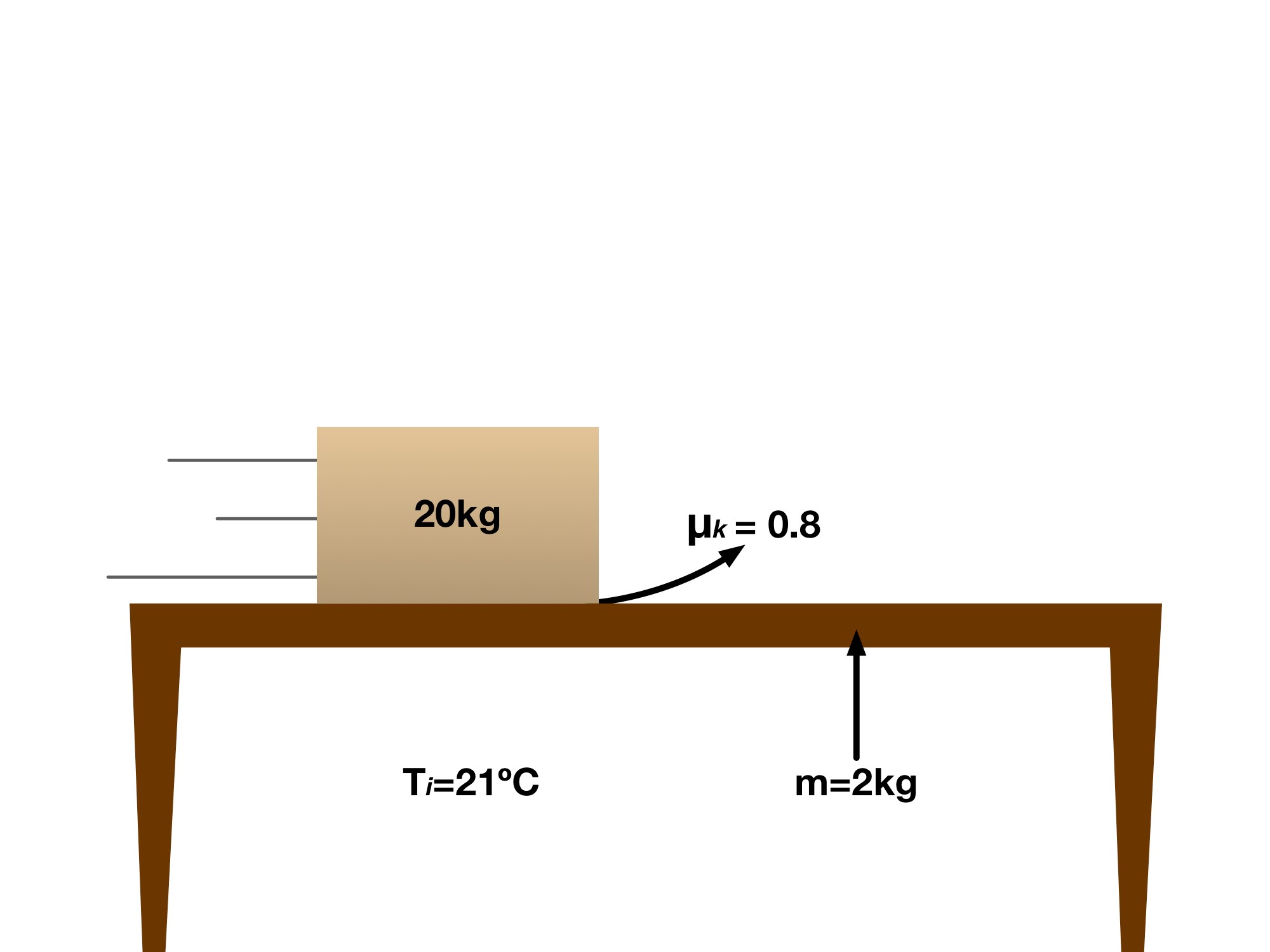
If a box slides along a , plank with a coefficient of kinetic friction of , determine the final temperature of the plank. Assume the plank absorbs all the heat generated by friction, and it starts at . The specific heat of the plank is
Step 1. Determine the heat added to the plank
If we want to determine the heat involved, we have to first identify the source of the heat. Friction is the only contributor in this case, as it contributes all its generated heat into the plank. But how much heat is that? Well to find that, we just need to calculate the work done by the force.
Remember the equation for work.
In this case, the force of friction can be given as:
F_friction = μ_kmg = 0.80(20 kg)(9.81 m/s²) = 156.96 N.
So work, which is will be:
Example 7.1.1 Contact Forces on the Box
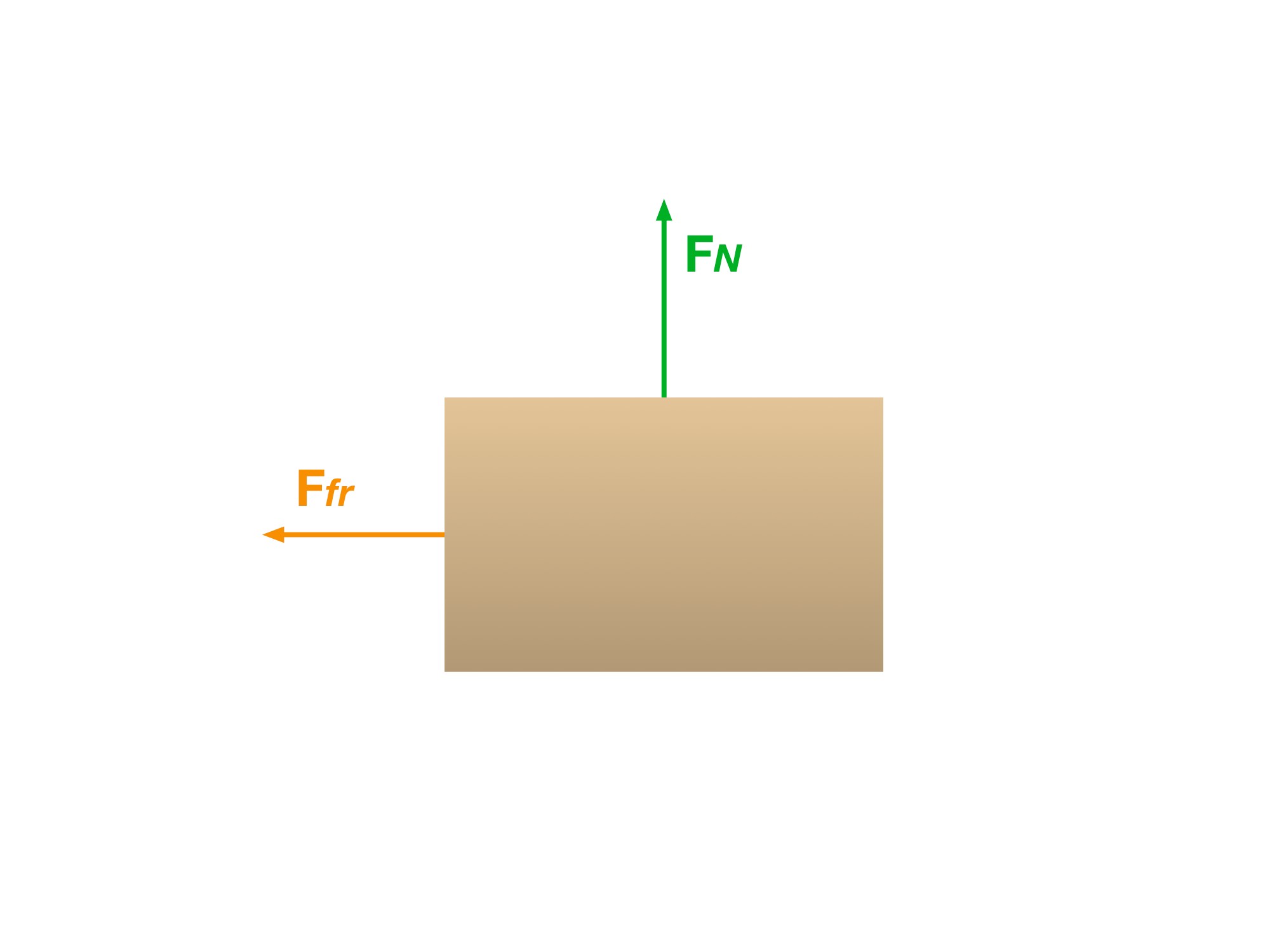
This drawing shows only the upward normal force and leftward friction. A complete free-body diagram also needs the box’s downward weight; on the level surface with no vertical acceleration, N = mg.
Physics I by Jake Yap and Laurence Vincent. Complete historical context and correction history →
Calorimetry: conserve energy across all named objects
In an insulated cup containing a hot object and cool water, choose object plus water plus cup as the system. If the cup’s energy change is negligible and there is no appreciable work, . Write each term as mc(T_f − T_i) with one common equilibrium T_f. The hot term is negative and the water term positive. Solve the energy balance; do not average the starting temperatures unless both heat capacities are equal.
An actual experiment must examine the cup, thermometer, heat leakage, and transfer delay. If a warm metal loses energy to the room before entering the water, the recorded initial metal temperature may be too high. If it loses energy to the cup or air after immersion, water gains less than the metal loses. Neglecting either loss commonly underestimates the inferred metal c. Repeats help reveal random scatter but do not automatically remove systematic heat loss.
Conductivity, geometry, and temperature difference determine a rate
For a uniform slab in steady one-dimensional conduction, with its two faces held at different temperatures, the magnitude of the energy-transfer rate is . ΔT is the positive temperature difference between faces, A the cross-sectional area perpendicular to the flow, L the distance between the faces, and k thermal conductivity in W/(m·K). Energy flows from the hot face to the cold face. Multiply a constant rate in watts by elapsed seconds to find energy in joules.
More parallel area lets more energy pass per second; doubling A doubles the rate. A longer path makes transfer slower; doubling L halves the rate. Doubling the face-to-face ΔT doubles the rate. These comparisons assume k and the other variables are fixed, uniform material, maintained face temperatures, negligible side leakage, and steady conditions. Thermal conductivity is an intrinsic material property related to its atoms’ arrangement and interactions, not a property of a particular slab thickness. Metals can conduct efficiently through mobile electrons. Changing dimensions changes the rate without changing k. Specific heat c and conductivity k have different units and meanings.
Infer a metal’s specific heat from equilibrium
A 0.100 kg metal at 100 °C is immersed in 0.200 kg water at 20 °C. They reach 25 °C in an insulated cup with negligible heat capacity. Use c_water = 4200 J/(kg·K). Find c_metal.
Water gains Q_w = (0.200)(4200)(25 − 20) = 4200 J.
Why this step? The water warms, so its Q is positive.
Metal has Q_m = (0.100)c_m(25 − 100) = −7.50c_m. Set −7.50c_m + 4200 = 0.
Why this step? The chosen two-body system is insulated; metal loss balances water gain.
c_m = 4200/7.50 = 560 J/(kg·K).
Why this step? Solving for the intrinsic property uses the measured temperature changes and masses.
Answer and check
c_metal = 560 J/(kg·K), under the negligible-loss and constant-c assumptions. The common temperature is closer to the water’s initial temperature because the water’s heat capacity is larger.
From conduction power to transferred energy
A slab has k = 0.20 W/(m·K), A = 0.80 m², L = 0.040 m, and its faces are held 20 K apart. Find steady transfer rate and energy transferred in 10 minutes.
Rate = kAΔT/L = (0.20)(0.80)(20)/(0.040) = 80 W.
Why this step? The area is perpendicular to flow and thickness is along flow; maintained face temperatures justify steady conduction.
Δt = 600 s; |Q| = (80 J/s)(600 s) = 4.8 × 10⁴ J.
Why this step? Power times time gives transferred energy only when the rate remains constant.
Doubling thickness with the same material and face temperatures would halve the rate to 40 W.
Why this step? The inverse dependence on L describes a longer conduction path; k itself has not changed.
Answer and check
80 W flows from hot to cold, transferring 48 kJ in 10 minutes.
Changing a path does not change the material coefficient
In conduction, energetic particles interact with their neighbors, and mobile electrons can transport energy in metals. The arrangement of atoms and the interactions among them determine how effectively energy travels through a material. Thermal conductivity k quantifies that material behavior: for steady one-dimensional flow through a uniform slab, transfer power is kAΔT/L. At fixed material state, k is an intrinsic material property; doubling the slab thickness does not change how its atoms are arranged or interact locally.
A longer slab gives energy a longer path and reduces power, while a larger area provides more parallel paths and increases power. Changing the material’s composition or atomic arrangement can change k even with identical dimensions. Measuring a different power alone cannot identify its cause: compare the material, area, thickness, and measured face temperatures. Specific heat c describes energy storage per kilogram per kelvin; k describes transport through a temperature gradient, so one cannot substitute for the other.
Equal slabs reveal a material difference
Two uniform slabs have A = 0.010 m², L = 0.020 m, and maintained hot/cold faces 20 K apart. At steady state with negligible side loss, material A transfers 4.0 W and material B transfers 8.0 W. A third slab is material A with twice the thickness.
- Solve k = power × L/(AΔT). k_A = (4.0)(0.020)/(0.010 × 20) = 0.40 W/(m·K); k_B = 0.80 W/(m·K).
- B’s atoms and charge carriers transport energy more effectively in this state; composition, atomic arrangement, and interactions set the larger intrinsic coefficient. Rate measurements alone do not reveal a unique microscopic mechanism.
- The thicker A slab still has k_A = 0.40 W/(m·K), but its transfer power is (0.40)(0.010)(20)/0.040 = 2.0 W.
- For 60 s, the original A, original B, and thicker A slabs transfer 240 J, 480 J, and 120 J respectively. Energy flows from hot to cold in each.
Answer and check
k_A = 0.40 and k_B = 0.80 W/(m·K); doubling A’s thickness halves power without changing k. These comparisons require unchanged material state and maintained boundary temperatures.
Try it from memory
Write your answer and reason before opening the worked answer. Your self-assessment is a study decision; it is not an automatically graded score.
Question 1
Equal masses of two materials receive the same thermal energy without phase changes or work. Material A has twice the specific heat of B. Compare their temperature rises.
Worked answer and reason
ΔT_A = ΔT_B/2.
Solving Q = mcΔT gives ΔT = Q/(mc). Specific heat is the material factor; equal mass and energy leave an inverse c dependence.
Question 2
A slab’s area doubles and thickness triples, with unchanged k and face temperatures. By what factor does its steady conduction rate change?
Worked answer and reason
The new rate is 2/3 of the old rate.
Rate is proportional to A/L. A geometry change does not change the intrinsic conductivity.
Question 3
Which experiment distinguishes c from k: measuring a sample’s temperature rise after known energy input, or measuring steady energy flow through a slab at a maintained temperature difference?
Worked answer and reason
The first can determine c from Q = mcΔT. The second can determine k from rate = kAΔT/L.
An energy-versus-temperature measurement and a rate-through-material measurement ask different physical questions.
JavaScript enables saved drafts and self-assessment. You can always work on paper.
Catch the tempting mistake
- Specific heat and heat capacity are the same quantity.
- Specific heat c is energy per kilogram per kelvin; the sample’s heat capacity mc also depends on its mass.
- A material with high conductivity must have low specific heat.
- Conductivity and specific heat describe different microscopic behavior. One governs transfer rate; the other energy required for a temperature change.
- A thick insulator changes its material conductivity.
- Its geometry changes transfer rate, but the material’s intrinsic k stays the same under the stated conditions.
Put it to work
Give the physical reason as well as the calculation. The worked solutions are on a separate page.
- Problem 9 · calculation; quantitative slope; intrinsic-property comparison
- Problem 10 · calculation; factors; controlled procedure
- Problem 14 · procedure; calorimetry balance; uncertainty interval; entropy
- Problem 15 · conduction rate; symbolic first-law derivation; microscopic scaling; entropy
Explain and apply the model
Try these problems before opening the solutions. Show the physical model, your calculation or sketch, and the reason your conclusion follows.
Distinguish a material change from a thickness change
At the same mean temperature, slabs A and B each have area 0.020 m² and thickness 0.030 m. Their faces are maintained 15 K apart. After steady state, measured transfer powers are 6.0 W for A and 10.0 W for B. A replacement A slab has thickness 0.060 m and unchanged area. Neglect side loss; each sample remains uniform.
(a) Determine k for A and B, the heat-flow direction, and the energy transferred by B in 2.0 minutes.
(b) Explain why A and B can have different intrinsic thermal conductivities even though their dimensions and boundary temperatures match. Your explanation must connect conductivity to atomic arrangement and interactions and distinguish a material coefficient from a slab’s geometry.
(c) Predict the replacement A slab’s power and k. Explain whether a doubling of sample mass by thickness requires a doubling of k, and why specific heat cannot replace k in your calculation.
Written working workspace
Drawing is temporarily unavailable. Work on paper if needed, then record your reasoning here.
Saving written working requires JavaScript. Keep your work on paper or in your own notes; the source problem above remains available.
Worked solution and rubric →Revisit the explanation →Revisit the explanation →
What does a thicker sample tell you?
A uniform insulator is replaced by the same material at the same temperature, with twice the thickness and unchanged area and face-to-face temperature difference. Side loss is negligible and both trials reach steady state.
(a) Which complete explanation is consistent with this change?
Scientific calculator workspace
Keep intermediate precision and report units. This calculator supports arithmetic and elementary functions.
Scientific calculator
This calculator requires JavaScript. Use the physics formula sheets and show your working manually.
+ − * / ^ ! · pi · e · sqrt · sin, cos, tan · asin, acos, atan · atan2(y,x) · ln, log · abs · exp · hypot(x,y). Use * between factors. Keep units in your written working.
For the teacher
- For calorimetry, students should name the combined system and every omitted energy store before setting energy gained equal to energy lost.
- Use the AP approximation of temperature-independent c, and avoid unprovided phase changes in Q = mcΔT problems.
- A steady conduction experiment needs two maintained boundary temperatures. A warming sample’s transient temperature curve is not automatically a measurement of k.
Source objectives and scope
- 9.5.A — Describe the energy required to change the temperature of an object by a certain amount.
- 9.5.B — Describe the rate at which energy is transferred by conduction through a given material.
AP Physics 2 will model specific heat as independent of temperature.
Suggested skills are teaching guidance. The course applies all science practices across its objectives.
Science references for this teaching
- College Board AP Physics 2 Course and Exam Description, Unit 9 (PDF pages 34–42; printed pages 27–35) — All Unit 9 learning objectives, essential knowledge clauses, and AP scope boundaries; source equations checked in the supplied pinned PDF.
- OpenStax University Physics Volume 2, Molecular Model of an Ideal Gas — Supporting open-textbook reading for ideal-gas assumptions, absolute pressure, and state-variable graphs; real-gas extensions in the source are beyond this unit’s AP requirements.
- OpenStax University Physics Volume 2, First Law of Thermodynamics — Supporting open-textbook reading for energy accounting; authoring translates any work-by convention into the AP work-on convention.
- OpenStax University Physics Volume 2, Entropy — Optional conceptual supporting reading for qualitative entropy and reversibility; quantitative entropy calculations in the source are outside this AP treatment.
Related source reading
These alternative explanations and examples retain their source context. Draft placement does not add accepted exam coverage.
- thermal calorimetry · alternative source explanation
- Thermal expansion and model limits · source context; placement review pending
Glossary and deeper reading · 13 refreshers
These editorial refreshers supplement the reading. Definitions and examples are added guidance; original source wording and recorded answers remain in their original context.
-
Specific heat
Specific heat is the energy needed per unit mass for a unit temperature increase under the stated conditions. Its units are joules per kilogram per kelvin, and the simple calorimetry model treats it as constant without a phase change. For example, equal masses of two materials can require different energy transfers for the same temperature rise.
-
Temperature
Temperature is a state quantity that determines the direction of net energy transfer through thermal contact. For a classical ideal gas it is proportional to the average translational kinetic energy per particle, rather than to the total energy of the sample. For example, a small hot metal sample can have a higher temperature but less total internal energy than a large cooler sample.
-
Thermal equilibrium
Thermal equilibrium between systems means their temperatures are equal and there is no net energy transfer between them through thermal processes. Microscopic energy exchanges can continue while their opposing contributions balance. For example, water and a metal sample left together in an insulated cup approach a common equilibrium temperature.
-
Mechanical work
Mechanical work is energy transferred by a force through displacement of its point of application. For a constant force on a particle, it depends on the force component along the particle’s displacement, and it can be positive, negative, or zero. For example, a magnetic force perpendicular to a particle’s displacement does zero work on that particle.
-
Internal energy
Internal energy is energy associated with the microscopic motion and configuration of a system’s constituents. It excludes the kinetic energy of the whole system’s bulk motion and depends on the thermodynamic state. For example, a stationary solid can gain internal energy as its atomic vibrations become more energetic.
-
Heat capacity
Heat capacity is the energy needed to raise the temperature of an entire object by one temperature unit under specified conditions. For a uniform sample in the simple constant-specific-heat model, it equals mass times specific heat. For example, twice as much of the same material has twice the heat capacity when its state and specific heat are unchanged.
-
Mechanical energy
Mechanical energy is the sum of the kinetic and potential energies included in a model. It stays constant when transfers to or from other energy stores and across the chosen boundary are absent. For example, a pendulum’s mechanical energy can remain approximately constant while energy shifts between motion and gravitational configuration.
-
Force
A force describes an interaction that can change an object’s momentum. It is a vector measured in newtons, so both size and direction matter when forces are added. For example, a rope can pull a cart while the floor exerts friction in another direction.
-
Heat
Heat is energy transferred between systems because of a temperature difference. It describes a transfer rather than a substance or energy store contained in an object. For example, when a warmer mug transfers energy to a cooler hand, the mug loses internal energy and the hand gains it.
-
Thermal conduction
Thermal conduction transfers energy through microscopic interactions without bulk flow of the material. Particles and, in metals, mobile electrons can carry energy from hotter regions toward cooler regions. For example, the handle of a metal spoon warms when its other end is placed in hot water.
-
Thermal conductivity
Thermal conductivity measures how readily a material conducts energy through a temperature gradient. It is a material property with units watts per meter per kelvin, distinct from the sample’s heat capacity or thickness. For example, a metal and an insulating foam slab of the same dimensions can have very different conduction rates.
-
Power
Power is the rate at which energy is transferred or converted. It is measured in watts, with one watt equal to one joule per second. For example, two motors can lift the same load through the same height but have different average powers if they take different times.
-
Kelvin temperature scale
The kelvin scale measures thermodynamic temperature from absolute zero. A temperature interval of one kelvin has the same size as one degree Celsius, but their zero points differ. For example, temperature ratios in the ideal gas law must use kelvin values rather than Celsius values.