Conduction Rate Equation
Reference from the original Physics I textbook.
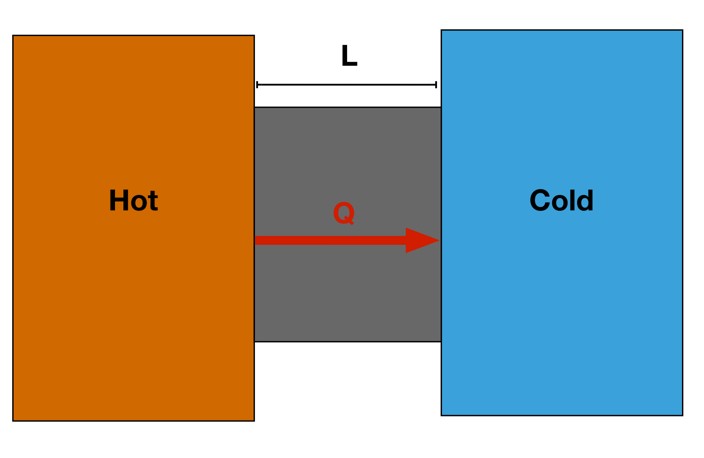
- Conduction Rate Equation
[]
- Related Glossary Terms
Conductionⓘ, Conduction Rate with Steady-State Equation, Steady-State, Table 7.3.1: Material Conductivities, Thermal Conductivityⓘ, Thermal Resistance, Thermal Resistance Equation
- Index
Glossary and deeper reading · 2 refreshers
These editorial refreshers supplement the reading. Definitions and examples are added guidance; original source wording and recorded answers remain in their original context.
-
Thermal conduction
Thermal conduction transfers energy through microscopic interactions without bulk flow of the material. Particles and, in metals, mobile electrons can carry energy from hotter regions toward cooler regions. For example, the handle of a metal spoon warms when its other end is placed in hot water.
-
Thermal conductivity
Thermal conductivity measures how readily a material conducts energy through a temperature gradient. It is a material property with units watts per meter per kelvin, distinct from the sample’s heat capacity or thickness. For example, a metal and an insulating foam slab of the same dimensions can have very different conduction rates.