Heat Transfer
Original textbook reading.
Enrichment beyond the AP course.
This original chapter is extra exploration beyond the supplied AP Physics 1 course. Keep it if you're curious about where these ideas go next.
In this section we will be dealing with the concepts of how heat energy is transferred. The three mechanisms of heat transfer that we will cover are conduction, convection, and radiation.
Imagine what happens when you place a metal pan on the stove on high heat. If you leave it there for a while, and then you try to grab it with your bare hands, what happens? That’s right, you burn yourself. Now what causes this? It’s probably your fault that you didn’t have the common sense to know that the energy from the fire is transferred to the metal pan through thermal conduction. (We are kidding by the way. We know all you boys and girls are smart).
In a metal, thermal energy is transferred by interactions among vibrating atoms and by mobile electrons. A temperature difference drives the transfer from hotter regions toward cooler ones.
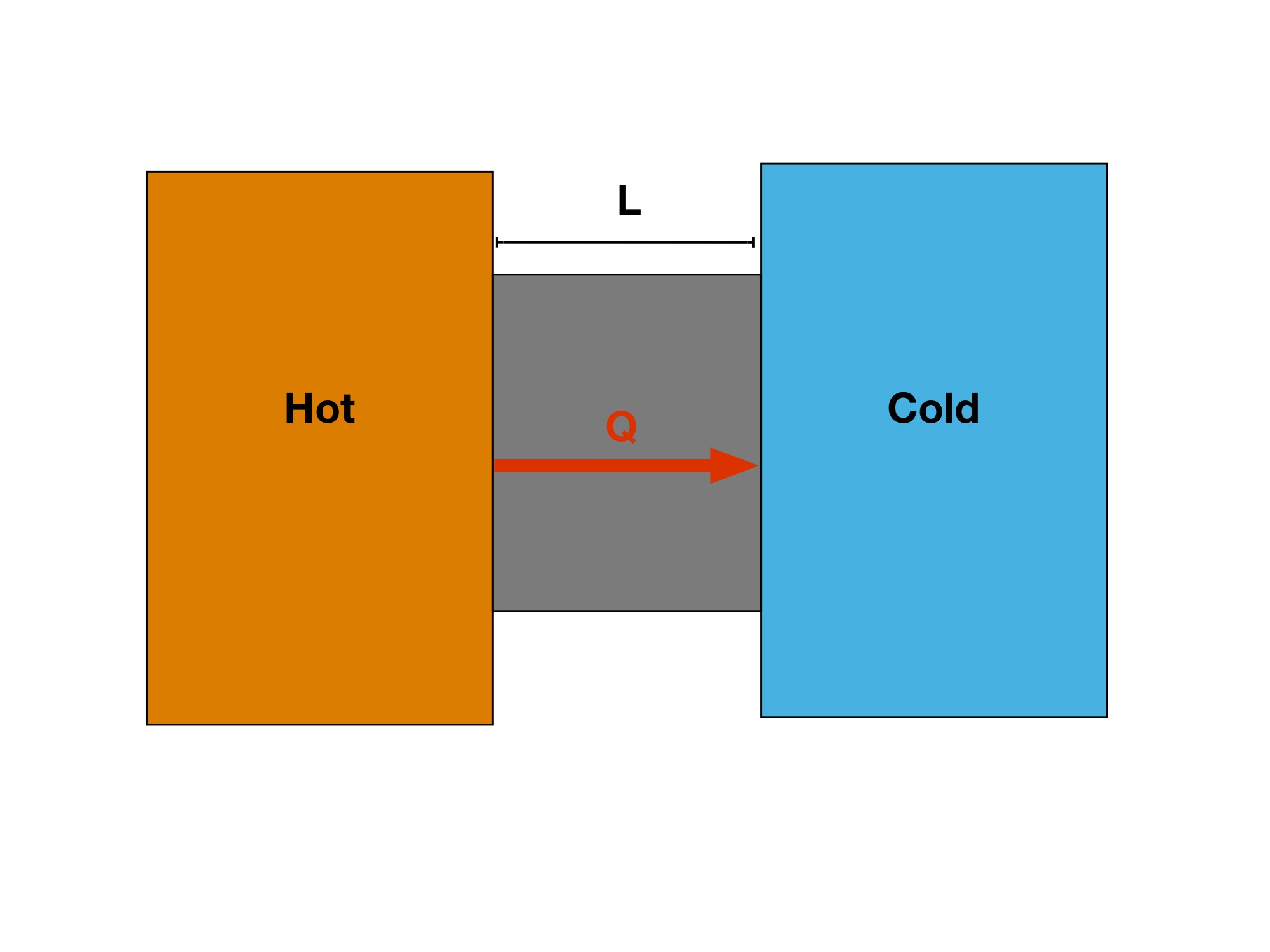
Consider a slab of thickness L and face area A whose two faces are held at different temperatures. Assume one-dimensional steady conduction with constant conductivity and no internal heat generation: the temperature profile is constant in time, but varies across the slab.
Figure 7.3.1 Conduction of a Block
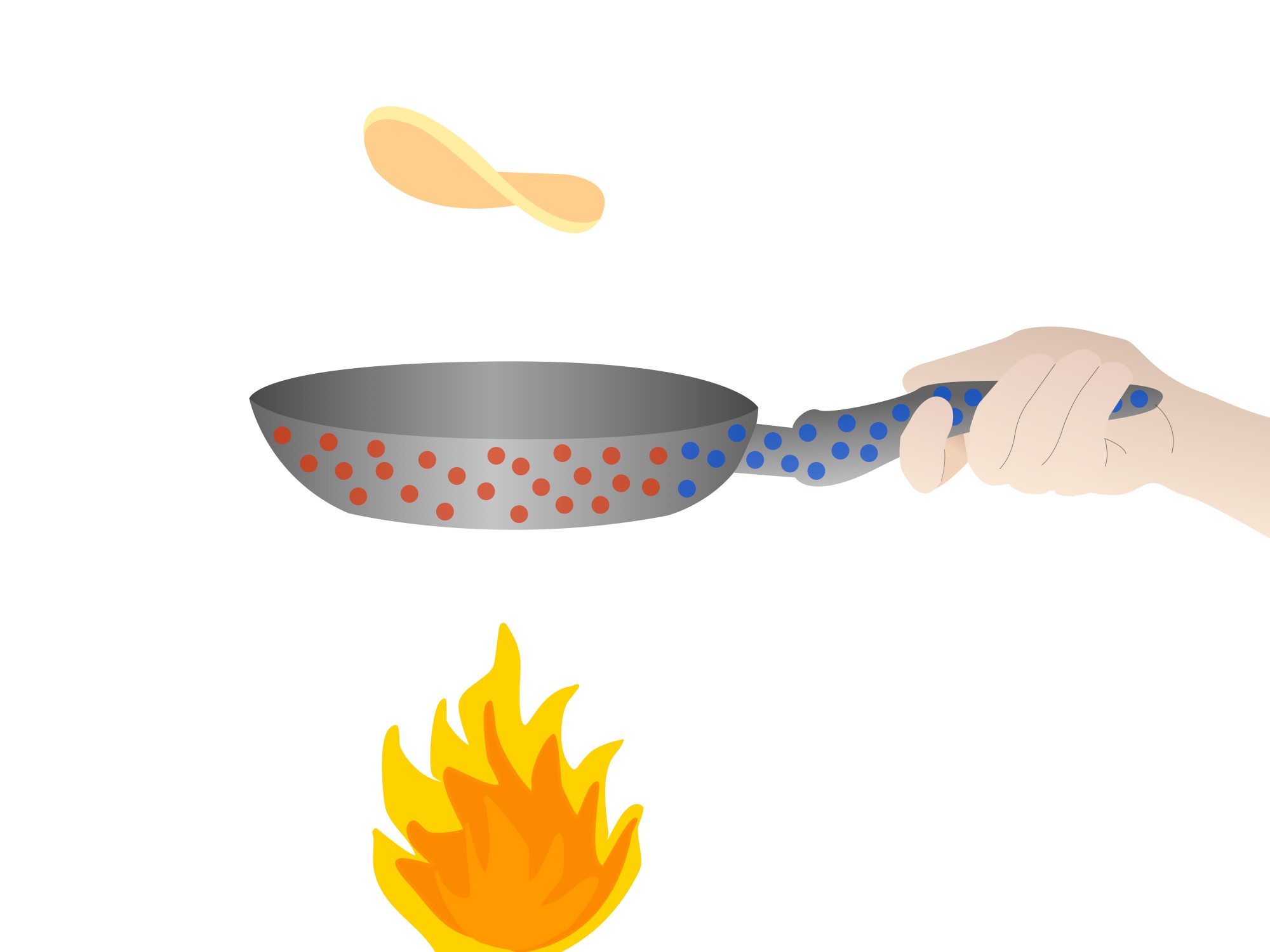
The pan is in the process of heating up indicated by the red molecules, while the handle is still cold (blue molecules).
Read every step and figure
Step 1
The pan is in the process of heating up indicated by the red molecules, while the handle is still cold (blue molecules).
Step 2
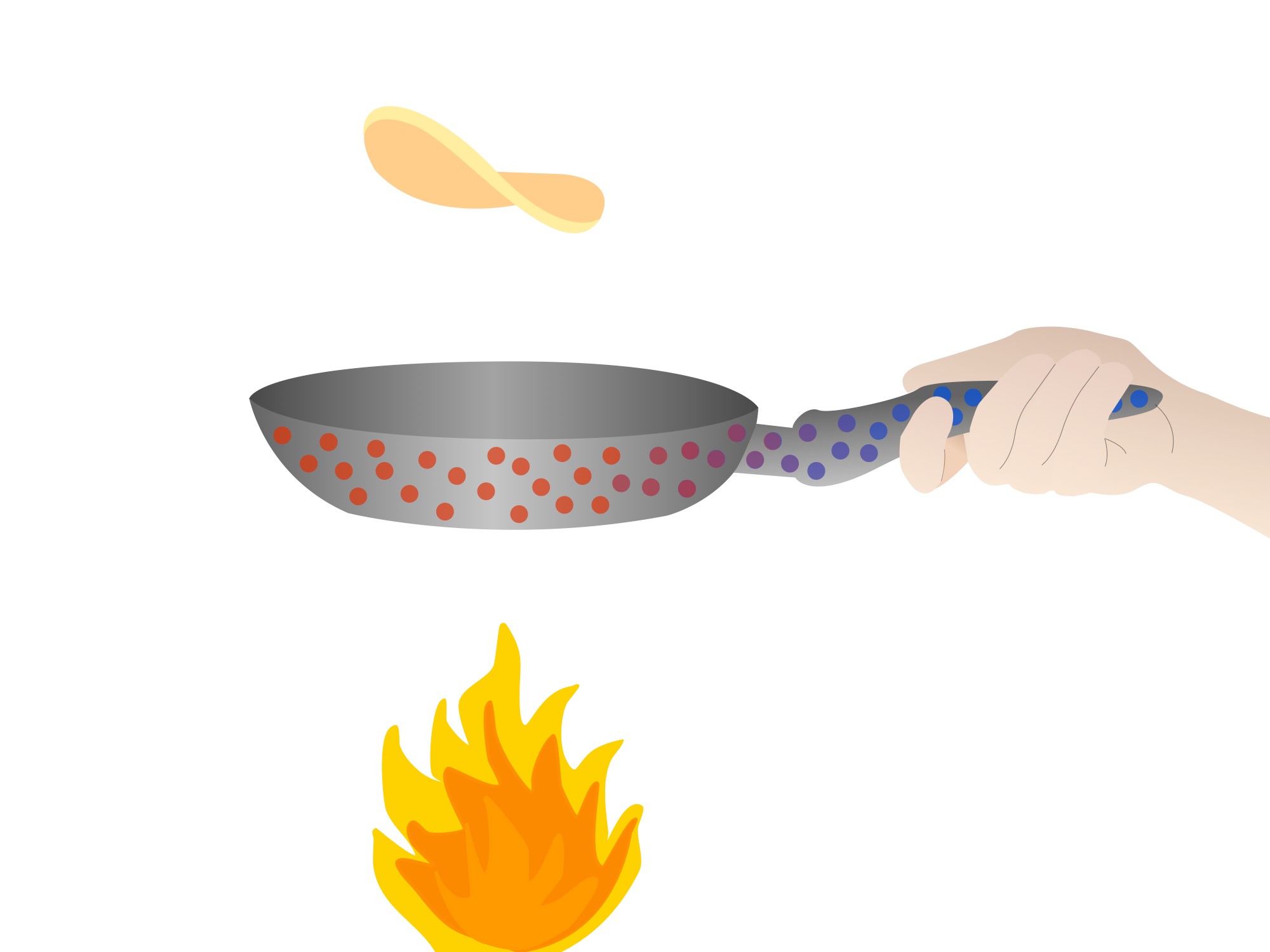
The molecules begin to vibrate and collide with each other so energy is transferred which is why the cold molecules start becoming warm.
Step 3
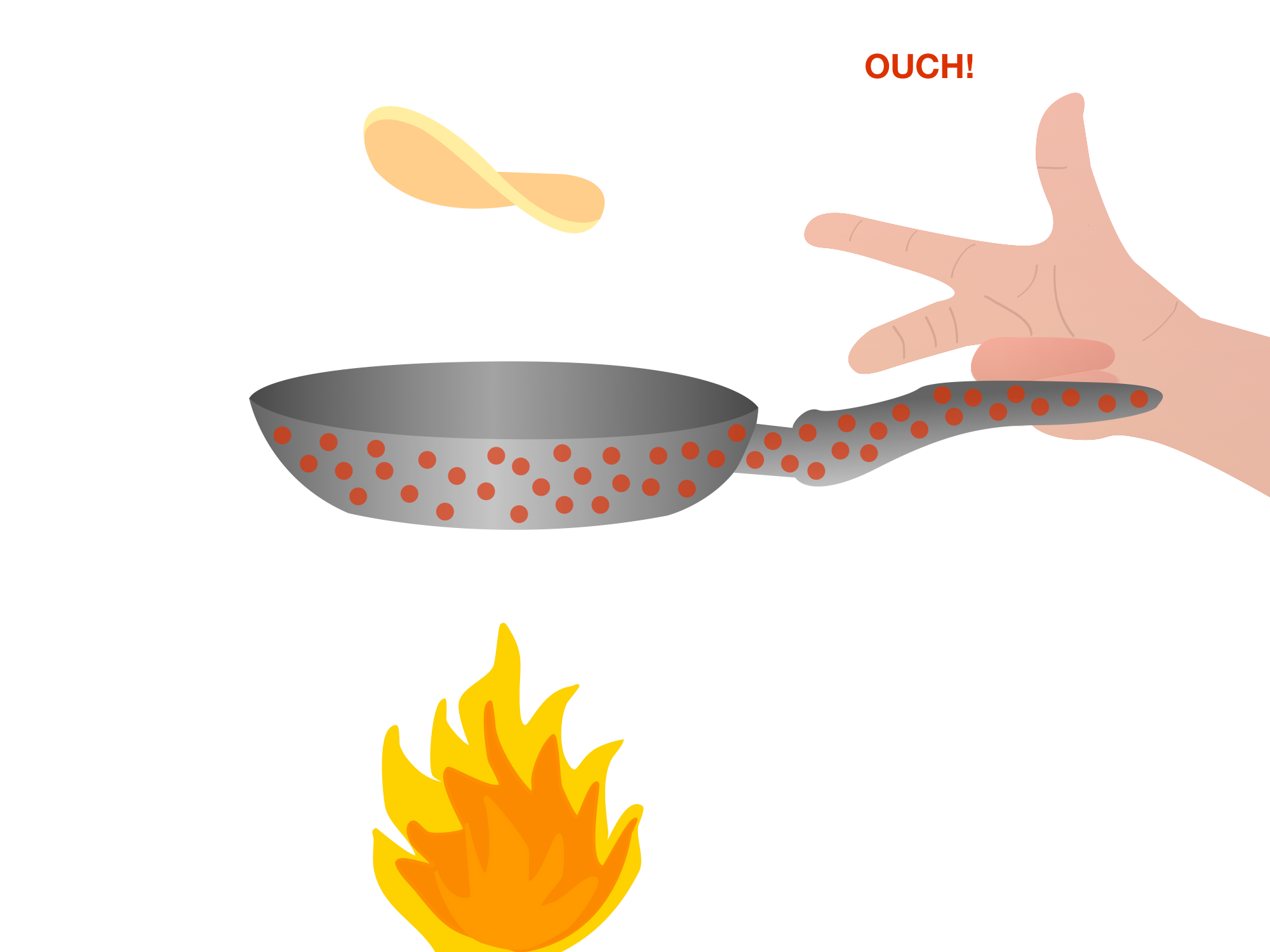
Experiments determine that the conduction rate through the block, which is the amount of energy transferred per unit time is written as:
Thermal conductivity k, measured in W/(m·K), determines heat flux for a given temperature gradient. It is not a speed at which heat first reaches another point; transient temperature evolution also depends on density and specific heat.
A table with some common materials that you may encounter with their respective -values is shown on the next column.
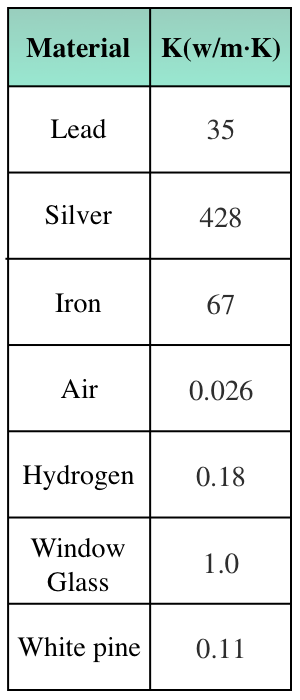
For a slab, the area-normalized thermal resistance is R = L/k, with units m²·K/W. The whole slab’s resistance is L/(kA), with units K/W. A small conductivity produces a large resistance for fixed thickness and area.
Imagine a material that has a low thermal conductivity. That would result in a high -value, meaning that the material has a high thermal resistance.
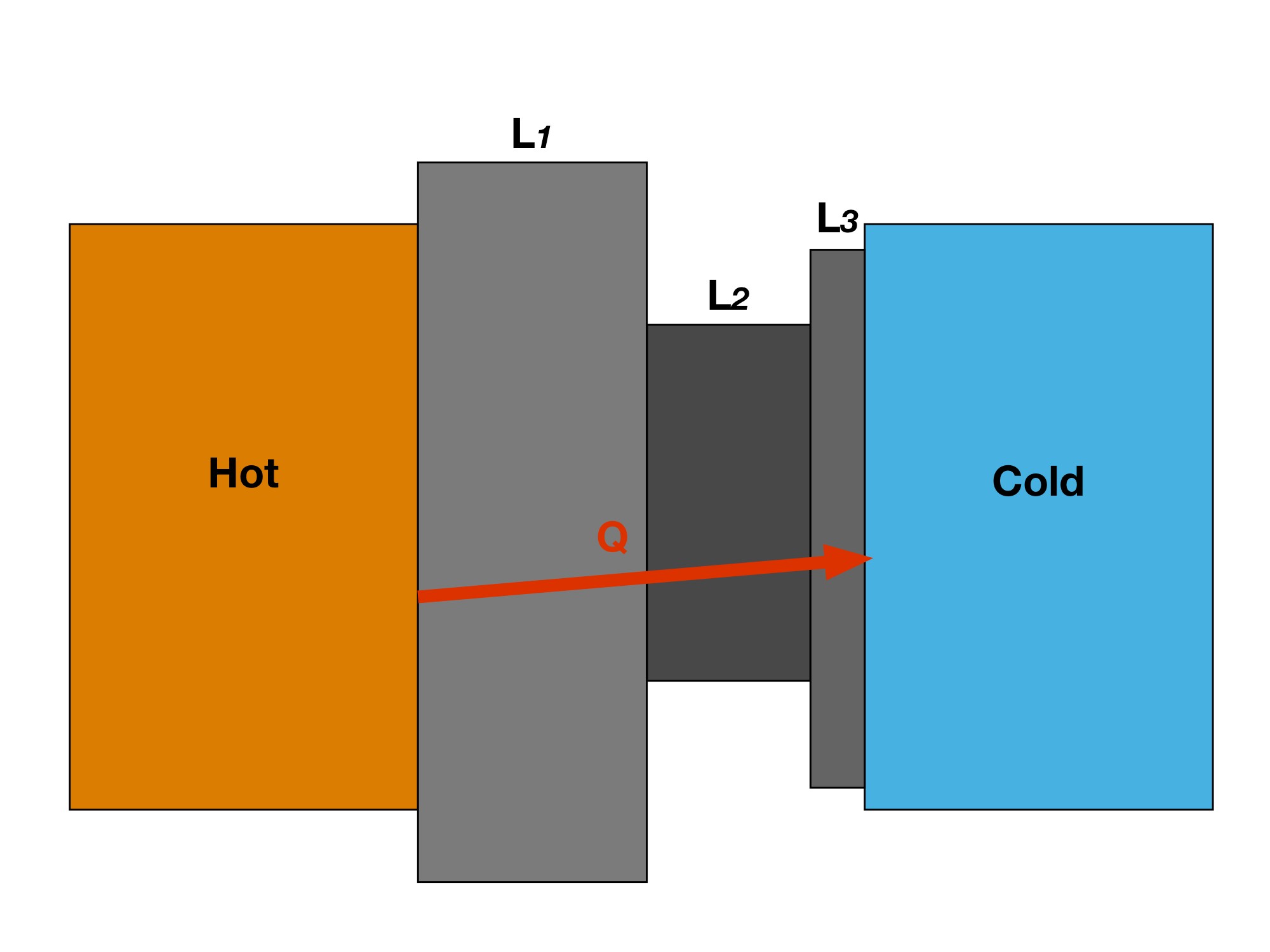
Notice how you can be put in a situation where you will be dealing with conduction through more than one material, therefore having multiple thermal conductivities. An assumption that we must make here is that the transfer of heat through both slabs is steady-state, meaning that the conduction rates between both materials are the same.
In other words the energy transferred through a material in a given time must be the same to the amount of energy transferred to the other materials in that same time. The equation that will help us the most in solving for any number of materials will be:
Figure 7.3.2 Conduction through multiple Objects
Example Problem 7.3.1
There is a window glass with length and thermal conductivity on one side and a lead wall with thickness and a thermal conductivity of on the other side. Sandwiched in between them is a layer of unknown material with an unknown length and .
Assuming that the layers reach steady state and that the temperatures of , , and are , , and , what is the temperature between the lead wall and the unknown material.
different materials and different thermal conductivities. This is why we will be using the thermal conduction equation.
Step 2: Realize that this is steady state
We are solving for the temperature at . However, we don’t have enough data to solve for it alone. If we knew the area and conduction rate of the material, we could probably solve it, but since we don’t we have to think critically on this.
Remember what was stated in the problem statement. We are to assume that this system will reach steady state. Meaning that the conduction rate is the same throughout all the materials.
With this in mind, let’s write the conduction rates out for the materials we know.
Example Problem 7.3.1
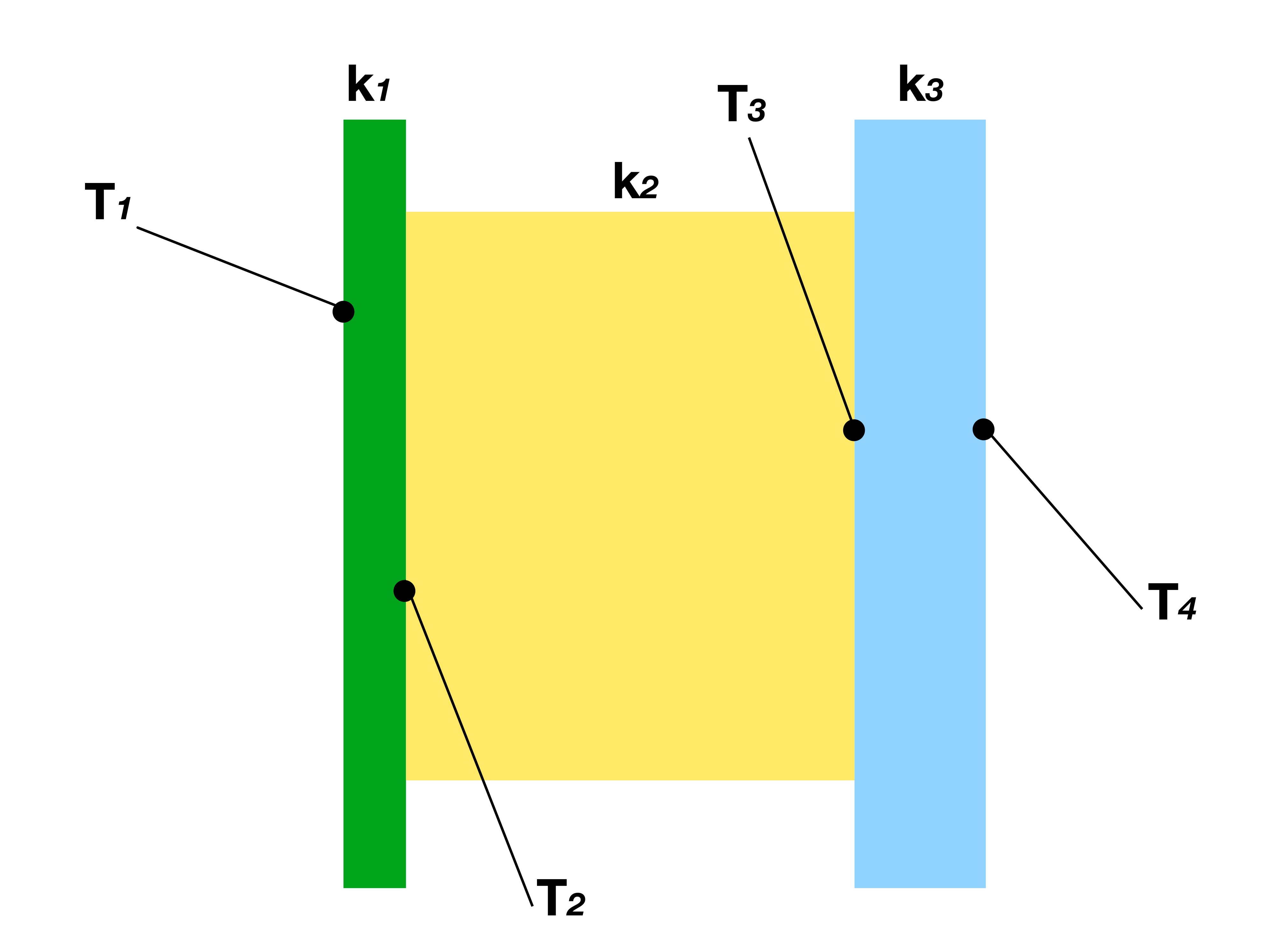
Conductivities follow the diagram’s left-to-right order: k₁ for glass, k₂ for the unknown layer, and k₃ for lead. The worked solution uses the material names.
and
P_lead = k_lead A(T_3 − T_4)/(4L).
Step 3: Solve for
Since we know that this is in steady state, we can equate our equations, so , do some algebra and solve for , giving us a more simplified version:
Now just plug in all our knowns. Remember from Table 7.3.1 that the thermal conductivities of glass and lead are and respectively.
Convection transfers thermal energy through macroscopic fluid motion. Natural convection can result from buoyancy caused by density differences; fans or pumps can produce forced convection.
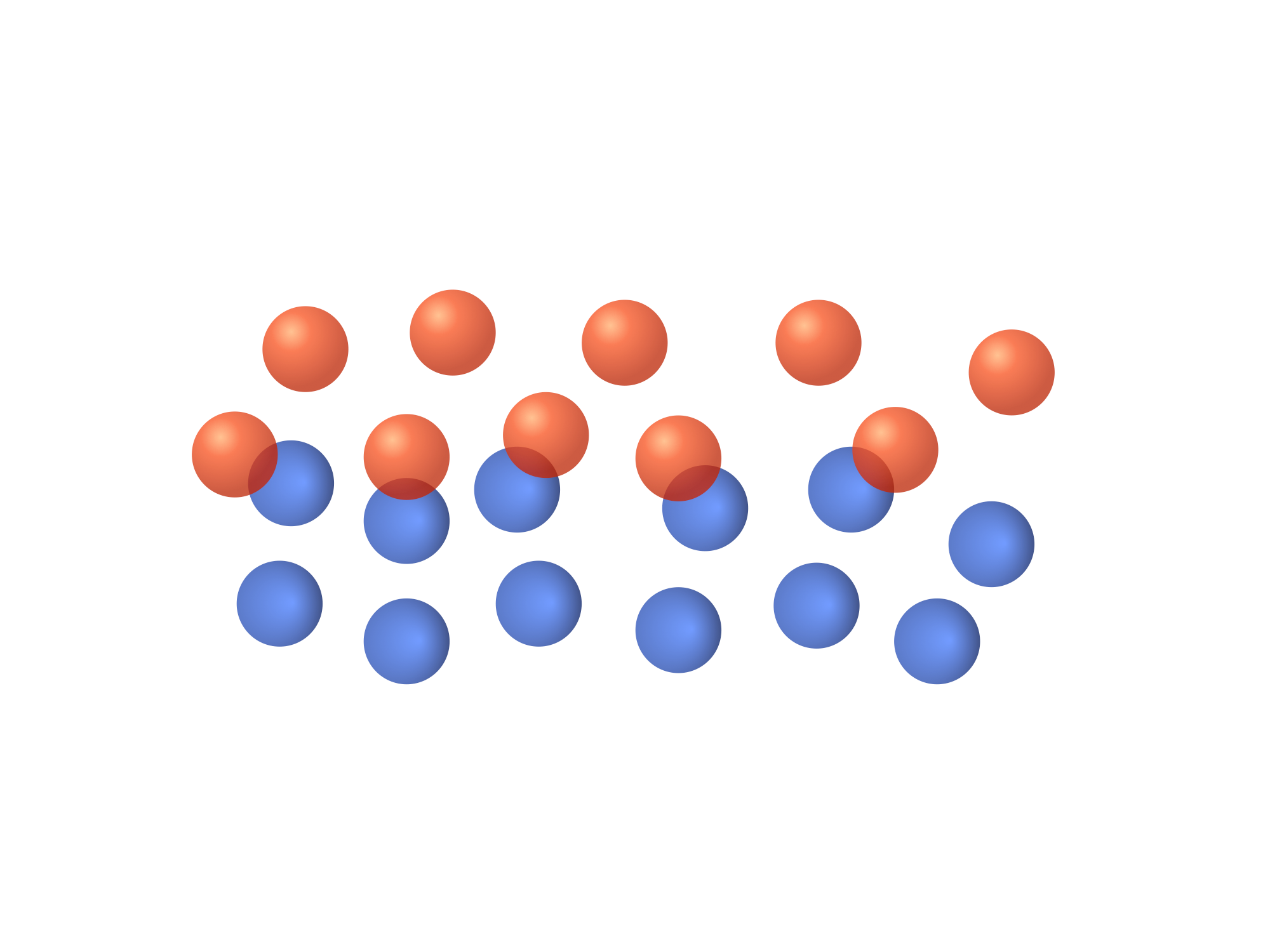
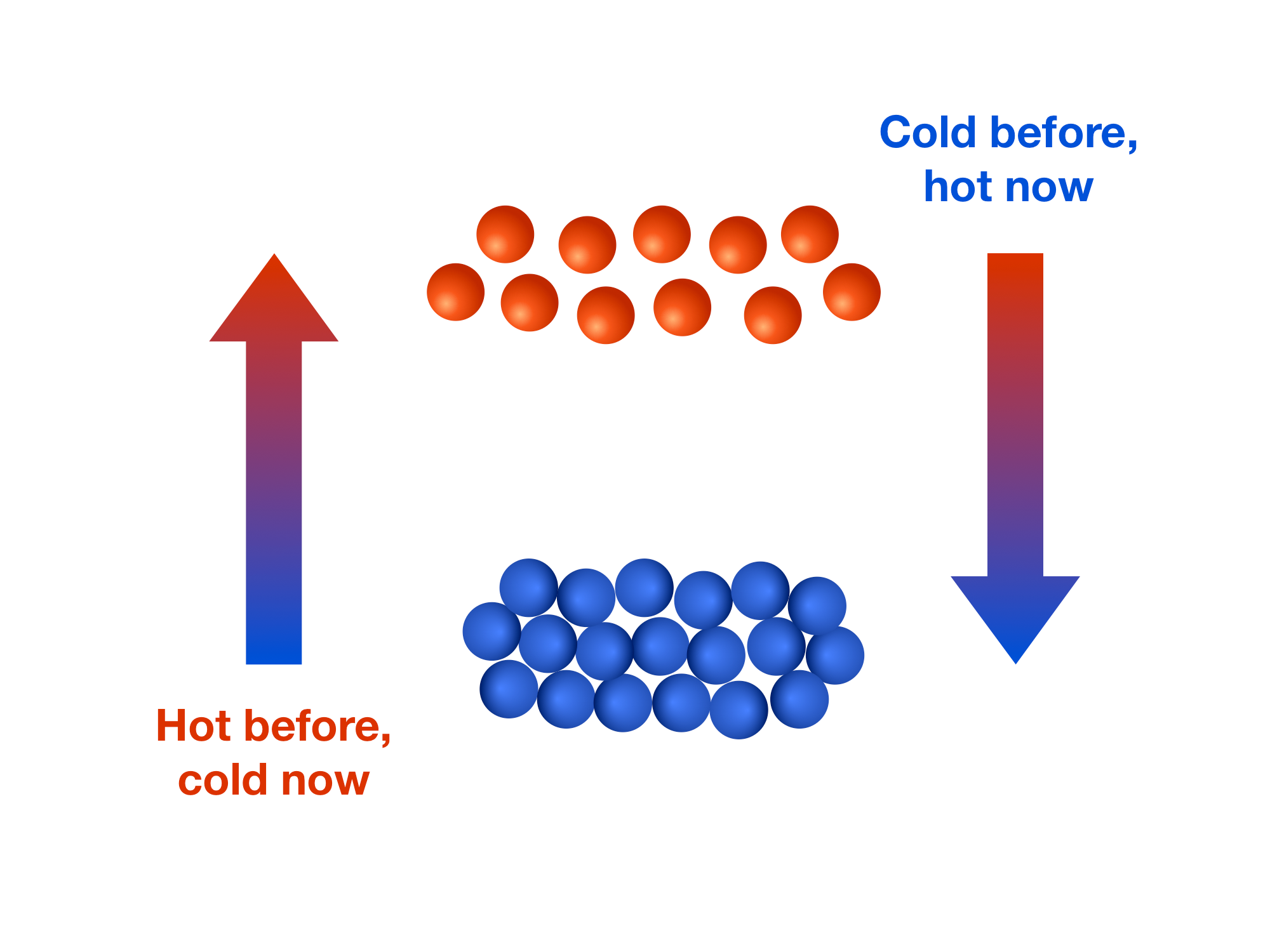
When heating makes a fluid less dense than its surroundings, buoyancy can cause the warmer fluid to rise while denser fluid moves downward. Energy is carried with that motion. Cooling and motion are related through the temperature and density fields; falling does not by itself cause cooling.
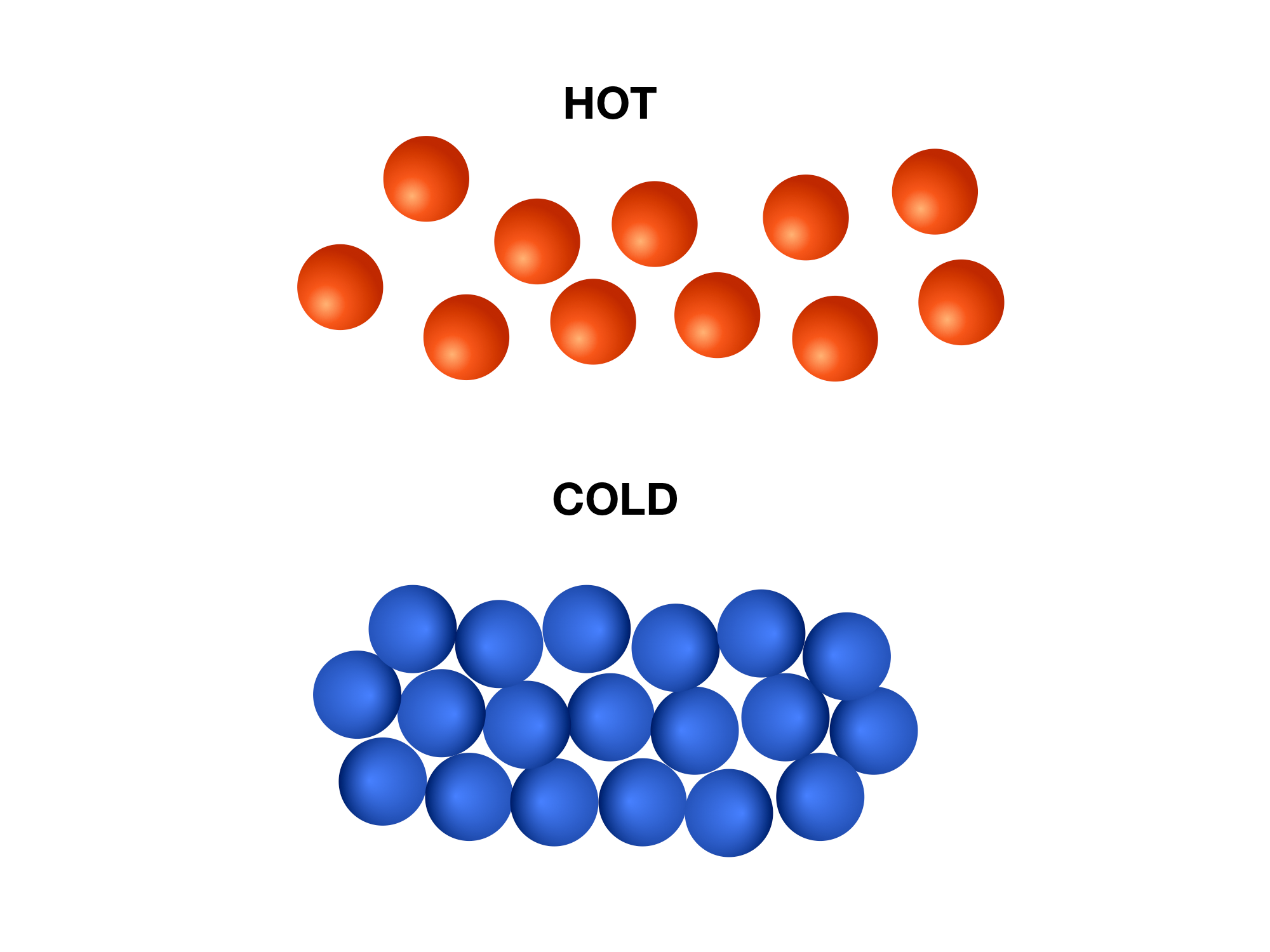
Cold air is coming in contact with warm air. What happens next?
The third and final set of heat transfer is known as radiationⓘ. This is heat transferred through electromagnetic waves. When energy is transferred this way, it is thermally radiating. This means that you don’t need a medium for the heat to transfer to you.
A hot device can transfer energy to a nearby hand by infrared radiation and by convection of warmed air. Radiation can transfer energy across empty space and does not require the hand to contact the device.
Equations that we are concerned with for this are the radiation rate:
And also the rate at which an object absorbs radiation:
Figure 7.3.3 Radiation between Two Objects
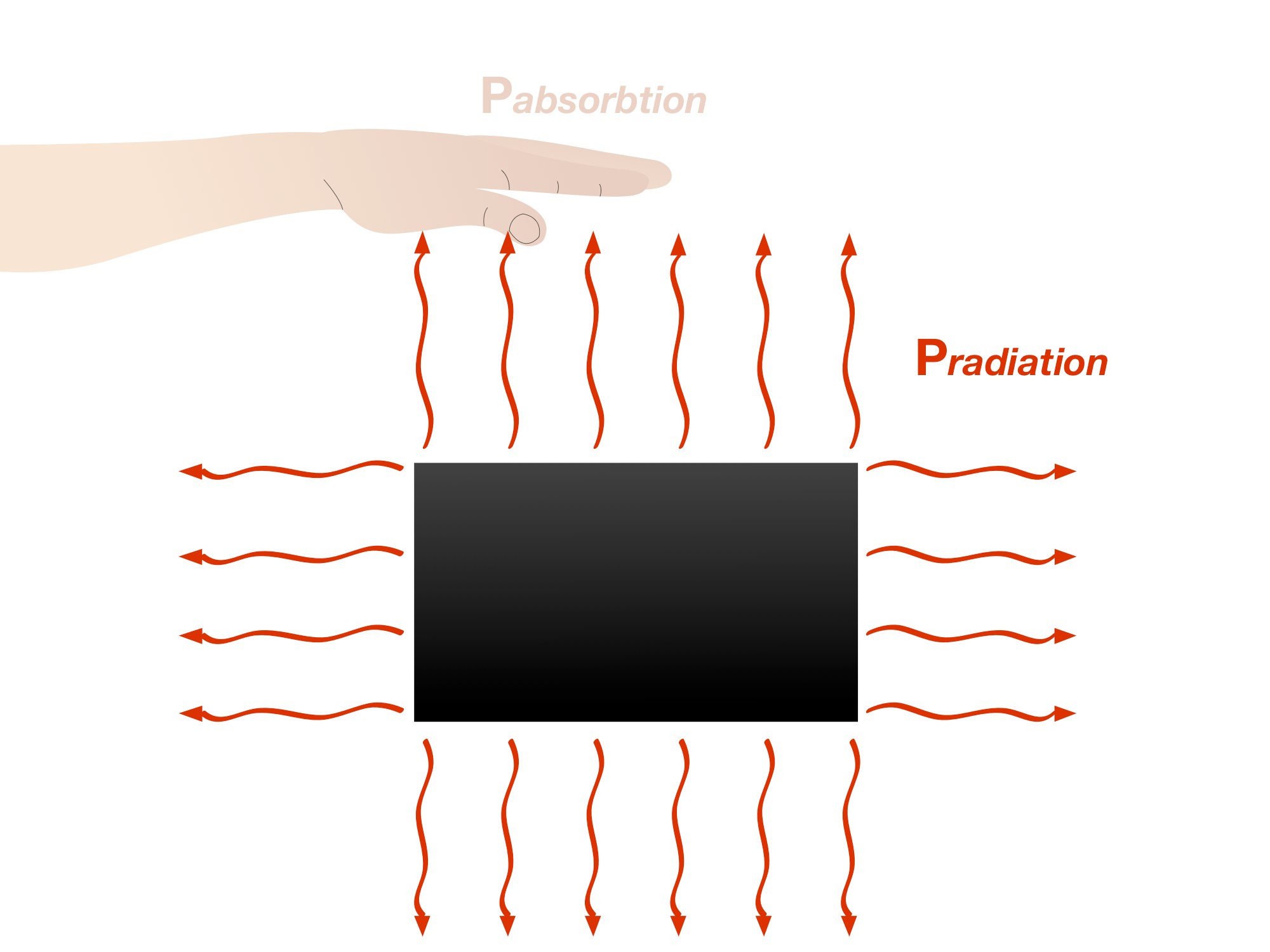
σ = 5.670374419 × 10⁻⁸ W/(m²·K⁴) is the Stefan–Boltzmann constant. Emissivity ε is dimensionless and lies between 0 and 1 in this thermal-radiation model. Temperatures in the fourth-power equations must be in kelvins.
Pop Quiz 7.3.1 Heat Transfer
Question 1 of 5 · 0 correct
Extra exploration · Read the worked solution
Lakes have a very rich nutrient reservoir at the bottom. This is due to organic matter accumulating on the bottom. In the spring, the lake “turnover” occurs where the water from the bottom rises to the top. What does this show?
Read every full question without answers
Question 1
Question 2
Question 3
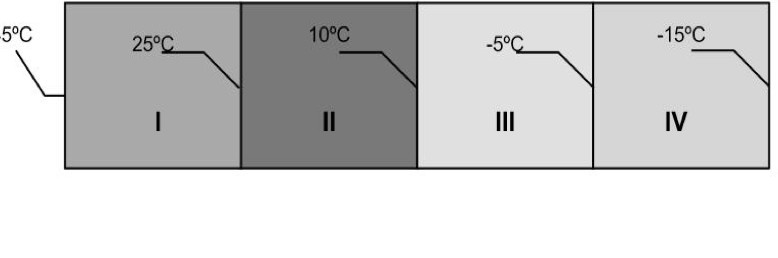
Four layers I, II, III and IV have equal thickness and area and carry the same nonzero steady heat rate. In order from hot to cold their boundary temperatures are 45, 25, 10, −5 and −15°C. Rank their conductivities from lowest to highest, allowing ties. Use these explicit values if the source diagram’s left label is clipped.
Question 4
Question 5
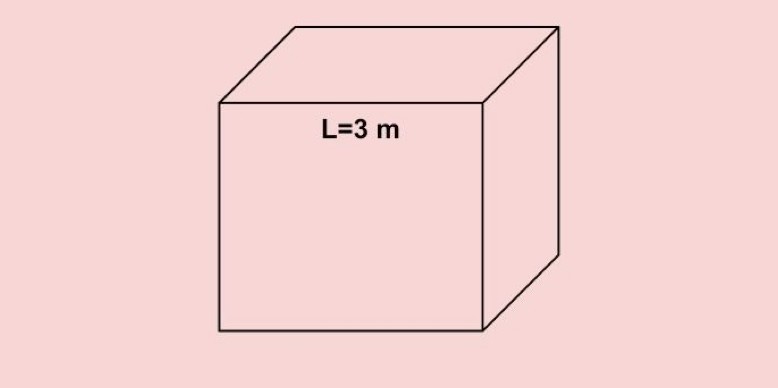
A cube of side 3.0 m is initially at 22°C in a large uniform 100°C enclosure. All six faces are exposed, with emissivity 0.65 and view factor 1. Ignoring conduction and convection, find its initial net radiative power into the cube. Use σ = 5.670374419 × 10⁻⁸ W/(m²·K⁴).
A is the exposed radiating surface area. For a small gray body in a large uniform isothermal enclosure with view factor effectively 1, the same effective emissivity model gives absorbed power εσA T_environment⁴ and emitted power εσA T_object⁴.
It is important to note that objects can both radiate and absorb energy so there is a net value associated with the total energy that an object receives, which can be easily be expressed as


Reviewed physics notes (17)
These corrections keep the original lesson’s purpose while fixing errors in the source edition.
- Electronic conduction is an important missing part of the source microscopic account for metals. — Reference 1
- A spatially constant temperature cannot sustain the stated nonzero steady conduction. — Reference 1
- Conduction rate and thermal propagation times are different concepts. — Reference 1
- The source formula L/k requires area-normalized resistance, not the unqualified whole-body resistance. — Reference 1
- Contact between differently heated fluids alone is not a definition of convection. — Reference 1
- Correct the causal description of buoyancy and the false claim that sinking causes cooling. — Reference 1
- A hand above a device is not a pure-radiation experiment. — Reference 1
- Specify dimensional units and the absolute-temperature requirement. — Reference 1
- The absorption equation requires an enclosure/view-factor and gray-body model. — Reference 1
- Use the same hot-to-cold positive direction as in the glass equation. — Reference 1
- The source claims that warmed molecules themselves expand and rise. — Reference 1
- Supply the conductivity values and clarify the resistance convention. — Reference 1
- The source image clips its left boundary value and the answer choices omit necessary ties. This repair states the complete boundary data. — Reference 1
- At fixed flux and thickness k is inversely proportional to the temperature drops 20, 15, 15 and 10 K. — Reference 1
- Specify units and the area-normalized R convention; remove unrelated wording. — Reference 1
- Specify six-face area, kelvin temperatures, geometry and sign. — Reference 1
- Net radiative power has units W, not W·K³. — Reference 1
Glossary and deeper reading · 15 refreshers
These editorial refreshers supplement the reading. Definitions and examples are added guidance; original source wording and recorded answers remain in their original context.
-
Heat
Heat is energy transferred between systems because of a temperature difference. It describes a transfer rather than a substance or energy store contained in an object. For example, when a warmer mug transfers energy to a cooler hand, the mug loses internal energy and the hand gains it.
-
Thermal conduction
Thermal conduction transfers energy through microscopic interactions without bulk flow of the material. Particles and, in metals, mobile electrons can carry energy from hotter regions toward cooler regions. For example, the handle of a metal spoon warms when its other end is placed in hot water.
-
Temperature
Temperature is a state quantity that determines the direction of net energy transfer through thermal contact. For a classical ideal gas it is proportional to the average translational kinetic energy per particle, rather than to the total energy of the sample. For example, a small hot metal sample can have a higher temperature but less total internal energy than a large cooler sample.
-
Thermal conductivity
Thermal conductivity measures how readily a material conducts energy through a temperature gradient. It is a material property with units watts per meter per kelvin, distinct from the sample’s heat capacity or thickness. For example, a metal and an insulating foam slab of the same dimensions can have very different conduction rates.
-
Specific heat
Specific heat is the energy needed per unit mass for a unit temperature increase under the stated conditions. Its units are joules per kilogram per kelvin, and the simple calorimetry model treats it as constant without a phase change. For example, equal masses of two materials can require different energy transfers for the same temperature rise.
-
Convection
Convection transfers energy as a fluid moves from place to place. The circulation can arise from density differences or be driven by a pump or fan. For example, warmer water can rise while cooler water sinks, carrying thermal energy through a container.
-
Fluid
A fluid is a material that flows and continuously deforms under a sustained shear stress. Liquids and gases are both fluids, although their compressibility and other properties can differ greatly. For example, both water in a pipe and air flowing through a duct are fluids.
-
Buoyancy
Buoyancy is the net upward force arising from pressure differences over an object in a fluid under gravity. Its magnitude equals the weight of the displaced fluid in the usual hydrostatic model. For example, a fully submerged object can rise, sink, or remain suspended depending on how buoyancy compares with its weight.
-
Mass density
Mass density is mass per unit volume of a material or sample. It is commonly measured in kilograms per cubic meter and can vary with temperature or pressure. For example, equal-volume samples of water and oil generally have different masses because their densities differ.
-
Thermal radiation
Thermal radiation is electromagnetic energy emitted by matter because of its temperature. It can transfer energy through a vacuum, and net radiative transfer between ordinary bodies is from hotter to cooler. For example, sunlight warming a surface does not need air to carry the energy across space.
-
Electromagnetic wave
An electromagnetic wave contains oscillating electric and magnetic fields that transport energy. In the plane-wave vacuum model, both fields are perpendicular to each other and to the propagation direction. For example, visible light and radio waves can both travel through empty space.
-
Stefan–Boltzmann constant
The Stefan–Boltzmann constant is the proportionality constant in the ideal blackbody law linking emitted power to surface area and the fourth power of kelvin temperature. Its value is approximately 5.67 × 10⁻⁸ W/(m²·K⁴), so multiplying it by area and temperature to the fourth power gives watts. For example, the same constant applies to two ideal blackbodies of different sizes, while their areas and temperatures determine their different emitted powers.
-
Emissivity
Emissivity describes a surface’s thermal-radiation emission compared with an ideal blackbody at the same temperature. It is dimensionless and can depend on wavelength, surface condition, and temperature. For example, two surfaces of equal area at the same temperature can radiate different powers because their emissivities differ.
-
Isothermal process
An isothermal process occurs at constant temperature. For a fixed amount of ideal gas, internal energy remains constant even though heat and work can be transferred. For example, a gas expanding slowly while exchanging energy with a temperature reservoir can remain isothermal.
-
Power
Power is the rate at which energy is transferred or converted. It is measured in watts, with one watt equal to one joule per second. For example, two motors can lift the same load through the same height but have different average powers if they take different times.