FFR - Thermal Expansion
Original textbook reading.
Enrichment beyond the AP course.
This original chapter is extra exploration beyond the supplied AP Physics 1 course. Keep it if you're curious about where these ideas go next.
In this section we will learn about two very important topics that are used heavily in real world applications. And that is measurement of heat capacity and specific heats of objects with a mass and also the thermal expansion of objects.
Heat Capacity and Specific Heat
The heat capacity of an object, you will see most commonly as:
(Equation 7.4.1)
where Tf and Ti are the final and initial temperatures respectively and being the heat that is either absorbed or loss from the object.
Heat capacity C depends on the object and its mass. Specific heat c is heat capacity per unit mass: for the same material, phase and temperature range, different-sized samples can share approximately the same c while their heat capacities C = mc differ.
(Equation 7.4.2)
Notice how these equations are basically the same, except the only difference is that you are multiplying by a mass term. The unit for specific heat is:
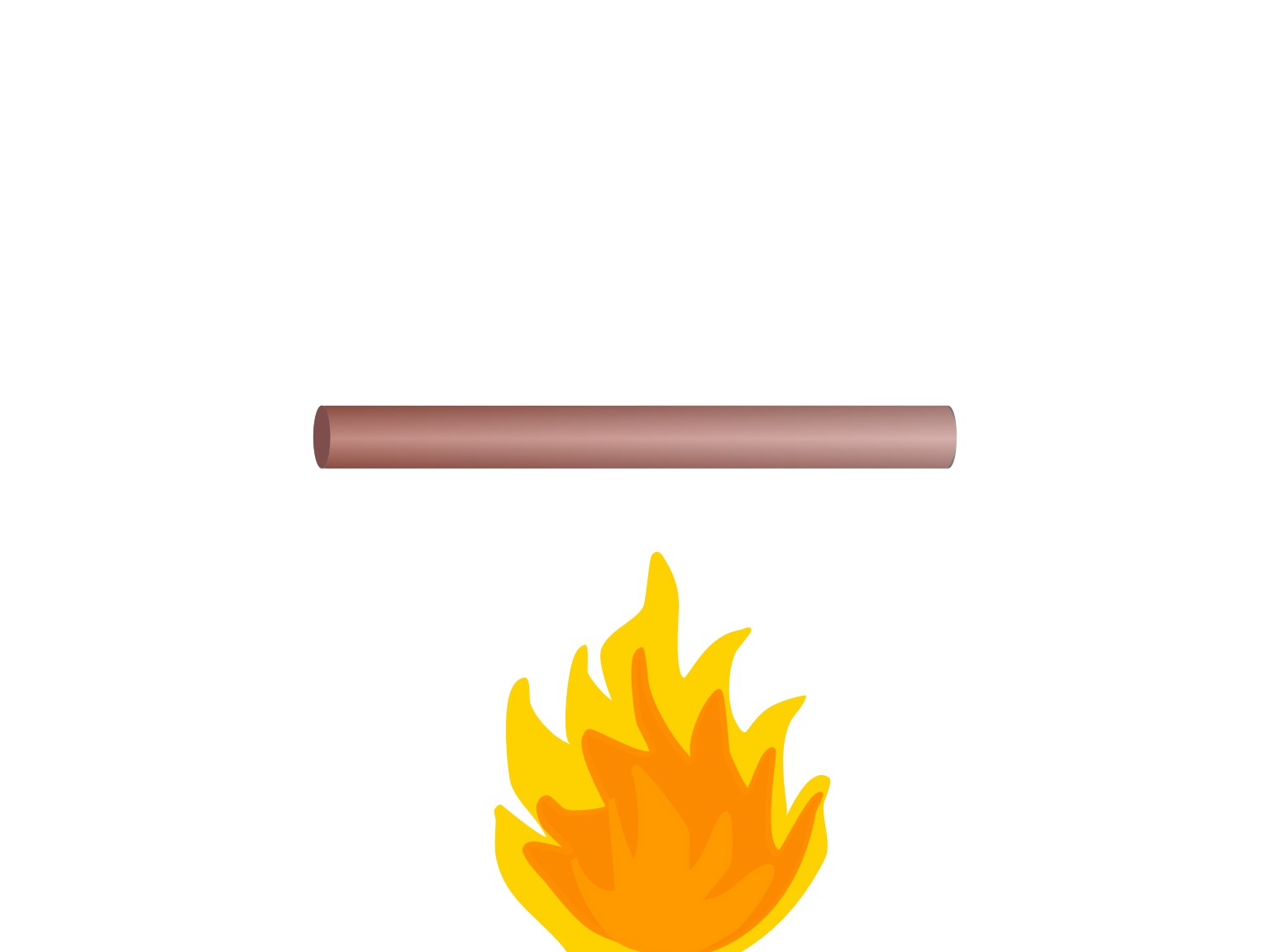
Rod is heated to 300ºC
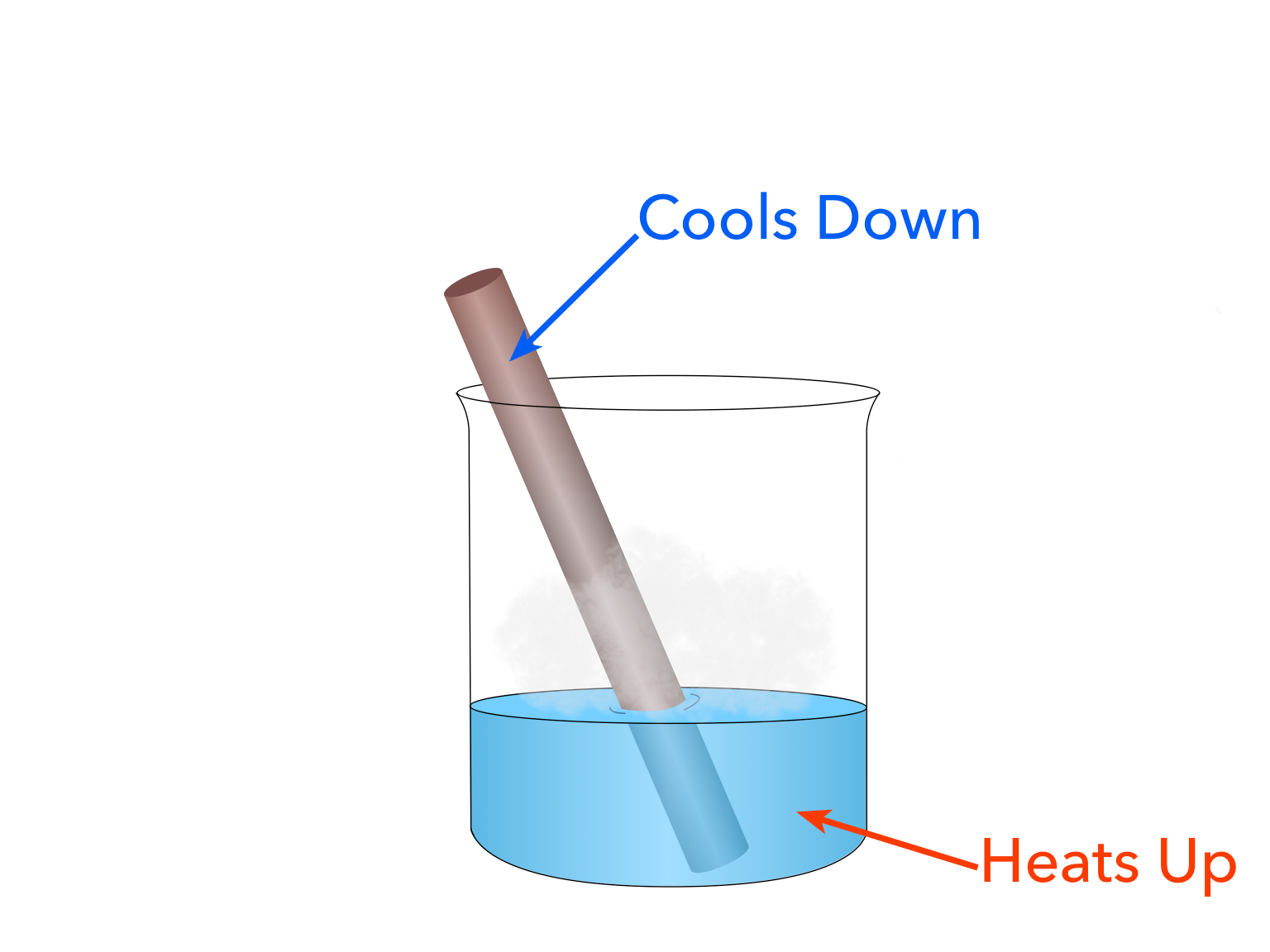
Let us take a look at an example that you may encounter.
Example Problem 7.4.1
Imagine that you have a silver rod with mass of and is heated to a temperature of . Then you place that hot silver rod into a beaker filled with of water with a temperature of . Assume that the rod-water system reaches an equilibrium and is isolated. Find the final temperature of the system. The specific heats of the silver rod and water are and respectively. Disregard the mass and heat capacity of the beaker.
Step 1: Notice that this is an isolated system
An isolated system means that there is no heat that is lost to the environment and that all the heat transfer is kept within the system, so the total energy cannot change.
Step 2: What does equilibrium mean in this context
Equilibrium means that the rod-water system will reach the same temperature. In other words, there is no more transfer of thermal energy between the two objects. This also means that as heat is transferred from the rod to the water, you should notice a loss of heat from the rod that is gained by the water.
This means that:
which can be rewritten as:
This should make sense conceptually because the negative sign is supposed to indicate that there is a loss of heat, which represents the heat that is lost from the silver rod when placed in the water.
Step 3: Solve for the final temperature
We can rewrite that equation plugging in Equation 7.4.2 for both values of :
−m_1c_1(T_f − T_1,i) = m_2c_2(T_f − T_2,i), where 1 is the silver and 2 is the water.
We’ll spare you all the algebra and just give you the equation for solving for of the system which will be the same for both the silver rod and the water.
Thermal Expansion
Thermal expansion is the expansion of an object through the use of thermal energy. You can see this when you place a cold jar under hot water. The hot water causes the lid on the jar to expand just a little bit and is therefore loosened. This is also why bridge designers have holes larger than needed when putting in rods for stability. The rod would have to be able to withstand expansion on hot summer days.
There are two types of thermal expansion that we are concerned with at this point: linear expansion and volume expansion.
Linear Expansion
If the temperature of a metal rod of length L is subjected to an increase in temperature of , then it has an increase in length equivalent to:
For a freely expanding homogeneous isotropic solid, α applies to every linear dimension in the small-temperature-range approximation. Use the original length L_0 and evaluate ΔL = L_0αΔT.
So if all the dimensions of a solid expand, then so should its volume. Volume expansion also occurs with an increase in temperature. The equation associated with volume expansion is:
(Equation 7.4.4)
where
β ≈ 3α for a homogeneous isotropic solid when |αΔT| is small.
The volume expansion coefficient β characterizes a material’s fractional volume change per kelvin. For liquid water near ordinary pressure, density is greatest near 4°C: water contracts when warmed from 0°C to 4°C and expands when heated above 4°C. Cooling from 4°C toward 0°C makes it expand.
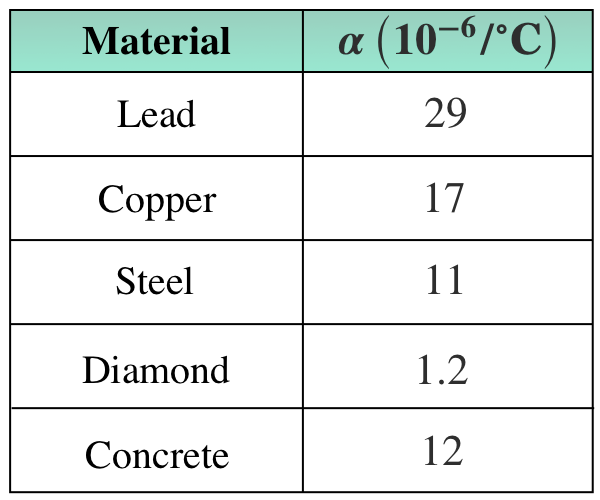
Below is a table of some coefficients of linear expansion for different materials.
Table 7.4.1: Coefficients of Linear Expansion
Pop Quiz 7.4.1 Thermal Expansion
Question 1 of 5 · 0 correct
Extra exploration · Read the worked solution
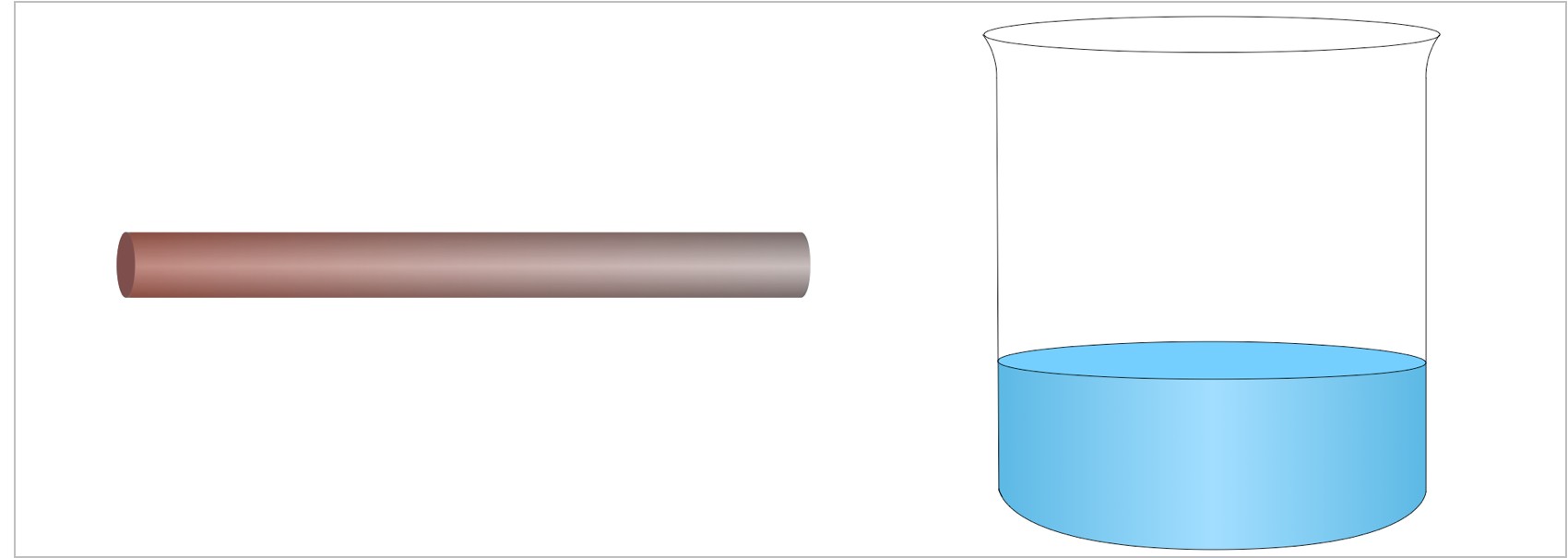
A hot metal rod is placed into cool water. Indicate on the image which object in the system is gaining energy and losing energy .
 12
Read every full question without answers
Question 1
A hot metal rod is placed into cool water. Indicate on the image which object in the system is gaining energy and losing energy .
12Match these labels to the numbered figure targets. Write your matches before opening the separate worked answer.
Question 2
Question 3
A silver block of is heated to an initial temperature of . The silver block is then placed in of cold water that has an initial temperature of . What is the difference in the final temperature that the water reaches after equilibrium is achieved? The specific heats of the silver rod and water are and respectively.
Question 4
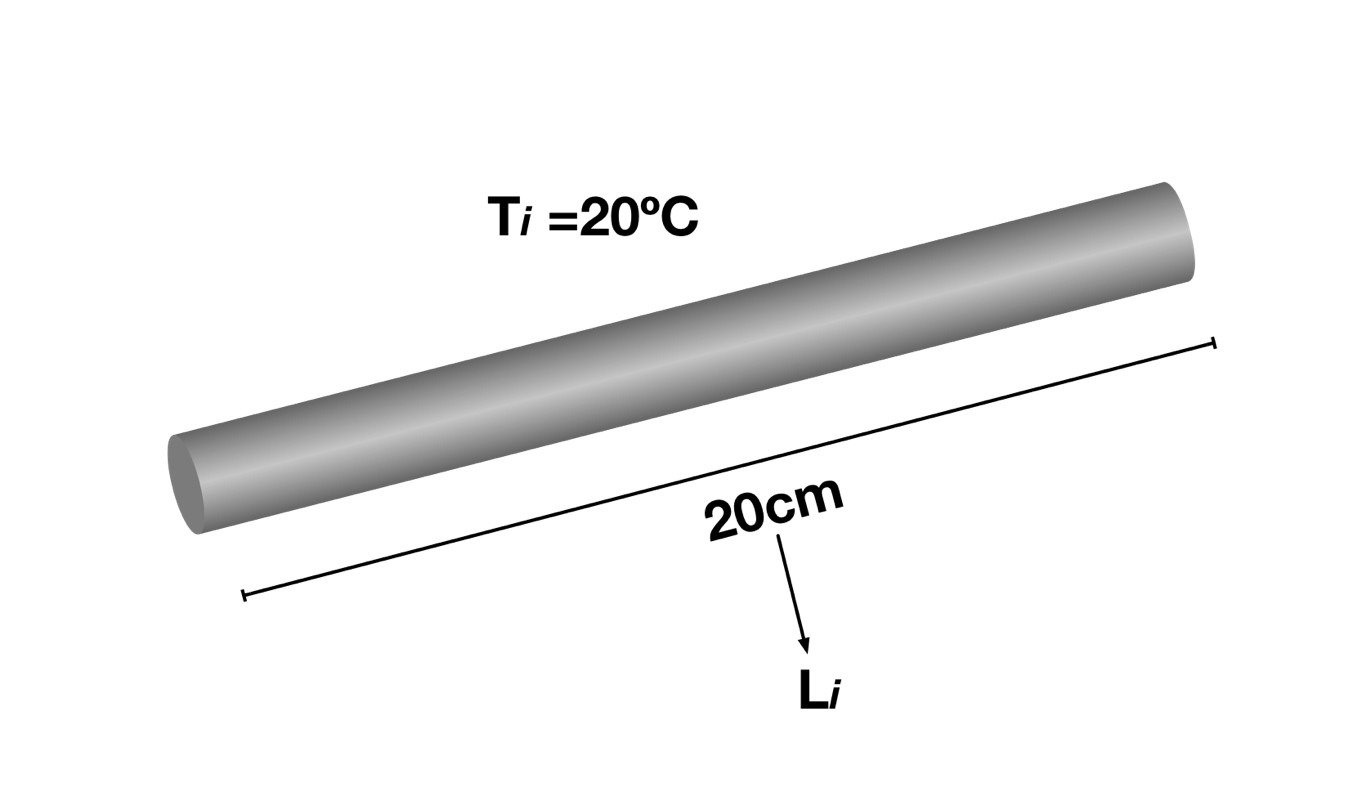
A concrete rod has initial length 20 cm at 20°C. If its length formally increases by 3 cm, what temperature does the constant-α linear formula predict using α = 12 × 10⁻⁶ K⁻¹? Also assess whether that large extrapolation is physically valid for concrete.
Question 5
Original problem 1
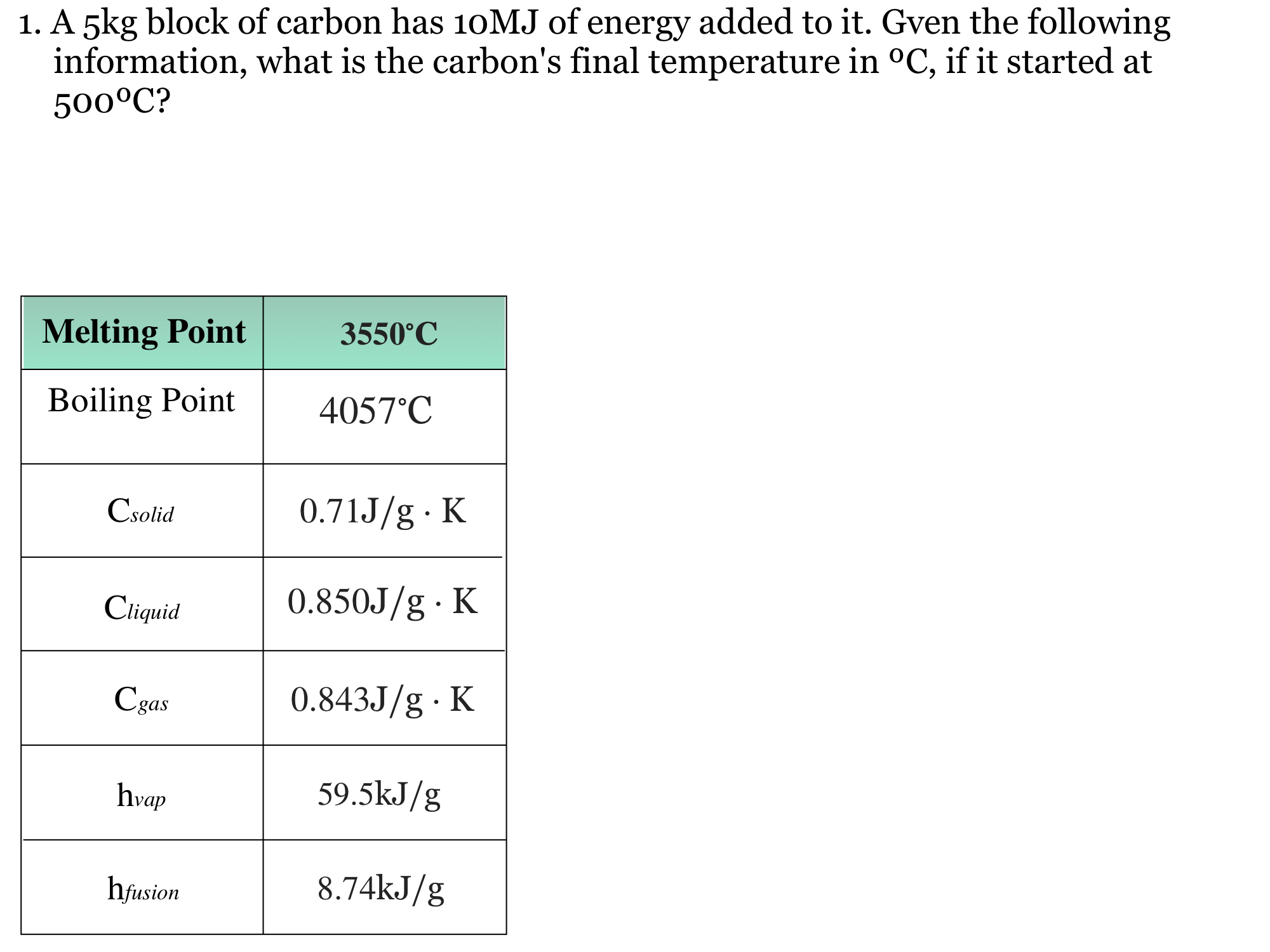
This is a constant-specific-heat exercise using the provided table. Real carbon’s high-temperature phase behavior depends on pressure and allotrope; its listed melting/boiling data are not a general atmospheric-pressure phase diagram. The unused phase data do not affect this calculation.
Problem text
A 5.0 kg carbon block initially at 500°C receives 10 MJ. In the supplied simplified material model, c_solid = 0.71 J/(g·K), the listed melting threshold is 3550°C, c_liquid = 0.850 J/(g·K), c_gas = 0.843 J/(g·K), the listed boiling threshold is 4057°C, L_f = 8.74 kJ/g and L_v = 59.5 kJ/g. Calculate its final temperature within this model and determine whether the listed phase thresholds are reached.
Drawing is temporarily unavailable. Work on paper if needed, then record your reasoning here.
Saving written working requires JavaScript. The problem remains available above; keep your work on paper or in your own notes.
Original problem 2
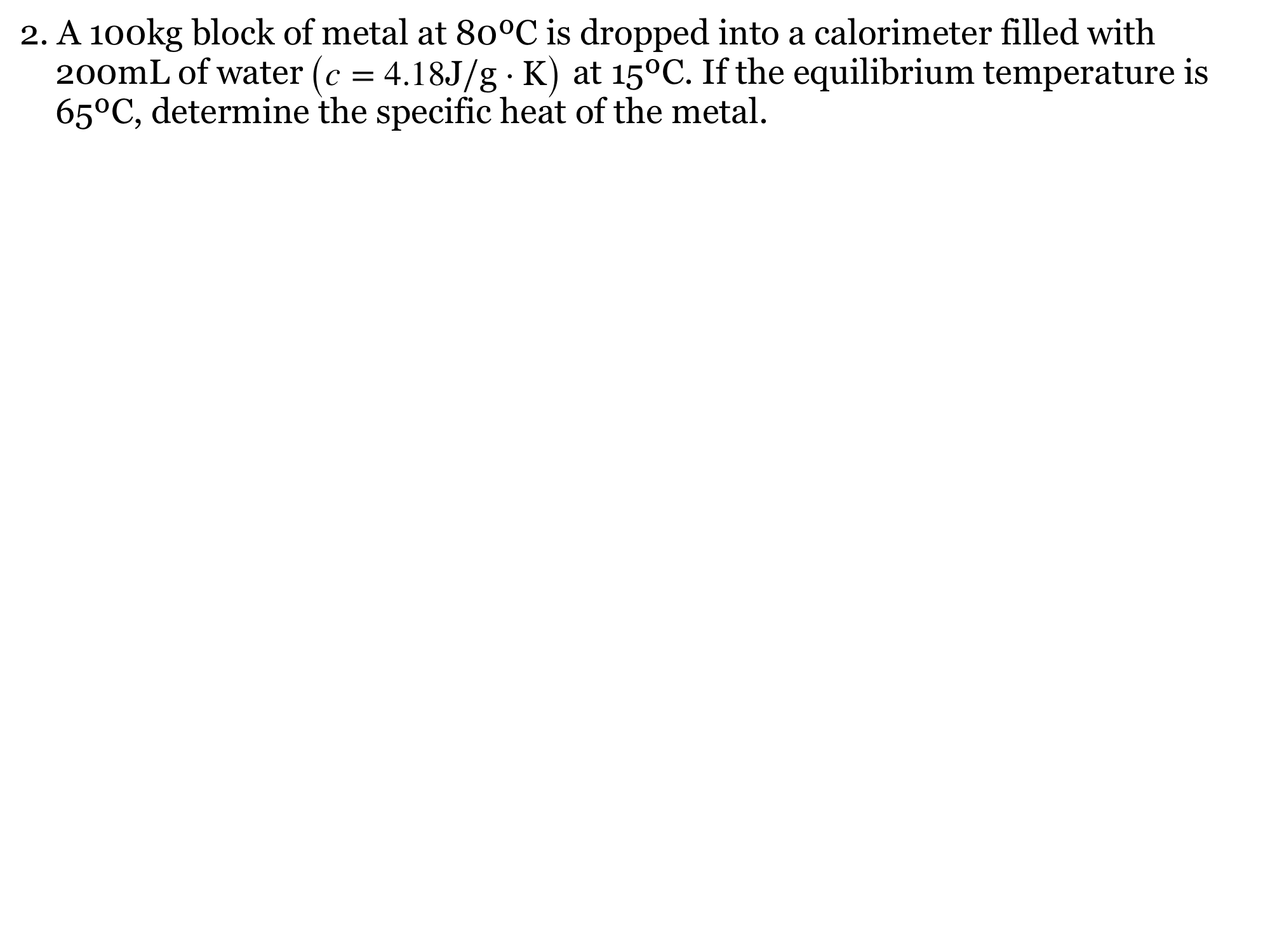
The source mass is preserved. Changing it to 100 g would yield 27.9 J/(g·K), which is also not a justified ordinary-metal value.
Problem text
The source states that a 100 kg metal block at 80°C is placed in 200 mL of water initially at 15°C and the final temperature is 65°C. Take water density as 1.00 g/mL and c_w = 4.18 J/(g·K), ignore the container and heat loss, and infer the metal’s specific heat. Comment on the plausibility of the source mass and resulting value.
Drawing is temporarily unavailable. Work on paper if needed, then record your reasoning here.
Saving written working requires JavaScript. The problem remains available above; keep your work on paper or in your own notes.


Original problem 3
Problem text
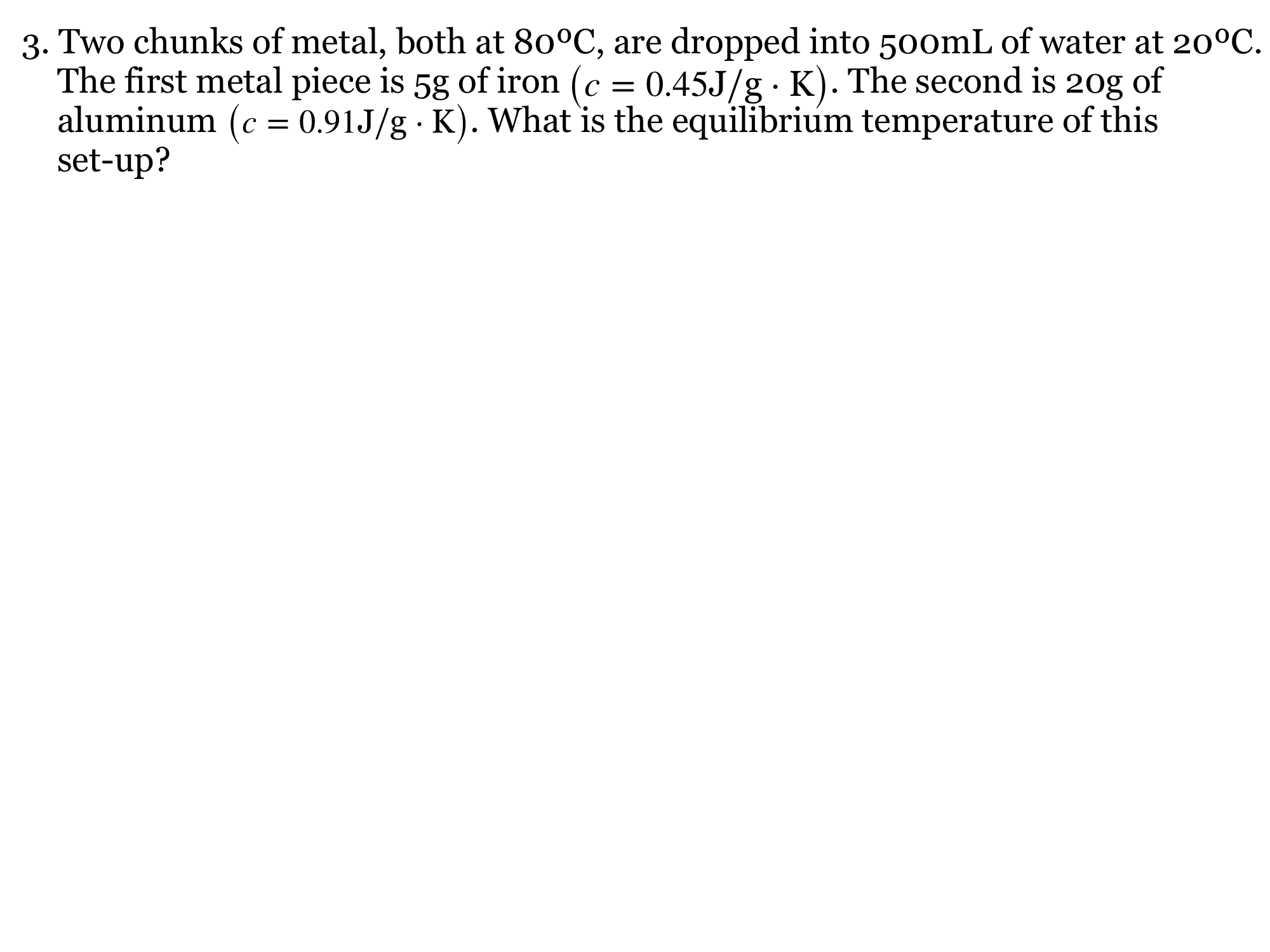
An insulated calorimeter contains 500 mL of water at 20°C. Add 5.0 g of iron with c = 0.45 J/(g·K) and 20 g of aluminum with c = 0.91 J/(g·K), both at 80°C. Use water density 1.00 g/mL and c_w = 4.18 J/(g·K). Neglect the calorimeter’s heat capacity. Find the final equilibrium temperature.
Drawing is temporarily unavailable. Work on paper if needed, then record your reasoning here.
Saving written working requires JavaScript. The problem remains available above; keep your work on paper or in your own notes.
Original problem 4
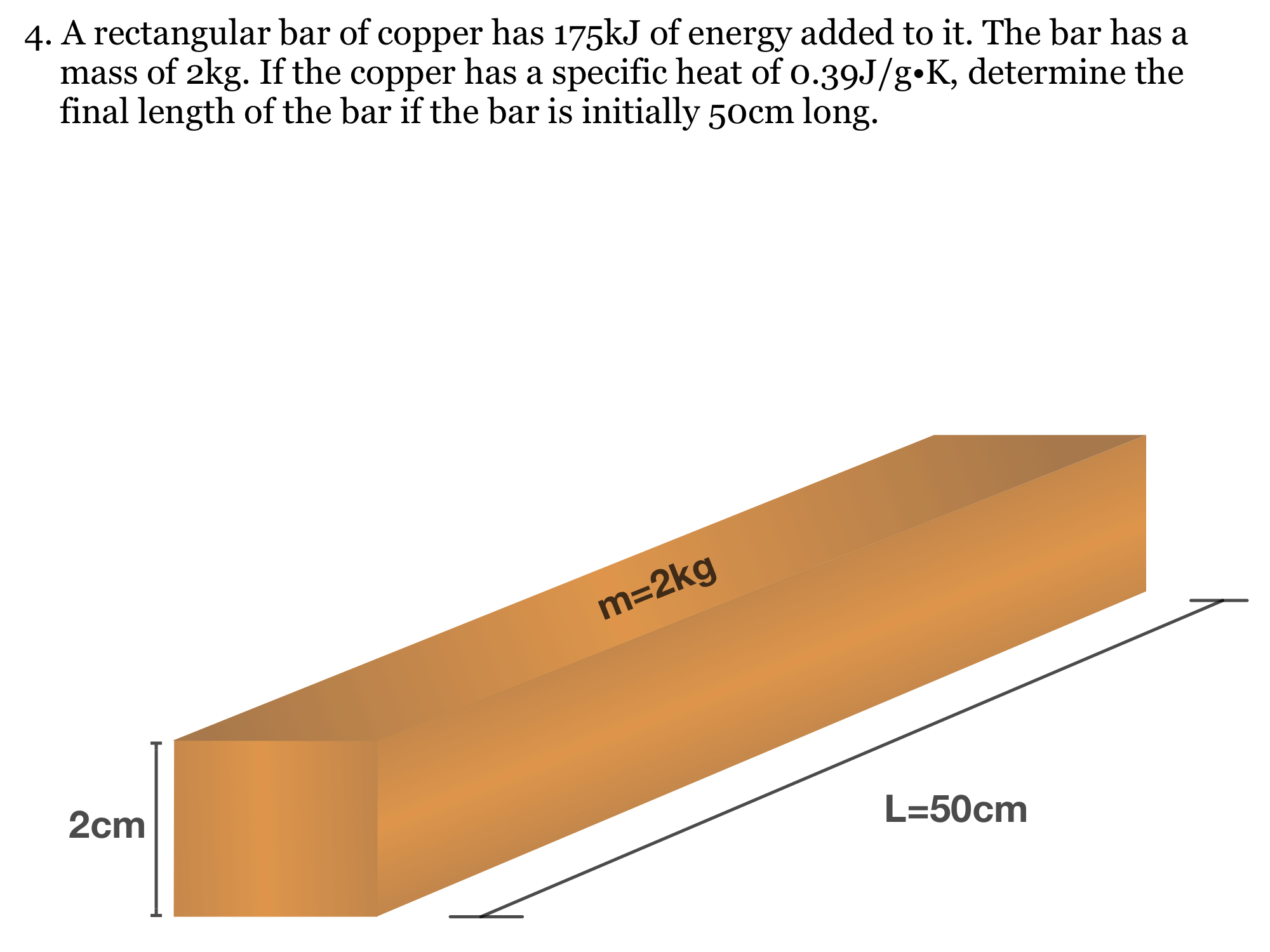
The source-table copper coefficient is supplied explicitly. An initial temperature is unnecessary for the length change with constant c and α, but remaining below a phase transition is required.
Problem text
A copper bar of mass 2.0 kg and initial length 0.50 m absorbs 175 kJ. Take c = 0.39 J/(g·K) and the source-table linear expansion coefficient α = 17 × 10⁻⁶ K⁻¹ as constant. Assume the bar remains solid and expands freely. Find its final length.
Drawing is temporarily unavailable. Work on paper if needed, then record your reasoning here.
Saving written working requires JavaScript. The problem remains available above; keep your work on paper or in your own notes.
Original problem 5
Problem text
A 200 mL sample of water begins at 80°C. A cooling device removes energy at a constant rate of 10 J/s. Use water density 1.00 g/mL, c_w = 4.18 J/(g·K), L_f = 334 J/g and a freezing temperature of 0°C at approximately atmospheric pressure. Ignore the cup and heat leaks. Find the time to turn all the water into ice at 0°C.
Drawing is temporarily unavailable. Work on paper if needed, then record your reasoning here.
Saving written working requires JavaScript. The problem remains available above; keep your work on paper or in your own notes.
Original problem 6
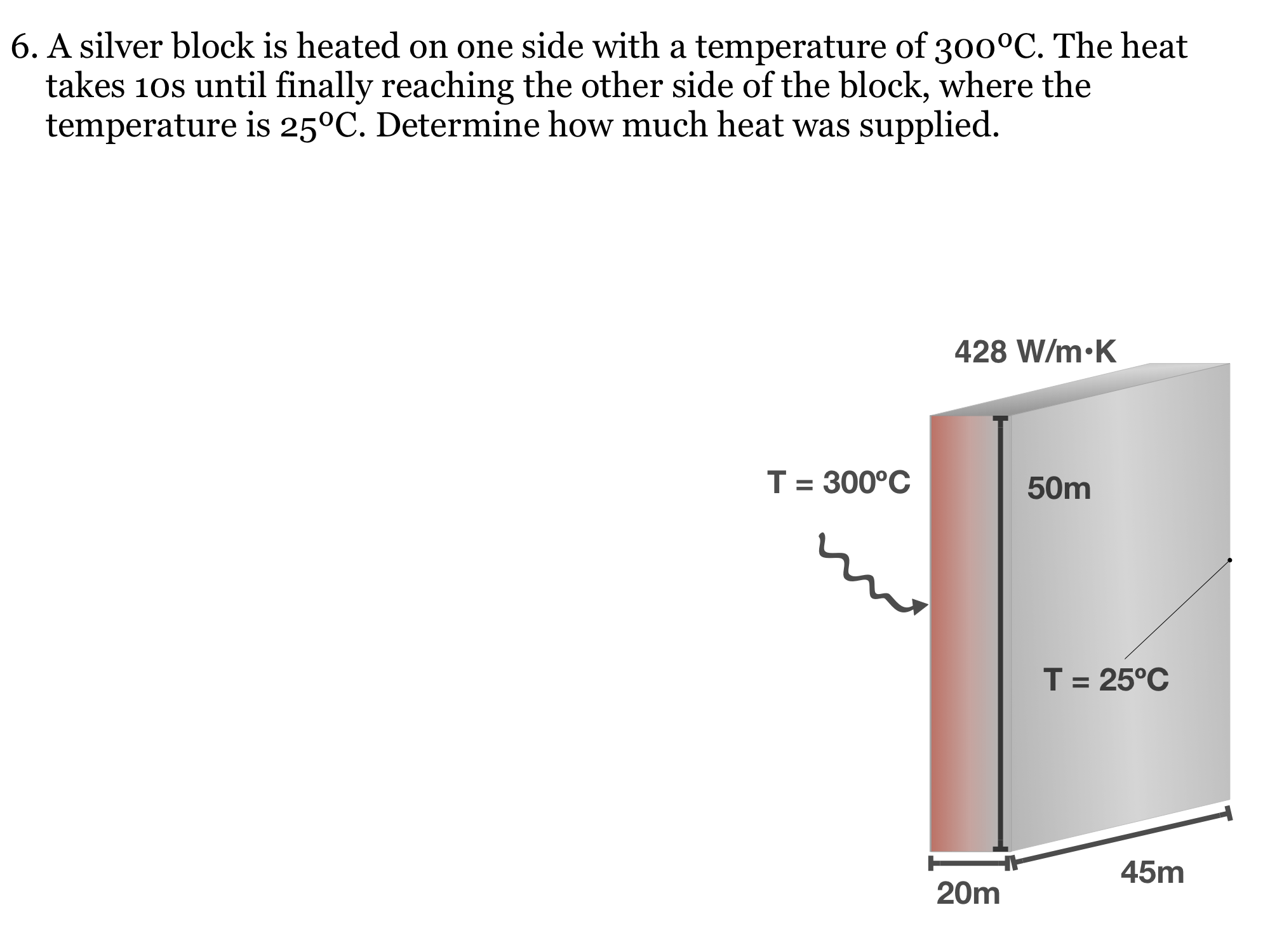
The original wording that heat “takes 10 s until reaching the other side” is not a steady-conduction boundary condition. A transient heating calculation would additionally need the initial temperature profile, density and specific heat. The dimensions are retained as meters, as shown.
Problem text
The source silver-block diagram has a heated face 50 m high by 20 m wide and a heat-flow length of 45 m. With conductivity k = 428 W/(m·K), keep one face at 300°C and the opposite face at 25°C. Assume one-dimensional steady conduction, insulated side faces and constant k. How much energy passes through the block during 10 s?
Drawing is temporarily unavailable. Work on paper if needed, then record your reasoning here.
Saving written working requires JavaScript. The problem remains available above; keep your work on paper or in your own notes.
Original problem 7
The source’s 1 cm³ means an initial volume, and the source-table steel coefficient is 11 × 10⁻⁶ K⁻¹. Density is used once to find mass at the initial state, not reapplied as a temperature-independent constraint on final volume.
Problem text
A steel cube initially has volume 1.00 cm³ at 150°C and density 7.85 g/cm³ at that temperature. Its specific heat is 0.49 J/(g·K). Place it into 500 mL of water at 65°C in an ideal insulated calorimeter; use water density 1.00 g/mL and c_w = 4.18 J/(g·K). Take steel’s source-table α = 11 × 10⁻⁶ K⁻¹ as constant. Find the final temperature, edge length and volume, neglecting the container.
Drawing is temporarily unavailable. Work on paper if needed, then record your reasoning here.
Saving written working requires JavaScript. The problem remains available above; keep your work on paper or in your own notes.
Original problem 8
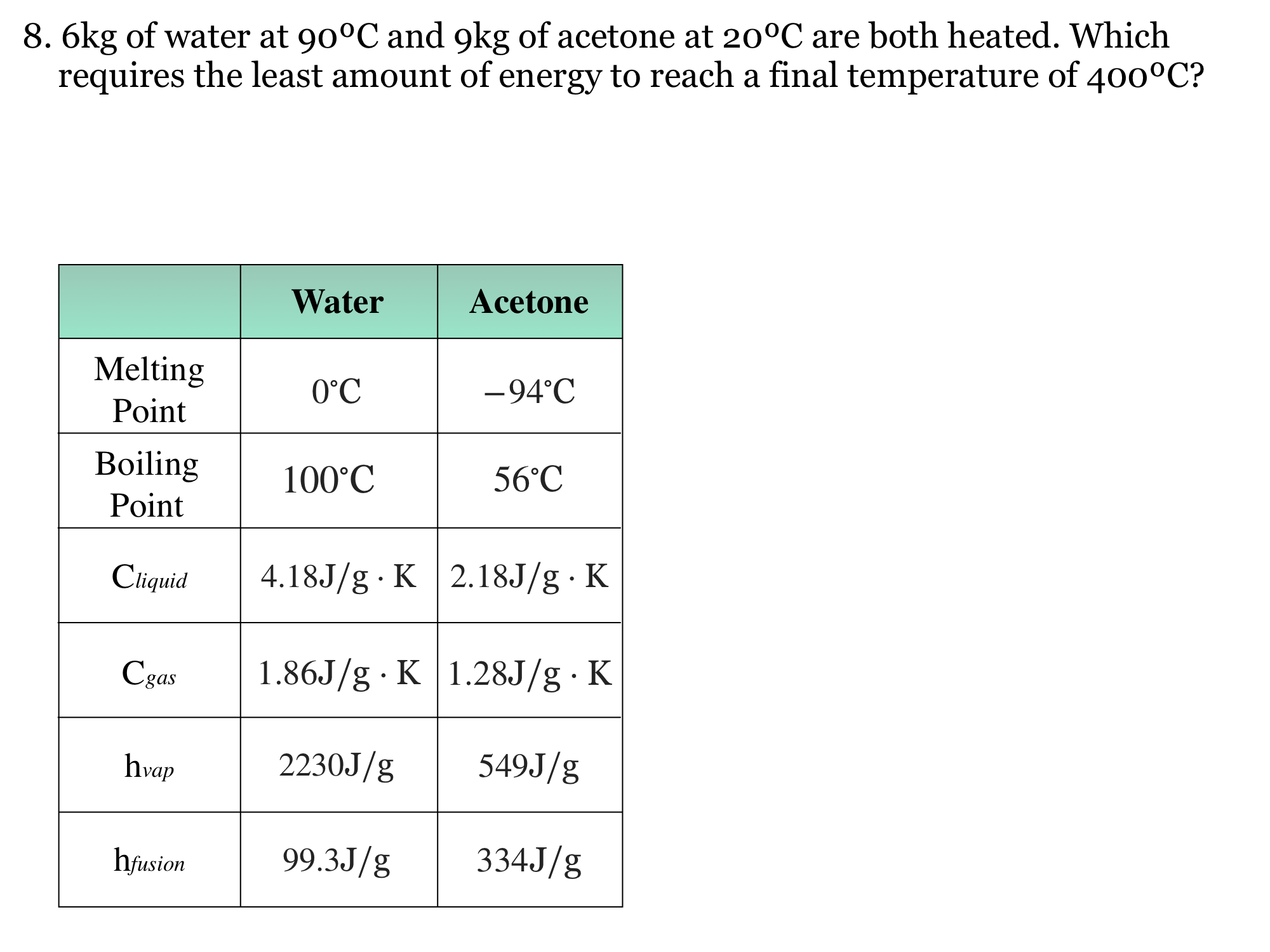
The source table interchanges the two fusion values, but fusion is not used in this exercise. The 400°C gas calculations are simplified constant-property estimates; acetone chemical stability and temperature-dependent heat capacities are outside the model.
Problem text
Compare the energy required to bring 6.0 kg of water from 90°C and 9.0 kg of acetone from 20°C to gases at 400°C. Use the source’s idealized constant-property model at approximately atmospheric pressure: water boils at 100°C, c_liquid = 4.18 J/(g·K), c_gas = 1.86 J/(g·K), L_v = 2230 J/g; acetone boils at 56°C, c_liquid = 2.18 J/(g·K), c_gas = 1.28 J/(g·K), L_v = 549 J/g. Neglect losses and chemical reactions.
Drawing is temporarily unavailable. Work on paper if needed, then record your reasoning here.
Saving written working requires JavaScript. The problem remains available above; keep your work on paper or in your own notes.
Original problem 9
Problem text
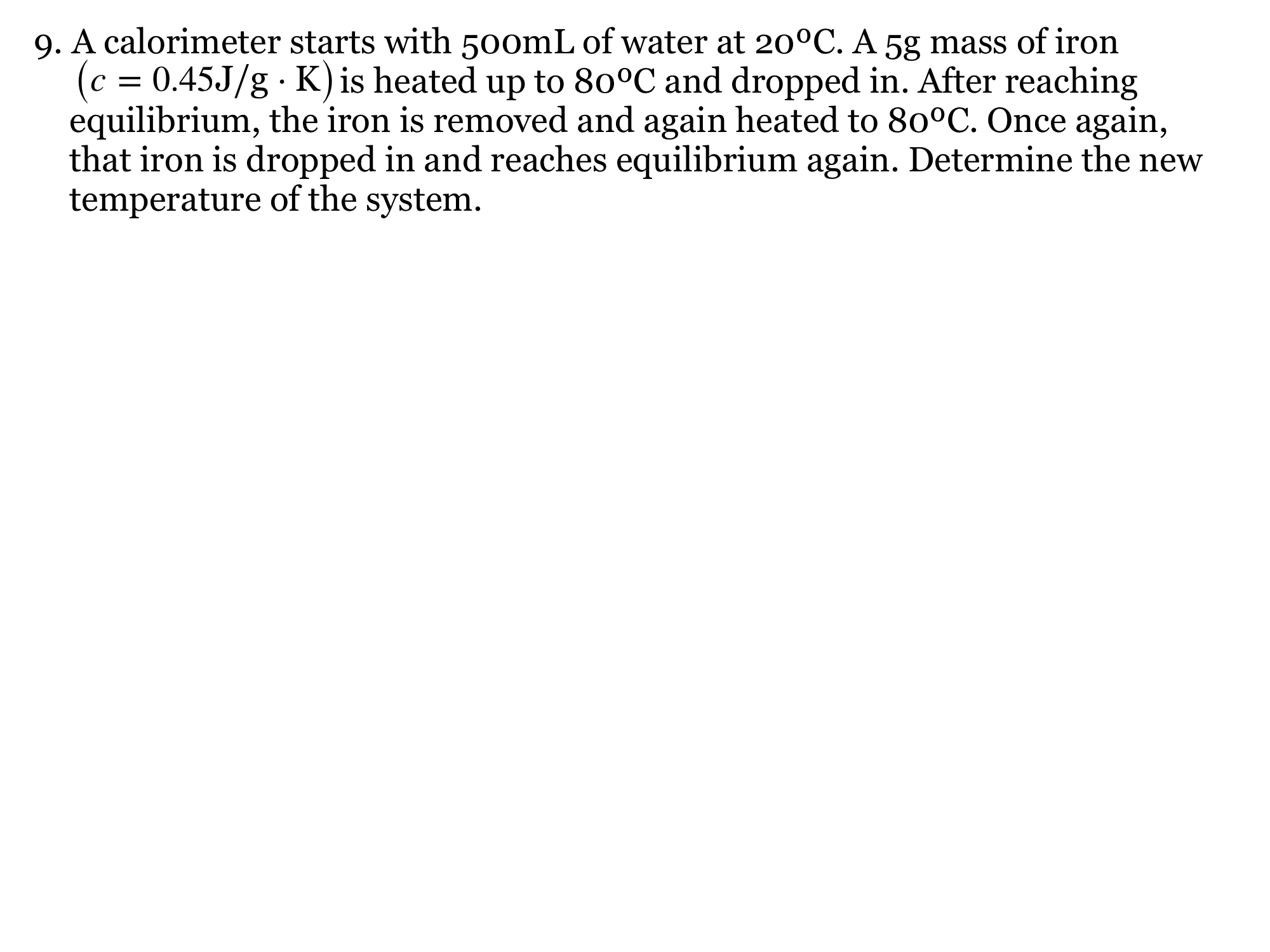
An ideal calorimeter contains 500 mL of water at 20°C. A 5.0 g iron sample with c_Fe = 0.45 J/(g·K), heated separately to 80°C, is placed in the water and allowed to equilibrate. Remove the iron without removing any water, reheat it to 80°C, return it, and allow a second equilibration. Use water density 1.00 g/mL and c_w = 4.18 J/(g·K). Find the second equilibrium temperature, neglecting the container and losses.
Drawing is temporarily unavailable. Work on paper if needed, then record your reasoning here.
Saving written working requires JavaScript. The problem remains available above; keep your work on paper or in your own notes.
Original problem 10
Problem text
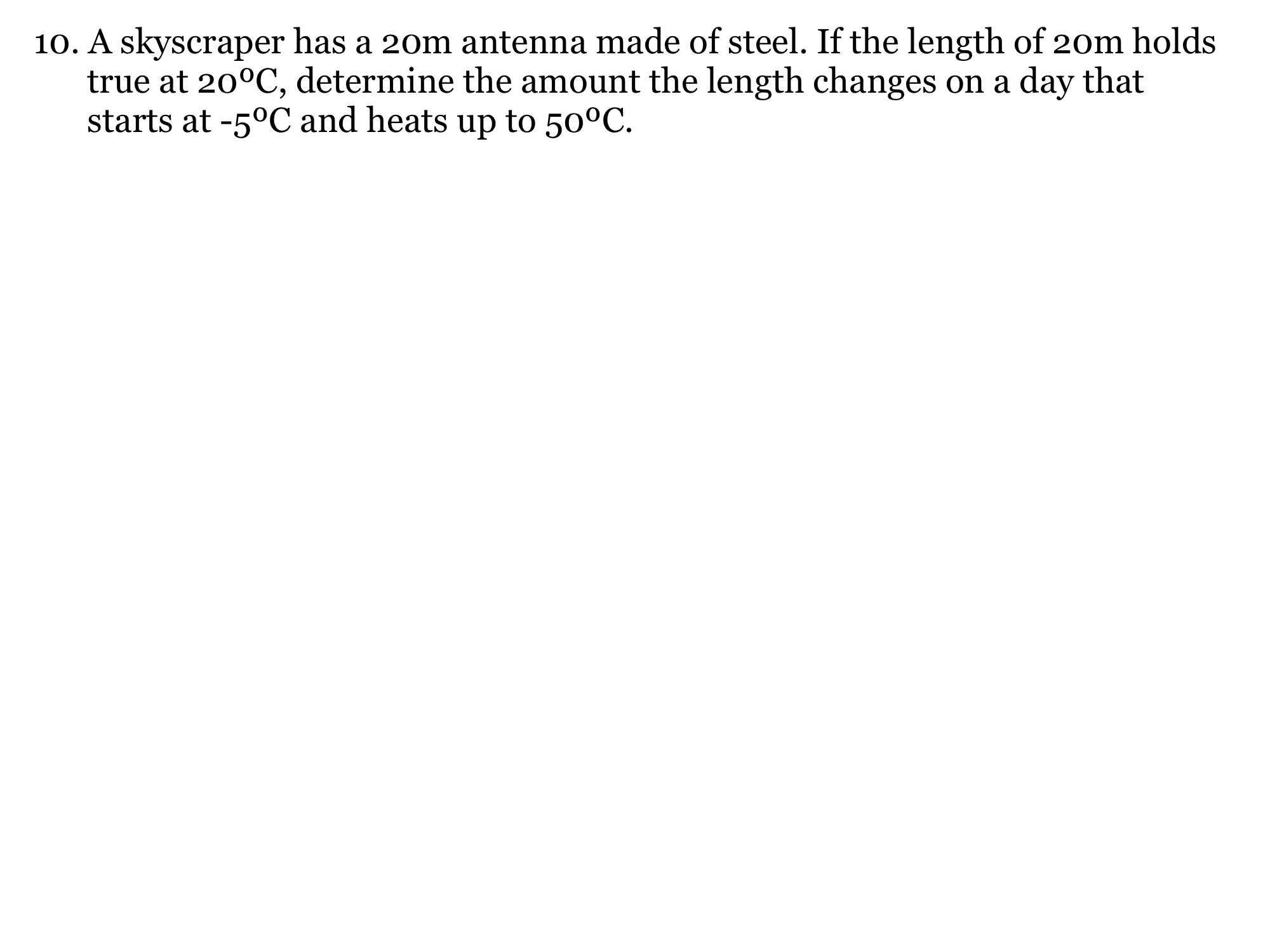
A steel antenna has length 20.0 m at 20°C. Use the source-table α = 11 × 10⁻⁶ K⁻¹ as constant. Find its lengths at −5°C and 50°C and the length increase as the day warms between these temperatures.
Drawing is temporarily unavailable. Work on paper if needed, then record your reasoning here.
Saving written working requires JavaScript. The problem remains available above; keep your work on paper or in your own notes.
Reviewed physics notes (12)
These corrections keep the original lesson’s purpose while fixing errors in the source edition.
- The source conflates different sample masses with different specific heats. — Reference 1
- Isotropic material and the reference length are needed for equal fractional expansion. — Reference 1
- The relation is a first-order solid expansion approximation, not a universal identity for liquids. — Reference 1
- The source gives an ambiguous temperature direction and implies the solid relation β = 3α applies to liquids. — Reference 1
- The original equation uses the same unspecified initial temperature for two different bodies. — Reference 1
- Equal energy transfer does not mean equal temperature-change rates or magnitudes. — Reference 1
- The source asks about temperature changes but shows heat equations; two choices are algebraically equivalent. — Reference 1
- Replace the duplicate correct distractor −Q_1 = Q_2, leaving Q_1 = −Q_2 as the unique correct choice. — Reference 1
- The huge 15% expansion exceeds the constant-coefficient solid model’s valid range. Preserve the numbers as a model-validity check. — Reference 1
- The formula’s numerical extrapolation is not a physically achievable intact concrete rod state. — Reference 1
- The source’s enormous expansion is outside the model and its arithmetic is wrong. — Reference 1
- ΔT = 0.06/(0.10 × 1.2 × 10⁻⁶) = 500,000 K; T_f = 500,025°C = 900,077°F. — Reference 1
Glossary and deeper reading · 7 refreshers
These editorial refreshers supplement the reading. Definitions and examples are added guidance; original source wording and recorded answers remain in their original context.
-
Heat capacity
Heat capacity is the energy needed to raise the temperature of an entire object by one temperature unit under specified conditions. For a uniform sample in the simple constant-specific-heat model, it equals mass times specific heat. For example, twice as much of the same material has twice the heat capacity when its state and specific heat are unchanged.
-
Thermal expansion
Thermal expansion is a change in a material’s dimensions as its temperature changes. A simple coefficient model approximates the change over a limited temperature range and depends on the material and geometry. For example, leaving gaps between sections of a metal rail allows space for expansion in warmer conditions.
-
Temperature
Temperature is a state quantity that determines the direction of net energy transfer through thermal contact. For a classical ideal gas it is proportional to the average translational kinetic energy per particle, rather than to the total energy of the sample. For example, a small hot metal sample can have a higher temperature but less total internal energy than a large cooler sample.
-
Heat
Heat is energy transferred between systems because of a temperature difference. It describes a transfer rather than a substance or energy store contained in an object. For example, when a warmer mug transfers energy to a cooler hand, the mug loses internal energy and the hand gains it.
-
Specific heat
Specific heat is the energy needed per unit mass for a unit temperature increase under the stated conditions. Its units are joules per kilogram per kelvin, and the simple calorimetry model treats it as constant without a phase change. For example, equal masses of two materials can require different energy transfers for the same temperature rise.
-
Kelvin temperature scale
The kelvin scale measures thermodynamic temperature from absolute zero. A temperature interval of one kelvin has the same size as one degree Celsius, but their zero points differ. For example, temperature ratios in the ideal gas law must use kelvin values rather than Celsius values.
-
Pressure
Pressure is the normal force per unit area exerted on a surface. It is a scalar measured in pascals, with one pascal equal to one newton per square meter. For example, a gas exerts pressure throughout its volume through many microscopic collisions, even when its bulk motion is zero.