Continuity Equation
Reference from the original Physics I textbook.
- Continuity Equation
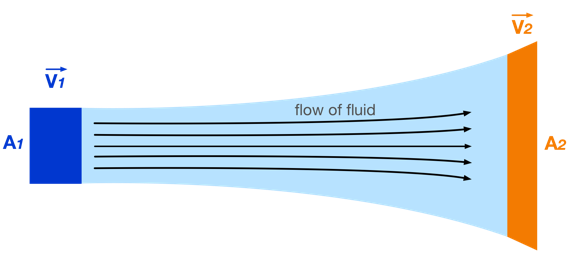
For steady incompressible flow, A₁v₁ = A₂v₂, where each v is the mean speed normal to its cross-section. In general, mass conservation gives ρ₁A₁v₁ = ρ₂A₂v₂.
A₁, A₂ = cross-sectional areas (m²); v₁, v₂ = mean flow speeds normal to those sections (m/s).
- Related Glossary Terms
- Index
Chapter 8 - Bernoulli’s Equation
Reviewed physics notes (2)
These corrections keep the original lesson’s purpose while fixing errors in the source edition.
- Vector equality would fail when a pipe bends; continuity conserves scalar volume or mass flow. — Reference 1
- Continuity variables are normal scalar flow speeds. — Reference 1
Glossary and deeper reading · 1 refreshers
These editorial refreshers supplement the reading. Definitions and examples are added guidance; original source wording and recorded answers remain in their original context.
-
Bernoulli’s equation
Bernoulli’s equation relates pressure, fluid speed, and elevation along a streamline in steady ideal flow. Its usual form assumes an incompressible, nonviscous fluid and no added or removed mechanical energy along the path. For example, in a horizontal pipe narrowing under those assumptions, higher flow speed accompanies lower pressure.