Bernoulli's Equation
Reference from the original Physics I textbook.
- Bernoulli's Equation
For steady, incompressible, inviscid flow along a streamline: P₁ + ½ρv₁² + ρgH₁ = P₂ + ½ρv₂² + ρgH₂. All terms have units Pa = J/m³.
P₁, P₂ = pressures (Pa); ρ = fluid density (kg/m³); v₁, v₂ = mean flow speeds (m/s); H₁, H₂ = heights relative to a common datum (m); g = gravitational-acceleration magnitude (m/s²).
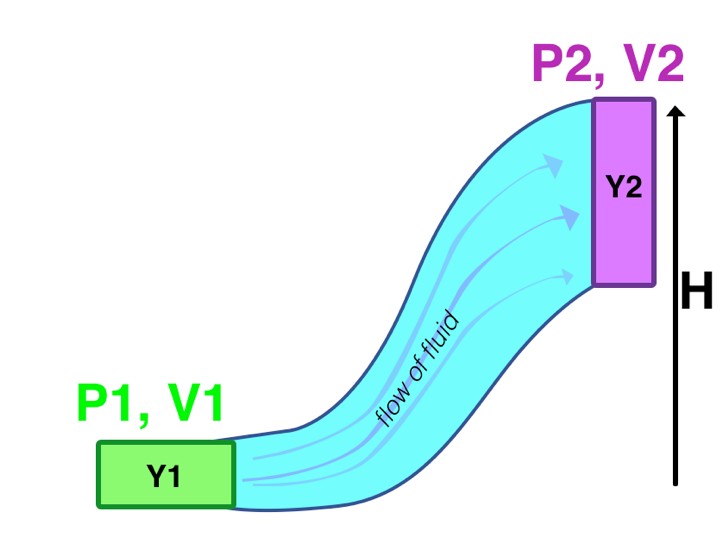
- Related Glossary Terms
Continuity Equation↗, Continuity Theory, Kinetic Energy of the Fluid, Potential Energy of a Fluid
- Index
Chapter 8 - Bernoulli’s Equation
Reviewed physics notes (2)
These corrections keep the original lesson’s purpose while fixing errors in the source edition.
- Bernoulli needs conditions and scalar speeds. — Reference 1
- Definitions must match scalar speeds in Bernoulli equation. — Reference 1
Glossary and deeper reading · 2 refreshers
These editorial refreshers supplement the reading. Definitions and examples are added guidance; original source wording and recorded answers remain in their original context.
-
Bernoulli’s equation
Bernoulli’s equation relates pressure, fluid speed, and elevation along a streamline in steady ideal flow. Its usual form assumes an incompressible, nonviscous fluid and no added or removed mechanical energy along the path. For example, in a horizontal pipe narrowing under those assumptions, higher flow speed accompanies lower pressure.
-
Continuity equation
The continuity equation expresses conservation of mass in fluid flow. For steady incompressible flow through one unbranched channel, cross-sectional area times average flow speed is constant. For example, water moves faster through a narrower part of a pipe when the same volume passes each second.