Doppler Effect
Reference from the original Physics I textbook.
- Doppler Effect
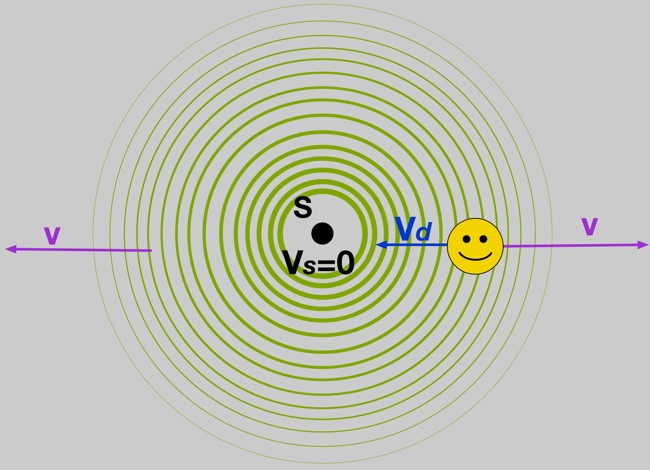
The Doppler effect is the change in observed wave frequency caused by motion of the source or detector relative to the propagation medium.
- Related Glossary Terms
- Index
Reviewed physics notes (1)
These corrections keep the original lesson’s purpose while fixing errors in the source edition.
- The change is in frequency, not simply sound level. — Reference 1
Glossary and deeper reading · 1 refreshers
These editorial refreshers supplement the reading. Definitions and examples are added guidance; original source wording and recorded answers remain in their original context.
-
Doppler effect
The Doppler effect is a difference between emitted and observed frequency caused by relative motion of source and observer. For sound, both motions must be considered relative to the medium; motion changes the rate at which wavefronts are encountered. For example, a sound source approaching a stationary listener usually produces a higher observed frequency than the source’s rest frequency.