Displacement
Reference from the original Physics I textbook.
- Displacement
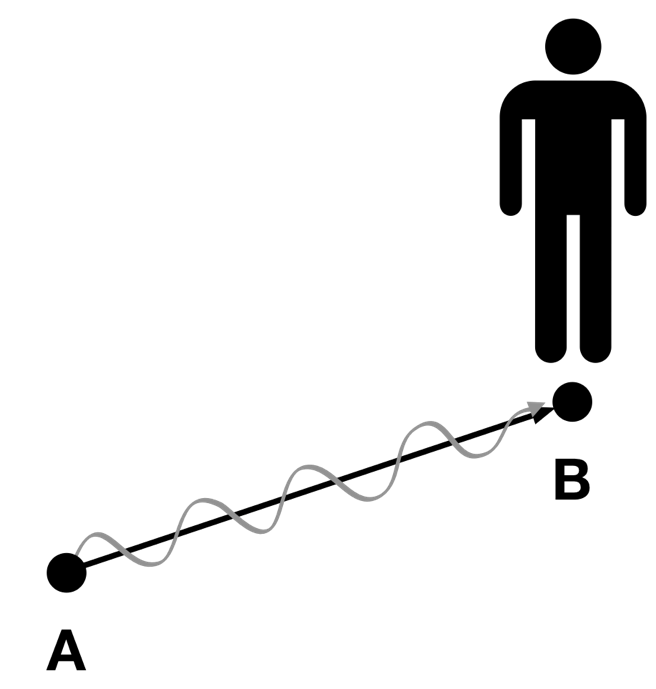
Displacement is the vector change in position: Δr⃗ = r⃗_f − r⃗_i. It points from the initial position to the final position and is independent of the path traveled.
- Related Glossary Terms
Kinematic Equations↗, Spring Potential Energy Equation, Velocity↗, Velocity Equation
- Index
Reviewed physics notes (1)
These corrections keep the original lesson’s purpose while fixing errors in the source edition.
- Original gives only the scalar distance between endpoints. — Reference 1
Glossary and deeper reading · 2 refreshers
These editorial refreshers supplement the reading. Definitions and examples are added guidance; original source wording and recorded answers remain in their original context.
-
Kinematics
Kinematics describes motion using position, velocity, acceleration, and time without first analyzing its forces. The familiar constant-acceleration equations apply only over intervals in which that acceleration is constant. For example, a ball falling near Earth with negligible air resistance can be modeled with constant vertical acceleration.
-
Velocity
Velocity describes how position changes with time and includes direction. Instantaneous velocity describes one moment, while average velocity is displacement divided by elapsed time. For example, a car turning a corner can change velocity while maintaining the same speed.