FFR - Wave-Particles
Original textbook reading.
Enrichment beyond the AP course.
This original chapter is extra exploration beyond the supplied AP Physics 1 course. Keep it if you're curious about where these ideas go next.
In this section, we are going to introduce a new topic and an old one that are very important applications of waves: the Doppler effect which deals with sound waves, and photons.
Doppler Effect
This may be something that you hear on a daily basis, but maybe won’t notice how it works. Ever been in a situation where you were in your car and you heard either an ambulance or a fire truck coming? It’s because they’re blasting their sirens trying to get you to move out of the way!
As a siren approaches, received intensity often rises because its distance decreases. Separately, relative motion changes the detected pitch: approach gives a higher frequency and recession a lower one under the usual subsonic conditions.
These changes in frequencies with respect to motion of a relative object is what is known as the doppler effect. When dealing with this, we will denote two other definitions: the source, which is the source of where the sound is coming from, and the detector, which is the object that detects the sound.
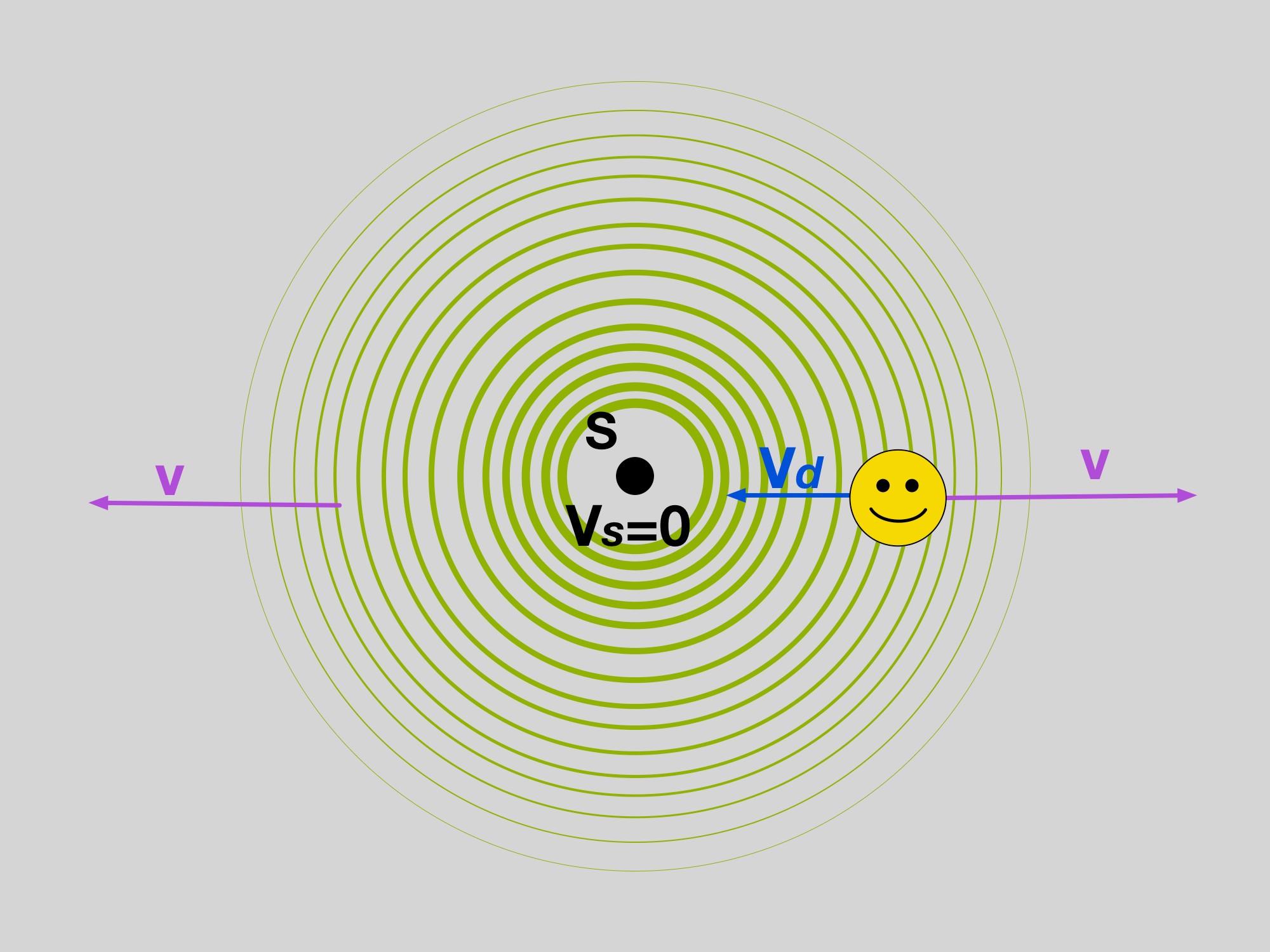
A detector moving toward a stationary sound source encounters wavefronts more frequently and hears a higher pitch. Intensity may also rise as it gets closer, but that is a separate distance effect.
The general equation for this is:
(Equation 9.4.1)
Where is the detected frequency, is the emitted frequency, is the speed of sound through the medium (in this case its air), and and are the speeds of the detector and source relative to the air, respectively. The reason for the “” is because you can have multiple scenarios that affect the detected frequency:
- Use +u_D in the numerator when the detector’s velocity component relative to the medium points toward the source.
- Use −u_S in the denominator when the source’s velocity component relative to the medium points toward the detector.
- Use +u_S in the denominator when the source’s velocity component relative to the medium points away from the detector.
- An object stationary relative to the medium has zero velocity in the Doppler formula. The usual expressions here assume collinear subsonic motion.
Example Problem 9.4.1
Ultrasound imaging detects reflected acoustic waves. A Doppler frequency shift can measure a moving reflector’s velocity component along the beam. The following example uses this reflected-wave effect.
The way it works is that it emits waves and produces an image by detecting waves that bounce off the objects. In that case, it forms the image on a screen from the reflected waves it catches back from within the woman’s womb.
In a hypothetical reflected-ultrasound model, a stationary transducer emits 2.30 × 10⁶ Hz and receives 3.0 × 10⁶ Hz from a reflector moving toward it. Sound speed is 1.54 × 10³ m/s. Find the reflector’s speed along the beam. These frequencies are not realistic fetal-heart data.
Step 1: Realize that this is a double doppler question
The tricky part about this question is realizing that you have different scenarios going on. First thing is that the initial source is the ultrasound machine that sends the waves to the detector which is the heart.
Then the heart emits back a wave for the ultrasound machine to receive and make into an image. This means that at that point the heart acts as the source and the ultrasound machine as the detector.
Step 2: Solve for the detected frequency of the Heart
We will be using our relative frequency equation:
But for this case since we’re dealing with multiple doppler effects, let’s change the subscripts to prevent confusion.
The first part to solving this requires us to set up the first part of the doppler system, where the heart acts as the detector (we’ll refer to it as ) and then the ultrasound, which we’ll refer to as , so the equation will look like:
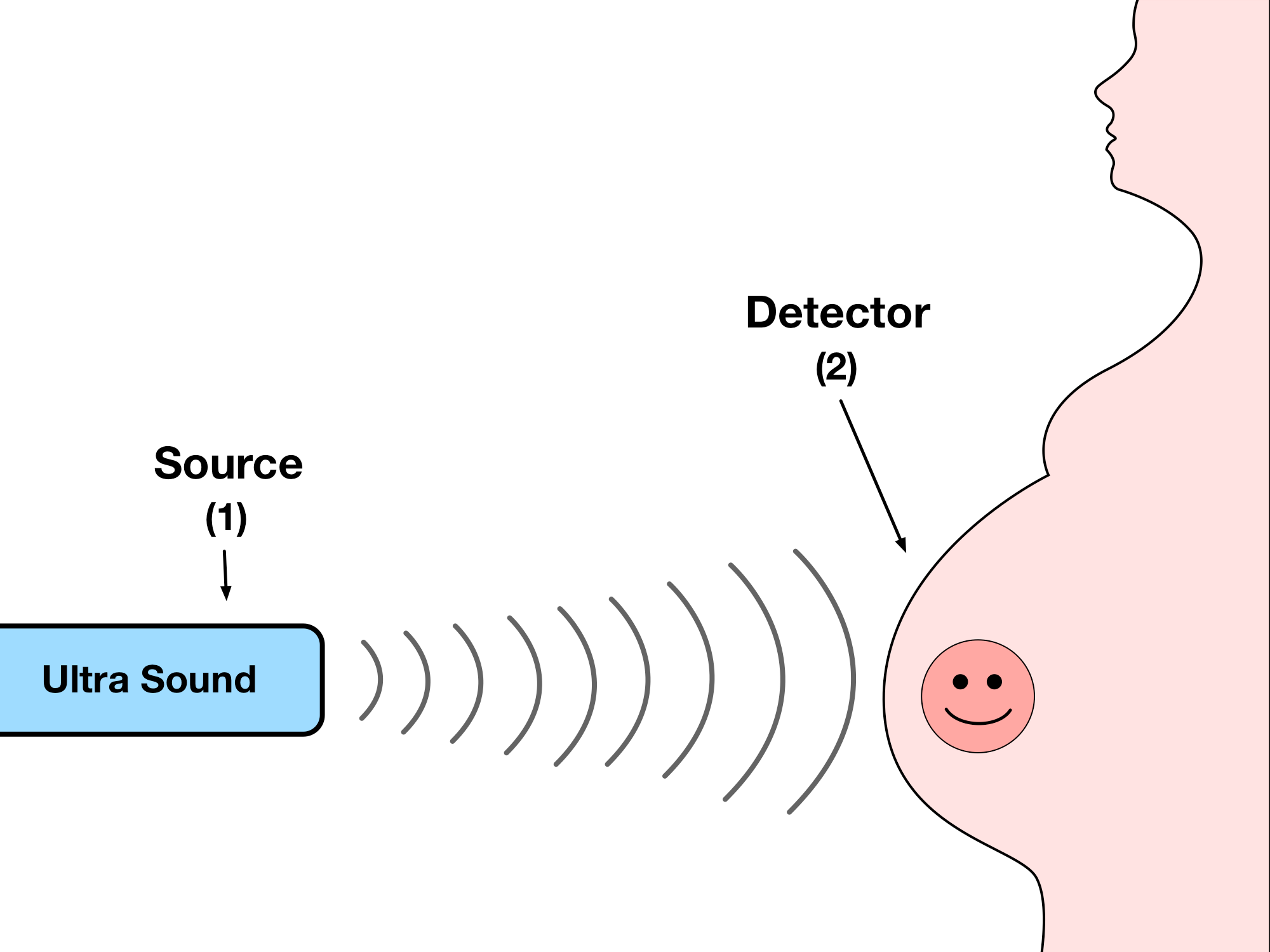
Initially, the ultrasound is the source while the fetus is the detector.
Read every step and figure
Step 1
Step 2
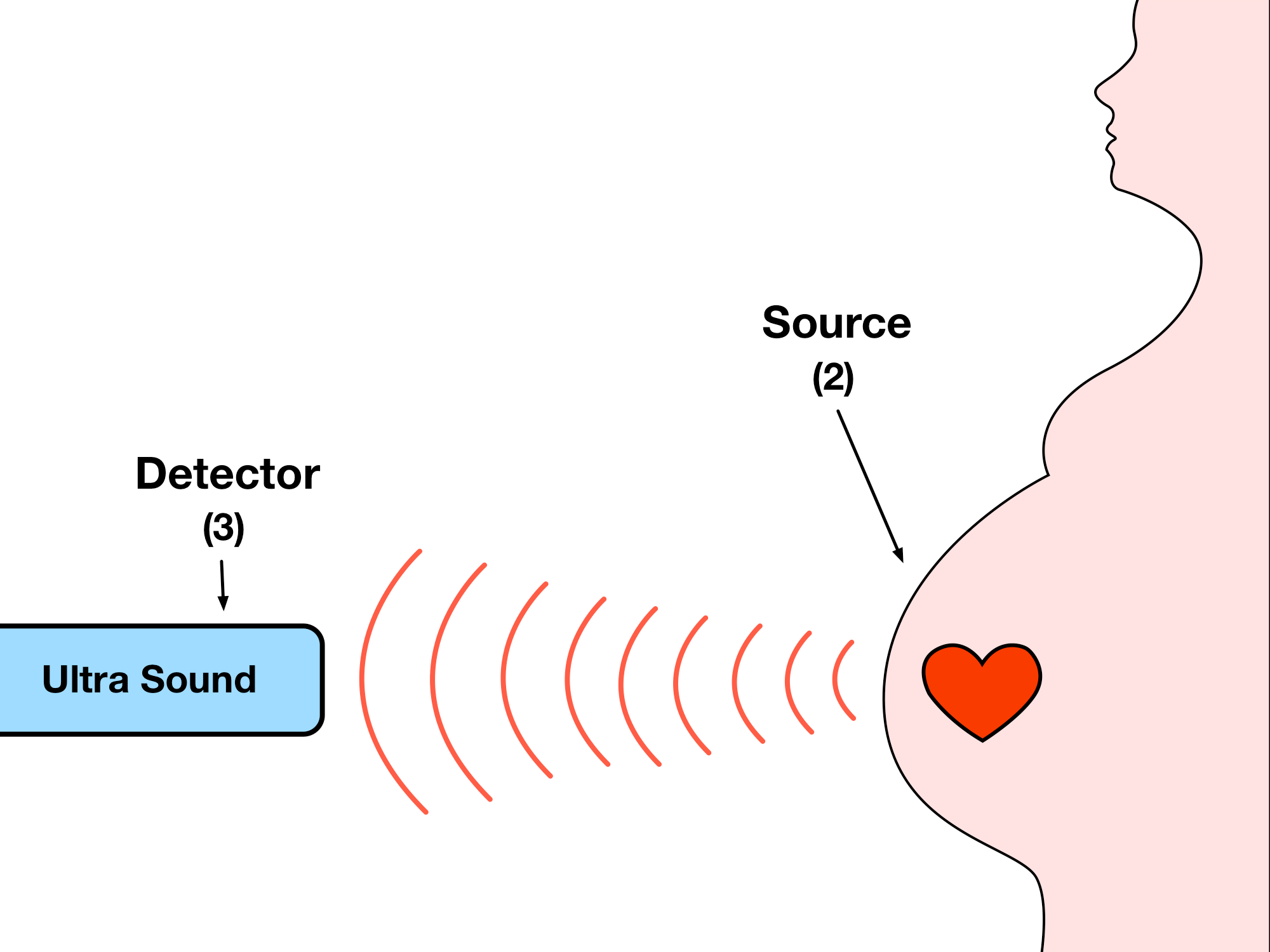
The reflector is moving toward the stationary transducer, so it encounters the incoming wavefronts more frequently. For this first shift, f₂ = f₁(v + u)/v.
which simplifies to
Step 3: Set up our second doppler equation
This time we are looking at the heart as the source since it will be reflecting waves back for the ultrasound to detect. We will designate the ultrasound as () since it is a new frequency that the ultrasound will detect. The heart is still partially moving, so it still has it’s velocity but this time the waves are moving away from the heart, so the source is essentially moving
On return, the reflector acts as a source moving toward the stationary transducer, so the source denominator is v − u.
Step 4: Find the equation for the velocity of the heart
We have equations with unknowns so we’ll have to use substitution to eliminate . Rearranging to solve for gives us:
and we already know that also equals therefore we can set these equal to each other to give us the following equation:
This sounds weird, we know but it’s actually very applicable in many situations. Remember from the previous section, you learned about light and how they emit waves.
Well in this part we tie that together by saying that light waves are actually made up of many “light particles” which we designate as photons.
A laser produces a beam through stimulated emission and optical amplification, often with high coherence and a narrow range of frequencies. Focusing can concentrate its optical power into a small area. Photons have zero rest mass and carry momentum p = E/c = h/λ in vacuum.
For photons in vacuum, use p = E/c. The nonrelativistic expression p = mv does not apply to a massless photon.

A photon is a quantum of the electromagnetic field. This drawing is a representation, not a picture of a photon emitting its own light wave.
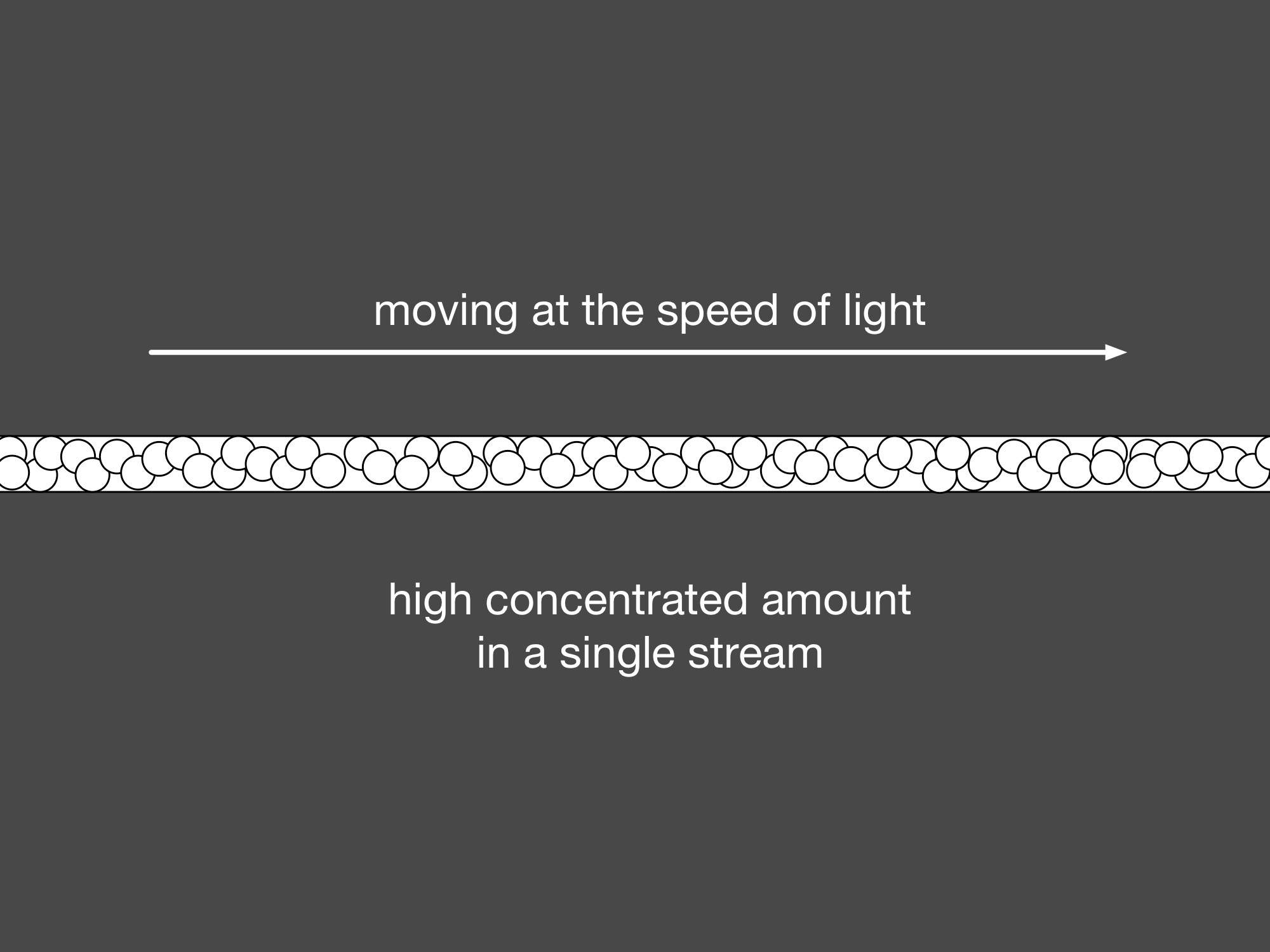
A cutting laser deposits concentrated energy in a material through absorption, producing heating, melting, vaporization, or ablation depending on the material and pulse conditions. Light also exerts radiation pressure, but photon momentum is not the usual explanation of laser cutting.
Wave Particle Duality
Proved through the double slit experiment. The basic principle of it was that it proved energy and matter could display characteristics of both waves and particles.
How the experiment was run was a single stream of light (a laser) was passed through a double slitted plate where the light would pass through and on the other side there would be a screen to view the light coming through.
A double slit produces an interference pattern when the alternatives remain coherent. Individual photon or electron detections are localized events; many such events can build an interference pattern. A model using only independent classical trajectories lacks the same interference pattern.
The interference pattern depends on whether which-path information is physically available, not on whether a person looks at the screen. A detector that distinguishes the slit paths can destroy their coherence. Detection at the screen is still localized while the accumulated distribution can show interference.
Take a look at the gallery on the next page. Hopefully that will clear things up.
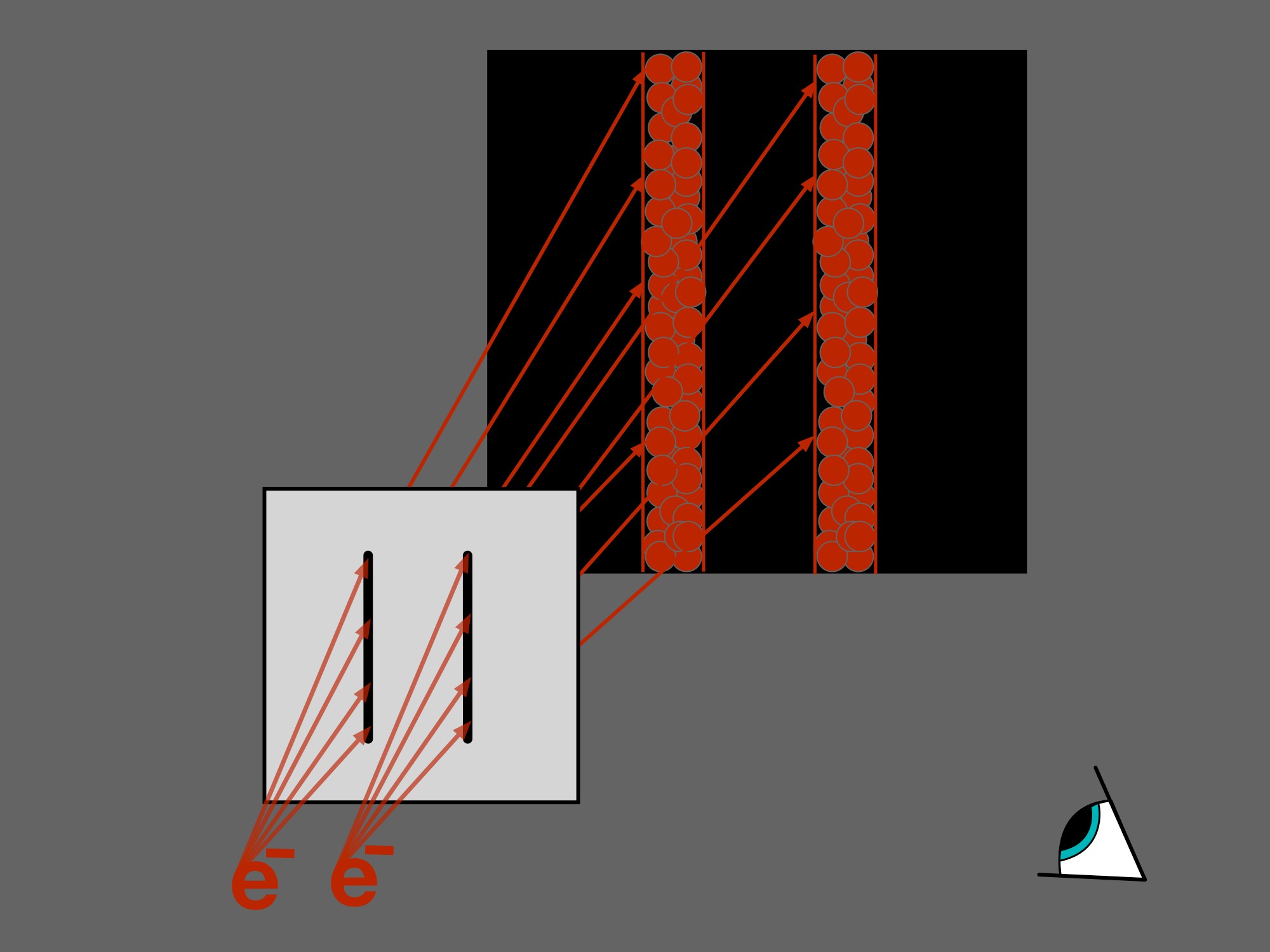
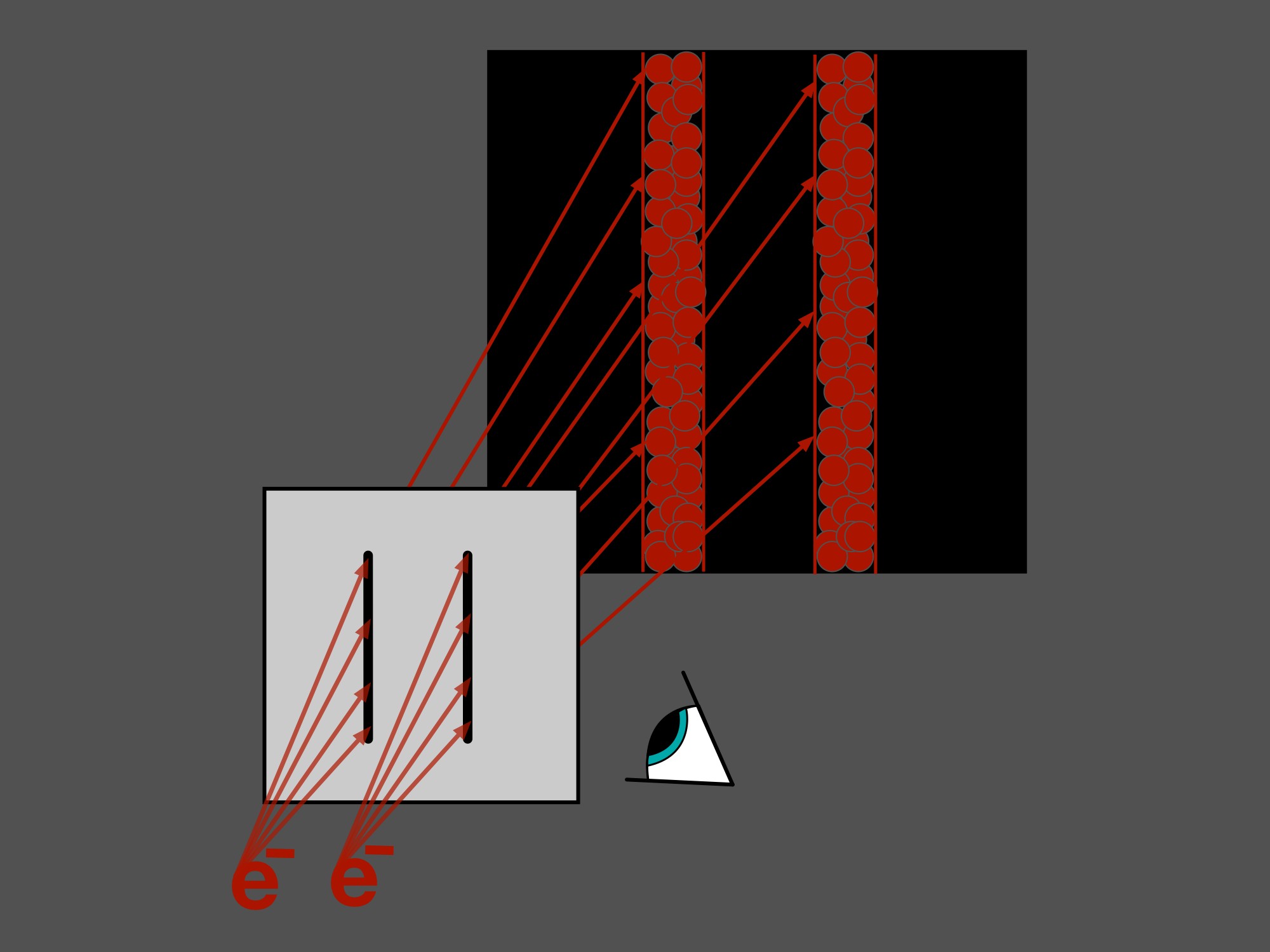
If electrons were modeled only by independent classical paths, no coherent two-path interference term would appear. Quantum electrons are detected as localized events, but their accumulated distribution can contain fringes.
Read every step and figure
Step 1
If electrons were modeled only by independent classical paths, no coherent two-path interference term would appear. Quantum electrons are detected as localized events, but their accumulated distribution can contain fringes.
Step 2
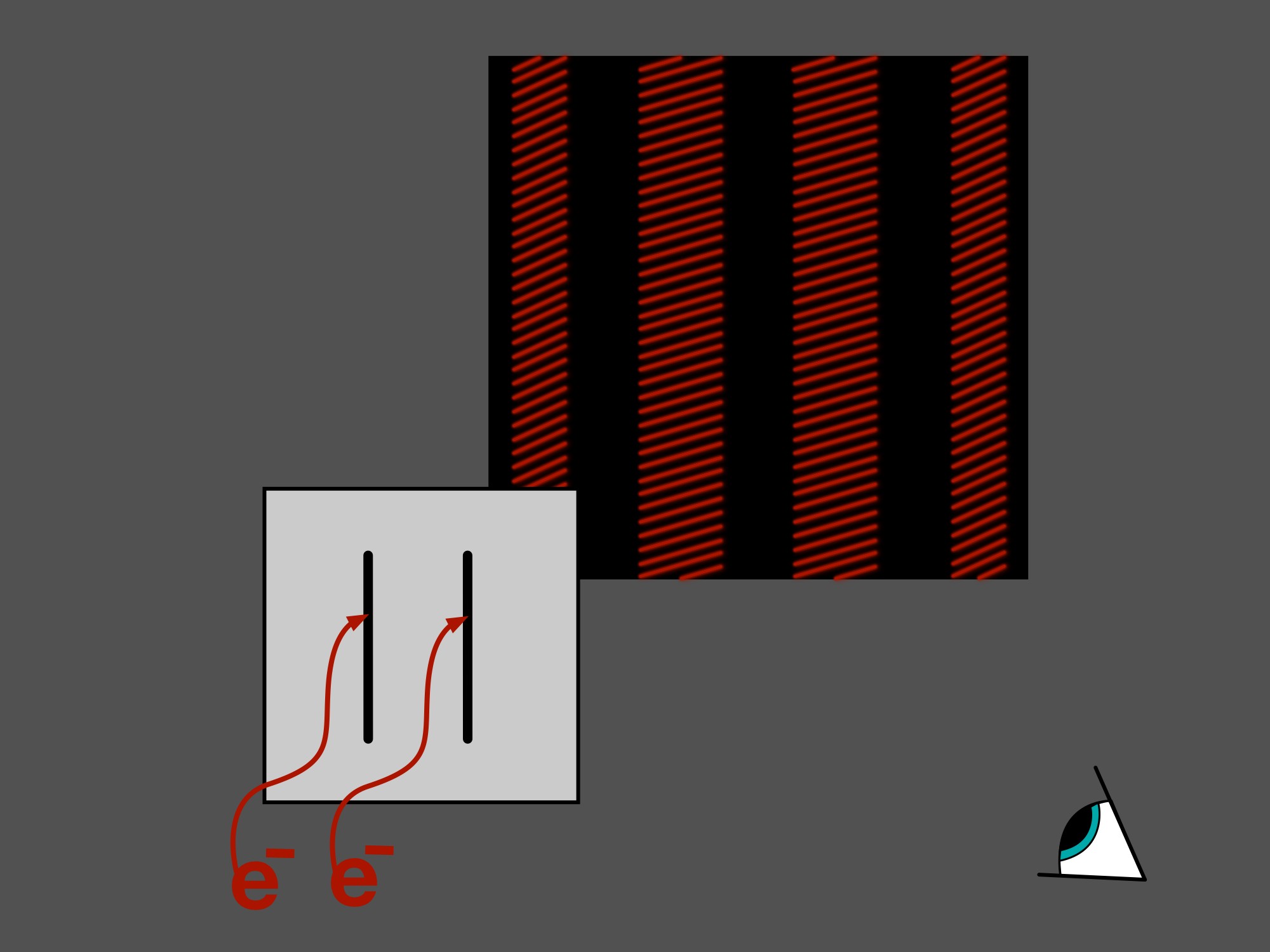
This image shows what happens in wave theory, a diffraction pattern that occurs when waves interfere with each other thus causing the alternating fringes or shadows that are shown on the screen. If the electrons behaved as a wave, as denoted by the squiggly lines, then interference would occur after going through the slits thus causing the band pattern on the screen where there are dark and light spots.
Step 3
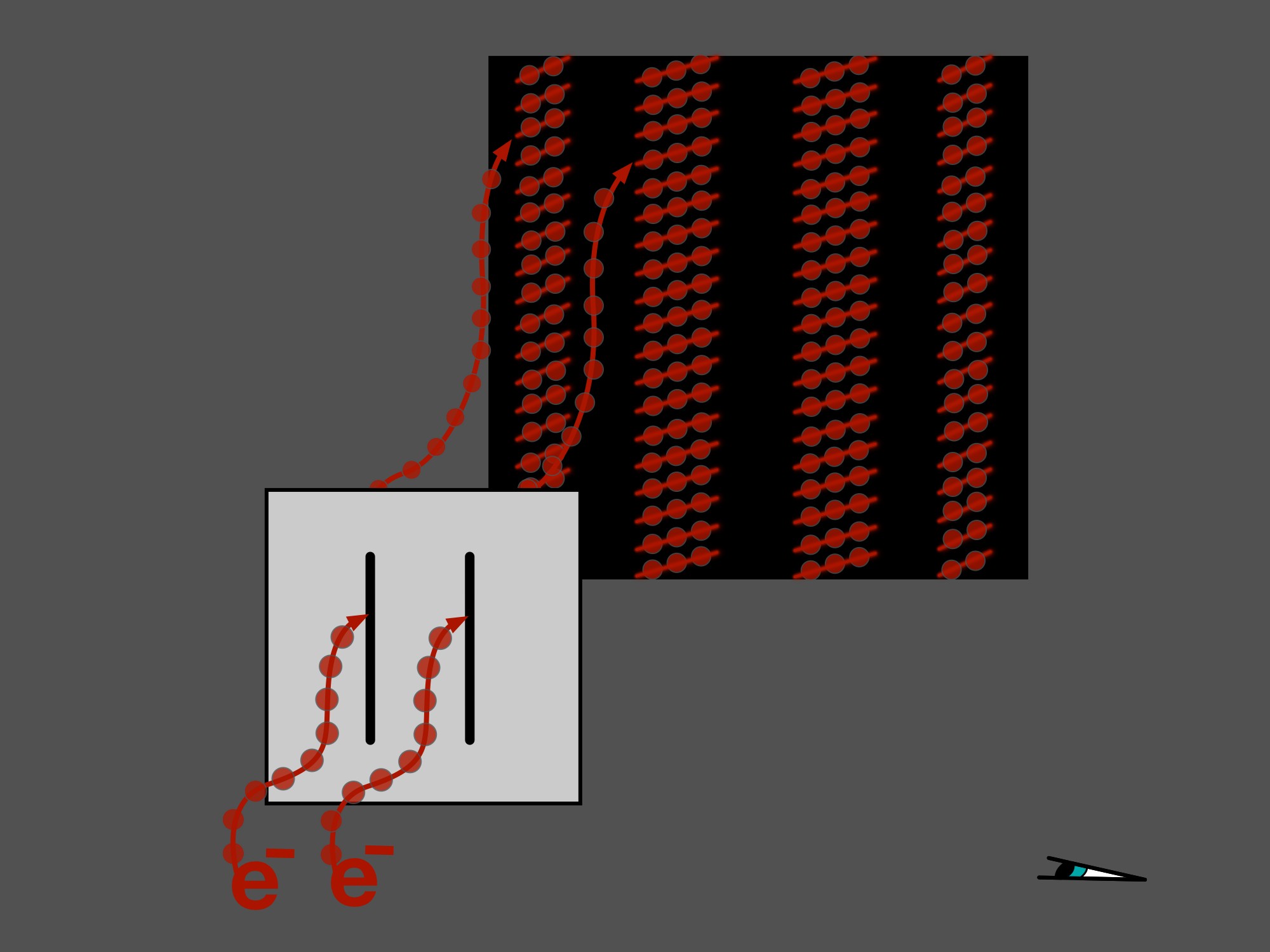
When the electrons are not measured before they hit the screen, then even though they are fired off one at a time, they will act like waves, showing an interference pattern. The detector is placed on the screen so that the screen lights up as each electron hits it.
Step 4
Pop Quiz 9.4.1 Doppler Effects and Light
Question 1 of 5 · 0 correct
Extra exploration · Read the worked solution
Read every full question without answers
Question 1
Question 2
Question 3
A police siren is behind a robber’s car, and both move forward through still air. Identify the source and detector. Use f′ = f(v − u_D)/(v − u_S), with both u_D and u_S positive in the forward direction. Match −u_D to the detector and −u_S to the source.
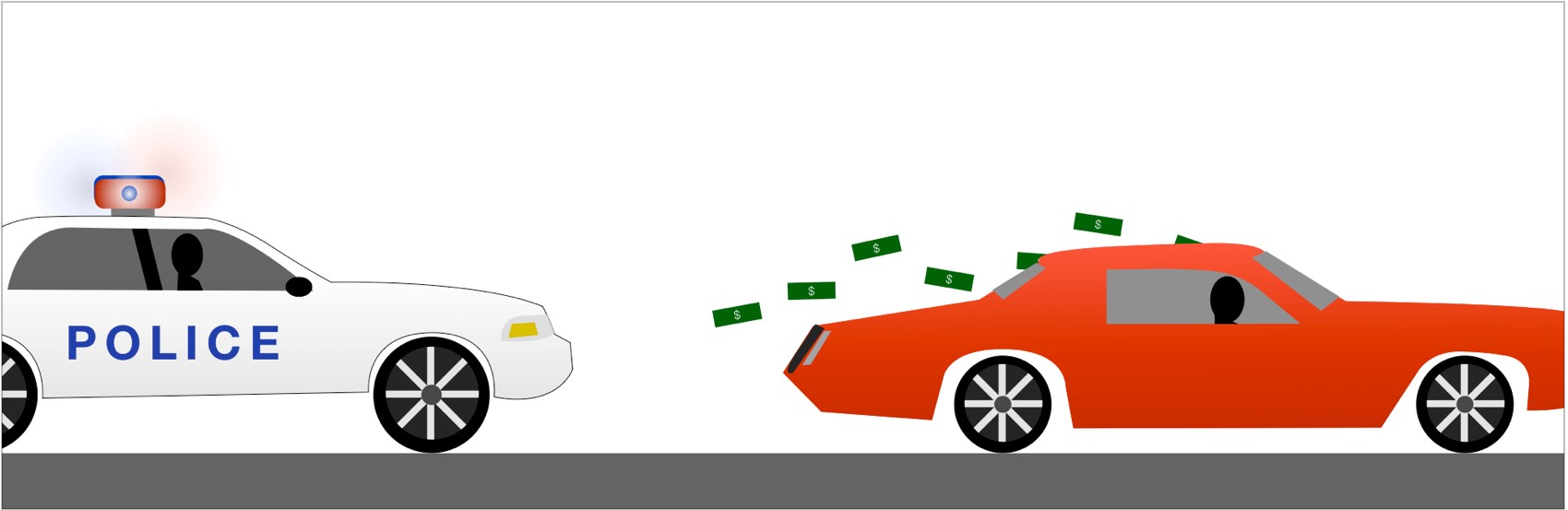 1234
Match these labels to the numbered figure targets. Write your matches before opening the separate worked answer.
Question 4
A detector moves directly away from a stationary alarm at 25 m/s while the stipulated sound speed is only 5 m/s. What problem arises when applying the usual subsonic Doppler model to ask for a lower observed frequency?
Question 5
The police siren source has speed 12.5 m/s in a medium with stipulated sound speed 8 m/s. Can the usual subsonic source–detector Doppler formula be used to infer a unique robber speed from a doubled detected frequency?

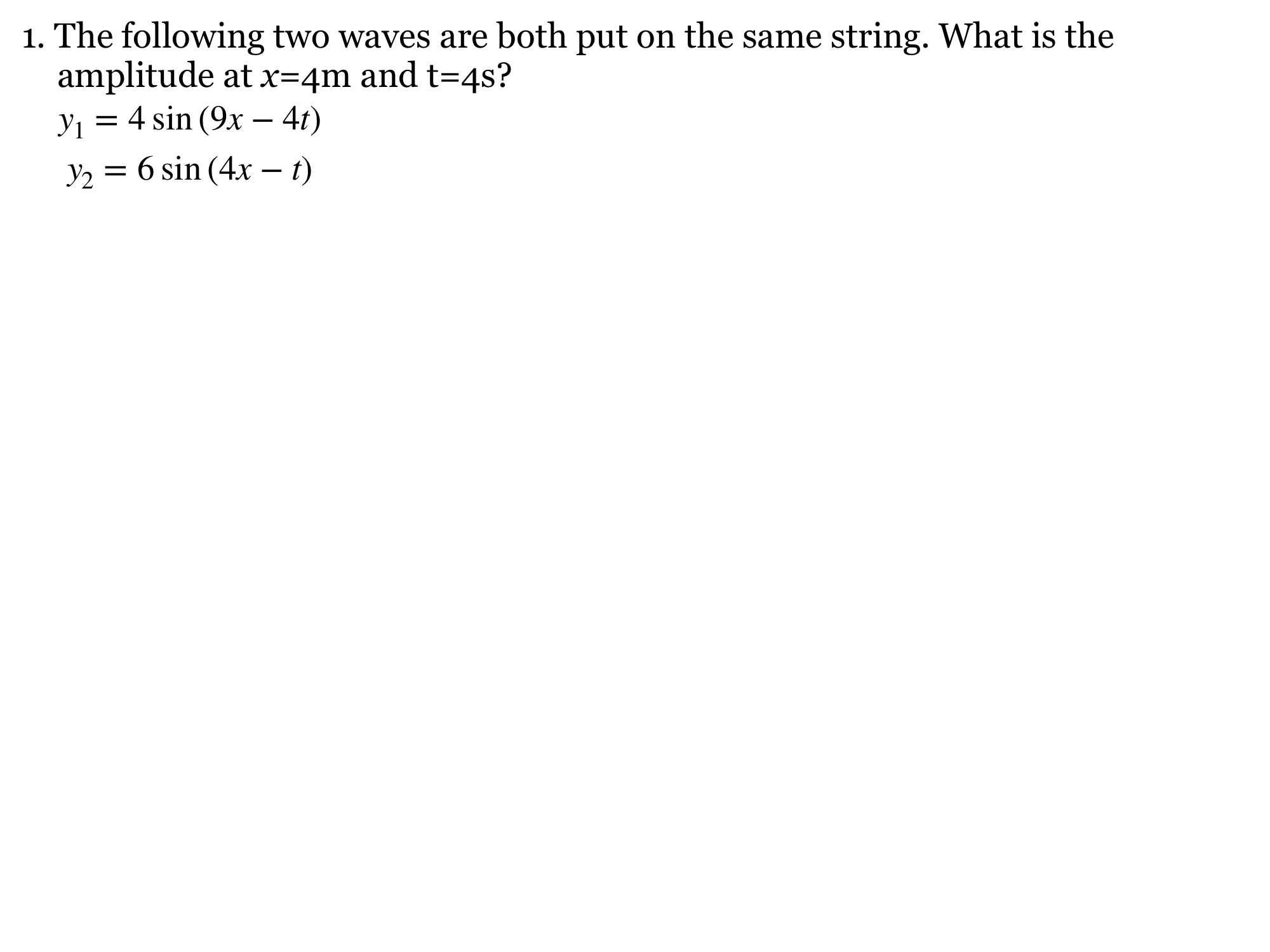
Original problem 1
The source calls this “amplitude,” but a value at one position and time is displacement. It omits the coefficients’ displacement unit, so metres cannot be asserted for y.
Problem text
Two waves on a string are y₁ = 4U sin(9x − 4t) and y₂ = 6U sin(4x − t), where x is in metres, t in seconds, and U denotes the common displacement unit omitted in the source. Find the resultant displacement at x = 4 m and t = 4 s. Use radians.
Drawing is temporarily unavailable. Work on paper if needed, then record your reasoning here.
Saving written working requires JavaScript. The problem remains available above; keep your work on paper or in your own notes.
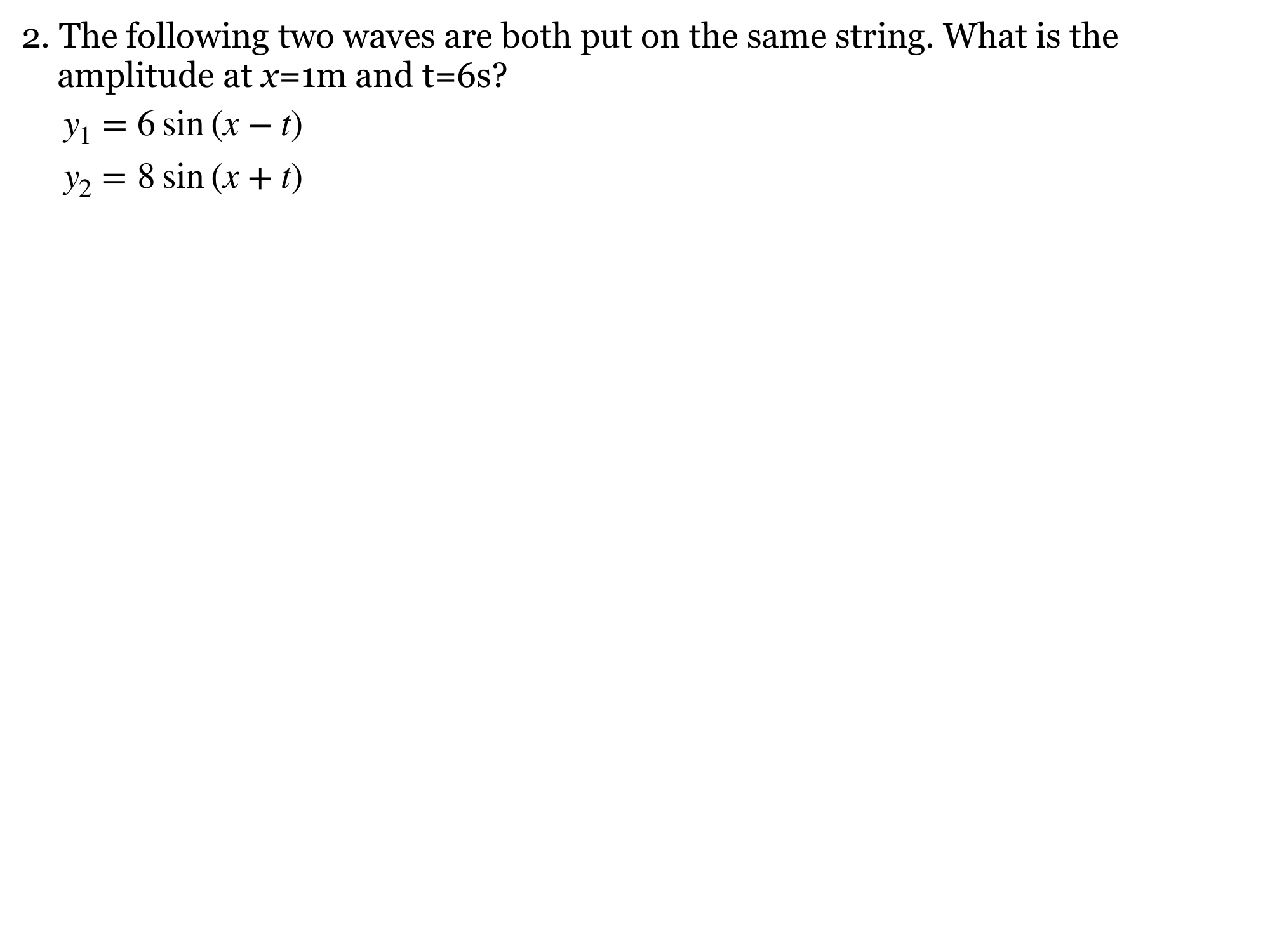
Original problem 2
The requested quantity is displacement, not a time-independent resultant amplitude. The source omits the displacement unit.
Problem text
Two waves on a string are y₁ = 6U sin(x − t) and y₂ = 8U sin(x + t), where x is in metres, t in seconds, and U is the common displacement unit omitted in the source. Find the resultant displacement at x = 1 m and t = 6 s. Use radians.
Drawing is temporarily unavailable. Work on paper if needed, then record your reasoning here.
Saving written working requires JavaScript. The problem remains available above; keep your work on paper or in your own notes.


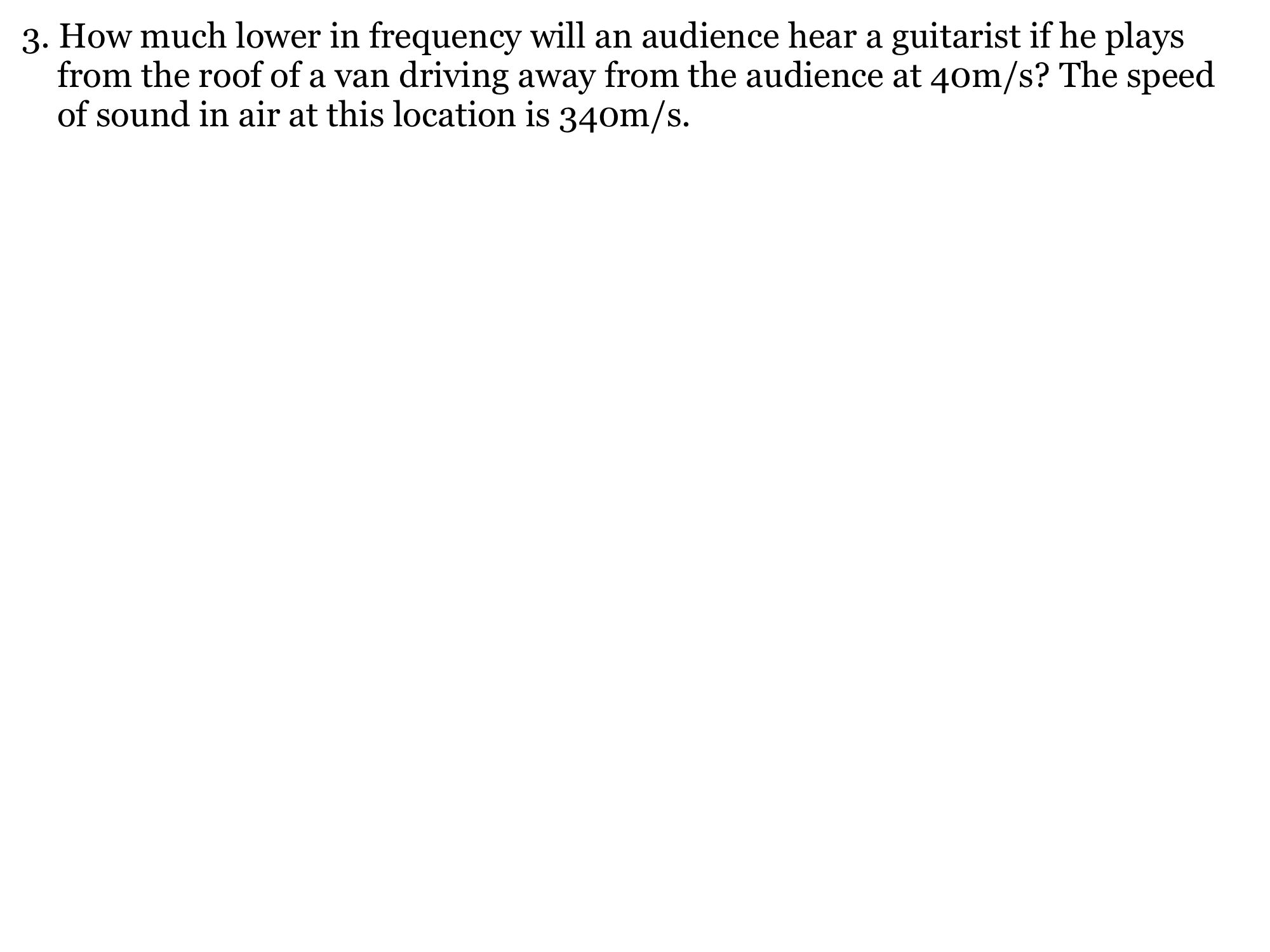
Original problem 3
An emitted frequency is not given, so the decrease cannot be stated as a unique number of hertz.
Problem text
A guitarist on a van travels directly away from a stationary audience at 40 m/s in still air. The local speed of sound is 340 m/s. Find the observed frequency as a fraction of the emitted frequency and the percentage decrease.
Drawing is temporarily unavailable. Work on paper if needed, then record your reasoning here.
Saving written working requires JavaScript. The problem remains available above; keep your work on paper or in your own notes.
Original problem 4
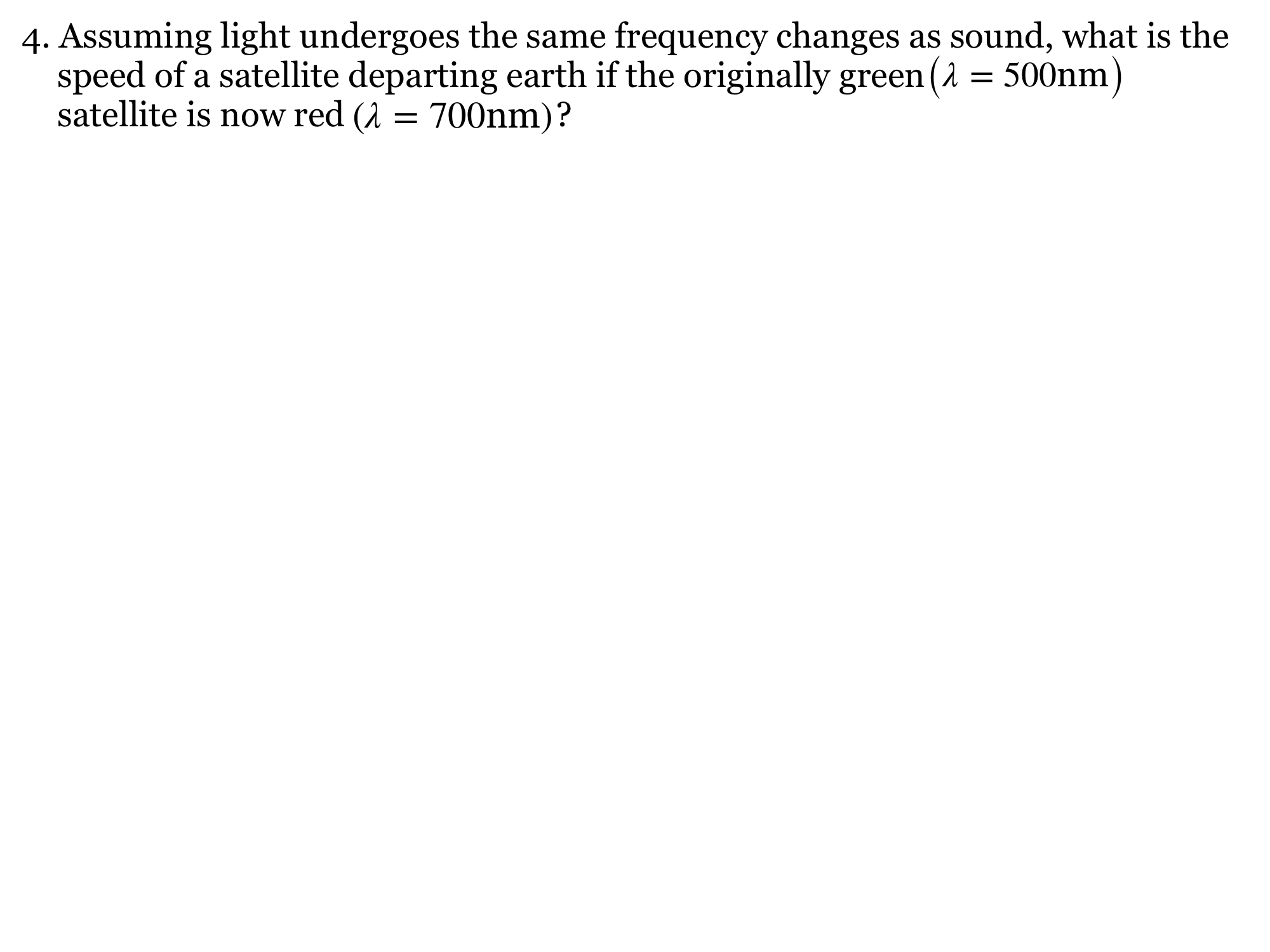
The source explicitly assumes light obeys the sound formula. That assumption is physically wrong. Its formal sound-like result would be 0.4c, but it is not the valid light answer. This is a hypothetical source; it is not a plausible Earth satellite speed.
Problem text
A source recedes directly from Earth in vacuum. Light emitted at wavelength 500 nm is observed at 700 nm. Find its relative recession speed using the relativistic longitudinal Doppler relation.
Drawing is temporarily unavailable. Work on paper if needed, then record your reasoning here.
Saving written working requires JavaScript. The problem remains available above; keep your work on paper or in your own notes.
Original problem 6
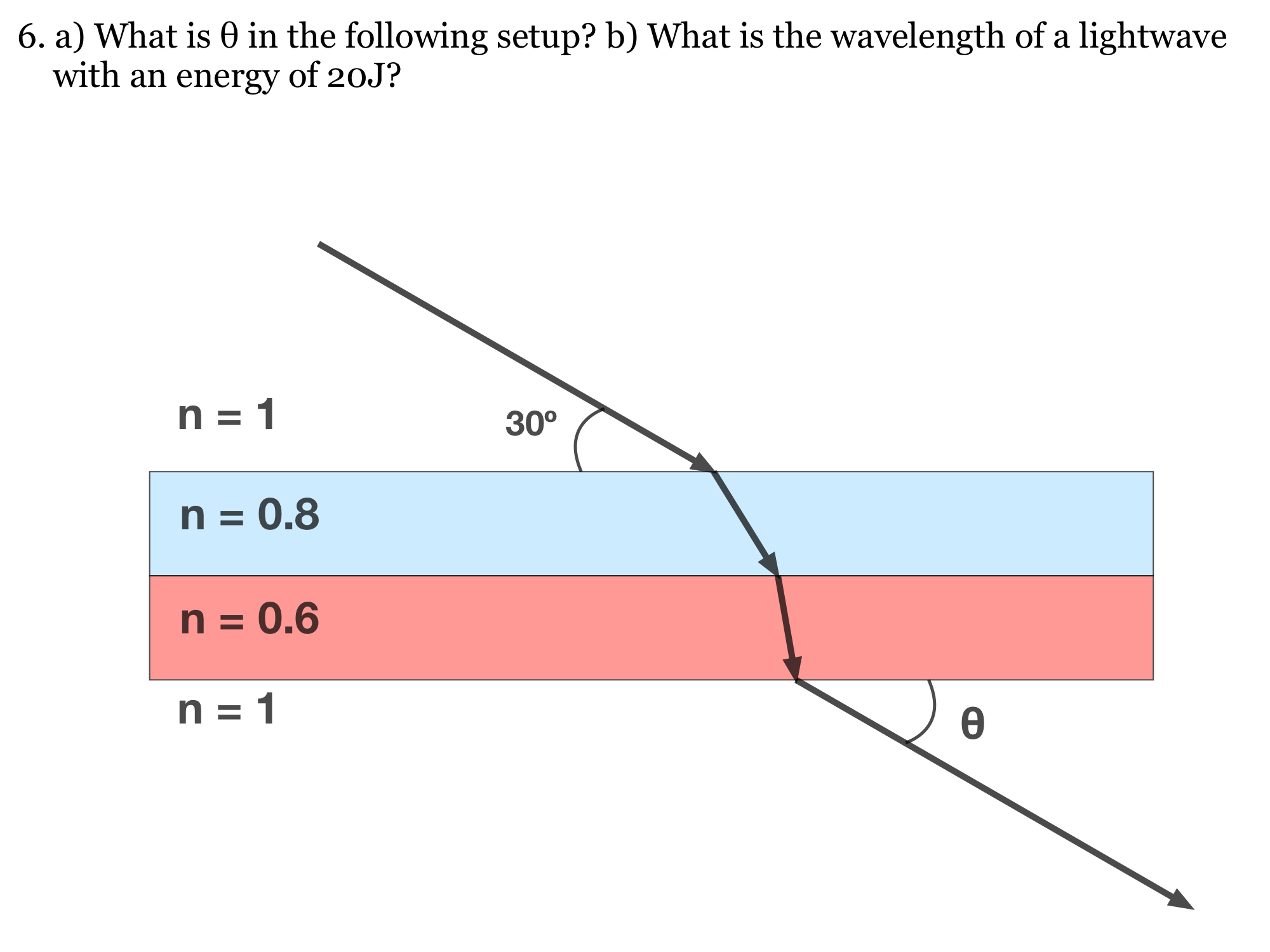
Indices below 1 are not ordinary visible-light glass/water indices. The solution checks the abstract given ray model without treating those layers as ordinary materials. Wave transmission through thin layers would require additional material and thickness data.
Problem text
In the source diagram, a ray in n = 1 is incident at 30° to a flat surface, followed by layers of index 0.8 and 0.6 and finally n = 1. In the simple Snell-law ray model, can a ray emerge with the indicated angle θ? Separately, can a light wave’s total energy of 20 J determine its wavelength? Give the formal wavelength if 20 J is instead the energy of one photon.
Drawing is temporarily unavailable. Work on paper if needed, then record your reasoning here.
Saving written working requires JavaScript. The problem remains available above; keep your work on paper or in your own notes.
Original problem 5
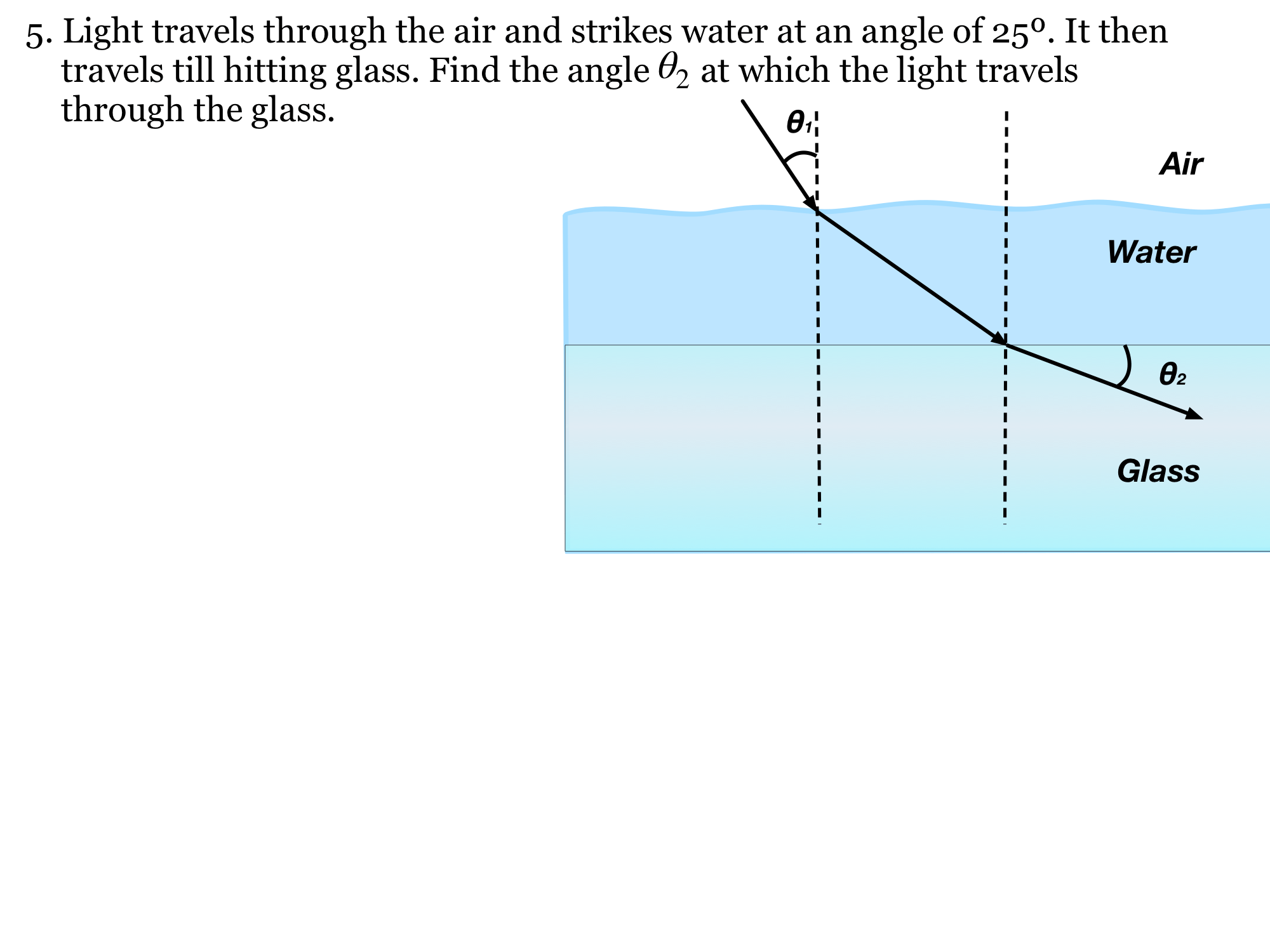
The drawn ray bends in the wrong direction on entering higher-index media. Use the labelled incidence angle and the parallel-interface model, not the ray’s pictorial slope. Refractive indices come from source Table 9.3.1.
Problem text
A light ray in air (n = 1.00) enters water (n = 1.33) at 25° to the normal and then enters glass (n = 1.52). Treat the interfaces as parallel. Find its angle in glass to the normal, and θ₂ marked in the source diagram, which is measured from the interface.
Drawing is temporarily unavailable. Work on paper if needed, then record your reasoning here.
Saving written working requires JavaScript. The problem remains available above; keep your work on paper or in your own notes.
Original problem 8
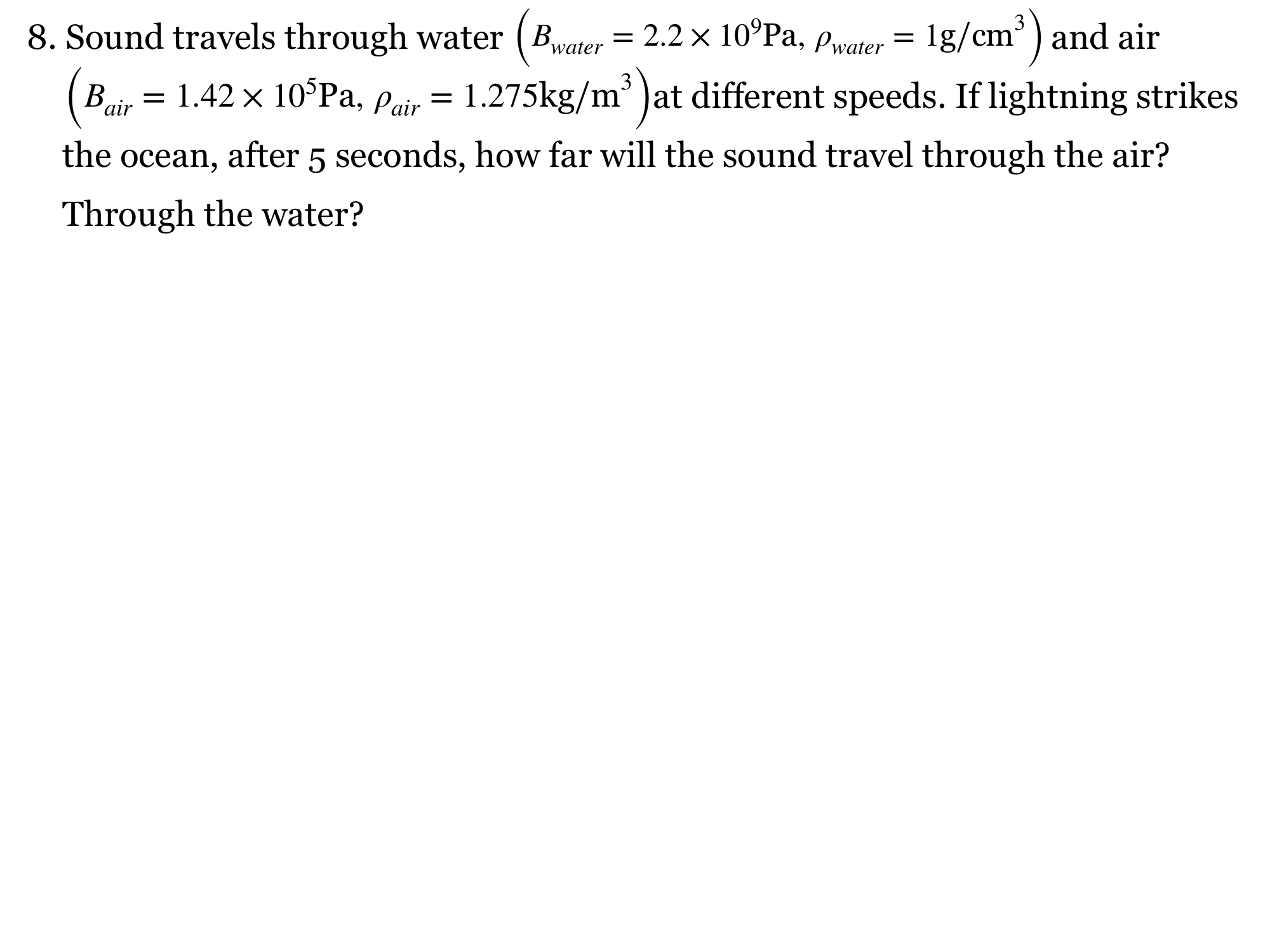
The question compares propagation distances. It does not model the efficiency of coupling a lightning-generated disturbance from air into water.
Problem text
For water, B = 2.2 × 10⁹ Pa and ρ = 1 g/cm³. For air, B = 1.42 × 10⁵ Pa and ρ = 1.275 kg/m³. Assuming the stated bulk moduli describe sound propagation in each uniform medium, how far does a disturbance travel through each medium in 5 s?
Drawing is temporarily unavailable. Work on paper if needed, then record your reasoning here.
Saving written working requires JavaScript. The problem remains available above; keep your work on paper or in your own notes.
Original problem 7
The source’s premise that five electrons are removed conflicts with its wavelength and work function. Five is an electron count, not permission to pool five photons’ energies into one ordinary photoelectric event. Multiphoton effects are outside this problem and require additional intensity information.
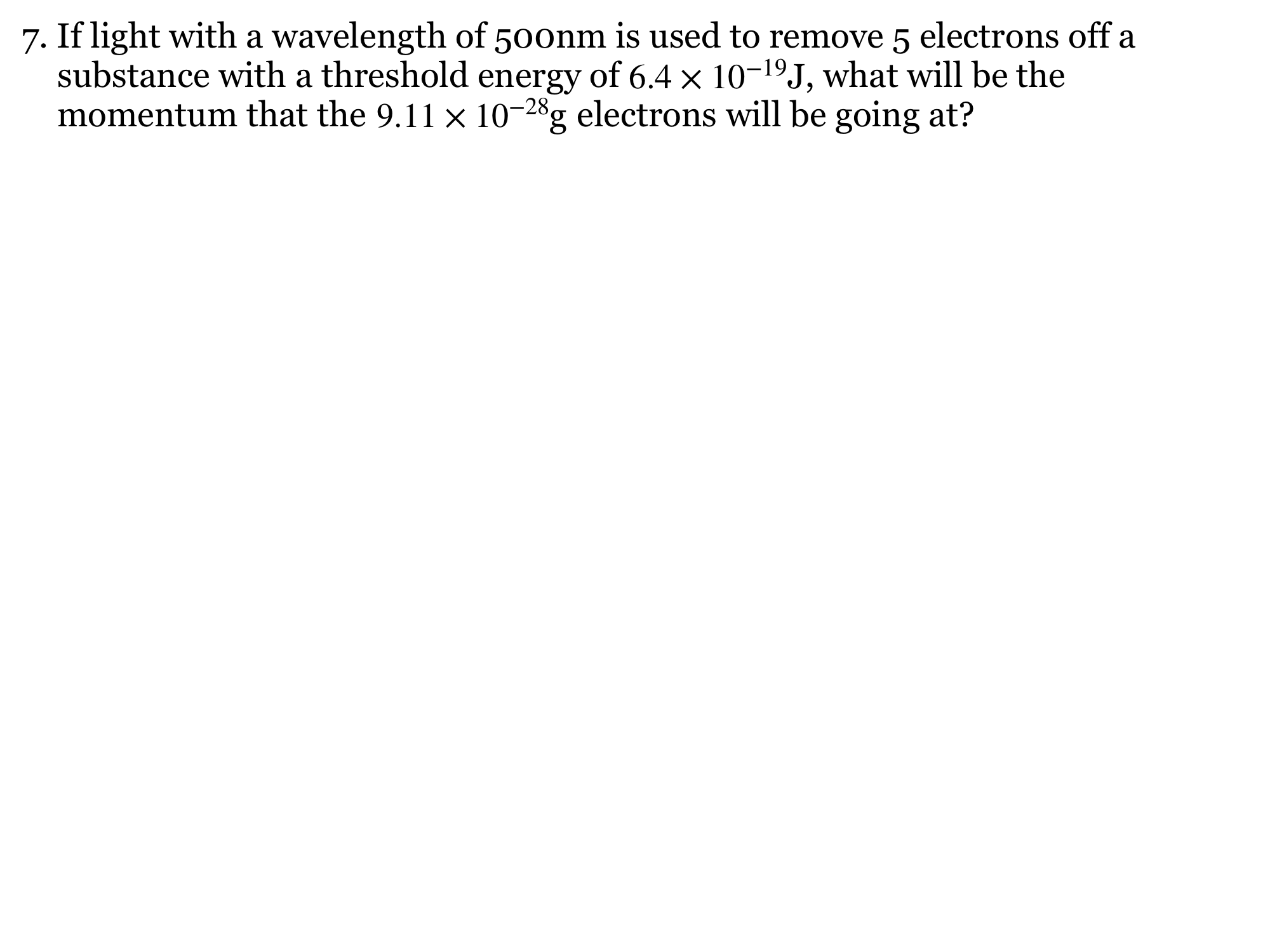
Problem text
Light of wavelength 500 nm strikes a material with work function 6.4 × 10⁻¹⁹ J. The electron mass is 9.11 × 10⁻²⁸ g. In the ordinary single-photon photoelectric model, can it remove the source’s stated five electrons? If emission occurs, determine the maximum momentum per electron.
Drawing is temporarily unavailable. Work on paper if needed, then record your reasoning here.
Saving written working requires JavaScript. The problem remains available above; keep your work on paper or in your own notes.
Original problem 10
125 dB is used only as the source’s given level. Pain and hearing injury do not have one universal threshold.
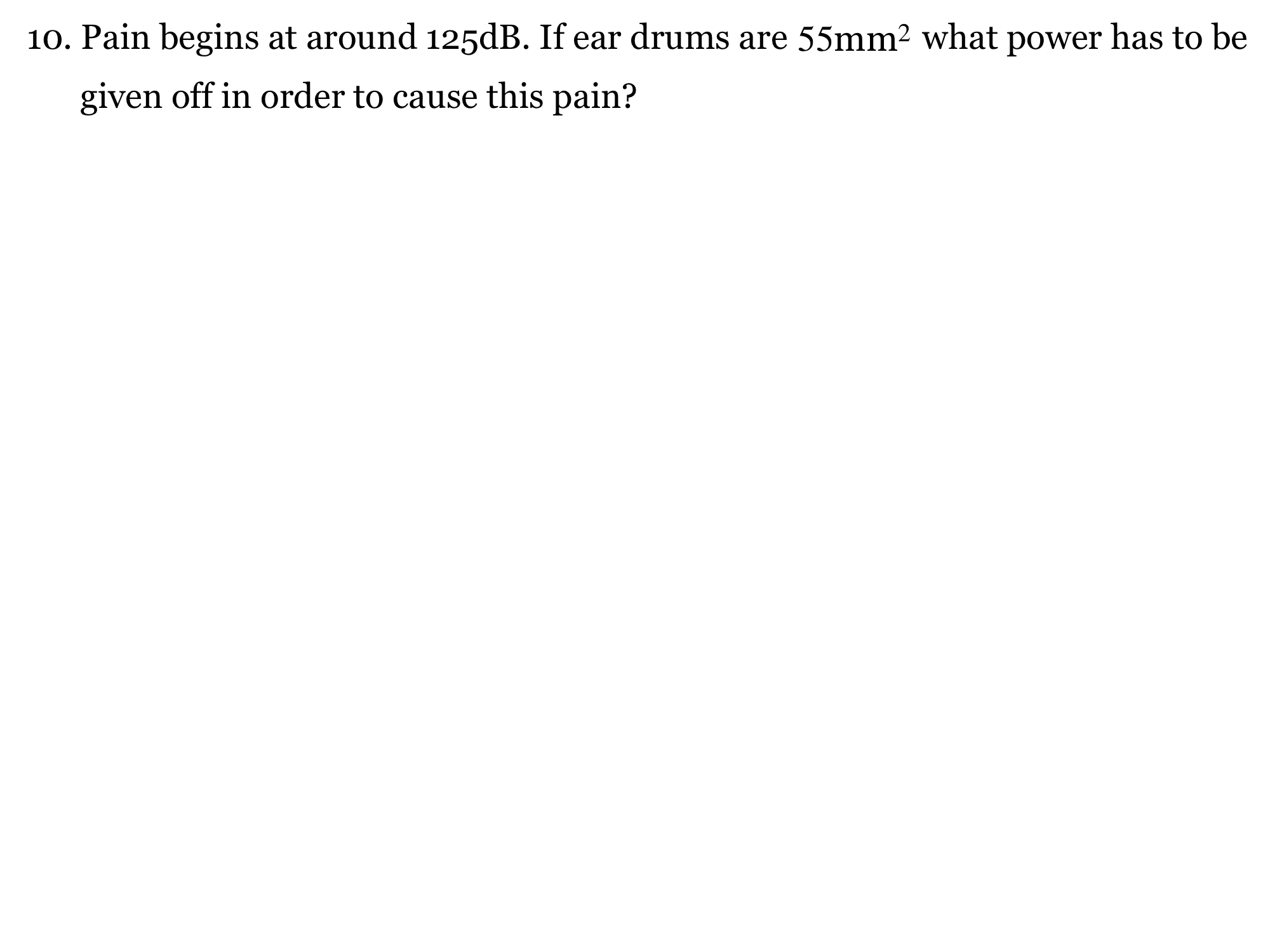
Problem text
Using the source’s stipulated level of 125 dB, find the acoustic power incident on one eardrum of area 55 mm². Use reference intensity I₀ = 10⁻¹² W/m² and uniform incident intensity. Is this sufficient to determine the source’s emitted power?
Drawing is temporarily unavailable. Work on paper if needed, then record your reasoning here.
Saving written working requires JavaScript. The problem remains available above; keep your work on paper or in your own notes.
Original problem 9
The source says “people conversing” rather than a calibrated per-person contribution. A head count is only valid if 65 dB is assumed for each person at the same detector. Different positions, coherence, and absorption would change the comparison.
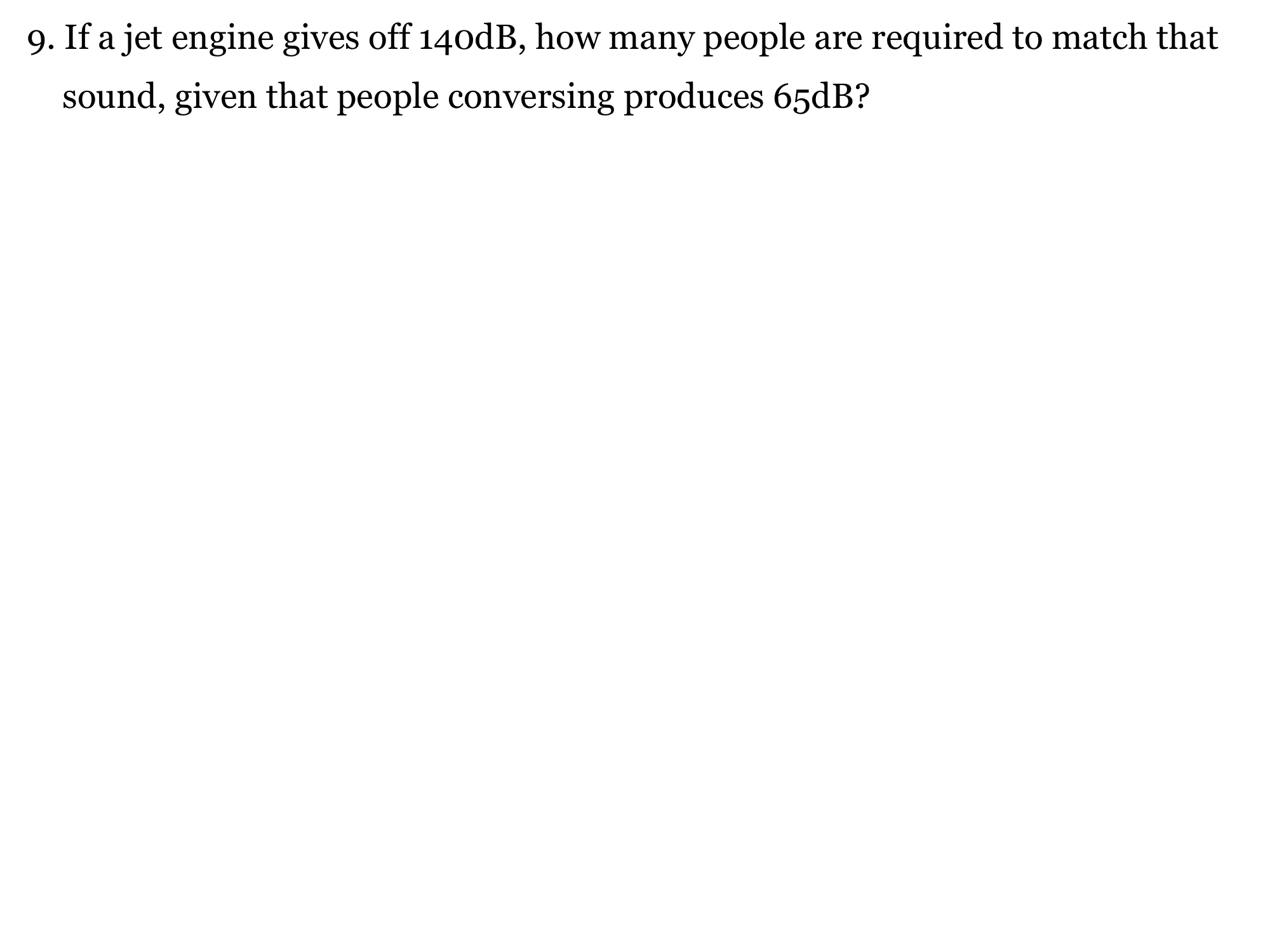
Problem text
A jet produces a sound intensity level of 140 dB at a detector. Assume each independent conversation source contributes 65 dB at that same detector and the intensities add. How many such sources are needed to match the jet’s intensity?
Drawing is temporarily unavailable. Work on paper if needed, then record your reasoning here.
Saving written working requires JavaScript. The problem remains available above; keep your work on paper or in your own notes.
Reviewed physics notes (31)
These corrections keep the original lesson’s purpose while fixing errors in the source edition.
- The source introduces intensity changes as if they were frequency changes. — Reference 1
- Clarifies that velocities are measured relative to the medium; relative car separation alone is insufficient. — Reference 1
- Makes the velocity convention consistent with the source/detector quiz. — Reference 1
- Clarifies the velocity convention. — Reference 1
- Stationary relative to the ground is not enough if the medium moves. — Reference 1
- Basic echo imaging is not itself a Doppler effect. — Reference 1
- The computed 203.4 m/s is mathematically consistent but physiologically implausible; keep the source numbers as a hypothetical reflector. — Reference 1
- The sign is determined by reflector motion relative to the medium, not merely by the fact that waves move toward it. — Reference 1
- The source prose calls it receding but uses the approaching-source sign. — Reference 1
- Removes “densified light” and the false claim that concentrating photons gives them inertial/rest mass. — Reference 1, Reference 2
- Replaces the incorrect mass-times-velocity derivation of photon momentum. — Reference 1
- The source wrongly attributes cutting hard materials to a large mechanical impulse from photons. — Reference 1
- Corrects the classical-particle comparison and removes the claim that all waves vanish on contact. — Reference 1
- Corrects observation-based switching between particle and wave and the confusion between slit and screen detection. — Reference 1
- The existing Doppler caption mentions only louder sound. — Reference 1
- A photon is not a source that emits a separate wave. — Reference 1
- Corrects the caption’s mass claim and the confusion between beam intensity and individual photon energy. — Reference 1
- Corrects the overly literal classical-particle stream description. — Reference 1
- The source claims a particle changes behavior based simply on when it is observed and ignores single-slit diffraction. — Reference 1
- Replaces a quiz built around the incorrect densified-light, inertial-mass, and momentum-only explanation. — Reference 1
- Incorrect mass claim becomes an explicit distractor. — Reference 1
- Momentum-only cutting claim becomes an explicit distractor. — Reference 1
- A third unambiguous distractor preserves the four-choice structure. — Reference 1
- Corrects the marked All of the Above answer. — Reference 1
- The source/detector signs cannot be assigned from “getting closer” alone when both move in the same direction. Explicit direction removes the ambiguity. — Reference 1
- The forward-moving detector uses v − u_D in this convention. Distinct labelled velocity terms keep the association choices unambiguous. Preserve the detector-sign association target. — Reference 1
- The source behind the forward-moving detector uses v − u_S in this explicit positive-forward convention. Preserve the source-sign association target. — Reference 1
- The source data are outside the ordinary subsonic model. They are retained as a model-validity check. — Reference 1
- The formal ratio (5 − 25)/5 = −4 is not a lower positive frequency by a factor of four. No silent change of the stipulated speed is made. — Reference 1
- The source is faster than the stated sound speed; the ordinary subsonic formula and insufficient geometry do not yield a valid unique answer. — Reference 1
- Replaces the invalid marked 33 m/s without fabricating a new speed of sound or car speed. — Reference 1
Glossary and deeper reading · 9 refreshers
These editorial refreshers supplement the reading. Definitions and examples are added guidance; original source wording and recorded answers remain in their original context.
-
Wave
A wave is a propagating disturbance that can transfer energy without transporting the medium as a whole. Mechanical waves require a material medium, while electromagnetic waves can propagate through vacuum. For example, a pulse travels along a rope while individual rope segments move locally around their equilibrium positions.
-
Photon
A photon is a quantum of electromagnetic radiation with energy proportional to its frequency. It has zero rest mass and no electric charge but carries energy and momentum. For example, increasing light’s frequency increases the energy of each photon, while increasing the number of same-frequency photons increases the total energy.
-
Frequency
Frequency is the number of complete repeating cycles per unit time. It is measured in hertz, meaning cycles per second, and is the reciprocal of the period. For example, a vibrating string with a higher frequency produces more cycles each second.
-
Velocity
Velocity describes how position changes with time and includes direction. Instantaneous velocity describes one moment, while average velocity is displacement divided by elapsed time. For example, a car turning a corner can change velocity while maintaining the same speed.
-
Coherence
Coherence describes a sufficiently stable phase relationship between waves for a sustained interference pattern. It depends on the sources and on the time or distance over which their phase relationship remains predictable. For example, illuminating two slits with one suitable monochromatic source produces a stable relative phase at the slits.
-
Linear momentum
Linear momentum is a vector describing an object’s motion and equals mass times velocity in the nonrelativistic model. The vector sum of momenta is conserved when the net external impulse on the system is zero. For example, two identical carts moving equally fast in opposite directions have zero total linear momentum but nonzero total kinetic energy.
-
Heat
Heat is energy transferred between systems because of a temperature difference. It describes a transfer rather than a substance or energy store contained in an object. For example, when a warmer mug transfers energy to a cooler hand, the mug loses internal energy and the hand gains it.
-
Thermal radiation
Thermal radiation is electromagnetic energy emitted by matter because of its temperature. It can transfer energy through a vacuum, and net radiative transfer between ordinary bodies is from hotter to cooler. For example, sunlight warming a surface does not need air to carry the energy across space.
-
Wave interference
Wave interference is the combination of overlapping wave disturbances. In a linear medium, the signed disturbances add at each location and time without permanently destroying the passing waves. For example, two overlapping upward rope pulses temporarily make a larger upward disturbance.