Nodes
Reference from the original Physics I textbook.
- Nodes
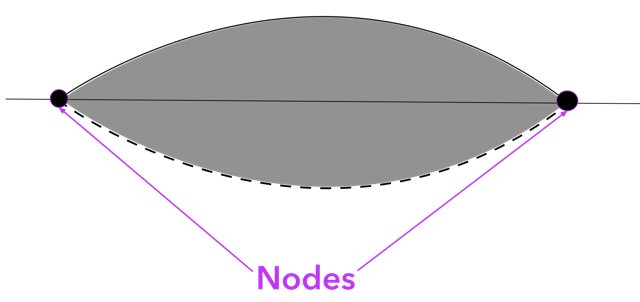
Nodes are fixed points of a standing wave where displacement is zero at every time. For y(x,t) = A sin(kx) cos(ωt), nodes occur at x = nπ/k.
- Related Glossary Terms
- Index
Reviewed physics notes (1)
These corrections keep the original lesson’s purpose while fixing errors in the source edition.
- A zero crossing of an arbitrary instantaneous sine graph need not be a node. — Reference 1
Glossary and deeper reading · 1 refreshers
These editorial refreshers supplement the reading. Definitions and examples are added guidance; original source wording and recorded answers remain in their original context.
-
Standing wave
A standing wave is a spatially fixed interference pattern formed by suitable waves traveling in opposite directions. Its nodes remain at zero displacement while antinodes mark positions of maximum oscillation amplitude. For example, a string fixed at both ends can support standing waves whose wavelengths fit the boundary conditions.