Standing Wave
Reference from the original Physics I textbook.
- Standing Wave
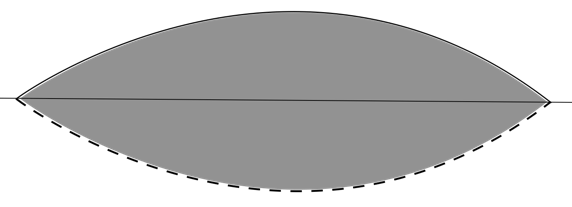
A standing wave has a stationary pattern of nodes and antinodes. Equal-frequency, equal-amplitude waves traveling in opposite directions can combine to form it. The two traveling waves are not equal at every point and time.
- Related Glossary Terms
Combined Standing Wave Equation, Initial Standing Wave Equation, Nodesⓘ, Reflective Standing Wave Equation
- Index
Reviewed physics notes (1)
These corrections keep the original lesson’s purpose while fixing errors in the source edition.
- Original incorrectly puts a reflected wave below the wave and declares equality at all points. — Reference 1
Glossary and deeper reading · 2 refreshers
These editorial refreshers supplement the reading. Definitions and examples are added guidance; original source wording and recorded answers remain in their original context.
-
Standing wave
A standing wave is a spatially fixed interference pattern formed by suitable waves traveling in opposite directions. Its nodes remain at zero displacement while antinodes mark positions of maximum oscillation amplitude. For example, a string fixed at both ends can support standing waves whose wavelengths fit the boundary conditions.
-
Wave node
A wave node is a location where the specified oscillating quantity has zero oscillation amplitude in a standing-wave pattern. Displacement nodes and pressure nodes in a sound standing wave need not occur at the same positions, so the quantity must be named. For example, the fixed ends of an ideal vibrating string are displacement nodes.