Simple Harmonics
Original textbook reading.
Enrichment beyond the AP course.
The opening restoring-force explanation supports AP SHM. Most of this original section teaches standing waves, which are extra exploration. Follow the AP Oscillations lessons for the full required SHM path.
Simple harmonic motion occurs when acceleration is proportional to displacement from equilibrium and directed toward that equilibrium: a=−ω²x. For an ideal mass on a spring, F=−kx. A pendulum is approximately harmonic only for small angular displacements, when sinθ≈θ.
Figure 10.1.1 Pendulum
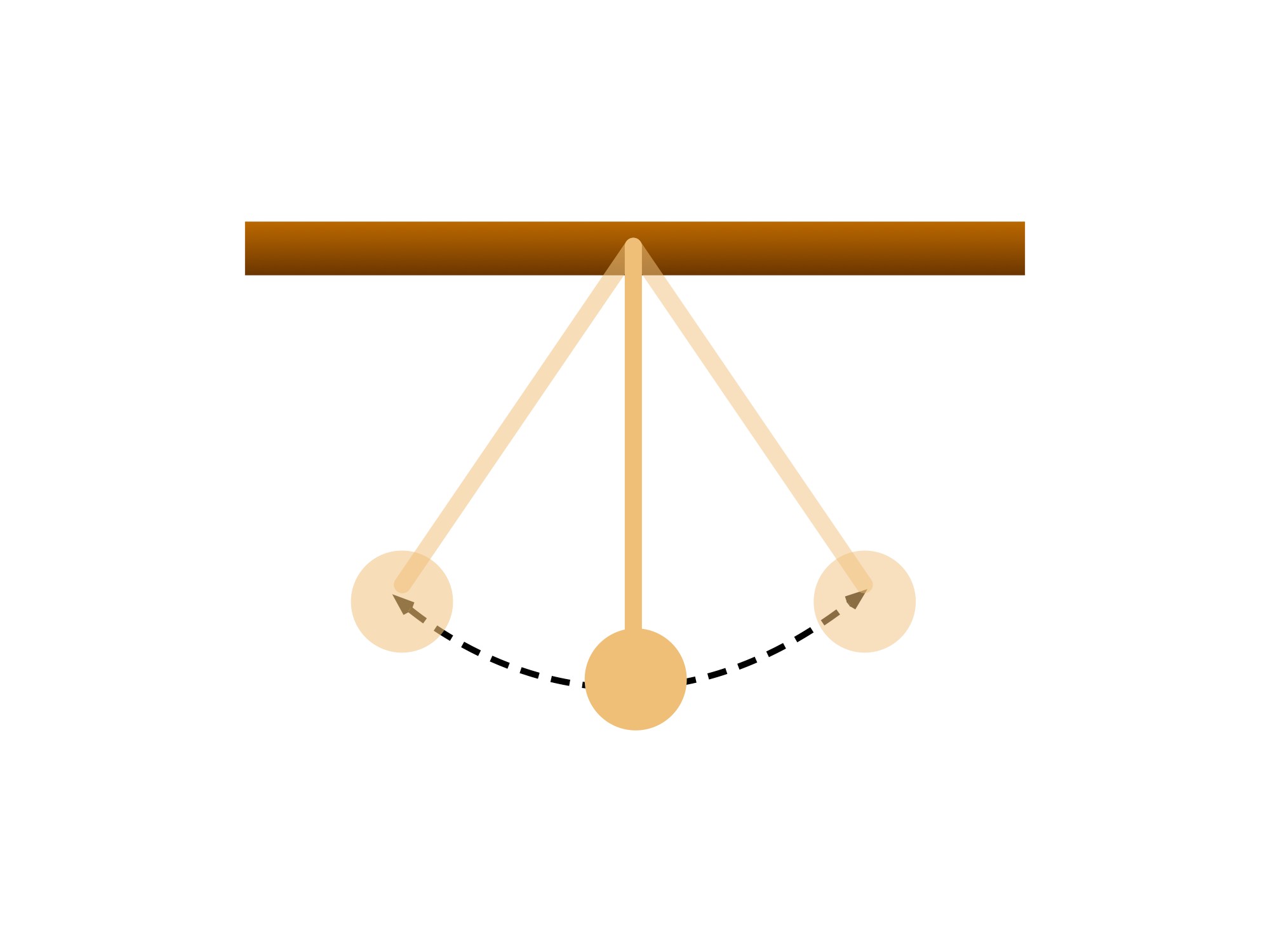
Figure 10.1.2 Standing Wave
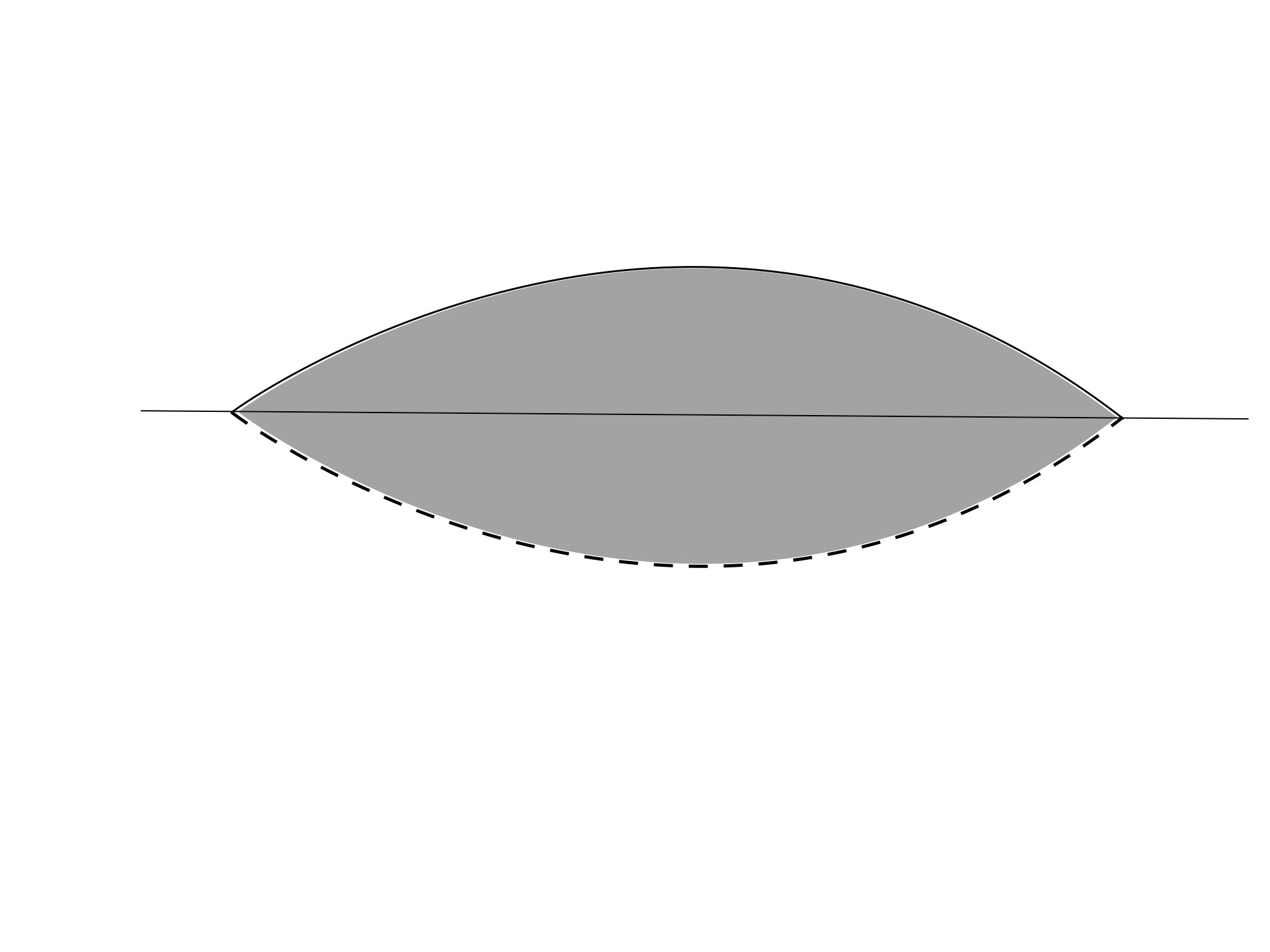
A sinusoidal traveling wave makes each medium element oscillate. A standing wave forms from equal-frequency, equal-amplitude waves traveling in opposite directions with suitable relative phase. Its nodes stay fixed in space. Standing waves can occur on real strings fixed at both ends; damping gradually reduces their amplitude unless a driver supplies energy.
Reflection can provide the counterpropagating wave that interferes with an incident wave. An ideal fixed endpoint reverses the reflected displacement, with the phase chosen so the total displacement remains zero there. Other pairs of counterpropagating waves can also form standing waves.
For the particular equal-amplitude, opposite-direction waves and phase convention below, the superposition is a standing wave:
Figure 10.1.3 Are Initial and Reversed Waves Different?
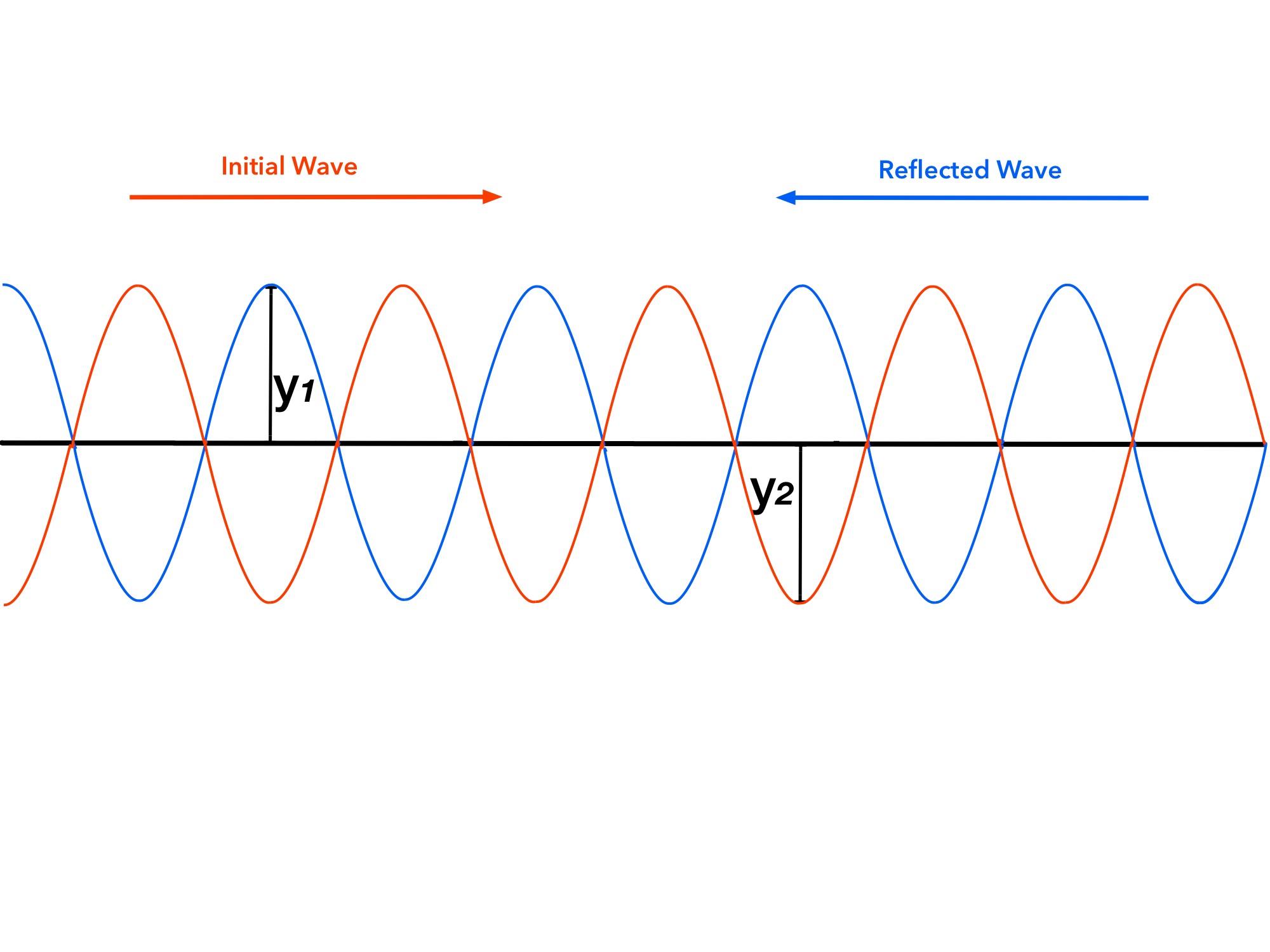
The equation of the reversed wave is:
Adding them together and combining the trigonometric functions gives us:
This means that the wave is oscillating in time, but there will be points on the wave that are always going to be at . These points can be found by the sine portion of the function, .
Nodes
For y=2y₀sin(kx)cos(ωt), nodes occur at x=jπ/k, where j is an integer: each node has zero displacement for every time. Adjacent nodes are λ/2 apart. Antinodes lie halfway between nodes and have maximum displacement amplitude 2|y₀|. A point that is zero at just one instant need not be a node.
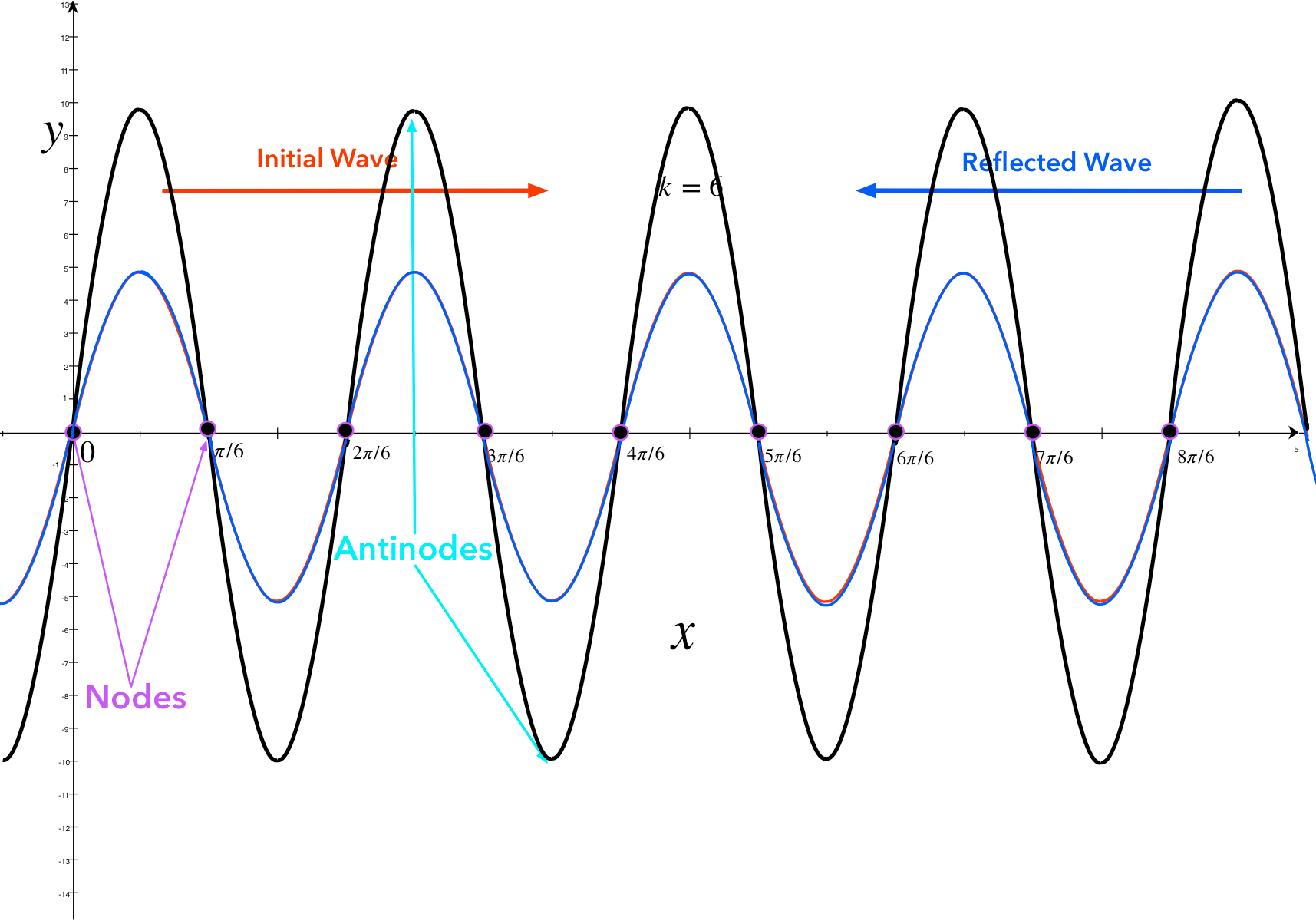
Nodes remain at zero as both the initial (red) and reflected (blue) waves move along the line. Notice here that the red wave and blue wave lie on top of each other so the peaks (black line) which are the antinodes are double the height of the original wave. Since k=6, the nodes occur every pi/6 increment.
Read every step and figure
Step 1
Nodes remain at zero as both the initial (red) and reflected (blue) waves move along the line. Notice here that the red wave and blue wave lie on top of each other so the peaks (black line) which are the antinodes are double the height of the original wave. Since k=6, the nodes occur every pi/6 increment.
Step 2
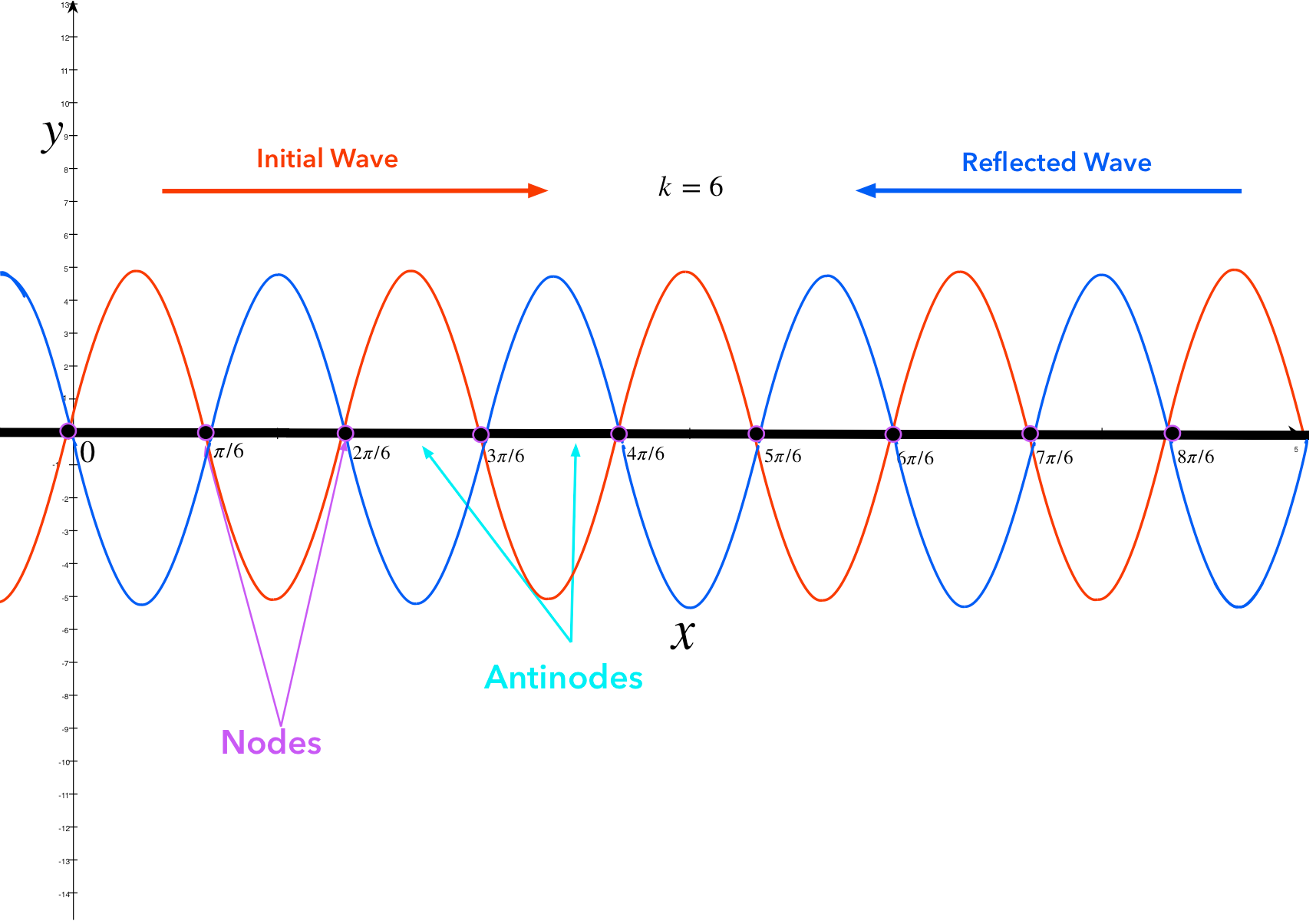
Here the blue waves shift left and red waves shift right so they are positioned such that they cancel each other through destructive interference which is why the resultant wave is a flat black line. But the nodes did not change, they still remain at a value of zero.
Step 3
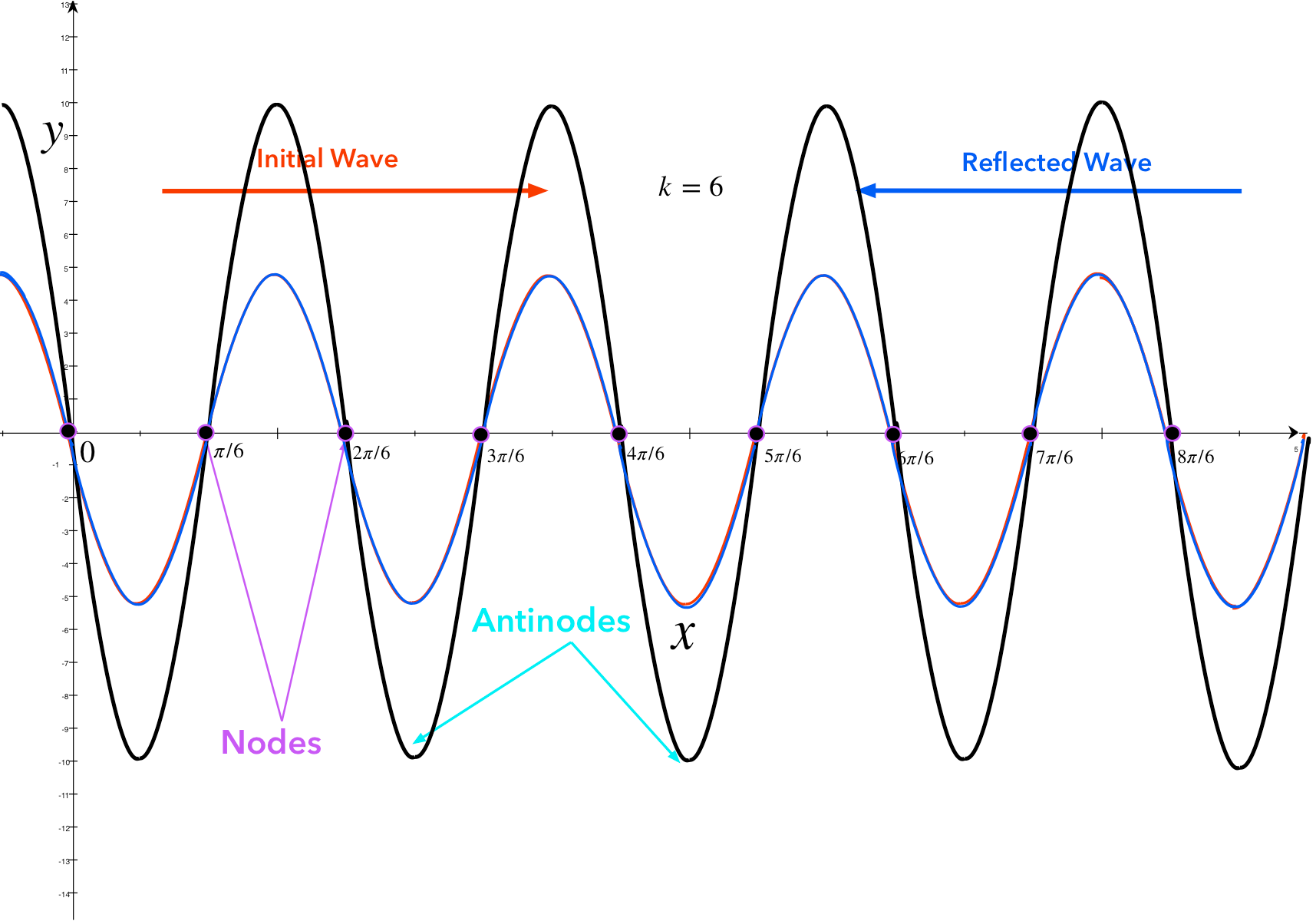
The waves are shifted and are positioned on top of each other again. Notice the black wave between pi/6 and 2pi/6 and how it lies above the x-axis? Before it was below the x-axis. And the nodes still remain at a value of 0 indicating that the black waves oscillate above and below the x-axis.
Step 4
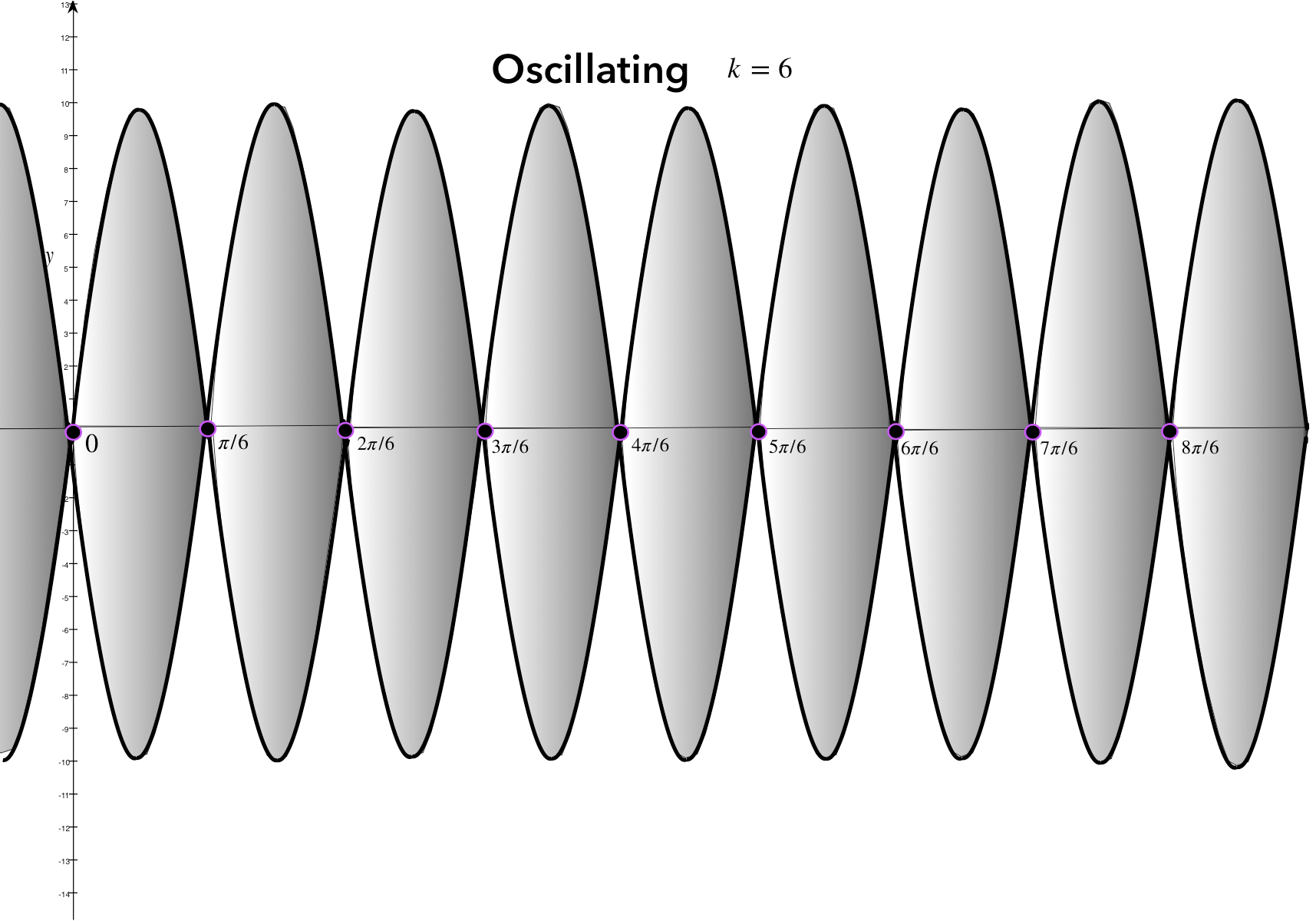
A uniform string with specified endpoints supports discrete normal modes. For two fixed ends, mode n has n half-wavelength loops, kₙ=nπ/L and fₙ=nv/(2L), where n=1,2,3,…. Arbitrary driving frequencies need not produce one of these resonant modes.
For a uniform string with both ends fixed, its allowed wavelengths satisfy:
In this case, is the length of the string, and is wavelength of the standing wave. The value of represents the harmonic state of a wave and is used to characterize a wave state and also determine the number of nodes. Simplest standing wave pattern is one we already know and is designated as the first harmonic (). There are multiple harmonics between two fixed points displayed in the images below.
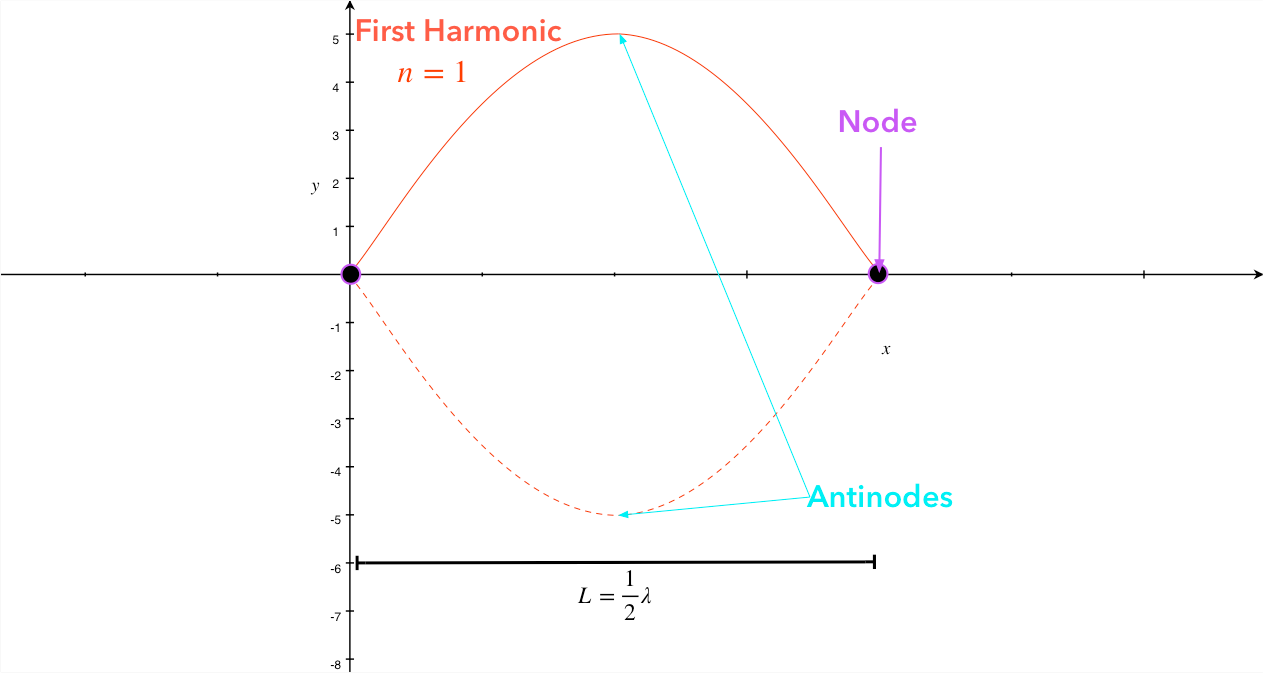
Dashed line represents the movement of the wave. Remember that the wave oscillates above and below the x-axis between the nodes such that it creates a loop shape. Best way to visualize harmonics is how many loops there are. The number of loops will tell you the harmonic state. In this case, there is one loop (n=1), so this wave is the first harmonic.
Read every step and figure
Step 1
Dashed line represents the movement of the wave. Remember that the wave oscillates above and below the x-axis between the nodes such that it creates a loop shape. Best way to visualize harmonics is how many loops there are. The number of loops will tell you the harmonic state. In this case, there is one loop (n=1), so this wave is the first harmonic.
Step 2
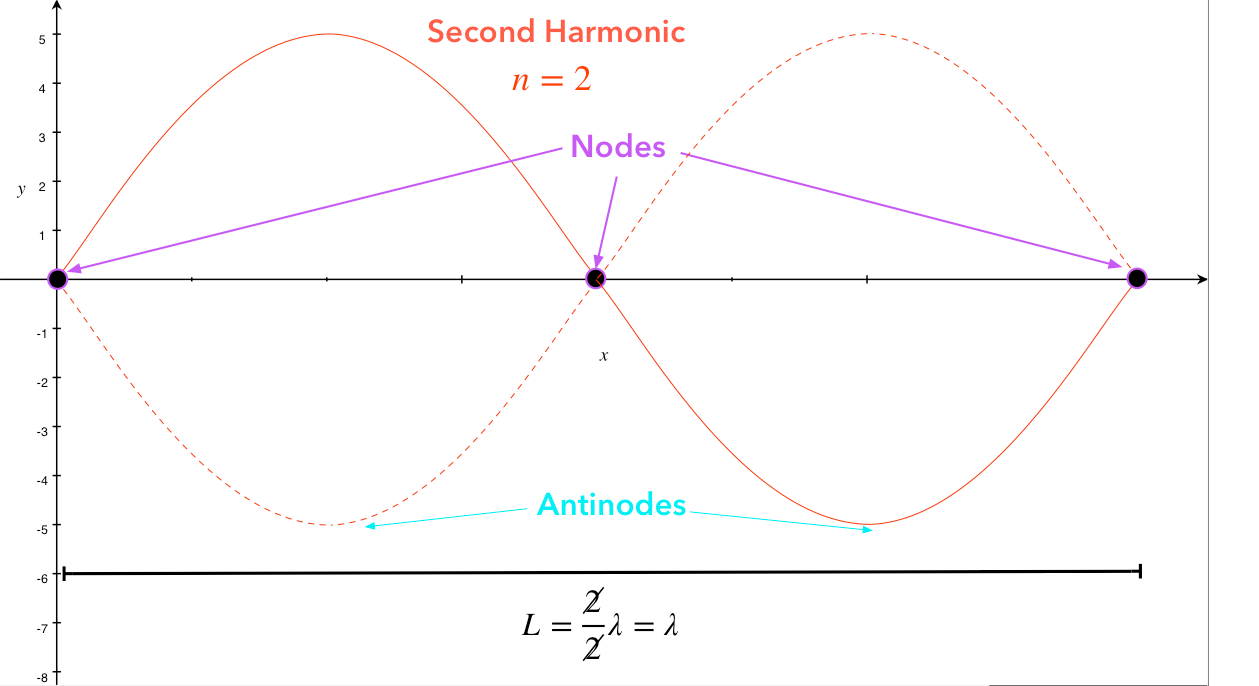
Here there are two loops, so this wave is in the second harmonic state. Notice there are 3 nodes, which is 1 value higher than the current harmonic (2+1). So the number of nodes is always 1 higher than the current harmonic when the wave is fixed at both ends.
Step 3
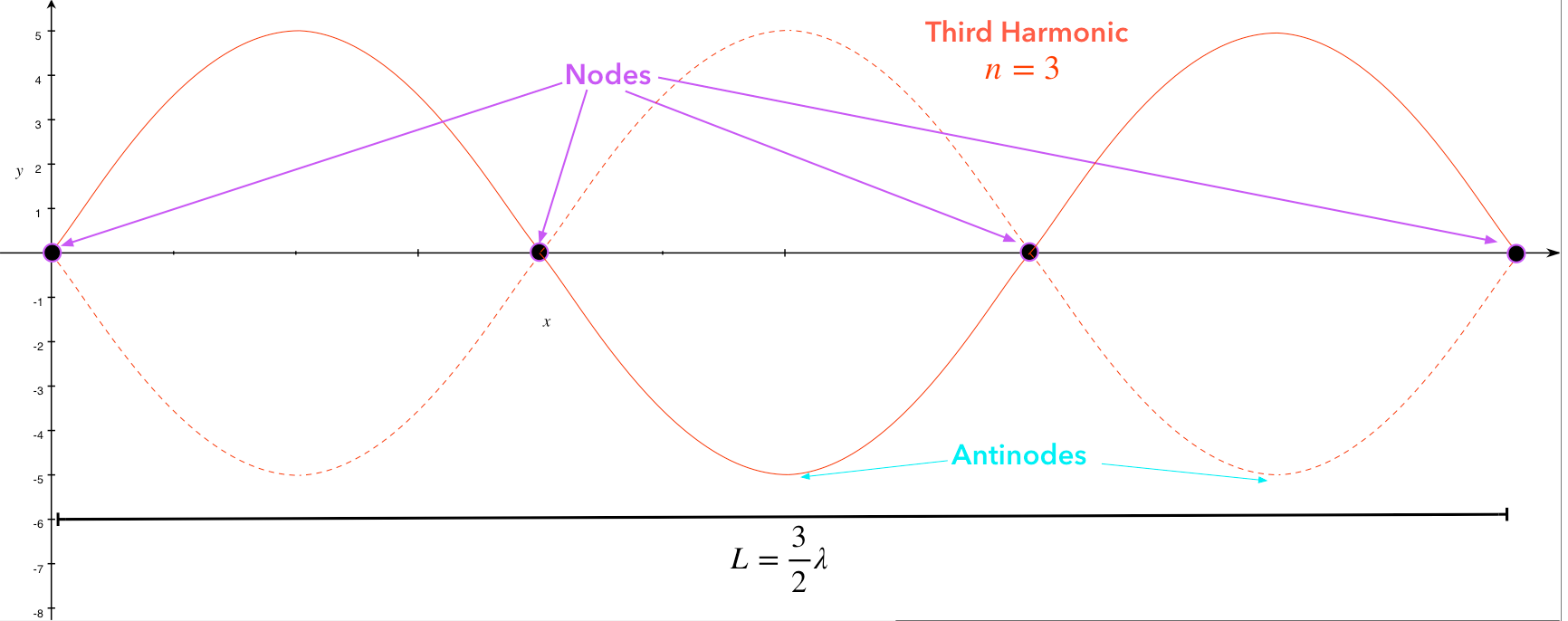
Key Note: If the string is fixed at both ends, such as a guitar string, then the number of nodes is found from nodes = . This includes both of the ends, as the fixation of the ends forces both ends to act as nodes. This is a good way to check yourself to see if you’re correct in terms of deciding a wave’s harmonic state.
In an ideal free–free transverse waveguide, both endpoint slopes are zero and the ends are antinodes. For nonzero mode n, L=nλ/2 and there are n interior nodes. A hand-held rope is a driven system; moving its ends does not automatically impose ideal free-end boundary conditions. A taut string needs tension to support the usual linear wave model.
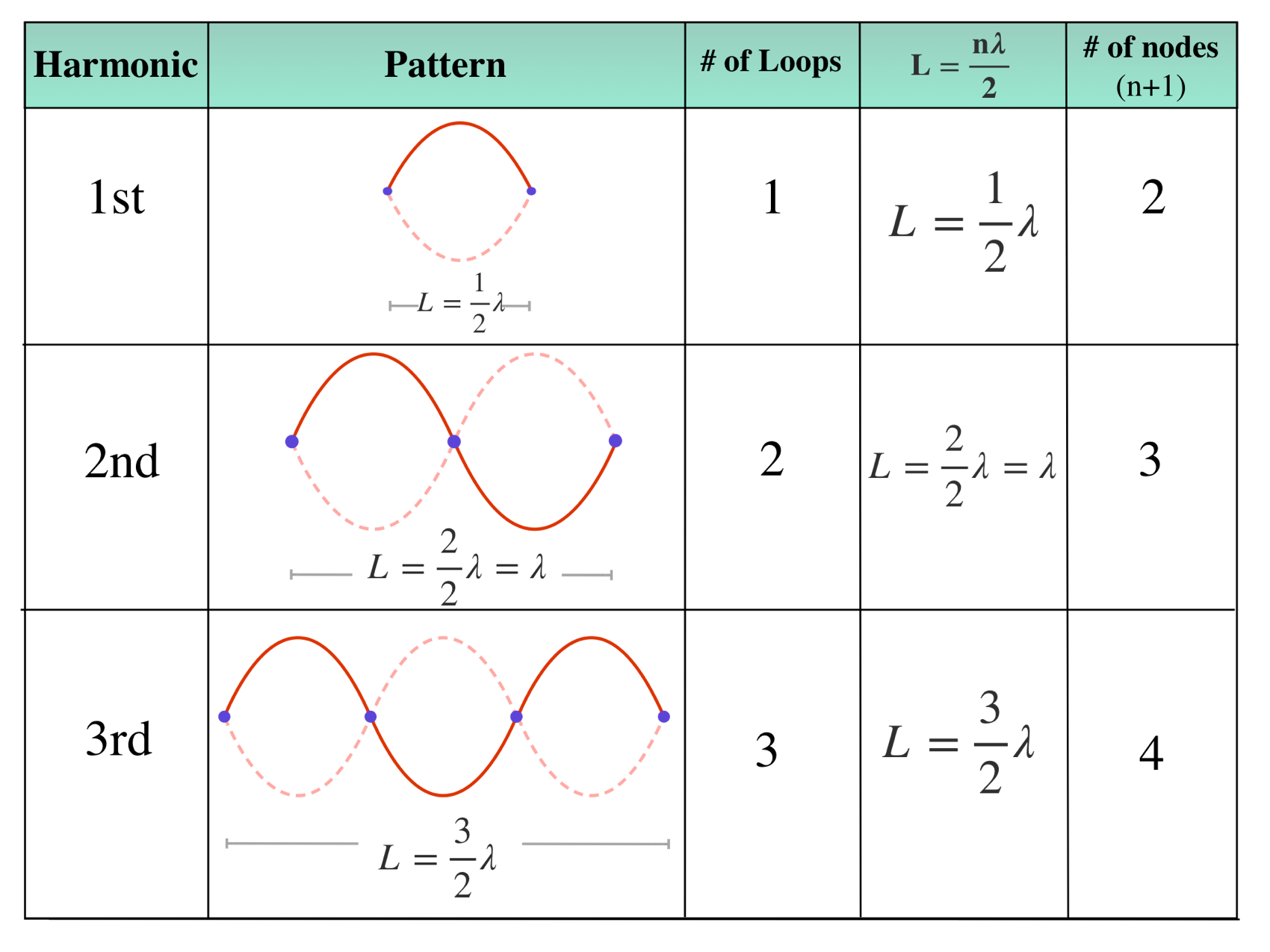
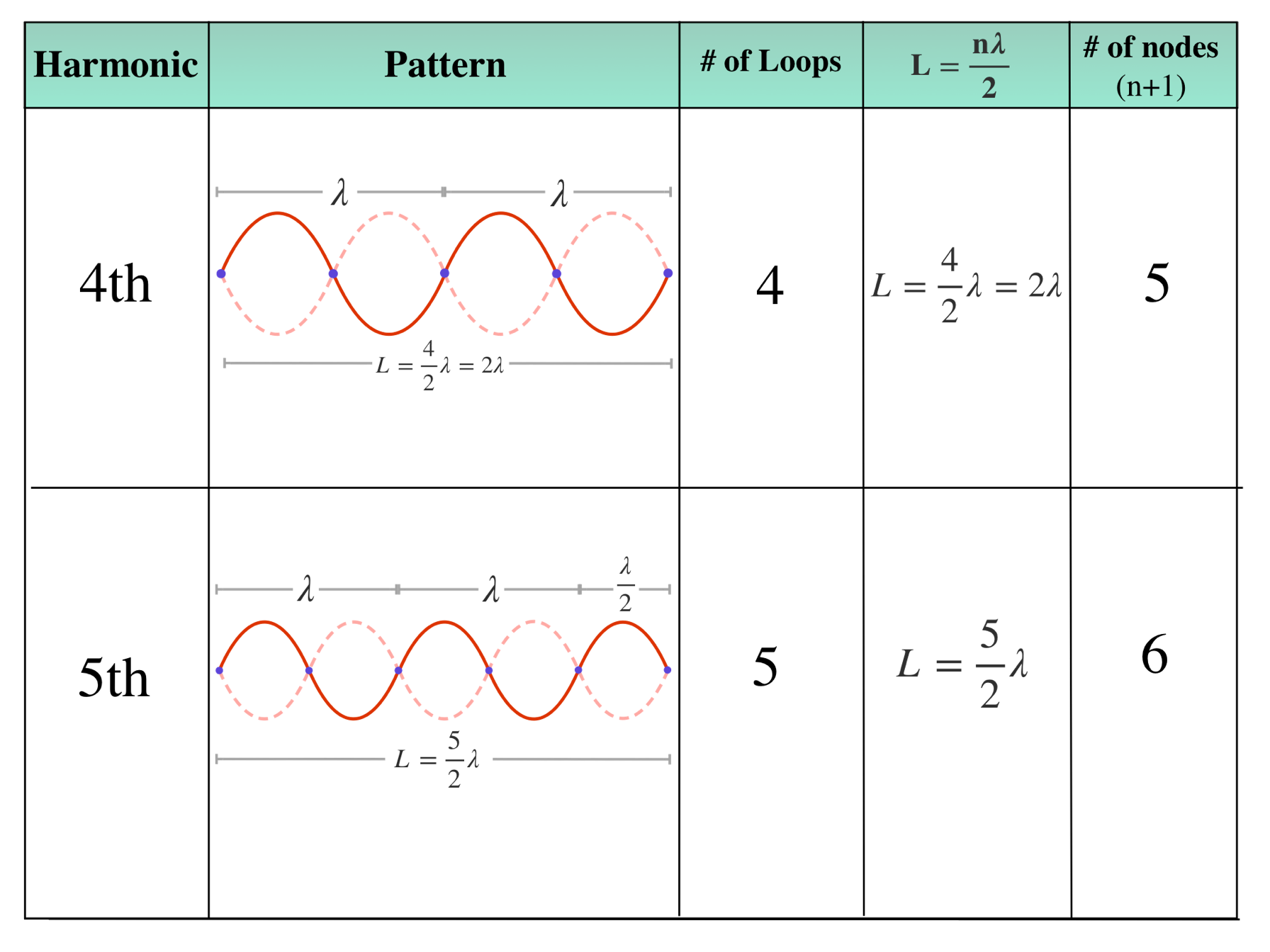
A table with a detailed list of harmonics is shown on the next page. Use it as a reference when dealing with problems.
If a wave with the following function was induced on a string with two fixed ends, how long must the string be if the standing wave produced was to have nodes? The units of are .


Reviewed physics notes (12)
These corrections keep the original lesson’s purpose while fixing errors in the source edition.
- Repeated motion alone is not sufficient for SHM, and pendulums need the small-angle limit. — Reference 1, Reference 2
- A time trace of SHM is not automatically a standing wave, and fixed-end standing waves exist in real systems. — Reference 1
- State the boundary-dependent reflection phase and avoid claiming reflection is the only mechanism. — Reference 1
- The displayed equations are one phase convention, not a universal reflected-wave rule. — Reference 1
- Distinguish permanent nodes from instantaneous zero crossings. — Reference 1
- Not every arbitrary frequency defines a harmonic normal mode. — Reference 1
- State the boundary condition of L=nλ/2. — Reference 1
- Free ends are boundary conditions, not simply endpoints that people move. — Reference 1, Reference 2
- Zero restoring torque does not mean zero net force at the bottom. — Reference 1
- Gravity is not switched on only at the top; maximum tangential magnitude statement requires the small-swing range. — Reference 1
- The counterpropagating component has to obey the endpoint phase. — Reference 1
- The initial traveling wave alone does not uniquely specify a reflected phase; make the supplied derivation explicit. — Reference 1
Glossary and deeper reading · 12 refreshers
These editorial refreshers supplement the reading. Definitions and examples are added guidance; original source wording and recorded answers remain in their original context.
-
Simple harmonic motion
Simple harmonic motion occurs when the net restoring force is proportional to displacement from equilibrium and points in the opposite direction. The resulting position varies sinusoidally with time in the ideal model. For example, a mass attached to an ideal spring can execute simple harmonic motion when damping is negligible.
-
Acceleration
Acceleration is the vector rate of change of velocity with time. It can change an object’s speed, direction, or both, and it is measured in meters per second squared. For example, a satellite moving at constant speed in a circular orbit accelerates toward the center.
-
Wave
A wave is a propagating disturbance that can transfer energy without transporting the medium as a whole. Mechanical waves require a material medium, while electromagnetic waves can propagate through vacuum. For example, a pulse travels along a rope while individual rope segments move locally around their equilibrium positions.
-
Frequency
Frequency is the number of complete repeating cycles per unit time. It is measured in hertz, meaning cycles per second, and is the reciprocal of the period. For example, a vibrating string with a higher frequency produces more cycles each second.
-
Reflection
Reflection occurs when a wave returns from a boundary into the region from which it arrived. For a light ray at a surface, the reflection angle equals the incidence angle when both are measured from the local normal. For example, a smooth mirror produces an orderly image while a rough surface scatters reflected rays in many directions.
-
Displacement
Displacement is the vector change in position from the start of an interval to its end. It depends on those endpoints rather than the length or shape of the path traveled. For example, walking around a closed track and returning to the start gives zero displacement but a nonzero distance traveled.
-
Amplitude
Amplitude is the maximum magnitude of a repeating disturbance measured from its equilibrium value. It describes the size of the oscillation rather than its frequency or propagation speed. For example, pulling a spring-mounted mass farther from equilibrium increases its oscillation amplitude when it is released from rest.
-
Oscillation phase
Phase specifies the position within a repeating oscillation cycle. A phase difference tells how much one oscillation leads or lags another at a chosen place and time. For example, two sinusoidal waves half a cycle out of phase can cancel when their amplitudes are equal.
-
Wave node
A wave node is a location where the specified oscillating quantity has zero oscillation amplitude in a standing-wave pattern. Displacement nodes and pressure nodes in a sound standing wave need not occur at the same positions, so the quantity must be named. For example, the fixed ends of an ideal vibrating string are displacement nodes.
-
Antinode
A wave antinode is a location where the specified oscillating quantity has its largest oscillation amplitude in a standing-wave pattern. Displacement antinodes and pressure antinodes describe different quantities, and their instantaneous values can still pass through equilibrium. For example, the center of a string in its fundamental two-fixed-end mode is a displacement antinode.
-
Wavelength
Wavelength is the spatial distance between neighboring points at the same phase of a periodic wave. It connects propagation speed and frequency through speed equal to frequency times wavelength. For example, neighboring crests of a sinusoidal water wave are separated by one wavelength.
-
Tension
Tension is a pulling force transmitted through a stretched rope, string, or similar connector. It acts along the connector away from the object it pulls, and an ideal massless rope has the same tension throughout an uninterrupted segment. For example, a rope supporting an accelerating load can have a tension different from the load’s weight.