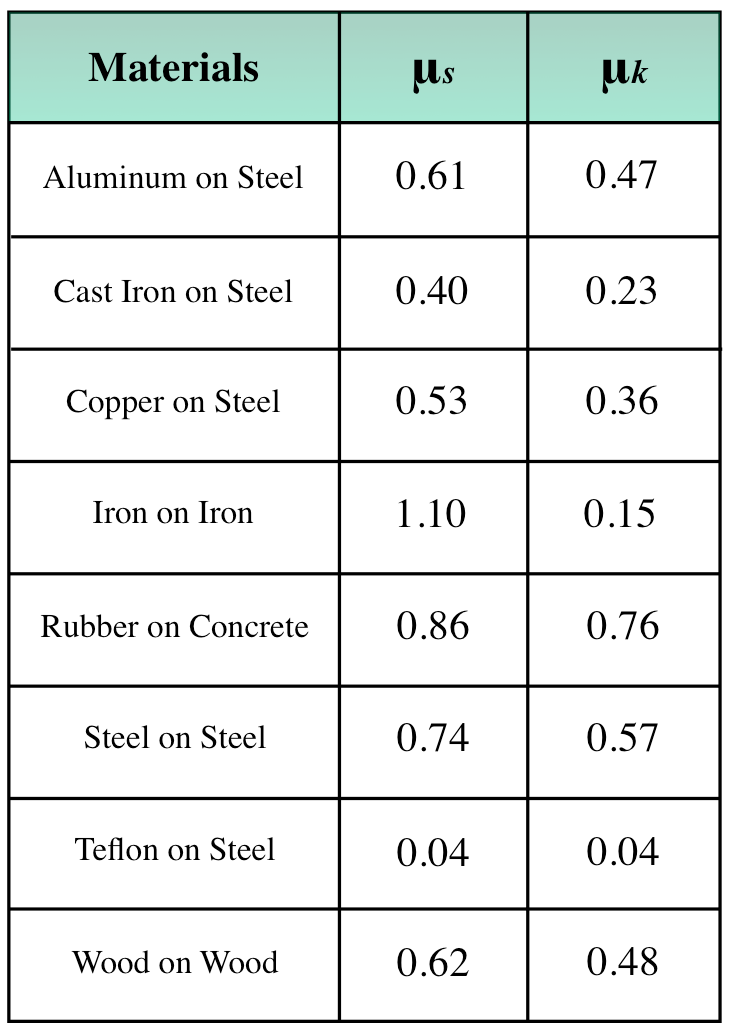
Table 1.4.1: List of Coefficient of Frictions
Reference from the original Physics I textbook.
- Table 1.4.1: List of Coefficient of Frictions
- Related Glossary Terms
Free body diagrams↗, Friction Force Equation, Static Friction↗
Glossary and deeper reading · 2 refreshers
These editorial refreshers supplement the reading. Definitions and examples are added guidance; original source wording and recorded answers remain in their original context.
-
Free-body diagram
A free-body diagram shows the external forces acting on one selected object or system. Each arrow names a real interaction, and its direction is the direction of that force. For example, a book resting on a desk has a downward gravitational force and an upward normal force; velocity is not an extra force arrow.
-
Static friction
Static friction opposes the tendency for relative sliding between surfaces that are not sliding at their contact. In the simple model it adjusts up to a maximum set by the coefficient of static friction and normal force. For example, static friction can push a walking person forward when the foot pushes backward on the ground.