AP Unit 2 Solutions
Worked solutions to all thirty Unit 2 problems. Each solution gives the mathematical steps and the reason for using them. Compare your setup and justification as well as the final answer.
Problem 1
For s(t)=t²−2t meters, find the average rate on [1,4] seconds and the instantaneous rate at t=1 using a limiting difference quotient.
- Compute s(1)=−1 and s(4)=8; average rate=(8−(−1))/(4−1)=3 m/s. Reason: a secant slope compares two endpoints.
- At 1, [s(1+h)−s(1)]/h=h for h≠0. Reason: s(1+h)=−1+h².
- Let h→0 to obtain 0 m/s. Reason: the instantaneous rate is the limiting secant slope.
Answer: Average 3 m/s; instantaneous at 1 is 0 m/s.
Final answer
Average 3 m/s; instantaneous at 1 is 0 m/s.
Review the teaching: Topic 2.1
Problem 2
Find the derivative of f(x)=x²+1 at x=−2 using lim(x→−2)[f(x)−f(−2)]/(x+2).
- Compute f(−2)=5, so the numerator is x²−4. Reason: the difference quotient compares nearby values with the base value.
- Factor and cancel: (x²−4)/(x+2)=x−2 for x≠−2. Reason: equal nearby expressions have the same limit.
- Take x→−2 to obtain −4. Reason: the simplified line is continuous.
Answer: f′(−2)=−4.
Final answer
f′(−2)=−4.
Review the teaching: Topic 2.1
Problem 3
A bacteria population B(t), measured in thousands, has B(3)=7 and B(3+h)=7+2h+0.4h² near h=0. Find B′(3), with units.
- Subtract B(3) and divide by h to obtain 2+0.4h for h≠0. Reason: this is the average-rate quotient.
- Take h→0 to get 2. Reason: the finite limit defines the derivative.
- Attach units thousands of bacteria per unit time. Reason: derivative units are output units divided by the input units.
Answer: B′(3)=2 thousand bacteria per unit time.
Final answer
B′(3)=2 thousand bacteria per unit time.
Review the teaching: Topic 2.1
Problem 4
Use the derivative definition to find f′(x) for f(x)=x²−3x.
- Compute f(x+h)−f(x)=2xh+h²−3h. Reason: expansion isolates the output change.
- For h≠0 the difference quotient is 2x+h−3. Reason: every numerator term has a factor h.
- Let h→0 to obtain f′(x)=2x−3. Reason: the finite limit exists for every real x.
Answer: f′(x)=2x−3.
Final answer
f′(x)=2x−3.
Review the teaching: Topic 2.2
Problem 5
For f(x)=x²+2, find the equation of the tangent line at x=−1.
- The tangent point is (−1,3). Reason: substitute into f.
- f′(x)=2x, so f′(−1)=−2. Reason: the derivative gives tangent slope.
- Use point-slope form y−3=−2(x+1), or y=−2x+1. Reason: a line is determined by its slope and point.
Answer: y=−2x+1.
Final answer
y=−2x+1.
Review the teaching: Topic 2.2
Problem 6
A graph of F passes through (2,5), and its tangent there passes through (4,1). Determine F′(2) and the tangent equation. State whether F(4) must equal 1.
- Compute tangent slope (1−5)/(4−2)=−2. Reason: both supplied points lie on the tangent line.
- Write F′(2)=−2 and tangent y−5=−2(x−2). Reason: the derivative equals the tangent slope.
- F(4) need not be 1. Reason: a point on a tangent away from tangency need not lie on the curve.
Answer: F′(2)=−2; tangent y=−2x+9; F(4) is not determined.
Final answer
F′(2)=−2; tangent y=−2x+9; F(4) is not determined.
Review the teaching: Topic 2.2
Problem 7
A water-depth function D(t) has D(6)=1.8 meters and D′(6)=−0.12 meters per minute. Explain the meaning of each value and write an equation for the tangent line using y for depth.
- D(6)=1.8 gives the depth at minute 6. Reason: D is the original output function.
- D′(6)=−0.12 means depth is decreasing at an instantaneous rate of 0.12 m/min at that time. Reason: the derivative is a signed rate.
- Write y−1.8=−0.12(t−6). Reason: use the depth and rate at the same input.
Answer: Depth 1.8 m; instantaneous decrease 0.12 m/min; tangent y−1.8=−0.12(t−6).
Final answer
Depth 1.8 m; instantaneous decrease 0.12 m/min; tangent y−1.8=−0.12(t−6).
Review the teaching: Topic 2.2
Problem 8
| t (s) | 1.8 | 2.0 | 2.2 |
|---|---|---|---|
| s(t) (m) | 5.24 | 6.00 | 6.84 |
Estimate s′(2) with a centered difference, and explain the units.
- Use the points on either side of 2. Reason: a centered difference samples both sides.
- Compute (6.84−5.24)/(2.2−1.8)=4. Reason: this is the nearby secant slope.
- Report s′(2)≈4 m/s. Reason: measured data give an estimate of position change per second.
Answer: Approximately 4 m/s.
Final answer
Approximately 4 m/s.
Review the teaching: Topic 2.3
Problem 9
A graph of a smooth function has a tangent at x=3 drawn through (1,−2) and (5,6). Estimate f′(3). Explain why choosing distant points on the curve instead would measure a different rate.
- Use the two points on the tangent: slope=(6−(−2))/(5−1). Reason: a tangent line has the same slope at all its points.
- Compute 8/4=2. Reason: slope is rise divided by run.
- Conclude f′(3)≈2; distant curve points give a secant average instead. Reason: the derivative describes the local tangent rate.
Answer: f′(3)≈2.
Final answer
f′(3)≈2.
Review the teaching: Topic 2.3
Problem 10
Use a calculator in radians to estimate f′(1) for f(x)=e^(−x²), using centered differences with h=0.01 and h=0.001. Round the final estimate to six decimals and describe a numerical limitation.
- At h=0.01, [f(1.01)−f(0.99)]/0.02≈−0.735734. Reason: the centered quotient estimates the local slope.
- At h=0.001, [f(1.001)−f(0.999)]/0.002≈−0.735759. Reason: checking a second step size tests the stability of the estimate.
- Report about −0.735759; very small h can introduce cancellation or rounding error. Reason: technology approximates a limiting process with finite precision.
Answer: f′(1)≈−0.735759.
Final answer
f′(1)≈−0.735759.
Review the teaching: Topic 2.3
Problem 11
Decide whether f(x)=|x−2| is continuous and differentiable at 2. Justify both conclusions.
- f(2)=0 and |x−2|→0 as x→2, so it is continuous. Reason: value and limit agree.
- The base-point quotient is |h|/h, equal to −1 for h<0 and 1 for h>0. Reason: the absolute value depends on the sign.
- No derivative exists at 2. Reason: the one-sided limiting slopes disagree.
Answer: Continuous at 2; not differentiable there.
Final answer
Continuous at 2; not differentiable there.
Review the teaching: Topic 2.4
Problem 12
A graph follows y=x² for x≠1 but has a filled dot at (1,7). Is the represented function differentiable at 1? Explain without calculating a derivative rule.
- The nearby graph approaches height 1 from both sides. Reason: x² is continuous.
- The filled point gives f(1)=7, so the graph is discontinuous at 1. Reason: the value differs from the limit.
- It is not differentiable at 1. Reason: differentiability implies continuity.
Answer: Not differentiable at 1, because it is discontinuous there.
Final answer
Not differentiable at 1, because it is discontinuous there.
Review the teaching: Topic 2.4
Problem 13
For f(x)=x^(1/3), test continuity and differentiability at 0 using the difference quotient. Interpret the tangent geometry.
- The function value and limit at 0 are both 0. Reason: the real cube-root function is continuous.
- For h≠0, [f(h)−f(0)]/h=h^(−2/3), which grows without bound positively as h→0. Reason: h^(2/3)>0 and shrinks to 0.
- There is a vertical tangent and no finite derivative at 0. Reason: a derivative requires a finite limiting slope.
Answer: Continuous; vertical tangent; no finite derivative at 0.
Final answer
Continuous; vertical tangent; no finite derivative at 0.
Review the teaching: Topic 2.4
Problem 14
Differentiate f(x)=x⁷ and evaluate f′(−1).
- Apply the power rule: f′(x)=7x⁶. Reason: multiply by 7 and reduce the exponent by 1.
- Evaluate at −1: 7(−1)⁶. Reason: the requested slope uses the derivative function.
- The result is 7. Reason: an even power of −1 is 1.
Answer: f′(x)=7x⁶; f′(−1)=7.
Final answer
f′(x)=7x⁶; f′(−1)=7.
Review the teaching: Topic 2.5
Problem 15
Differentiate f(x)=1/x⁴ and state its domain.
- Write f(x)=x^(−4), x≠0. Reason: power notation exposes the negative exponent.
- Differentiate to −4x^(−5). Reason: the power rule also applies to negative powers on their domains.
- Rewrite as −4/x⁵ and retain x≠0. Reason: differentiation does not fill a missing input.
Answer: f′(x)=−4/x⁵ for x≠0.
Final answer
f′(x)=−4/x⁵ for x≠0.
Review the teaching: Topic 2.5
Problem 16
Differentiate f(x)=x^(3/2) for x>0. Find the right-hand limiting difference quotient at 0 if f(0)=0; explain the distinction between this endpoint result and a two-sided derivative on a real neighborhood.
- For x>0, f′(x)=(3/2)√x. Reason: subtract 1 from the exponent 3/2.
- At 0 from the right, [h^(3/2)−0]/h=√h→0. Reason: allowed h must be positive in the real domain.
- This gives a right endpoint rate of 0, rather than a two-sided derivative on a real open neighborhood. Reason: the real function is undefined for negative x.
Answer: For x>0, f′(x)=(3/2)√x; right endpoint rate at 0 is 0, with no two-sided real-neighborhood derivative asserted.
Final answer
For x>0, f′(x)=(3/2)√x; right endpoint rate at 0 is 0, with no two-sided real-neighborhood derivative asserted.
Review the teaching: Topic 2.5
Problem 17
Differentiate P(x)=5x⁴−3x²+2x−11.
- Differentiate 5x⁴ to 20x³. Reason: constant multiple and power rules.
- Differentiate −3x² and 2x to −6x and 2. Reason: linearity preserves coefficients and signs.
- Differentiate −11 to 0 and combine terms. Reason: a constant has no change.
Answer: P′(x)=20x³−6x+2.
Final answer
P′(x)=20x³−6x+2.
Review the teaching: Topic 2.6
Problem 18
Let A(x)=2x³−4x+9 and B(x)=x²−3. Find the derivative of 3A−2B at x=1.
- A′(x)=6x²−4 and B′(x)=2x. Reason: polynomial derivatives use power and linearity rules.
- (3A−2B)′=3(6x²−4)−2(2x). Reason: derivatives pass through constant multiples and differences.
- At 1 the result is 3·2−2·2=2. Reason: evaluate after differentiating.
Answer: (3A−2B)′(1)=2.
Final answer
(3A−2B)′(1)=2.
Review the teaching: Topic 2.6
Problem 19
Differentiate f(x)=3sin x−2cos x+eˣ+ln x, giving the domain of the formula.
- The trig terms give 3cos x+2sin x. Reason: cosine differentiation introduces a minus sign that cancels the coefficient sign.
- The exponential and logarithm terms give eˣ+1/x. Reason: use the familiar derivative rules.
- Combine and require x>0. Reason: the logarithm restricts the original domain.
Answer: f′(x)=3cos x+2sin x+eˣ+1/x, x>0.
Final answer
f′(x)=3cos x+2sin x+eˣ+1/x, x>0.
Review the teaching: Topic 2.7
Problem 20
Evaluate lim(h→0)[sin(π/6+h)−sin(π/6)]/h without a calculator.
- Recognize the derivative definition for f(x)=sin x at a=π/6. Reason: the numerator is f(a+h)−f(a).
- Use f′(x)=cos x in radians. Reason: the known rule evaluates the limiting quotient.
- Compute cos(π/6)=√3/2. Reason: this is a familiar unit-circle value.
Answer: √3/2.
Final answer
√3/2.
Review the teaching: Topic 2.7
Problem 21
Evaluate lim(x→2)[ln x−ln 2]/(x−2), and identify the function and base input.
- The function is f(x)=ln x and the base input is 2. Reason: the expression matches [f(x)−f(2)]/(x−2).
- Its limit is f′(2). Reason: this is the x-form derivative definition.
- Since f′(x)=1/x, the value is 1/2. Reason: 2 lies in the logarithm domain.
Answer: Function ln x, base 2, limit 1/2.
Final answer
Function ln x, base 2, limit 1/2.
Review the teaching: Topic 2.7
Problem 22
Find the tangent line to y=eˣ at x=0.
- The tangent point is (0,1). Reason: e⁰=1.
- The derivative is eˣ, so the slope at 0 is 1. Reason: the exponential rate equals its value.
- Use y−1=1(x−0). Reason: point-slope form uses the tangent point and rate.
Answer: y=x+1.
Final answer
y=x+1.
Problem 23
Differentiate f(x)=x²cos x.
- Identify derivatives 2x and −sin x for the two factors. Reason: both factors are differentiable.
- Apply the product rule: 2x cos x+x²(−sin x). Reason: each factor contributes a rate term.
- Simplify signs to 2x cos x−x²sin x. Reason: combining signs preserves the formula.
Answer: f′(x)=2x cos x−x²sin x.
Final answer
f′(x)=2x cos x−x²sin x.
Review the teaching: Topic 2.8
Problem 24
| Quantity | Value |
|---|---|
| f(2) | −1 |
| f′(2) | 3 |
| g(2) | 4 |
| g′(2) | −2 |
Find (fg)′(2).
- Write (fg)′(2)=f′(2)g(2)+f(2)g′(2). Reason: the product rule applies to both differentiable factors.
- Substitute 3·4+(−1)(−2). Reason: all values use input 2.
- Add 12+2=14. Reason: the negative product contributes positively.
Answer: 14.
Final answer
14.
Review the teaching: Topic 2.8
Problem 25
A rectangular sheet has length L(t) and width W(t). At t=3 seconds, L=5 cm, W=2 cm, L′=−0.4 cm/s and W′=0.6 cm/s. Find the instantaneous area rate.
- A(t)=L(t)W(t). Reason: rectangular area is the product of its dimensions.
- A′=L′W+LW′=−0.4·2+5·0.6. Reason: both dimensions change.
- Compute A′=2.2 cm²/s. Reason: area-change units come from length-rate times length.
Answer: Area is increasing at 2.2 cm²/s.
Final answer
Area is increasing at 2.2 cm²/s.
Review the teaching: Topic 2.8
Problem 26
Differentiate f(x)=(x²+2)/(x+1), stating the domain.
- Use numerator derivative 2x and denominator derivative 1. Reason: both are polynomials.
- Form [2x(x+1)−(x²+2)]/(x+1)². Reason: the quotient rule keeps numerator order and squares the denominator.
- Simplify to (x²+2x−2)/(x+1)² with x≠−1. Reason: the original denominator still restricts the domain.
Answer: f′(x)=(x²+2x−2)/(x+1)², x≠−1.
Final answer
f′(x)=(x²+2x−2)/(x+1)², x≠−1.
Review the teaching: Topic 2.9
Problem 27
| Quantity | Value |
|---|---|
| f(1) | 6 |
| f′(1) | −2 |
| g(1) | 3 |
| g′(1) | 4 |
Find (f/g)′(1).
- Check g(1)=3≠0. Reason: a quotient must be defined at the requested input.
- Use [f′(1)g(1)−f(1)g′(1)]/g(1)²=[−2·3−6·4]/9. Reason: the quotient rule applies.
- Compute −30/9=−10/3. Reason: exact reduction avoids rounding.
Answer: −10/3.
Final answer
−10/3.
Review the teaching: Topic 2.9
Problem 28
Find the derivative of R(x)=(x²+1)/x by first rewriting it. Verify the result with the quotient rule.
- For x≠0, rewrite R=x+1/x. Reason: divide each numerator term by x.
- Differentiate to 1−1/x². Reason: use the sum and negative-power rules.
- The quotient rule gives [2x·x−(x²+1)]/x²=(x²−1)/x², the same result. Reason: equivalent domain-preserving methods should agree.
Answer: R′(x)=1−1/x², x≠0.
Final answer
R′(x)=1−1/x², x≠0.
Review the teaching: Topic 2.9
Problem 29
Differentiate f(x)=tan x−cot x and evaluate f′(π/4).
- Use (tan x)′=sec²x and (cot x)′=−csc²x. Reason: these follow from trig identities and the quotient rule.
- Thus f′=sec²x+csc²x. Reason: subtracting cotangent cancels its derivative minus sign.
- At π/4 each squared reciprocal is 2, so f′=4. Reason: sine and cosine both equal √2/2.
Answer: f′(x)=sec²x+csc²x on the common domain; f′(π/4)=4.
Final answer
f′(x)=sec²x+csc²x on the common domain; f′(π/4)=4.
Review the teaching: Topic 2.10
Problem 30
Differentiate f(x)=sec x+csc x. Evaluate f′(π/6) exactly and state the excluded inputs.
- Differentiate to sec x tan x−csc x cot x. Reason: the reciprocal-trig rules have different signs.
- At π/6, sec·tan=(2/√3)(1/√3)=2/3 and csc·cot=2√3. Reason: use exact unit-circle values.
- The value is 2/3−2√3; exclude sin x=0 or cos x=0. Reason: both original terms must be defined.
Answer: f′(x)=sec x tan x−csc x cot x; f′(π/6)=2/3−2√3; sin x and cos x must both be nonzero.
Final answer
f′(x)=sec x tan x−csc x cot x; f′(π/6)=2/3−2√3; sin x and cos x must both be nonzero.
Review the teaching: Topic 2.10
Explain and apply: worked solutions
Compare the setup and the reasoning, as well as the final answer. Use the rubric to find your next step; equivalent correct reasoning earns the same credit.
Derive the complete reciprocal-trig suite
Angles x are in radians. You may use (sin x)′ = cos x, (cos x)′ = −sin x, (1)′ = 0, the quotient rule, and sin²x + cos²x = 1. Derive the requested rules from identities rather than citing memorized tan, cot, sec or csc derivative formulas.
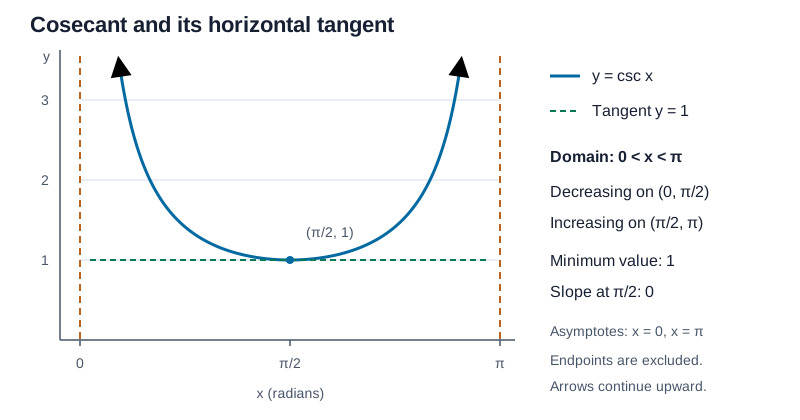
Inspect diagram labels
The diagram keeps its full size here. Focus the view and use the arrow keys, or scroll across it, to inspect every label.
Return to the unit problem →Try this problem in its lesson →
Diagnose a quotient sign or domain error
For radian x, csc x = 1/sin x and (sin x)′ = cos x. The quotient derivative is (u′v − uv′)/v².
Return to the unit problem →Try this problem in its lesson →
Represent the interval rate and its limiting tangent
A position model is s(t) = t² − 4t + 7 meters, for t in seconds. Consider the average rate on [3,6], the instantaneous rate at 3, and the derivative function. Use limiting difference quotients rather than the power rule.
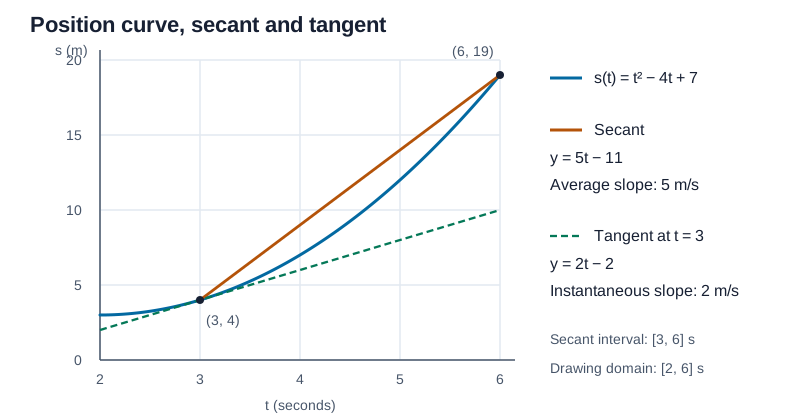
Inspect diagram labels
The diagram keeps its full size here. Focus the view and use the arrow keys, or scroll across it, to inspect every label.
Return to the unit problem →Try this problem in its lesson →