Function Transforms
Selected prerequisite review of reflection order, translations, scaling, inverse relations, and completing the square. This is not complete precalculus preparation.
This original textbook reading covers part of the AP topic. Follow the AP course outline for complete topic instruction and practice.
This reading includes verified answer corrections and explicitly stated clarifications.
Unfortunately, they do not have anything to do with giant fighting robots. Transforms are a way to change the behavior of functions in predictable ways by changing specific values and parameters. A few basic transforms are: reflection, translation, stretching and compression. Each transform can also occur horizontally (in the x-direction) or vertically (in the y-direction).
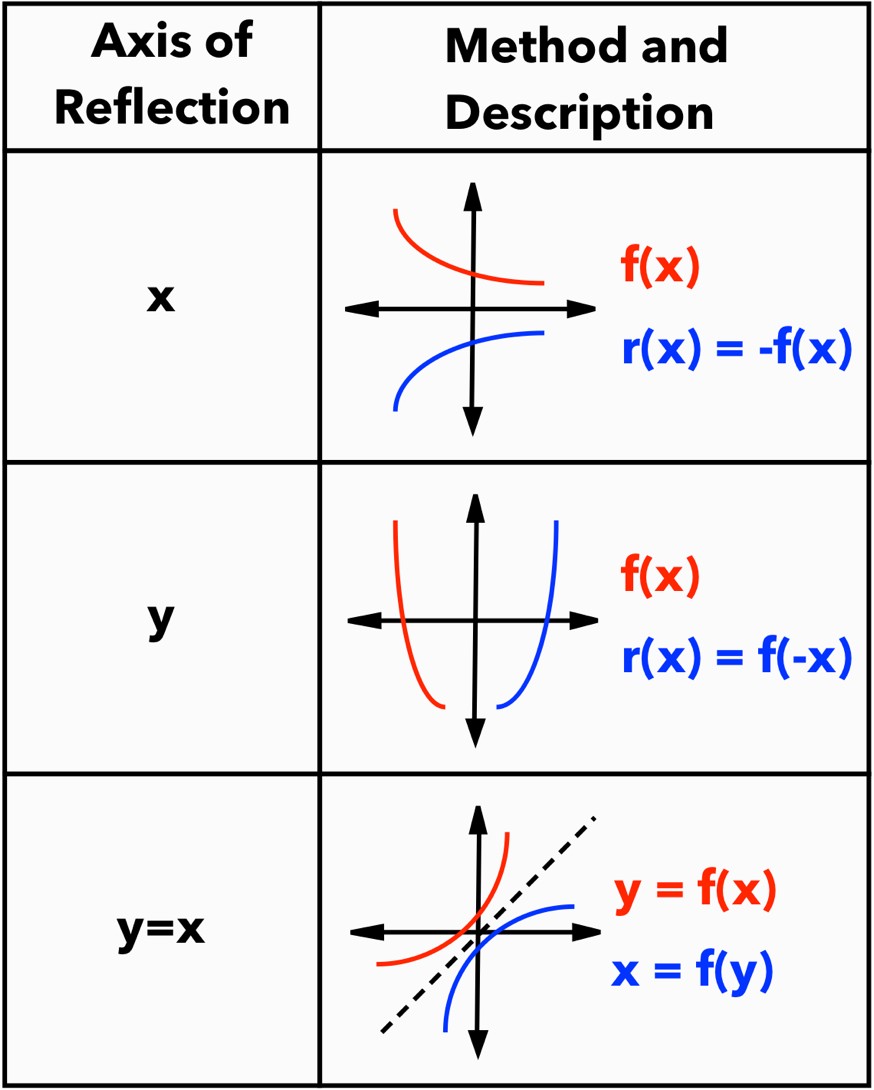
Reflection is perhaps the easiest transform to understand. Think of reflection as creating an imaginary mirror for the function to look at. You can place the mirror on the x-axis or on the y-axis, resulting in a reflection across the x-axis or a reflection across the y-axis, respectively. Here is a brief tutorial on how to do both.
Reflection across x-axis:
For any function f(x), its reflection across the x-axis is represented by the function -f(x).
For any function f(x), its reflection across the y-axis is represented by the function f(-x).
Reflection across y=x (also known as the inverse function): For any function represented by y=f(x), its reflection across the y=x line is represented by x=f(y).
The following picture summarizes the three types of reflection and how to perform them.
 What does this mean? Let’s look at some examples:
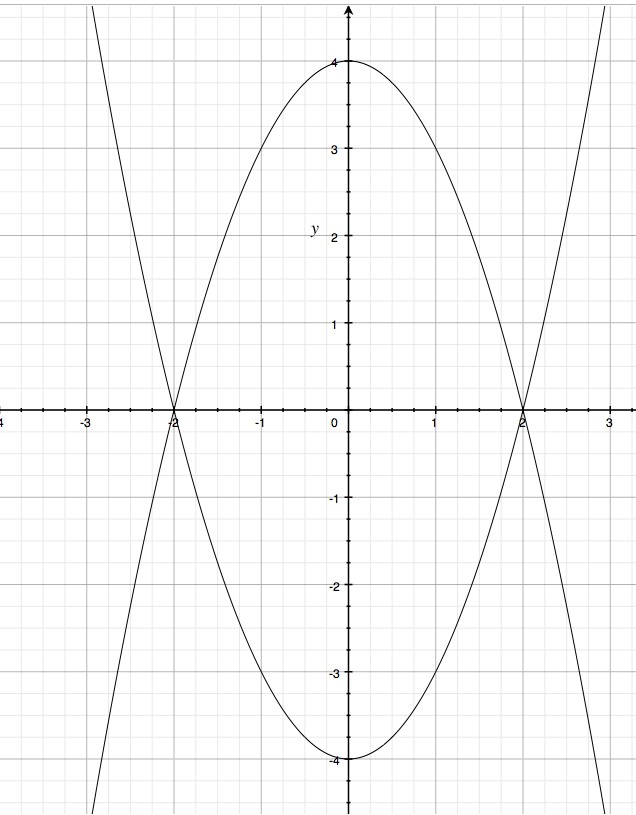
Perform all three reflections mentioned for the function .
Here is a slideshow of reflections to help you visualize the changes. When you combine reflections, keep track of their order: some pairs commute, and some do not.
Reflecting across the x-axis and then the y-axis gives the same result as reversing those two reflections. But an axis reflection and reflection across y = x generally do not commute. Try the point (1, 2): x-axis then y = x gives (−2, 1), while y = x then x-axis gives (2, −1). For a graph, apply each transformation to the result of the previous step.
Hint #2: Write out all possible combinations of different reflections without repeating any. There should be 7, plus the parent function makes a total of eight functions. After that it’s just matching the reflections to their graphs.
Additional Exercise: Write down the equations for each of the colored graphs shown in the last slide
Gallery 1.2.1 Examples of reflection at work.
Read all original image captions
Image 1
Image 2
Image 3
Image 4
of Gallery 1.2.1.
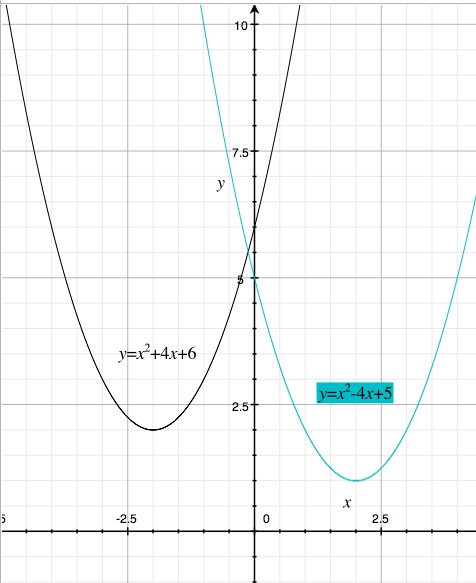
Translation simply means moving the graph in the x and y direction. A translation of the function by units is represented by the function . The h represents horizontal translation. The k represents vertical translation. Notice that positive horizontal translation is accomplished by a negative h term. yields translation in the negative-x direction by h units.
Example Problem 1.2.2
Translate the equation y= so that the new vertex is four values to the right and one value down. Write the new function.
Example Problem 1.2.3
Translate the equation horizontally 3 units in the positive direction and –2 units in the vertical direction. Write the final equation.
Gallery 1.2.2. Graphs from Example Problems 1.2.2 and 1.2.3
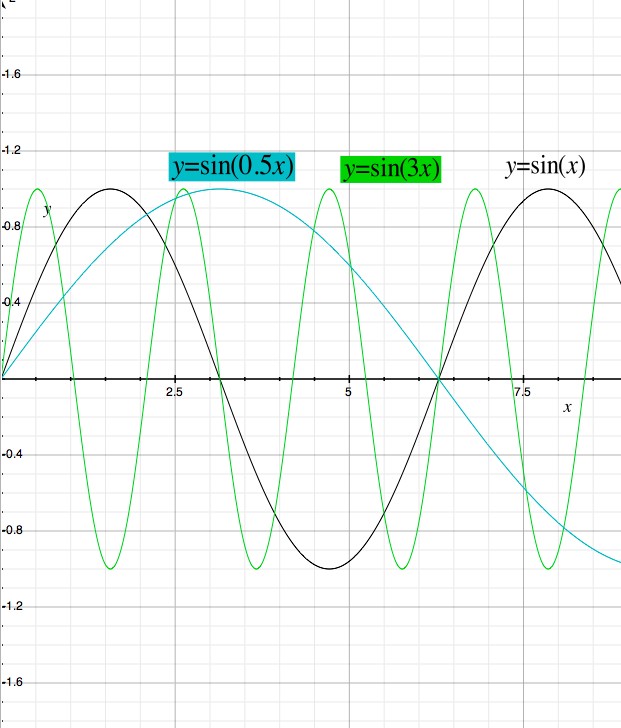
Stretching and Compression of functions is most often seen in sinusoidal functions (sin(x) and cos(x)).
Stretching and compression in the x-direction:
Stretching and compressing a function in the x-direction is accomplished by transforming the function f(x) into f(c•x), where c is the factor of stretching or compression. For c<1, the function stretches. For c>1, the function compresses. This is known as horizontal stretching and compression.
Stretching and compression in the y-direction:
Stretching and compressing a function in the y-direction is accomplished by multiplying the entire function by a constant. For any function f(x), its vertically stretched version is represented by s(x) = c • f(x). However, this time, for c<1, the function compresses down in the y-direction and for c>1, the function stretches out in the y-direction. This is known as vertical stretching and compression. What does this look like?
Gallery 1.2.3. Stretching and Compression
We have learned about many function transforms, but the trickiest part is knowing which combination of transformations is used, and how it affects the graph of the parent function. If you can identify which transformations are involved, you can predict the general behavior of a similar function given to you. This is especially important in dealing with sinusoidal functions, sin(x) and cos(x). Their general forms are given by the equations:
.
A = Amplitude, or the vertical stretching/compression term.
B = Phase shift, or horizontal translation.
C = Vertical shift, or vertical translation.
k is a special term. It represents horizontal stretching or compression, it is proportional to the frequency, and can be used to calculate the period. The period, T, if you recall, is how often the function repeats itself.
T= .
Next, you will find a section quiz on all the material covered so far, not just in this section. So get a pen or pencil and a some paper and get ready to solve mathematical puzzles!
Glossary and deeper reading · 2 refreshers
These editorial refreshers supplement the reading. Definitions and examples are added guidance; original source wording and recorded answers remain in their original context.
-
Graph reflection
A graph reflection flips points across a specified line. Replacing f(x) by −f(x) reflects across the horizontal axis, while f(−x) reflects across the vertical axis. For example, −x² is the reflection of y=x² across the horizontal axis. Reflecting across y=x interchanges input and output coordinates and can produce an inverse relation.
-
Graph translation
A graph translation shifts every point by the same horizontal and vertical amounts. The graph y=f(x−h)+k moves the original graph h units right and k units up. For example, y=(x−2)²+3 shifts y=x² right 2 and up 3. Negative shifts move in the opposite directions.