AP Unit 7 Problems
Thirty problems for AP Unit 7. Try the problem before opening its separate solution. Write the mathematical setup and the reason your method applies.
Choose your next practice
Find the problems you need.
Mix the choices to focus your practice. Problem numbers and worked-solution links stay the same.
30 of 30 problems shown.
Selection: All topics and practice types.
Printing includes the currently visible selection. Reset filters first to print all 30 problems.
Problem 1
A tank’s inflow is 5 L/min. Outflow is proportional to its current volume V with coefficient 0.1 min⁻¹. Write a differential equation and find the rate when V=20 L.
Written working workspace
Drawing is temporarily unavailable. Work on paper if needed, then record your reasoning here.
Saving written working requires JavaScript. Keep your work on paper or in your own notes; the source problem above remains available.
Problem 2
A body’s temperature T moves toward a room temperature of 20°C at a rate proportional to the temperature difference, with positive coefficient k. Write the model and explain the sign when T=30.
Written working workspace
Drawing is temporarily unavailable. Work on paper if needed, then record your reasoning here.
Saving written working requires JavaScript. Keep your work on paper or in your own notes; the source problem above remains available.
Problem 3
A particle’s acceleration is 2t m/s² at time t seconds, and its initial velocity is 3 m/s. Write an initial-value problem for velocity.
Written working workspace
Drawing is temporarily unavailable. Work on paper if needed, then record your reasoning here.
Saving written working requires JavaScript. Keep your work on paper or in your own notes; the source problem above remains available.
Problem 4
Verify that y=3e^(2x) solves y′=2y and y(0)=3.
Written working workspace
Drawing is temporarily unavailable. Work on paper if needed, then record your reasoning here.
Saving written working requires JavaScript. Keep your work on paper or in your own notes; the source problem above remains available.
Problem 5
Does y=x²+1 solve y′=2x and y(0)=0?
Written working workspace
Drawing is temporarily unavailable. Work on paper if needed, then record your reasoning here.
Saving written working requires JavaScript. Keep your work on paper or in your own notes; the source problem above remains available.
Problem 6
Verify that y=Ceˣ is a family of solutions to y′=y. Which member satisfies y(0)=−2?
Written working workspace
Drawing is temporarily unavailable. Work on paper if needed, then record your reasoning here.
Saving written working requires JavaScript. Keep your work on paper or in your own notes; the source problem above remains available.
Problem 7
Does y=eˣ+x solve y′=y? Explain without using a graph.
Written working workspace
Drawing is temporarily unavailable. Work on paper if needed, then record your reasoning here.
Saving written working requires JavaScript. Keep your work on paper or in your own notes; the source problem above remains available.
Problem 8
For y′=x−y, give slopes at (0,0), (1,2), and (2,−1), and describe the corresponding segments.
Written working workspace
Drawing is temporarily unavailable. Work on paper if needed, then record your reasoning here.
Saving written working requires JavaScript. Keep your work on paper or in your own notes; the source problem above remains available.
Problem 9
| y | −2 | −1 | 0 | 1 | 2 |
|---|---|---|---|---|---|
| slope | −2 | −1 | 0 | 1 | 2 |
Written working workspace
Drawing is temporarily unavailable. Work on paper if needed, then record your reasoning here.
Saving written working requires JavaScript. Keep your work on paper or in your own notes; the source problem above remains available.
Problem 10
For y′=x+y, where are the slope-field segments horizontal?
Written working workspace
Drawing is temporarily unavailable. Work on paper if needed, then record your reasoning here.
Saving written working requires JavaScript. Keep your work on paper or in your own notes; the source problem above remains available.
Problem 11
For y′=1/(x−y), can a slope-field segment be drawn at (1,1)? What is the slope at (1,0)?
Written working workspace
Drawing is temporarily unavailable. Work on paper if needed, then record your reasoning here.
Saving written working requires JavaScript. Keep your work on paper or in your own notes; the source problem above remains available.
Problem 12
For y′=2−y, identify the equilibrium and describe a solution starting at y(0)=1 for x≥0.
Written working workspace
Drawing is temporarily unavailable. Work on paper if needed, then record your reasoning here.
Saving written working requires JavaScript. Keep your work on paper or in your own notes; the source problem above remains available.
Problem 13
For y′=2−y, describe a solution starting at y(0)=3 for x≥0.
Written working workspace
Drawing is temporarily unavailable. Work on paper if needed, then record your reasoning here.
Saving written working requires JavaScript. Keep your work on paper or in your own notes; the source problem above remains available.
Problem 14
For y′=xy, find y′ and y″ at a solution point (1,2).
Written working workspace
Drawing is temporarily unavailable. Work on paper if needed, then record your reasoning here.
Saving written working requires JavaScript. Keep your work on paper or in your own notes; the source problem above remains available.
Problem 15
Find the general solution of y′=2xy, including any equilibrium lost by division.
Written working workspace
Drawing is temporarily unavailable. Work on paper if needed, then record your reasoning here.
Saving written working requires JavaScript. Keep your work on paper or in your own notes; the source problem above remains available.
Problem 16
Find the general solution of y′=x(1+y²).
Written working workspace
Drawing is temporarily unavailable. Work on paper if needed, then record your reasoning here.
Saving written working requires JavaScript. Keep your work on paper or in your own notes; the source problem above remains available.
Problem 17
Solve y′=3(1−y) generally, including its equilibrium.
Written working workspace
Drawing is temporarily unavailable. Work on paper if needed, then record your reasoning here.
Saving written working requires JavaScript. Keep your work on paper or in your own notes; the source problem above remains available.
Problem 18
Solve y′=xy with y(0)=2.
Written working workspace
Drawing is temporarily unavailable. Work on paper if needed, then record your reasoning here.
Saving written working requires JavaScript. Keep your work on paper or in your own notes; the source problem above remains available.
Problem 19
Solve y′=y² with y(0)=1 and give the largest interval containing 0 on which the solution is defined.
Written working workspace
Drawing is temporarily unavailable. Work on paper if needed, then record your reasoning here.
Saving written working requires JavaScript. Keep your work on paper or in your own notes; the source problem above remains available.
Problem 20
Solve y′=y/x with y(1)=3 and give a connected domain containing the initial point.
Written working workspace
Drawing is temporarily unavailable. Work on paper if needed, then record your reasoning here.
Saving written working requires JavaScript. Keep your work on paper or in your own notes; the source problem above remains available.
Problem 21
Give a solution to y′=e^(−x²), y(0)=2, using an accumulation function, and verify it.
Written working workspace
Drawing is temporarily unavailable. Work on paper if needed, then record your reasoning here.
Saving written working requires JavaScript. Keep your work on paper or in your own notes; the source problem above remains available.
Problem 22
Solve y′=3x²−2 with y(1)=4.
Written working workspace
Drawing is temporarily unavailable. Work on paper if needed, then record your reasoning here.
Saving written working requires JavaScript. Keep your work on paper or in your own notes; the source problem above remains available.
Problem 23
Solve y′=2xy with y(0)=0.
Written working workspace
Drawing is temporarily unavailable. Work on paper if needed, then record your reasoning here.
Saving written working requires JavaScript. Keep your work on paper or in your own notes; the source problem above remains available.
Problem 24
Solve y′=−x/y with y(0)=2 and give the interval of this branch.
Written working workspace
Drawing is temporarily unavailable. Work on paper if needed, then record your reasoning here.
Saving written working requires JavaScript. Keep your work on paper or in your own notes; the source problem above remains available.
Problem 25
A population follows P′=kP, P(0)=100, P(3)=200, with t in hours. Find k and P(6).
Written working workspace
Drawing is temporarily unavailable. Work on paper if needed, then record your reasoning here.
Saving written working requires JavaScript. Keep your work on paper or in your own notes; the source problem above remains available.
Problem 26
A substance has half-life 4 days and starts at 80 g. Give its differential equation and its amount after 12 days.
Written working workspace
Drawing is temporarily unavailable. Work on paper if needed, then record your reasoning here.
Saving written working requires JavaScript. Keep your work on paper or in your own notes; the source problem above remains available.
Problem 27
For y′=0.05y with y(0)=100, use a calculator to find y(10) and the doubling time, to three decimals.
Written working workspace
Drawing is temporarily unavailable. Work on paper if needed, then record your reasoning here.
Saving written working requires JavaScript. Keep your work on paper or in your own notes; the source problem above remains available.
Problem 28
A cooling model is T′=−0.2(T−20), T(0)=80, with T in °C and time in minutes. Find T(t) and its limiting temperature.
Written working workspace
Drawing is temporarily unavailable. Work on paper if needed, then record your reasoning here.
Saving written working requires JavaScript. Keep your work on paper or in your own notes; the source problem above remains available.
Problem 29
A particle has acceleration a(t)=2t m/s² and velocity v(0)=3 m/s. Find v(t) and its velocity at 2 s.
Written working workspace
Drawing is temporarily unavailable. Work on paper if needed, then record your reasoning here.
Saving written working requires JavaScript. Keep your work on paper or in your own notes; the source problem above remains available.
Problem 30
A positive quantity has a continuous relative rate k=0.05 per year. Explain why its one-year percent increase is not exactly 5%, and calculate it to three decimals.
Written working workspace
Drawing is temporarily unavailable. Work on paper if needed, then record your reasoning here.
Saving written working requires JavaScript. Keep your work on paper or in your own notes; the source problem above remains available.
More chapter problems
Try these problems before opening the solutions. Show your setup, the hypotheses behind your method, and what your answer means.
Estimate two members of a solution family
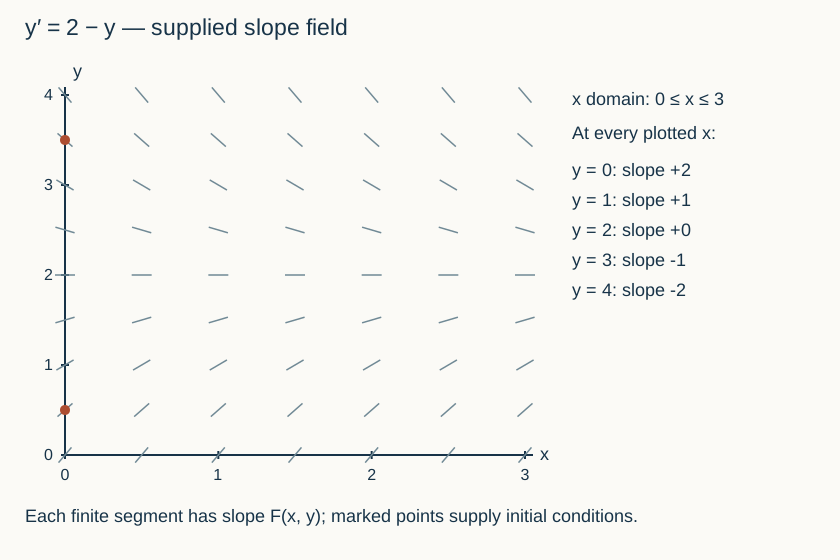
Inspect diagram labels
The diagram keeps its full size here. Focus the view and use the arrow keys, or scroll across it, to inspect every label.
Written working workspace
Drawing is temporarily unavailable. Work on paper if needed, then record your reasoning here.
Saving written working requires JavaScript. Keep your work on paper or in your own notes; the source problem above remains available.
Worked solution and rubric →Revisit the explanation →Revisit the explanation →Read the relevant lesson →
Follow a turning curve through a two-coordinate field
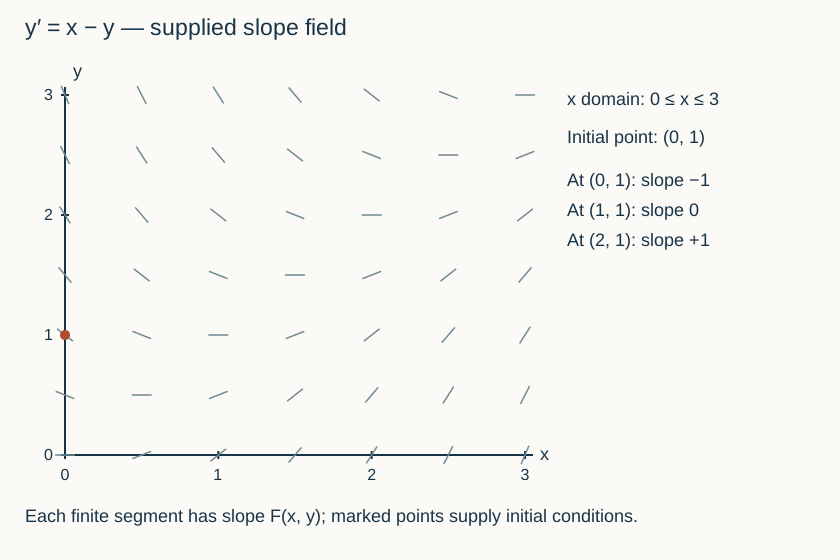
Inspect diagram labels
The diagram keeps its full size here. Focus the view and use the arrow keys, or scroll across it, to inspect every label.
Written working workspace
Drawing is temporarily unavailable. Work on paper if needed, then record your reasoning here.
Saving written working requires JavaScript. Keep your work on paper or in your own notes; the source problem above remains available.
Worked solution and rubric →Revisit the explanation →Revisit the explanation →Read the relevant lesson →