AP Unit 1 Problems
Thirty problems for AP Unit 1. Try the problem before opening its separate solution. Write the mathematical setup and the reason your method applies.
Choose your next practice
Find the problems you need.
Mix the choices to focus your practice. Problem numbers and worked-solution links stay the same.
30 of 30 problems shown.
Selection: All topics and practice types.
Printing includes the currently visible selection. Reset filters first to print all 30 problems.
Problem 1
A cart has position s(t)=t²+3t meters. At t=2 seconds, find the average rate from 2 to 2+h (h≠0), then the instantaneous rate suggested by its limit.
Written working workspace
Drawing is temporarily unavailable. Work on paper if needed, then record your reasoning here.
Saving written working requires JavaScript. Keep your work on paper or in your own notes; the source problem above remains available.
Problem 2
Write “the concentration C(t), in milligrams per liter, approaches 8 as t approaches 5 minutes from the left” in limit notation. Explain what this says about C(5).
Written working workspace
Drawing is temporarily unavailable. Work on paper if needed, then record your reasoning here.
Saving written working requires JavaScript. Keep your work on paper or in your own notes; the source problem above remains available.
Problem 3
Suppose lim(x→4⁻)f(x)=2, lim(x→4⁺)f(x)=2 and f(4)=−1. State lim(x→4)f(x), and explain why it differs from f(4).
Written working workspace
Drawing is temporarily unavailable. Work on paper if needed, then record your reasoning here.
Saving written working requires JavaScript. Keep your work on paper or in your own notes; the source problem above remains available.
Problem 4
Use the hole graph in Topic 1.3 (text equivalent: f(x)=x+1 for x≠2 and f(2)=5). State the left limit, right limit, two-sided limit and actual value at 2.
Written working workspace
Drawing is temporarily unavailable. Work on paper if needed, then record your reasoning here.
Saving written working requires JavaScript. Keep your work on paper or in your own notes; the source problem above remains available.
Problem 5
A calculator seems to draw sin(1/x) as a dark band near x=0. Decide whether its limit exists. Explain why the plotting window cannot settle the question.
Written working workspace
Drawing is temporarily unavailable. Work on paper if needed, then record your reasoning here.
Saving written working requires JavaScript. Keep your work on paper or in your own notes; the source problem above remains available.
Problem 6
| x | 0.9 | 0.99 | 1.01 | 1.1 |
|---|---|---|---|---|
| F(x) | 2.71 | 2.9701 | 3.0301 | 3.31 |
Estimate lim(x→1)F(x). State whether this finite table alone proves the limit.
Written working workspace
Drawing is temporarily unavailable. Work on paper if needed, then record your reasoning here.
Saving written working requires JavaScript. Keep your work on paper or in your own notes; the source problem above remains available.
Problem 7
Evaluate lim(x→−1)(2x²+3)/(x²+4), stating the condition needed for the quotient limit rule.
Written working workspace
Drawing is temporarily unavailable. Work on paper if needed, then record your reasoning here.
Saving written working requires JavaScript. Keep your work on paper or in your own notes; the source problem above remains available.
Problem 8
Let f(x)=x² for x<1 and f(x)=2x+1 for x≥1. Find both one-sided limits and decide whether lim(x→1)f(x) exists.
Written working workspace
Drawing is temporarily unavailable. Work on paper if needed, then record your reasoning here.
Saving written working requires JavaScript. Keep your work on paper or in your own notes; the source problem above remains available.
Problem 9
Evaluate lim(x→−2)(x²+x−2)/(x+2).
Written working workspace
Drawing is temporarily unavailable. Work on paper if needed, then record your reasoning here.
Saving written working requires JavaScript. Keep your work on paper or in your own notes; the source problem above remains available.
Problem 10
Evaluate lim(x→0)(√(9+x)−3)/x.
Written working workspace
Drawing is temporarily unavailable. Work on paper if needed, then record your reasoning here.
Saving written working requires JavaScript. Keep your work on paper or in your own notes; the source problem above remains available.
Problem 11
In radians, evaluate lim(x→0)sin(4x)/(3x).
Written working workspace
Drawing is temporarily unavailable. Work on paper if needed, then record your reasoning here.
Saving written working requires JavaScript. Keep your work on paper or in your own notes; the source problem above remains available.
Problem 12
For each limit, name a suitable first method and then evaluate: (a) lim(x→2)(x²−4)/(x−2); (b) lim(x→0)(√(1+x)−1)/x; (c) lim(x→0⁺)1/x.
Written working workspace
Drawing is temporarily unavailable. Work on paper if needed, then record your reasoning here.
Saving written working requires JavaScript. Keep your work on paper or in your own notes; the source problem above remains available.
Problem 13
Prove lim(x→0)x²cos(1/x)=0 using the squeeze theorem.
Written working workspace
Drawing is temporarily unavailable. Work on paper if needed, then record your reasoning here.
Saving written working requires JavaScript. Keep your work on paper or in your own notes; the source problem above remains available.
Problem 14
A function satisfies 5−2|x−1|≤g(x)≤5+3|x−1| for 0<|x−1|<0.2. Find lim(x→1)g(x), and explain whether g(1) must be 5.
Written working workspace
Drawing is temporarily unavailable. Work on paper if needed, then record your reasoning here.
Saving written working requires JavaScript. Keep your work on paper or in your own notes; the source problem above remains available.
Problem 15
For x≠3, H(x)=(x²−9)/(x−3); H(3) is undefined. Describe its nearby table values at 2.99 and 3.01, the corresponding graph feature, its limit notation, and the verbal meaning.
Written working workspace
Drawing is temporarily unavailable. Work on paper if needed, then record your reasoning here.
Saving written working requires JavaScript. Keep your work on paper or in your own notes; the source problem above remains available.
Problem 16
Classify the discontinuity at the indicated input: (a) (x²−4)/(x−2) at 2; (b) f(x)=−1 for x<0 and 1 for x≥0 at 0; (c) 1/(x+1)² at −1. Say whether one finite replacement value can repair each.
Written working workspace
Drawing is temporarily unavailable. Work on paper if needed, then record your reasoning here.
Saving written working requires JavaScript. Keep your work on paper or in your own notes; the source problem above remains available.
Problem 17
Let f(x)=2x+1 for x≠2 and f(2)=4. Test all three continuity conditions at 2.
Written working workspace
Drawing is temporarily unavailable. Work on paper if needed, then record your reasoning here.
Saving written working requires JavaScript. Keep your work on paper or in your own notes; the source problem above remains available.
Problem 18
Let g(x)=x² when x≤1 and g(x)=2x−1 when x>1. Is g continuous at 1? Give a complete reason.
Written working workspace
Drawing is temporarily unavailable. Work on paper if needed, then record your reasoning here.
Saving written working requires JavaScript. Keep your work on paper or in your own notes; the source problem above remains available.
Problem 19
Find the maximal intervals of continuity of R(x)=(x+2)/(x²−4). Does cancelling a factor add x=−2 to the original domain?
Written working workspace
Drawing is temporarily unavailable. Work on paper if needed, then record your reasoning here.
Saving written working requires JavaScript. Keep your work on paper or in your own notes; the source problem above remains available.
Problem 20
On which maximal interval is L(x)=ln(x−2) continuous? Explain the endpoint restriction.
Written working workspace
Drawing is temporarily unavailable. Work on paper if needed, then record your reasoning here.
Saving written working requires JavaScript. Keep your work on paper or in your own notes; the source problem above remains available.
Problem 21
Define f(x)=(x³−8)/(x−2) for x≠2. Choose f(2) to make f continuous at 2.
Written working workspace
Drawing is temporarily unavailable. Work on paper if needed, then record your reasoning here.
Saving written working requires JavaScript. Keep your work on paper or in your own notes; the source problem above remains available.
Problem 22
Find a so f(x)=ax+2 for x<1 and f(x)=x²+4 for x≥1 is continuous at 1.
Written working workspace
Drawing is temporarily unavailable. Work on paper if needed, then record your reasoning here.
Saving written working requires JavaScript. Keep your work on paper or in your own notes; the source problem above remains available.
Problem 23
For V(x)=−2/(x−3), find both one-sided limits at 3 and state the vertical asymptote.
Written working workspace
Drawing is temporarily unavailable. Work on paper if needed, then record your reasoning here.
Saving written working requires JavaScript. Keep your work on paper or in your own notes; the source problem above remains available.
Problem 24
For W(x)=(x+1)/(x−2)², determine the two-sided infinite-limit behavior at 2. Is +∞ a finite real limit?
Written working workspace
Drawing is temporarily unavailable. Work on paper if needed, then record your reasoning here.
Saving written working requires JavaScript. Keep your work on paper or in your own notes; the source problem above remains available.
Problem 25
Find both limits at infinity and any horizontal asymptote of F(x)=(4x²−3x+1)/(2x²+7).
Written working workspace
Drawing is temporarily unavailable. Work on paper if needed, then record your reasoning here.
Saving written working requires JavaScript. Keep your work on paper or in your own notes; the source problem above remains available.
Problem 26
Find lim(x→∞)√(4x²+1)/x and lim(x→−∞)√(4x²+1)/x.
Written working workspace
Drawing is temporarily unavailable. Work on paper if needed, then record your reasoning here.
Saving written working requires JavaScript. Keep your work on paper or in your own notes; the source problem above remains available.
Problem 27
Use a calculator table at x=2,5,10,20 to inspect x²/eˣ. The established limit as x→∞ is 0. Interpret that limit as a growth comparison, and explain why the four rows alone do not prove it.
Written working workspace
Drawing is temporarily unavailable. Work on paper if needed, then record your reasoning here.
Saving written working requires JavaScript. Keep your work on paper or in your own notes; the source problem above remains available.
Problem 28
Prove x³−2x−2=0 has at least one solution in (1,2), without finding the solution.
Written working workspace
Drawing is temporarily unavailable. Work on paper if needed, then record your reasoning here.
Saving written working requires JavaScript. Keep your work on paper or in your own notes; the source problem above remains available.
Problem 29
A continuous tank-temperature function T(t) has T(0)=14°C and T(8)=22°C. Must it reach 19°C during (0,8)? Must it do so exactly once?
Written working workspace
Drawing is temporarily unavailable. Work on paper if needed, then record your reasoning here.
Saving written working requires JavaScript. Keep your work on paper or in your own notes; the source problem above remains available.
Problem 30
A graph consists of y=−1 for x<0 and y=1 for x≥0. Its endpoint values at −2 and 2 have opposite signs. Explain why IVT cannot establish a zero, and decide whether any zero actually exists.
Written working workspace
Drawing is temporarily unavailable. Work on paper if needed, then record your reasoning here.
Saving written working requires JavaScript. Keep your work on paper or in your own notes; the source problem above remains available.
More chapter problems
Try these problems before opening the solutions. Show your setup, the hypotheses behind your method, and what your answer means.
Compare a model and its supplied rate separately
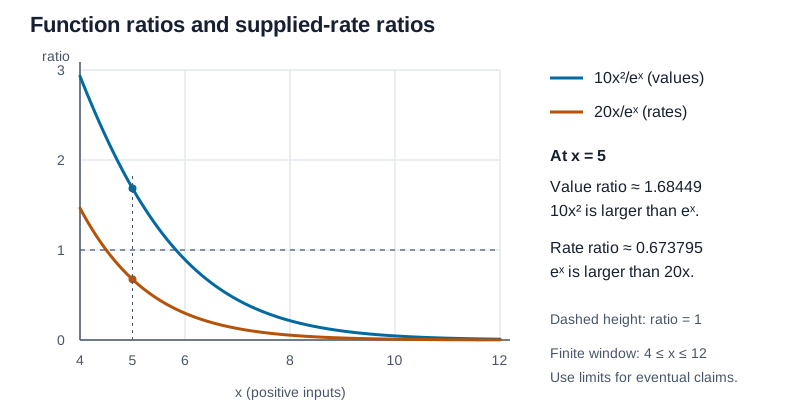
Inspect diagram labels
The diagram keeps its full size here. Focus the view and use the arrow keys, or scroll across it, to inspect every label.
Written working workspace
Drawing is temporarily unavailable. Work on paper if needed, then record your reasoning here.
Saving written working requires JavaScript. Keep your work on paper or in your own notes; the source problem above remains available.
Worked solution and rubric →Revisit the explanation →Revisit the explanation →Read the relevant lesson →
What does a vanishing ratio say?
Worked solution and rubric →Revisit the explanation →Read the relevant lesson →
Estimate nearby behavior from two displays
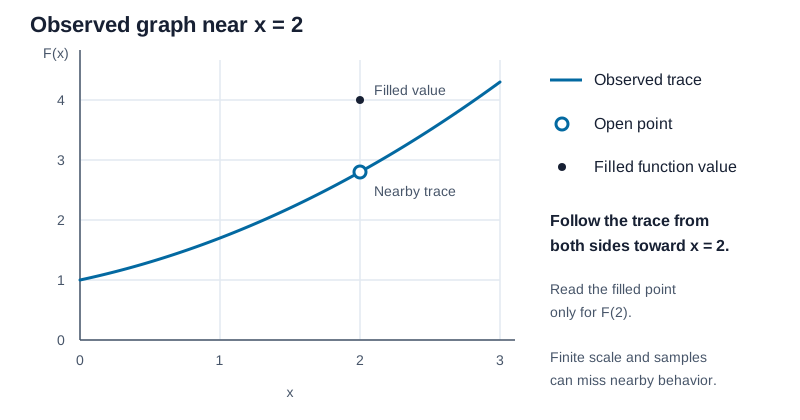
Inspect diagram labels
The diagram keeps its full size here. Focus the view and use the arrow keys, or scroll across it, to inspect every label.
Written working workspace
Drawing is temporarily unavailable. Work on paper if needed, then record your reasoning here.
Saving written working requires JavaScript. Keep your work on paper or in your own notes; the source problem above remains available.
Worked solution and rubric →Revisit the explanation →Revisit the explanation →Read the relevant lesson →