Angular-momentum directions
Enrichment article
Read the related lesson → · Full original reading →
Native AP1 instruction uses one-dimensional signs and magnitudes; cross-product direction reasoning remains here. In the retained worked example, use magnitude L = r_perp p, and assign vector direction using L = r × p. The printed product is not a vector multiplication rule. The linked gyroscope question keeps its conditional force-application assumption and its existing separate solution.
Angular Momentum
Figure 6.4.1 is a very important figure as it explains the concept of angular momentum. Notice that there is a particle with mass and velocity . Therefore, there is a momentum associated with it. However, this time, there is a position vector, associated with the location of the particle with respect to the origin O. Angular Momentum can be defined as a vector through the equation:
And since we know that :
Figure 6.4.1- What is Angular Momentum
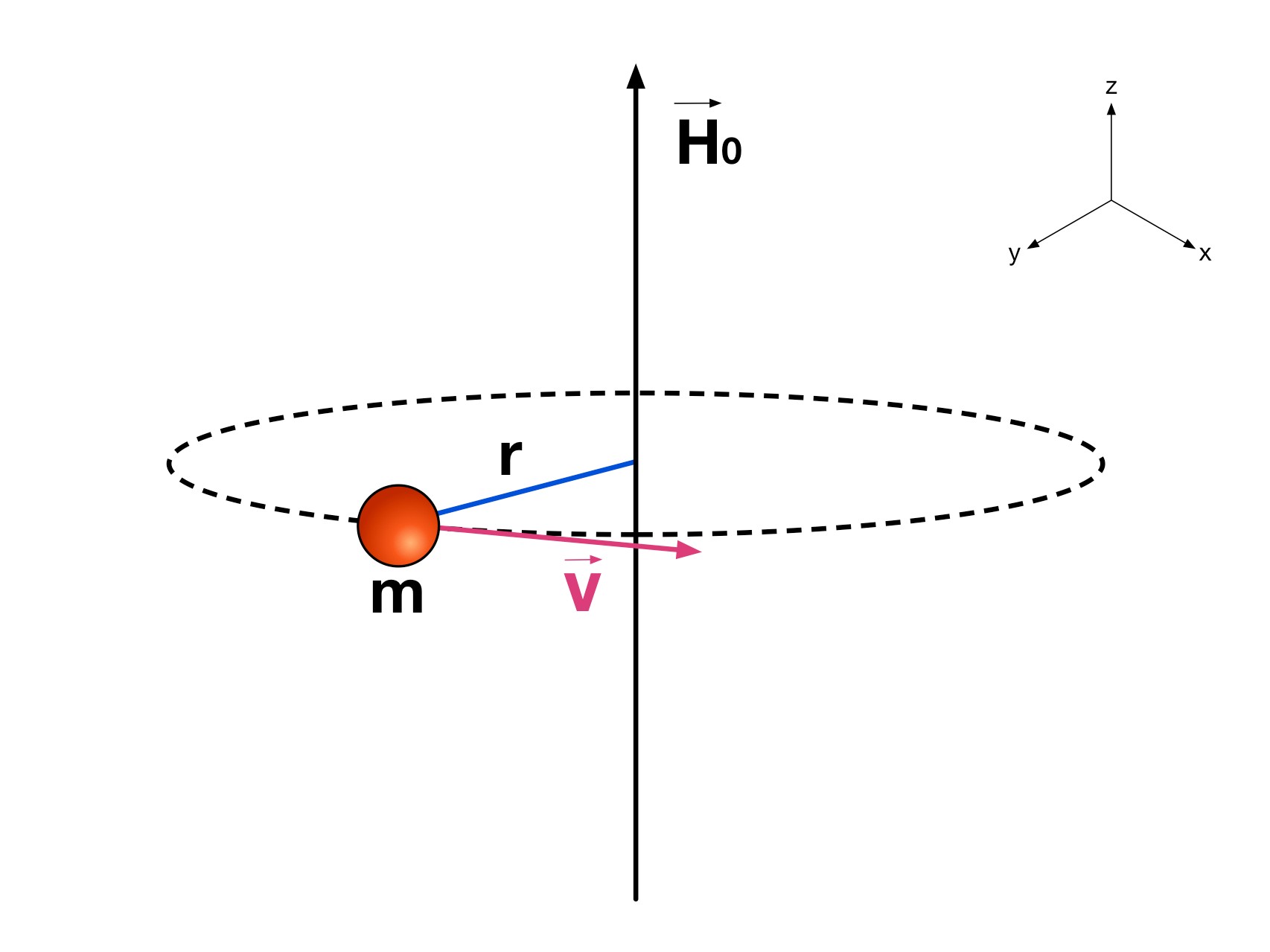
This equation shows that the cross product between r and v give us a resulting vector, that is perpendicular to the others, where is representative of the angular momentum of the particle.
Key Point: Remember to use the right hand rule to determine the sign of the angular momentum. Run your fingers along the position vector, then curl them in the direction of momentum to get the direction of the angular momentum. We can do this because we are dealing with cross products!
Notice how in the figure, there is an arrow circling the vector . This is to indicate the direction that the particle will be rotating around. As the particle moves in the same direction as its momentum, the position vector, rotates around O and .
In more simple terms, Equation 6.4.1 can be generally written as:
|H_O| = rmv sinθ, where θ is the angle between the position and velocity vectors.
and..
The vectors need not be perpendicular: only the component of velocity perpendicular to r contributes, or equivalently the perpendicular distance from O to the particle’s line of motion is used.
Example Problem 6.4.1
Particle A has momentum 3 kg·m/s and a straight path whose perpendicular distance from O is 4 m; its angular momentum points into the page. Particle B has momentum 2 kg·m/s and a path whose perpendicular distance from O is 3 m; its angular momentum points out of the page. Find the net angular momentum about O.
Example Problem 6.4.1
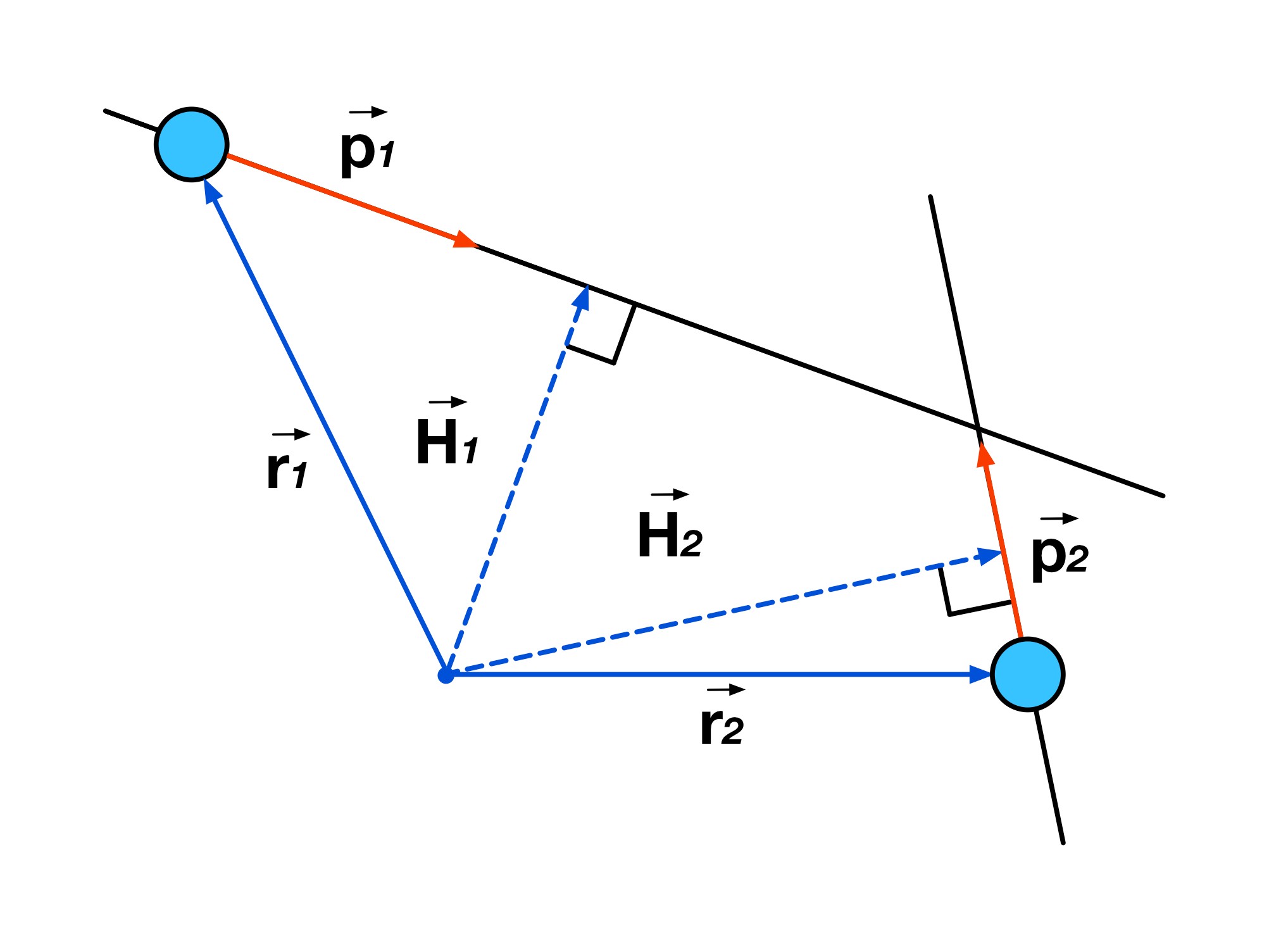
therefore we can use the equation:
So let’s plug in the values.
Step 2: Find the Angular Momentum of Particle 2
Particle B’s perpendicular path offset from O is 3 m, so |H_B| = 3(2) = 6 kg·m²/s.
Step 3: Find the Directions of the Angular Momentums
For Particle 1: Use the right hand rule. In this case, the vector will be pointing into the page, which is negative.
For Particle 2: same thing as we did for particle 1. This time the resultant vector is out of the page which we designate as positive.
Step 4: Find the Net Angular Momentum
We know the angular momentums for particles and and their associate directions so
H_net,z = −12 + 6 = −6 kg·m²/s.
Negative sign means that the system’s net angular momentum is negative therefore going into the page.
Source and curriculum context
Adapted from Physics I by Jake Yap and Laurence Vincent.
Glossary and deeper reading · 6 refreshers
These editorial refreshers supplement the reading. Definitions and examples are added guidance; original source wording and recorded answers remain in their original context.
-
Angular momentum
Angular momentum describes motion about a specified point or axis. For rigid rotation about a fixed principal axis it can be written as rotational inertia times angular velocity; a translating particle can also have angular momentum about a point. For example, a ball moving past a pole has angular momentum about the pole even though the ball’s path is straight.
-
Velocity
Velocity describes how position changes with time and includes direction. Instantaneous velocity describes one moment, while average velocity is displacement divided by elapsed time. For example, a car turning a corner can change velocity while maintaining the same speed.
-
Cross product
A cross product combines two vectors to form a vector perpendicular to both. Its magnitude depends on both magnitudes and the sine of their included angle, while reversing input order reverses its direction. For example, a force whose line of action passes through the pivot gives zero torque cross product about that pivot.
-
Vector
A vector is a quantity with a magnitude and a direction, represented by an arrow or by components along chosen axes. Vectors add by adding corresponding components rather than simply adding their magnitudes. For example, an eastward displacement followed by a northward displacement produces a resultant pointing northeast. The zero vector has zero magnitude and no unique direction.
-
Right-hand rule
A right-hand rule is a convention for determining the direction of a vector cross product or a current-produced magnetic field. The chosen gesture must use the correct input vectors in their correct order, with reversal when a negative charge requires it. For example, the thumb-and-curl rule around a straight wire uses conventional current as the thumb direction.
-
Linear momentum
Linear momentum is a vector describing an object’s motion and equals mass times velocity in the nonrelativistic model. The vector sum of momenta is conserved when the net external impulse on the system is zero. For example, two identical carts moving equally fast in opposite directions have zero total linear momentum but nonzero total kinetic energy.