Angular Momentum
Original textbook reading.
Angular momentum and conservation fit AP. Three-dimensional vector directions and gyroscopic precession go beyond this CED's fixed-plane rotation.
Angular momentum is the rotational counterpart of linear momentum. This section develops its definition and conservation law about a chosen origin or axis.
Angular Momentum
Figure 6.4.1 is a very important figure as it explains the concept of angular momentum. Notice that there is a particle with mass and velocity . Therefore, there is a momentum associated with it. However, this time, there is a position vector, associated with the location of the particle with respect to the origin O. Angular Momentum can be defined as a vector through the equation:
And since we know that :
Figure 6.4.1- What is Angular Momentum
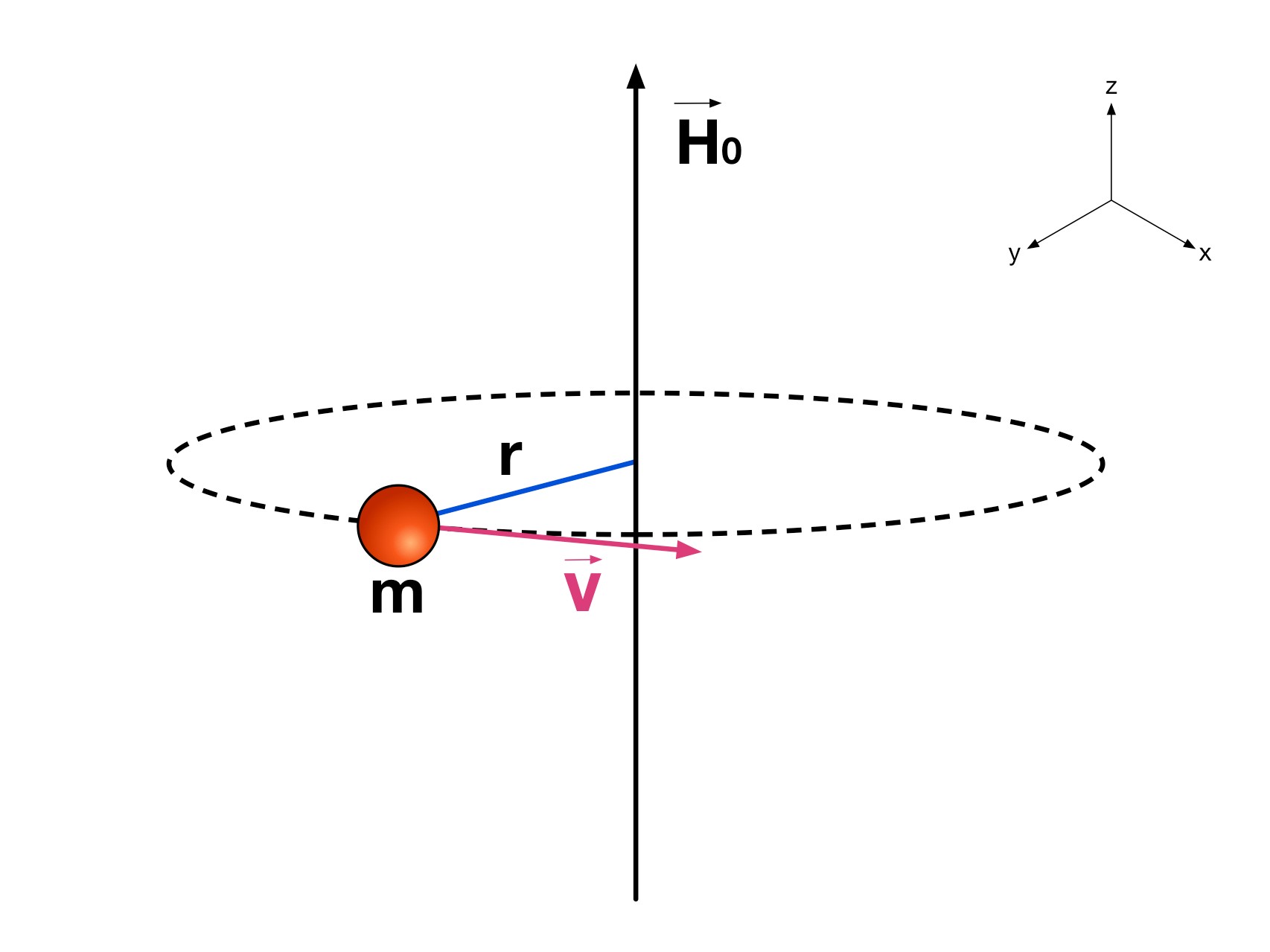
This equation shows that the cross product between r and v give us a resulting vector, that is perpendicular to the others, where is representative of the angular momentum of the particle.
Key Point: Remember to use the right hand rule to determine the sign of the angular momentum. Run your fingers along the position vector, then curl them in the direction of momentum to get the direction of the angular momentum. We can do this because we are dealing with cross products!
Notice how in the figure, there is an arrow circling the vector . This is to indicate the direction that the particle will be rotating around. As the particle moves in the same direction as its momentum, the position vector, rotates around O and .
In more simple terms, Equation 6.4.1 can be generally written as:
|H_O| = rmv sinθ, where θ is the angle between the position and velocity vectors.
and..
The vectors need not be perpendicular: only the component of velocity perpendicular to r contributes, or equivalently the perpendicular distance from O to the particle’s line of motion is used.
Example Problem 6.4.1
Particle A has momentum 3 kg·m/s and a straight path whose perpendicular distance from O is 4 m; its angular momentum points into the page. Particle B has momentum 2 kg·m/s and a path whose perpendicular distance from O is 3 m; its angular momentum points out of the page. Find the net angular momentum about O.
Example Problem 6.4.1
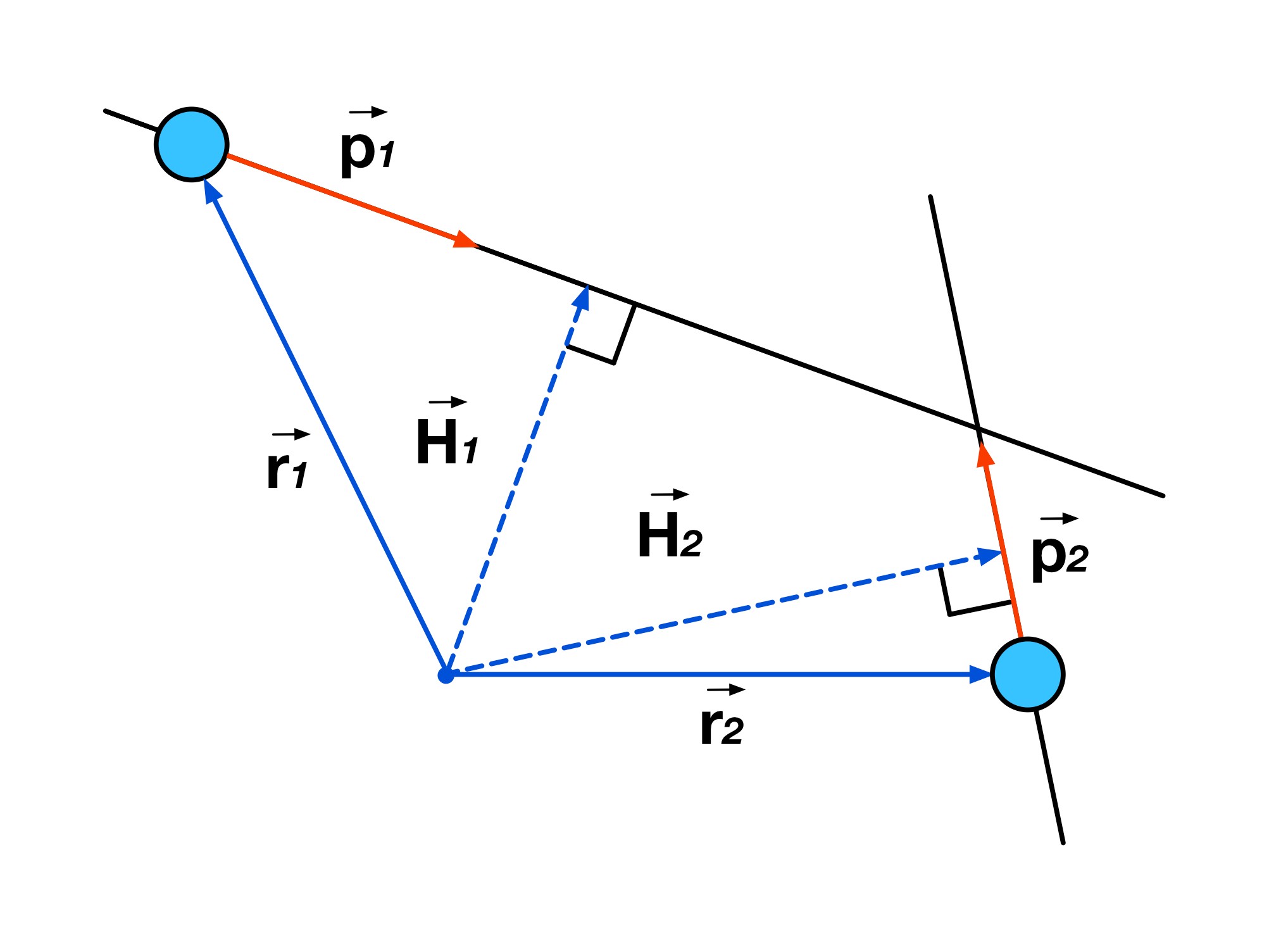
therefore we can use the equation:
So let’s plug in the values.
Step 2: Find the Angular Momentum of Particle 2
Particle B’s perpendicular path offset from O is 3 m, so |H_B| = 3(2) = 6 kg·m²/s.
Step 3: Find the Directions of the Angular Momentums
For Particle 1: Use the right hand rule. In this case, the vector will be pointing into the page, which is negative.
For Particle 2: same thing as we did for particle 1. This time the resultant vector is out of the page which we designate as positive.
Step 4: Find the Net Angular Momentum
We know the angular momentums for particles and and their associate directions so
H_net,z = −12 + 6 = −6 kg·m²/s.
Negative sign means that the system’s net angular momentum is negative therefore going into the page.
Angular Momentum of a Rigid Body
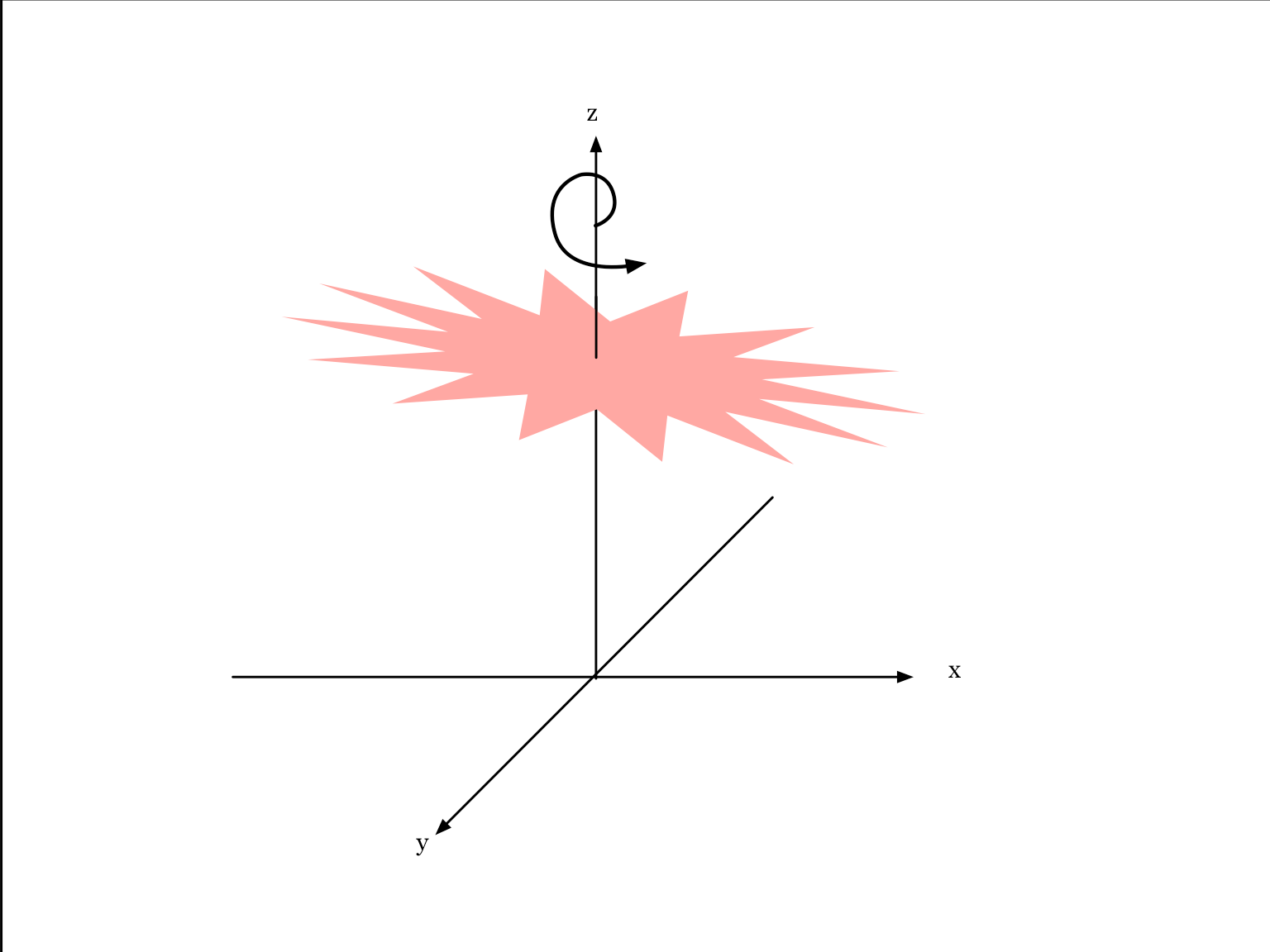
Now you are trying to see what the angular momentum of this rigid body is about the fixed z-axis! Not as easy as you think.
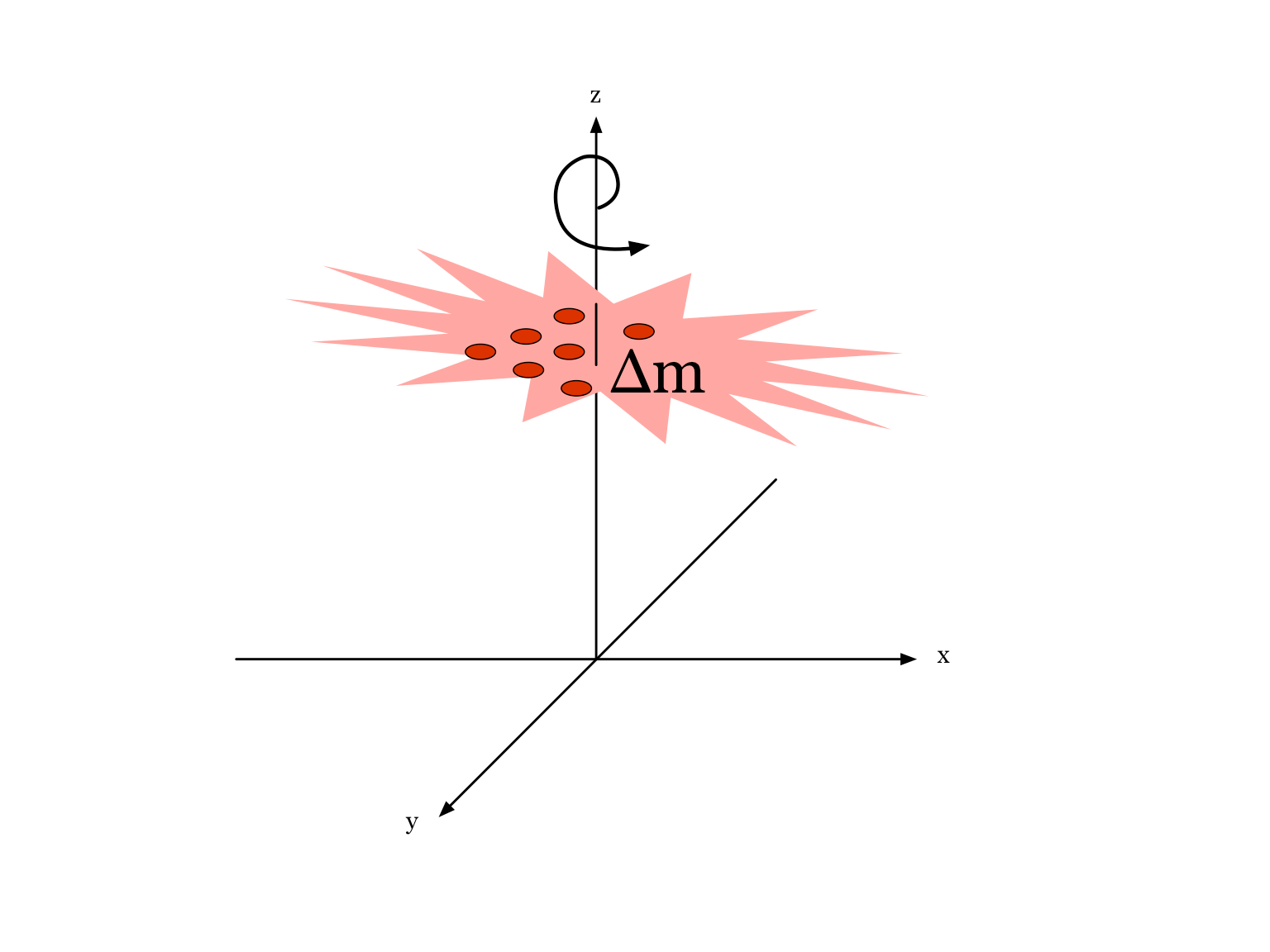
Up to this point, we have talked about the angular momentum of a single particle. Imagine rotating the crazy body displayed in the gallery below.
Remember that the object is not a single particle so you can’t do the same thing as we did before. Think of the rigid body as a system of particles each with a small mass . Look at the second image in the gallery. At this point, what you’ll need to know is that this rigid body has a moment of inertia↗, associated with it and that the angular velocity () is constant for all the particles that make up the rigid body. The main equation for this is:
H_z = I_zω for rotation about the fixed z-axis (Equation 6.4.2). The full angular-momentum vector is parallel to ω for rotation about a principal axis; that alignment is not universal for an asymmetric body.
Now it might be beneficial for you to see the comparison of linear momentum to angular momentum. How different are they??
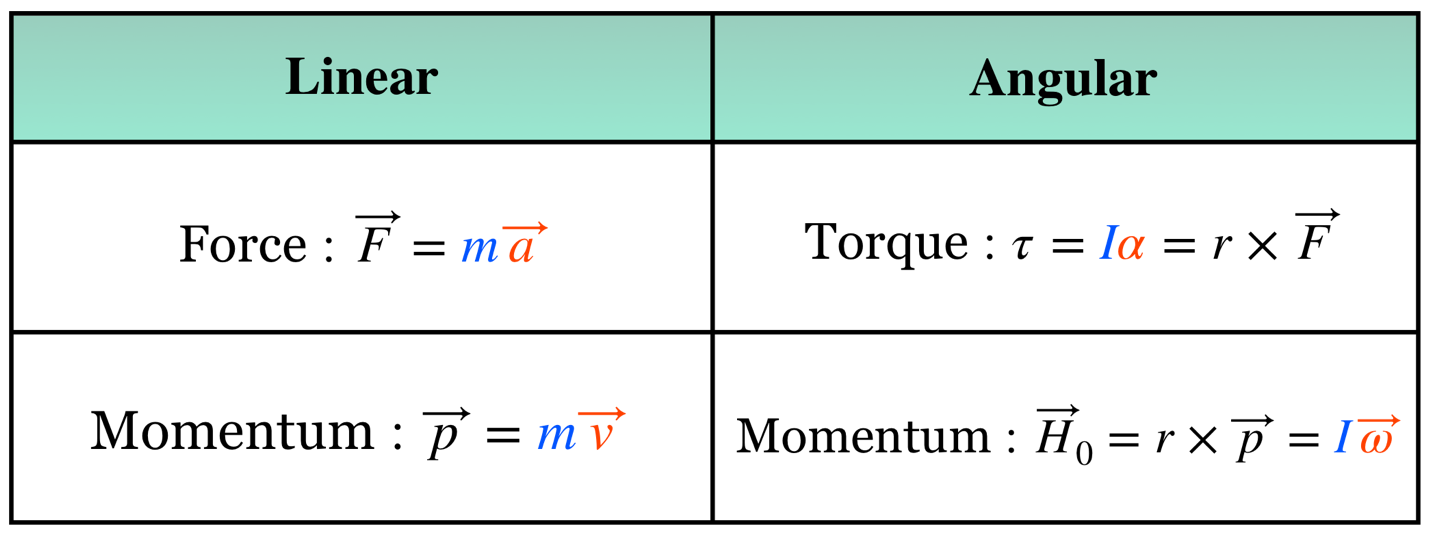
We think that this is a good table comparing the differences between linear motion and angular motion. Both linear and angular quantities are somewhat similar. Forceⓘ and torque↗ seem similar by just looking at the equations. The mass in the force can be analogous to the rotational inertia in torque, which makes sense since all rotational inertia is, is the mass of an object at a given distance. And the acceleration of a mass is analogous to the rotational acceleration.
Linear and angular momentum are almost similar as well. Only difference is that linear momentum has mass and velocity, while angular momentum has rotational inertia and an angular velocity. The variables are almost similar. This is key to understand just because it will help you remember how to interchange from linear motion to angular motion and vice versa.
Now after reviewing this, let’s look at something else similar. Remember how there was conservation of linear momentum? Well guess what, there is such thing as conservation of angular momentum.
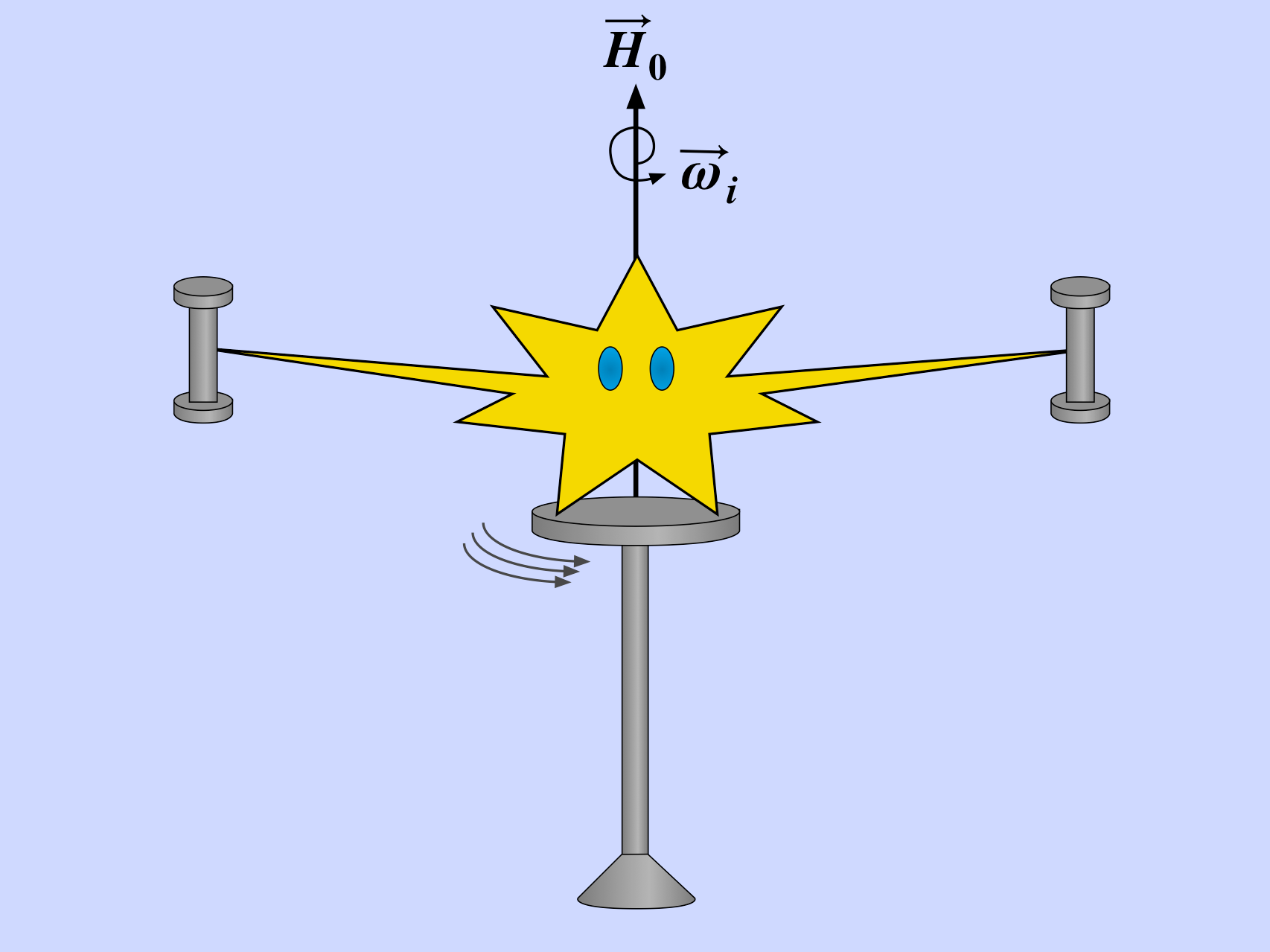
Notice here that alien is stretching its arms with dumb bells on both ends. Assume that he is rotating on a stool. At this point, Starmee has a rotational inertia and an angular velocity. Knowing that, Starmee must also have an angular momentum.
Conservation of Angular Momentum
This is almost the same thing as the conservation of linear momentum. Remember the definition stated that if no external force acts on the object, then the linear momentum is conserved. We can apply this same definition for angular momentum except it’s no longer force, it is torque. So we can say that angular momentum is conserved if there is no external torque that acts on the object. Therefore:
This can be further defined with our equations: (Equation 6.4.3)
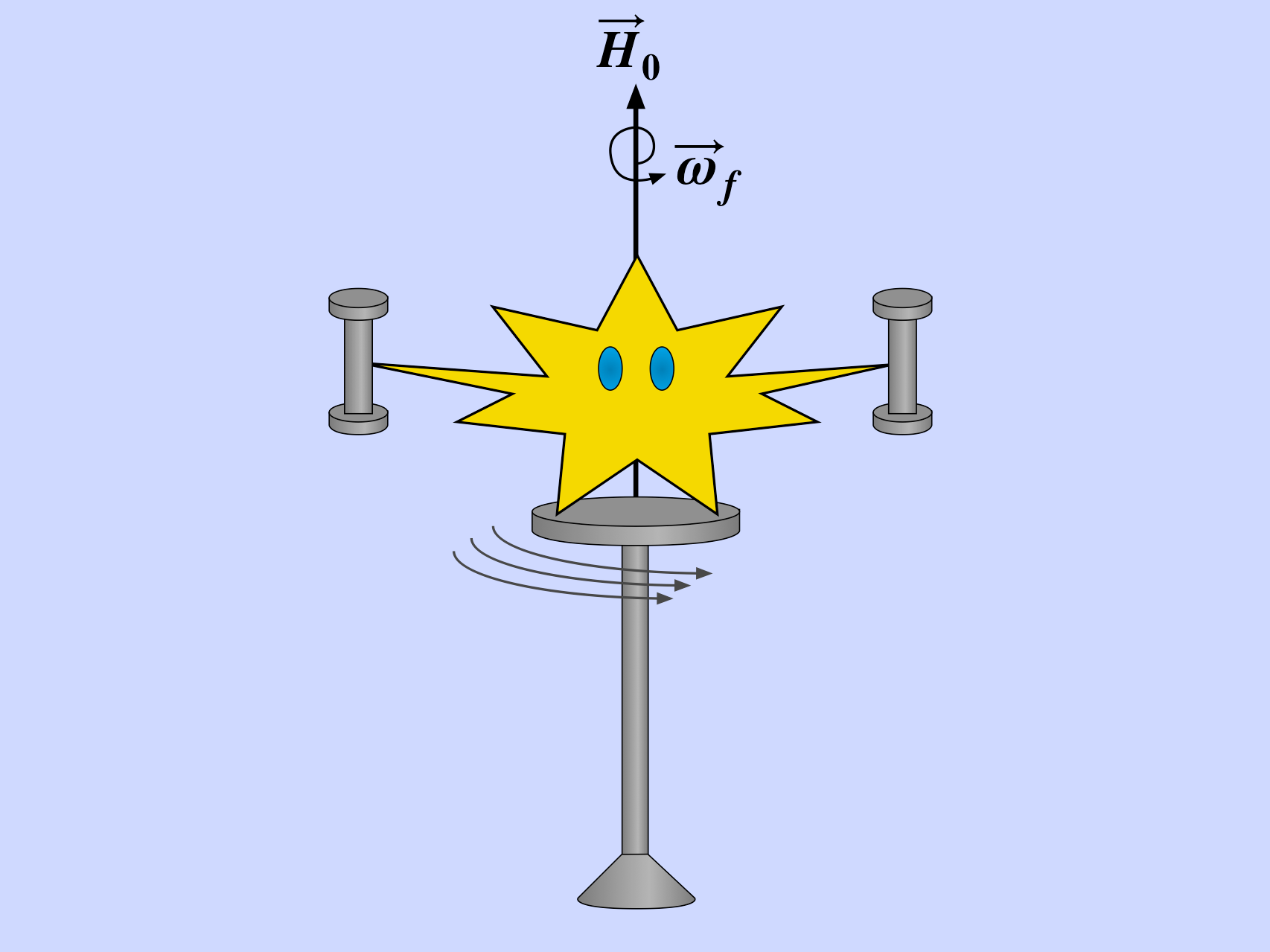
A really good example can be seen on Gallery 6.4.2. Notice how Starmee spins faster when the dumb bells are pulled in closer to it’s body. This is because the rotational inertia of the body is reduced and since we know that there is no external torque added to the system the angular momentum must be conserved. Therefore, a decrease in rotational inertia means an increase in angular velocity in order to keep the angular momentum balanced. Therefore, the conservation equation can be rewritten as:
Example Problem 6.4.2
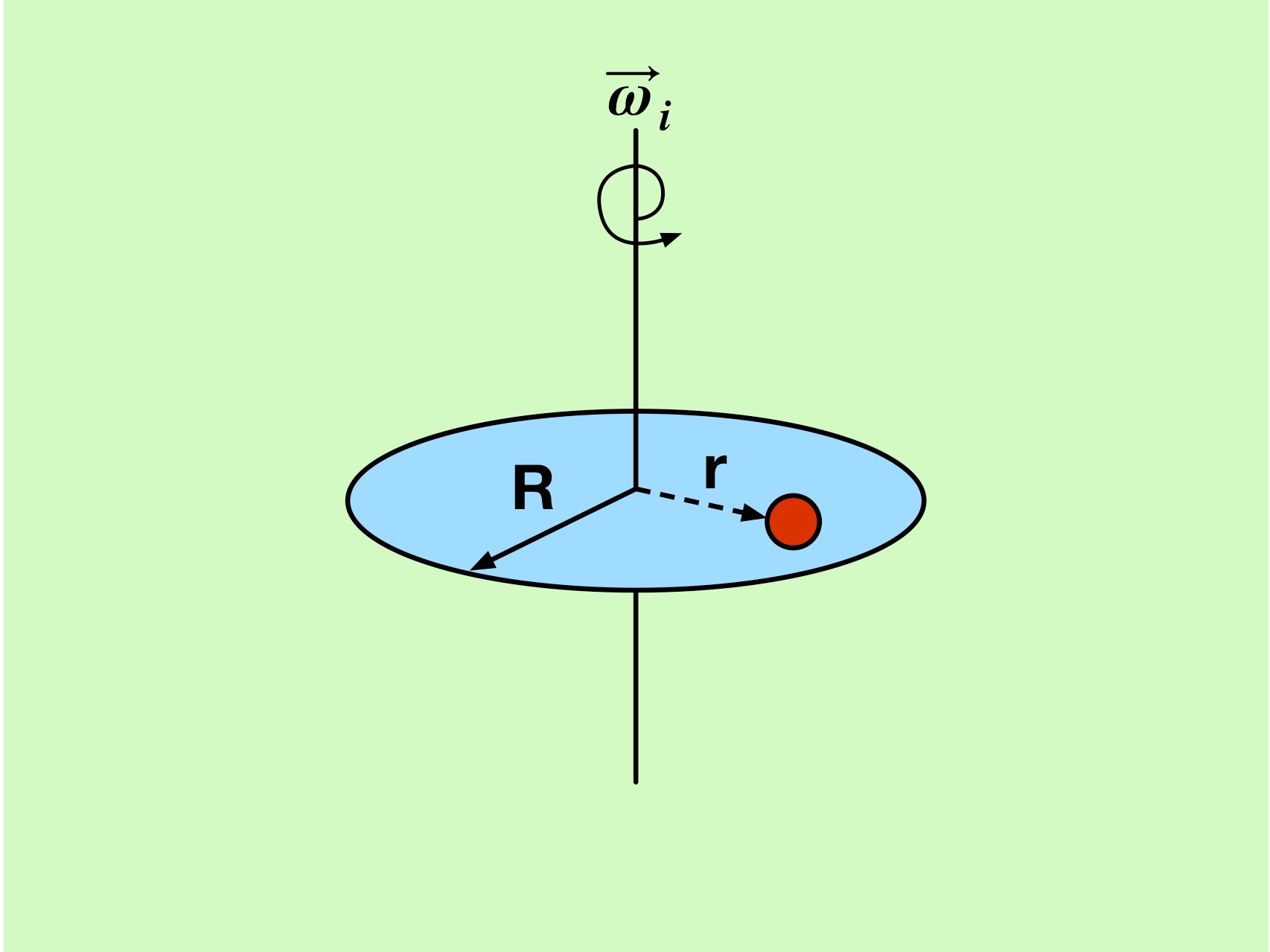
A uniform disk of mass 5.0 kg and radius R rotates counterclockwise at 3.0 rad/s on a frictionless axle. A 1.0 kg bead, treated as a point mass, is constrained by a radial groove and initially co-rotates at radius 0.60R. It moves to the rim and is then held there, co-rotating again. With no external torque about the axle, find the final angular speed.
Example Problem 6.4.2
Step 1: This is a Conservation of Angular Momentum Problem
How do we know this? Well its the title of this section for one and two, there is no external torque acting on the system to change it. Now why would we give you a problem that you we didn’t cover...that would just be rude.
The angular momentum of a rigid body/particle is shown in Equation 6.4.4. This will come in handy later.
Step 2: Find the Rotational Inertia of the Disk
The rotational inertia of a disk remember from section 2 of this chapter is:
We know all the values so let’s plug them in:
Step 3: Find the Rotational Inertia of the Ball
Now what is key to understand is that we are gonna treat the ball like a particle. Since the ball is rotating about a fixed axis, it has a rotational inertia associated with it as well.
We know the mass is and that the initial radius of the ball is . Let’s plug it in!
Step 4: Finding the Total Initial Rotational Inertia
Now these are the only two objects rotating about the fixed axis,therefore they are the only two things contributing to the rotational inertia of the system, so the total rotational inertia is just the sum of the rotational inertias:
Step 5: Find the Total Final Rotational Inertia
The rotational inertia of the disk will remain the same, but the ball’s will change because it’s location changes. Remember in the problem statement that the ball moves towards the edge. That means that the final placement is when the ball has a radius .
Therefore, we can use the same equation for the rotational inertia of a particle, and since we know that the mass is still :
So the total final rotational inertia is the sum:
Step 6: Solve for the Final Angular Velocity
This is conservation of angular momentum about the disk axis.
And we know that the angular momentum of a rigid body/particle is . Also we know the momentum conservation equation:
We have all our values so let’s plug them in:
The values cancel out and we get a final angular velocity of:
Which should make sense conceptually because by increasing the radius of the ball (ball moving from its initial spot) the whole systems rotational inertia increased. Remember since angular momentum is conserved, if the rotational inertia increased then we know that the angular velocity has to decrease in order to balance it out.
Pop Quiz 6.4.1 Angular Momentum
Question 1 of 5 · 0 correct
AP Topic 6.3 · Read the worked solution
Two particles have momenta of magnitudes 4 and 5 kg·m/s. Their straight paths have perpendicular offsets of 3 and 4 m from the same origin. Find the ratio of their angular-momentum magnitudes, particle 1 to particle 2.
Read every full question without answers
Question 1
Question 2
Question 3
Question 4
Which diagram has the largest angular-momentum magnitude when the magnitudes of r and p are fixed?
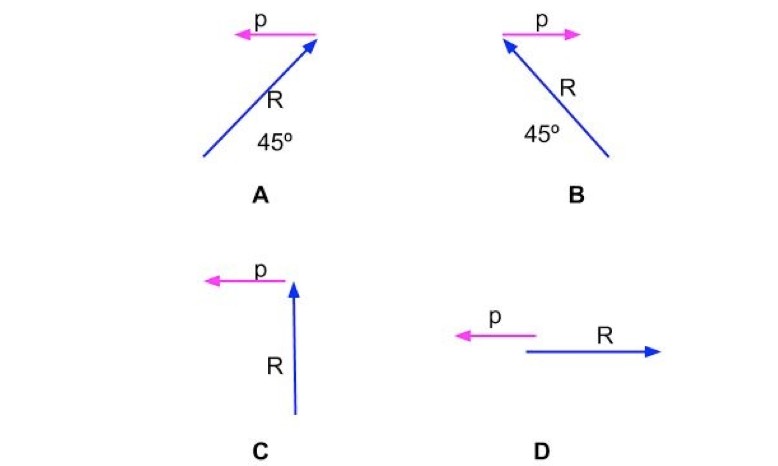
Diagram A
Diagram B
Diagram C
Diagram D
Question 5
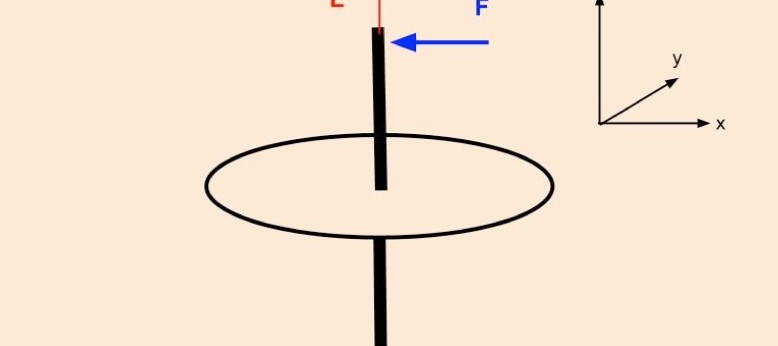
A spinning wheel has its angular momentum vector pointing in the direction.If you press gently on the axle in the direction, as shown in the diagram, in what direction does the axle move?
Compare angular-momentum magnitudes
Which diagram has the largest angular-momentum magnitude when the magnitudes of r and p are fixed?
- Diagram A
- Diagram B
- Diagram C
- Diagram D
Separate worked answer and scoring criteria →
Clarified wording and original source
The original wording calls the vectors constant while the diagrams change their relative directions. The comparison holds their magnitudes fixed and varies the angle.
The original prompt remains in the preserved source:
AP source clause (College Board) · Original companion solution


Reviewed physics notes (16)
These corrections keep the original lesson’s purpose while fixing errors in the source edition.
- Angular momentum is not the opposite of linear momentum. — Reference 1
- The source drops the cross product without the required sine. — Reference 1
- These equations concern magnitudes and perpendicular components, not equality of vector directions. — Reference 1
- The source incorrectly requires perpendicular position and velocity. — Reference 1
- Travel distance before passing O is not the angular-momentum lever arm. — Reference 1
- If its straight line literally passes through O, its angular momentum about O would be zero. — Reference 1
- Use perpendicular path offset instead of traveled distance. — Reference 1
- The source unsigned addition conflicts with its signed result. — Reference 1
- Repair the corresponding interactive-image caption. — Reference 1
- Cross-product order affects the sign, and angular momentum also applies to straight motion. — Reference 1
- For a general rigid body the full-vector relation uses an inertia tensor. — Reference 1
- A rolling finite-size ball has spin and contact dynamics that the source ignores. The bead model states the intended assumptions. — Reference 1
- The source incorrectly calls it linear-momentum conservation. — Reference 1
- Specify perpendicular lever arms and magnitude ratio. — Reference 1
- The original traveled distances are insufficient and the signed sum was wrong. — Reference 1
- Net L_z = −4(3) + 5(4) = +8 kg·m²/s. — Reference 1
Glossary and deeper reading · 10 refreshers
These editorial refreshers supplement the reading. Definitions and examples are added guidance; original source wording and recorded answers remain in their original context.
-
Linear momentum
Linear momentum is a vector describing an object’s motion and equals mass times velocity in the nonrelativistic model. The vector sum of momenta is conserved when the net external impulse on the system is zero. For example, two identical carts moving equally fast in opposite directions have zero total linear momentum but nonzero total kinetic energy.
-
Velocity
Velocity describes how position changes with time and includes direction. Instantaneous velocity describes one moment, while average velocity is displacement divided by elapsed time. For example, a car turning a corner can change velocity while maintaining the same speed.
-
Vector
A vector is a quantity with a magnitude and a direction, represented by an arrow or by components along chosen axes. Vectors add by adding corresponding components rather than simply adding their magnitudes. For example, an eastward displacement followed by a northward displacement produces a resultant pointing northeast. The zero vector has zero magnitude and no unique direction.
-
Cross product
A cross product combines two vectors to form a vector perpendicular to both. Its magnitude depends on both magnitudes and the sine of their included angle, while reversing input order reverses its direction. For example, a force whose line of action passes through the pivot gives zero torque cross product about that pivot.
-
Right-hand rule
A right-hand rule is a convention for determining the direction of a vector cross product or a current-produced magnetic field. The chosen gesture must use the correct input vectors in their correct order, with reversal when a negative charge requires it. For example, the thumb-and-curl rule around a straight wire uses conventional current as the thumb direction.
-
Rotational inertia
Rotational inertia measures how strongly a mass distribution resists a change in angular velocity about a specified axis. Mass farther from that axis contributes more strongly because each contribution depends on squared distance. For example, moving small masses outward along a rotating rod increases its rotational inertia without changing its total mass.
-
Angular velocity
Angular velocity describes the rate and direction of rotation about an axis. For a fixed axis, a signed angular velocity is measured in radians per second, while its magnitude is angular speed. For example, points on one rigid turntable share the same angular speed even though outer points have greater linear speeds.
-
Force
A force describes an interaction that can change an object’s momentum. It is a vector measured in newtons, so both size and direction matter when forces are added. For example, a rope can pull a cart while the floor exerts friction in another direction.
-
Torque
Torque describes a force’s turning effect about a chosen axis or point. Its magnitude is force times the perpendicular lever arm, and its direction or sign describes the rotation tendency. For example, pushing near the handle of a door produces more torque than the same perpendicular push near the hinge.
-
External force
An external force is exerted on part of a chosen system by something outside that system. The sum of external forces determines the rate of change of the system’s total momentum. For example, Earth’s gravitational force is external to a system consisting only of a falling ball.