Kepler orbit models
Enrichment article
Read the related lesson → · Full original reading →
Read the ellipse geometry and quantitative third-law model with common central mass, isolated two-body assumptions and semimajor axis. Keep AU/year conventions separate from SI units. Native angular-momentum conservation is a related model; this article has no accepted course attribution.
In this section, we are going to spend all our time dealing with one of the most important Laws that govern the universe. It is known as Kepler’s Three Laws and was proposed by Johannes Kepler in the early 1600s. These laws are very important as they describe the very motion of the planets in our solar system. We deem it important for you to know this as a way to solidify your knowledge of planetary motion and recognize how what you’re learning can be applied to real life principles.
Also known as the Law of Ellipses, it states that the path (orbits) of the planets around the sun is elliptical in shape with the center of the sun being located at one of the foci. In the previous section, we assumed that the planets orbited that sun in a circular motion. But in reality, they actually follow an elliptical path. The equation of an ellipse is:
In that equation, and are the radii of the ellipse’s x and y-axes, respectively. The larger radius corresponds to the major axis, while the smaller axis corresponds to the minor axis.
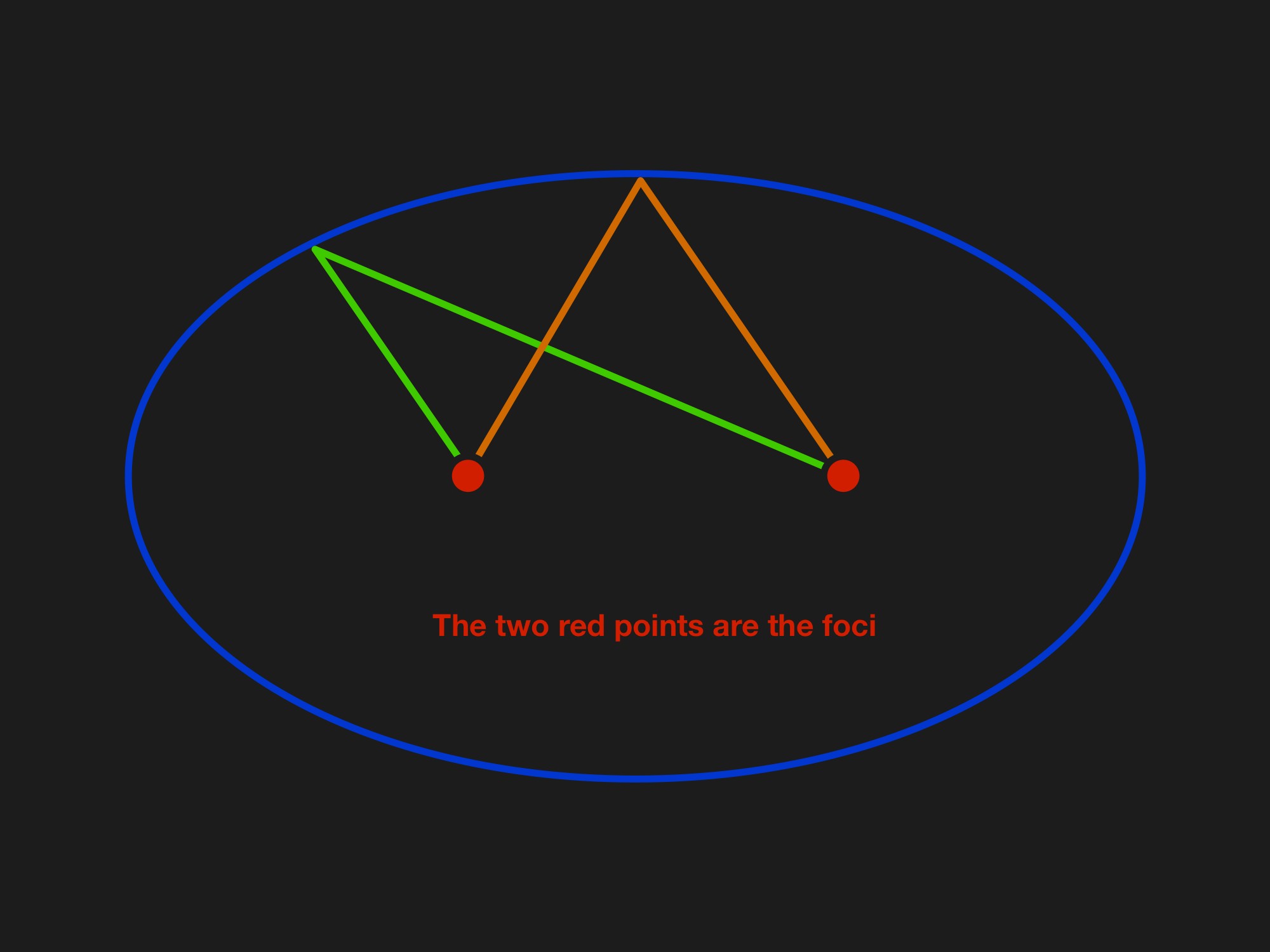
An ellipse is a very special shape where the sum of the distances from every point on the elliptical curve to two other points are equal Let’s look at the Gallery 3.4.1 for a better understanding:
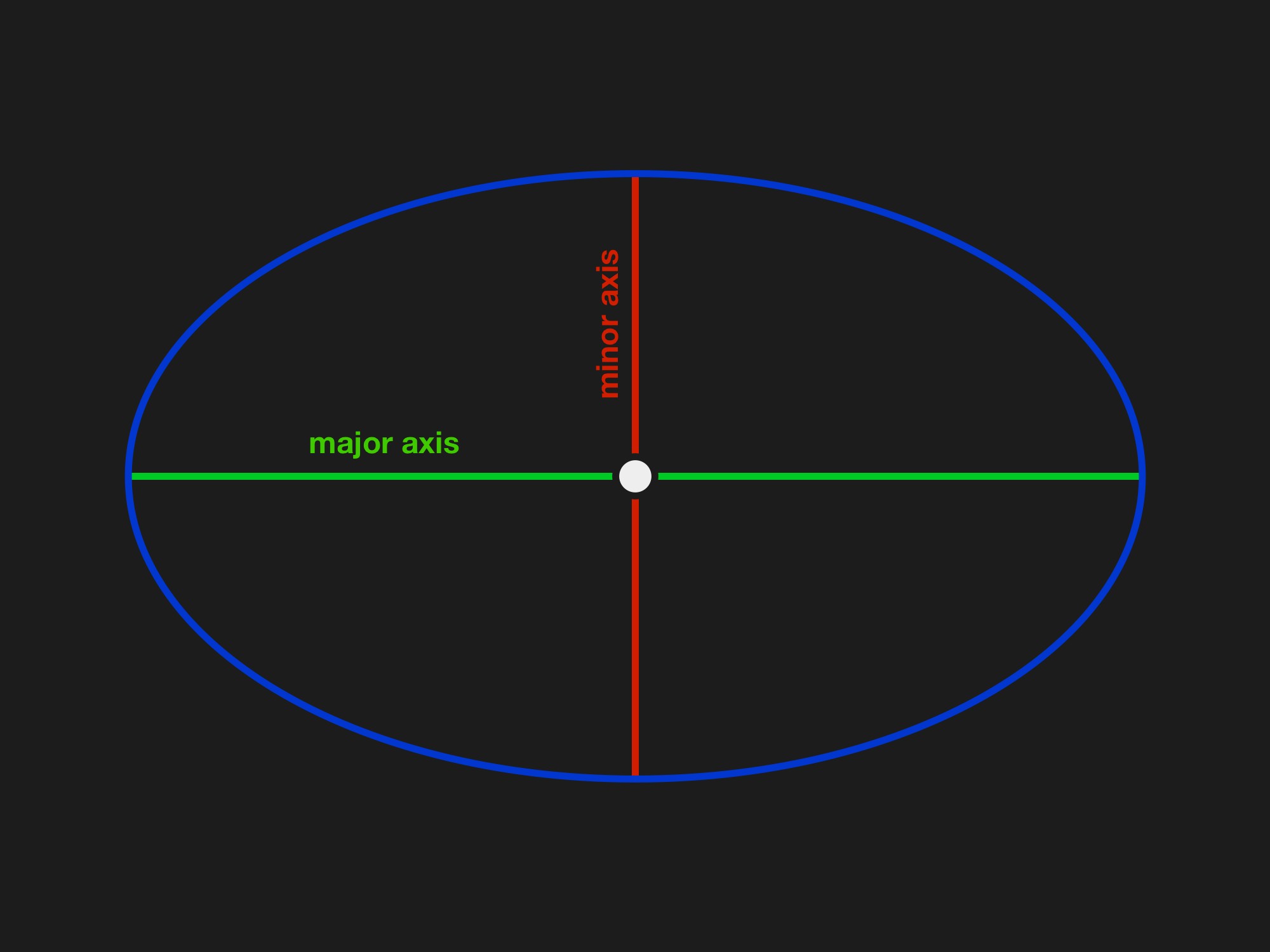
An ellipse is made up of a major and minor axis with a center point in the middle.
Read every step and figure
Step 1
Step 2
Step 3
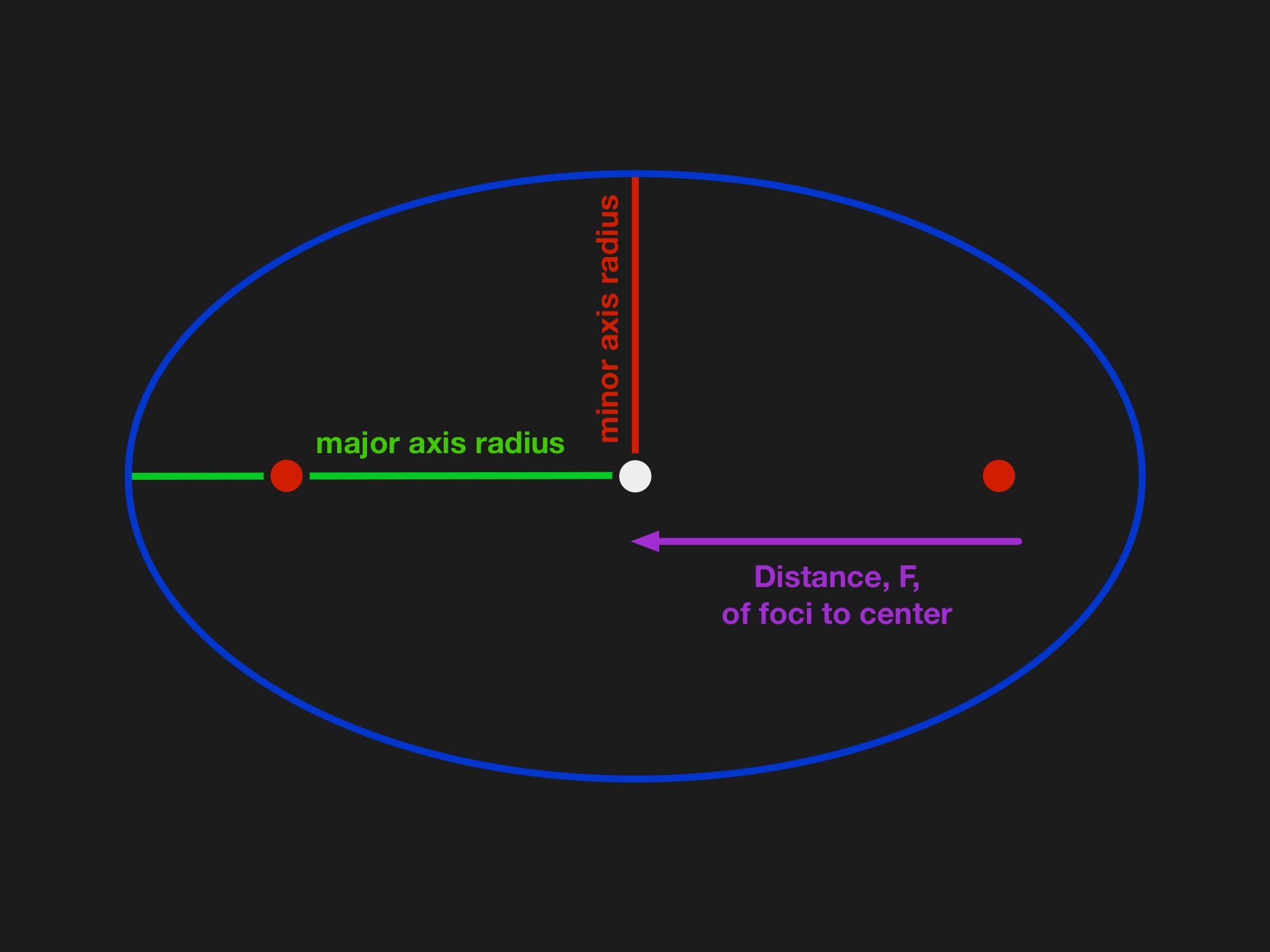
We can calculate the location of the foci if we know the radii of the major and minor axes. The equation for calculating the distance of a foci to the center of the ellipse is:
(Equation 3.4.2)
Here, is the radius of the major axis, is the radius of the minor axes, and is the distance of a foci to the center of the ellipse.
The foci are always along the major axis of the ellipse. The coordinates of the foci of an ellipse centered at and with a major axis along the x-axis are and
Also known as the Law of Equal Areas, it states that any imaginary line that is drawn from the center of the sun to a planet that lies on the orbital path sweeps the same amount of area in the same period of time. This helps characterize the velocity that the planet has at any given time while orbiting the sun. The green circles represent the planet at different time intervals and the blue and orange triangles are the areas that the planet covers from one instant of time to the next.
Figure 3.4.1 Kepler’s Second Law (The Law of Equal Areas)
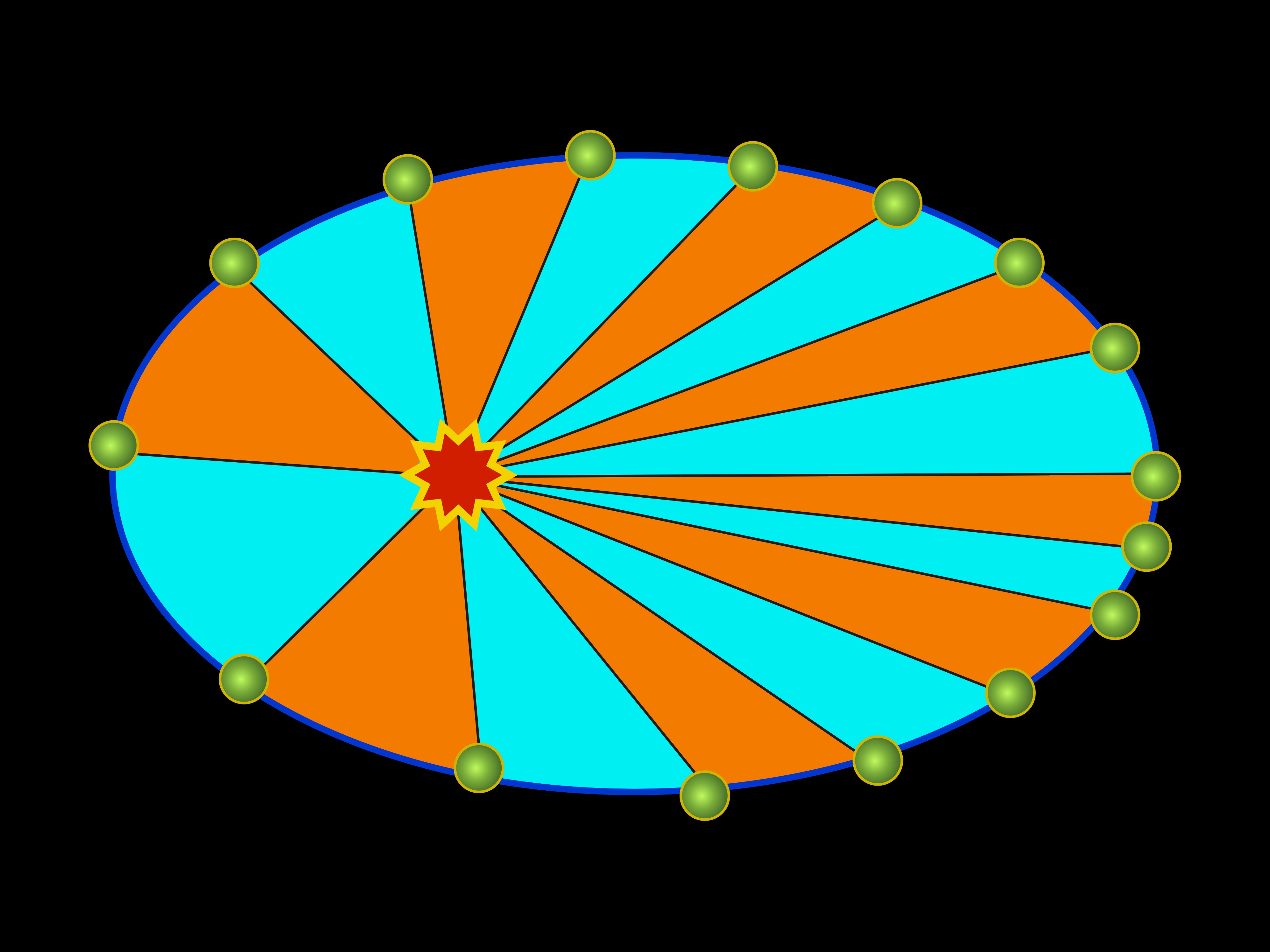
Along one elliptical orbit, the planet moves faster near the Sun and slower farther away. Conservation of angular momentum gives constant areal speed; conservation of orbital energy also relates speed to distance.
In equal time intervals, the radius from the Sun to the planet sweeps equal areas. These are orbital sectors bounded by the curved path; drawn triangles only approximate the sector areas when the intervals are small.
Kepler’s third law relates orbital period T to semimajor axis a: T²/a³ = 4π²/[G(M+m)] for an isolated Newtonian two-body system. When all orbiting bodies have negligible mass compared with the same central body M, this ratio is approximately the same. For a circular orbit, a equals the radius.
Planets, dwarf planets and other bodies orbiting the same dominant mass approximately share that constant. Satellites of a different central mass have a different constant. The observations support Kepler’s law; a table is not a proof that one constant applies to every orbit.
Table 3.4.1- Kepler’s Third Law
| Planet | Period T (yr) | Semimajor axis a (AU) | T²/a³ (yr²/AU³) |
|---|---|---|---|
| Mercury | 0.241 | 0.39 | 0.98 |
| Venus | 0.615 | 0.72 | 1.01 |
| Earth | 1.00 | 1.00 | 1.00 |
| Mars | 1.88 | 1.52 | 1.01 |
| Jupiter | 11.8 | 5.20 | 0.99 |
| Saturn | 29.5 | 9.54 | 1.00 |
| Uranus | 84 | 19.18 | 1.00 |
| Neptune | 165 | 30.06 | 1.00 |
For approximate solar-orbit calculations, express period in Earth years and semimajor axis in au, giving T² ≈ a³. Use 1 year ≈ 3.156 × 10⁷ s. One astronomical unit is exactly 149 597 870 700 m; it is close to Earth’s orbital semimajor axis, not its varying instantaneous distance from the Sun.
Source and curriculum context
Adapted from Physics I by Jake Yap and Laurence Vincent.
Glossary and deeper reading · 4 refreshers
These editorial refreshers supplement the reading. Definitions and examples are added guidance; original source wording and recorded answers remain in their original context.
-
Velocity
Velocity describes how position changes with time and includes direction. Instantaneous velocity describes one moment, while average velocity is displacement divided by elapsed time. For example, a car turning a corner can change velocity while maintaining the same speed.
-
Conservation of angular momentum
Angular momentum is conserved about a chosen axis when the net external angular impulse about that axis is zero. Internal interactions can change the distribution of mass and the rotation rates of parts without changing the total. For example, a rotating skater who pulls their arms inward can spin faster as their rotational inertia decreases.
-
Orbital period
An orbital period is the time needed for one complete orbit. In a two-body model it depends on the attracting mass and the orbit’s size rather than just the orbiting object’s mass. For example, a larger circular orbit around the same planet has a longer orbital period.
-
Oscillation period
An oscillation period is the time required for one complete repeating cycle. It is the reciprocal of frequency and is measured in seconds. For example, measuring the time for several pendulum swings and dividing by the number of cycles estimates the period.