Friction warming a plank
Background reading · AP Physics 2
Read the related lesson → · Full original reading →
Friction removes mechanical energy from the box; the stipulated deposited energy raises the plank’s internal energy. Positive friction-magnitude times distance is dissipated energy, not the signed friction work on the box, and dissipation is not automatically thermodynamic heat crossing a boundary. Assume a level stationary plank with N = mg, completion of the full 10 m relative slide, all dissipated energy deposited in the plank, constant specific heat, no phase change or losses, and a uniform final temperature.
The first equation that we will use temperature in is to cover specific heatⓘ. The concept of specific heat is pretty simple; it’s the amount of energy that is needed to raise an object’s temperature. Some objects are easier to heat up than other, like oil versus rubber. The way that we quantify that property is the specific heat. Formally, the specific heat of an object is the amount of energy in that it takes to raise the of the object’s temperature by .
The equation for specific heat is simple:
Q is energy transferred as heat because of a temperature difference. In Q = mcΔT, positive Q is transferred into the sample and negative Q out of it, under the constant-specific-heat, no-phase-change model.
Example Problem 7.1.1
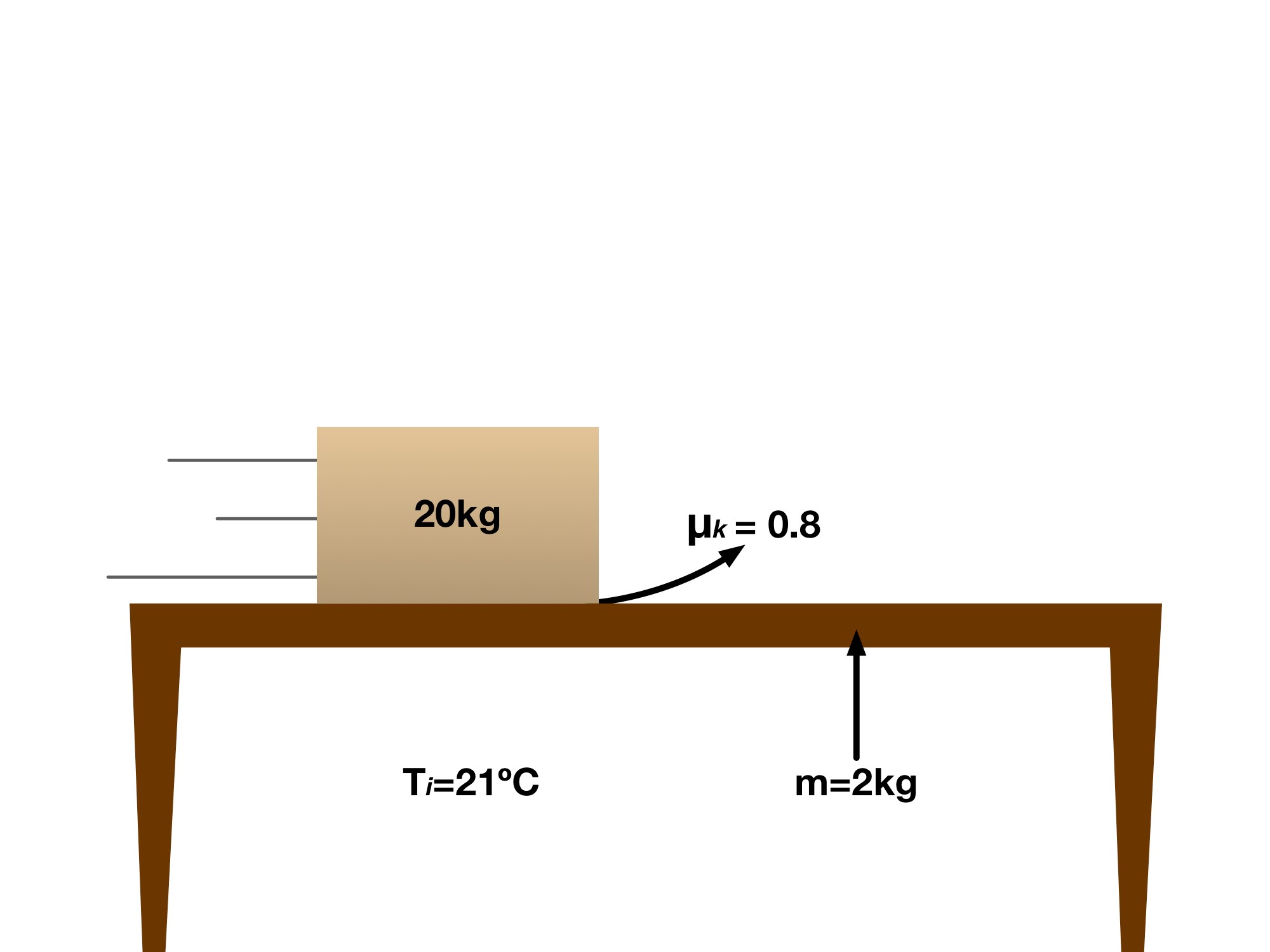
If a box slides along a , plank with a coefficient of kinetic friction of , determine the final temperature of the plank. Assume the plank absorbs all the heat generated by friction, and it starts at . The specific heat of the plank is
Step 1. Determine the heat added to the plank
If we want to determine the heat involved, we have to first identify the source of the heat. Friction is the only contributor in this case, as it contributes all its generated heat into the plank. But how much heat is that? Well to find that, we just need to calculate the work done by the force.
Remember the equation for work.
In this case, the force of friction can be given as:
F_friction = μ_kmg = 0.80(20 kg)(9.81 m/s²) = 156.96 N.
So work, which is will be:
Example 7.1.1 Contact Forces on the Box
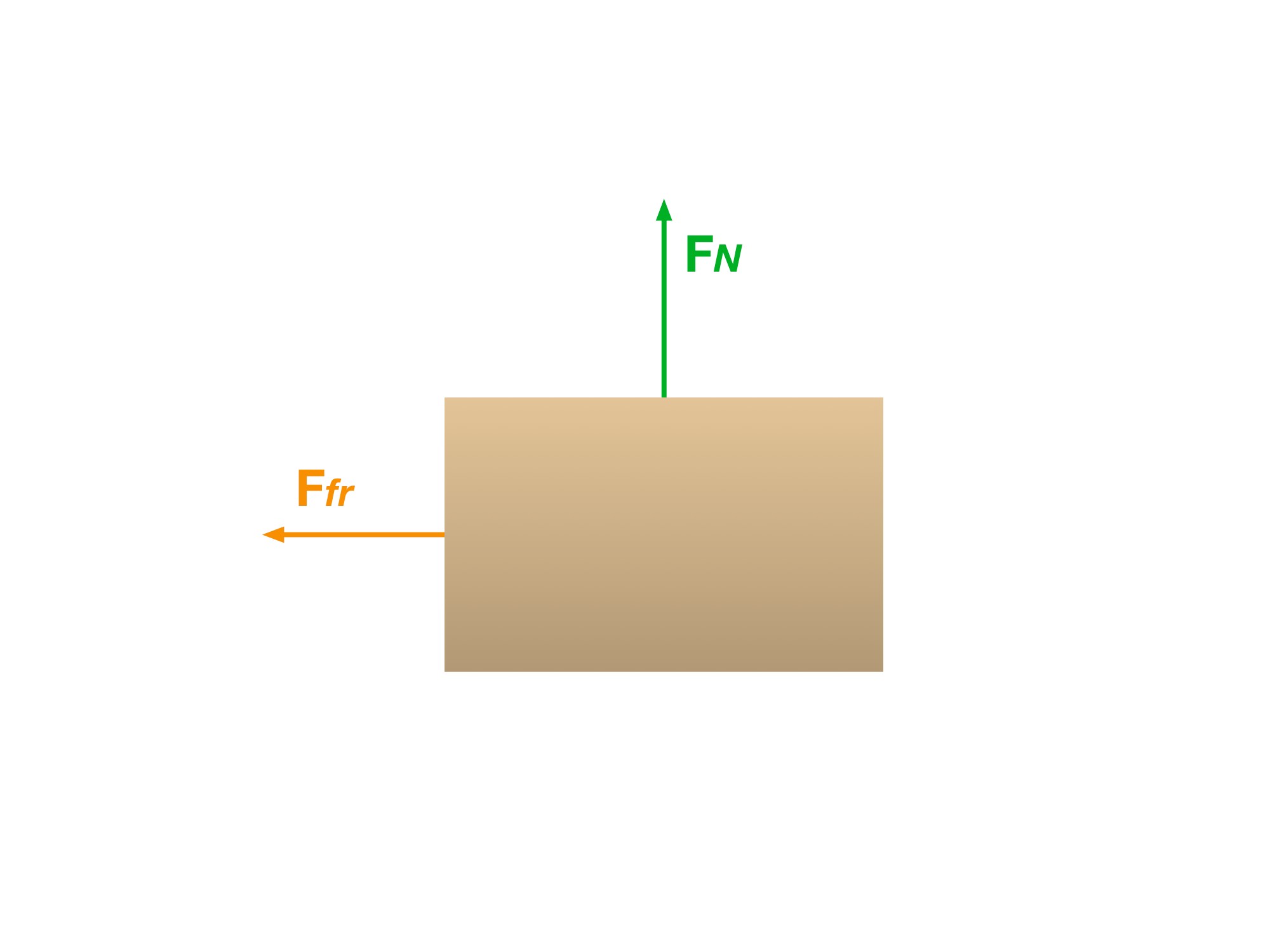
This drawing shows only the upward normal force and leftward friction. A complete free-body diagram also needs the box’s downward weight; on the level surface with no vertical acceleration, N = mg.
Source and curriculum context
Adapted from Physics I by Jake Yap and Laurence Vincent.
physics2 · 9.5.A.1, 9.4.B.1 · printed pages 31, 33.
Glossary and deeper reading · 3 refreshers
These editorial refreshers supplement the reading. Definitions and examples are added guidance; original source wording and recorded answers remain in their original context.
-
Temperature
Temperature is a state quantity that determines the direction of net energy transfer through thermal contact. For a classical ideal gas it is proportional to the average translational kinetic energy per particle, rather than to the total energy of the sample. For example, a small hot metal sample can have a higher temperature but less total internal energy than a large cooler sample.
-
Specific heat
Specific heat is the energy needed per unit mass for a unit temperature increase under the stated conditions. Its units are joules per kilogram per kelvin, and the simple calorimetry model treats it as constant without a phase change. For example, equal masses of two materials can require different energy transfers for the same temperature rise.
-
Heat
Heat is energy transferred between systems because of a temperature difference. It describes a transfer rather than a substance or energy store contained in an object. For example, when a warmer mug transfers energy to a cooler hand, the mug loses internal energy and the hand gains it.