Temperature
Original textbook reading.
Enrichment beyond the AP course.
This original chapter is extra exploration beyond the supplied AP Physics 1 course. Keep it if you're curious about where these ideas go next.
When you think of temperature, you might just think of the thermometer on your wall, or the one you use to check for a fever. That alone isn’t a useful definition of temperature.
Temperature is a measure of thermal state that determines the direction of heat transfer: energy flows spontaneously from higher to lower temperature. It is not total or average internal energy. For a classical ideal gas, absolute temperature is proportional to the mean translational kinetic energy per particle.
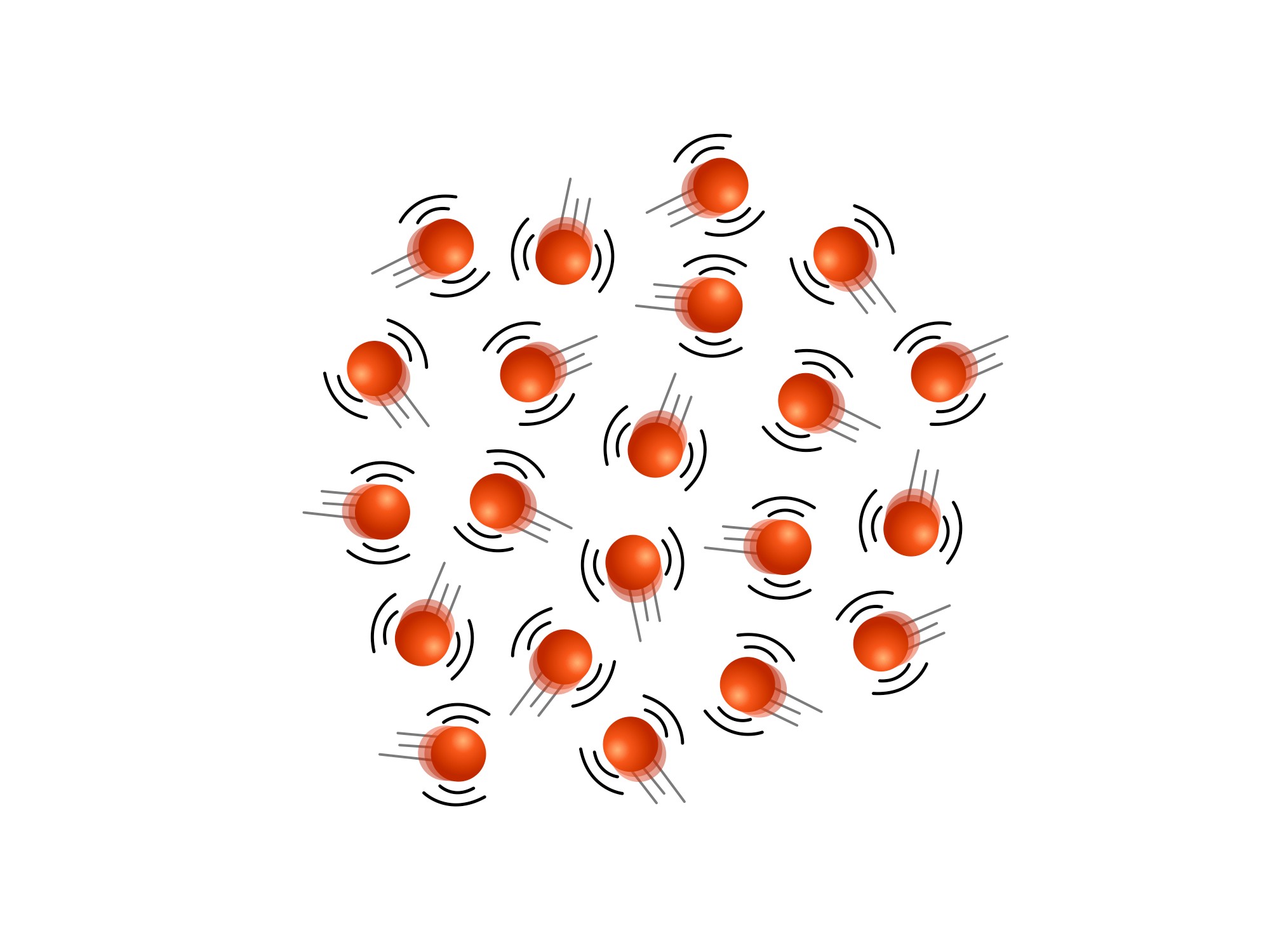
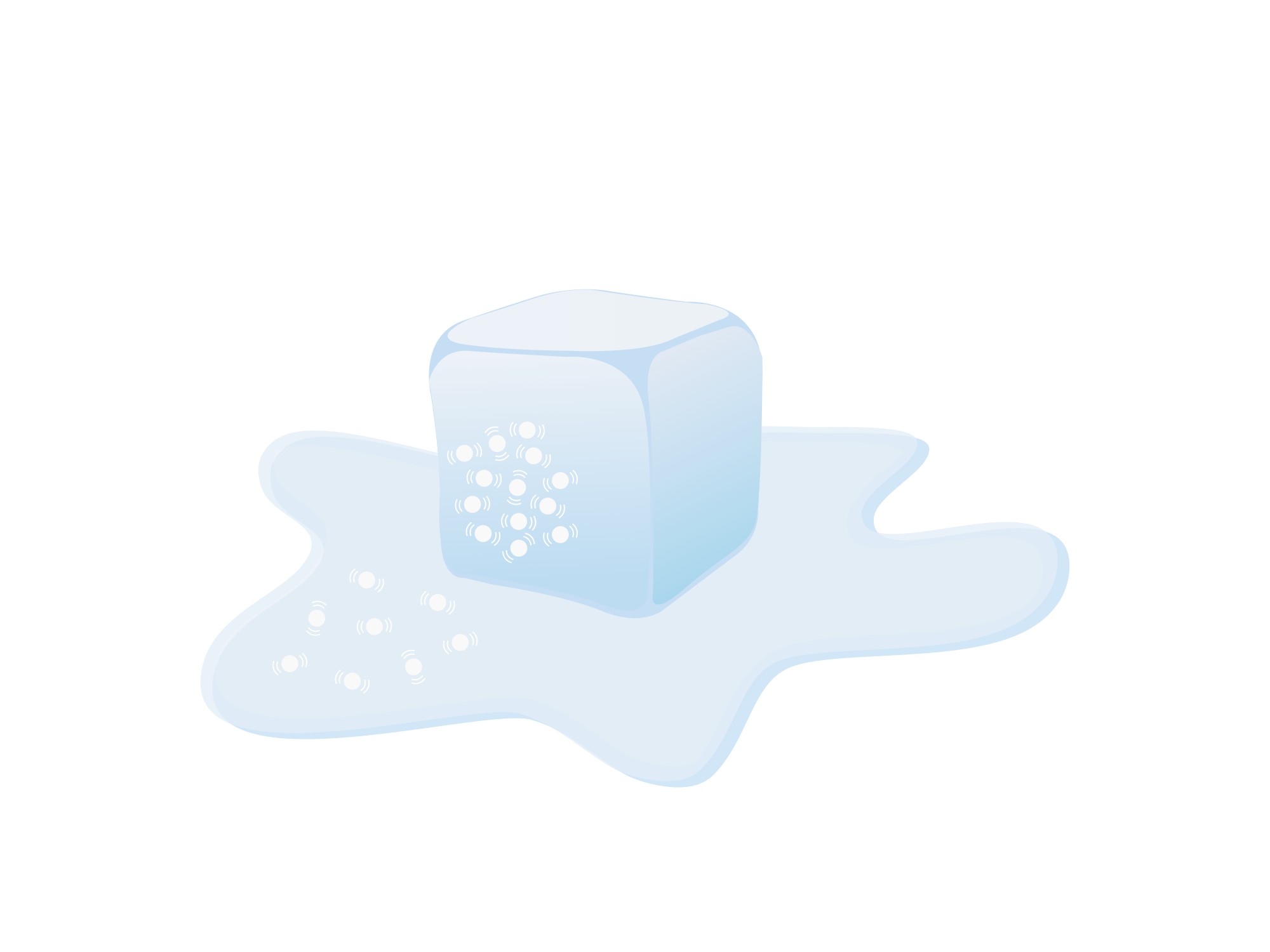
Microscopic thermal motion includes vibrations in solids and translational and other motions in fluids. Increasing temperature generally increases typical thermal kinetic energy, but melting also changes the organization and interactions of the particles.
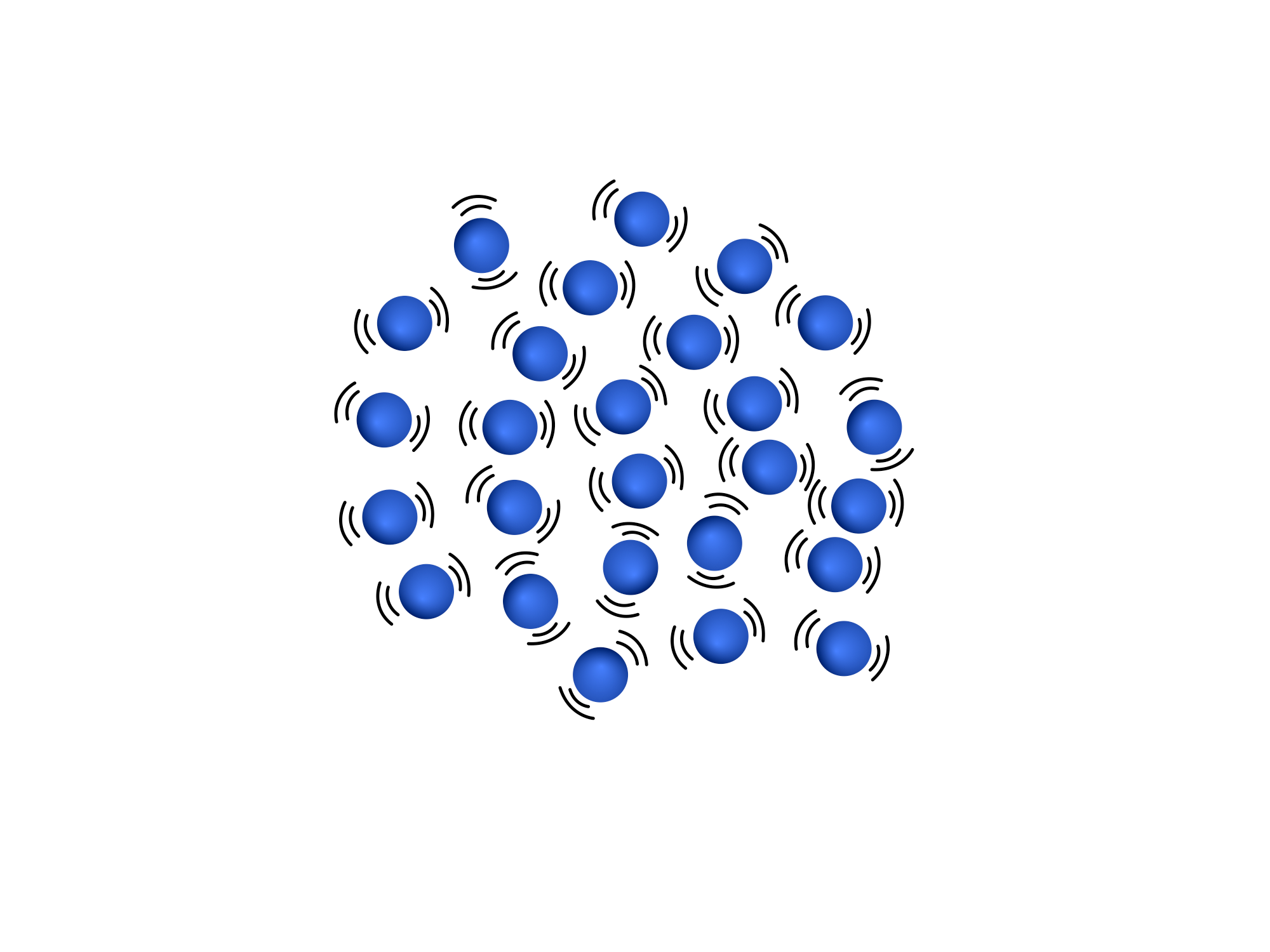
This is a what an atom looks like when it’s vibrating under cold temperatures. Very small vibrations with little movement.
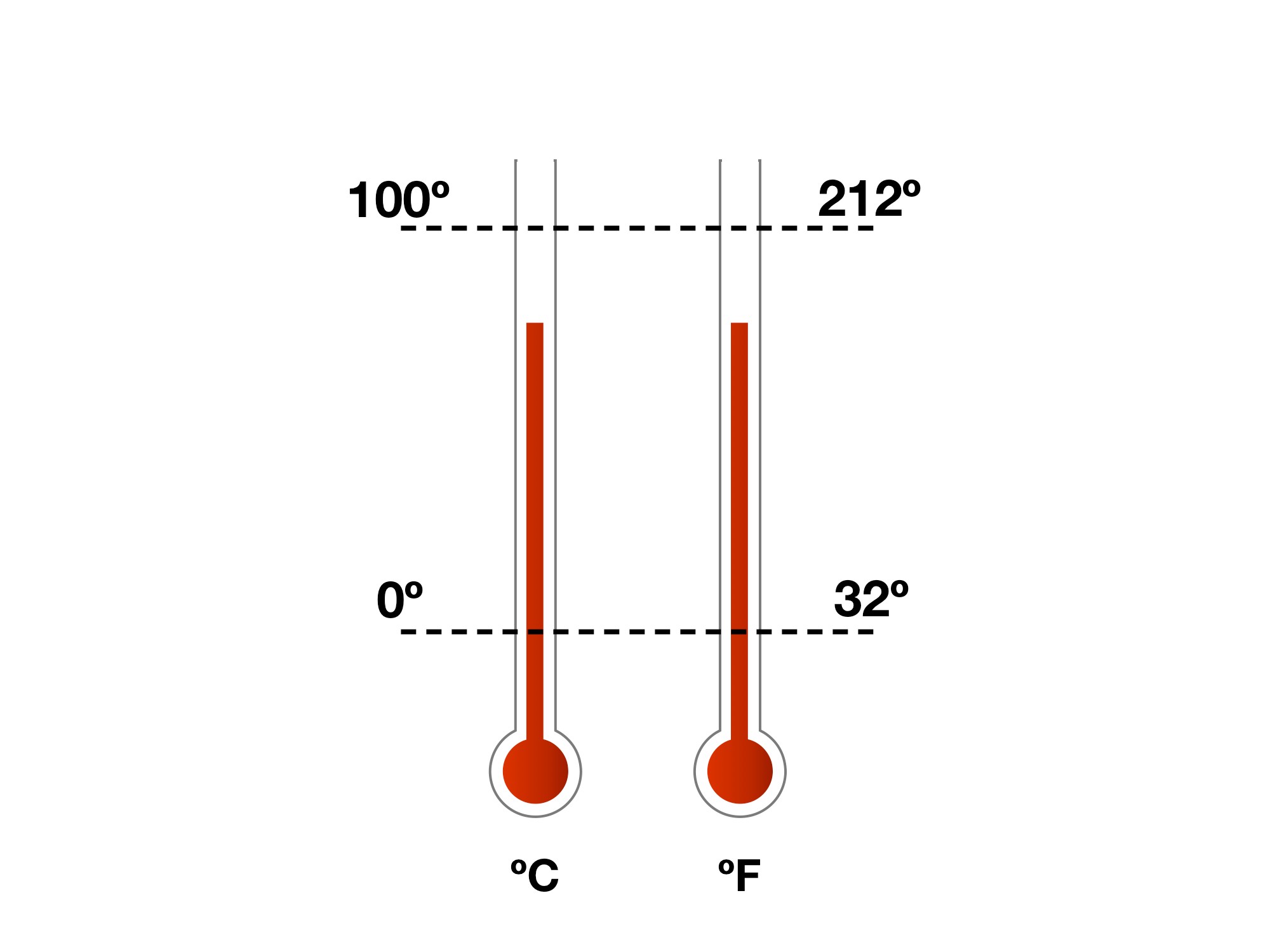
Celsius and Fahrenheit are temperature scales with different zero points and degree sizes. A degree measures a temperature interval, not a fixed amount of energy: the energy for a given rise depends on the sample’s heat capacity.
At approximately standard atmospheric pressure, pure water freezes near 0°C and boils near 100°C. These familiar points help illustrate the Celsius scale; boiling and freezing temperatures can change with pressure or composition.
The Celsius and Fahrenheit scales measure the same temperature with different numerical conventions: 0°C corresponds to 32°F.
The Fahrenheit scale set the point of to be the lowest temperature that an ice, water, and salt mixture could reach. This scale allowed for the conversion between the Fahrenheit and Celsius scales. This conversion is:
Figure 7.1.1 Temperature Scales
The kelvin is the SI unit of thermodynamic temperature. For the ordinary equilibrium systems in this chapter, the absolute scale has its lower limit at 0 K, called absolute zero.
Kelvin scale, as mentioned, is based off of the celsius scale. In order to get to kelvin scale, the equation to be used is:
Basically all you have to do is add to whatever the measurement is. For example, if the current temperature was measured as , the conversion to Kelvin scale would be:
Use T/K = t/°C + 273.15. Replacing 273.15 by 273 is an approximation and should only be used when its 0.15 K error is smaller than the required precision.
Absolute Temperature
In the classical ideal-gas model, mean translational kinetic energy approaches zero as thermodynamic temperature approaches 0 K. This model provides an introductory link between temperature and microscopic motion.
Absolute zero is the 0 K limit of the thermodynamic temperature scale. It does not imply that every microscopic motion stops or that the internal energy is zero; quantum systems can retain ground-state energy. An arbitrary choice of energy reference cannot define the lower limit of temperature.
Zero kelvin corresponds to −273.15°C or −459.67°F. Use kelvins in equations that require thermodynamic temperature, such as fourth-power thermal-radiation laws.
Figure 7.1.2 Atoms in Motion
The Kelvin scale uses the Celsius degree as the degree for its own scale. That means that an object that is warmer than another object is also warmer than that object.
The first equation that we will use temperature in is to cover specific heatⓘ. The concept of specific heat is pretty simple; it’s the amount of energy that is needed to raise an object’s temperature. Some objects are easier to heat up than other, like oil versus rubber. The way that we quantify that property is the specific heat. Formally, the specific heat of an object is the amount of energy in that it takes to raise the of the object’s temperature by .
The equation for specific heat is simple:
Q is energy transferred as heat because of a temperature difference. In Q = mcΔT, positive Q is transferred into the sample and negative Q out of it, under the constant-specific-heat, no-phase-change model.
Example Problem 7.1.1
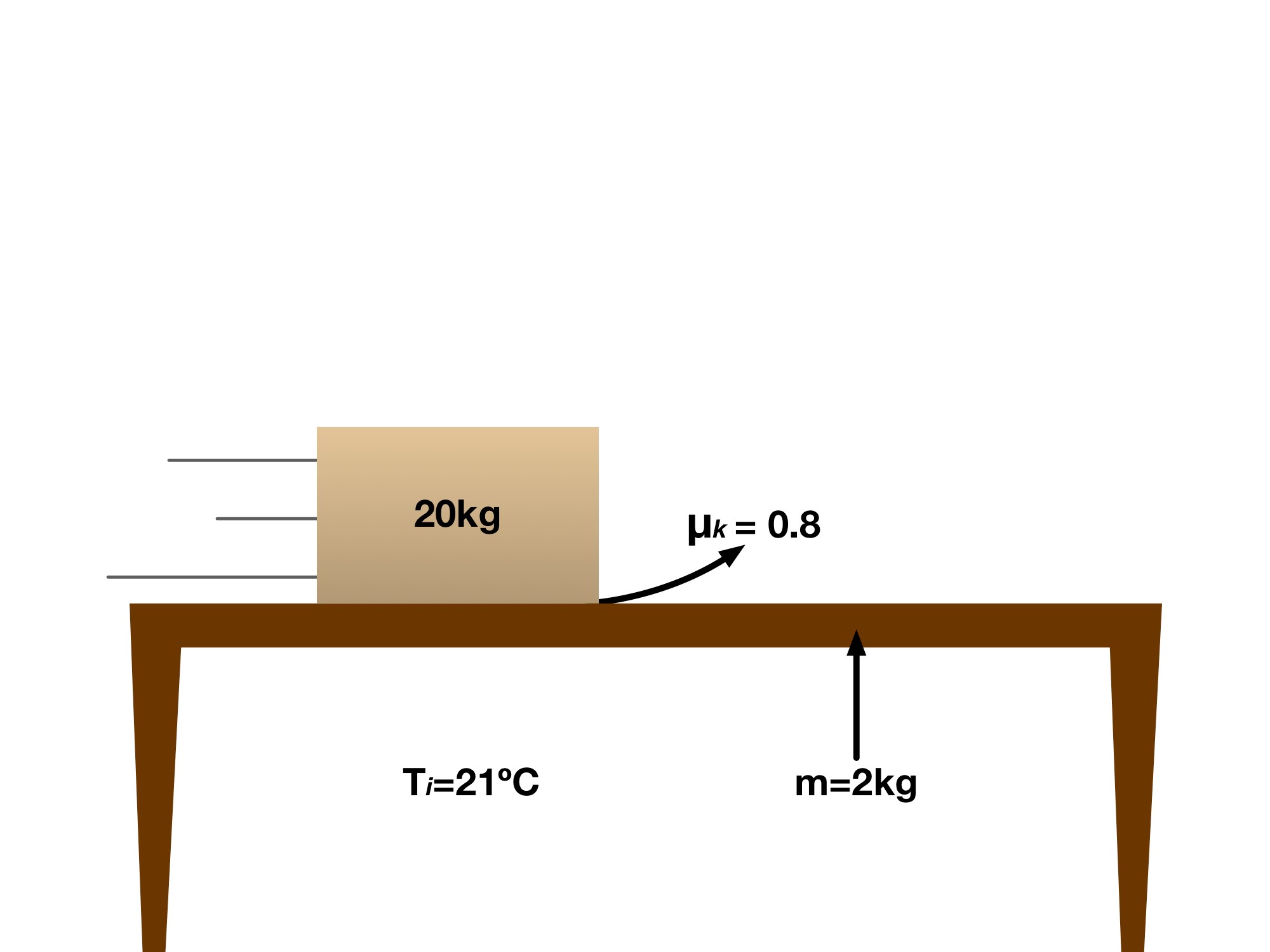
If a box slides along a , plank with a coefficient of kinetic friction of , determine the final temperature of the plank. Assume the plank absorbs all the heat generated by friction, and it starts at . The specific heat of the plank is
Step 1. Determine the heat added to the plank
If we want to determine the heat involved, we have to first identify the source of the heat. Friction is the only contributor in this case, as it contributes all its generated heat into the plank. But how much heat is that? Well to find that, we just need to calculate the work done by the force.
Remember the equation for work.
In this case, the force of friction can be given as:
F_friction = μ_kmg = 0.80(20 kg)(9.81 m/s²) = 156.96 N.
So work, which is will be:
Example 7.1.1 Contact Forces on the Box
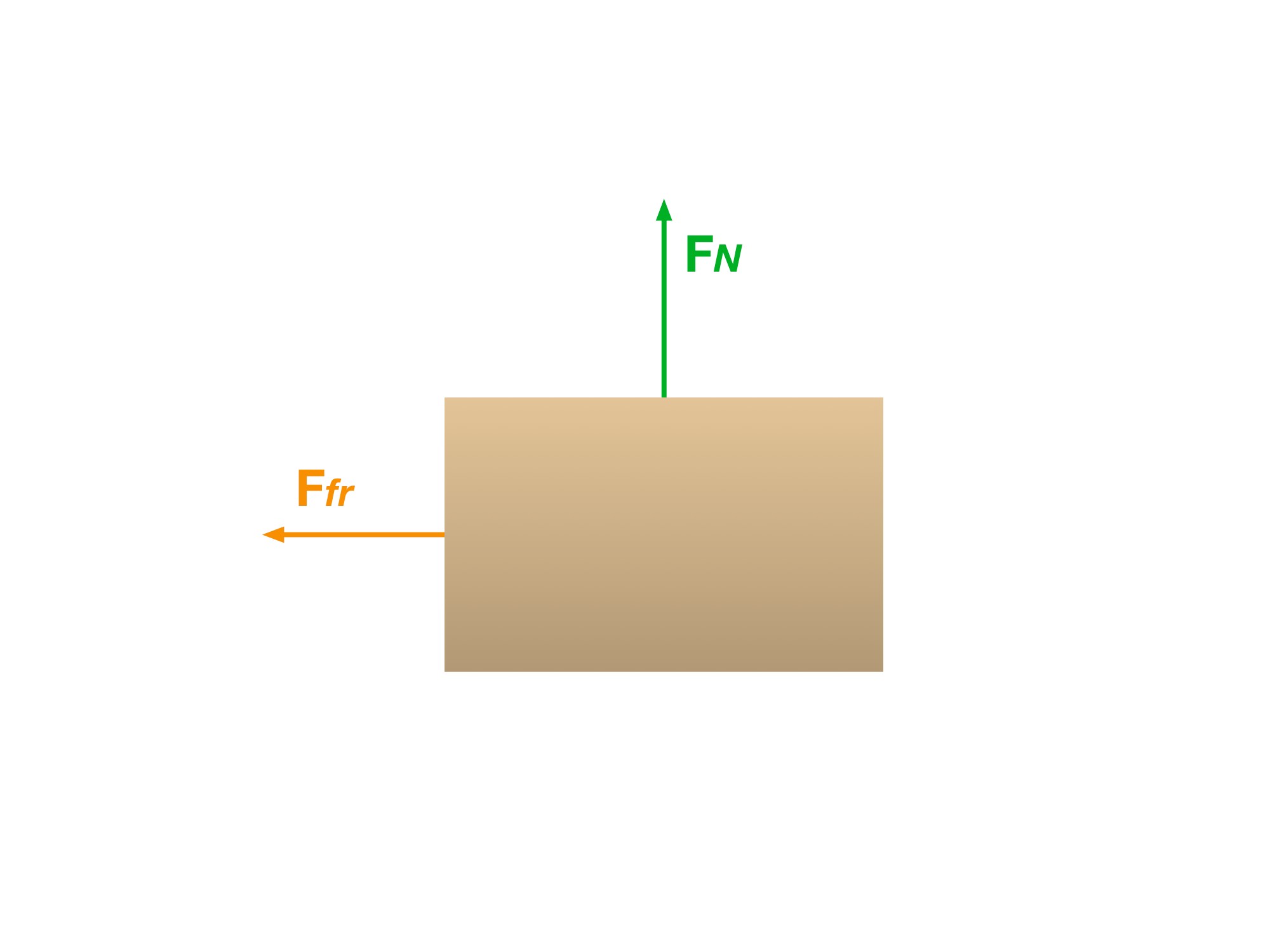
This drawing shows only the upward normal force and leftward friction. A complete free-body diagram also needs the box’s downward weight; on the level surface with no vertical acceleration, N = mg.
One aspect of specific heat that you should know about is calorimetry. Calorimetry is, in essence, is the way that the specific heat of objects are determined.
The technique of calorimetry relies on an instrument called a calorimeter. This instrument is an insulated container which isolates the energy of the system from the surroundings.
Inside the instrument, an object is placed into water. The object’s initial temperature must be known, as well as the water’s initial temperature. Then, the two are allowed to reach an equilibrium. Generally, the object in question is heated, so equilibrium is reached when the water absorbs the heat from the object until the two are at the same final temperature. Once the objects are at the same temperature, the final temperature is measured. This, in conjunction with the knowledge of the specific heat of water, gives the ability to calculate the specific heat of the unknown object .


Reviewed physics notes (24)
These corrections keep the original lesson’s purpose while fixing errors in the source edition.
- An object’s amount of internal energy depends on mass, material and phase, not temperature alone. — Reference 1
- The source treats vibration as all thermal motion. — Reference 1
- One degree does not correspond to a universal energy increment. — Reference 1
- The water reference points require stated conditions. — Reference 1
- Thermometers measure temperature, not internal energy. — Reference 1
- Avoid defining kelvin through an energy-zero argument. — Reference 1
- The source claims a rounding approximation is harmless in all applications. — Reference 1
- The classical ideal-gas relation is not a definition of all internal energy. — Reference 1
- The source incorrectly eliminates all motion and internal energy at 0 K. — Reference 1, Reference 2
- Avoid the false argument that negative internal energy is intrinsically impossible. — Reference 1
- Heat is a transfer of energy, not a stored substance interchangeable with all energy. — Reference 1
- Use the full precision before the final temperature calculation. — Reference 1
- Clarify that this is deposited energy; the work of friction on the moving box has the opposite sign. — Reference 1
- Keep consistent arithmetic. — Reference 1
- The source division gives 0.436°C incorrectly. — Reference 1
- Propagate the corrected temperature rise. — Reference 1
- Replace the incorrect source final temperature. — Reference 1
- The source ties phase change only to faster motion and conflates atoms with water molecules. — Reference 1
- Specify the heat capacity convention and solve the initial-temperature question correctly. — Reference 1
- T_i = 20 − 200/(10 × 1.012) = 0.23715°C = 273.38715 K. — Reference 1
- The original question omits the heat capacity needed to determine its numerical answer. — Reference 1
- The 16.5°C key requires the stated energy-absorption assumption. — Reference 1
- The corrected 273.4 K choice is the initial absolute temperature. — Reference 1
- The source 243.7 K key is arithmetically incorrect. — Reference 1
Glossary and deeper reading · 13 refreshers
These editorial refreshers supplement the reading. Definitions and examples are added guidance; original source wording and recorded answers remain in their original context.
-
Temperature
Temperature is a state quantity that determines the direction of net energy transfer through thermal contact. For a classical ideal gas it is proportional to the average translational kinetic energy per particle, rather than to the total energy of the sample. For example, a small hot metal sample can have a higher temperature but less total internal energy than a large cooler sample.
-
Heat
Heat is energy transferred between systems because of a temperature difference. It describes a transfer rather than a substance or energy store contained in an object. For example, when a warmer mug transfers energy to a cooler hand, the mug loses internal energy and the hand gains it.
-
Internal energy
Internal energy is energy associated with the microscopic motion and configuration of a system’s constituents. It excludes the kinetic energy of the whole system’s bulk motion and depends on the thermodynamic state. For example, a stationary solid can gain internal energy as its atomic vibrations become more energetic.
-
Fluid
A fluid is a material that flows and continuously deforms under a sustained shear stress. Liquids and gases are both fluids, although their compressibility and other properties can differ greatly. For example, both water in a pipe and air flowing through a duct are fluids.
-
Kinetic energy
Kinetic energy is energy associated with motion relative to a chosen reference frame. For a nonrelativistic translating object it is one half of its mass times speed squared. For example, doubling a cart’s speed quadruples its translational kinetic energy when its mass stays fixed.
-
Heat capacity
Heat capacity is the energy needed to raise the temperature of an entire object by one temperature unit under specified conditions. For a uniform sample in the simple constant-specific-heat model, it equals mass times specific heat. For example, twice as much of the same material has twice the heat capacity when its state and specific heat are unchanged.
-
Pressure
Pressure is the normal force per unit area exerted on a surface. It is a scalar measured in pascals, with one pascal equal to one newton per square meter. For example, a gas exerts pressure throughout its volume through many microscopic collisions, even when its bulk motion is zero.
-
Kelvin temperature scale
The kelvin scale measures thermodynamic temperature from absolute zero. A temperature interval of one kelvin has the same size as one degree Celsius, but their zero points differ. For example, temperature ratios in the ideal gas law must use kelvin values rather than Celsius values.
-
Absolute zero
Absolute zero is zero kelvin, the lower limit of thermodynamic temperature in the models used here. It corresponds to minus 273.15 degrees Celsius and does not mean all quantum motion disappears. For example, an ideal-gas pressure-versus-Celsius graph can be extrapolated toward this limit, although a real gas may condense before reaching it.
-
Ideal gas
An ideal gas model treats particles as having negligible volume and no sustained intermolecular forces between brief elastic collisions. The equilibrium state obeys the ideal gas law using absolute pressure and kelvin temperature. For example, a dilute gas far from condensation often approximates this model better than a dense gas near a phase change.
-
Power
Power is the rate at which energy is transferred or converted. It is measured in watts, with one watt equal to one joule per second. For example, two motors can lift the same load through the same height but have different average powers if they take different times.
-
Thermal radiation
Thermal radiation is electromagnetic energy emitted by matter because of its temperature. It can transfer energy through a vacuum, and net radiative transfer between ordinary bodies is from hotter to cooler. For example, sunlight warming a surface does not need air to carry the energy across space.
-
Specific heat
Specific heat is the energy needed per unit mass for a unit temperature increase under the stated conditions. Its units are joules per kilogram per kelvin, and the simple calorimetry model treats it as constant without a phase change. For example, equal masses of two materials can require different energy transfers for the same temperature rise.