Physical-pendulum period
Enrichment article · Physics C: Mechanics
Read the related lesson → · Full original reading →
Figure 10.2.1 Oddly Shaped Mass for a Pendulum
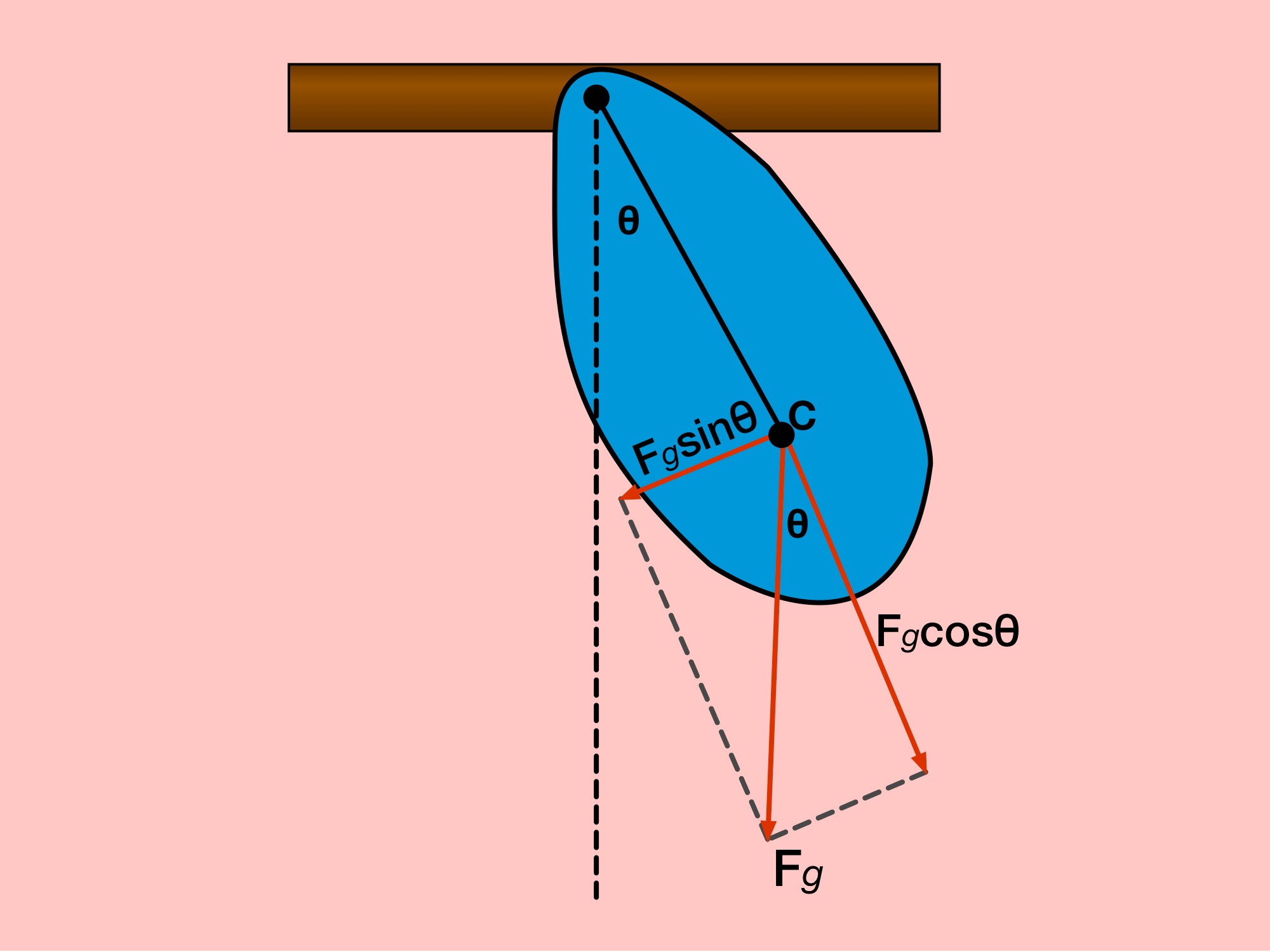
There is also another type of pendulum that we have to consider. We just dealt with a point mass, the ball. But what if the mass didn’t have a shape like that? What if it was irregularly shaped?
Oddly Shaped Masses
As shown in the figure, the mass can look as something as strange as that. Does this mass follow a SHM? Does it have a period?
A rigid body suspended from a fixed pivot is a physical pendulum. If its centre of mass lies a distance h below the pivot, its torque is −mgh sinθ. For small angular oscillations, the period depends on h and the moment of inertia about the pivot:
T=2π√[I/(mgh)] (Equation 10.2.2), for small angles; g is the positive magnitude of gravitational acceleration.
Here I is the moment of inertia about the pivot axis and h is the pivot-to-centre-of-mass distance. The equivalent simple-pendulum length is L_eq=I/(mh), which generally differs from h.
Example Problem 10.2.1
Notice how there are two pendulum systems occurring here. We have the point mass-string pendulum and the rod pendulum. Given that the center of mass of the rod is in the middle of the rod, from the pivot point , and the total distance of the rod is , find the period of the pendulum system and the distance on the rod where the periods of the ball and the rod systems will be the same.
Example Problem 10.2.1
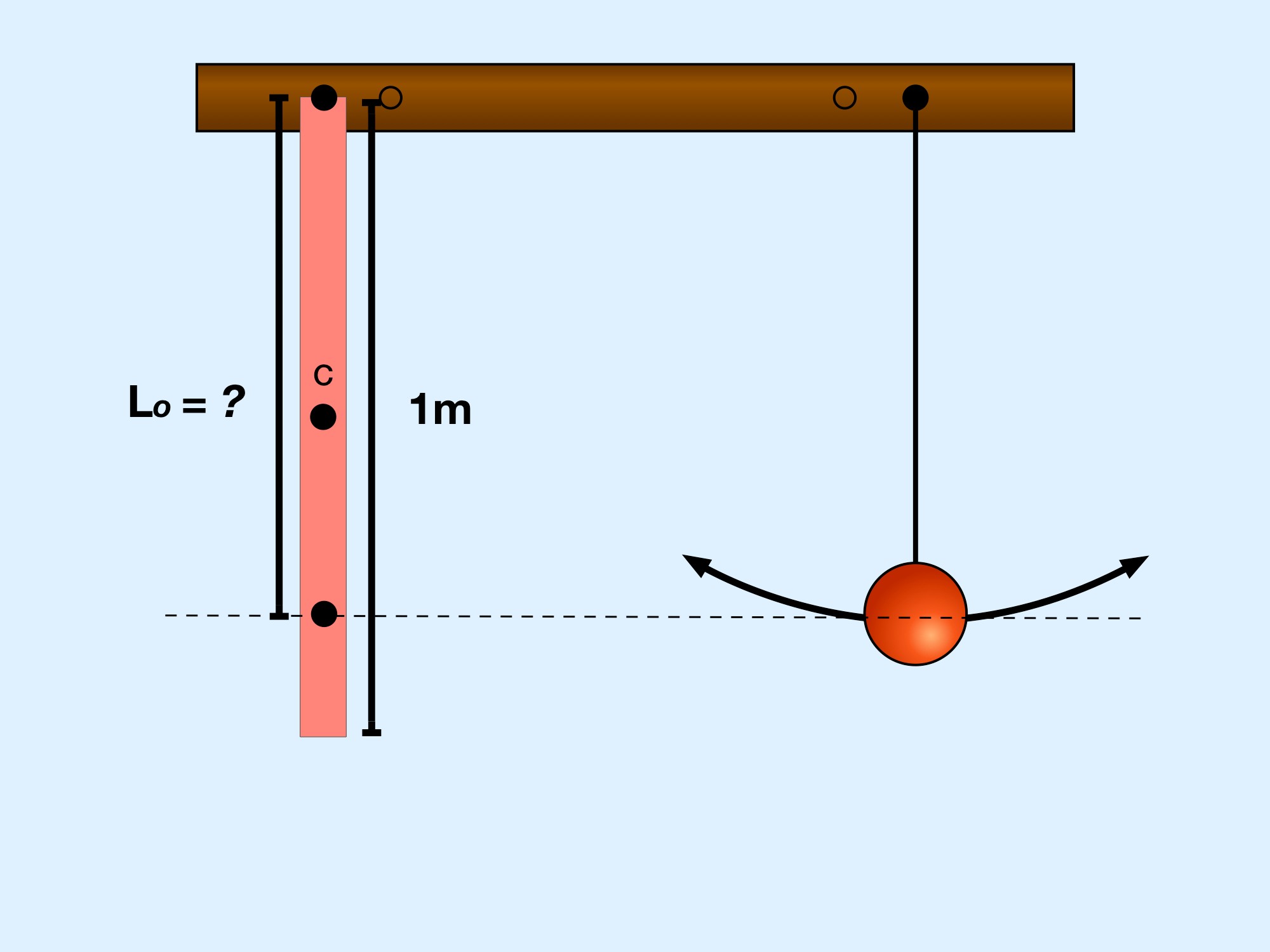
Step 1: Find the period of the rod
Well since the rod has a total length of , we can then say that the center of mass of the rod is located at a distance of . With that in mind, let’s find the period using our Pendulum equation. We are using that equation since the mass of the pendulum is not a simple ball string one.
T=2π√[I/(mgh)], with I measured about the pivot.
In this case, the rotational inertia of a rod is:
Plugging this in to the period equation, we get:
Step 3: Set the periods of the two systems equal to each other
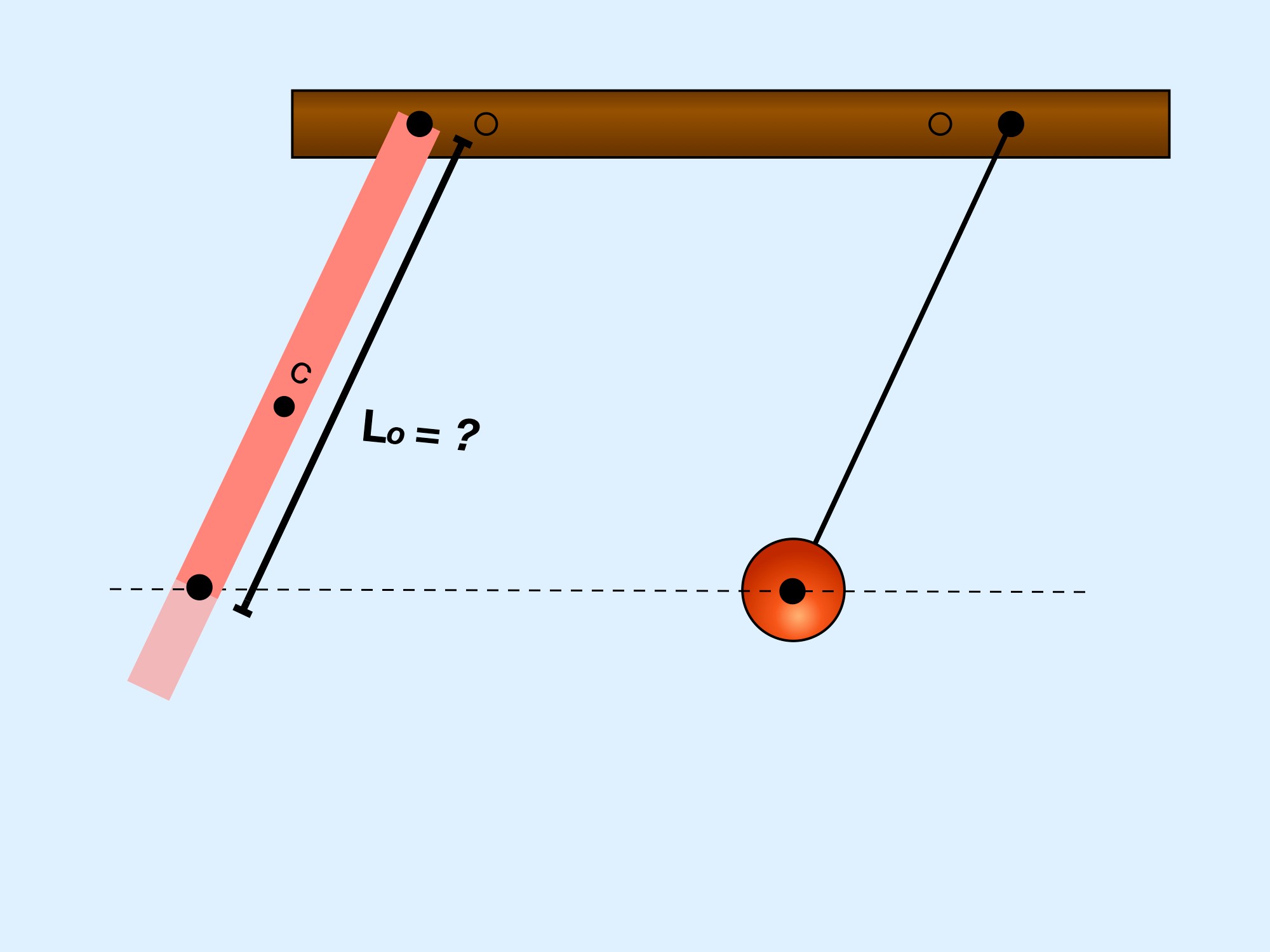
Since we know that the systems are going to have the same periods, let’s just set the period of the simple ball system equal to the period of the rod system:
T_simple=2π√(L₀/g)=T_rod=2π√[2L/(3g)].
In this case, the is supposed to represent the distance where the rod has the same period as the ball. Since the two equations are essentially the same, we can rewrite the top equation as simply:
Example 10.2.1 How are the Periods the Same?
Source and curriculum context
Adapted from Physics I by Jake Yap and Laurence Vincent.
physics-c-mechanics · 7.5.A.1, 7.5.A.2 · printed pages 132, 133.
Glossary and deeper reading · 7 refreshers
These editorial refreshers supplement the reading. Definitions and examples are added guidance; original source wording and recorded answers remain in their original context.
-
Pendulum
A pendulum is a system that swings about a support under a restoring torque. A simple pendulum approximates a small mass on a light string and follows simple harmonic motion only for sufficiently small angles. For example, a short string pendulum completes small swings more quickly than a longer one under the same gravitational field.
-
Simple harmonic motion
Simple harmonic motion occurs when the net restoring force is proportional to displacement from equilibrium and points in the opposite direction. The resulting position varies sinusoidally with time in the ideal model. For example, a mass attached to an ideal spring can execute simple harmonic motion when damping is negligible.
-
Center of mass
The center of mass is the position obtained by weighting each part’s position by its mass. Its motion represents the translational motion of the whole system under the net external force. For example, adding a heavy object to one end of a light bar shifts the center of mass toward that end.
-
Torque
Torque describes a force’s turning effect about a chosen axis or point. Its magnitude is force times the perpendicular lever arm, and its direction or sign describes the rotation tendency. For example, pushing near the handle of a door produces more torque than the same perpendicular push near the hinge.
-
Magnitude
Magnitude is the nonnegative size of a vector quantity. It does not specify direction, and it differs from a signed component. For example, a westward velocity can have a negative x component while its speed, the velocity magnitude, stays positive.
-
Acceleration
Acceleration is the vector rate of change of velocity with time. It can change an object’s speed, direction, or both, and it is measured in meters per second squared. For example, a satellite moving at constant speed in a circular orbit accelerates toward the center.
-
Rotational inertia
Rotational inertia measures how strongly a mass distribution resists a change in angular velocity about a specified axis. Mass farther from that axis contributes more strongly because each contribution depends on squared distance. For example, moving small masses outward along a rotating rod increases its rotational inertia without changing its total mass.