A traveling-wave equation and displacement
Enrichment article · AP Physics 2
Read the related lesson → · Full original reading →
Use the ideal sinusoidal string model with zero phase and propagation toward positive x. State units. Exact k = 2π rad/m and ω = π/4 rad/s give y(9 m,0) = 0; the displayed rounded coefficients are approximations. Zero instantaneous displacement does not mean zero amplitude.
Figure 9.1.2 Sine Wave Variables
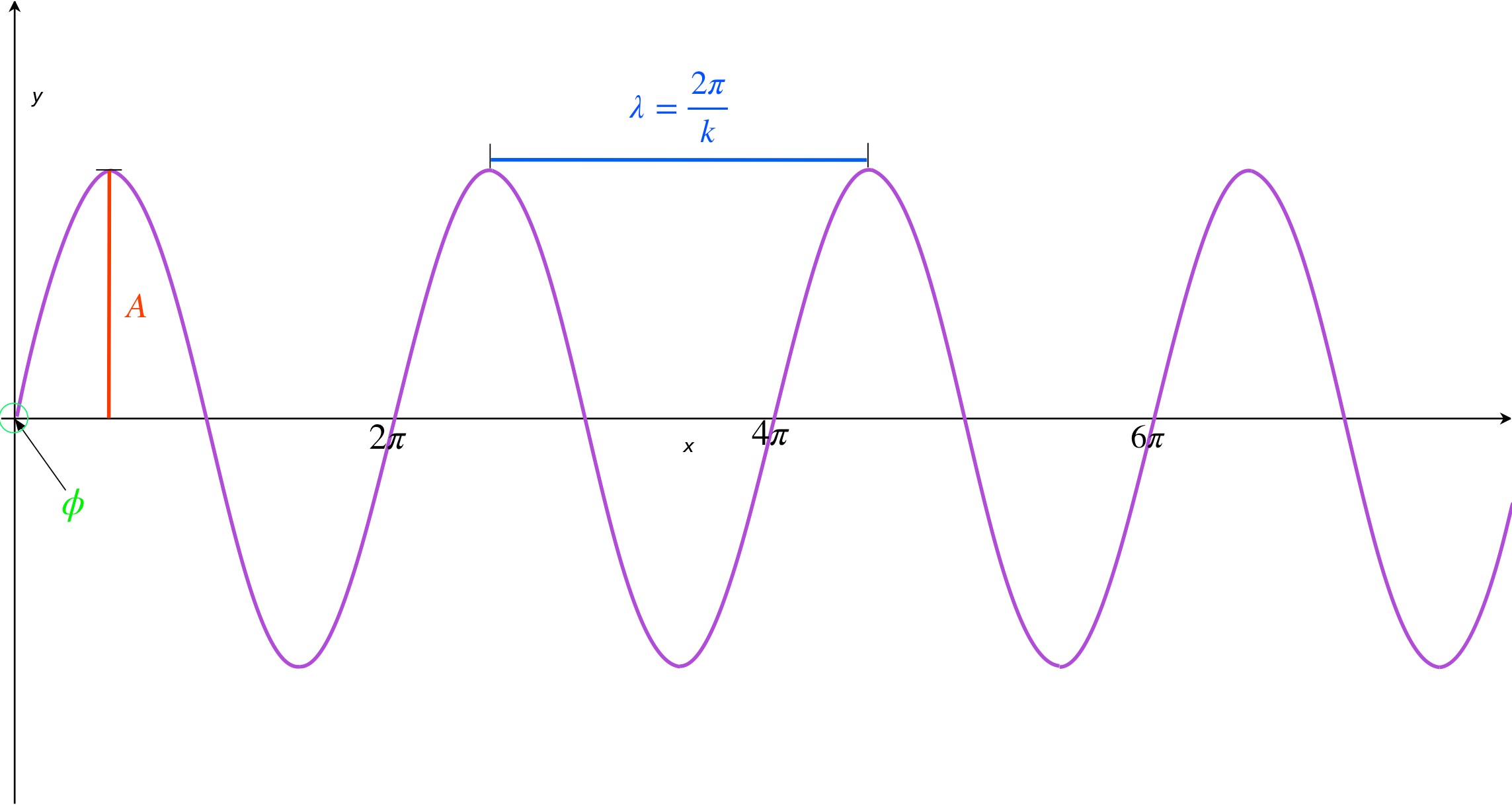
When dealing with waves in physics, we will represent them mathematically using the general sine wave function:
Here, the refers to the amplitude of the wave and is the highest value that can reach, refers to the angular frequency, and represents the phase, which basically means, where is the wave at time ?
The angular frequencyⓘ is a function of the normal frequency:
The coordinate x specifies position along the medium. Wavenumber k is spatial phase change per unit distance, measured in rad/m, and is related to wavelength by k = 2π/λ.
Another useful variable in waves is the period. The period is the time it takes for one wavelength to pass. It is actually the inverse of the frequency:
A graph of y versus x at a fixed t is a spatial snapshot. A graph of y versus t at a fixed x shows one point’s oscillation. Both can be plotted in two dimensions; a three-dimensional surface is optional when showing all x and t together.
However, this concept will be important in future classes if you are planning to go into certain engineering fields or become a physics major!
A sinusoidal wave on a string has amplitude 15 mm, wavelength 1 m, period 8 s, zero phase, and travels toward +x. Write its equation, find its displacement at x = 9 m and t = 0 s, and sketch y versus x at t = 0.
We can replace in terms of the period, , by solving for in Equation 9.1.4 to get:
- with this, we plug it back in to get
The other unknown is . We know is :
Example Problem 9.1.1 Graphed Solution
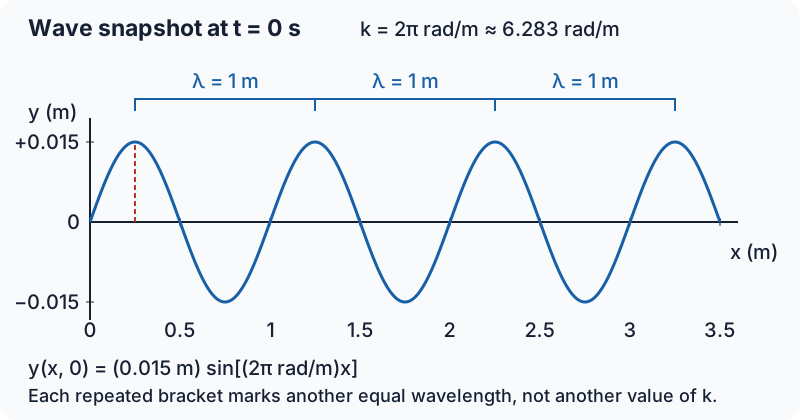
Every adjacent-crest bracket marks the same λ = 1 m. The wavenumber is k = 2π/λ = 2π rad/m; the brackets do not count out different wavenumbers. Sinusoidal-wave model.
Step 3. Write the wave equation
Combining all we know, we can write:
Step 4. Calculate the displacement at the given point.
Using exact k = 2π rad/m, y(9 m, 0 s) = (0.015 m)sin(18π) = 0.
y = 0 m.
y = 0 mm; the wave amplitude is still 15 mm.
Just for added practice, let’s see what the graph looks like on the next page at just to see if everything matches up. Our equation for the graph will be:
Source and curriculum context
Adapted from Physics I by Jake Yap and Laurence Vincent.
physics2 · 14.2.A · printed pages 112, 113.
Glossary and deeper reading · 7 refreshers
These editorial refreshers supplement the reading. Definitions and examples are added guidance; original source wording and recorded answers remain in their original context.
-
Amplitude
Amplitude is the maximum magnitude of a repeating disturbance measured from its equilibrium value. It describes the size of the oscillation rather than its frequency or propagation speed. For example, pulling a spring-mounted mass farther from equilibrium increases its oscillation amplitude when it is released from rest.
-
Wave
A wave is a propagating disturbance that can transfer energy without transporting the medium as a whole. Mechanical waves require a material medium, while electromagnetic waves can propagate through vacuum. For example, a pulse travels along a rope while individual rope segments move locally around their equilibrium positions.
-
Angular frequency
Angular frequency measures how rapidly the phase of a sinusoidal oscillation advances. It equals two pi times the ordinary frequency and is measured in radians per second. For example, two oscillators at the same ordinary frequency also have the same angular frequency even if their amplitudes differ.
-
Frequency
Frequency is the number of complete repeating cycles per unit time. It is measured in hertz, meaning cycles per second, and is the reciprocal of the period. For example, a vibrating string with a higher frequency produces more cycles each second.
-
Wavenumber
Angular wavenumber measures the change of wave phase per unit distance. In the sinusoidal convention used in the source reading, it equals two pi divided by wavelength and is measured in radians per meter. For example, shortening a wave’s wavelength increases its angular wavenumber.
-
Wavelength
Wavelength is the spatial distance between neighboring points at the same phase of a periodic wave. It connects propagation speed and frequency through speed equal to frequency times wavelength. For example, neighboring crests of a sinusoidal water wave are separated by one wavelength.
-
Oscillation period
An oscillation period is the time required for one complete repeating cycle. It is the reciprocal of frequency and is measured in seconds. For example, measuring the time for several pendulum swings and dividing by the number of cycles estimates the period.