Gravity in Depth
Original textbook reading.
In this section, we will delve into a more in-depth analysis of gravitational force. After introducing gravitational force, we’ll then apply it to something that is present in our universe, which is planetary motion.
Like we discussed in Section 1.3 and Section 2.2, gravity is a natural force that occurs here on Earth. It is what causes all objects to accelerate towards the center of the Earth. But there is actually more to it then that.
Sir Isaac Newton can be credited with this idea of gravitation. He believed that when the apple fell from the tree, it was because of the force of gravity. With this in mind, he believed then that there was a way that the gravitational force could extend even beyond Earth, all the way up to the moon!
Is there a reason why the moon stays in orbit around the Earth? What keeps the moon in this perfect orbit around the Earth? Newton hypothesized that if an object travels with the right velocity around the Earth while staying within Earth’s gravitational field, it will fall into orbit around the planet Earth due to the constant acceleration towards Earth’s surface. With this, Newton was able to formulate an idea that any two objects exert a gravitational attraction to each other.
The gravitational-force magnitude between two point masses, or outside spherically symmetric bodies, is proportional to the product of their masses and inversely proportional to the square of their center-to-center separation.
(Equation 3.3.1)
= Universal gravitational constant =
= mass of 1st object (kg)
= mass of 2nd object
= distance between the two objects’ centers (m)
The force applies to both bodies equally, and pulls each body towards the other. With this in mind, lets take a look at some example problems
Weight is the gravitational force exerted on an object by the relevant astronomical body. Near Earth’s surface, mg is a convenient approximation to GMm/r². The two notations describe the same gravitational interaction at different levels of approximation.
A 150 kg object is 10 km above Earth’s surface. Use G = 6.673 × 10⁻¹¹ m³/(kg·s²), Earth radius 6378 km and Earth mass 5.97 × 10²⁴ kg. Find its gravitational-force magnitude. Ignore other forces for this calculation.
Step 1: Determine the Givens
The given data are G, the object’s mass, Earth’s mass, Earth’s radius and the object’s altitude above the surface.
Step 2: Determine the Distance () between the two objects
This seems like a simple thing to calculate, but sometimes people get tricked up by the definition of . Remember that it is the distance from the center of the masses, so we must take into account the radius of the Earth.
Example Problem 3.3.1
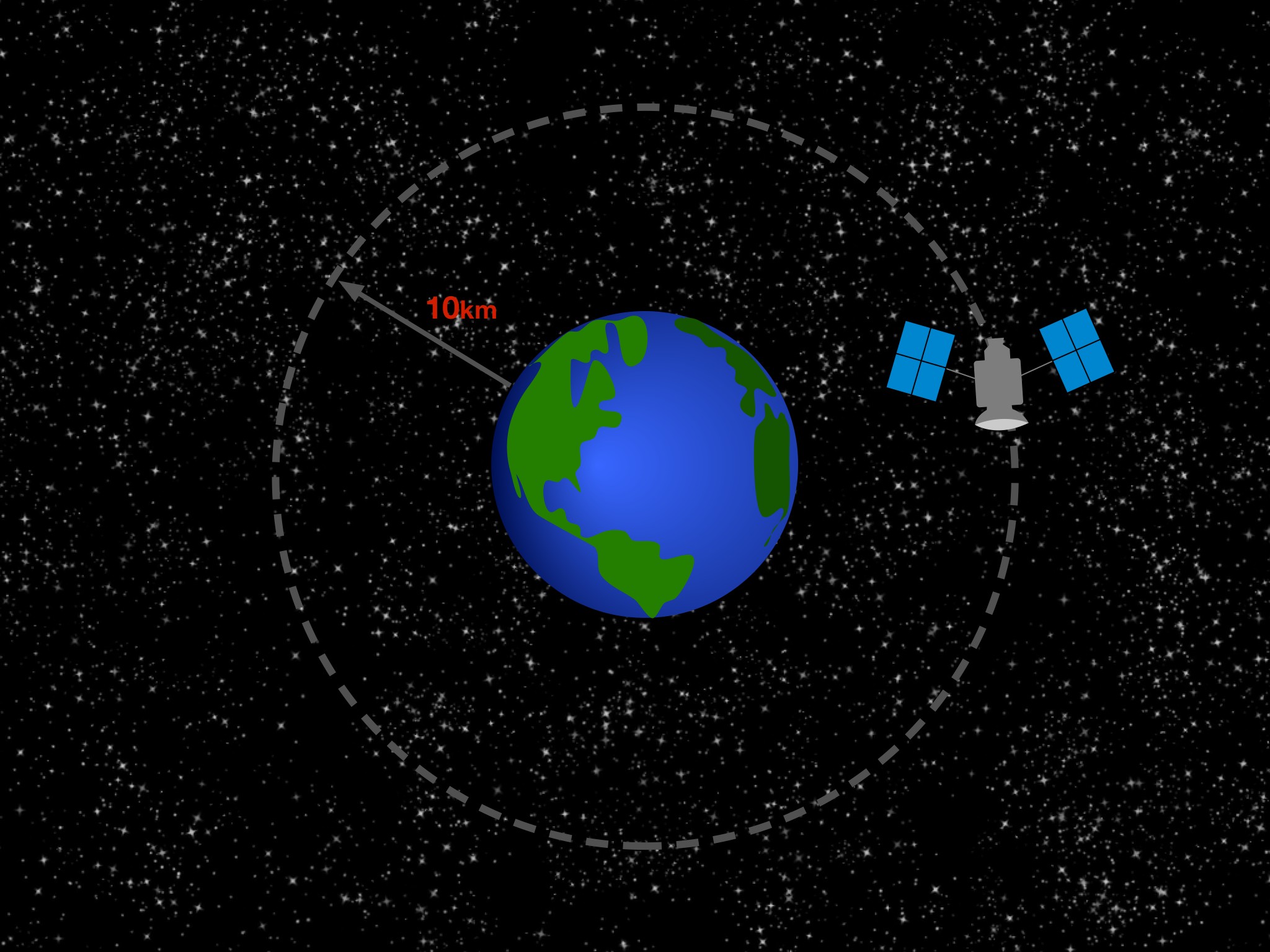
Therefore:
The center-to-center distance is r = R_Earth + h = 6378 km + 10 km = 6388 km = 6.388 × 10⁶ m.
Step 3: Determine the Gravitational Force
Now that we have all the values, let’s solve for the gravitational force. We are using the gravitational force equation:
F = (6.673 × 10⁻¹¹ m³/(kg·s²))(150 kg)(5.97 × 10²⁴ kg)/(6.388 × 10⁶ m)² = 1464.39 N.
The gravitational acceleration at this altitude is F/m ≈ 9.763 m/s². Whether an object is in orbit or escaping also depends on its velocity; force magnitude alone does not decide that.
It is important to note that gravitational forces are highly important because it is the reason why our solar system exits. It is what causes the orbiting of all the planets around the Sun. With this in mind, what do you think, will the gravitational force between say the sun and Earth be greater than or less than the gravitational force between the satellite and Earth from our previous problem? Let’s find out!
Let’s consider the same idea as the previous problem, except this time we want to find the gravitational force between the Sun and the Earth. The mass of the Earth is . The mass of the Sun is . The distance between the center of the Earth to the center of the Sun is . Given this, what is the exerted between the two bodies ?
Example Problem 3.3.2
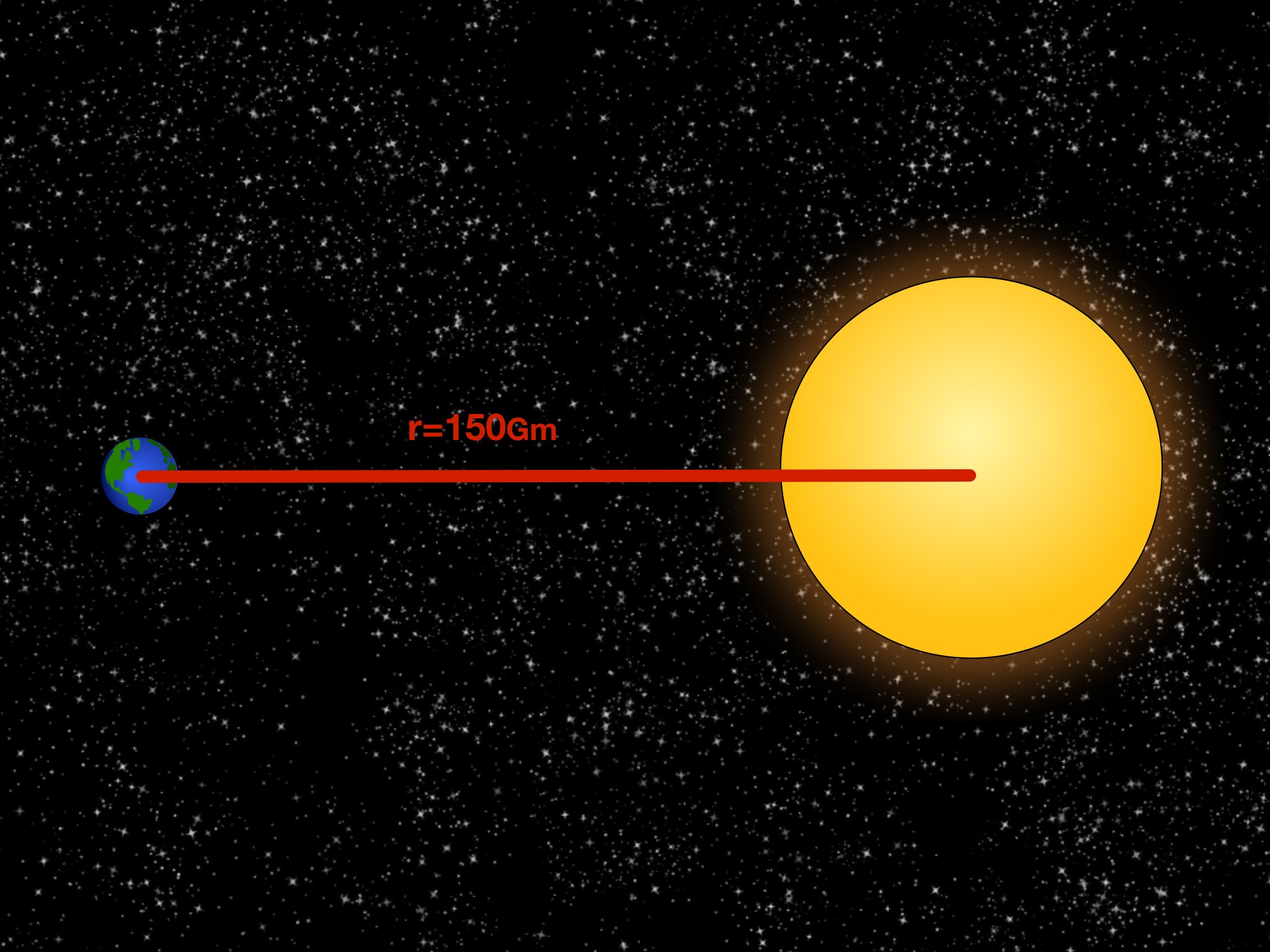
Step 1: Determine the Givens
Pretty simple set up just like the previous problem. Find all the givens, which we have.
Step 2: Determine the Gravitational Force
Using our gravitational force equation:
As you can see, the gravitational force is huge! Many magnitudes larger than the previous problem with the satellite.
Pop Quiz 3.3.1: Gravity
Question 1 of 5 · 0 correct
AP Topic 2.6 · Read the worked solution
What is the attraction force between Drew and Jake given that their masses are each, and the distance between them is meters?
Read every full question without answers
Question 1
Question 2
Question 3
Question 4
Question 5
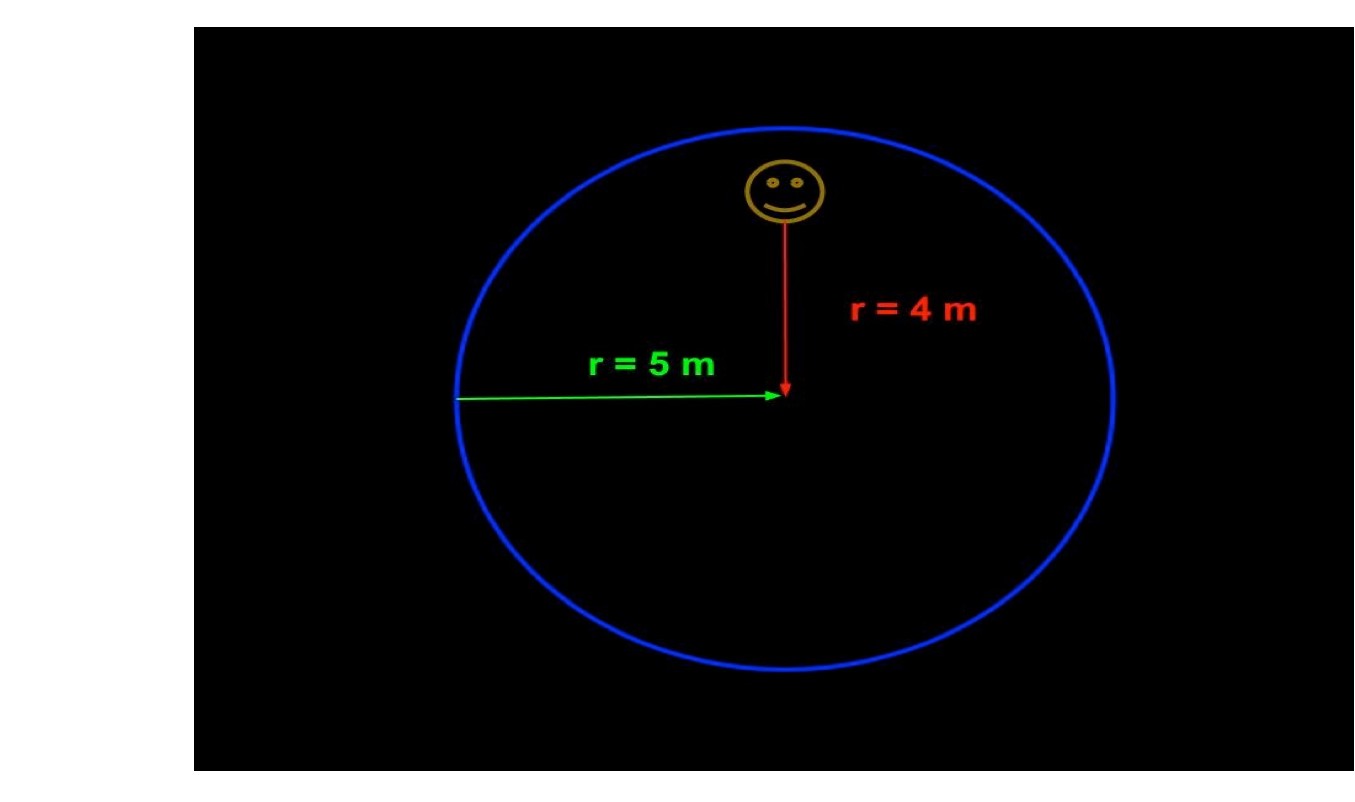
A person of mass m₁ is anywhere inside an otherwise empty spherical shell whose mass m₂ is distributed uniformly over the shell. Ignoring all other bodies, what gravitational force does the shell exert on the person?

Reviewed physics notes (11)
These corrections keep the original lesson’s purpose while fixing errors in the source edition.
- The source omits “square” in prose despite its squared denominator. — Reference 1
- The source claims weight and gravitational force are different forces. — Reference 1
- 10 km is inside Earth’s atmosphere; use the radius shown in the source figure and worked solution. — Reference 1
- Altitude is not the object’s radius. — Reference 1
- Use altitude plus Earth radius, and convert to SI metres. — Reference 1
- A bare kilometre denominator with SI G is dimensionally misleading. — Reference 1
- The source infers the object cannot leave Earth’s pull from force magnitude alone. — Reference 1
- A larger radius does not itself imply greater gravitational force. — Reference 1
- A dimensionless mass factor avoids the source’s dimensionally ambiguous expressions using a unit-bearing G. — Reference 1
- Keeping F fixed requires a mass multiplier (3/2)² = 2.25, hence a 125% increase. — Reference 1
- The zero-force shell theorem requires spherical symmetry of the mass distribution. — Reference 1
Glossary and deeper reading · 5 refreshers
These editorial refreshers supplement the reading. Definitions and examples are added guidance; original source wording and recorded answers remain in their original context.
-
Force
A force describes an interaction that can change an object’s momentum. It is a vector measured in newtons, so both size and direction matter when forces are added. For example, a rope can pull a cart while the floor exerts friction in another direction.
-
Velocity
Velocity describes how position changes with time and includes direction. Instantaneous velocity describes one moment, while average velocity is displacement divided by elapsed time. For example, a car turning a corner can change velocity while maintaining the same speed.
-
Gravitational field
A gravitational field gives the gravitational force per unit mass at a location. Its direction is the direction of the force on a positive test mass, and its units can be written as newtons per kilogram. For example, near Earth the field points approximately downward, whether or not a ball is placed there.
-
Magnitude
Magnitude is the nonnegative size of a vector quantity. It does not specify direction, and it differs from a signed component. For example, a westward velocity can have a negative x component while its speed, the velocity magnitude, stays positive.
-
Weight
Weight is the gravitational force exerted on an object by a specified attracting body. Near Earth’s surface its magnitude is approximately mass times the local gravitational field strength, and it is measured in newtons. For example, an astronaut has less weight on the Moon while retaining the same mass.