Variables of Motion
Original textbook reading.
The averages, motion graphs and constant-acceleration models fit AP Physics 1. Derivative notation is an optional way to connect the ideas; calculus is not required.
We’ve discussed the basics of how acceleration relates to force, and how position relates to displacement versus distance.
What we have not really discussed at all was how time fits into the grand schemes of motion. Even in the section on work, we only defined work as it relates to distance.
In actuality, the values of position, velocity, and acceleration are very closely related, and all are related through time. To make this more obvious, we can look at the units of each.
Average velocity is displacement divided by elapsed time. Average acceleration is velocity change divided by elapsed time. Instantaneous velocity and acceleration are derivatives.
Average velocity is v_avg = Δx/Δt (Equation 3.1.1), and average acceleration is a_avg = Δv/Δt (Equation 3.1.2). Both definitions apply over any interval with nonzero elapsed time. Instantaneous values are obtained from derivatives.
The average formulas hold over any nonzero time interval even when velocity or acceleration varies. They need not equal the instantaneous values at a particular time.
This concept relates to average velocity and acceleration. Basically, the average velocity of some particle is given by the above equation, for any interval . This doesn’t mean, however, that the velocity at every point is equal to that average velocity. That concept we will discuss later.
First things first, we must understand the relationships between average velocity and acceleration. To identify the average velocity given any known position history, be it a word problem or a graph, you simply use the previous equation. You just figure out the change in over the change in time.
That is actually a basic process in calculus called the derivative.
The ’s in those equations represent differentials, which refers to minute changes. The approach that we use to solve physics problems with this idea is only one way calculus students utilize derivatives, instead of taking derivatives of functions, we just use the basic idea of the changes in our system.
What you saw before, for the work in section 2.4, was actually an integral. Those are just the opposite of derivatives. Now, you can’t just take the opposite of the change, so we need an easier approach to dealing with those.
Now if you want to figure out what the velocity or acceleration is at a certain time, however, that requires a bit more skill.
That is what you saw with regards to the area under the curve.
Specifically the relationships in the integrals are given by the following formulas:
v(t₂) − v(t₁) = ∫ from t₁ to t₂ of a(t) dt; x(t₂) − x(t₁) = ∫ from t₁ to t₂ of v(t) dt.
Signed area under a velocity–time graph gives displacement. Total distance is the area under the speed graph |v(t)|.
Or, if you have a graph of acceleration, and you want to know how much the velocity changes, you find the area under the curve.
The tangent slope of a velocity–time graph gives instantaneous acceleration. A secant slope gives average acceleration over an interval.
Instantaneous velocity is dx/dt and instantaneous acceleration is dv/dt, the limits of the corresponding average rates as the interval approaches zero.
For a graph, the tangent slope gives the instantaneous rate wherever that derivative exists; a straight segment has a constant slope.
The technique I am referring to is the slope-analysis. This technique is only possible when you have a graph of either position versus time, if you want to solve for velocity, or velocity versus time, if you want to solve for acceleration.
Slope-analysis is simply figuring out the slope of the graph at the point in question.
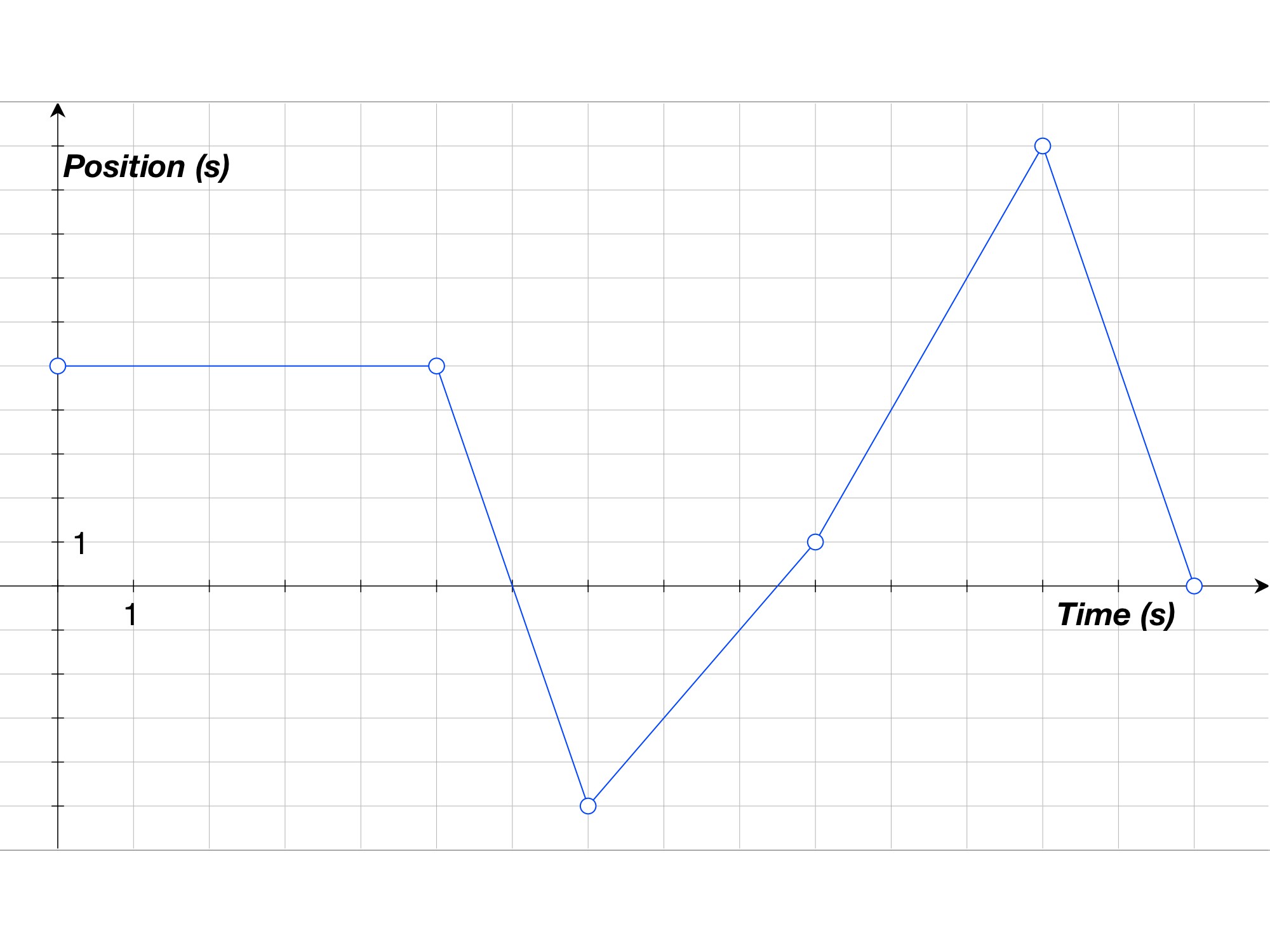
Correction to the retained axis label: position is measured in metres here, so the vertical label should read Position (m), not Position (s). Time is in seconds on the horizontal axis.
Step 1: Read the motion. The vertices are (t, x) = (0, 5), (5, 5), (7, −5), (10, 1), (13, 10), and (15, 0), in seconds and metres.
Step 2: Use slope for velocity. Each straight segment has v = Δx/Δt. The flat first segment means rest; descending segments mean negative velocity; rising segments mean positive velocity. At a sharp corner, the instantaneous slope is undefined in this idealized graph. For average velocity over the whole trip, use only the overall displacement and elapsed time.
Read every step and figure
Step 1
Correction to the retained axis label: position is measured in metres here, so the vertical label should read Position (m), not Position (s). Time is in seconds on the horizontal axis.
Step 1: Read the motion. The vertices are (t, x) = (0, 5), (5, 5), (7, −5), (10, 1), (13, 10), and (15, 0), in seconds and metres.
Step 2: Use slope for velocity. Each straight segment has v = Δx/Δt. The flat first segment means rest; descending segments mean negative velocity; rising segments mean positive velocity. At a sharp corner, the instantaneous slope is undefined in this idealized graph. For average velocity over the whole trip, use only the overall displacement and elapsed time.
What is the average velocity of the particle over the entire time duration shown?
What is the particle’s velocity at ?
What is the particle’s velocity at 8 s?
Step 1: Average Velocity Calculation
The graph starts at x = 5 m and ends at x = 0 m after 15 s. Average velocity is (0 − 5)/15 m/s.
This gives us an average velocity of:
−0.333 m/s.
Step 2: Velocity at
To determine the velocity at this time, we just need to figure out what the slope of the graph is at this point. recall that slope is rise over run, more explicitly outlined in the slope equation:
The main set of equations that you will see throughout any motion-based problems are the so-called ‘kinematic equations’. These equations are simply an illustration of the relationship between position, velocity, and acceleration for one body, given that that body is undergoing constant acceleration.
The four kinematic equations are as follows:
(Equation 3.1.3)
(Equation 3.1.4) (Equation 3.1.5)
(Equation 3.1.6)
These equations all use the subscript to represent the variable at time . In other words, the represents the starting position, while the plain represents the finishing position. Also realize that just because it says , it doesn’t mean that it is in the x direction. It is merely a variable defining position, you might also see , , , or used, depending on the situation you are working with.
For motion in more than one dimension, apply these scalar equations to each coordinate component separately, using the same elapsed time.
Pop Quiz 3.1.2 Graphical Analysis
Question 1 of 5 · 0 correct
AP Topic 1.2 · Read the worked solution
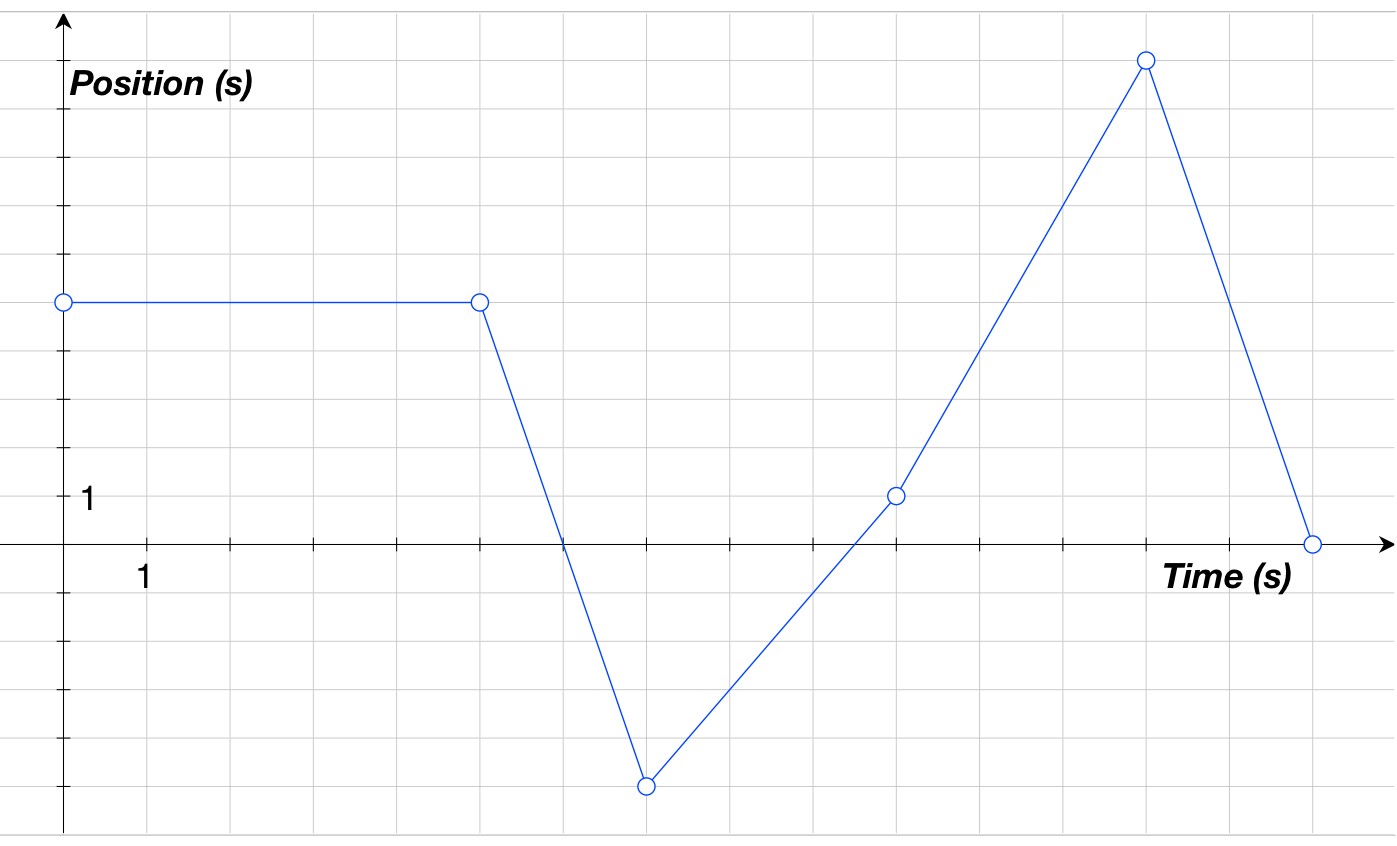
Read every full question without answers
Question 1
Question 2
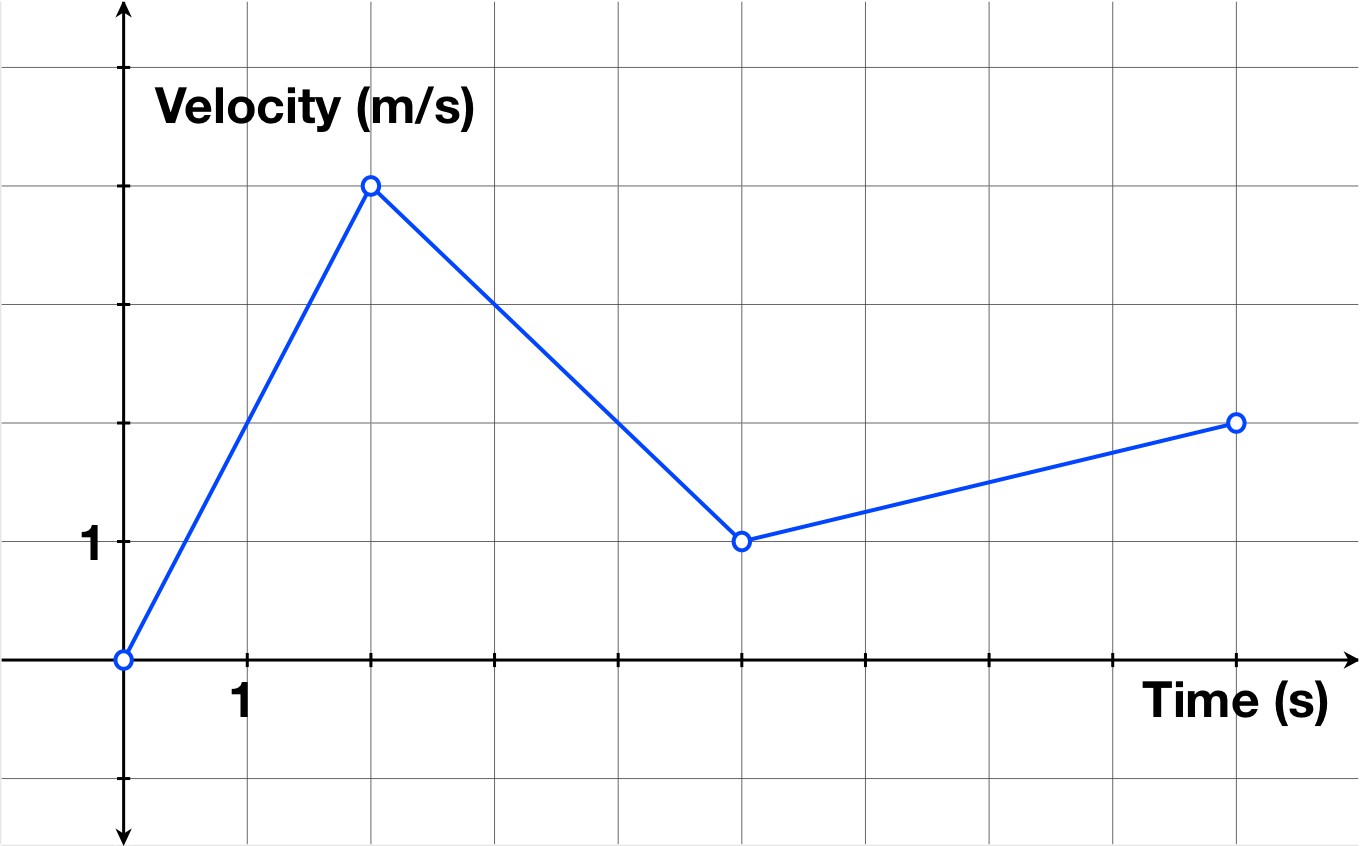
For the following velocity versus time graph, what is the acceleration in the direction of motion at ?
Question 3
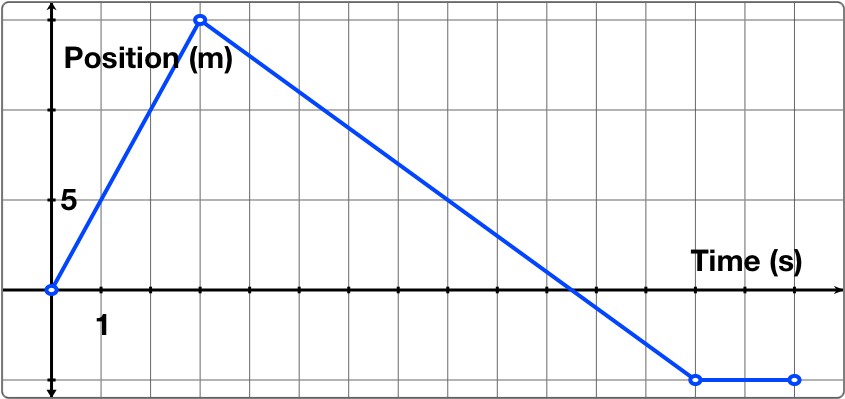
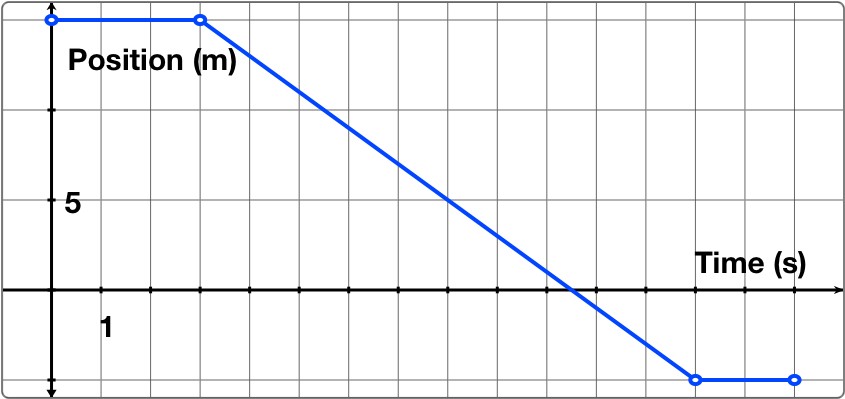
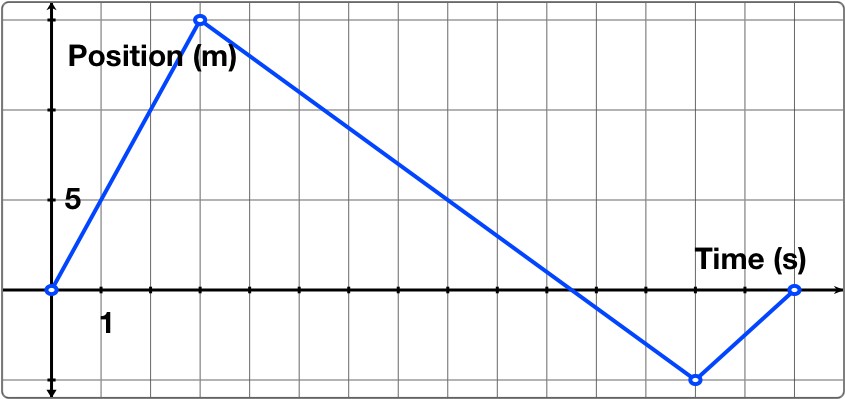
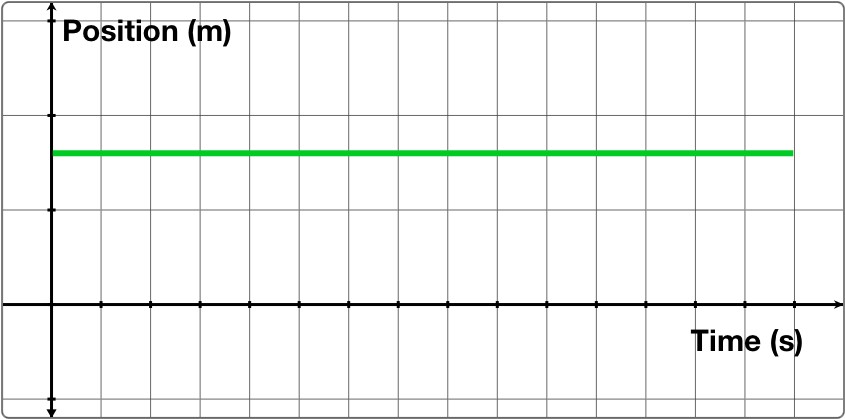
Draw the position–time graph of a one-dimensional particle that starts at 0 m with velocity 5 m/s, changes to −2 m/s at 3 s, continues at that velocity for another 10 s, then remains stopped for 2 s.
Question 4
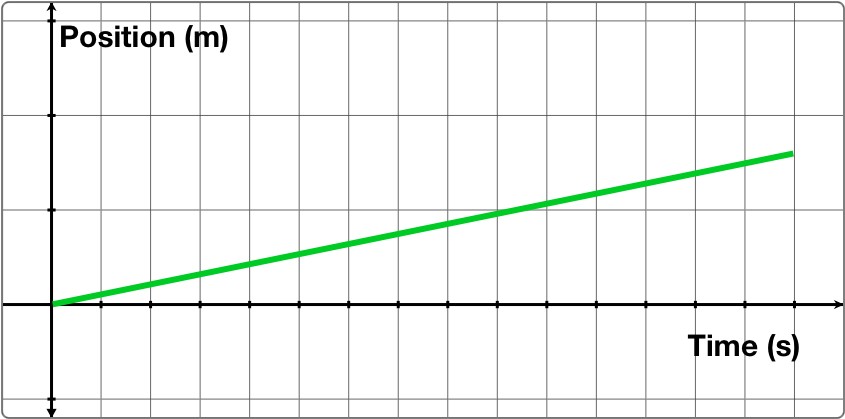
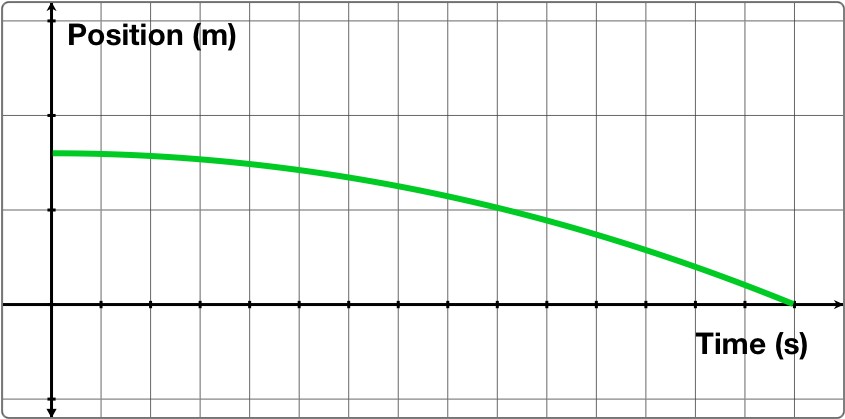
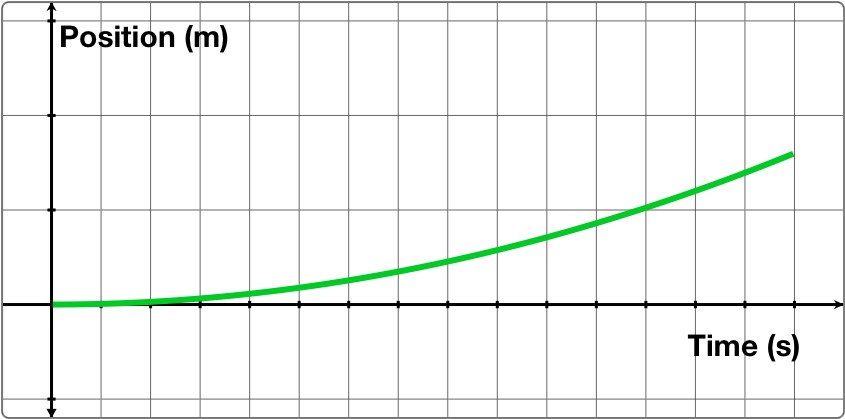
Question 5
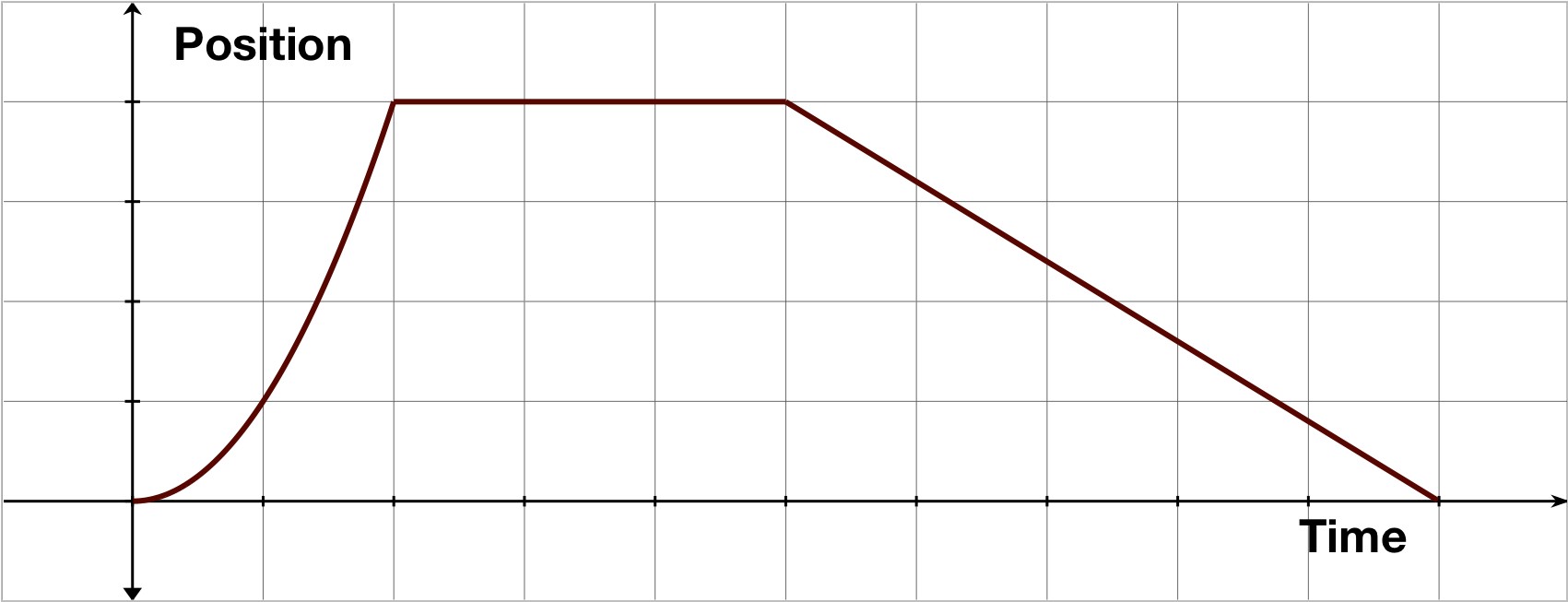 123
Match these labels to the numbered figure targets. Write your matches before opening the separate worked answer.
Example Problem 3.1.2
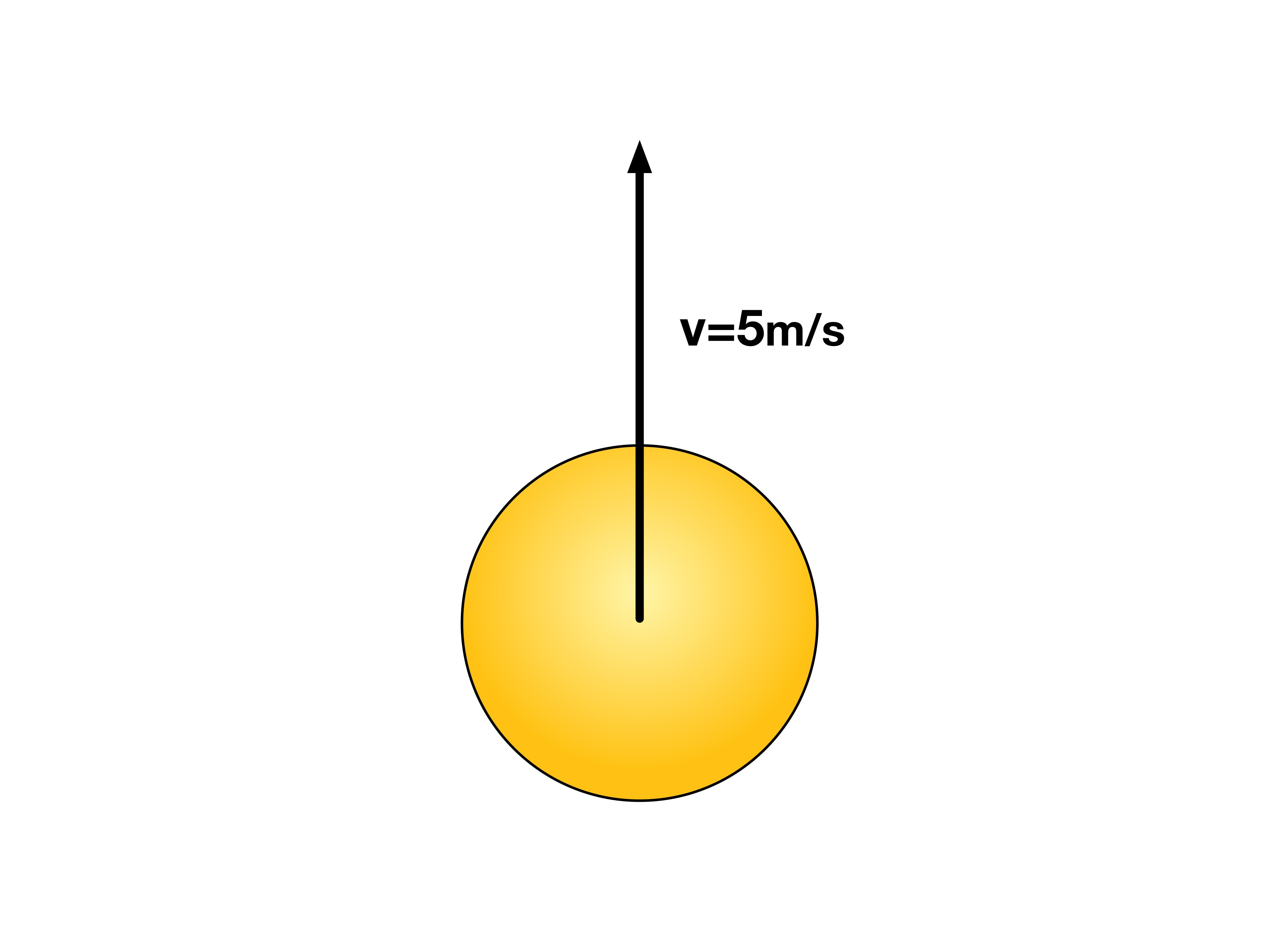
The arrow gives an upward velocity of 5 m/s. It is a velocity arrow, not an acceleration or force arrow. For the subsequent free-flight model in the example, choose up as positive and use aᵧ = −g; the ball can be moving upward while accelerating downward.
A ball is thrown upwards with an initial velocity of . How long will it take to reach its starting position? How high does the ball reach above the starting position before starting to fall back down?
Step 1: Determine the time until ball returns
In any kinematic problem, the first thing you need to do is to pick your equation.
To do so, you need to know what you are solving for and what you know.
In this case, we want to know time. We have initial velocity, , acceleration, , starting position, , and finishing position, .
For these values, we choose this equation:
We need this one as all the other equations involve final velocity, , which we don’t know, and we are not worried about.
Using that equation, we find that the time is
Step 2: Determine how high the ball reaches.
What we know is initial velocity, acceleration, and initial position. We want to know final position.
In terms of variables, we are working with: . No matter which equation we pick, we will always need something else.
The trick to this question is to realize that we actually already know the final velocity at the peak of the ball’s trajectory. The ball temporarily is suspended in midair, so what would its velocity be at the peak? Zero!
Key point: At the top of any trajectory, the vertical velocity of the projectile is 0.
Now that we have another variable, , we can pick an equation.
Whenever you are in doubt about which kinematic equation to use, just take a look at what you have to work with. You want an equation that contains everything you are given as well as the value you are looking to solve for.
Pop Quiz 3.1.3 Kinematics
Question 1 of 5 · 0 correct
AP Topic 1.3 · Read the worked solution
If a ball is thrown upwards at , how long does it take to fall to below where it was initially thrown?
Read every full question without answers
Question 1
Question 2
Question 3
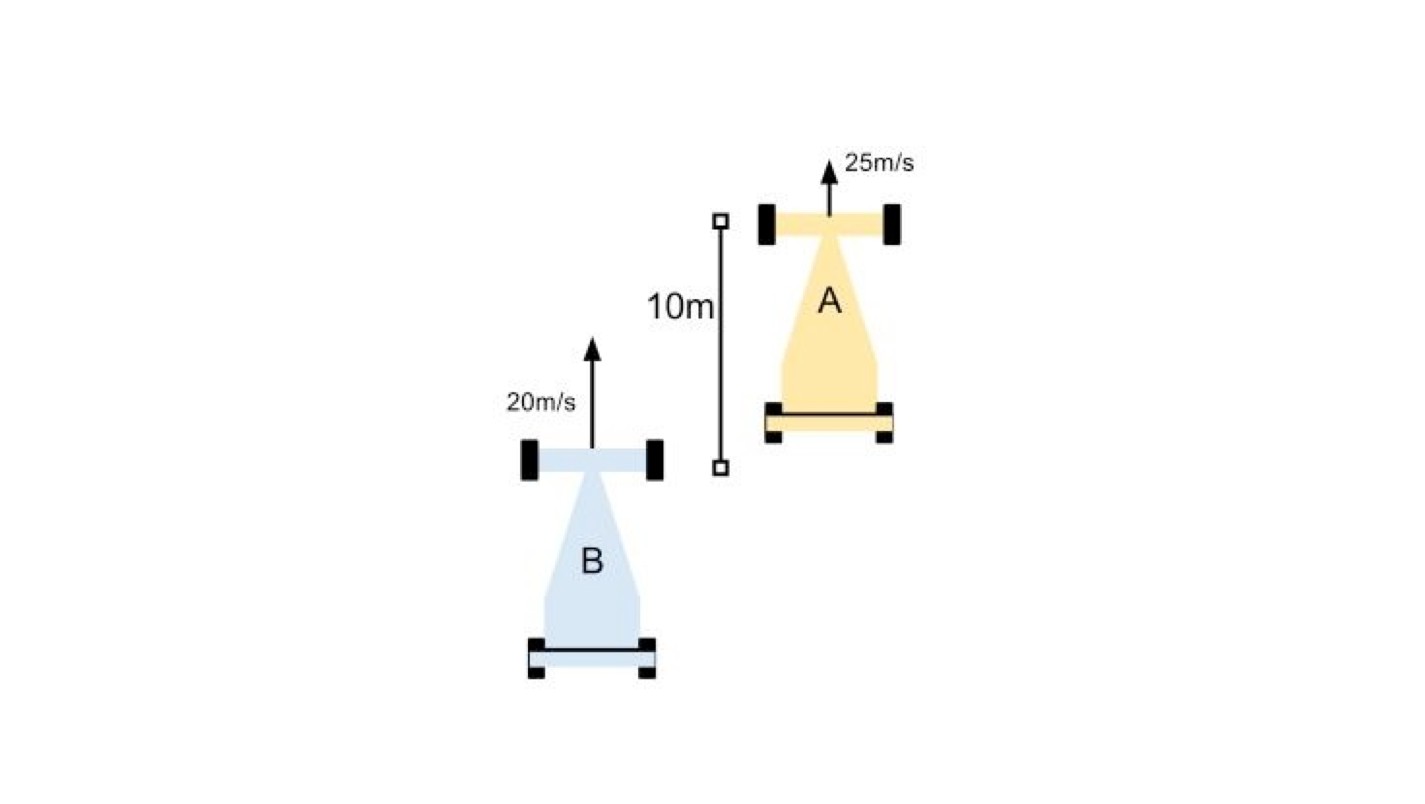
If two cars are racing each other, and they have the velocities as shown, and car A has an acceleration of , and car B has an acceleration of , how long will it take for car B to pass car A?
Question 4
Question 5


Reviewed physics notes (16)
These corrections keep the original lesson’s purpose while fixing errors in the source edition.
- Position/time is not generally velocity. — Reference 1, Reference 2
- The source incorrectly restricts average definitions to constant motion. — Reference 1, Reference 2
- The source says to find an integral to obtain instantaneous rates. — Reference 1, Reference 2
- Correct the derivative/integral confusion in the follow-up. — Reference 1
- Definite integrals give changes; the original omits initial values. — Reference 1
- Distance and displacement differ when velocity changes sign. — Reference 1
- Clarify instantaneous versus average acceleration. — Reference 1
- The source uses a velocity change rather than displacement and loses the sign. — Reference 1
- The net displacement is −5 m. — Reference 1
- The original asks at the sharp corner t = 7 s, where instantaneous velocity is undefined; 8 s matches the worked solution’s straight segment. — Reference 1
- The original specifies only the x-axis, without the direction needed for signed displacement. — Reference 1
- The source image incorrectly labels position in seconds and the keyed speed is wrong. — Reference 1
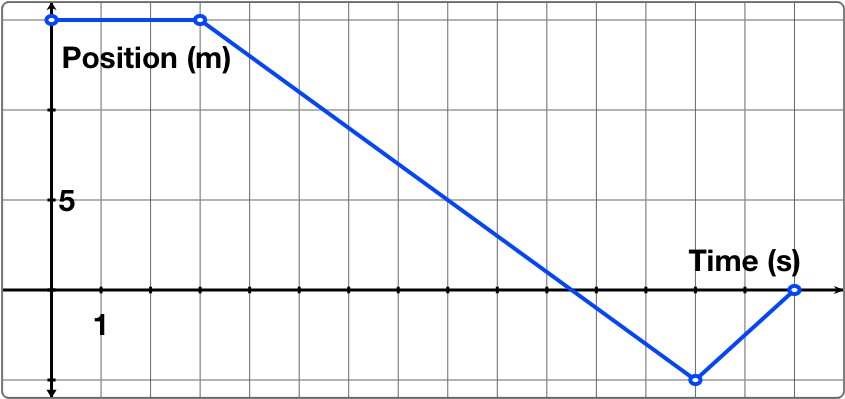
- From 13 to 15 s, position falls from 10 m to 0 m; velocity is −5 m/s and speed is 5 m/s. — Reference 1
- The keyed graph reaches x = −5 m at t = 13 s, requiring 10 s at −2 m/s rather than 9 s. — Reference 1
- Correct the source’s instruction not to use these equations for multidimensional problems. — Reference 1
- The acceleration ratio is an average over the interval, and the definitions do not require constant velocity or acceleration. — Reference 1, Reference 2
Glossary and deeper reading · 5 refreshers
These editorial refreshers supplement the reading. Definitions and examples are added guidance; original source wording and recorded answers remain in their original context.
-
Force
A force describes an interaction that can change an object’s momentum. It is a vector measured in newtons, so both size and direction matter when forces are added. For example, a rope can pull a cart while the floor exerts friction in another direction.
-
Displacement
Displacement is the vector change in position from the start of an interval to its end. It depends on those endpoints rather than the length or shape of the path traveled. For example, walking around a closed track and returning to the start gives zero displacement but a nonzero distance traveled.
-
Average velocity
Average velocity is the displacement over an interval divided by the elapsed time. It is a vector and need not equal the average speed, which uses total distance. For example, a runner who returns to the starting line has zero average velocity for the full lap.
-
Instantaneous velocity
Instantaneous velocity is the rate of change of position at a particular moment. On a position-versus-time graph, its component is the slope of the tangent at that time. For example, the velocity just before a ball lands differs from the average velocity of its entire flight.
-
Scalar
A scalar is a quantity described by a value and unit without a spatial direction. A scalar can have a sign when its definition or reference permits one; scalar does not mean always positive. For example, mass is a scalar, whereas the velocity of that mass also needs a direction.