Nonideal gas, head loss and jet momentum
Enrichment article
Read the related lesson → · Full original reading →
The real-gas, head-loss and jet-momentum models extend the linked ideal models. Keep the outlet-speed claim beside its fixed-flow-rate qualification: constriction increases speed at fixed flow rate, while a real restriction can reduce the flow rate. This article pairs the straight-pipe and bend figures with the corresponding physical descriptions; the historical source captions remain preserved.
In this section, we will learn about other relevant topics that are related to our chapter of Fluids. In this section we will see how the Ideal Gas Laws are actually not that “Ideal” and also that fluids flowing through a pipe actually has some resistance to it.
In section of this chapter, we covered the concepts behind ideal gas laws. Well, those laws only work in “ideal” situations. What do we mean by ideal? The ideal gas laws work under the assumptions that:
- The collisions between the gas molecules and the wall are completely elastic, therefore there is no loss in kinetic energy.
- That gas molecules take up no volume
- That there are no attractive or repulsive forces-also known as Van der Waals forces: felt between molecules.
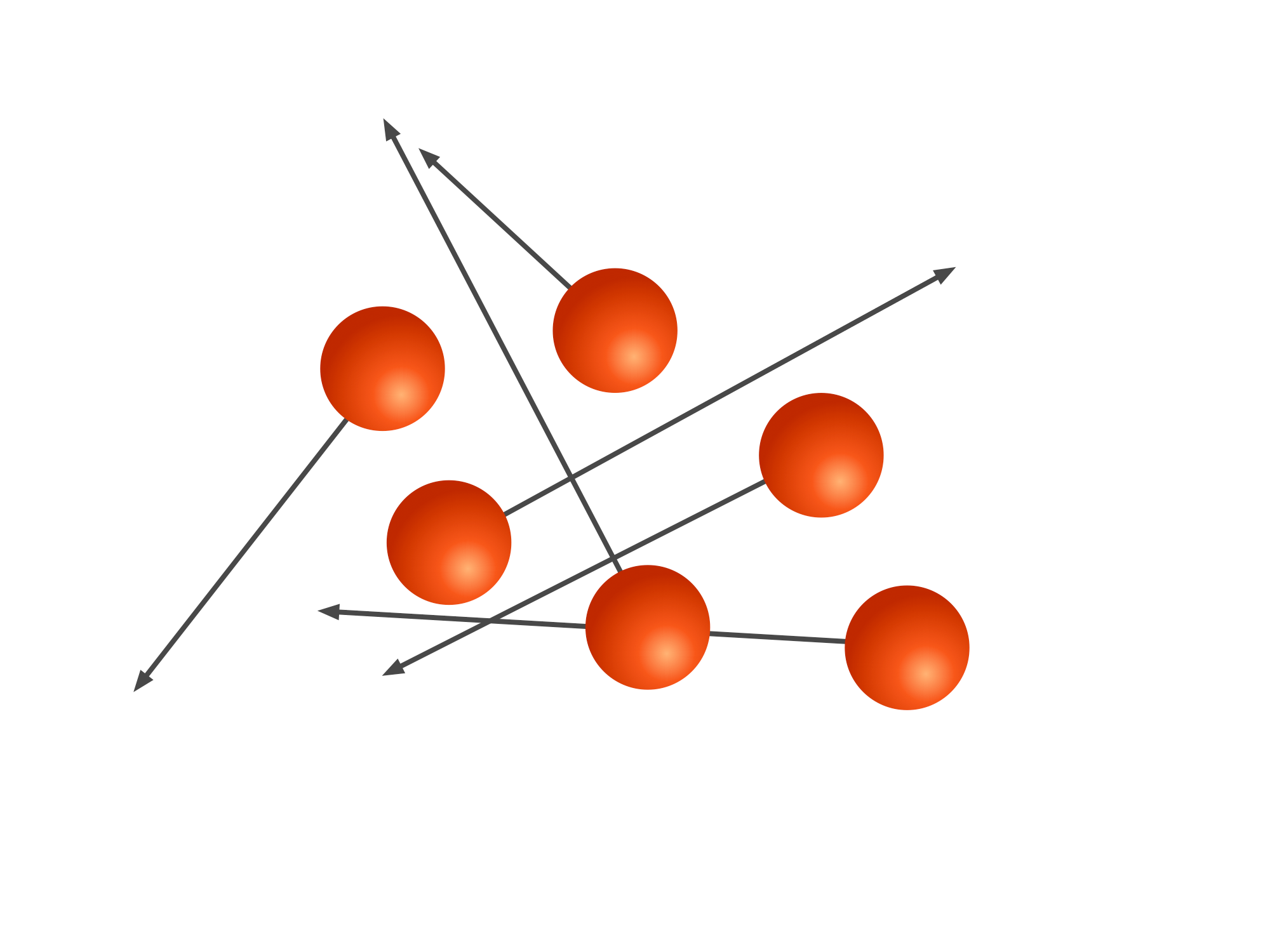
At higher temperature, thermal kinetic energy can make intermolecular attractions less important relative to molecular motion. Attractions do not cease to exist.
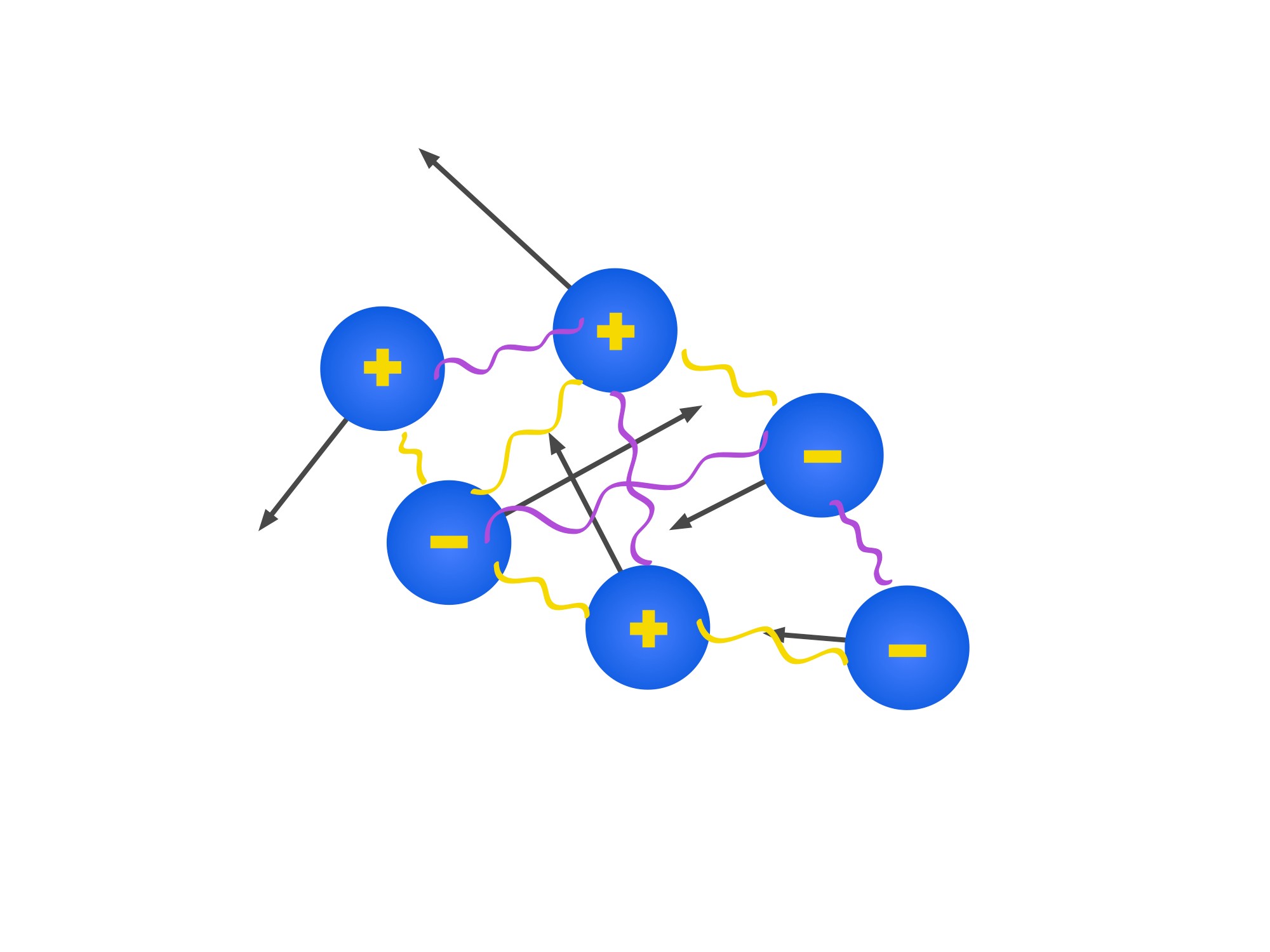
Ideal-gas behavior is often a good approximation at low density and temperatures well above condensation. Molecular volume then occupies a small fraction of the container, and intermolecular potential energies are small compared with thermal kinetic energy.
These non ideal situations of gases occur in two scenarios: one at low temperature and high pressure.
At low temperature, intermolecular attraction can be more significant relative to thermal kinetic energy, and condensation may occur. The collision rate also depends on density and molecular speed.
At high pressures, the volume is really small, so you would be very concerned about the volume of your gas molecules.
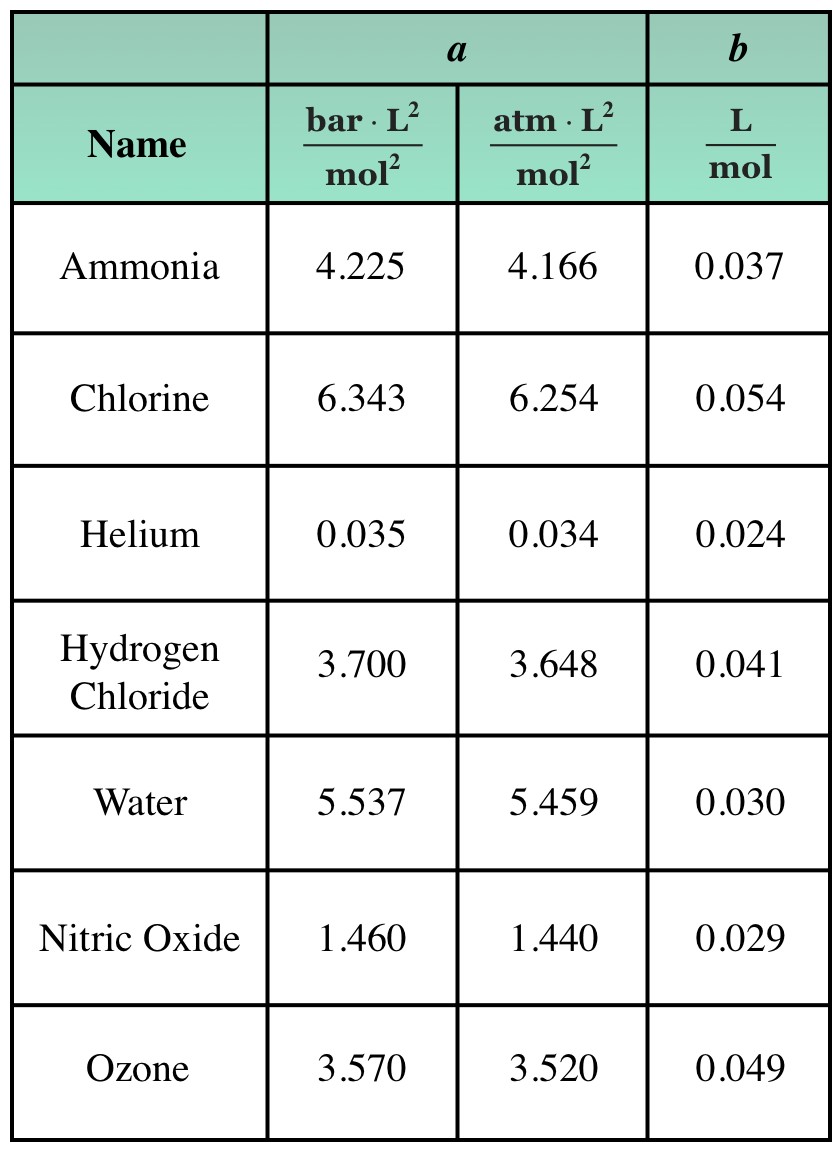
We already know that the ideal gas law utilizes Equation 8.1.1 We know what you’re thinking, if there is an ideal gas law equation, what is the non-ideal gas equation. Well, such an equation exists to help characterize how real gas molecules act, and it is known as the van der Waals equation:
In the van der Waals model, a(n/V)² corrects for attractions that reduce the measured pressure, and nb is an excluded-volume correction. The constants a and b depend on the gas; b is not simply one molecule’s literal volume per mole.
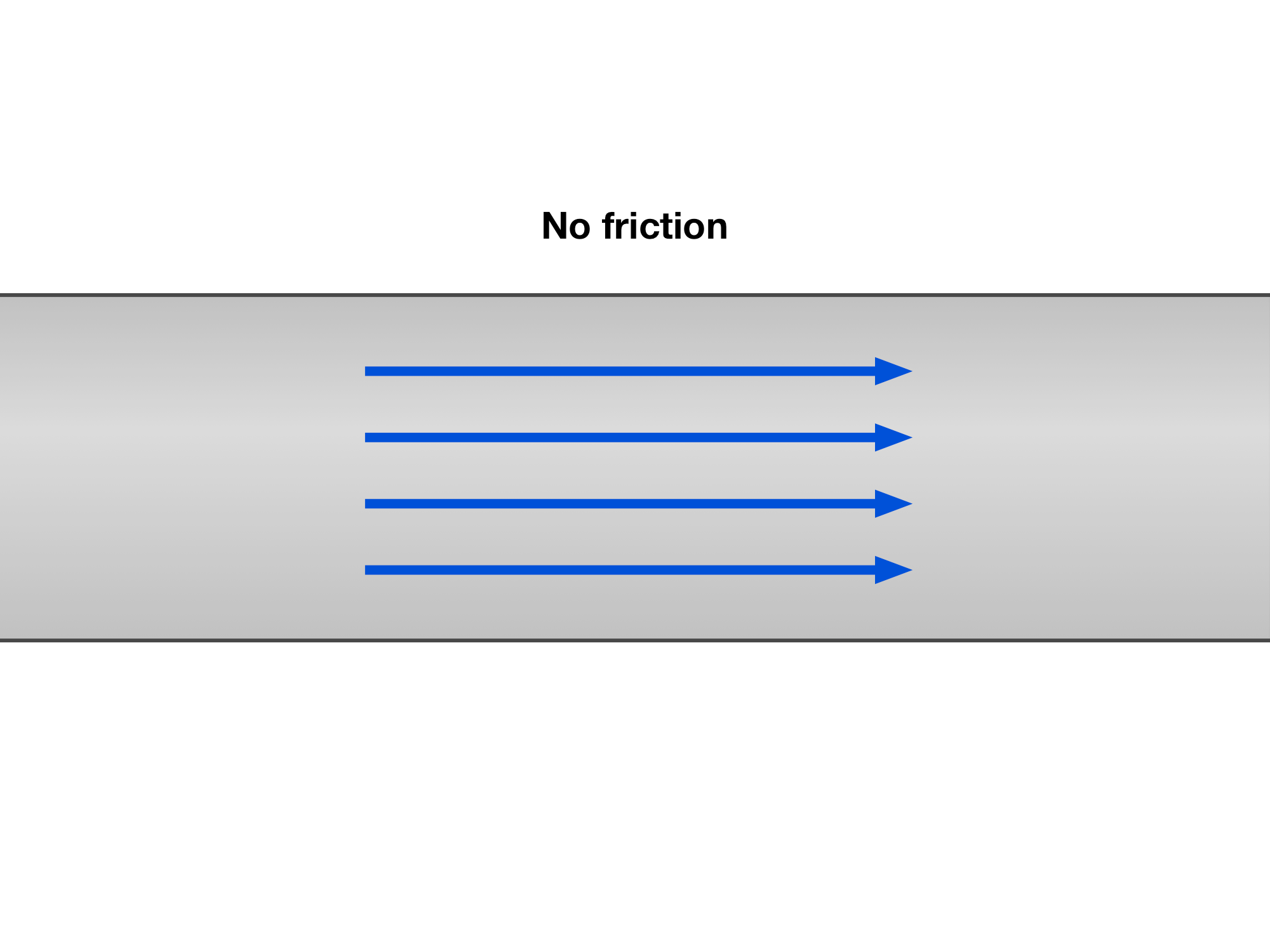
Here water is flowing through a pipe with no head loss, so it is flowing naturally
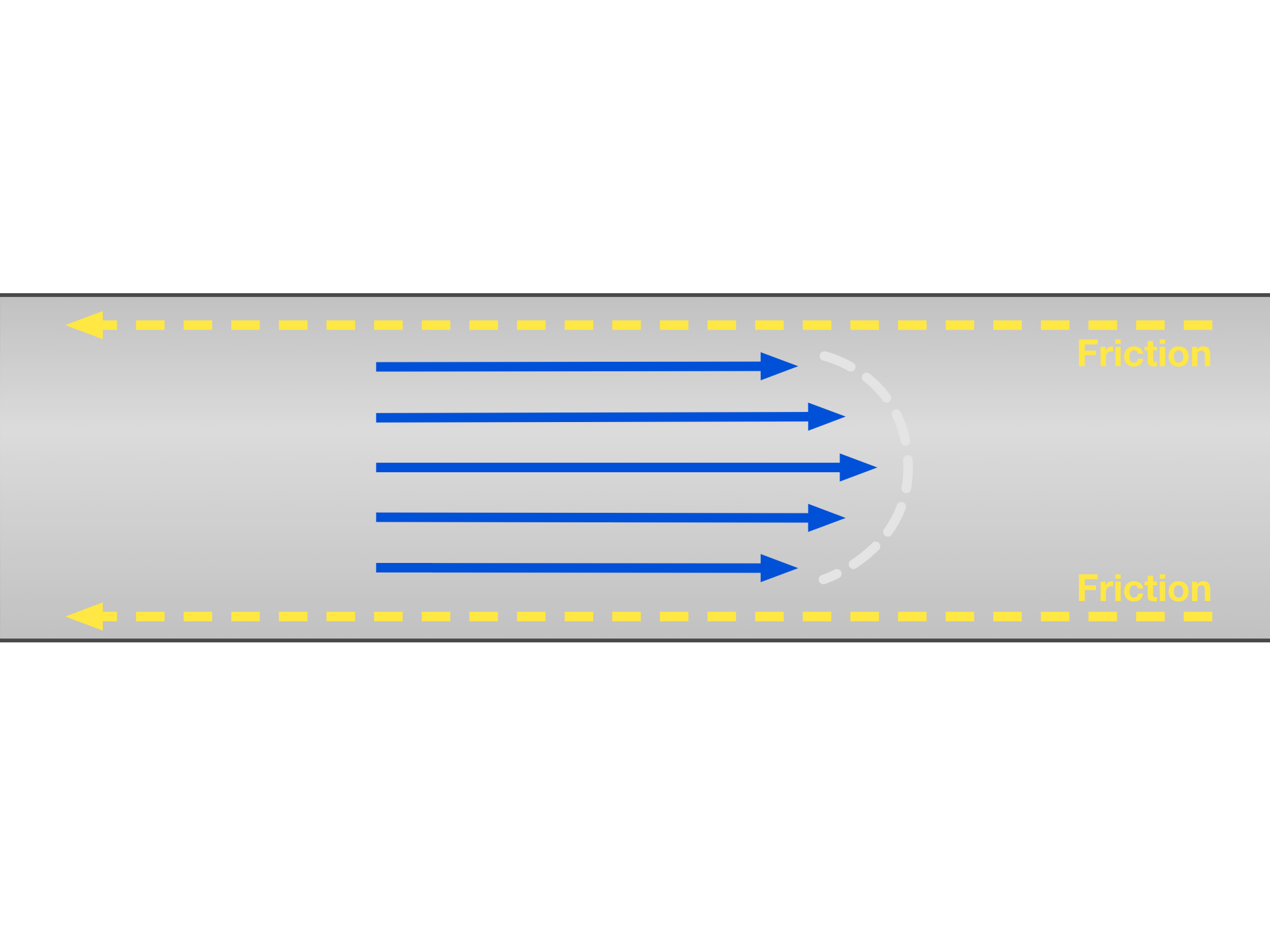
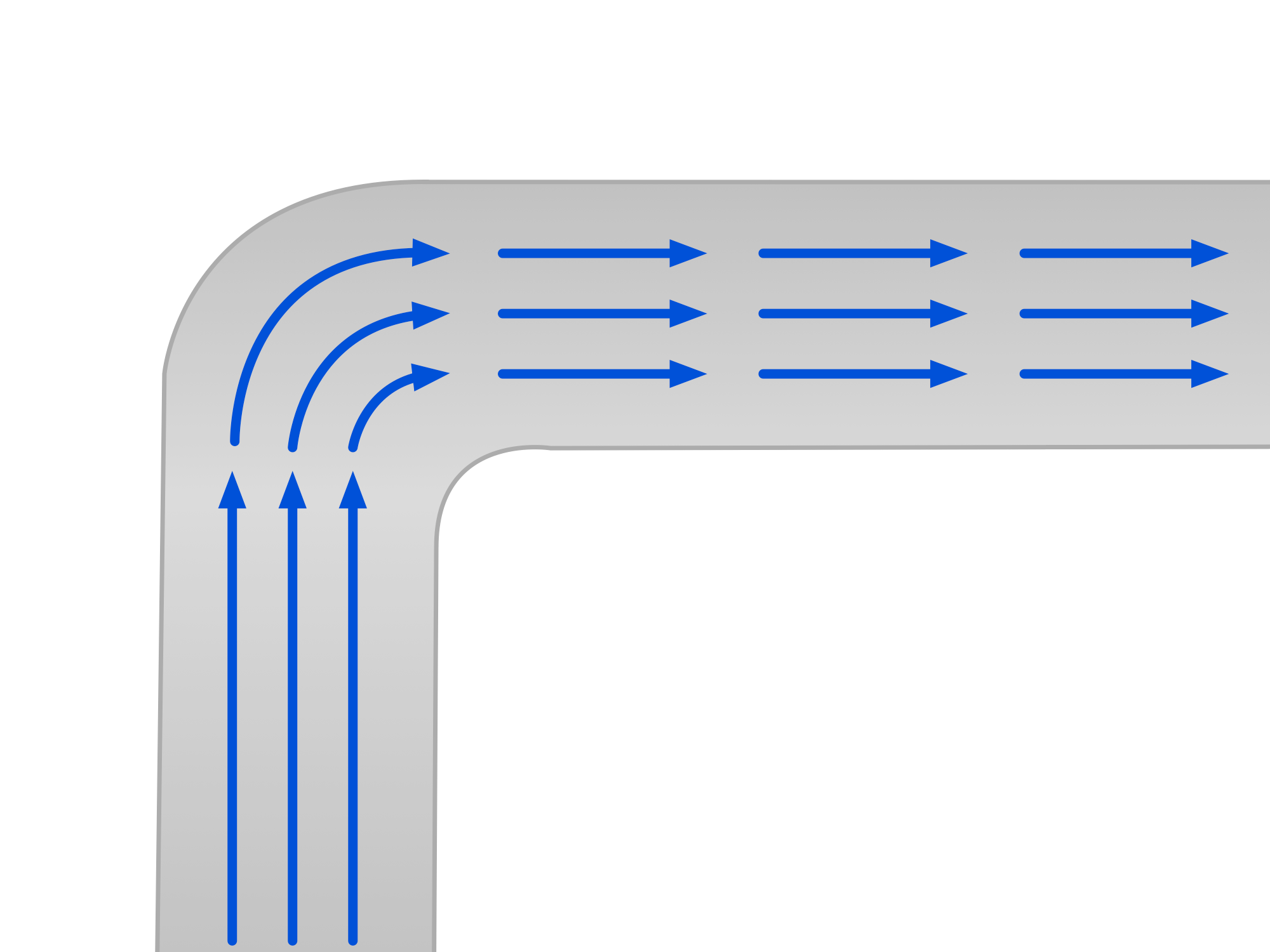
Head loss is a reduction in mechanical energy per unit weight of flowing fluid, often expressed as a length. Friction in straight pipe and local disturbances at fittings, valves, entrances, and bends can dissipate energy.
- Frictional head loss is mechanical energy dissipated by viscous flow through pipe. In a uniform pipe carrying steady incompressible flow, continuity keeps mean speed constant; a pressure gradient supplies the dissipated energy.
- Minor head losses are local energy losses at entrances, exits, bends, valves, and other fittings. They depend on flow speed and the geometry of the disturbance; the word minor does not mean they are always smaller than straight-pipe losses.
Figure 8.4.1 Fluid Momentum
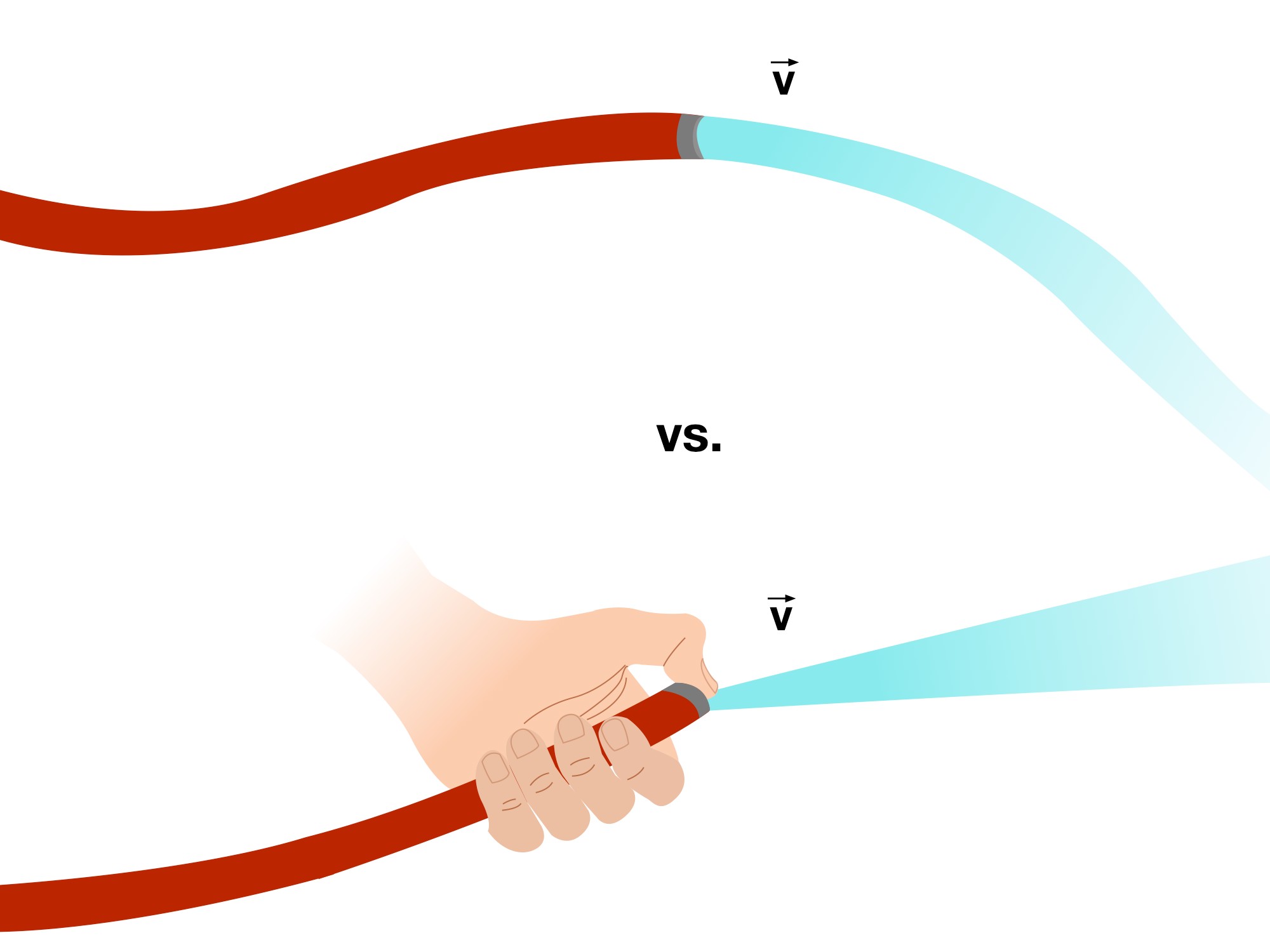
Fluid momentum is exactly what it sounds like. It means that fluids also have an associated momentum, just like objects with a mass do. Water coming out of a hose has a a stream of water coming out with some velocity. At the same time, the water has an associated mass per unit time exiting the hose. If you were to put your hand to partially cover the opening on the hose, the water velocity would increase. Imagine that water hitting your bare skin. It would hurt right? That’s because that fluid has an associated momentum with it.
A fluid parcel has momentum mv. In steady flow, mass flow rate is ṁ = ρQ, and momentum transported per unit time in a uniform jet is ṁv. The net force depends on the change in momentum flux. A smaller outlet raises speed if Q is held fixed, but partly closing a real hose can also reduce Q.
Source and curriculum context
Adapted from Physics I by Jake Yap and Laurence Vincent.
Glossary and deeper reading · 16 refreshers
These editorial refreshers supplement the reading. Definitions and examples are added guidance; original source wording and recorded answers remain in their original context.
-
Fluid
A fluid is a material that flows and continuously deforms under a sustained shear stress. Liquids and gases are both fluids, although their compressibility and other properties can differ greatly. For example, both water in a pipe and air flowing through a duct are fluids.
-
Ideal gas
An ideal gas model treats particles as having negligible volume and no sustained intermolecular forces between brief elastic collisions. The equilibrium state obeys the ideal gas law using absolute pressure and kelvin temperature. For example, a dilute gas far from condensation often approximates this model better than a dense gas near a phase change.
-
Mechanical work
Mechanical work is energy transferred by a force through displacement of its point of application. For a constant force on a particle, it depends on the force component along the particle’s displacement, and it can be positive, negative, or zero. For example, a magnetic force perpendicular to a particle’s displacement does zero work on that particle.
-
Kinetic energy
Kinetic energy is energy associated with motion relative to a chosen reference frame. For a nonrelativistic translating object it is one half of its mass times speed squared. For example, doubling a cart’s speed quadruples its translational kinetic energy when its mass stays fixed.
-
Mass density
Mass density is mass per unit volume of a material or sample. It is commonly measured in kilograms per cubic meter and can vary with temperature or pressure. For example, equal-volume samples of water and oil generally have different masses because their densities differ.
-
Temperature
Temperature is a state quantity that determines the direction of net energy transfer through thermal contact. For a classical ideal gas it is proportional to the average translational kinetic energy per particle, rather than to the total energy of the sample. For example, a small hot metal sample can have a higher temperature but less total internal energy than a large cooler sample.
-
Pressure
Pressure is the normal force per unit area exerted on a surface. It is a scalar measured in pascals, with one pascal equal to one newton per square meter. For example, a gas exerts pressure throughout its volume through many microscopic collisions, even when its bulk motion is zero.
-
Ideal gas law
The ideal gas law relates absolute pressure, occupied volume, amount of gas, and kelvin temperature. The forms using moles and using particle count express the same state relationship with different constants. For example, heating a fixed amount of ideal gas in a rigid sealed container raises its pressure.
-
Mole
A mole is an amount of substance containing Avogadro’s number of specified entities. Those entities must be named, such as atoms, molecules, or ions, and a mole is not itself a mass unit. For example, one mole of helium atoms and one mole of oxygen molecules contain the same number of specified entities but have different masses.
-
Head loss
Head loss describes a decrease in a flowing fluid’s mechanical energy per unit weight. Friction and fittings can produce losses that the ideal Bernoulli model omits. For example, a long rough pipe can require a greater pressure difference than a short smooth one to maintain the same flow.
-
Mechanical energy
Mechanical energy is the sum of the kinetic and potential energies included in a model. It stays constant when transfers to or from other energy stores and across the chosen boundary are absent. For example, a pendulum’s mechanical energy can remain approximately constant while energy shifts between motion and gravitational configuration.
-
Viscosity
Viscosity measures a fluid’s resistance to relative motion between neighboring layers. Viscous effects can dissipate mechanical energy and alter the velocity profile of flowing fluid. For example, honey flows more reluctantly than water under comparable conditions because it is more viscous.
-
Incompressible fluid
An incompressible-fluid model treats density as constant despite pressure changes in the modeled situation. This approximation often works for liquids over modest pressure ranges but is not a universal property of all fluids. For example, water flowing through a narrowing pipe can often be treated as incompressible.
-
Linear momentum
Linear momentum is a vector describing an object’s motion and equals mass times velocity in the nonrelativistic model. The vector sum of momenta is conserved when the net external impulse on the system is zero. For example, two identical carts moving equally fast in opposite directions have zero total linear momentum but nonzero total kinetic energy.
-
Velocity
Velocity describes how position changes with time and includes direction. Instantaneous velocity describes one moment, while average velocity is displacement divided by elapsed time. For example, a car turning a corner can change velocity while maintaining the same speed.
-
Net force
Net force is the vector sum of all forces acting on the object or system under consideration. For constant mass in an inertial frame, it equals mass times acceleration. For example, equal upward and downward forces give zero net force even though neither force is zero.